
Restoring a faded, oxidized boat hull to a deep, glossy finish requires more than just elbow grease and a bucket of soap. The wrong tool can leave holograms, burn through the gelcoat, or simply fail to remove years of sun damage. A specialized marine-grade buffer delivers the precise orbital action and variable speed control needed to safely correct heavy oxidation without damaging the underlying finish.
I’m Min — the co-founder and writer behind Gadgets Feed. I’ve spent countless hours analyzing technical specifications, poring over real customer experiences, and researching the performance of dozens of marine polishers to separate the tools that actually restore a boat’s finish from those that just spin in place.
After thorough research, this guide identifies the most reliable options for restoring a boat’s gelcoat, covering everything from dual-action orbital safety to rotary power for deep correction, all within the best buffer polisher for boats.
How To Choose The Best Buffer Polisher For Boats
Selecting a marine buffer isn’t the same as picking a car polisher. Boat gelcoat is thicker than automotive clear coat, but it’s also softer and more prone to burning through with excessive heat or pressure. You need a tool that balances correction power with safety, especially if you’re new to machine polishing. The key differentiators are the type of action, the orbit throw, the motor’s torque, and whether you’ll benefit from going cordless.
Dual-Action vs. Rotary: Safety vs. Speed
Dual-action (DA) polishers spin the pad in a random orbit, which prevents heat buildup in a single spot and virtually eliminates the risk of burning the gelcoat or creating holograms. For any beginner or intermediate user, a DA is the only safe choice for marine work. Rotary buffers offer faster cut rates for heavy oxidation but require significant skill to avoid damage. Think of a DA as the safe, consistent choice for most maintenance and moderate correction, while a rotary is reserved for extreme cases where you’re comfortable with the risk.
Orbit Throw: 9mm, 15mm, or 21mm
The orbit throw — the diameter of the pad’s circular motion — directly dictates how fast you can correct a finish. A standard 8mm to 9mm throw is the safest, gentlest option, ideal for applying waxes and light polishes on already well-maintained hulls. A 15mm long-throw polisher covers a much larger surface area per pass, cutting correction time in half while still being beginner-friendly. For large boats like center consoles or cruisers, a 15mm or 21mm throw is a massive time-saver, but if you will also use the polisher on small, tight areas (like a dinghy), the larger throw may be harder to control.
Motor Power and Variable Speed Range
Look for motors rated at least 1000 watts (corded) for reliable, bog-free performance under pressure. Lower-wattage tools can stall when you lean into a heavily oxidized hull. The speed range also matters: you need a low end around 2,500 OPM for applying wax or sealant without splattering, and a high end above 5,000 OPM for cutting compounds. A variable speed trigger or dial gives you fine-grained control, allowing you to feather the speed as you move between different stages of the polishing process.
Quick Comparison
On smaller screens, swipe sideways to see the full table.
| Model | Category | Best For | Key Spec | Amazon |
|---|---|---|---|---|
| Shurhold 3101 | DA Starter Kit | Complete beginner kit | 5.0 lb, 2500-6500 OPM | Amazon |
| Griot’s G9 | DA Polisher | Ergonomic all-rounder | 1000W, 6″ backing plate | Amazon |
| Meguiar’s MT300 | DA Polisher | Torque management | Soft Start, 5.4 lb | Amazon |
| Adam’s Swirl Killer 9mm | DA Polisher | Entry-level long throw | 1000W, 9mm orbit, 16′ cord | Amazon |
| DEWALT DWP849 | Rotary Buffer | Heavy oxidation removal | 12A, 7″/9″ pad | Amazon |
| Maxshine M15 Pro | Long-Throw DA | Faster correction | 1000W, 15mm throw, 5″ plate | Amazon |
| Milwaukee M18 2738-20 | Cordless Rotary | Mobility without cords | 0-2200 RPM, bare tool | Amazon |
| Makita 9237CX2 | Rotary Buffer | Professional rotary work | 1200W, soft start, 7″ | Amazon |
| Makita DPO600Z | Cordless DA | Forced rotation hybrid | 780W, 5.5mm orbit, 18V | Amazon |
In‑Depth Reviews
1. Shurhold 3101 Dual Action Random Orbital Car Boat Buffer Polisher Starter Kit

The Shurhold 3101 is the complete marine-ready package, combining a lightweight 5-pound dual-action polisher with a 16oz bottle of Pro Polish Wax, a 6.5-inch foam pad, a microfiber towel, and a padded carrying bag. Its 2,500–6,500 OPM variable speed range lets you start low for wax application and ramp up to full speed for cutting through heavy oxidation on a 23-foot center console. The rubberized body and adjustable handle provide a secure, slip-free grip even when your hands are wet from splash or sweat.
Multiple verified buyers reported restoring severely faded hulls — one brought a candy apple red boat back from a chalky rose-pink finish after over 100 hours of polishing, with the buffer holding up under sustained summer heat. Another owner finished an 18-foot Bayliner in two hours and noted the deep shine lasted months with water beading through salt and sand exposure. The 20-foot power cord is a practical asset for boats still in the water, saving you from dragging extension cords across a wet deck.
The included Pro Polish Wax is a marine-specific formula that beads water aggressively, so you save roughly – on separate chemicals. The only compromise is the velcro pad system, which can wear over time, but owners confirm quick changes are straightforward and pads stay secure at max RPM. For a first-time boat polisher buyer, this kit removes all guesswork.
Why it’s great
- Complete starter kit with marine wax and pad
- Lightweight at 5.0 pounds, easy to maneuver
- 20-foot cord prevents extension cable hassle
Good to know
- Velcro pad attachment may need replacement over extended use
- Power switch requires deliberate press to avoid accidental shutdown
2. Maxshine M15 Pro Dual Action Polisher – 15mm Long Throw
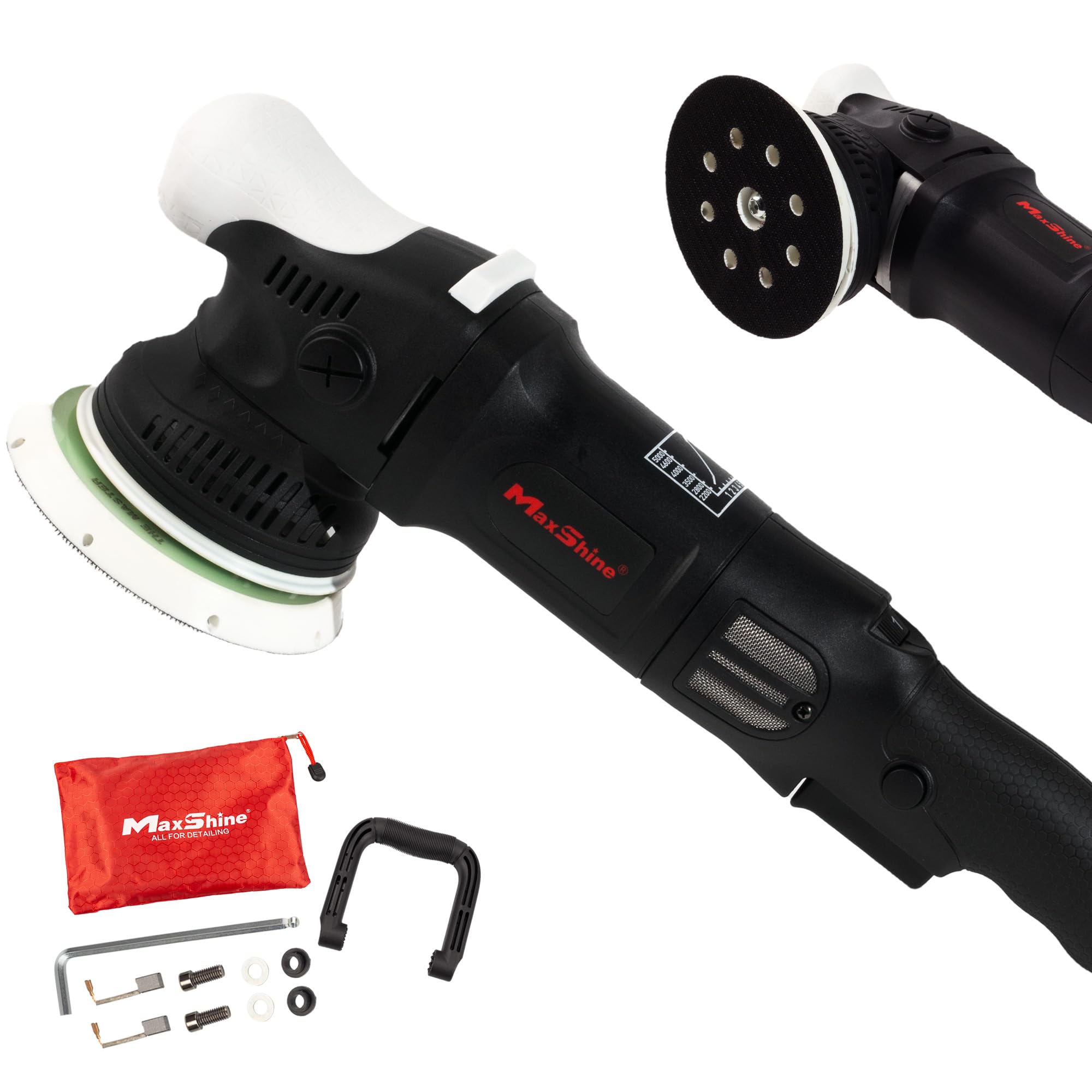
The Maxshine M15 Pro uses a 15mm long-throw orbit — nearly double the stroke of a standard 8mm DA polisher — which translates into significantly faster paint correction across large marine surfaces. The 1000-watt motor delivers consistent torque that won’t bog down when you apply pressure to cut through years of gelcoat oxidation on a 30-foot cruiser. Its variable speed trigger allows precise feathering from a gentle 2,500 OPM for sealant application up to 5,000 OPM for aggressive compounding.
Seasoned detailers who upgraded from Porter-Cable 7424XP units report that the M15 Pro is quieter, lighter, and far less fatiguing during all-day sessions. One owner with a 200k-mile Honda CRV used it with an orange pad and 3D Speed compound, removing over 90% of surface imperfections in a single pass — a result they couldn’t achieve with their previous standard-throw polisher. The 5-inch backing plate is a deliberate design choice, making the tool more maneuverable around compound curves and tight transom corners compared to a 6-inch system.
The low-vibration grip and balance block reduce hand fatigue, but the 5.2-pound weight still feels noticeable after an hour of sustained work. Included backing plate adjustment tools are a nice touch, though buyers will need to purchase their own pads and compounds. For anyone tackling a deep boat restoration without a budget for Rupes-level tools, the Maxshine delivers 80% of the performance at roughly half the cost.
Why it’s great
- 15mm long throw cuts correction time significantly
- 1000W motor maintains speed under load
- 5-inch plate navigates tight boat curves
Good to know
- Pads and compounds sold separately
- Some stalling sensitivity on sharp edges without included spacer
3. Griot’s Garage G9 Random Orbital Polisher 10901

The Griot’s Garage G9 is engineered for extended use, featuring a double-shot rubber grip and contoured shroud that reduce vibration transfer to your hands. Its 1000-watt motor with constant speed control prevents the pad from stalling even when you bear down on a heavily oxidized section of the hull. The 6-inch vented backing plate provides stable pad rotation, and the 10-foot quick-connect cord gives you flexibility to move around a boat on a trailer without tripping over the tool.
Six variable speed settings (2,000–6,400 OPM) cover the full spectrum from wax spreading to heavy cutting, and the speed dial is accessible for both left and right-handed users — a thoughtful detail for boaters who may need to switch hands when working around cleats and rub rails. The fan-cooled counterbalance and premium bearing construction keep the tool running cool and smooth during long polishing marathons. Owners note that the G9 runs notably cooler and with less vibration than many competitors at the same price tier.
One common critique is the trigger lock design, which some find less intuitive than a sliding switch, and a few owners had to trim the cord plug to fit certain heavy-duty extension cords. The lack of a removable right-angle handle also means you rely entirely on the top-grip ergonomics, which can be fatiguing on overhead hull sides. Still, for a weekend warrior spending 3–4 hours per session, the G9’s balance and low vibration make it one of the most comfortable DA polishers available.
Why it’s great
- Low-vibration ergonomic design for comfort
- Constant speed control prevents stalling
- 6-speed range suitable for wax to compound
Good to know
- Trigger lock design takes getting used to
- No optional right-angle handle included
4. Meguiar’s MT300 Variable Speed Dual Action Polisher

Meguiar’s MT300 stands apart with its Digital Torque Management, which electronically adjusts motor output to maintain consistent pad rotation regardless of the pressure you apply. This is a real advantage on boat hulls where inconsistent gelcoat thickness can cause a standard DA to bog down in softer sections. The soft-start technology gradually ramps up pad speed, preventing polish and compound from slinging everywhere when you first pull the trigger — a messy problem that plagues many polishers.
The multi-position D-handle improves leverage and control, particularly when polishing vertical hull sides or the steep contours of a deep-V keel. A billet counterweight keeps the tool balanced, minimizing the wobble that can cause uneven finishing. Owners have used the MT300 to restore severely weathered fiberglass on an RV, bringing it from chalky gray to bright white using Meguiar’s Marine/RV three-step system. The polisher speeds up the process significantly compared to hand application, though edges still require careful hand work.
One recurring note is that the MT300 requires a separate backing plate and pads — it ships as a bare polisher only. The speed fluctuation reported in some units (where the motor seems to surge intermittently) appears to affect a small number of tools, with one owner tracing the issue to a nearly severed negative wire inside the trigger housing. For most users, however, the torque management and soft start make it a polished, professional-grade experience that’s safer for marine gelcoat than traditional rotary buffers.
Why it’s great
- Digital Torque Management maintains consistent speed
- Soft start prevents compound splatter
- Comfortable D-handle for vertical surfaces
Good to know
- Backing plate and pads sold separately
- Minor vibration at max speed reported
5. Adam’s Polishes 9mm Dual Action Car Polisher

Adam’s Swirl Killer 9mm DA polisher pairs a 1000-watt motor with a 9mm throw orbit to deliver safe, consistent correction without the learning curve of a rotary buffer. Its max speed of 6,500 OPM provides enough aggression to cut through moderate boat oxidation, while the concave rubber contact points absorb vibration effectively during hour-long sessions. The 16-foot power cord is one of the longest in this class, letting you reach the bow of a 25-foot boat on a trailer without swapping outlets.
First-time users report excellent results on heavily weathered paint — one owner polished a 20-year-old Lexus in preparation for a graphene ceramic coating and was impressed by the swirl-free finish. Another beginner spent 4.5 hours on a 2021 Jeep Wrangler and achieved a deep, even gloss with minimal holograms. The tool weighs under 5.5 pounds, which keeps arm fatigue manageable for weekend boaters who might spend an afternoon on the hull and deck.
The polisher ships with a backing plate but no pads or compounds, so you’ll need to budget for those separately. Some users mention that the 9mm throw, while safe, requires more passes than a 15mm long-throw tool to correct heavy oxidation. The red soft-touch head cover looks sharp but may show dirt and compound residue quickly. For a dedicated DIYer who values safety and ease of use over raw speed, this is a reliable entry point into marine polishing.
Why it’s great
- Long 16-foot cord for boat access
- Low vibration and beginner-friendly design
- 1000W motor provides ample cutting power
Good to know
- Pads and compounds not included
- 9mm throw slower than long-throw alternatives
6. DEWALT Variable Speed Polisher (DWP849)

The DEWALT DWP849 is a corded rotary buffer — not a dual-action polisher — built for professional detailers who need maximum cut speed to strip heavy oxidation and sand scratches from marine gelcoat. Its 12-amp motor provides relentless torque, and the variable speed trigger gives you fingertip control from 0 to full RPM. The 2-position side handle and 7-inch or 9-inch backing pad capacity make it adaptable to large flat hull panels and curved bow sections alike.
One professional boat detailer who uses the DWP849 daily reports that the tool delivers smooth, instant torque and a predictable trigger that makes it easier to control than competing rotary buffers. They emphasized the importance of using a heavy-gauge extension cord to reduce motor heat and recommended cleaning the vents and replacing carbon brushes every three months to extend the tool’s lifespan beyond a year of commercial use. Another experienced user noted that it easily removed oxidized paint that smaller polishers couldn’t touch, cutting their time on a three-car, trailer, and boat setup significantly.
The rotary action requires skill: if you linger in one spot, you risk burning through the gelcoat, so this is not recommended for beginners. The tool itself is heavier than a DA polisher, and the 2.1-pound listed weight appears to be an error — actual package weight is closer to 9.6 pounds, and the bare tool feels substantial in hand. For a pro who already owns a DA for finishing work, the DWP849 fills the heavy-correction gap effectively.
Why it’s great
- 12-amp motor for aggressive gelcoat correction
- Variable speed trigger for precise control
- Accepts 7″ and 9″ backing pads
Good to know
- Rotary action requires practice to avoid gelcoat burn
- Heavier than most DA polishers
7. MILWAUKEE M18 Fuel 7 In. Variable Speed Polisher (2738-20)
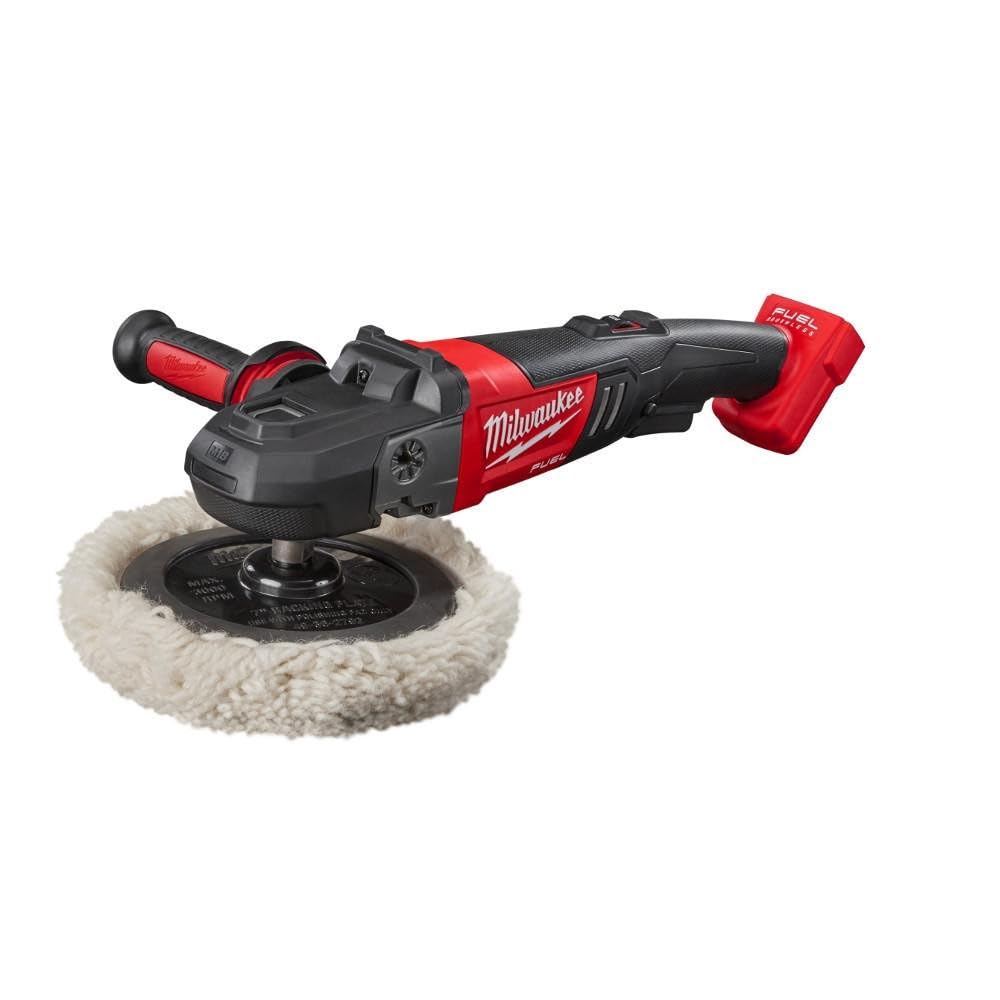
The Milwaukee M18 Fuel 2738-20 is a cordless rotary polisher that liberates you from extension cords when working on boats at the dock or on a trailer far from an outlet. Its 0–2,200 RPM variable speed range allows careful speed management for polishing and light compound work, though it lacks the gentle low end of a DA tool. The progressive trigger lets you fine-tune the rotation speed based on the pressure you apply, which is useful for transitioning between spreading wax and hitting a stubborn oxidation patch.
Boat owners using a 5.0Ah M18 battery report that the tool can finish a full-size car on a single charge and easily handles a 50-foot boat with battery life to spare, provided you’re not running at full speed continuously. Multiple users praised its ability to effortlessly remove saltwater residue and sun oxidation that had baked into the gelcoat. The cordless design also makes it practical for throwing into a dinghy or using on a yacht at anchor where power isn’t available.
As a bare tool, it requires an existing M18 battery and charger investment, which adds significant upfront cost if you’re not already in the Milwaukee ecosystem. The rotary action means it’s best suited for experienced users who are comfortable with non-random orbit tools. One professional detailer mentioned that while the 7-inch pad capacity works well for large flat surfaces, it can be less maneuverable around tight boat fittings than a smaller 5-inch DA system.
Why it’s great
- True cordless freedom for dockside use
- Full-size boat possible on one 5Ah charge
- Progressive trigger for speed control
Good to know
- Bare tool — battery and charger sold separately
- Rotary design requires skilled technique
8. Makita 9237CX2 7″ Polisher
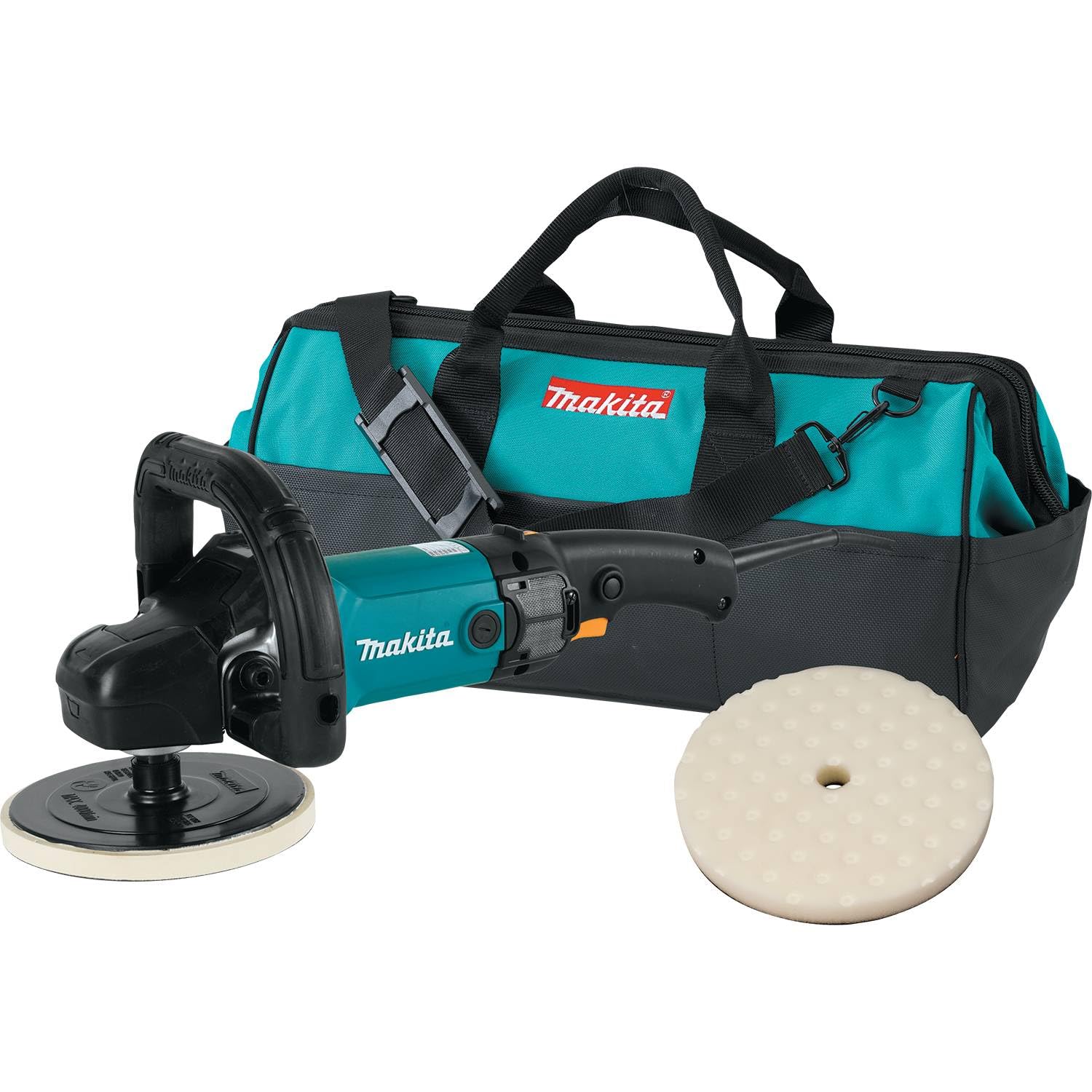
The Makita 9237CX2 is a serious rotary buffer with a 1,200-watt motor that delivers the kind of sustained power needed for heavy-duty marine paint rejuvenation. Its soft-start feature gradually ramps up pad rotation, which minimizes the sling of compound during start-up — a practical benefit when working with expensive marine polishes. The variable speed dial and trigger give you two layers of control, allowing you to set a maximum speed and then feather the trigger within that range for precise feedback.
Included in the kit are a 7-inch hook-and-loop backing pad, an 8-inch white foam polishing pad, a side handle, a loop handle, a pad alignment sleeve, and a tool bag — essentially everything you need to start correcting gelcoat immediately. The rubberized loop handle and gear housing protect delicate surfaces from accidental contact, which is critical when you’re working around non-skid deck surfaces or painted stripes. The wire mesh intake covers prevent wool fibers from polishing pads being sucked into the motor, a common failure point on less thoughtfully designed buffers.
Experienced owners describe this as the “buy once, cry once” option, with one professional noting it’s the fourth Makita polisher they’ve owned over 20 years. The 13-pound item weight makes it significantly heavier than a DA, and sustained overhead work will be physically demanding. For a skilled detailer who needs a rotary that can correct deep oxidation on a large hull without stalling, the 9237CX2 is the tool that shops reach for first.
Why it’s great
- 1200W motor for heavy oxidation removal
- Soft start reduces polish splatter
- Includes backing pad, foam pad, and tool bag
Good to know
- Heavy at 13 pounds, fatiguing overhead
- Rotary design not beginner-friendly
9. Makita DPO600Z 18V LXT Brushless Random Orbit Polisher

The Makita DPO600Z is a unique dual-action polisher that offers both standard random orbit mode (6,800 OPM) and a forced rotation mode (780 RPM) — letting you switch between safe DA finishing and the faster cut of a rotary-style rotation within a single tool. This dual-mode capability makes it incredibly versatile for marine work: you can use the forced rotation mode to spread compound aggressively across a large hull, then switch to random orbit for a swirl-free final finish. The brushless motor runs efficiently on a 5.0Ah battery for about 20 minutes of continuous use in forced rotation mode, or longer in standard orbit mode.
Users who have switched from car-branded DA polishers report that the DPO600Z’s forced rotation feature is excellent for quickly spreading polish and wax over large surfaces without the holograms typical of a true rotary. The lockable trigger and variable speed dial give you the same feel as a corded tool, and the 6.4-pound weight is distributed well thanks to the LXT battery placement. One owner noted it outperforms other battery-powered polishers significantly, though the battery drain is noticeable — a single 4Ah pack lasts about 20 minutes, meaning you’ll need multiple batteries for a full boat detail.
The tool ships as a bare unit with a pad, side grip, and hex wrench, but requires separate purchase of 18V LXT batteries and a charger, which adds considerably to the total cost. The brushless motor requires no carbon brush replacements, lowering long-term maintenance compared to the corded Makita 9237CX2. For someone already invested in the Makita LXT platform who needs a cordless DA with the unusual option of forced rotation, the DPO600Z is a standout hybrid.
Why it’s great
- Dual-mode: random orbit and forced rotation
- Brushless motor with low maintenance
- Excellent for spreading wax quickly
Good to know
- Bare tool — batteries and charger not included
- 20-minute battery run time in forced mode
FAQ
Can I use a car polisher on my boat’s gelcoat?
Should I choose a dual-action or rotary buffer for my boat?
How long does it take to polish an average boat?
Final Thoughts: The Verdict
For most users, the best buffer polisher for boats winner is the Shurhold 3101 because it combines a lightweight dual-action polisher with marine-specific wax and all the accessories you need to start restoring your hull immediately. If you want faster correction and are willing to buy pads separately, grab the Maxshine M15 Pro with its 15mm long-throw design. And for cordless freedom on a large boat, nothing beats the Milwaukee M18 2738-20 when you already own the battery platform.