
Oxidized gelcoat turns a proud boat into a chalky eyesore, but the right compound cuts through that damage and reveals the deep factory gloss hidden underneath. Choosing the wrong abrasive can waste hours of buffing or even burn through the clear coat, making the selection of a precise marine-grade compound critical to any restoration project.
I’m Min — the co-founder and writer behind Gadgets Feed. I’ve analyzed the cutting power, abrasive grit ratings, and real-world oxidation removal data across dozens of marine compounds to build this precise guide for boat owners who want measurable results.
After evaluating grit levels from fine 2000-grit polishes to aggressive 800-grit heavy-cut compounds, this guide identifies the best buffing compound for boats that reliably removes heavy oxidation without leaving swirls behind.
How To Choose The Best Buffing Compound For Boats
Marine buffing compounds differ from car polishes in one key way: they must handle chalky, UV-blasted gelcoat that develops a porous surface layer over years of sun exposure. A boat compound needs enough cutting aggression to break through that oxidized crust without being so coarse that it leaves pigtail swirls or requires wet-sanding afterward. Understanding the abrasive technology and your own buffer setup is essential before buying.
Abrasive Grit Grade: Fine vs Heavy Cut
The grit number on a marine compound directly determines how fast it removes material and what surface damage it can fix. Compounds around 800 to 1000 grit — like the Shurhold Buff Magic — are designed for moderate to heavy oxidation where the gelcoat surface feels rough or chalky. Finer grades around 1200 to 2000 grit, such as the 3M Perfect-It EX AC, are better for removing 1200-grade wet sanding scratches or light haze after a heavy cut. Beginners often buy a fine polish expecting it to remove heavy oxidation, only to find the abrasives are too mild to break through the chalk layer.
Open Time and Workability
A compound that dries out too quickly forces you to work in tiny sections and risks burning the gelcoat. Professional-grade marine compounds like TotalBoat TotalBuff are formulated with longer open times, meaning the liquid stays wet long enough for the abrasives to do their work without the pad dragging. If you plan to use a variable-speed rotary buffer or a dual-action polisher, look for compounds described as “long open time” or “non-dusting,” which indicates the formula stays lubricated under high-speed pad rotation.
One-Step vs Multi-Step Systems
Some boat compounds are designed as the first step in a three-part restoration — compound first, then polish, then wax or sealant. Others, like Meguiar’s M6701 One Step Compound, combine cutting and gloss-building in a single bottle to save time on lighter oxidation. The trade-off is clear: a dedicated heavy-cut compound removes deeper pitting and oxidation faster, but demands a follow-up polish to restore full gloss. One-step products work well for annual maintenance oxidation but struggle on heavily neglected gelcoat that has turned white or gray.
Compatibility With Your Equipment
Boat compounds vary widely in viscosity. Some are thin and runny — like the TotalBoat TotalBuff — which works well with a paintbrush for precise application before buffing. Others are thick paste-style compounds that load onto a wool pad better for rotary buffers. The 3M Perfect-It EX AC is formulated for industrial use and works best with high-speed roto-orbital machines, while Meguiar’s Ultra Pro Speed Compound M110 is optimized specifically for dual-action (DA) polishers with microfiber cutting pads. Always match the compound’s intended tool to your actual buffer.
Quick Comparison
On smaller screens, swipe sideways to see the full table.
| Model | Category | Best For | Key Spec | Amazon |
|---|---|---|---|---|
| Shurhold Buff Magic | One-Step Compound | Moderate oxidation removal on gelcoat and metal | 800 Grit / Aluminum Oxide | Amazon |
| TotalBoat TotalBuff | Heavy-Cut Compound | Heavy oxidation and wet sand scratch removal | 1000 Grit / 32 oz Quart | Amazon |
| Meguiar’s M110 Ultra Pro | DA-Optimized Compound | Swirl removal and fine scratch correction | 200 Grit / 32 oz | Amazon |
| 3M Perfect-It Boat Wax | Protective Wax | Post-compound sealing and UV protection | Carnauba Wax / Quart | Amazon |
| Meguiar’s M6701 One Step | One-Step Cleaner Wax | Light to medium oxidation on gelcoat and RVs | 1 Gallon / Abrasive+Gloss | Amazon |
| Poli Glow Restoration Kit | Acrylic Sealer System | Long-term fiberglass sealing with no buffing | 2000 Grit / 32 oz + Prep | Amazon |
| 3M Perfect-It EX AC 36061 | Industrial Rubbing Compound | Professional fast-cut on hard clearcoats | 1200 Grit / 1 Gallon | Amazon |
In‑Depth Reviews
1. Shurhold Buff Magic Compound
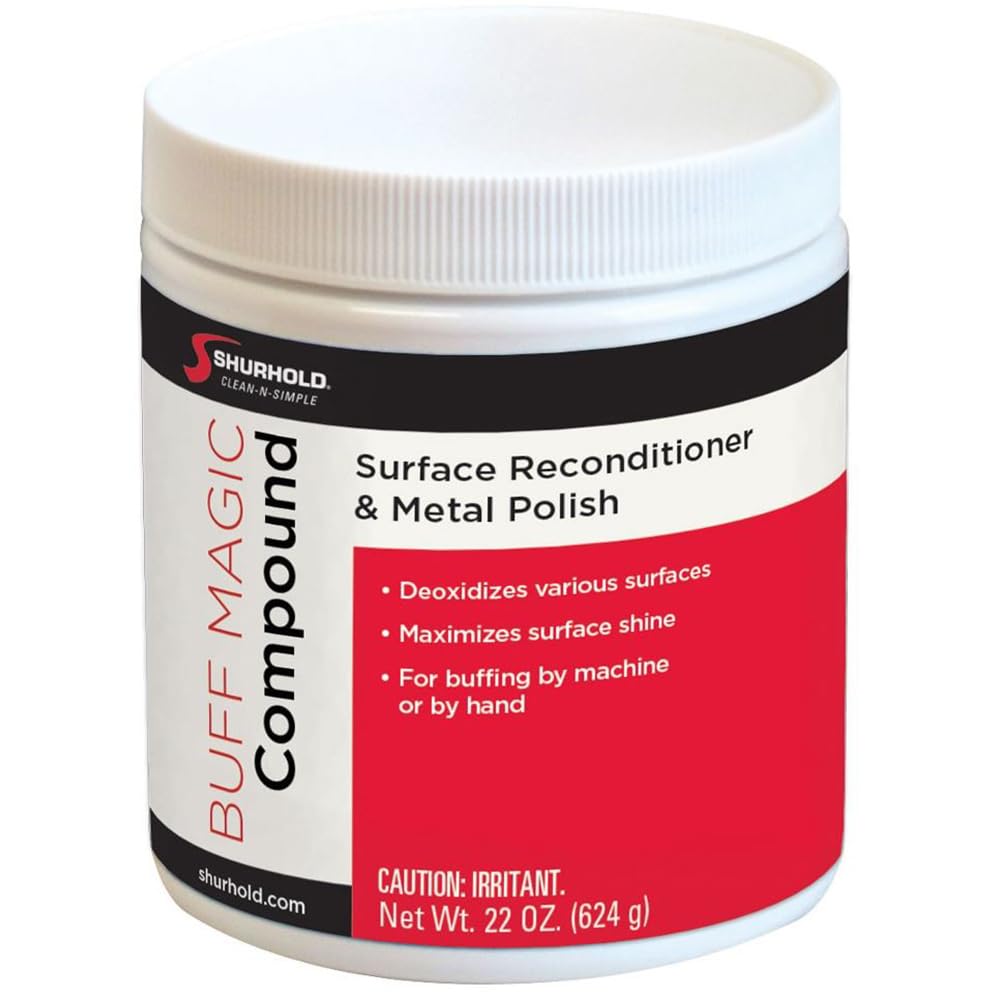
The Shurhold Buff Magic Compound stands as the most consistent performer across moderate to heavy oxidation restoration on fiberglass gelcoat. Its 800-grit aluminum oxide abrasive provides enough cut to remove chalky surface damage from years of sun exposure, yet the controlled-cut formula progressively refines the surface rather than leaving harsh pigtail swirls. Owners of 20- to 30-foot boats report that a single jar paired with a wool pad on a rotary buffer transforms severely oxidized blue, black, and red hulls into deep, mirror-like finishes in about half a day’s work.
What separates this compound from others in the same price tier is its versatility across materials. The formula works equally well on aluminum, bronze, and painted metal surfaces, meaning the same product can restore the hull gelcoat, bimini top supports, and metal hardware without switching bottles. Multiple seasoned restorers note that while the product demands patient, slow-speed passes to avoid burning, the end result rivals professional yard work. The 1.55-pound jar is compact but dense enough to cover a 27-foot boat with product left over.
The compound excelled in customer reports where other three-step systems failed on black gelcoat. One verified owner of a 30-foot Rinker with heavy oxidation tried three competing compounds and orbital polishers before Shurhold cut through the damage in multiple passes. The drawback is that this is a pure cutting compound — it does not contain wax or sealants, so a separate wax step is mandatory after buffing. Beginners should test on a hidden area first to gauge cut speed before committing to the full hull.
Why it’s great
- 800-grit cuts heavy oxidation without swirls
- Works on fiberglass, metal, and painted surfaces
- One jar covers an entire 27-foot boat
- Progressive refinement leaves smooth base for wax
Good to know
- Requires rotary or high-speed orbital buffer for best results
- No built-in wax or UV protection — must seal afterward
- Needs multiple passes on severely chalked gelcoat
2. TotalBoat TotalBuff Marine Rubbing Compound
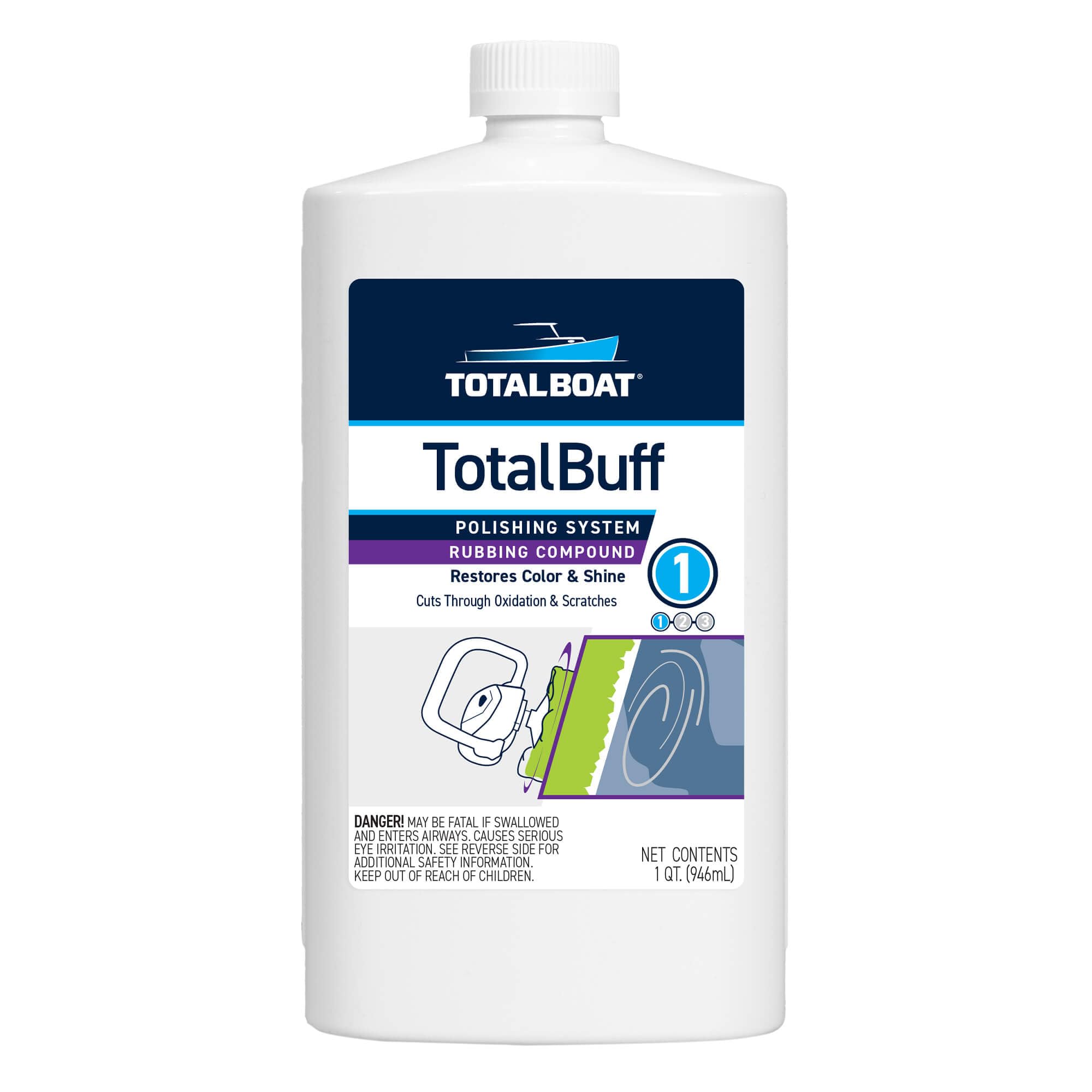
TotalBoat TotalBuff delivers the most aggressive cut in the mid-range price segment, outperforming industry staples like 3M Super Duty in direct user comparisons. The 1000-grit aluminum oxide formula contains a high concentration of fine abrasive particles that remain suspended in a thin, runny liquid, allowing the compound to penetrate deep into chalked gelcoat without the paste drying out. Users report removing nearly all oxidation on a 30-foot sailboat from the rail to the waterline using just two-thirds of one quart bottle.
The open-time workability is a standout feature for DIY boat owners. The compound stays wet long enough to apply with a brush across a 2×2-foot section before buffing with a white wool pad at medium speed, eliminating the panic of dried-on residue. It is explicitly designated as Step 1 in a three-step restoration system, followed by the brand’s TotalShine polish and TotalBoat wax. Professional detailers note that the thin viscosity can feel unsettling — it runs easily — but the resulting cut speed saves significant time compared to thicker paste compounds.
Customer feedback highlights its ability to remove 600 to 800-grit wet sanding scratches in a single pass, a claim that holds up under verified owner reports on both fiberglass and painted boat surfaces. The formula leaves no sticky film behind, making wipe-down quick. The main caveat is that the thin consistency requires careful section management to avoid dripping onto non-target areas, and the product is not formulated for one-step gloss — it aggressively cuts but leaves a matte finish that demands a subsequent polish step for full reflectivity.
Why it’s great
- Outcuts 3M Super Duty and Presta Super Cut
- Long open time prevents drying during buffing
- Removes 600-800 grit wet sand scratches in one pass
- Excellent value per quart for heavy oxidation
Good to know
- Very runny formula — requires careful section control
- Must follow with polish and wax for full gloss
- Not suitable as a standalone one-step product
3. Meguiar’s M110 Ultra Pro Speed Compound
Meguiar’s M110 Ultra Pro Speed Compound is engineered as a dedicated dual-action (DA) polisher formula, making it the best option for boat owners who own a DA machine rather than a rotary buffer. The 200-grit aluminum oxide abrasive is aggressive enough to remove P1200 sanding marks, heavy swirls, and moderate oxidation, but the micro-abrasive suspension technology prevents the compound from drying too fast — a common problem with automotive compounds when used on large fiberglass panels. Users report that with a microfiber cutting pad on a DA, the compound cuts smooth and finishes nearly haze-free.
This is the professional-grade choice from a brand with over a century of surface refinishing expertise. The formula is noticeably easier to work with than 3M’s equivalent compounds, requiring less pressure and fewer passes to achieve the same cut depth. One verified user described it as “dummy-proof” for novice detailers tackling a repainted hull. The compound works especially well on colored gelcoats where maintaining uniform gloss is critical — owners of dark blue and black boats report even reflectivity across panels without visible micro-marring.
The practical downside is that the 200-grit aggressive cut is designed for heavy correction work, not for light annual maintenance. Users who apply this to a boat with only mild haze may find it removes more material than necessary. Additionally, while it finishes well, pairing it with Meguiar’s M210 Ultra Pro Finishing Polish is recommended for optimal clarity on dark-colored hulls. The 32-ounce bottle provides good coverage — roughly a full 20-foot boat — but the price per ounce is higher than bulk gallon options for high-volume users.
Why it’s great
- Optimized for DA polishers — no rotary needed
- Removes 1200 grit sanding marks and heavy swirls
- Easy to spread and wipe off without dusting
- Finishes nearly haze-free on colored gelcoat
Good to know
- Too aggressive for light oxidation maintenance
- Best results require follow-up finishing polish
- Higher cost per ounce than gallon alternatives
4. 3M Perfect-It Boat Wax

While not a buffing compound in the abrasive sense, the 3M Perfect-It Boat Wax is the essential final step after any aggressive compound work, and its formulation is specifically designed for marine gelcoat rather than automotive paint. The carnauba wax content creates a hard, durable shell that protects against UV degradation and oxidation, preventing the chalky surface from returning after a full restoration. Users report that the wax maintains its deep gloss longer than store-brand alternatives, especially on fiberglass RVs and boats exposed to constant sunlight.
Application is straightforward — the liquid wax applies easily by hand directly from the bottle, making it accessible for owners who prefer not to machine-apply wax. It works effectively on gelcoat, aluminum, chrome, and glass surfaces, restoring a consistent shine across the entire vessel. One verified owner on a fiberglass RV noted that the 3M wax outlasted every other brand tried, with the shine holding for months through rain and sun exposure. The formula is safe for all gelcoats and painted metal, eliminating the risk of staining or etching.
The primary consideration is that this is purely a protective wax with minimal abrasive cleaning action. If applied over oxidized gelcoat without prior compounding, it will not remove chalkiness or restore color depth — it simply seals whatever surface exists underneath. Some users experienced a slight haze or swirl appearance during application, which may indicate the need for better surface prep or a final buff with a clean microfiber towel. The quart size is sufficient for multiple applications on a 25-foot boat.
Why it’s great
- Hard carnauba shell resists UV and oxidation
- Safe on gelcoat, metal, chrome, and glass
- Easy hand application — no machine required
- Long-lasting shine compared to generic waxes
Good to know
- No abrasive cutting action — requires prior compounding
- Can produce haze if not buffed thoroughly
- Smaller coverage area than spray-on sealants
5. Meguiar’s M6701 One Step Compound
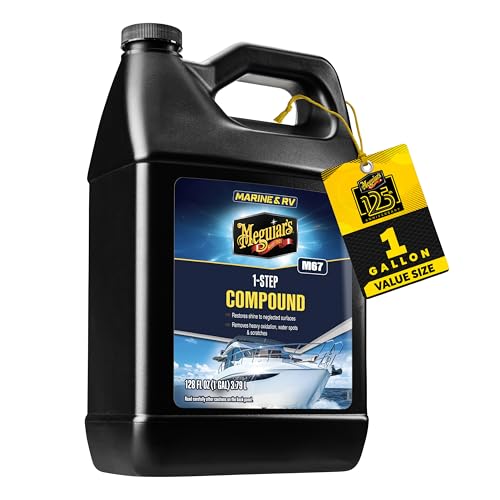
The Meguiar’s M6701 One Step Compound is a unique hybrid that cleans and polishes gelcoat in a single pass while leaving behind a rich gloss finish, making it ideal for boat owners who want to skip the three-step process on lighter oxidation. The abrasive formula contains cleaning agents that effectively remove heavy oxidation, scratches, stains, and tough water spots without requiring a separate polish step. Verified users on 30-plus-foot motorhomes report that a single application removed years of white chalky oxidation and restored the original color depth.
The gallon size provides tremendous value for owners of large vessels or multiple boats. At just over 128 fluid ounces, this is one of the most cost-effective options per ounce among professional-grade marine compounds. The formula works well both by hand and by machine, though user reports note that machine application with a cordless buffer yields significantly more consistent results on large flat panels. The one-step nature saves about half the labor time compared to using a dedicated cutting compound followed by a separate polish.
The trade-off is that on severely oxidized surfaces, the one-step formula may not cut deep enough to fully remove pitting or deep staining. One verified owner reported that the RV looked great indoors after application, but after two days of direct sun exposure, the oxidation seemed to return — likely because the one-step couldn’t fully penetrate the deepest chalk layer. This product works best on light to medium oxidation rather than neglected boats with a white, powdery surface. A follow-up wax coat is still recommended for UV protection, though the M6701 does leave some gloss behind.
Why it’s great
- One-step cleaning and polishing saves time
- Gallon size offers exceptional value per ounce
- Works well by hand or with a buffer
- Removes water spots, stains, and light oxidation
Good to know
- Not aggressive enough for heavy pitted oxidation
- Gloss may fade on severely chalked gelcoat
- Wax-layer durability is limited without separate sealant
6. Poli Glow Boat & RV Restoration Kit
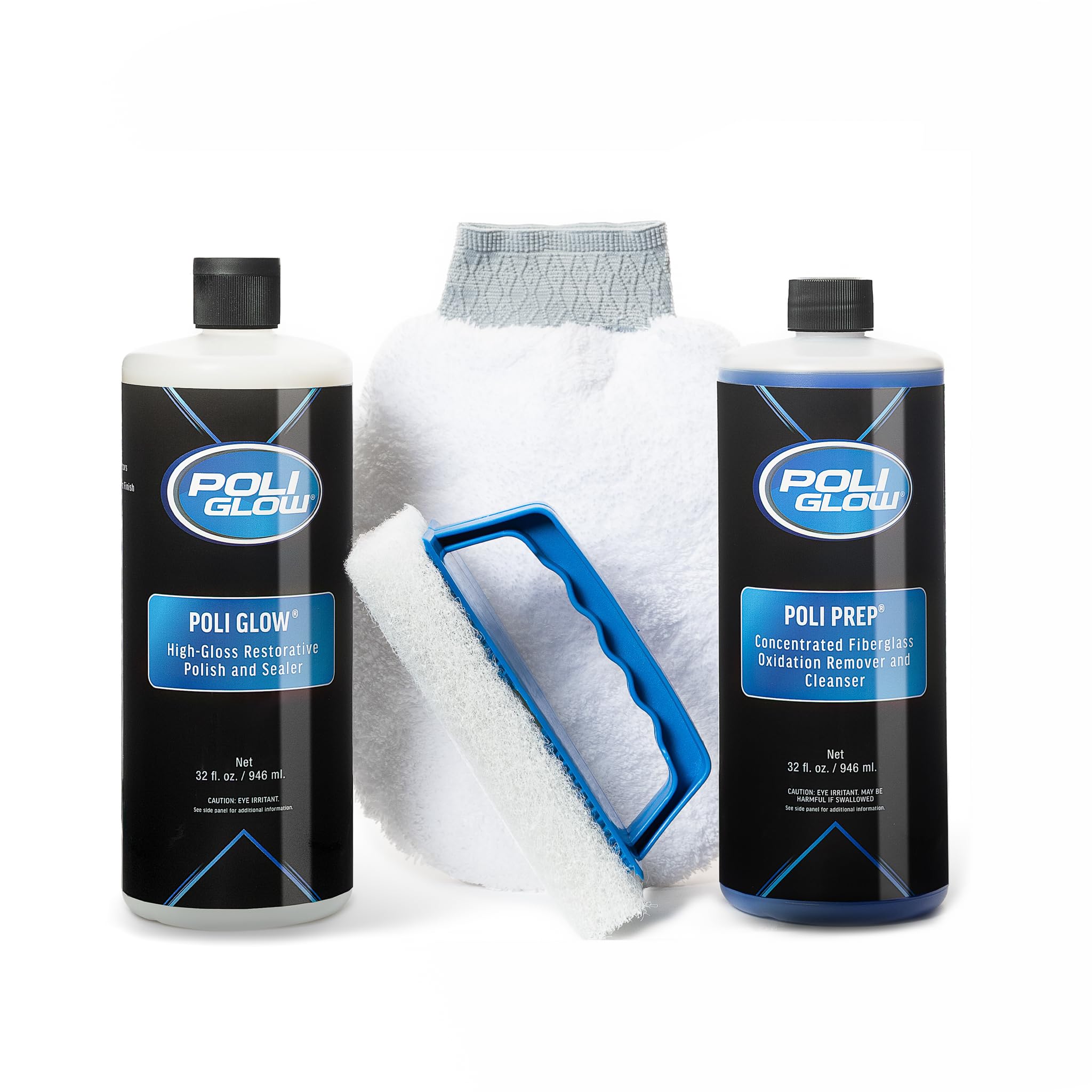
The Poli Glow Restoration Kit takes a fundamentally different approach to boat restoration compared to traditional abrasive compounds. Instead of mechanically cutting away oxidized gelcoat, its acrylic polymer formula penetrates and seals the fiberglass, creating a durable barrier that resists UV damage, water intrusion, and future oxidation for up to six years with proper maintenance. This makes it an excellent alternative for owners who want to avoid the physical labor of compounding with a rotary buffer — the kit requires only simple hand application using the included mitt and scrub pad.
The kit includes a 32-ounce bottle of Poli Prep cleaner, a 32-ounce bottle of Poli Glow sealer, a mitt applicator, a white scrub pad with handle, and gloves. Application involves cleaning the surface with Poli Prep to remove contaminants, then applying a minimum of six thin coats of Poli Glow, allowing each coat to dry before the next. Verified owners of 40-year-old boats and RVs report dramatic transformations from chalky white to mirror-like gloss with a fraction of the effort required for traditional compounding. The system works especially well on solid white gelcoats and solid colors.
The limitation is that Poli Glow does not physically remove deep scratches, pitting, or heavy oxidation. It fills and seals over the damaged surface rather than cutting it away. If the gelcoat has deep gouges or significant texture loss from UV damage, the sealer may magnify those imperfections. Additionally, applying the sealer requires patience — rushing the coat drying times can create streaks or bumps, and metal flake finishes may not regain full original sparkle. The kit is best suited for boats with uniform surface texture where the main issue is fading and chalkiness rather than physical surface damage.
Why it’s great
- No heavy compounding labor — hand application only
- UV-blocking acrylic seals gelcoat for years
- Complete kit with prep cleaner and applicator
- Proven results on 40-year-old fiberglass
Good to know
- Does not remove deep scratches or pitting
- Requires minimum 6 coats with proper drying time
- Streaks may appear if applicator edges dry out
7. 3M Perfect-It EX AC Rubbing Compound 36061

The 3M Perfect-It EX AC 36061 is the industrial-grade rubbing compound trusted by professional marine shops for fast-cutting performance on hard gelcoats and clearcoats. Its 1200-grit aluminum oxide abrasive is specially formulated to remove P1200 grade or finer scratches while preventing sticking and residual film buildup — a common frustration with consumer-grade compounds that gum up pads on large hulls. The gallon container is designed for high-volume use, making it the most economical choice per ounce for owners of multiple vessels or serious restoration work.
What distinguishes this compound from consumer options is its anti-dusting formulation. When used with a high-speed rotary buffer and a wool pad, the compound reduces airborne particle dust significantly compared to standard rubbing compounds. Professional users who have relied on this product for years consistently rate it as the best rubbing compound on the market for its ability to deliver fast, smooth results with minimal cleanup. One verified owner noted that the price through Amazon was substantially better than local jobber supply stores, making it accessible for serious DIY restorers.
The “industrial/occupational use only” label is worth noting — this compound is designed for experienced users with high-speed rotary buffers, not for casual hand application or novice DA users. The aggressive cut and extended open time require knowledge of proper pad speed and pressure to avoid hologramming or burning the gelcoat. Additionally, because this is a 1200-grit rubbing compound for post-sanding correction, it will not remove heavy oxidation as quickly as an 800-grit heavy-cut compound; it excels at refinement rather than aggressive material removal.
Why it’s great
- Industrial-grade formula for professional shops
- Minimal dusting during high-speed buffing
- Excellent value per ounce in gallon size
- Removes 1200 grit scratches with smooth finish
Good to know
- Not for light oxidation — designed for scratch removal
- Requires rotary buffer experience to avoid damage
- Industrial rating means no consumer instructions
FAQ
Can I use automotive compound on my boat’s gelcoat?
What is the difference between a rubbing compound and a buffing compound for boats?
How do I know if my boat needs a heavy-cut compound or a one-step cleaner wax?
Will a buffer damage my gelcoat if I use the wrong compound?
Final Thoughts: The Verdict
For most users, the best buffing compound for boats winner is the Shurhold Buff Magic Compound because its 800-grit controlled-cut formula removes heavy oxidation across 20-plus-foot hulls while leaving a smooth base ready for wax. If you want the fastest heavy-oxidation removal, grab the TotalBoat TotalBuff for its aggressive 1000-grit cut that outcompetes industry standards. And for one-step convenience on lighter oxidation, nothing beats the Meguiar’s M6701 One Step Compound in the economical gallon size.