
The worry of a hidden microphone in your hotel room or a GPS tracker silently reporting your vehicle’s location is no longer a fringe concern. A dedicated counter-surveillance tool shifts the balance of power back to you, turning paranoia into a systematic, proactive search.
I’m Min — the co-founder and writer behind Gadgets Feed. After countless hours analyzing RF chipset specs, IR lens apertures, and user-reported detection ranges across dozens of models, I built this guide to separate the devices that actually sweep a room from those that only make noise.
Whether you are a frequent traveler, a privacy-conscious professional, or someone safeguarding a confidential space, you need a tool that reliably identifies RF emissions, magnetic fields, and optical reflections. This guide covers the key features to look for and the trade-offs between different detection methods to help you choose the best bug detector multifunction counter surveillance device for your specific threat model.
How To Choose The Best Bug Detector Multifunction Counter Surveillance
Not all bug detectors are created equal. A device that excels at finding a wireless body microphone might completely miss a wired pinhole camera with no active transmitter. Understanding the three core detection methods—RF, magnetic, and optical—is the only way to match a tool to your real risk environment.
RF Spectrum Detection: The Core of Wireless Sweeps
This is the primary method for finding any device that transmits a radio signal. A good detector covers a wide frequency range, typically from 1 MHz up to 6 GHz or more, to catch everything from old-school FM bugs to modern 5.8 GHz Wi-Fi cameras. The key spec here is sensitivity, which determines how far away a device can be detected. However, be aware that a detector with no sensitivity adjustment can be rendered useless by high ambient RF noise in a city or a hotel with strong Wi-Fi.
Optical Lens Detection: The Must-Have for Hidden Cameras
Many modern spy cameras record locally to an SD card and broadcast no wireless signal, making them invisible to an RF detector. This is why a built-in IR (infrared) LED array and a red filter lens finder are critical. The detector’s bright LEDs reflect off the curved glass lens of a camera, creating a telltale bright spot that your eye can see through the viewfinder. The quality of this lens and the power of the LEDs directly dictate whether you can spot a camera tucked into a smoke detector across a room.
Magnetic Detection: Finding Passive Devices and GPS Trackers
A strong neodymium magnet in the device can detect magnetic fields, which is useful for finding hidden speakers, magnets in a GPS tracker attached to a car, or the metal components inside a concealed device. This is a complementary tool rather than a primary one. It will not find a plastic-bodied camera, but it is superb for quickly scanning a car’s undercarriage or the back of a cabinet for non-transmitting trackers.
Quick Comparison
On smaller screens, swipe sideways to see the full table.
| Model | Category | Best For | Key Spec | Amazon |
|---|---|---|---|---|
| SITEEDAN M8000 | Premium | All-in-One AI Sweep | 12hr battery, AI auto-scan | Amazon |
| JAXTIN G66 Pro | Mid-Range | Multi-Mode Detection | AI scan, magnet & IR lens | Amazon |
| JMDHKK K68+ | Mid-Range | Portable Travel Sweep | 2.4/5.8 GHz RF detection | Amazon |
| KAXYUYA RF Detector | Premium | High Sensitivity RF & IR | IP54 rated, metal build | Amazon |
| Spy Hawk PRO Sweep 10GHz | Premium | Law-Grade Signal Sweep | 10 GHz RF sweep range | Amazon |
| TEMIRUP 5-in-1 EMF | Budget | EMF & RF Awareness | 30MHz-8GHz RF detection | Amazon |
| DP25 Thermal Camera | Specialty | Thermal Leak Detection | 256×192 IR, 25Hz refresh rate | Amazon |
In‑Depth Reviews
1. SITEEDAN M8000 5-in-1

The SITEEDAN M8000 is the closest you can get to a professional sweeper without paying thousands. It packs five dedicated detection modes—camera, magnetic field, microphone, Wi-Fi device, and AI auto scan—into a compact silver chassis. The upgraded German microprocessor allows it to quickly differentiate between a false alarm from a passing Bluetooth signal and a genuine hidden device, which is a massive advantage over single-mode detectors.
Its AI auto-scan mode is particularly useful for users who are not expert sweeepers. You simply activate the mode and slowly move around the room; the device uses a combination of sensors to flag suspicious electronic activity. The 12-hour continuous battery life means you can thoroughly inspect a large home or multiple hotel rooms on a single charge without worrying about power.
Users consistently highlight its reliability for travel, noting that it successfully detects hidden cameras and listening devices in vacation rentals. The inclusion of a carrying case and a reinforced fast-charging cable rounds out a package that delivers professional-level peace of mind. It is the benchmark for a modern, multifunction counter-surveillance tool.
Why it’s great
- AI auto-scan mode simplifies the sweeping process for beginners
- Excellent 12-hour battery life supports thorough inspections
- Professional-grade chipset minimizes false positives
Good to know
- Premium tier cost may be overkill for casual users
- Learning all five modes requires reading the manual
2. JAXTIN G66 Pro

The JAXTIN G66 Pro packs an AI auto-scan feature that attempts to automate the detection process, similar to the SITEEDAN, but at a lower price point. It combines this with a magnetic field sensor for finding GPS trackers and an enhanced IR optical lens for spotting camera reflections. The Type-C fast charging is a modern convenience that ensures you are not hunting for a proprietary cable before your next trip.
Where this device truly shines is in its utility. Users have successfully used it to find hidden cameras in a grandfather clock and to sweep rental cars for trackers. The visual screen interface clearly displays the detection mode and signal strength, making it easier to locate devices compared to audio-only detectors. However, the build quality feels a bit lighter than the premium options, and the user manual is sparse, requiring a few practice runs to master the button controls.
The G66 Pro is a strong contender for anyone who needs the full suite of detection methods—RF, magnetic, and optical—but is operating on a tighter budget. It provides a genuine multi-layered sweep capability that can catch both active and passive threats, though you may need to consult online tutorial videos to unlock its full potential.
Why it’s great
- Combines AI scan, magnet, and IR lens for comprehensive coverage
- Type-C fast charging is a practical, modern feature
- Clear visual screen aids in precise device location
Good to know
- Instructions are inadequate; requires external learning resources
- Build quality feels somewhat less robust than premium rivals
3. JMDHKK K68+

The JMDHKK K68+ is a popular mid-range choice that focuses on the essentials: wireless signal detection and a wide IR viewer. It covers the critical 2.4 GHz and 5.8 GHz frequency bands, which covers the vast majority of modern Wi-Fi and wireless cameras. The unit is very compact, fitting easily into a pocket or a small travel bag, and it features a magnetic probe that can help locate a tracker attached to a metallic surface like a car frame.
The ultra-bright LED array makes the IR lens finder particularly effective at spotting pinhole cameras from across a room. The passive signal observation mode is a unique feature that continuously monitors for intermittent transmissions, which is helpful for catching a device that only broadcasts periodically. However, the user interface is somewhat complex, and the plastic housing scratches relatively easily, which detracts from the overall feel.
For the frequent traveler who wants a dedicated, no-nonsense detector for the most common hotel threats, the K68+ offers a strong balance of function and portability. Its battery life is excellent for its size, and it has proven effective for users who need to sweep an Airbnb or a hotel room quickly without pulling out a larger kit.
Why it’s great
- Very portable form factor fits in any travel bag
- Effective IR lens with ultra-bright LEDs for camera spotting
- Passive monitoring catches intermittent signal bursts
Good to know
- Plastic body scratches easily with regular use
- Controls can be confusing without thorough practice
4. KAXYUYA RF & Camera Detector

The KAXYUYA detector immediately feels more substantial than its mid-range competitors, thanks to its metal alloy construction and an IP54 rating for dust and water resistance. This is a tool built to be used in varied environments, from dusty crawling spaces to damp hotel bathrooms. It uses an upgraded ultra-sensitive chip that allows for very fine sensitivity adjustments, which is crucial for dialing out background noise in a high-EMF environment to focus on a genuine threat.
The inclusion of both RF detection and a powerful infrared sensor for camera lenses makes it a true dual-threat device. Users have reported excellent results finding AirTags hidden in vehicles and confirming no cameras are active in hotel rooms. The sound and vibration alerts provide clear feedback without requiring constant visual attention to the LED display. The lack of a carrying case is a minor oversight, but the durable metal body mitigates the scratch risk.
This is the detector to choose if you value ruggedness and adjustable sensitivity above all else. It allows a more experienced user to perform a nuanced sweep that a fixed-sensitivity device cannot match. For professionals who perform security sweeps regularly or for very cautious individuals, the build quality and chipset performance justify its position.
Why it’s great
- Rugged metal build with IP54 rating for harsh environments
- Adjustable sensitivity filters out ambient RF noise
- Reliable detection of AirTags, GPS trackers, and cameras
Good to know
- No carrying case is included for storage
- Requires close proximity (inches away) for precise detection
5. Spy Hawk PRO Sweep 10GHz

The Spy Hawk PRO Sweep claims “law grade” performance, and its standout feature is the ability to sweep up to 10 GHz, which covers advanced wireless protocols that consumer-grade detectors cannot touch. It combines this wide radio frequency detection with a camera lens finder, making it one of the most technically comprehensive sweepers on the market. It is designed for serious privacy professionals who need to be certain no advanced transmitter is active.
However, this power comes with a significant caveat. The most common criticism from users is the lack of a sensitivity adjustment knob. The omni-directional antenna is great for picking up signals from any direction, but without the ability to attenuate the gain, the device can become overwhelmed by the ambient Wi-Fi signals in a typical motel, rendering it nearly unusable in those environments. You have to rely on retracting the antenna to reduce range, which is a crude solution.
The Spy Hawk is a specialist tool. If you are in a rural or low-RF environment and need to detect a very specific, high-frequency transmitter, it is a powerful ally. For the average traveler checking into a city hotel, the lack of sensitivity control can be a frustrating barrier, and you may find cheaper alternatives to be more practical in that high-interference setting.
Why it’s great
- Widest RF sweep range up to 10 GHz for advanced threats
- High accuracy for detecting signals in low-noise areas
- Includes a camera lens finder for visual inspection
Good to know
- No sensitivity adjustment makes it useless in high-RF areas
- Build quality is not commensurate with the premium price tag
6. TEMIRUP 5-in-1 EMF Detector
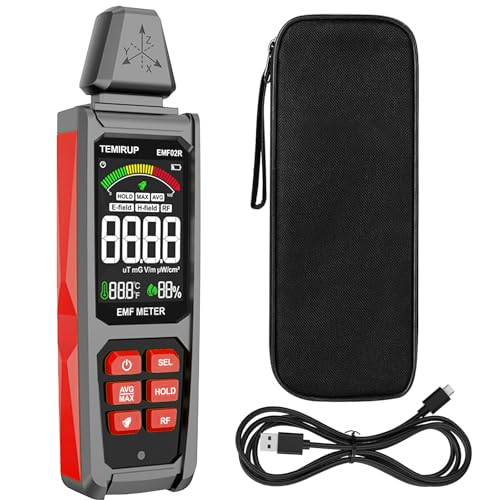
The TEMIRUP 5-in-1 is primarily an EMF meter designed for ghost hunting and home radiation awareness, but its RF detection mode covers 30 MHz to 8 GHz, making it a highly budget-friendly tool for spotting active wireless devices. It measures magnetic fields (in mG/µT), electric fields (V/m), and RF power density (uW/cm²), along with temperature and humidity. This is a different approach to counter-surveillance, using environmental data to spot anomalies.
While it lacks a dedicated IR lens for camera spotting, its RF mode is sensitive enough to detect transmissions from a Wi-Fi router or a hidden camera’s transmitter. The large color LCD clearly displays the signal strength with a color-coded gauge and an audible alarm that triggers when radiation levels are high. This can be used to walk through a room and identify areas with unexpected RF energy. Users find it easy to use and have fun teaching others about household EMF.
This is a fantastic entry-level device for someone who is more curious than paranoid. It gives you a general awareness of the RF environment and can flag major anomalies, but it will not help you find a non-transmitting camera or a GPS tracker in deep sleep. It is a tool for education and broad-stroke sweeps, not for professional-grade privacy protection.
Why it’s great
- Very affordable entry point into RF detection
- Measures multiple types of radiation (EF, RF, MF)
- Clear color LCD with an intuitive audio alarm system
Good to know
- No camera lens finder limits its counter-surveillance use
- Not designed for discreet professional sweeps
7. DP25 Dual Lens Thermal Camera
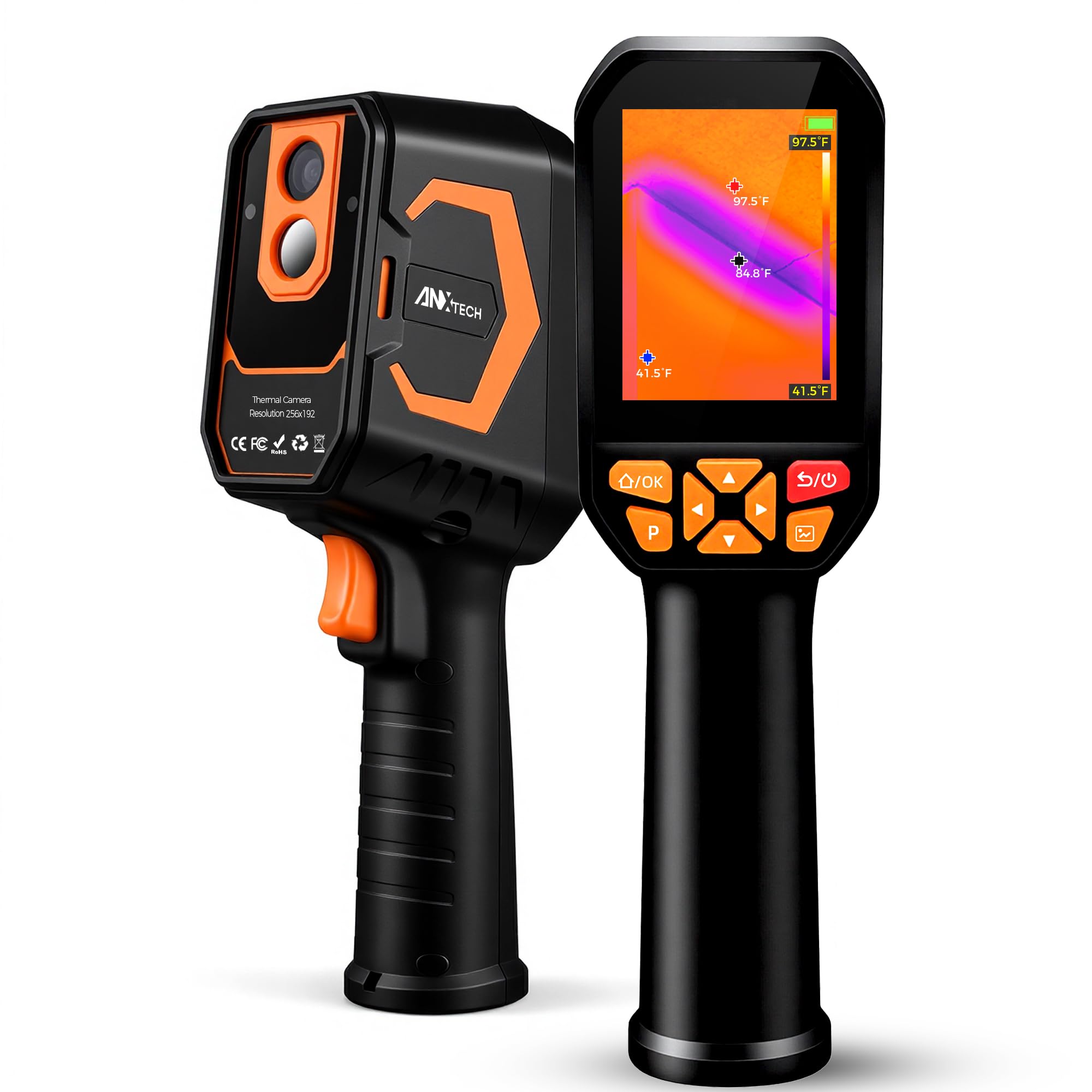
The DP25 is not a traditional bug detector; it is a professional-grade thermal imaging camera. Its primary purpose is finding water leaks, insulation gaps, and electrical hot spots, but it has a unique place in the counter-surveillance toolkit. A hidden camera that is actively recording and powered on generates heat. In a completely dark, cold room, a thermal camera like the DP25 can spot the heat signature of a hidden device that no RF sweep or optical lens finder could catch.
It features a 256×192 IR resolution with super-resolution up to 512×384, providing the thermal clarity needed to differentiate a hot spot from ambient background. The ≤50mK thermal sensitivity is pro-grade, detecting minute temperature differences that cheaper cameras miss. The 25Hz refresh rate allows you to pan a room smoothly without blurring the thermal image. It also offers PC-based 2D/3D image analysis for professional reporting.
This device is for the serious professional who needs to leave no stone unturned. It is bulky, requires training to interpret thermal data, and is not a primary bug detector. However, for finding a camera hidden behind a one-way mirror, inside a wall, or in a ceiling tile—where no wires or lenses are exposed—the DP25 is the absolute best tool, making it a valuable if specialized member of this list.
Why it’s great
- Detects heat signatures of active hidden cameras RF can’t find
- Pro-grade ≤50mK sensitivity for subtle temperature changes
- PC analysis software enables detailed inspection reporting
Good to know
- Not a dedicated bug detector; requires skill to interpret images
- Bulkier than standard RF detectors, less travel-friendly
FAQ
Can a bug detector find a camera that is not transmitting?
Why does my bug detector go off even when I think nothing is there?
What is the difference between detecting a GPS tracker and a listening device?
Final Thoughts: The Verdict
For most users, the best bug detector multifunction counter surveillance winner is the SITEEDAN M8000 because its five-mode AI-driven system offers the broadest, easiest-to-use protection against both active bugs and hidden cameras. If you want a more budget-friendly but highly capable multi-tool, grab the JAXTIN G66 Pro. And for the professional needing law-grade RF bandwidth or specialty thermal detection, the KAXYUYA or the DP25 Thermal will cover threats no other device can see.