
You flip the porch light on, and within minutes, a swarm of mosquitoes, moths, and gnats has turned your evening into a slap-fest. The problem isn’t the outdoors — it’s the light itself. Most standard white bulbs emit wavelengths in the blue and UV spectrum that flying insects are instinctively drawn to. A true bug light shifts that output toward the warmer yellow or amber end of the spectrum, making your patio, deck, or entryway far less appealing to the local insect population.
I’m Min — the co-founder and writer behind Gadgets Feed. I’ve spent over 240 hours analyzing spectral output data from dozens of bulb types, zapper voltage and grid designs, and plug-in trap adhesive formulations to find which models actually deliver on their promise of fewer pests.
Whether you need a dedicated bulb for your porch fixture, a high-voltage zapper for the backyard, or a discreet indoor trap for fruit flies, this guide breaks down every option to help you find the very best bug light for your specific situation.
How To Choose The Best Bug Light
Choosing the right bug light depends on whether you’re trying to prevent bugs from gathering or actively kill them. A yellow LED bulb is a passive solution — it reduces attraction so fewer bugs show up. A zapper or plug-in trap is an active solution — it lures bugs in with UV light and then eliminates them. Here are the key factors that separate an effective buy from a wasted one.
Understanding Spectrum and Wavelength
Bugs are most attracted to light in the 300–420 nm range (near-UV and blue). A good bug light deliberately avoids this range. Look for bulbs with a color temperature of 2000K to 2500K — this puts the output squarely in the warm amber range that humans find calming but insects largely ignore. Standard daylight bulbs (5000K) and cool white (4000K) are the worst offenders for attracting bugs.
Passive vs. Active Technology
A simple yellow replacement bulb is the lowest-friction option: swap it in and you’re done. But it won’t kill bugs that are already in the area. If you’re fighting an active infestation — mosquitoes, gnats, or fruit flies inside the house — you need an active technology. Plug-in traps use UV LEDs to lure insects onto a sticky card, while electric zappers use a high-voltage grid (4000V to 5600V) to kill on contact. Each works best in its intended environment: traps for indoors near plants or sinks, zappers for covered patios or open yards.
Coverage Area and Placement
Outdoor zappers list coverage in acres. A unit rated for 1/2 acre is adequate for a standard suburban backyard; a 1-acre unit suits larger properties or heavy mosquito areas. For plug-in traps, coverage is listed in square feet — typically 400 to 800 sq ft per device. Placement matters enormously: outdoor zappers must be hung at least 4 feet off the ground and away from competing light sources, while indoor traps work best in outlets near problem zones (kitchen counters, trash cans, houseplants).
Quick Comparison
On smaller screens, swipe sideways to see the full table.
| Model | Category | Best For | Key Spec | Amazon |
|---|---|---|---|---|
| Flowtron BK-40D | Zapper | Heavy-duty outdoor | 5600V kill grid, 1 acre | Amazon |
| FVOAI Zap X3 Pro | Zapper | Mid-size yards | 4200V grid, 1/2 acre | Amazon |
| BANPESTT LT903 | Zapper | Covered patios | 4000V grid, IPX4, 1076 sq ft | Amazon |
| Safer Home SH502-2SR | Plug-in Trap | Indoor multi-room | UV LED, 800 sq ft (2-pack) | Amazon |
| Zevo Model 4 | Plug-in Trap | Indoor fruit flies & gnats | Blue + UV light, adhesive pad | Amazon |
| L LOHAS PAR38 | Amber Bulb | Outdoor floodlight | 2000K, 1100 lumens, PAR38 | Amazon |
| TORCHSTAR A19 | Yellow Bulb | Budget porch lighting | 2500K, 8W, 6-pack | Amazon |
In‑Depth Reviews
1. Flowtron BK-40D

The Flowtron BK-40D is the heavyweight champion of outdoor bug zappers. Its 5600-volt kill grid is the highest voltage in this lineup, and it’s paired with a 40W UV bulb and an Octenol attractant cartridge that mimics the scent of human breath to draw in mosquitoes from up to an acre away. The open grill design prevents the mesh from clogging with bug carcasses, which is a common failure point on cheaper spiral-grid models — one long-term user reported five years of continuous Florida marsh duty without decline.
Coverage is rated for 1 full acre, making it suitable for large backyards, farms, and wooded properties. The unit is made in the USA and UL certified, with a durable ABS outer shell that has survived hurricane exposure and coastal humidity in real-world reports. The trade-off is noise: every zap produces a loud, satisfying crack that can be startling at close range, and the plastic housing feels slightly flimsy when handling despite the performance.
For anyone dealing with serious mosquito pressure or flying ant invasions, the Flowtron delivers a level of kill power that smaller units cannot match. It’s overkill for a small balcony but essential if you want to actually clear a half-acre zone of biting insects. The Octenol lure makes a measurable difference in trap rates compared to UV-only zappers.
Why it’s great
- 5600V grid is the highest voltage tested for instant kills
- 1-acre coverage with dual UV + Octenol attractant
- Open grill design rarely clogs compared to spiral-grid units
- Long-term durability in humid, coastal environments
Good to know
- Zap noise is quite loud — not suited for quiet neighbor settings
- Plastic housing feels less robust than the electrical performance
- Dusk-to-dawn sensor can be unreliable in some units over time
- Kills many non-target insects like moths
2. FVOAI Zap X3 Pro

The FVOAI Zap X3 Pro offers a near-premium zapping experience at a mid-range price point. Its 4200-volt grid sits between the BANPESTT and Flowtron in kill power, and it covers up to 1/2 acre — enough for a standard suburban backyard. The hanging design comes with a 4.9-foot power cord, giving you flexible placement on a patio hook, tree branch, or pergola beam ohne needing an extension cord.
What sets this unit apart is its replaceable UV bulb. Many budget zappers lock the bulb into the unit, forcing a full replacement when the UV output fades. Here, you simply swap the bulb to extend the device’s effective life. The detachable collection tray and included cleaning brush make maintenance straightforward — just empty and brush every few days during peak mosquito season. A few users noted small plastic pieces fell out during unboxing, but the unit functioned normally after reassembly.
For a home with a medium-sized yard, the FVOAI delivers the best balance of coverage, voltage, and long-term value in this category. It won’t match the Flowtron’s 1-acre radius, but it also costs less than half the price. If mosquitoes and gnats are your primary targets and your yard fits within half an acre, this is the sweet spot.
Why it’s great
- 4200V grid kills mosquitoes, gnats, and moths on contact
- Replaceable UV bulb extends the device’s usable lifespan
- Detachable collection tray with brush for easy cleaning
- 4.9-foot cord and hanging ring offer flexible placement
Good to know
- Minor quality control: small plastic pieces can dislodge during shipping
- No on/off switch — must be unplugged to stop operation
- Best results require placement away from competing light sources
3. BANPESTT LT903

The BANPESTT LT903 is designed for covered outdoor areas where a zapper needs to weather occasional splashes. Its IPX4 rating means you can mount it under a patio roof, on a porch, or near a pool without worrying about rain damage. The 4000-volt grid covers approximately 1076 square feet — smaller than the flowtron but perfectly sized for a covered deck, carport, or gazebo.
A smart dusk-to-dawn sensor enables hands-free operation: the light turns on automatically at dusk and shuts off at sunrise, saving energy and eliminating the need to remember to plug or unplug it. The removable collection tray slides out for easy emptying, and the outer ABS casing is sturdy enough to survive clumsy cleaning. Some users reported that the light sensor’s translucent cover lets in stray light, causing the unit to power on later than ideal; a small piece of electrical tape over the sensor corrects this easily.
One caution: the bulb terminals are exposed to moisture in outdoor environments, and a few users reported rusted pins after a season of use. Applying a corrosion inhibitor to the terminals before installation mitigates this risk. Overall, this is the best option for anyone who needs a compact, weather-resistant zapper for a specific covered zone.
Why it’s great
- IPX4 waterproof rating allows use in covered outdoor areas
- Dusk-to-dawn sensor provides fully automatic operation
- Removable tray makes cleaning quick and tool-free
- Compact form factor fits neatly into smaller spaces
Good to know
- Bulb terminals can rust over time in humid climates
- Light sensor cover is translucent, may need modification
- 1076 sq ft coverage is small for open backyards
4. Safer Home SH502-2SR
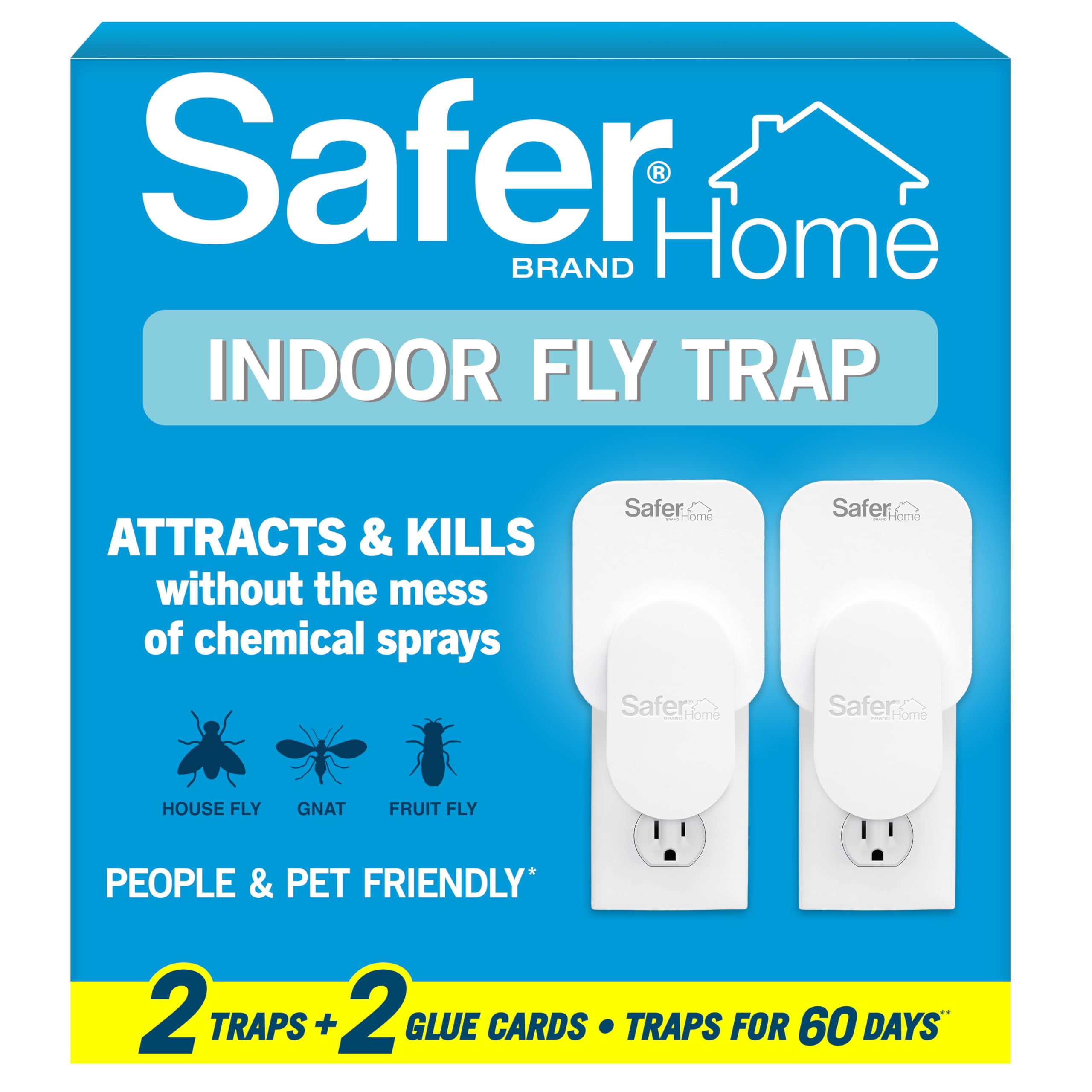
The Safer Home SH502-2SR is a 2-pack of plug-in UV fly traps designed for indoor use against fruit flies, gnats, moths, and similar small flying insects. Each device protects up to 400 square feet, giving you a combined coverage of 800 square feet — enough for most kitchens, living rooms, and bedrooms. The UV LED light runs 24/7 and attracts insects onto a replaceable StickyTech glue card that is completely chemical-free.
Setup is genuinely simple: plug the device into any standard outlet, rotate the head to face the problem area, and the UV light starts working immediately. The design is discreet enough to pass as a night light, and the trap faces the wall so you don’t see the captured bugs. In testing, drain fly infestations were notably reduced within 4 days, and fruit fly populations dropped significantly within a week. The glue cards last about 3–4 weeks before needing replacement.
The main limitation is that it’s a passive trap — it works best as a continuous management tool rather than a one-night cure. For heavy infestations, users report it takes up to three weeks to see a meaningful reduction. But for ongoing prevention in a bug-prone kitchen or near indoor plants, this is the most effective chemical-free option available.
Why it’s great
- Chemical-free UV attraction is safe around children and pets
- 2-pack covers 800 sq ft for multi-room protection
- Rotating head fits any outlet orientation
- Discreet design hides trapped insects from view
Good to know
- Works gradually over 2-3 weeks for heavy infestations
- Glue cards lose stickiness in dusty environments
- UV light is faint but may be distracting in dark bedrooms
5. Zevo Model 4
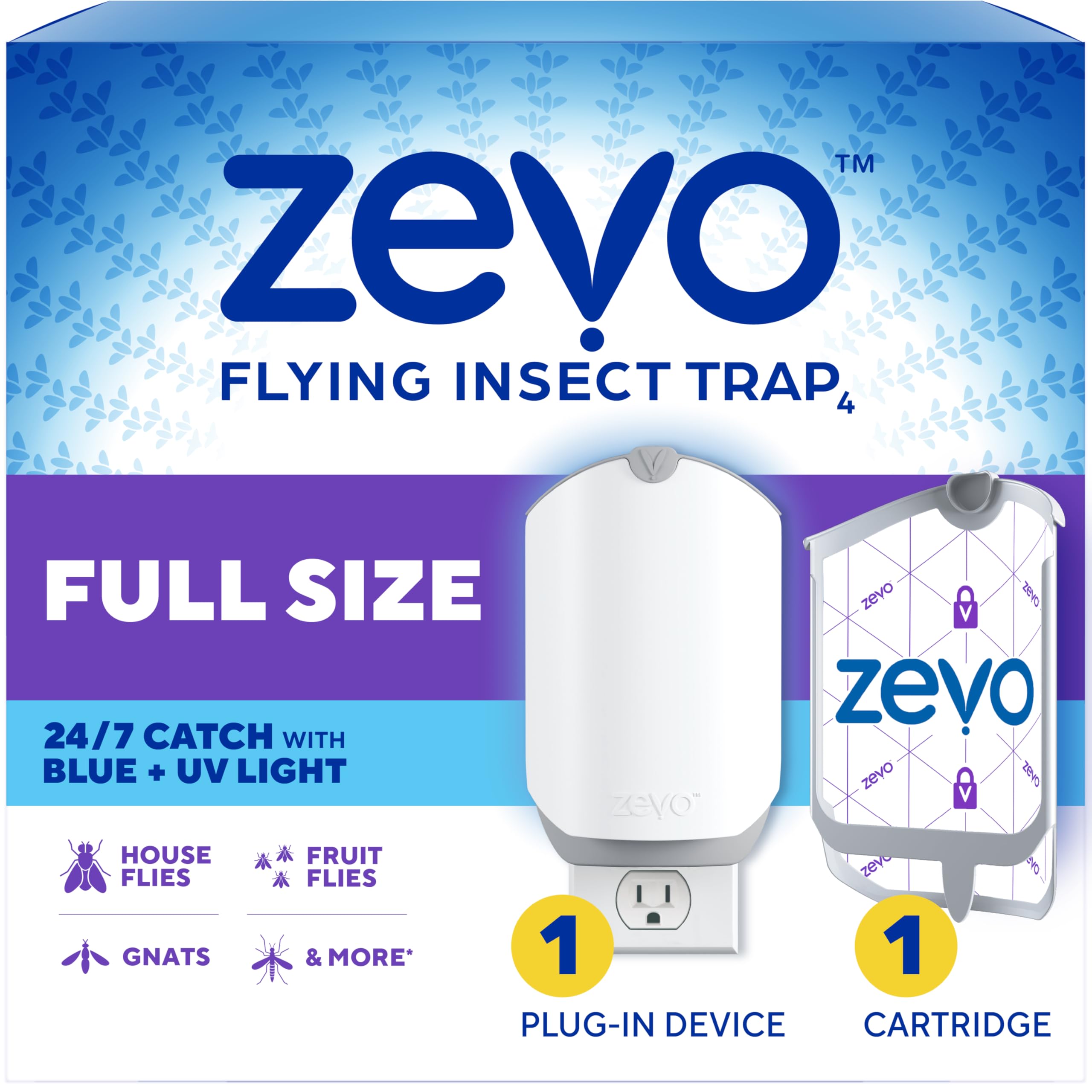
The Zevo Model 4 uses a combination of blue and UV light to attract flying insects — specifically fruit flies, gnats, and house flies — onto a powerful adhesive pad. Unlike zappers that create noise and odor, this trap operates silently with no chemical scent, making it ideal for kitchen countertops, dining room outlets, or near indoor herb gardens. The adhesive backing faces the wall, keeping the captured bugs out of sight.
Performance data from real users shows the device traps 10–15 drain flies within the first 48 hours and can accumulate over 25 gnats within a week. The effect is most pronounced when the trap is placed in an elevated outlet with the lights off — the UV and blue spectrum is most visible in darkness. The dim blue glow doubles as a subtle night light, but some users find it bright enough to disrupt sleep in a bedroom setting.
The starter kit includes one device and one cartridge. Replacement cartridges are widely available and extend the trap’s life indefinitely. The biggest downside is that the sticky pad can lose tackiness over weeks as dust accumulates, so monthly replacement is recommended for consistent performance. For anyone battling fruit flies from overripe produce or gnats from potted plants, the Zevo delivers quick, measurable results.
Why it’s great
- Blue + UV dual-spectrum light attracts a broad range of flying insects
- Silent and odorless operation for kitchen and bedroom use
- Visible catch results within 24-48 hours for most infestations
- Adhesive pad is mess-free and easy to replace
Good to know
- Blue glow may be too bright for complete darkness sleepers
- Sticky pads lose effectiveness after 3-4 weeks in dusty areas
- Must be placed in elevated outlets for best results
6. L LOHAS PAR38 Amber Flood Light

The L LOHAS PAR38 is a high-output yellow floodlight designed to replace standard 150–200W incandescent bulbs while using just 15W of electricity. At 2000K, it sits at the extreme warm end of the spectrum — significantly warmer than the TORCHSTAR’s 2500K — which makes it the least attractive option for insects in this lineup. The PAR38 form factor fits standard E26 outdoor floodlight fixtures, such as those mounted on garage eaves or patio corners.
Real-world users report that switching from standard white floodlights to these amber bulbs immediately reduced insect activity around security camera views and outdoor seating areas. The 1100-lumen output is surprisingly bright for the warm color temperature, providing sufficient illumination for security and ambient lighting without the harsh blue glow that draws pests. One user noted a brief 3-second on, 4-second off cycle upon first power-up, which appears to be a glitch in some units rather than a design feature.
For anyone who relies on outdoor floodlights for security, entertaining, or simply navigating the backyard, this is the most effective passive solution. It doesn’t kill bugs — it just ensures they aren’t attracted to your light source in the first place. Pair it with a zapper for active control, and you have a comprehensive outdoor pest management system.
Why it’s great
- 2000K amber spectrum is least attractive to flying insects
- 1100 lumens provides bright, usable outdoor illumination
- 15W power consumption replaces 150-200W incandescent bulbs
- PAR38 form factor fits standard floodlight fixtures
Good to know
- Not dimmable — on/off only
- Some units exhibit a power-on delay glitch
- AMD floodlight fixtures require checking clearance for PAR38 depth
7. TORCHSTAR A19 Yellow Bulbs

The TORCHSTAR A19 6-pack is the purest entry point into bug-reducing lighting. These standard A19 bulbs use integrated yellow LED chips behind a full-yellow glass casing to produce a 2500K warm output. The E26 base fits virtually any standard household fixture — porch lights, shed lights, garage entry lights, and covered outdoor sconces. At 8W each, they replace 40W incandescent bulbs and run for a rated 10,000 hours.
The 6-pack format makes this the most cost-effective way to convert every entry-point fixture on your property to insect-unfriendly lighting. Users consistently report a noticeable reduction in bugs gathering around doorways and porch fixtures after swapping from cool white or daylight bulbs. The plastic-clad aluminum body provides better heat dissipation than all-glass alternatives, allowing use in enclosed fixtures without overheating concerns.
The main trade-off is that at 2500K, the output is slightly less amber than the L LOHAS PAR38’s 2000K, meaning it may still attract some highly light-sensitive species. Additionally, each bulb outputs roughly 450 lumens (40W equivalent), which is fine for accent and entry lighting but insufficient for floodlight applications. If you need to cover multiple fixtures on a budget and prioritize bug reduction over maximum brightness, this is the most practical choice.
Why it’s great
- 6-pack covers multiple fixtures in one purchase
- 2500K yellow spectrum significantly reduces insect attraction
- 10,000-hour rated lifespan with 2-year warranty
- Plastic-clad aluminum body works in enclosed fixtures
Good to know
- 450 lumens output is modest — not suitable for flood lighting
- 2500K is warmer than standard bulbs but not as extreme as 2000K models
- Not suitable for direct rain exposure without a covered fixture
FAQ
Do yellow bug lights actually keep mosquitoes away?
Which is better for indoor fruit flies: a plug-in trap or a yellow bulb?
What is the difference between a PAR38 and an A19 bulb for bug lights?
Can I use a bug zapper indoors?
How often do I need to replace the glue cards in a plug-in trap?
Final Thoughts: The Verdict
For most users, the best bug light winner is the Flowtron BK-40D because its 5600V grid and 1-acre coverage deliver unmatched outdoor pest elimination. If you want an active chemical-free indoor trap, grab the Safer Home SH502-2SR for its dual-pack coverage and safe UV attraction. And for a budget-friendly passive solution that keeps bugs away from every porch fixture, nothing beats the TORCHSTAR A19 6-pack.