
Our readers keep the lights on and my morning glass full of iced black tea. As an Amazon Associate, I earn from qualifying purchases.
Specs are compiled from manufacturer listings and verified buyer reviews and can change over time — please confirm the key details on the product page before buying.
You drop a marker over your favorite fishing spot, look away for ten seconds, and by the time you turn back it has drifted or vanished. A buoy fixes that — it keeps you tied to the exact piece of water you care about, whether that is a honey hole, a ski course corner, or a swimmer in a dark wetsuit. Below are the nine buoys that hold up best at that job, sorted by what they actually do: mark, protect, or float.
I’m Min — the founder and writer behind Gadgets Feed. This guide is built by comparing the manufacturers’ published specifications and the patterns across verified customer reviews, so you get each pick’s real strengths and trade-offs instead of marketing spin.
You will see the difference between a marker that sinks and holds, a fender that protects a hull, and a swim float that keeps you visible — because those are three very different jobs. The right buoy is the one whose job matches yours, not the one with the brightest color on the page.
Our Picks at a Glance


How To Choose The Best Buoy
Buoy shopping trips up people because the word covers four separate tools. A marker buoy drops an anchor line and tells you where your spot is. A fender ball cushions your hull against a dock. A tow float follows a swimmer for visibility. A mooring buoy holds a boat to a fixed point. A great fender makes a poor marker, so the type has to come first.
Match the type to the job first
If you want to mark a fishing hole, you need a weighted line that drops fast and a buoy that will not unwind in the wind. That means a heavy weight at the bottom (often measured in ounces or grams) and a nylon line you can trust. If you want to protect a hull, you need vinyl that compresses on impact and a sealed one-piece body that does not split. If you need to be seen while swimming, you need a bright tow float that trails behind you without adding drag.
Then look at inflation and durability
Most vinyl fenders and mooring buoys ship deflated so they pack small, and you fill them yourself with a standard pump or needle. The maker of the X-Haibei ball recommends about 2 psi (roughly 0.013Mpa) and warns against over-filling, leaving a little give so the surface presses in under a finger. Over-inflation is the single biggest cause of a seam letting go in week two. Look for one-piece construction, UV protection so the color does not fade, and reinforced eyelets so the line hole does not tear out.
Weight and size decide where it works
A 1 kg vinyl ball that is 14.9 inches across handles a dock or a mooring line. A 6.5-ounce weight on a marker is about getting to the bottom fast. A swim float that weighs around 8 ounces will ride behind a swimmer without dragging. Match the weight and diameter to your hull or your swim distance before you look at color.
Quick Comparison
| Model | Best For | Type | Stated Size | Stated Weight | Amazon |
|---|---|---|---|---|---|
| RITE-HITE Best Buoy-Marker★ Best Overall | Marking fishing spots | Marker buoy with line | 75 ft line | 6.5 oz weight | Amazon |
| Polyform WS Series Water Ski BuoyCourse Ready | Ski courses and course markers | Ski buoy | 8″ x 8.5″ | 9.6 oz | Amazon |
| X-Haibei Boat Fender BallBig Boat Ball | Dock and mooring protection | Inflatable fender | D14.9 x H17.8 in | 2.2 kg package | Amazon |
| VEITHI Boat Buoy Balls | All-purpose lake use | Inflatable fender | 10 inch diameter | 0.75 kg | Amazon |
| New Wave Swim Bubble | Open-water swim visibility | Tow float | 16″L x 8″W | 8.48 oz | Amazon |
| New Wave Swim Buoy Drybag 15L | Swimming with gear aboard | Tow float with dry bag | 24″L x 10″W | 9.9 oz | Amazon |
| YLVERX Pair of Mooring Buoys | Big boats and heavy waves | Inflatable fender pair | D14.9 x H17.7 in | 1.72 kg package | Amazon |
| attwood 9350-4 Anchor Buoy | Marking a dropped anchor | Anchor buoy | 9 inch | 1 kg | Amazon |
| Taylor Made Tuff End Buoy | Large boat hull protection | Inflatable fender | 12 inch | 2 lbs | Amazon |
In‑Depth Reviews
1. RITE-HITE Best Buoy-Marker Accurate UV-Coated
Our pick — 4.5+★ from 750+ verified ratings; the strongest balance of quality and price.
A marker that drops fast and stays put so your spot does not disappear with the wind.
This is the one to buy if your main worry is losing a fishing spot rather than protecting a hull. It ships as a 2-pack, each buoy carrying 75 feet of nylon line and a 6.5-ounce weight that is made to get to the bottom quickly. The weight contains no lead, so you are not adding heavy metal to the lake bed when you drop it.
It wins on the whole package, not one headline spec. The high-visibility orange coating is UV-treated (coated to resist sun fading), so it does not fade to dull pink by August. The snap-together design means two buoys travel as one compact unit instead of tangling in a bucket. The line is monofilament nylon (single-strand fishing line) rated at line weight 10, a sensible match for dropping a small weight and pulling it back by hand.
The honest catch is twofold. Owners who fish deeper or in strong current sometimes wish the weight were heavier, so the buoy would bite harder into the bottom. And the snap joint does not always lock with a satisfying click, which means you should check it before you drop. In still water and light chop this marks beautifully; in a fast drift it may drift with you.
What sells it
- 75 feet of nylon line gets you to the bottom on most inshore marks without a separate spool.
- 6.5-ounce lead-free weight drops quickly and keeps the line taut.
- UV-coated orange holds color through a full sun season.
- Two buoys per pack, so you can mark a spot and a backup.
Where it asks for care
- Deep or fast water may want a heavier weight than 6.5 ounces.
- The snap joint can feel loose until you seat it firmly.
The right call when: you fish still or lightly moving water and want to mark a spot without carrying a separate anchor rig.
Look past it when: you regularly fish deep current where a heavier weight would hold better.
2. Polyform 28539331 WS Series Water Ski Buoy
A small, cheap red marker that does exactly one job and does not pretend otherwise.
Sized at 8 inches by 8.5 inches and weighing 9.6 ounces, this is the buoy for setting a ski course turn or a lane marker where you want a light object you can move and reposition. The PVC body is simple and rugged enough to take a rope through, and it is small enough that a handful fits in the boat locker.
At 8.48 ounces it is noticeably lighter than the New Wave Swim Bubble — the Polyform adds just over an ounce more — so it sits a little lower and reads differently on the water. That is a fair trade for a course marker you handle often. Value is where this one earns its place: it costs the least of the full-size markers while still being a branded, single-item buoy.
Durability is the thing to watch. PVC this thin and this cheap will not last like a heavy marine vinyl ball, so treat it as a consumable for the ski season rather than a permanent fixture. That is a reasonable deal at the price, but buy a spare if you run a full course.
Where it earns its keep: a light ski-course marker you can set, shift, and store without fuss, at the friendliest tier in the category.
The honest limit: thin PVC that you should expect to replace after a hard season.
Pick it if: you are marking a turn or a lane and want something simple, light, and easy to move.
Move on if: you need a buoy that lives on a mooring line year-round.
3. X-Haibei Boat Fender Ball Round Anchor Buoy
A big, soft buffer that sits between your hull and the dock when the wind picks up.
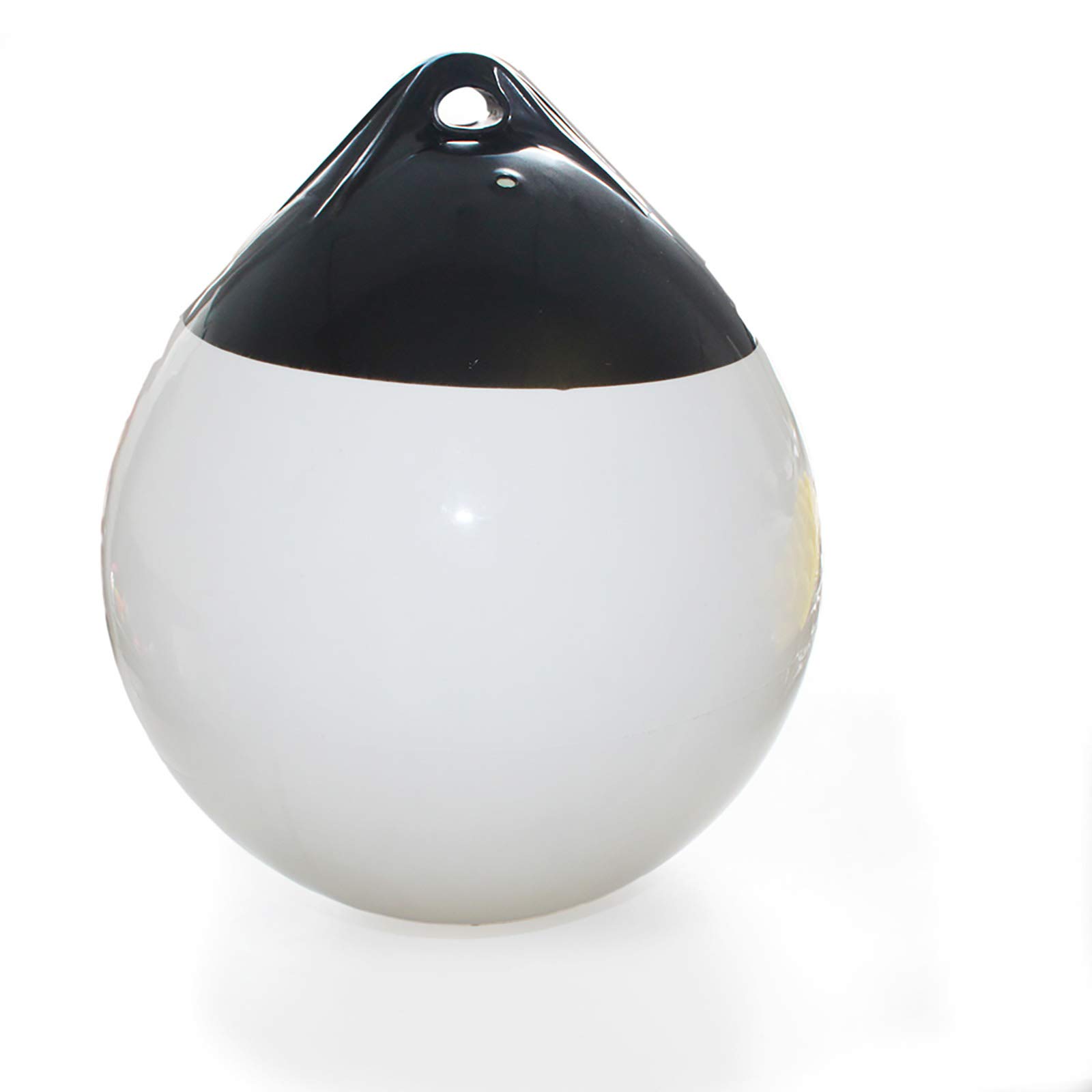
If your problem is a boat banging the dock in chop, you want a fender, not a marker. This ball measures 14.9 inches across and 17.8 inches tall, which is enough cushioning for a small boat, a yacht dock, or a mooring line. The package weight is 2.2 kg, so it has real mass once inflated and does not skate up over the rub rail.
Compare that to the VEITHI buoy balls at 0.75 kg package weight: the X-Haibei is the heavier, larger option, and you are paying for that extra material. The PVC is UV-protected so it does not fade, and the maker lists it for anchoring, mooring, navigation, and water safety, which means one ball can serve several jobs on the boat. The free inflating needles are a small but real convenience — you do not need to hunt for one the day it arrives.
Two cautions pull this one out of the top slot. It ships deflated and you inflate it yourself, so plan a pump and a little patience. And while build quality gets good word of mouth, air retention is where owners split — leave it under-inflated per the maker’s 2 psi guidance and it holds better. Store it indoors over winter to protect the vinyl.
The standout: a 14.9-inch soft cushion with enough bulk and UV-protected skin to handle a real dock and a real chop.
The trade-off: it arrives flat, so you supply the air and the attention.
Worth it for: anyone protecting a small to mid-size hull against a dock.
Think twice if: you want something that arrives ready to use, or you plan to deflate and re-inflate often.
4. VEITHI Boat Buoy Balls (10/12/15 inch)

The pick-one-buoy that swings from dock protection to anchor marker without blinking.
Most buyers here are not sure whether they need a fender or a marker, and this ball is the answer to that indecision. It comes in 10, 12, and 15 inch diameters with a consistent 3.8 mm wall, and the maker says the 10-inch is matched to boats of 10 to 18 feet. Even wall thickness is what keeps a vinyl ball from bulging on one side and splitting on the other.
No glued seam can let go, because the one-piece smooth construction has none — that is the real feature. The drop-shaped design is meant to stabilize it when it floats as an anchor marker. Reinforced perforations at the end let you tie off to the boat without tearing the eyelet. At 0.75 kg it is light to stow, and it ships with an inflation needle. If protection is your priority, the X-Haibei ball above is the heavier, more substantial option; if you want one ball that does a bit of everything, this is it.
The air story is the thing to manage. Buyers report easy inflation, but the ball does not always hold pressure over a full season, so check it before each trip and keep it at the recommended 2 psi rather than topping it up hard. Color choice matters too — the white 1-pack is the tested configuration, so if you go for a different shade or pack size, verify what you are getting.
Why it fits most boats
- Three diameter options, with the 10 inch recommended for 10 to 18 foot boats.
- One-piece smooth vinyl means no seam to split.
- Reinforced line hole holds up to daily tying and untying.
- Works as a fender, mooring ball, or anchor marker.
What to plan around
- Air retention can soften over the season, so it needs a periodic top-up.
- Color and pack options vary, so check the listing carefully.
Buy this one if: you want a single versatile buoy for a smaller boat and dock.
skip it if: you need a guaranteed airtight fender for a heavy mooring.
5. New Wave Swim Bubble Tow Float

The ultralight shadow that follows your kick so boats see you before they see your dark wetsuit.
If you swim open water and your worry is being invisible in a black wetsuit, this is the tool. It measures 16 inches long by 8 inches wide and weighs 8.48 ounces, so it trails behind you like a small shadow rather than a load. The PVC body is bright orange, and the whole point is that a driver sees the float before they see you.
This is the stripped version of New Wave’s swim buoy — no dry bag inside, no compartments. That is why it weighs less and floats higher than the version with storage below. For triathlon training where you are not carrying keys or a phone into the water, the missing pocket is not a missing feature; it is the reason the float behaves better. And what wins people over is its suitability for open water: it tows with minimal drag, so your stroke stays long instead of tugging against an extra anchor.
The obvious limit is that there is no place to put anything. If you want to carry a phone or keys, you need the dry bag version instead. And this is a visibility aid and float-to-rest, not a personal flotation device. The maker is clear on that, so do not swap a life vest for it. For the small storage-free job it does, the value holds up.
What makes it click: a bright orange float at just 8.48 ounces that you forget is behind you until you need to rest.
Where it draws the line: no storage, no dry bag, and not a replacement for a PFD.
Made for: open-water swimmers and triathletes who want visibility and a float without extra baggage.
Not the one for: anyone who needs to carry a phone, keys, or a wallet into the water.
6. New Wave Swim Buoy Drybag 15 Liter

Same bright float, now with a 15-liter pocket so your keys ride the whole swim with you.
Here is the pickup for the swimmer who wants visibility and a dry bag in one tow. It is 24 inches long and 10 inches wide and comes with a 15 liter dry compartment, big enough for keys, phone, and a layer. In yellow PVC, it reads clearly against dark water, and the maker points out that it is noticeable to boaters, jet skis, and paddlers.
You inflate it and tow it behind you, and the float doubles as a place to rest and hold on if you cramp. The storage gets real praise from owners: the pocket is large enough to swallow the essentials and the dry section keeps them separated. Run a tracking app in a phone inside a sealed bag and you can share your route with someone on shore. It weighs 9.9 ounces, so it is still light enough to forget about while you swim.
The thing to watch is water entry. Sealing is what makes or breaks a dry bag, and some owners mention moisture getting in around the closure. Pack valuables in a secondary zip bag and make sure the roll is tight. That is a small habit that protects the feature you paid for.
Why swimmers like it
- 15 liters of dry space for phone, keys, and a layer.
- Bright yellow float is easy for boaters and spotters to see.
- Doubles as a float to rest on when you cramp.
- 9.9 ounces so it does not drag your stroke.
Keep an eye on
- The dry seal can let moisture in if it is not rolled tight.
- Not a personal flotation device, so do not swap it for one.
The one for: swimmers who need to carry a phone or keys and still want to be seen.
Overkill if: you swim light with nothing to carry.
7. YLVERX Pair of Mooring Buoys

Two matched 14.9-inch balls that keep a bigger boat off the dock in a hard wind.
This package gives you a pair of round fenders, each 14.9 inches across and 17.7 inches tall with a 3.8 mm wall. The maker lists them for boats from 15 to 40 feet, so they suit a pontoon, a runabout, or a cruiser. Marine-grade vinyl with UV protection is soft enough not to scuff your hull and easy to wipe clean afterward.
The details are where this pair earns its premium tier. Each ball has a large 1-1/8 inch line hole so most shackles and rope fit, and the eyelets are reinforced so tying and untying over a season does not tear them out. The one-piece construction is meant to prevent splitting, and both an inflator and two needles come in the box so you can set the pressure right away. A two-year warranty is a real signal of how the maker sees its own build.
You will still inflate them yourself, and the pair is heavier in the hand than a single small ball, so stowing is a bit of a job. Owners do split on whether the pair feels like good value, so weigh the two-for-one against a single premium ball. For a boat that needs protection both sides, having the pair is the practical win.
What you get: a matched pair with reinforced eyelets, a two-year warranty, and a pump and needles in the box.
The fine print: you supply the labor to inflate, and the pair takes up more locker space.
Ideal for: owners of a 15-to-40-foot boat who want both sides protected at once.
Not for you if: you only tie up on one side and want a single leaner fender.
8. attwood 9350-4 Anchor Buoy

A one-piece vinyl flag that rides your anchor line so you know exactly where the hook sits.
This is a dedicated anchor buoy, which means its job is narrow and it does it well. Tie it on the anchor line and it floats above the hook, so you can see where your anchor landed instead of guessing. It is 9 inches long, one piece, and made from premium marine-grade vinyl that stays soft and pliable rather than hardening in the sun.
The details are built for a long life in salt and sun. Built-in UV inhibitors fight the color fade, the fluorescent orange is chosen for spotting from a distance, and MicroGuard protection is meant to hold off rot, mold, and mildew. The one-piece build means there is no seam to fail at the wrong moment, which is the kind of thing you learn to care about when a buoy matters. It weighs 1 kg, so it is substantial enough to ride the line properly and small enough to stow in a cubby.
The honest trade-off is cost. At the premium tier, you are paying for the brand, the MicroGuard treatment, and the one-piece construction, and the gap to a generic ball is real. It functions well and owners find it durable, but if your only goal is to see an anchor, a cheaper marker will also work. Buy this one when you want the longevity and the treated vinyl.
Where it shines: a 9-inch treated vinyl float that marks your anchor line and holds its color and surface through the sun.
The catch: you are paying a premium for that treatment when a basic marker would technically do the job.
Choose it if: you want a long-lived, mold-resistant marker dedicated to your anchor line.
Save your money if: you only need a rough visual marker and are not fussed about fading.
9. Taylor Made Tuff End Buoy, White (12″)

A 12-inch white fender for a 25-to-40-foot boat, built with a valve you can fill like a football.
For a bigger hull that needs a broad cushion against a dock, this fender measures 12 inches. It is made in the USA from flexible marine-grade vinyl in a smooth one-piece body the maker calls the strongest in the industry. The injection-molded ends are tested to 2000 psi tensile strength, and the large line holes fit most ropes and shackles.
The real convenience is the Tri-valve: you inflate it with a standard ball pump or a football needle, so you do not need a specialty accessory to set it up. That makes it friendlier than fenders that need a proprietary adapter, and it means you can adjust it on the dock with what you already own. It is a solid 2 pounds, so it hangs with real presence on the line.
Here is where you need to be deliberate. The inflation and sealing are the parts to manage: customers note valve-related leakage if it is not seated correctly and inflation handled carelessly, so make sure the valve is clean and tight before it hits the water. A fender at the right pressure compresses on impact; a soft one just hangs there. Set it up right and it does its job.
The strong points
- Tri-valve inflates with a standard ball pump or football needle.
- Injection-molded ends tested to 2000 psi tensile strength.
- smooth one-piece vinyl body with large line holes.
Set it up right
- Valve and seal need careful seating to avoid slow leaks.
- Bigger and heavier than a small fender, so it needs locker room.
The best fit: a 25-to-40-foot boat that needs a broad, easy-to-inflate dock cushion.
Pass it by if: you want a clamp-and-go fender and are not willing to manage the valve.
Understanding the Specs
Inflation Pressure (psi)
Vinyl fenders ship deflated so they fit in a small box, and you fill them yourself. The pressure matters: the maker of the X-Haibei ball recommends about 2 psi (roughly 0.013Mpa) and says to leave some give so the surface presses in under a finger. A buoy that is rock-hard has nowhere to compress when it hits the dock, and that is when seams and valves let go. Soft but firm is the target.
Line Weight and Weight
A marker buoy is only as good as its line and its weight. The RITE-HITE carries 75 feet of nylon line with a 6.5-ounce weight to drop it to the bottom quickly. A heavier weight holds better in current; a lighter one drops faster in still water. For fenders, weight tells you how much material and bulk you are getting — the X-Haibei package weighs 2.2 kg, while the lighter VEITHI comes in at 0.75 kg.
Vinyl and UV Protection
Marine-grade vinyl is the standard for buoys because it stays soft and compresses instead of cracking. UV protection is what keeps the orange from fading to dull pink and keeps the plastic from going brittle in the sun. The attwood adds UV inhibitors plus MicroGuard for mold and mildew, while the YLVERX and X-Haibei both list UV-protected surfaces.
Eyelets and Line Holes
The line hole is where a buoy fails first. Look for reinforced eyelets and a hole wide enough for your rope or shackle — the YLVERX pair uses 1-1/8 inch holes, and the VEITHI reinforces its end perforations. A cheap hole tears out under load, and then the buoy is just floating loose.
FAQ
Will a marker buoy hold in strong wind and waves?
How much air should I put in a vinyl buoy?
Can a swim buoy replace a life vest?
What size fender do I need for my boat?
Do boat buoys come inflated?
What is the difference between an anchor buoy and a fender?
How do I deflate a boat buoy for storage?
Will vinyl buoys fade or crack in the sun?
Can I use a ski buoy as a swim marker?
Final Thoughts: The Verdict
Start with the RITE-HITE Best Buoy-Marker, because it wraps the whole marking job into one package — 75 feet of nylon line, a 6.5-ounce lead-free weight, and two UV-coated orange buoys per pack, so your spot stays marked without extra gear. Protecting a hull? Reach for the X-Haibei 14.9-inch fender ball for its size and soft vinyl, or the YLVERX pair when you need both sides covered and want the two-year warranty. And if you swim open water, the New Wave Swim Bubble is the light, bright shadow that keeps you seen.
Decide which of the three jobs you need done before you buy. Marker, fender, or tow float matters more than any color or brand on the page.
How We Picked
We do not accept paid placement. Every pick is matched to a real buyer and a real use-case; we do not hands-on test units.
Sources & Methodology
Specifications: manufacturer listings and product documentation. Review insights: verified customer reviews, as of November 2026. Pricing: not shown on this page (it changes often); check the current price via the retailer link.
As an Amazon Associate, Gadgets Feed earns from qualifying purchases. This does not affect which products we feature.