
A bushcraft knife is your primary wood-processing tool, fire-starting companion, and camp craft enabler — it lives in your hand, not on a shelf. The wrong blade fights you on every feather stick, dulls mid-project, or fails during batoning, and no amount of sharpening skill fixes a knife with poor geometry or an unsafe handle. The right knife disappears into your grip, holds a working Scandi edge through a weekend of carving, and sparks a ferro rod without deformation.
I’m Min — the co-founder and writer behind Gadgets Feed. I’ve spent countless hours analyzing steel compositions, tang constructions, and sheath retention across dozens of bushcraft-specific fixed blades to separate the gear that performs from the gear that just looks the part. This guide focuses on the specs that actually matter when you’re processing wood by hand in the field.
After comparing over thirty bushcraft knives against real wood-carving, batoning, and fire-starting criteria, these seven blades represent the top tier of field-ready design — this is your definitive resource for finding the best bushcraft knife for your specific outdoor needs.
How To Choose The Best Bushcraft Knife
A bushcraft knife is not a general-purpose survival knife or a hunting skinner — it is a specialized woodworking tool designed for repetitive carving, feather-stick production, and controlled batoning. Selecting the right one requires understanding three interdependent factors: tang integrity, blade geometry, and steel composition.
Full Tang vs. Hidden Tang: Why It Matters for Batoning
The tang is the portion of the blade that extends into the handle. A full-tang design (one continuous piece of steel from tip to butt) transmits impact force directly into your palm without a weak point. Hidden tang knives, where the steel narrows inside the handle scales, can snap at the junction under batoning stress. For any bushcraft knife that will process firewood, full tang is the baseline — anything less is a liability.
Scandi Grind: The Bushcraft Standard
The Scandi grind creates a single bevel that runs from the blade’s primary flat straight to the cutting edge. This geometry produces a thick, stable edge that bites aggressively into wood and is extremely easy to resharpen in the field because you simply lay the bevel flat on a stone. Full-flat grinds slice better for food prep, but they lack the edge stability for heavy carving and the sharpening simplicity that makes Scandi the dominant bushcraft grind.
Steel Selection: Carbon vs. Stainless in Wet Environments
High carbon steels like 1095 and Sandvik 12C27 hold a keen edge, sharpen quickly, and are tough enough to withstand batoning without chipping. The trade-off is corrosion resistance — carbon steel will patina and rust if neglected. Stainless options like 8Cr13MoV resist moisture but are harder to sharpen to a razor’s edge and tend to roll rather than chip under impact. Choose carbon for serious wood processing, stainless if your knife will see constant wet exposure without maintenance.
Quick Comparison
On smaller screens, swipe sideways to see the full table.
| Model | Category | Best For | Key Spec | Amazon |
|---|---|---|---|---|
| Morakniv Garberg Full Tang Carbon | Premium | All-around bushcraft with integrated fire starter | Sandvik 12C27 carbon steel, 4.3″ blade | Amazon |
| ESEE 4P Survival Knife | Premium | Hard-use survival and heavy batoning | 1095 carbon steel, 4.5″ blade, Micarta handle | Amazon |
| ESEE-6 1095 Carbon Steel | Premium | Larger camp tasks and chopping | 1095 carbon steel, 6.5″ blade, 3D Micarta handle | Amazon |
| Bloodline Fixed Blade Survival Knife | Mid-Range | Complete kit with ferro rod and Kydex sheath | 1095 high carbon steel, 4″ blade, G10 handle | Amazon |
| Gerber Gear Principle Fixed-Blade | Mid-Range | Compact EDC with fire-striking spine | 420HC steel, 3.1″ blade, full tang | Amazon |
| Spyderco Bow River Fixed Blade | Mid-Range | Hunting and food prep with leather sheath | 8Cr13MoV stainless steel, 4.36″ blade | Amazon |
| Condor Tool & Knife Terrasaur | Budget | Entry-level price with full Scandi geometry | 1095 high carbon steel, 4.15″ blade | Amazon |
In‑Depth Reviews
1. Morakniv Garberg Full Tang Fixed Blade Knife with Carbon Steel Blade

The Morakniv Garberg is the most robust model in Mora’s lineup, featuring a hardened Sandvik 12C27 carbon steel blade with a true Scandi grind and a full-tang construction that sets it apart from Mora’s classic Companion series. The 4.3-inch blade is 0.13 inches thick and terminates in a 90-degree spine that mates perfectly with the included integrated fire starter, allowing you to throw sparks immediately without carrying a separate striker. The geometry delivers that signature Mora carving control — thin behind the edge for aggressive wood bite, yet thick enough at the spine to withstand moderate batoning without flex.
The kit includes a diamond sharpener and reflective paracord lanyard, which makes this a complete field-ready system rather than just a blade. The polymer sheath offers solid retention and a functional belt loop, though some users note the attachment could be more secure on wider belts. At 13.8 ounces with the sheath, it’s light enough for backpack carry but substantial enough to feel planted during heavy carving sessions — the rubberized handle texture provides a secure grip even when wet.
The Garberg’s edge retention is excellent for a carbon steel blade at this specification, and the Scandi grind makes field sharpening trivially simple — just lay the bevel flat on a stone and sweep. The carbon steel will develop a natural patina with use, but it requires drying after wet exposure to prevent rust. The included fire starter and diamond sharpener add genuine utility without inflating the price into premium territory, making this the most complete package for someone who wants one do-it-all bushcraft tool.
Why it’s great
- Full-tang Scandi grind with superb carving geometry
- Includes integrated fire starter and diamond sharpener
- Lightweight at 13.8 oz with sheath
- 90-degree spine for reliable ferro rod ignition
Good to know
- Carbon steel requires rust prevention in wet climates
- Sheath belt loop attachment could be more secure
- Coating on blade may scratch with heavy use
2. ESEE 4P Survival Knife

The ESEE 4P is a field-tested fixed blade built from 1095 carbon steel with a full-tang construction that has earned a reputation for surviving the kind of abuse that would snap lesser knives. The 4.5-inch drop-point blade with a full-flat grind is 0.125 inches thick, providing a balance between slicing efficiency and prying strength that makes this knife equally capable of detailed carving and heavy batoning of hardwood knots. The gray linen Micarta handle scales are contoured to fill the hand without creating hot spots, and the texture provides a positive grip even when wet with blood or sap.
The molded polymer sheath includes a removable clip plate that allows multiple carry orientations including scout, drop-leg, and MOLLE mounting. The sheath’s retention is excellent — the knife clicks in audibly and stays secure through rough movement. Weighing approximately 8.0 ounces, the ESEE 4P is lightweight for a blade of this strength, and the flat grind performs admirably for food prep and rope cutting in addition to wood processing. The black powder coat finish is durable but will wear at the edge with sharpening, exposing the raw 1095 steel underneath.
The ESEE “no questions asked” lifetime warranty is a genuine differentiator — if you break this knife, ESEE replaces it regardless of how it happened, which speaks to their confidence in the design. The 1095 steel at 55-57 RC is tough enough to handle rock-striking and prying without catastrophic failure, though the edge will roll before it chips, making field touch-ups with a ceramic rod straightforward. The Micarta scales have a texture some users describe as blocky — those who prefer a rounded contour should consider the aftermarket scale options or the 3D handle version of the larger ESEE-6.
Why it’s great
- Unbreakable full-tang construction with lifetime warranty
- Versatile flat grind handles both carving and batoning
- Micarta handle provides secure grip when wet
- Multiple sheath carry configurations
Good to know
- Square Micarta scales can feel blocky for smaller hands
- Powder coat wears at the edge over time
- 1095 steel requires oiling to prevent rust
3. ESEE-6 1095 Carbon Steel with Black Sheath

The ESEE-6 upgrades the proven 1095 carbon steel platform with a 6.5-inch blade that delivers substantially more reach and chopping authority than the 4P, making it a true camp knife for processing larger firewood and shelter poles. The blade thickness jumps to 0.188 inches, providing exceptional lateral stiffness for heavy batoning through knotted hardwood without any flex concern. The full-flat grind produces a cutting edge that slices aggressively while maintaining the thick spine necessary for prying and splitting tasks.
The 3D contoured natural canvas Micarta handle is a significant ergonomic improvement over the standard ESEE scales — the palm swell and finger groove reduce hand fatigue during extended chopping sessions, and the jimping along the spine provides thumb traction for detailed carving control. The ambidextrous polymer sheath uses a clip plate system that accommodates belt, MOLLE, and scout carry, and the retention is tight enough that the knife will not rattle loose even during trail runs. At 13 ounces for the knife alone and 18 ounces with the sheath, it is heavy enough to feel substantial in hand but light enough for day-pack carry.
The cryo-quenched heat treatment at -300°F optimizes the 1095 steel’s grain structure for toughness and edge stability, and the textured powder coat finish resists scratching better than the standard coating on the ESEE 4P. The no-questions-asked lifetime warranty applies to this model as well, which is reassuring given the abuse a 6.5-inch blade invites. The edge geometry out of the box is shaving sharp, though the grind angle is closer to 25 degrees than the advertised 20 degrees — users who want a finer edge will need to reprofile with a guided sharpening system.
Why it’s great
- Longer blade for chopping and splitting larger wood
- 3D contoured Micarta handle reduces fatigue
- Cryo-quenched 1095 steel for edge stability
- Outstanding sheath with multiple carry options
Good to know
- Heavier than smaller bushcraft knives at 18 oz with sheath
- Edge grind angle is closer to 25 degrees than stated
- May be oversized for detailed carving work
4. Bloodline Fixed Blade Survival Knife – Holtzman’s Gorilla Survival
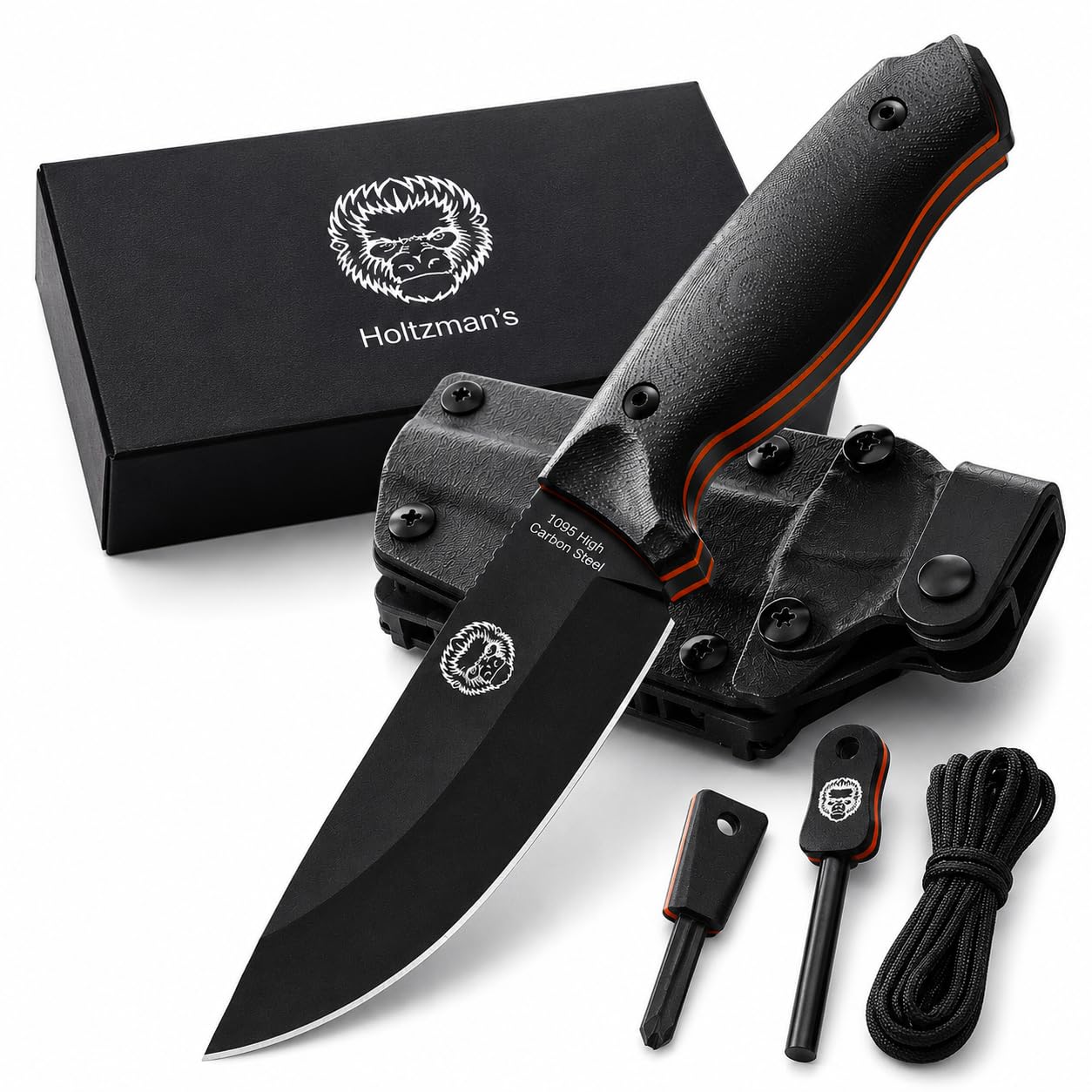
The Bloodline fixed blade delivers a complete bushcraft kit that punches well above its price tier: a full-tang 1095 high carbon steel blade with a compound bevel edge, a textured G10 handle with orange liner accents, a custom-fit Kydex sheath, a ferro rod with striker, and paracord — all in a presentation box with magnetic closure. The 4-inch straight-back blade geometry with a 90-degree spine provides a stable platform for both wood carving and ferro rod striking, and the jimping along the spine gives controlled thumb placement for detailed cuts.
The G10 handle scales offer excellent texture for wet-condition grip, and the three-screw construction (Colby bolts) allows easy disassembly for cleaning or scale replacement. The Kydex sheath is the standout feature at this price point — it accommodates the knife and ferro rod in separate molded compartments with positive retention, and the included Tek Lok and leather dangler offer scout, drop, and belt carry options. The ferro rod itself is substantial, and the striker produces consistent showers of sparks even for beginners.
The 1095 steel at this price point is a genuine value — it holds an edge comparably to higher-priced competitors and responds well to stropping between uses. The compound bevel grind sacrifices some of the wood-biting aggression of a pure Scandi edge, but it provides a more durable edge geometry that resists rolling during heavy use. The black G10 handle with orange liner is not subtle, but the visual contrast makes it easy to locate if dropped in leaf litter. The sheath’s ferro rod retention is excellent, though the striker piece only attaches in one orientation, which limits carrying versatility.
Why it’s great
- Complete kit with Kydex sheath, ferro rod, and striker
- Full-tang 1095 steel with G10 handle for durability
- Multiple sheath carry configurations included
- Excellent value for a full-tang bushcraft setup
Good to know
- Compound bevel grind less aggressive than pure Scandi for carving
- Striker attachment is unidirectional
- Black coating may wear at contact points
5. Gerber Gear Principle Fixed-Blade Survival Knife
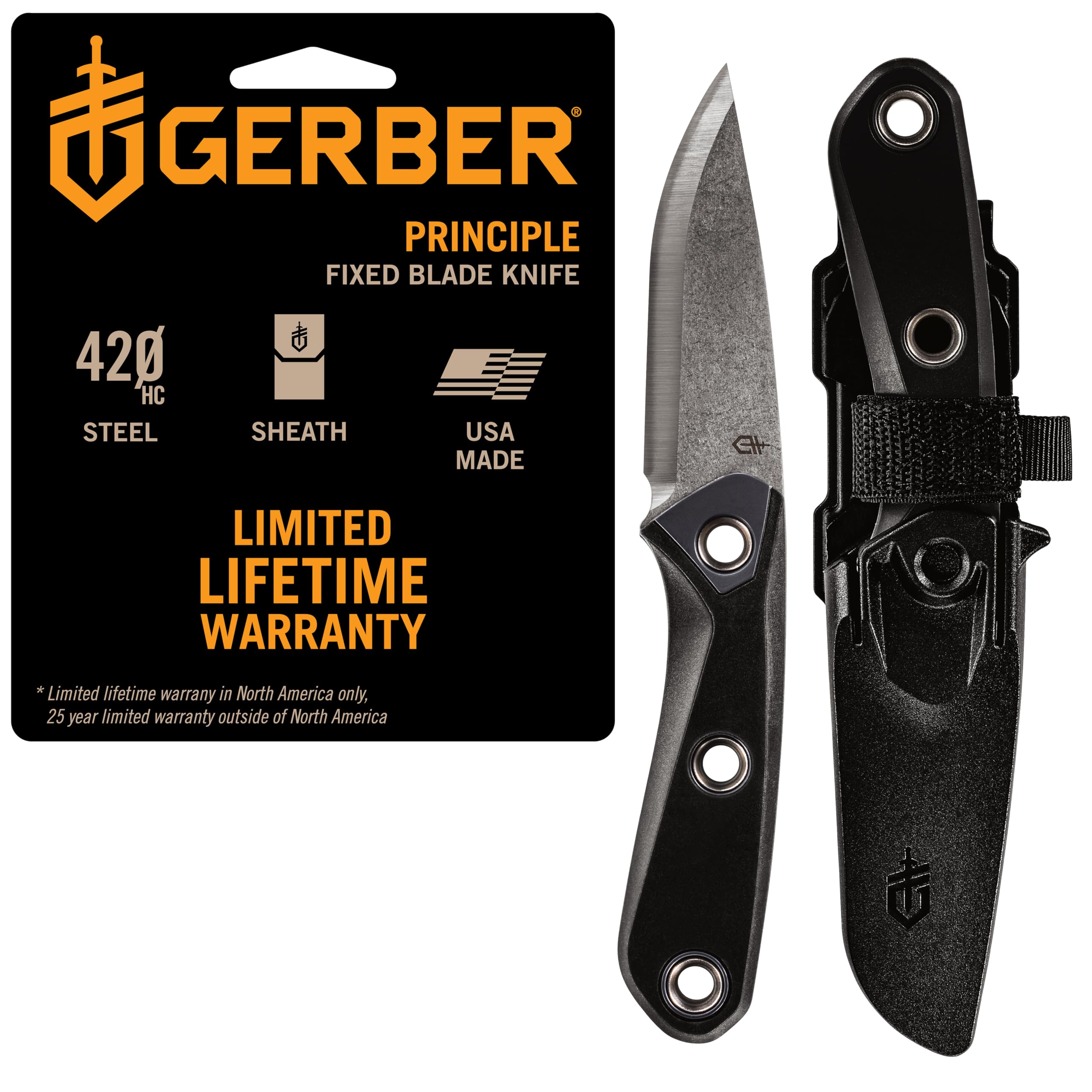
The Gerber Gear Principle is a compact full-tang fixed blade with a 3.1-inch blade made from 420HC steel, designed specifically for the bushcrafter who prioritizes packability and precise carving over heavy batoning. The zero-edge Scandinavian grind is authentically Scandi — the single bevel runs from the blade flat to the edge, giving this small knife surprisingly aggressive wood-biting performance for its size. The 90-degree fire-striking spine is machined with distinct corners that catch ferro rod material effectively, and the drop-blade shape provides a useful belly for slicing tasks.
The triple-mounting sheath system supports MOLLE, drop-leg, and scout carry configurations through a combination of polymer clips and straps, though the sheath itself is basic injection-molded plastic with no belt loop — users who prefer traditional belt carry will need to add a loop. The ergonomic handle supports baseball, precision, and chest-lever grips without discomfort, and the full-tang construction extends through the handle for solid impact transfer during batoning of smaller diameter wood. At 7.5 inches overall length, this knife disappears in a pack or on a shoulder strap.
The 420HC steel, when properly heat-treated by Gerber’s US facility, offers a balance of edge retention and toughness that suits moderate bushcraft tasks, and it resists corrosion better than 1095 carbon steel. The small blade size limits the Principle to feather sticks, notching, and light batoning of finger-thick wood — this is not a knife for processing full-sized logs. The sheath has good retention but lacks the refinement of Kydex options at similar prices, and the clip is not reversible for left-handed scout carry.
Why it’s great
- True Scandi grind for aggressive wood carving
- Compact size ideal for EDC and small packs
- Multiple sheath mounting configurations
- Fire-striking spine is effective and sharp
Good to know
- Short blade limits heavy batoning capability
- Sheath lacks belt loop and is non-reversible
- 420HC steel requires more frequent sharpening than 1095
6. Spyderco Bow River Fixed Blade Outdoor Hunting Knife

The Spyderco Bow River, designed in collaboration with master knifemaker Phil Wilson, offers a full-flat-ground 8Cr13MoV stainless steel blade that excels at field dressing, food preparation, and general camp cutting tasks where corrosion resistance is critical. The 4.36-inch trailing-point blade shape provides a generous belly for skinning and slicing, and the flat grind geometry delivers thin-behind-the-edge performance that glides through meat and vegetables without wedging. The black and gray G-10 handle scales are contoured for comfort during extended use, though the surface is notably smooth — users with wet or greasy hands should expect reduced traction.
The handcrafted leather sheath that ships with the Bow River is a premium touch at this price point — it is form-fitted to the blade, secures the knife with good retention, and features a traditional belt loop that sits comfortably on the hip. The full-tang construction provides the structural integrity needed for light batoning and camp chores, though the 8Cr13MoV steel at its standard hardness is better suited to slicing than to heavy impact. At 4.36 inches, the blade length is versatile enough for both detailed carving and larger cutting tasks without feeling unwieldy.
The Bow River is Spyderco’s most affordable fixed blade, and it delivers the brand’s characteristic factory edge sharpness — most units arrive shaving-sharp and ready for immediate use. The G-10 handle scales offer zero jimping on the spine, which limits thumb traction during detailed control cuts, and some users report the grip can feel slick when wet. The stainless steel composition eliminates rust concerns, making this the best choice for users who hunt in wet conditions or who prefer minimal blade maintenance, but the 8Cr13MoV steel will not hold a working edge as long as 1095 carbon steel during wood processing.
Why it’s great
- Stainless steel resists corrosion for wet-hunt use
- Beautiful leather sheath included
- Full-flat grind excels at slicing and food prep
- Phil Wilson design delivers premium geometry at a fair price
Good to know
- Smooth G-10 handle offers minimal traction when wet
- No jimping on spine for thumb control
- 8Cr13MoV steel requires more frequent sharpening than carbon alternatives
7. Condor Tool & Knife Terrasaur Bushcraft Knife

The Condor Terrasaur is an entry-level full-tang bushcraft knife that delivers genuine 1095 high carbon steel with a true Scandi grind at a price that undercuts most of its competition by a significant margin. The 4.15-inch straight-back blade is 3mm thick with a Scandi edge that slices through wood aggressively, and the high impact polypropylene handle provides a comfortable, secure grip that is also exceptionally durable — the PP material resists moisture absorption, temperature extremes, and impact without cracking. The army green color scheme blends well with natural environments, and the blade’s acid-wash finish reduces glare and provides a base level of corrosion resistance.
The high impact polypropylene sheath with leather belt loop is a mixed bag — the loop is well-stitched and deep enough to fit wide belts, but the sheath covers so much of the handle that drawing the knife can be difficult, especially with gloved hands. The sheath does include drain holes and bidirectional snap retention, which are thoughtful details for a product in this price tier. At 7.1 ounces, the Terrasaur is light enough for all-day carry, and the 1095 steel responds exceptionally well to field sharpening — a few passes on a fine stone restores a working edge quickly.
The Terrasaur’s true Scandi grind is its strongest asset — it carves feather sticks and notches with the same aggression as knives costing twice as much, and the thick 1095 edge resists rolling during moderate batoning. The polypropylene handle, while not as premium as G10 or Micarta, provides a secure grip without the cold-shock or hot-spot issues that affect metal-handled knives. The sheath tightness is the primary functional complaint — users who prioritize rapid deployment may need to heat and mold the sheath for better clearance. For the bushcrafter on a tight budget who refuses to compromise on steel type or tang construction, the Terrasaur delivers remarkable capability.
Why it’s great
- Genuine 1095 steel with true Scandi grind at a budget price
- Lightweight at 7.1 ounces for all-day carry
- Durable polypropylene handle resists moisture and impact
- Excellent edge retention for the price tier
Good to know
- Sheath covers too much handle, making draw difficult
- Polypropylene handle lacks texture for wet grip
- Sheath may require modification for smooth deployment
FAQ
Is full tang really necessary for bushcraft?
Why does Scandi grind matter for wood carving?
Should I choose carbon steel or stainless steel for my bushcraft knife?
Final Thoughts: The Verdict
For most users, the best bushcraft knife winner is the Morakniv Garberg Full Tang Carbon because it delivers a true Scandi grind, full-tang construction, and integrated fire-starting accessories in a lightweight, field-tested package. If you want a heavier-use knife for extended batoning and prying, grab the ESEE 4P Survival Knife. And for the budget-conscious bushcrafter who refuses to compromise on steel type or tang integrity, nothing beats the value of the Condor Tool & Knife Terrasaur.