
Our readers keep the lights on and my morning glass full of iced black tea. As an Amazon Associate, I earn from qualifying purchases.
Specs are compiled from manufacturer listings and verified buyer reviews and can change over time — please confirm the key details on the product page before buying.
Hanging an upper cabinet alone is the part of a kitchen project that goes wrong fastest. You need one hand to hold the box level, one to drive the screw, and somehow a third to stop the whole thing tipping onto your head. A cabinet jack is that missing third hand — a pole or arm that holds the cabinet exactly where you set it so both your hands stay free. This guide covers nine real options, from compact arms that lift a fridge to tall poles that pin drywall to the ceiling.
I’m Min — the founder and writer behind Gadgets Feed. This guide is built by comparing the manufacturers’ published specifications and the patterns across verified customer reviews, so you get each pick’s real strengths and trade-offs instead of marketing spin.
Two numbers decide whether a cabinet jack earns its keep: how high it reaches and how much weight it holds. Get those wrong and the pole never leaves the garage. That is what separates a real best cabinet jacks shortlist from a wasted purchase.
Our Picks at a Glance

How To Choose The Best Cabinet Jacks
Two cabinet jacks can look almost identical on the shelf and behave completely differently on the job. The difference is almost always in two numbers and one mechanism.
Lift range versus height range
A short arm jack and a tall support pole solve different problems. An arm-style jack lifts a workpiece a matter of inches — enough to slide a cabinet up onto a cleat or shim a fridge into place. A telescopic support pole spans from the floor to whatever you are holding overhead, so its range is measured in feet, not inches. If you are installing uppers against a wall, you want the pole. If you are lifting a heavy object a few inches off the ground, you want the arm.
Why the load rating is not the whole story
A load capacity figure is measured under ideal conditions — straight up, fully vertical. Lean the pole against a wall at an angle and the real limit drops. One pick in this list spells that out plainly, noting its tilted capacity falls well below its vertical rating. If your job involves angled bracing, plan around the lower number, not the headline one.
Controlled lowering and non-slip contact
Getting a cabinet up is half the job. Getting it back down without a drop is the other half. Look for a release that steps down gradually rather than dropping the load the moment you touch it. On the contact side, textured or rubberized pads grip the underside of a cabinet and protect the finish, and a wider foot spreads the weight so the pole does not skate across a slick floor.
Quick Comparison
| Model | Best For | Load Capacity | Reach / Lift Range | Pack Size | Amazon |
|---|---|---|---|---|---|
| DEWALT Toughseries Construction Jack DWHT83550★ Best Overall | Solo panel and cabinet alignment | 340 lb | Hand-arm lift with foot pedal | 1-piece | Amazon |
| Kolvoii Labor Saving Arm JackBest Value | Budget two-handed lifting | 260 lb | 0 to 10 in | 2-pack | Amazon |
| Leikius 2PK Metal Cabinet JacksCompact Pick | Short-reach cabinet support | 200 lb | 15.8 to 23.6 in | 2-pack | Amazon |
| ACEBINTE 2PK Steel Telescopic 3rd Hand | Extra-tall overhead bracing | 154 lb | 49.2 to 114.2 in | 2-pack | Amazon |
| OUTIMATE Third Hand Support Pole | Full kitchen install on your own | 154 lb | 49-1/5 to 114-1/5 in | 2-pack | Amazon |
| FastCap 3-H UPPERHAND | Upper cabinets at normal height | 50 lb | 28.25 to 61 in | 1-pack | Amazon |
| SHALL Cabinet Jack Support Pole | Ceiling and overhead boards | 154 lb | 54 to 114 in | 4-pack | Amazon |
| WORKPRO Cabinet Jacks | Weekly solo DIY use | 154 lb | 54 to 114 in | 4-pack | Amazon |
| Viking Arm Hand Lifting Tool Jack | Heavy furniture and appliances | 330 lb | 6 to 215 mm | 1-piece | Amazon |
In-Depth Reviews
1. DEWALT Toughseries Construction Jack Set (1-Piece) DWHT83550
Our pick — over 4.5★ from 750+ verified ratings; the strongest balance of quality and price.
The foot-operated jack that holds 340 pounds and steps down one notch at a time.
This is the strongest straight-up lifter in the group. Its 340-pound load capacity (the maximum weight it is rated to hold) beats the 200-pound rating on the budget Leikius pack by a clear margin, so a full cabinet box plus a helper’s body weight is not a concern. The alloy steel body and slim tapered base slide under a cabinet, a door, or a sagging gate, and you pump it up with your foot — both hands stay on the workpiece. Owners lean on it for exactly that: leveling and reinforcing a drooping gate, then sliding it straight under to do it again.
What wins people over is the release. Most jacks drop to the bottom the moment you ease off, which is how a cabinet face gets chipped. This one lets you lower in small, controlled increments with a push-button on top, so you can seat a cabinet gently against its neighbor. One reviewer put the working method plainly: “Powerful, precise. Used as mechanical ‘extra leg’ for furniture installation; pushed wall panels together (0.5″ gap) vertically against wall.” It also has a second, faster release for when you just want it down.
The honest trade-off is weight and price tier. At 16 ounces it lives in a tool bag easily, but it is a one-hand-at-a-time tool — you cannot fine-tune the height while both hands grip a cabinet. The blade could be longer for very deep cabinets, though the base has holes for adding extensions. And the standalone price sits in the premium tier for a single unit, where the two-pack options in this list cost less per jack. If you want one jack that outlasts the project, the premium price is the trade.
Where it pulls ahead
- 340 lb load capacity — the highest vertical rating here
- Incremental lowering via top push-button, plus a fast release
- Foot-pedal raise keeps both hands on the cabinet
- Slim tapered base slides under doors and appliances
Worth knowing first
- Single unit — no matching second jack in the box
- Blades could be longer for deep cabinets, though base holes allow extensions
- Premium tier for a one-piece set
Pick this for: anyone doing fine panel or cabinet alignment where a gentle, step-by-step lower matters as much as the lift.
Look past it if: you need two jacks at once and want them in one box — a two-pack like the Kolvoii covers more of the job per buy.
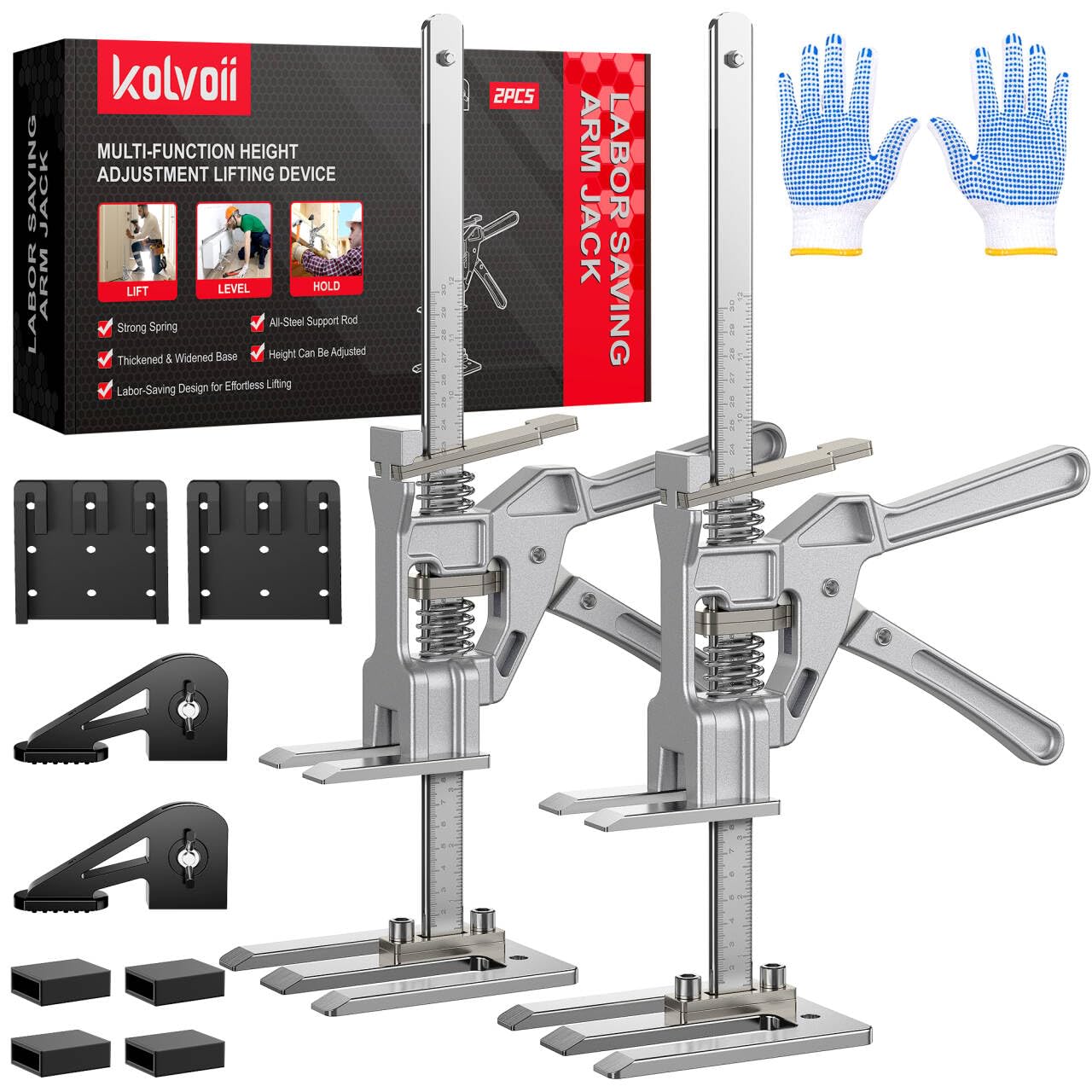
2. Kolvoii Labor Saving Arm Jack 2 Pack, 10 in Lift Range
Two arm jacks, ten inches of travel, and a handle you squeeze with one hand.
This pair is built for leverage. Squeeze the handle with one hand and the arm rises from 0 to 10 inches — enough to get a cabinet up onto a cleat or lift a fridge so you can slide a pad under a foot. The base is a 3.55 x 3.15 x 0.2 in steel plate with anti-slip rubber pads, so it grips a hard floor instead of skating while you work. Stainless steel and aluminum keep the body solid at 2 pounds, and the two-pack lets you support both ends of a wide run at once.
People who already own a set push them past cabinets. The claim buyers report is that a pair lifts a full fridge, and one buyer’s note sums up the appeal: “Great device. It even lifts a full fridge.” Another used the pair to stabilize a bed frame so it could not tip while working on it. That is the honest value here: an arm jack holds anything heavy steady at a set height, not just cabinets.
The catch is durability, and the reviews say so plainly. Some owners mention theirs have held up for years, while others report a set failing quickly — so treat this as a fit question, not a knock. It also takes real hand strength to squeeze the handle, which several owners flag. And lowering is fast: you use the pressure plate to control it, but delicate pieces need a hand underneath on the way down. Farm gates and bed frames, yes. A finished heirloom clock, handle with care.
The value read: a two-pack in the budget-friendly tier means you get a working pair for the cost of what many single jacks charge. That is the smart play if you are not yet sure how often you will reach for a pair.
Reach for these: when you want two lifting arms without two separate purchases, and you are comfortable squeezing a handle under load.
Buy something else if: you need feather-light control on fragile furniture — the drop on release is not gentle enough by a wide margin.
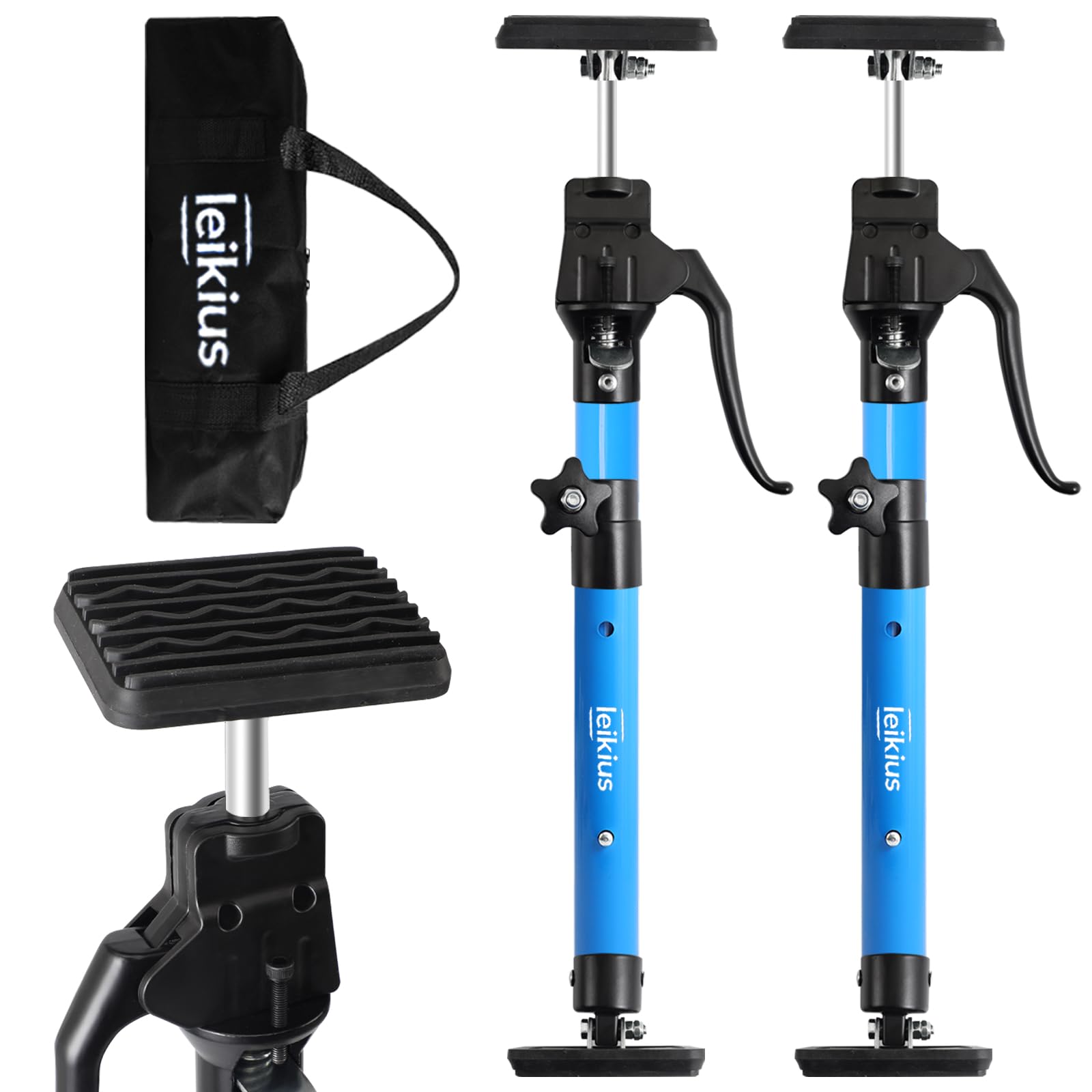
3. Leikius 2PK Metal Cabinet Jacks, 15.8–23.6 in Support Pole
A short double-pole set that props up a heavy appliance without a second set of hands.
Picture sliding a range hood microwave out of its cutout by yourself. This pair is built for that job. The poles adjust from 15.8 to 23.6 inches and hold up to 200 pounds, with dual spring-loaded pins that pop into the outer pole holes so the height stays locked while you work. The textured nylon pads rotate 130 degrees, from -65 to +67 degrees, so they sit flat against an angled surface instead of digging into it.
The clever parts are small but useful. A quick-release lever lets you extend and retract the pole without fighting it, and the handle is cast from rust-resistant aluminum. Owners used these hanging uppers and report they took the load without a wobble — a recurring note is that they hold more weight than an empty cabinet ever throws at them. The pads are the standout detail for anyone working against a finished surface.
The limitation to know going in is the short reach. At their full extension these will not bridge the gap under a cabinet that sits above a stove or fridge with no counter below — that is a job for a longer pole. One buyer’s caution about the release is worth repeating: lowering moves fast, so keep a hand on the delicate stuff. There is also a plastic clamp on the height lock rather than a spring detent, which is a minor note but a real one.
Go with these: for short-reach jobs like holding a heavy appliance while you work above it, where the rotating pads and low-profile size do the heavy lifting.
Skip the idea of these if: your cabinets sit high over an open gap — you need a pole that reaches the ceiling, not the counter.
4. ACEBINTE 2PK Steel Telescopic 3rd Hand Support System

The pole that stretches from waist height to almost ten feet of bracing room.
Reach is the whole reason this set exists. The support rod expands from 49.2 to 114.2 inches — roughly floor to ceiling in most rooms — and holds up to 154 pounds. That span is what you need to pin a sheet of drywall or a long crown molding overhead while both hands drive screws. The handle is cast aluminum for fine adjustment on top of the main extension, and TPR non-slip pads (a rubbery grip layer) plus a second, larger pair of PVC pads cover different surfaces.
Owners consistently describe it as a solo-work tool, and the extra reach gets called out again and again — a recurring theme is working alone on large overhead pieces without needing a helper to hold the other end. The two-pack plus a carrying case means you can brace both ends of a long board.
Where it gets honest: the highest-mentioned quality is sturdiness, and it comes in mixed. Some owners find it solid and steady; others report the handles breaking or the pole not staying locked under load. The base can slide under heavy weight, and the clamps are small for bulky items. This is a light-to-medium duty tool — treat it as a bracing aid, not a structural support for a load you would not want to fall.
Who it suits: someone bracing drywall, trim, or a dust barrier overhead on a solo job, where the long reach is the deciding factor.
The honest limit: plan around careful placement — it is built for steadying, not for taking a heavy dynamic load.
Best if: you need adjustable length that reaches nearly nine and a half feet and you are holding light-to-medium material.
Not for: jobs that involve leaning weight or a downward pull on the pole — the lock is the weak point there.
5. OUTIMATE Third Hand Support Pole, 49-1/5 to 114-1/5 in, 2-PC
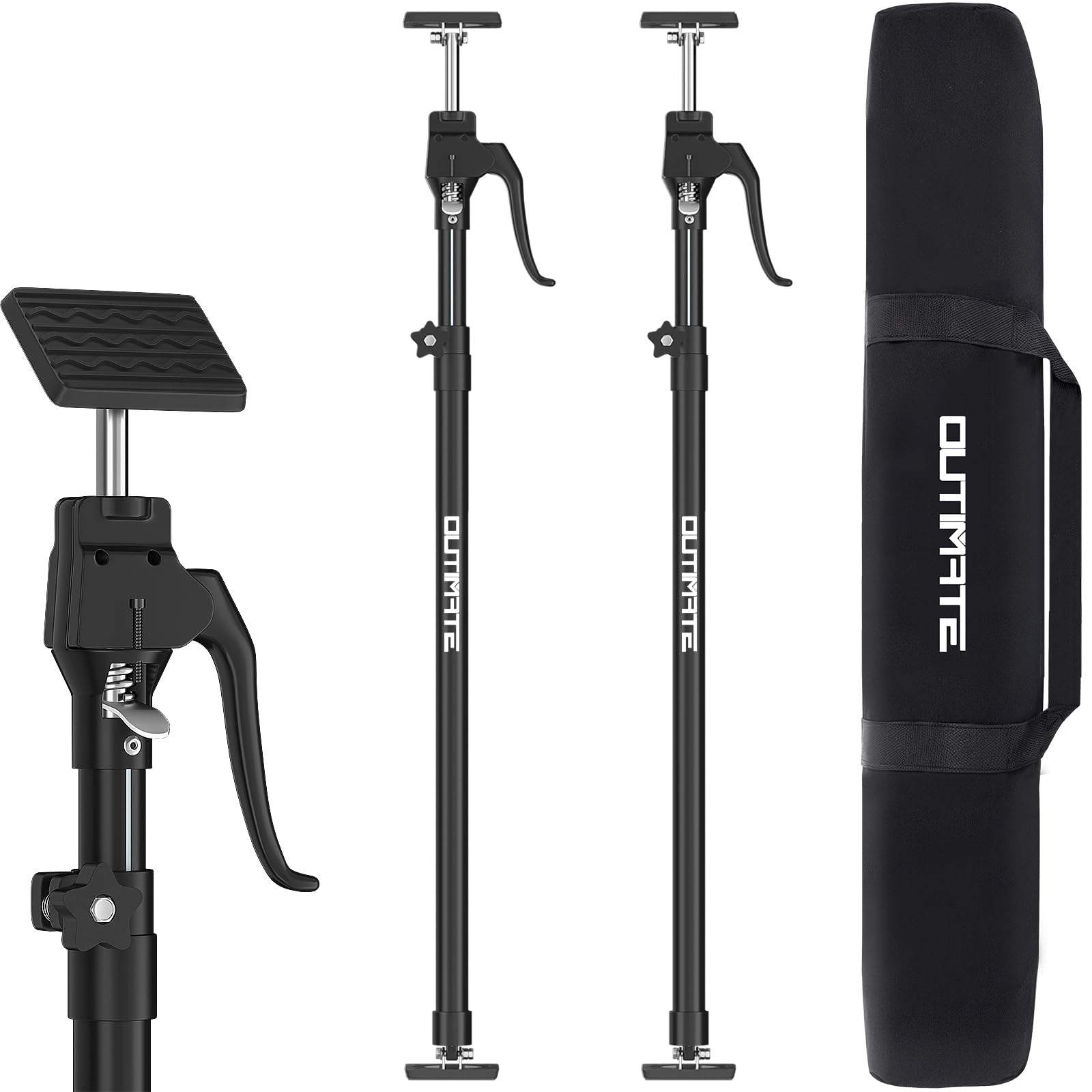
A two-pole set tuned for kitchen installs, with feet that pivot to the floor angle.
Here is the detail that decides it for cabinet work: the feet swivel and lock. The pairs of 5″ x 3.5″ non-slip swivel feet adjust to sit flat on an uneven floor, and you can tighten the screws on them to fix the angle in place. The pole spans 49-1/5 to 114-1/5 inches and carries 154 pounds, with spring-loaded pins that pop into holes aligned to a white line, then a locking knob and a fine-tune handle on top of that.
For solo installs, owners describe hanging a whole kitchen alone — using two poles for the vertical lift and level, then a second pair set at an angle to stabilize the cabinet while the anchor screws go in. The heavy steel tubes and cast aluminum handle take that load. The kit ships with a carrying case, which is handy if you store these rather than leave them set up.
The spec you must not miss is the angled limit. Straight up, this holds 154 pounds, but at a 45-degree tilt the supported weight falls to 66 pounds — an important figure if you plan to lean the pole. That tilt number is why angled support gets its own role here. There is also a quick-release lever that lowers sharply, so the maker’s own advice is to mind the sudden drop; a screw above the lever locks the position so it cannot be tripped by accident.
What earns it the spot
- Swivel feet that lock to match an uneven floor
- Spring-pin locking plus a fine-tune handle for precise fit
- Straight-up 154 lb capacity with a clearly stated angled limit
- Ships with a carrying case for storage
The fine print
- Angled support drops to 66 lb — plan around it
- Quick-release lever lowers sharply, so watch the drop
- Storage bag is a snug fit for the poles
Made for: a DIYer installing a run of upper cabinets solo who wants the pole to stay put on a floor that is not perfectly level.
Think twice if: your job leans the pole at an angle under real weight — the 66 lb tilted limit will not carry a loaded cabinet.
6. FastCap 3-H UPPERHAND Upper Hand, 28.25″ to 61″, 1-Pack
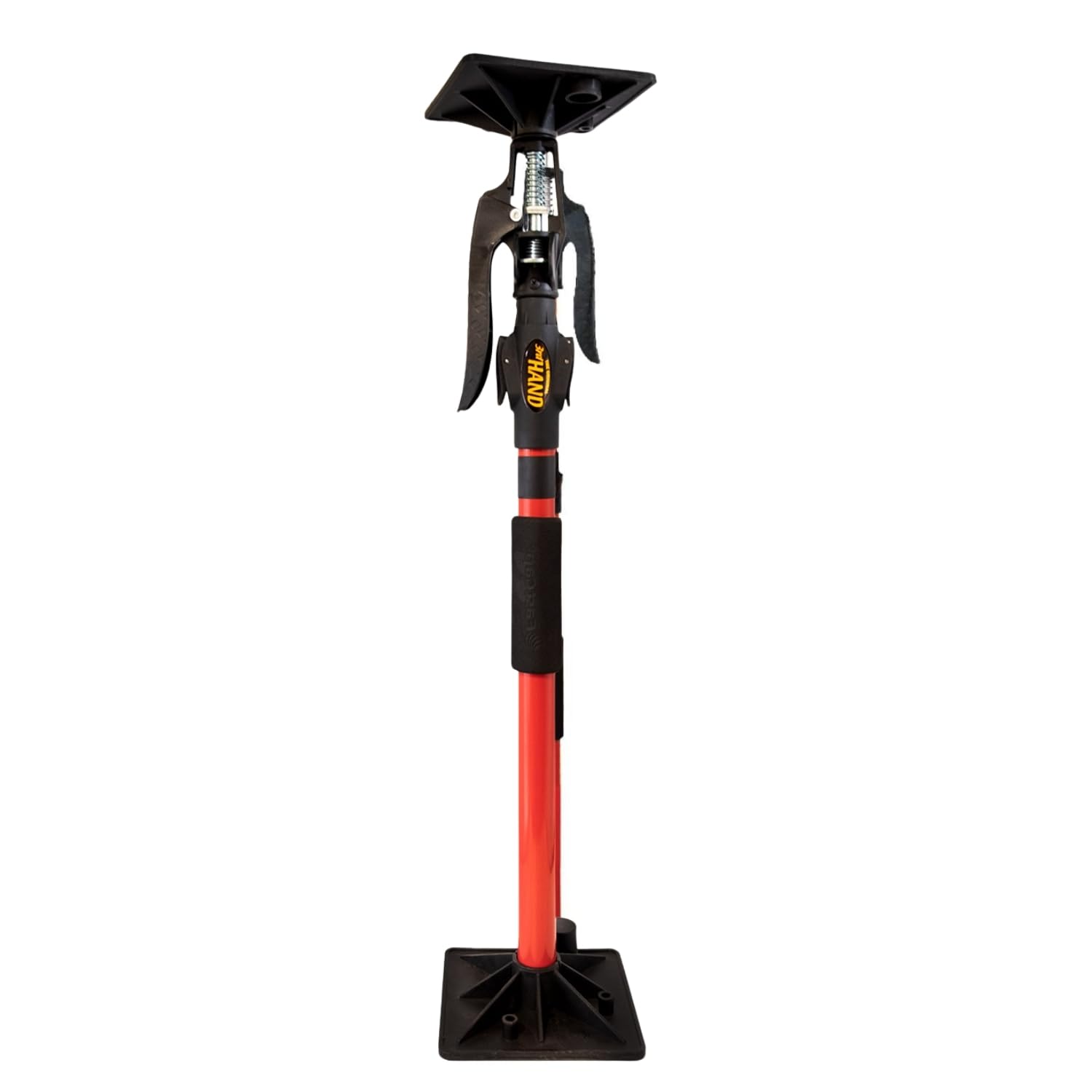
A dedicated upper-cabinet holder with a foot wide enough to stand steady.
FastCap built this one job-specific: hold an upper cabinet at height while you fasten it. The pole runs 28.25 to 61 inches, which covers standard wall-cabinet heights, and the load capacity is 50 pounds — plenty for an empty cabinet, since a bare upper box rarely tops that. The base is a solid 6 inch by 6 inch UniversalFoot, wide enough to spread the load and stay planted without tipping. A neoprene grip keeps the top surface from marring the cabinet.
The mechanism is an easy-pump handle for raising and ball detents (spring-loaded pins) that lock the height positively, so the pole does not creep down while you work. That is the feature owners lean on — a few note it held far more than its stated rating without slipping, and it stays rock solid under load even after the initial break-in. One buyer’s verdict, working solo above a washer and dryer: “One buyer working solo above a washer and dryer reported it held both cabinets steady through the install.”
Two things to weigh. First, it is sold as a single unit, and several owners say buy two — balancing a cabinet on one pole is tricky and still wants a helper. Second, it will not reach refrigerator-height cabinets, since the pole tops out at 61 inches; owners work around that with a bucket or a stacker box underneath. from the start it can feel tight to pump, then loosens with use.
Right for: cabinet installers who want a purpose-built upper-cabinet holder with a wide, stable foot and a positive height lock.
Only if you accept: one pole, a 50 lb rating, and a 61-inch ceiling — buy two, and know it stops short of fridge-height cabinets.
7. SHALL Cabinet Jack Support Pole, 54–114 in, 4-Pack with Storage Bag
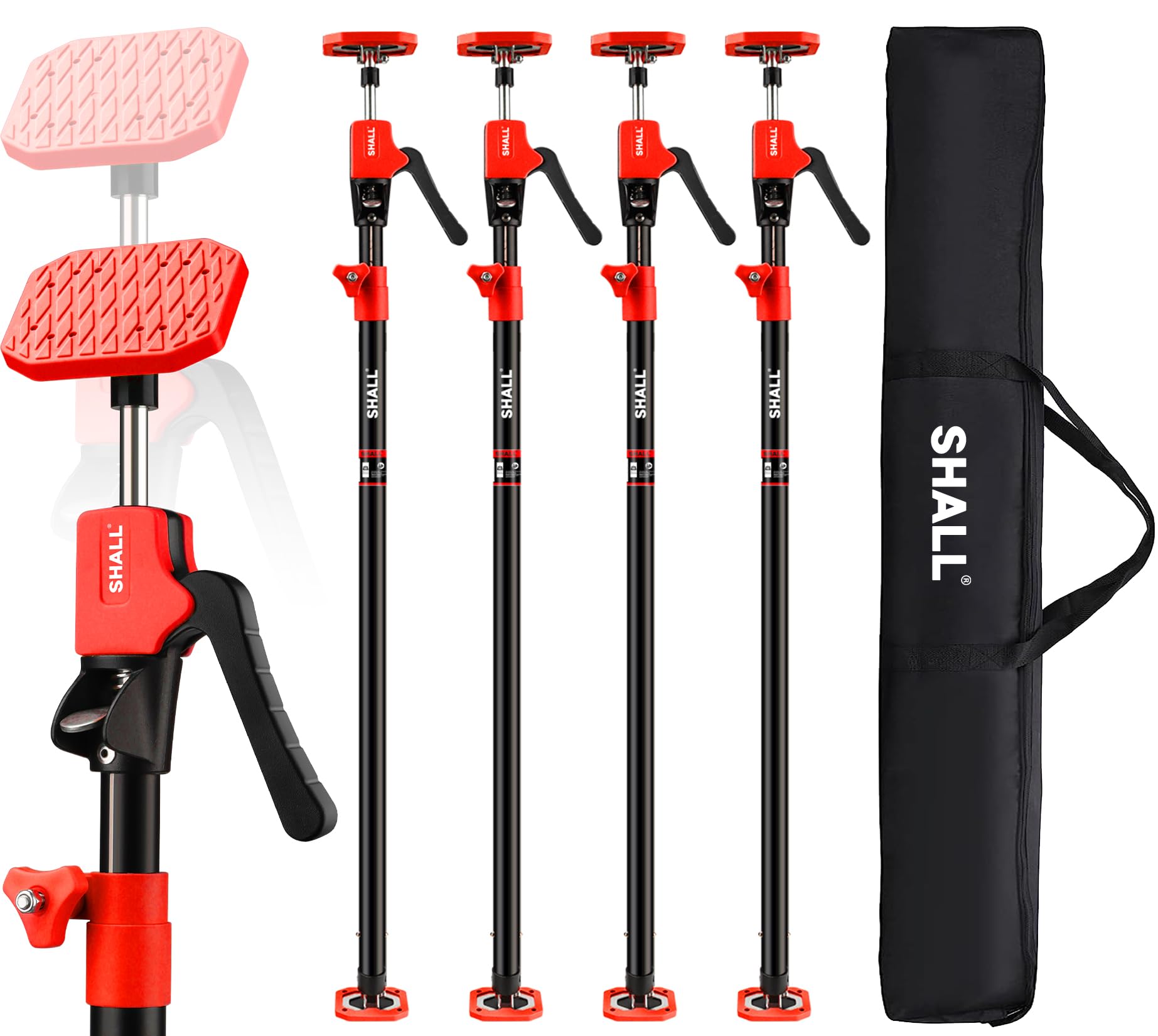
Four galvanized poles that make short work of a whole ceiling of boards.
This is the set for overhead work in volume. Four poles, each adjusting from 54 to 114 inches and holding up to 154 pounds, built from galvanized steel and die-cast aluminum to resist corrosion. Six separate holes along the bar let you set the extension, then the ergonomic handle fine-tunes the height. The rotating pads pivot from -65 to +65 degrees and carry a textured nylon layer over steel, so they grip a surface without marking it.
With four poles, a solo worker can hold a run of boards or panels across a wide span instead of bracing one piece at a time. Customers note using them to install a 12-foot shiplap ceiling alone — holding heavy boards overhead for nailing, and even holding a laser level in position. Others braced them between RV slide-outs to seal out air and dust, which shows how well a straight vertical brace does the job. A water-repellent 400D x 400D Oxford cloth storage bag carries the set.
The honest limit is release. Owners who use these report the mechanism is hard to disengage under load — the recurring complaint is how stiff the release is — and a few note the poles sliding back or the pads slipping under heavy force. Treat these as light-to-medium duty braces. They work well when the load is steady and vertical, and fight you when you need to break a tight joint down. As the maker’s own note puts it, they are fine for light support; for firm pressure on heavy tile, look elsewhere.
The four-pole logic: more poles per buy means you can brace several points at once, which is the real advantage for a big ceiling or a wall of panels.
One thing to plan for: practice the release on an unloaded pole first — it takes force to trip, and you do not want that surprise mid-job.
Choose this set: if you have a wide overhead job and want enough poles to support multiple points at once.
Not the tool if: you need to knock a tight joint apart quickly — the release is the slow part of this design.
8. WORKPRO Cabinet Jacks, 54–114 in Adjustable Support Pole, 4-Pack

Four steel poles with pads that tilt to match any surface angle you throw at them.
The head is the star here. Both steel support plates wear non-slip PVC pads and pivot up to ±65 degrees, so they sit flat against an inclined surface — the maker rates that for surfaces inclined up to 45 degrees. Each pole carries 154 pounds and extends from 54 to 114 inches, with a six-position adjustment system plus a fine-adjustment handle for picking the exact height. A red line on the bar marks where the pins sit, so you can align the hole without guessing.
Owners using these describe them as a one-person job enabler — holding material overhead so both hands stay free, and reaching for them again and again beyond the original project. The build gets called out as better than the tier suggests, with a die-cast aluminum handle over the steel body. Set includes a bag for portability.
The recurring gripe is the release. Tension is genuinely hard to let go — the lever takes real effort, and some owners end up sliding the pole sideways to break it free. Fully extended, a few find it slightly flimsy. Neither is a deal-breaker for holding overhead work, but if your job involves tightening a joint under pressure and then releasing it, budget for the fight.
Ideal for: anyone who needs angled support on a sloped or uneven surface, thanks to the tilting pads and six locked positions.
Weigh this first: the stiff release under load — if your job is more about pressing than holding, plan for the extra effort.
9. Viking Arm Hand Lifting Tool Jack, Stainless Steel, 330 lb Capacity

A compact arm jack that lifts heavy things and sets them down like they weigh nothing.
What sets this apart is the release. A lock-and-release mechanism lowers in small, controlled steps — the quality owners mention first, because cheaper arm jacks simply drop under load. The arm lifts up to 330 pounds and runs a range from 6 to 215 mm, with mounting holes so you can screw it down for extra stability. It is made from stainless steel in Norway and passes through FIMTECH testing, per the maker.
The real-world stories are the reason people buy it. One owner reports gently lowering a console piano in small increments to place pads under it; another reports lifting a fully loaded refrigerator with ease, and a third says it moved a 500-pound armoire. That range — from a piano you cannot afford to scratch to an appliance you would not think one person could hold — comes from that step-down release and the stainless build. Only 3 pounds, so it lives in a tool bag until you need it, and it fits under cabinets, flooring, windows, and doors.
The trade-off is price. The Viking Arm sits in the premium tier, and the value-for-money comments are split — some owners find it steep for one unit, others say the control is worth it. A couple of competing knockoffs cost less, but the reviews on those describe stamped metal and arms that stop lowering halfway. If you want a single jack that outlasts the project, this is it; for holding one cabinet for an afternoon, a two-pack of poles costs a fraction as much.
The standout: the controlled lowering is what separates this from arm jacks that drop, and it is the reason owners trust it on a piano or a full fridge.
The honest cost: premium tier, single unit, and a value debate — great for a lifetime tool, over-spec for a one-time cabinet.
Pick the Viking Arm: for lifting and setting down heavy furniture, appliances, or delicate pieces where a gentle release is non-negotiable.
Keep looking if: your priority is holding cabinets overhead on a budget — a two-pole set covers that for less.
Understanding the Specs
Load capacity — the number and its limit
Load capacity is the maximum weight a jack is rated to hold. The arm jacks here range widely — from 50 pounds on the FastCap upper-cabinet holder up to 330 pounds on the Viking Arm, with poles sitting around 154 to 200 pounds. The catch is that this figure is quoted for a straight, vertical hold. Lean a pole at an angle and the real limit drops, sometimes sharply, as one pick here spells out. Always check the rating for your supporting angle, not just the headline number.
Reach — lift range versus height range
Two different measurements describe how high these tools work. An arm jack has a lift range — how far it raises a load, measured in inches, like the 10-inch range on the Kolvoii or the 6 to 215 mm on the Viking Arm. A support pole has a height range — the span it bridges from the floor up, measured in feet, from 49-1/5 to 114-1/5 inches on the OUTIMATE or 28.25 to 61 inches on the FastCap. Match the number you need to the job: inches for a lift, feet for an overhead hold.
Release mechanism
How a jack lowers matters as much as how it lifts. A controlled, step-down release — like the incremental lowering on the DEWALT and the Viking Arm — lets you set a cabinet down gently and precisely. A fast quick-release is handy when you just want the tool out of the way, but can drop the load quickly. Look for a jack with both, or at least a release you can slow down with a supporting hand.
Contact pads and base stability
The points where a jack touches the workpiece and the floor decide how steady the whole thing is. Textured or rubberized pads grip the surface and protect the finish, and tilting pads — up to ±65 degrees on the WORKPRO — conform to a sloped surface. On the floor, a wider foot spreads the load so the pole does not skate on a slick floor. A swivel foot that locks to the floor angle, as on the OUTIMATE, keeps a pole planted even on uneven ground.
FAQ
How much weight can a cabinet jack actually hold?
What is the difference between a cabinet jack and a third-hand support pole?
Can I install upper cabinets by myself with these?
Will a support pole damage my ceiling or the cabinet finish?
Why does the load capacity drop when I angle the pole?
Is a two-pack worth it over a single jack?
How do I lower a cabinet jack without dropping my cabinet?
Will a cabinet jack reach cabinets above a fridge or stove?
What is the difference between a cabinet jack and a drywall lift?
How long do these jacks last?
Final Thoughts: The Verdict
For most people installing cabinets alone, the best cabinet jacks winner is the DEWALT Toughseries Construction Jack DWHT83550, because it carries the highest vertical load here at 340 pounds and lowers in small, controlled steps so a cabinet seats gently instead of dropping. If you want a single tool that lifts heavy furniture and appliances as well as cabinets, the Viking Arm Hand Lifting Tool Jack is the premium pick — its controlled lowering is the detail owners trust on a piano or a full fridge. And for a solo kitchen install on a budget, a two-pole set like the OUTIMATE Third Hand Support Pole holds your cabinets at height while both hands stay on the screwgun. Whichever you choose, match the reach and the load rating to your actual job before you buy — that single check is what separates a tool you use for years from one that sits in the garage.
How We Picked
We do not accept paid placement. Every pick is matched to a real buyer and a real use-case; we do not hands-on test units.
Sources & Methodology
Specifications: manufacturer listings and product documentation. Review insights: verified customer reviews, as of September 2026. Pricing: not shown on this page (it changes often); check the current price via the retailer link.
As an Amazon Associate, Gadgets Feed earns from qualifying purchases. This does not affect which products we feature.