
Nothing kills a movie night faster than a pixelated screen, audio that stutters, or a channel that freezes mid-dialogue. When your cable TV signal is weak, the culprit is often signal loss through long cable runs, old splitters, or the sheer number of devices connected. A specific tool exists to fix this without calling your provider.
I’m Min — the co-founder and writer behind Gadgets Feed. I’ve spent hundreds of hours studying the technical specifications of home signal distribution, parsing noise figures, gain ratings, return path designs, and surge protection across dozens of models to separate the amplifiers that actually clean up your picture from those that just add noise.
To get you back to watching TV without interruptions, I’ve assembled and analyzed the top contenders on the market to find the best cable tv signal booster amplifier for different home setups and budgets.
How To Choose The Best Cable TV Signal Booster Amplifier
Choosing the wrong booster can actually make your picture worse by amplifying noise or blocking your modem’s return signal. Focus on three critical specs that define whether a unit will fix your flicker or cause new headaches.
Noise Figure vs. Gain
Gain (measured in dB) is how much the amplifier boosts the signal, but a high gain with a poor noise figure just amplifies static and interference. Look for a noise figure of 3 dB or lower to ensure the amplifier cleans up the signal rather than dirtying it. Most quality home units offer between +7 dB and +15 dB of forward gain.
Passive Return vs. Active Return
If you only need to boost an over-the-air antenna signal for multiple TVs, a passive return amplifier is fine. But if you also have a cable modem that needs to send data back to your provider (upstream), you need an active return amplifier. This ensures your internet speeds don’t tank after installation.
Number of Ports and Surge Protection
Count how many TV boxes, DVRs, and modems you need to feed. A 4-port model suffices for most homes, while an 8-port unit handles larger setups with room to spare. Ensure the amplifier includes 6 kV surge protection on all ports to guard against lightning-induced voltage spikes traveling through the coax line.
Quick Comparison
On smaller screens, swipe sideways to see the full table.
| Model | Category | Best For | Key Spec | Amazon |
|---|---|---|---|---|
| Arris BDA-42-4-AR-R | Premium | Boosting cable modem & TV together | Active return with 5x forward gain | Amazon |
| Antronix FRA1-1510 | Premium | Single-line high-power boost | Bi-directional, 6 kV surge rating | Amazon |
| Reliable Cable 9-Port | Premium | Large homes with 8+ outlets | 8 lossless amplified outputs + VoIP port | Amazon |
| Antennas Direct JUICE4 | Mid-Range | 4K/8K and ATSC 3.0 compatibility | 1.2 GHz frequency range | Amazon |
| Antronix MRA4-8 | Mid-Range | Reliable 4-port signal distribution | +7.5 dB per port, 3 dB noise figure | Amazon |
| Lindsay LSA84 | Mid-Range | Fixing pixelation from Comcast/Xfinity | 8 dB gain, weather-tight seal | Amazon |
| Reliable Cable 4-Port (Antronix) | Mid-Range | Entry-level signal cleanup | Passive return, nickel-plated housing | Amazon |
In‑Depth Reviews
1. Arris 4-Port Cable Modem, TV, HDTV Amplifier Splitter Signal Booster with Active Return

The Arris BDA-42-4-AR-R is built for households that need both clear TV reception and stable cable internet. Its active return path boosts your upstream signal by 2x, which directly addresses the common problem of cable modems running at high upstream transmit power (50+ dBmV) that cause intermittent disconnects. Users have reported dropping their upstream power from 51 dBmV down to 38 dBmV after installation, eliminating dropouts entirely.
Weather sealing and protective coating allow for outdoor installation at the cable entry point, which is where most signal distribution should start. The amplifier boosts forward signal by 5x across four outputs, making it an excellent replacement for a passive splitter that has been degrading your picture. Critical to note: this unit is NOT compatible with OTA antennas or satellite systems due to its active return design.
Many reviewers noted that installing the Arris unit resolved pixelated video and stuttering audio from Spectrum and Xfinity that multiple technician visits could not fix. One user saw their internet speeds jump from 400 Mbps to 650 Mbps on a gigabit plan after the amp corrected the signal loss through old in-wall coax. The unit runs warm during operation, so mount it with adequate airflow.
Why it’s great
- Active return fixes cable modem upstream power issues directly
- Weather-sealed housing for indoor or outdoor mounting at cable entry
- 5x forward signal boost eliminates pixelation on multiple TVs
Good to know
- Not compatible with OTA antennas or satellite dishes
- Output #1 must feed your modem or the system may not work properly
- Runs hot; requires ventilation to maintain lifespan
2. Antronix FRA1-1510 Forward/Return Bi-Directional Amplifier

The Antronix FRA1-1510 is a single-output bi-directional amplifier designed for high-performance signal boosting in demanding environments. It amplifies both forward and return paths, making it an ideal solution if you need to boost a single coax line feeding a cable modem or a single TV. The unit includes a power inserter (120V AC to 18V DC) and can withstand 6 kV surges on all ports.
This unit is frequently used by cable technicians themselves as a drop amplifier at the service entry. Users reports its reliable since 2017, outperforming other brands like Channel Master for pulling in distant signals. It runs hot, which is a sign of its robust internal design, and some users recommend unplugging it when not in use as a precautionary measure.
For users with high upstream power issues on their cable modem, this amp has been a proven fix. One reviewer replaced a dead Motorola BDA-K1-RA with the FRA1-1510 and immediately saw downstream and upstream power levels fall into optimal range. Note that this is a single-channel amplifier, so you will need a separate splitter downstream if you need to feed multiple devices.
Why it’s great
- Robust bi-directional amplification for modem and TV on one line
- 6 kV surge protection on all ports for harsh environments
- Proven reliability — technicians and long-term users trust it
Good to know
- Single output only; requires an external splitter for multiple rooms
- Runs very hot during continuous operation
- Power inserter and connecting coax sold separately
3. Reliable Cable 9 Port Bi-Directional Cable TV Splitter Signal Booster/Amplifier Kit

When you need to feed a house full of coax outlets without losing signal strength, the 9-port Reliable Cable amplifier is the solution. It provides 8 lossless amplified output ports with active return, meaning every connected TV and modem gets the full signal strength without the typical 3.5 dB loss per split you get from a passive splitter. A dedicated MODEM port ensures VoIP equipment stays powered during a power outage.
This unit sits in the premium tier for its sheer port count and features CamPort auto-seizing F-ports, which grip the coax connector tightly and prevent signal bleed. The powder-coated aluminum housing resists corrosion, and the all-ports-facing-down design keeps cable management clean. Users replacing old amplifiers with this unit found it resolved all Xfinity X1 issues, including TVs that wouldn’t connect and frequent signal freezes.
One reviewer noted that this amp improved the picture quality on a long cable run that passed through multiple basements, solving signal degradation that a passive splitter could not. Another confirmed that after installation, all modems and set-top boxes worked instantly without any configuration changes. Not recommended for use with OTA antennas — use a passive return amplifier instead.
Why it’s great
- 8 lossless amplified ports for whole-home coverage
- Active return path supports cable modems and VoIP
- Dedicated MODEM port keeps phone line powered during outages
Good to know
- Not compatible with OTA antennas or satellite systems
- Requires a nearby power outlet for the 12V adapter
- Heavier than smaller units at over 1.2 pounds
4. Antennas Direct ClearStream JUICE4 Distribution Amplifier
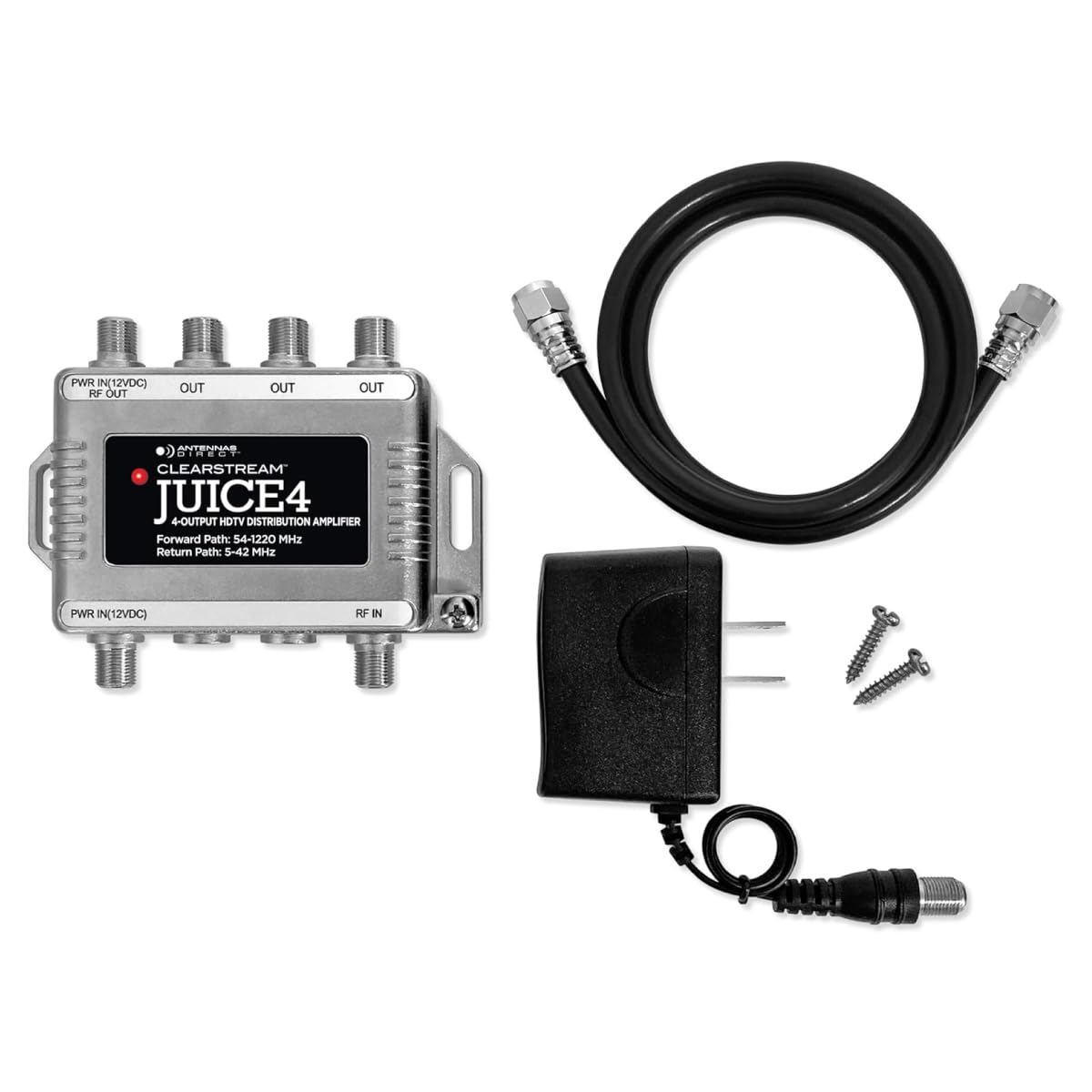
The Antennas Direct ClearStream JUICE4 is engineered for the latest broadcast standards, supporting ATSC 3.0 (NEXTGEN TV), 4K, and 8K UHD signals. Its operating frequency extends to 1.2 GHz, which accommodates cable broadband applications and future-proofs your setup. The compact silver housing measures only 3.8 x 1 x 3.5 inches, making it one of the smallest distribution amps on this list.
Precision diecast zinc housing protects against ESD and moisture, and the unit includes watertight F-connectors and weather boots for outdoor placement. It is compatible with both HDTV antennas and legacy CATV systems. Users have reported that installing the JUICE4 resolved skipping and spidering on channels that were previously unwatchable, with one user gaining 61 channels across four TVs.
A key detail is that this amplifier is designed to work with an antenna signal, not as a fix for a fundamentally weak cable drop. One review noted the unit stopped working after five days, though most users experienced reliable long-term performance. It includes a 12V DC power adapter and coaxial cable in the box for a straightforward setup.
Why it’s great
- Supports ATSC 3.0, 4K, and 8K signals for future broadcast standards
- Compact weather-sealed housing with watertight connectors
- 1.2 GHz range covers cable broadband and advanced TV signals
Good to know
- Some units have reported early failure within the first month
- Designed for antenna signals, not for boosting weak cable company feeds
- Requires indoor power plug; place away from rain
5. Antronix MRA4-8 Reliable Cable 4-Port Digital Signal Amplifier

The Antronix MRA4-8 is a straightforward 4-port amplifier that delivers +7.5 dB of gain per port with a 3 dB noise figure, ensuring you amplify the signal without adding excessive static. It includes a passive return path, making it a good fit for cable TV systems where the modem does not require active upstream boosting. The nickel-plated housing offers excellent corrosion resistance against salt fog and rust.
Users living close to the cable drop — as near as 75 yards — report that this unit works significantly better than the amplifiers provided by their cable company. One user replaced a failing Motorola 4-port booster and found the MRA4-8 was able to use the same 12V feed from the old unit, making the swap nearly instant. The kit includes a UL-listed power supply, a 36-inch coax cable, and two 75-ohm terminators.
This unit excels at maintaining signal quality across four outputs without introducing noise. A reviewer noted the build quality is excellent, with a solid metal housing that feels durable. However, one user who was far from broadcast towers only got seven channels after installation, indicating that this amplifier boosts existing signals effectively but cannot salvage a fundamentally weak input.
Why it’s great
- Clean +7.5 dB gain per port with low 3 dB noise figure
- Nickel-plated housing resists corrosion and rust
- Includes all components for a quick installation out of the box
Good to know
- Passive return — not ideal for cable modems with high upstream power
- Cannot fix a fundamentally weak or damaged incoming signal
- Not for outdoor use; mount inside near the cable entry point
6. Lindsay LSA84 4-Port Cable TV/Antenna/HDTV Digital Signal Amplifier

The Lindsay LSA84 is a 4-port amplifier that delivers 8 dB of gain and is specifically noted for resolving pixelation issues from major cable providers like Comcast and Xfinity. One user reported that it completely solved low-signal pixellation on three TVs and the internet connection, saving them over in rewiring costs. The unit operates at a 15 PSI weather-tight seal and handles temperatures from -40 to +60 °C.
This amplifier is also well-regarded for boosting OTA antenna signals. One user replaced a basic 2-way splitter with the LSA84 and saw their OTA channel count jump from approximately 60 to 140 across three TVs, with crystal clear reception and no flickering. It includes two 75-ohm terminators in the box for capping unused ports, which prevents signal reflection.
Note that the LSA84 is NOT compatible with systems that already have an amplifier, and it is not MoCA compatible. It also does not come with a power cable, so you will need to use your own or purchase one separately. The manufacturer states this product is NOT intended to fix a weak signal — only to boost a good one, so ensure your incoming line is healthy before installing.
Why it’s great
- 8 dB gain effectively resolves Comcast and Xfinity pixellation
- Weather-tight seal and wide temperature range for rugged placement
- Can dramatically increase OTA channel count with a good antenna
Good to know
- No power cable included in the box
- Not MoCA compatible — may conflict with certain cable systems
- Cannot create a signal where none exists; needs a healthy baseline
7. Reliable Cable 4-Port Cable TV/Antenna/HDTV/Internet Digital Signal Amplifier (Antronix)

This entry-level 4-port amplifier from Reliable Cable (manufactured by Antronix) offers the same core specs as its siblings with a slightly lower price point. It provides +7.5 dB of gain per port with a 3 dB noise figure and includes 6 kV surge protection on all ports. The PTC short-circuit protected UL-listed adapter ensures safe operation if a short occurs.
Users who live 35 miles from broadcast towers have reported that this amplifier, combined with a roof antenna, eliminated the need for an additional inline booster and delivered all channels regardless of weather. However, one reviewer noted that while it boosted channels close to the tower to crystal clear reception, it only yielded seven total channels from a setup that previously received 25, suggesting it works best for users closer to the signal source.
A critical review noted that the unit did not work well for cable TV specifically, producing a fuzzy picture and channel finding issues, while the same unit worked fine for OTA antenna splitting. This inconsistency highlights the importance of matching the amplifier type (passive return vs. active return) to your specific use case — cable TV typically benefits from an active return amplifier.
Why it’s great
- Low noise figure for clean amplification of weak signals
- 6 kV surge protection guards against lightning damage
- Complete kit with terminators and UL-listed power supply
Good to know
- Passive return path may not work optimally for cable TV systems
- Best suited for users within reasonable distance to signal source
- Inconsistent performance reported between antenna and cable use cases
FAQ
Can I use a cable TV signal booster with an over-the-air antenna?
Will a signal booster fix my cable modem internet speed?
Why does my pixelation get worse after installing a booster?
How many TVs can one amplifier support?
Is MoCA compatibility important for a cable TV booster?
Final Thoughts: The Verdict
For most users, the best cable tv signal booster amplifier winner is the Arris BDA-42-4-AR-R because it actively boosts both your TV picture and your cable modem’s upstream signal, covering the most common failure points in a single unit. If you need to feed a whole house with eight outlets, grab the Reliable Cable 9 Port. And for a single-line high-power boost that technicians rely on, nothing beats the Antronix FRA1-1510.