
A single loose tolerance in your 3D printer’s extruder or a filament diameter that is off by 0.02 mm can turn a perfect print into a stringy, failed mess. The humble digital caliper is the one tool that bridges the gap between a g-code file and a finished part, letting you verify every hole, shaft, and layer height with repeatable accuracy. Without one, you are effectively blind to the subtle dimensional errors that cause parts to not fit together.
I’m Min — the co-founder and writer behind Gadgets Feed. I have spent countless hours cross-referencing engineering tolerances, comparing resolution specs, and testing stainless steel bodies against carbon fiber composites to find the calipers that deliver real, repeatable measurements for 3D printing work.
After sifting through seven top contenders, from entry-level stainless models to IP54-rated workshop tools, I have settled on the definitive picks that define the best calipers for 3d printing for every budget and skill level.
How To Choose The Best Calipers For 3D Printing
Choosing the right caliper for 3D printing is not just about picking the cheapest digital readout. You need to consider material, measurement range, power source, and how the caliper handles the dusty, resin-rich environment of a print farm. The wrong choice can lead to inaccurate readings that throw off your entire printer calibration.
Accuracy And Resolution
For 3D printing work, an accuracy rating of ±0.02 mm (0.001 inches) is the gold standard. This is the level needed to reliably measure filament diameter, nozzle height, and hole tolerances. A resolution of 0.01 mm (0.0005 inches) is also important — it tells you how fine the increments are on the display, which matters when you are dialing in a Z-offset or checking a press-fit bearing. Anything less introduces measurement uncertainty that can cascade into failed prints.
Build Material And Durability
Stainless steel is the default choice for 3D printing calipers because it resists corrosion from the oils in your hands and the occasional splash of IPA or resin. Plastic calipers are lightweight and cheap, but they flex under pressure and wear out faster in a busier workspace. Look for a fully stainless or metal-body caliper with a hardened beam — this prevents the rails from bending, which corrupts the slide action and causes false readings. Some higher-end models also offer an IP54 splash and dust resistance rating, which is a real bonus for a print room.
Power Source And Convenience
The most convenient calipers for 3D printing use either a standard coin-cell battery (CR2032 or LR44) that is easy to replace, or a built-in lithium-ion pack that recharges via USB-C. Rechargeable models save you from hunting for a battery mid-print, but they require you to remember to charge them. A low-battery warning indicator is a very practical feature — it prevents a half-dead battery from giving you false readings. Auto-off after five minutes of inactivity is standard, but some models also have an auto-on feature when you slide the jaw, which helps you measure faster without fiddling with buttons.
Quick Comparison
On smaller screens, swipe sideways to see the full table.
| Model | Category | Best For | Key Spec | Amazon |
|---|---|---|---|---|
| S&F STEAD & FAST | Premium | Workshop durability & IP54 | IP54 rated, CR2032 battery | Amazon |
| Fowler 54-101-150-2 | Premium | Daily professional use | 0.001″ accuracy, brand reliability | Amazon |
| HARDELL | Mid-Range | All-metal with backlight | All-metal body, backlight LCD | Amazon |
| werka | Mid-Range | Auto-on precision | 0.001″ accuracy, auto-on | Amazon |
| Preciva | Mid-Range | Rechargeable convenience | Type-C rechargeable, 50 min | Amazon |
| Jiavarry | Budget | Large LCD readability | Extra-large LCD, 3 units | Amazon |
| NEIKO 01407A | Budget | Best value entry-level | Fractional conversion, price | Amazon |
In‑Depth Reviews
1. S&F STEAD & FAST Digital Caliper
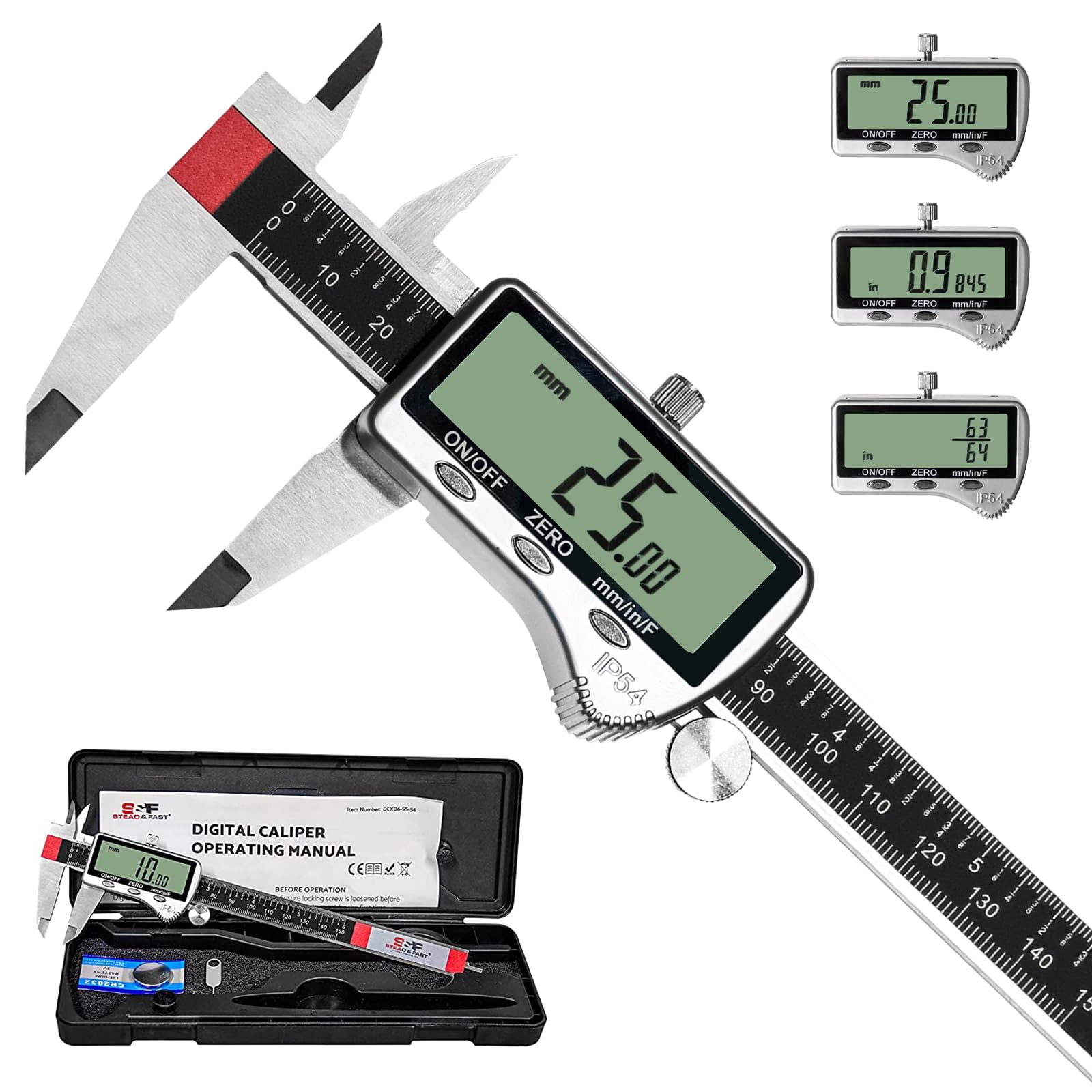
The S&F STEAD & FAST caliper is built for the 3D printing workshop that sees spills, dust, and daily use. Its IP54 rating means it resists splashes and fine particulate, which is rare in this price bracket — most calipers have no ingress protection at all. The high-finish stainless steel body and hardened stainless rails feel more solid than the budget options, and the thumb roller delivers smooth, consistent slide action even after months of use.
Accuracy clocks in at ±0.02 mm with a 0.01 mm resolution, so you can trust it for checking nozzle heights, filament diameter, and part fitment. The extra-large LCD is genuinely easy to read across a bench, and the included metal pin for battery replacement (CR2032) eliminates the need for a screwdriver. The zero function works reliably from any position, which is handy for measuring stepped features on 3D printed parts.
Some users initially complained about a scratched display, but this is a protective film that peels off to reveal a flawless screen. The case has robust latches and rubber bumpers, which is better than the flimsy boxes that come with cheaper calipers. For the workshop that needs both precision and resilience, this is the pick.
Why it’s great
- IP54 splash and dust resistance — perfect for a busy print farm
- Extra-large LCD with high repeatability, tested within 0.0005 inches of a Mitutoyo
- Sturdy case with metal battery key and spare CR2032 included
Good to know
- Protective film on the screen can scratch during shipping — peel it off upon arrival
- The fractional display mode is less useful for metric-based 3D printing work
2. Fowler 54-101-150-2 Xtra-Value Cal

The Fowler 54-101-150-2 is a tier above the typical hobbyist caliper. It delivers an accuracy of ±0.001 inches (0.03 mm) with a resolution of 0.0005 inches, and it consistently holds its zero over extended use — a well-documented pain point with cheaper units that drift after a few measurements. The stainless steel body is fully metal, and the slide action is smooth without being loose, supported by a reliable locking screw.
This caliper uses a CR2032 coin-cell battery, which is widely available and lasts a long time. The LCD is clear and easy to read from most angles, though it does not have a backlight. The included hard case is decent, and you get two batteries plus a full one-year warranty. For the 3D printing professional who measures dozens of parts every day, the Fowler justifies its higher price with repeatable, drift-free performance that instills confidence.
Users who have owned multiple cheaper calipers report that the Fowler is the first set that does not lose zero after a few weeks of daily use. It is not as buttery smooth as a Mitutoyo, but at roughly a third of the cost, it offers a very high ratio of precision to price. If you are calibrating a printer for production runs, the Fowler is the right investment.
Why it’s great
- Highly repeatable measurements with no zero drift, even with frequent use
- Uses standard CR2032 batteries — easy to find and replace
- Full one-year warranty from a known brand in metrology
Good to know
- No backlight on the LCD — hard to read in dim print rooms
- Roughly three times the price of an entry-level caliper, so it is for serious users only
3. HARDELL Digital Caliper
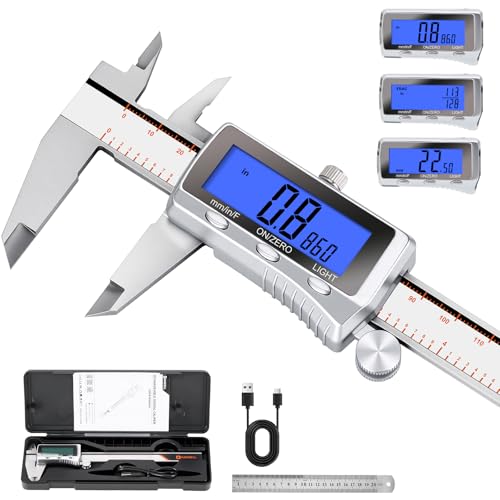
The HARDELL caliper is a mid-range contender that punches above its price class with an all-metal body and a backlit LCD screen. The backlight is a genuine advantage in a dim workshop or when you are measuring inside an enclosure — you can press the “LIGHT” button and read the display without angling it toward a lamp. The metal construction, including the screen frame, provides a much sturdier feel than the plastic-and-steel hybrids that dominate this tier.
It uses a built-in lithium-ion rechargeable battery that charges fully in about 20 minutes via a standard USB-C cable, and it claims to hold a charge for up to four months. The accuracy is rated at ±0.001 inches (0.02 mm) with a 0.0005-inch resolution, which is adequate for checking filament and print tolerances. The thumb roller is a bit loose, but it rolls smoothly, and the auto-off after five minutes is standard. The polishing on the edges is good for a caliper at this price, reducing hand strain during repeated measurements.
Some users note that the caliper feels a bit bulky compared to slimmer designs, and the thumb wheel is less tight than some prefer, but these are minor trade-offs for the all-metal build and backlit display. The one-year warranty provides peace of mind. For the user who measures in varied lighting conditions, the HARDELL is a strong value.
Why it’s great
- Backlit LCD screen makes reading measurements easy in low-light print rooms
- All-metal body (including screen) is more durable than plastic-hybrid calipers
- Rechargeable via USB-C with long battery life between charges
Good to know
- Body is slightly bulkier than other 6-inch calipers, which may feel heavy in hand
- Thumb wheel is loose; some users prefer a more damped slide action
4. werka Digital Caliper

The werka digital caliper offers a refined user experience that feels closer to a professional tool than its price would suggest. Its standout feature is the auto-on function — simply slide the jaw and the caliper powers on, eliminating any button pressing before you measure. This is a major convenience when you are juggling a freshly printed part and need to check dimensions quickly. The slide is smooth and firm, with no perceptible play in the jaws even at full 6-inch extension.
Accuracy is rated at ±0.001 inches with a resolution of 0.0005 inches, and user tests with gauge blocks confirm it is highly repeatable. The low-battery warning (the screen flashes) is a practical touch that prevents you from chasing false readings. It uses two LR44 batteries, which are included along with a spare set in the hard case. The packaging is notably premium — a thick, padded plastic case with a sponge cavity that holds everything snugly.
The polished stainless steel frame feels durable, and the balanced design of the display digits is better than many budget alternatives that suffer from uneven font weighting. This is a caliper that is equally at home in a 3D printing bin as it is in a jewelry or woodworking shop. For a mid-range price, the werka delivers a polished, daily-driver experience that is hard to beat.
Why it’s great
- Auto-on slide activation — no button pressing needed to take a measurement
- Exceptional build quality and smooth slide action for the price tier
- Low-battery warning via screen flash prevents inaccurate readings
Good to know
- Uses LR44 batteries rather than the more common CR2032
- No backlight on the LCD, so reading in dim conditions requires a light source
5. Preciva Digital Caliper
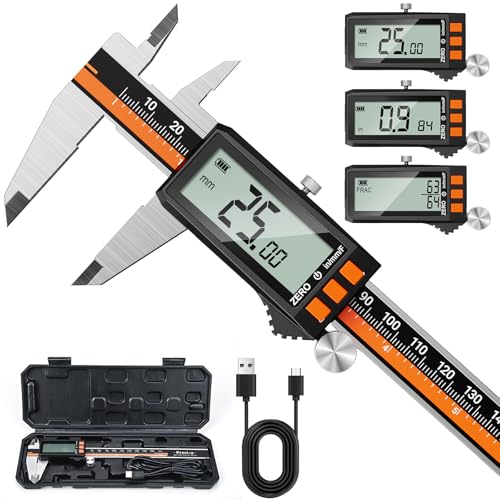
The Preciva digital caliper is built around the convenience of Type-C rechargeability. Instead of hunting for a coin-cell battery, you simply plug it into any USB-C charger — a full charge takes about 50 minutes and lasts through many print sessions. The stainless steel body is high-strength, and the large LCD display is easy to read, though it lacks a backlight. The one-button conversion between metric, imperial, and fractional units works reliably.
Accuracy is rated at ±0.001 inches (0.03 mm), which is on the edge of what you need for 3D printing — fine for checking filament diameter and basic part dimensions, but not as tight as the ±0.02 mm you get from the premium models. The auto-off after five minutes of inactivity helps conserve the battery, and the four measurement modes (internal, external, depth, step) cover all the basics. The glide action from the thumb roller and locking screw provides stable measurement positioning.
Some users note that the digits are small when viewed in dim light, but the overall build is solid for the price. The included case is standard but functional. If you want to stop dealing with button-cell batteries and already use USB-C for everything else, the Preciva offers a clean solution for a very reasonable price.
Why it’s great
- Type-C rechargeable lithium battery eliminates the need for coin-cell replacements
- Stainless steel construction with smooth slide action and locking screw
- Instant unit conversion between inches, mm, and fractions
Good to know
- Accuracy is ±0.03 mm rather than the stricter ±0.02 mm — marginal but notable
- No backlight on the display; small digits can be hard to read in low light
6. Jiavarry Digital Caliper

The Jiavarry digital caliper is the most affordable option on this list that still delivers usable accuracy for 3D printing work. Its defining feature is the extra-large LCD screen, which is noticeably bigger than standard displays — you can read the numbers clearly even with bifocals or from an angle. The accuracy is rated at ±0.02 mm with a resolution of 0.01 mm, which matches the higher-tier models for print calibration purposes.
The caliper uses a stainless steel and plastic hybrid construction. The beam is steel, but the body includes plastic elements, which keeps the weight low and the cost down. The slide action is smooth, and there is a fine adjustment thumb wheel and a locking screw for stable positioning. It offers three unit conversions (inch, mm, fraction) and the standard four measurement modes. The hard case is decent, and it comes with spare batteries.
Some users reported the included battery was dead on arrival, but this is a minor inconvenience — a fresh CR2 battery solves the issue. The Jiavarry is not built for heavy daily use or a dusty workshop, but for the hobbyist who needs a reliable, easy-to-read caliper for occasional part verification and printer calibration, it delivers a lot of value.
Why it’s great
- Extra-large LCD makes reading measurements effortless, even from a distance
- ±0.02 mm accuracy matches premium calipers, at a fraction of the price
- Includes spare batteries and a protective hard case
Good to know
- Battery (CR2) sometimes arrives dead; keep a fresh one on hand
- Plastic-and-steel hybrid build is less durable than all-metal options
7. NEIKO 01407A Electronic Digital Caliper
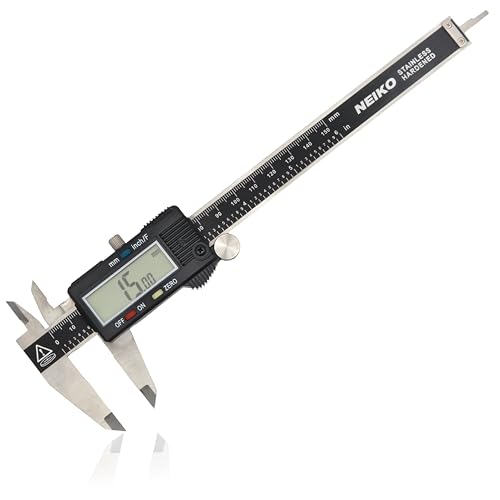
The NEIKO 01407A is a classic entry-level digital caliper that has been a staple in hobbyist workshops for years. It features a quick-change button that cycles through inch, fraction, and millimeter modes — the fractional mode is a nice bonus if you work with standard fasteners alongside metric 3D printed parts. The stainless steel body is finely polished, and the knurled thumb roller and locking screw provide good control.
Accuracy is rated at ±0.001 inches with a resolution of 0.0005 inches, and multiple users have verified this against gauge blocks. The extra-large LCD is clear and easy to read. The caliper is splash- and dust-resistant, which gives it a small edge over purely unsealed models. It is powered by a single LR44 battery, which is included along with a spare, and the gray foam case offers solid protection.
One minor gripe reported by users is that the battery connection can sometimes lose contact, causing the display to flicker or reset; reseating the battery usually fixes it. Also, the slide was a bit tight out of the box on some units, but a drop of oil solves it. For the budget-conscious 3D printing enthusiast who just needs a reliable digital caliper for calibration and part checking, the NEIKO offers proven performance at a low entry point.
Why it’s great
- Quick-change button for inch, fraction, and millimeter conversions
- Splash- and dust-resistant body is unusual for this price point
- Verified accuracy to ±0.001 inches with gauge blocks by users
Good to know
- Battery connection can occasionally flicker; reseating the LR44 solves it
- Slide may feel tight initially — a small drop of lubricant improves action
FAQ
What accuracy do I need for 3D printing calibration work?
Are rechargeable calipers better than those using coin-cell batteries?
How often should I zero my digital caliper for 3D printing measurements?
Final Thoughts: The Verdict
For most users, the calipers for 3d printing winner is the S&F STEAD & FAST because it combines IP54 dust and splash protection, ±0.02 mm accuracy, and a robust stainless build at a very reasonable price. If you want the convenience of a backlit display and a rechargeable battery, grab the HARDELL. And for the budget-conscious enthusiast who needs reliable measurements without breaking the bank, nothing beats the NEIKO 01407A for pure value.