
If you spend your workday on calls, the difference between a good headset and a frustrating one is whether people on the other end can actually hear you clearly — or spend half the conversation asking you to repeat yourself. The problem is that a lot of headsets claim “noise cancellation” when they really just block sound from reaching your own ears, leaving your callers to hear every dog bark and office door slam right alongside your voice.
I’m Min — the co-founder and writer behind Gadgets Feed. This guide is built by comparing the manufacturers’ published specifications and the patterns across verified customer reviews, so you get each pick’s real strengths and trade-offs instead of marketing spin.
You need a call headset that gives you clear audio, all-day comfort, and a microphone that cancels background noise for the person on the line. These six options solve that problem in different ways.
How To Choose The Best Call Headset
The right call headset comes down to three things: whether your callers can hear you without background noise, whether you can wear it all day without pain, and whether the connection is reliable enough that calls don’t drop. Here is what to look for.
Microphone Noise Cancellation
This is the most important feature in a call headset. A microphone with active noise cancellation (a technology where the microphone filters out consistent background sounds like fans or typing) makes sure your voice is the only thing your callers hear. Without it, every background noise in your room becomes part of the conversation. Some headsets also offer passive noise isolation, which uses the physical padding of the ear cups to muffle outside sound for you — but what matters most for professional calls is the microphone’s noise cancellation, not the ear cup’s sound blocking.
Battery Life and Charging Speed
For wireless headsets, battery life determines how long you can work without reaching for a charger. Look for a minimum of 20 hours of talk time to comfortably cover a full work week between charges. Charging speed also matters — a headset that can fully charge in 2 hours or less means you can top it up during a lunch break if you forget to plug it in overnight. Wired headsets do not have this concern, which is one reason some people prefer them for all-day use.
Comfort for Extended Wear
A headset that is too tight or heavy with materials that trap heat can make an eight-hour day miserable. Look for memory foam ear pads, a lightweight design under 5.5 ounces, and an adjustable headband. Over-ear (over the ear) designs that fully enclose your ears tend to be more comfortable for long stretches than on-ear (resting on the ear) styles because they distribute pressure more evenly.
Wired vs Wireless Connectivity
Wired headsets, which connect via a USB cable, offer the most reliable connection with no risk of audio dropouts or needing to charge, but they tether you to your desk. Wireless headsets, which connect via Bluetooth, let you walk around while on a call, but you need to keep the battery charged and the connection can occasionally glitch. Many modern wireless headsets include a USB dongle (a small plug-in adapter) for computers without built-in Bluetooth, which gives you the best of both worlds — wireless freedom with a stable connection.
Compatibility with Your Platforms
Most call headsets work with standard apps like Zoom, Microsoft Teams, and Google Meet through a simple USB plug-and-play connection. But some headsets are specifically certified for certain platforms, which means the mute button, call answer controls, and volume wheel will work automatically without extra setup. If you live in Microsoft Teams all day, a Teams-certified headset saves you small frustrations.
Quick Comparison
On smaller screens, swipe sideways to see the full table.
| Model | Category | Best For | Key Spec | Amazon |
|---|---|---|---|---|
| Vonztek Bluetooth Headset | Wireless | Long workdays without charging | 26-hour talk time | Amazon |
| Poly Blackwire 3220 | Wired | Reliable plug-and-play calls | Hi-Fi stereo sound | Amazon |
| Plantronics Blackwire C3220 | Wired | Sturdy build with noise-cancelling mic | Sturdy metal headband | Amazon |
| Yealink UH34 USB Headset | Wired | Light all-day comfort | 5 oz lightweight | Amazon |
| JIAMQISHI Wireless Headset | Wireless | Easy setup with USB dongle | Bluetooth 5.2 | Amazon |
| Jabra Evolve 20 (2025 Edition) | Wired | Background noise blocking for others | 28mm speakers | Amazon |
In‑Depth Reviews
1. Vonztek Bluetooth Headset with Microphone

26 hours of continuous talk time from a single 2-hour charge makes the Vonztek Bluetooth Headset the top pick for anyone who needs to get through a full work week without recharging. It weighs just 4.5 ounces (about the same as a deck of cards), so you barely notice it on your head during back-to-back meetings.
Its AI noise-canceling microphone is the standout feature here — according to the brand, it is designed to cancel up to 99.6% of background noise, meaning your callers should hear your voice clearly even if you are in a busy room. Buyers report that the “noise cancellation microphone” is “excellent” and that the “convenient mute button” on the headset makes it easy to cut your audio during private moments. The 270-degree rotatable microphone arm lets you position it exactly where it picks up your voice best.
The catch is that this headset does not come with a USB audio dongle, so if your computer lacks Bluetooth, it will not work wirelessly out of the box. Some buyers also note that the ear cups can feel tight after several hours, so try it for a short session first. For the talk time and noise cancellation at this level, this is the best daily driver for most remote workers.
Why it’s great
- 26-hour talk time covers a full work week
- AI noise-canceling microphone blocks background noise for callers
- Lightweight at 4.5 oz for comfortable extended wear
Good to know
- No USB dongle included — needs Bluetooth on your computer
- Some users find the ear cups tight after several hours
- Power button requires holding for over 3 seconds to turn on
2. Poly Blackwire 3220 Wired Headset

Where the Vonztek wins on wireless freedom, the Poly Blackwire 3220 beats it on pure reliability — you never have to worry about battery life, Bluetooth dropouts, or pairing issues because it connects directly to your computer via a USB-C cord with an included USB-A adapter. Its noise-canceling boom microphone and passive noise isolation (where the ear cushions physically block out ambient sound) mean your callers hear only your voice. It also delivers Hi-Fi stereo sound (higher quality audio reproduction with clearer highs and lows) for music and multimedia between calls.
Owners mention the adjustable strap and soft ear padding do a good job preventing headaches during long workdays, and the inline controls — volume wheel and mute button — are intuitive enough that you do not need to glance down to use them. One reviewer reports the headset “emits a low beep reminder” when the mute function is active, a thoughtful touch that prevents accidental mute-mode mishaps during important calls.
Choose this over the Vonztek if you want a rock-solid wired connection and you prefer to never think about charging. The downside is that the cord can feel restrictive — it is not a headset you can wear while walking to the kitchen or pacing around your office. For a desk-bound professional who values call clarity above all else, this is the wise pick.
Where it shines
- Reliable wired connection with no battery to charge
- Noise-canceling boom mic blocks background noise for callers
- Hi-Fi stereo sound for clear audio and music
Worth noting
- Wired only — not for moving around your space
- One reviewer noted it quit working after the return window closed
- Ear pieces can feel slightly floppy on some units
3. Plantronics Blackwire C3220 USB Headset

Imagine you are on calls for seven hours straight in a busy call center or open-plan office — you need a headset that survives being worn, adjusted, and dropped repeatedly. That is exactly the scenario the Plantronics Blackwire C3220 was built for. It features a metal headband covered in sturdy plastic, and buyers consistently report it “stays on head well” and feels “sturdy build” even after months of daily use. The 40-millimeter dynamic drivers (the speakers inside each ear cup) deliver sound that one reviewer described as “completely noise-cancelling” and “amazing sound quality.”
The inline controls on the cord let you answer and end calls, adjust volume, and mute the microphone without fumbling. This headset uses the same core hardware as the Poly Blackwire 3220 (both are from Poly, the company behind Plantronics), so the noise-canceling microphone quality is nearly identical. Where it falls short of the Poly is on the cord length — some buyers find it a bit short, causing the headset to yank if you lean forward.
Its defining strength is that metal-reinforced build quality that feels like it will survive a drop from desk height. If you are rough on your gear or work in a shared environment where headsets get handled by multiple people, this one holds up better than the Poly Blackwire 3220 or the Vonztek wireless option.
What stands out
- Metal headband and sturdy build for high-use environments
- Completely noise-cancelling microphone for clear caller audio
- Easy-to-reach inline controls for volume and mute
The trade-offs
- Cord is short and can pull if you lean forward
- No Bluetooth — wired only
- Volume control area does not detach for direct connection
4. Yealink UH34 USB Headset

If comfort is your top priority — meaning you can put a headset on at 9 AM and forget it is still there at 5 PM — the Yealink UH34 is the headset to beat. It weighs just 5 ounces, which makes it significantly lighter than many competitors, and the memory foam ear cushions are soft and breathable enough that your ears do not get hot or sweaty. Buyers consistently say it is “super comfortable” and that it “does not press on your ears.” One reviewer who compared it to five other headsets called it “the most comfortable headset” and bought two more as backups.
The Yealink is certified for Microsoft Teams, meaning it auto-configures as your default audio device the moment you plug it in. The noise-canceling microphone reduces background noise for your callers, though some customers note it is not as aggressive at filtering noise as the Poly or Plantronics options. The 6.89-foot cable gives you plenty of slack to move around your desk without strain.
At 5 ounces, it is 0.5 ounces lighter than the Vonztek and noticeably more comfortable over a full day. If you have ever had to take a headset off because your ears hurt, this one is worth the upgrade for the comfort alone.
The upsides
- Ultra-light 5 oz design for all-day comfort
- Microsoft Teams certified for automatic setup
- Long 6.89 ft cable for desk mobility
Keep in mind
- Noise cancellation is moderate, not top-tier
- USB-A connection may need an adapter for newer laptops
- Some users find the fit slightly odd on their head shape
5. JIAMQISHI Bluetooth Wireless Headset

The JIAMQISHI Bluetooth Wireless Headset gives you a USB dongle right in the box, so you can use it wirelessly with any computer — even one without built-in Bluetooth. This makes it the best option for hopping between a desktop at the office and a laptop at home without needing to pair devices each time. It uses Bluetooth 5.2 (the latest widely available version, offering faster pairing and better connection stability than the 5.0 version in the Vonztek) for a range of up to 33 feet.
The memory foam ear pads are plush and comfortable, and reviewers point out the headset is “comfortable, clear sound, literally perfect” and that the charging stand (included) is a nice convenience. The high-sensitivity microphone delivers clear voice quality for calls, and the mute function lets you cut audio instantly. One buyer praised the “long battery life” and noted they got over 16 hours of use on a single charge.
The one thing you give up for the convenience of the USB dongle and Bluetooth 5.2 is the strength of the noise cancellation — shoppers say that background noise blocking is weaker than the Poly or Plantronics wired options. If your workspace is quiet and you value wireless flexibility and quick setup above all, this headset is perfect for the budget buyer who wants modern wireless features without spending on premium noise cancellation.
Why we’d pick it
- Includes a USB dongle for computers without Bluetooth
- Bluetooth 5.2 for stable wireless connection
- Memory foam ear pads for extended comfort
A few caveats
- Noise cancellation is weaker than wired alternatives
- Mute feature may not work reliably on all units
- Ear pads can feel stiff initially
6. Jabra Evolve 20 Wired Headset (2025 Edition)
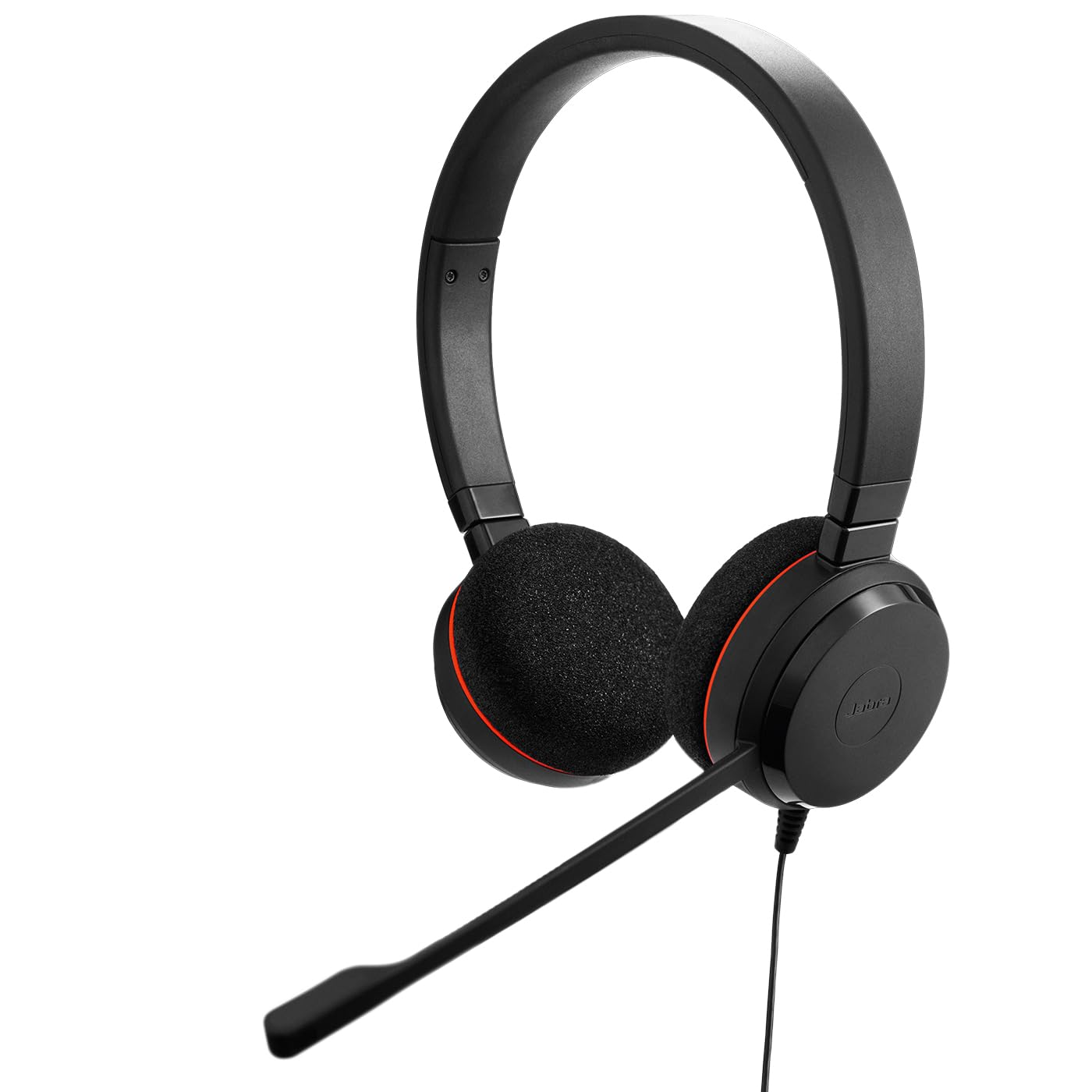
This is the headset to pick if your workspace is genuinely noisy — open office, kids at home, street traffic — and you need absolute confidence that callers hear only your voice. What you get for the extra spend is a design purpose-built for office environments: the noise-canceling microphones (it has two, one for voice pickup and one for ambient noise filtering) do an outstanding job of making sure your callers cannot hear background noise. Buyers report that clients “are unable to hear lawnmowers or barking dogs” on the other end, which is as strong a real-world test as you can get.
The headset connects via a USB-C cord with a USB-A adapter, and the 28mm speakers deliver good audio quality for calls and media. It is comfortable for long wear — one reviewer who spends 90% of their workday on calls said it is “extremely comfy on the ears vs other headsets.” The build quality, however, feels more plasticky than the Plantronics C3220’s metal frame, and some owners mention a concern about long-term durability.
This is the headset to pick if your workspace is genuinely noisy — open office, kids at home, street traffic — and you need absolute confidence that callers hear only your voice. The rest of the field offers better value for quieter environments, but be aware that its plasticky build may not withstand years of heavy use as well as metal-framed alternatives.
Strong points
- Superior noise cancellation blocks loud background noises for callers
- Works with USB-C and USB-A out of the box
- Comfortable foam ear cushions for all-day wear
Before you buy
- Build materials feel less premium than some alternatives
- Audio driver size is 28mm, smaller than many competitors’ 40mm
- Not certified for Microsoft Teams or Zoom
Understanding the Specs
Noise Cancellation vs. Noise Isolation
Noise cancellation is a technology built into the microphone that actively filters out background sounds so your callers hear only your voice. Noise isolation is passive — it is the physical blocking of sound by the ear cushions themselves, which helps you hear your callers clearly. For a call headset, microphone noise cancellation matters more than isolation because the person on the other end is the one who suffers from background noise, not you.
Talk Time and Battery Capacity
Talk time is measured in hours of continuous use during a call, which is different from standby time (the time the headset stays on while not in use). A headset with 26 hours of talk time means you can be on calls for over three full workdays before needing to recharge. Battery capacity is measured in milliamp-hours (mAh), and a typical office headset ranges from 400mAh to 800mAh — the higher the number, the more talk time you get.
Audio Driver Size and Sound Quality
The audio driver is the small speaker inside each ear cup, measured in millimeters (mm). A larger driver like 40mm generally produces fuller sound with better bass than a smaller one like 28mm, which matters for hearing voices clearly and for enjoying music between calls. For call quality specifically, driver quality (how accurately it reproduces human voices) matters more than size, but as a rule, larger drivers from reputable brands tend to sound better.
Bluetooth Version and Connectivity
The Bluetooth version determines how fast and reliably your headset connects to devices, and how far away you can move before the signal drops. Bluetooth 5.0 is the baseline for modern headsets, offering a range of about 33 feet. Bluetooth 5.2 adds better connection stability and slightly lower power consumption, so you get slightly longer battery life and fewer dropouts. For desktop use where you are stationary, the difference between 5.0 and 5.2 is minimal.
FAQ
Does noise cancellation on a call headset block sound for me or for the person I am talking to?
Can I use a wireless call headset with a computer that does not have Bluetooth?
Is a wired or wireless headset better for call quality?
How many hours of battery life do I need in a wireless call headset?
Do I need a headset certified for Microsoft Teams or Zoom?
Final Thoughts: The Verdict
If you want one dependable pick, the call headset winner is the Vonztek Bluetooth Headset because it combines 26 hours of talk time, effective noise cancellation, and a lightweight design at a price that represents the best overall value. If you want a rock-solid wired connection with no battery concerns, grab the Poly Blackwire 3220 for its reliable plug-and-play performance. And for all-day comfort that feels like you are wearing nothing, the standout is the Yealink UH34 USB Headset.