
Our readers keep the lights on and my morning glass full of iced black tea. As an Amazon Associate, I earn from qualifying purchases.
Specs are compiled from manufacturer listings and verified buyer reviews and can change over time — please confirm the key details on the product page before buying.
Calligraphy lives or dies by its paper. The right sheet lets your nib glide, holds crisp hairlines, and never lets ink bleed through to the table beneath. The wrong sheet turns every stroke into a frustrated mess. This guide breaks down the best paper for pointed-pen scripts, broad-edged styles, and brush-based sumi work — so you can match the sheet to the ink you actually use.
I’m Min — the founder and writer behind Gadgets Feed. This guide is built by comparing the manufacturers’ published specifications and the patterns across verified customer reviews, so you get each pick’s real strengths and trade-offs instead of marketing spin.
Whether you are learning copperplate, practicing kanji, or pulling gel prints, the right foundation makes every session smoother. Find your perfect calligraphy paper here.
Our Picks at a Glance


How To Choose The Best Calligraphy Paper
Calligraphy paper is not one thing. A sheet that is perfect for a dip pen with iron gall ink will be a disaster under a wet sumi brush. Before you buy, match the paper to three things: your tool, your ink, and your skill level.
Match the paper to your tool
Pointed pens need a smooth, hard surface so the delicate hairlines don’t snag. Broad-edged pens want a paper with a little tooth to grip the ink. Brushes demand an absorbent sheet that pulls ink from the tip and lets it spread naturally.
Look for printed guides if you are learning
Practicing letterforms is much easier when the sheet already shows you where the x-height sits. Pre-printed grids and slant lines remove the guesswork so you can focus on pressure and pen angle instead of measuring every stroke.
Know your ink’s bleed behavior
Liquid inks and heavy washes will find any weak spot in the paper. If you are working with watery ink, a heavier sheet with a high gsm rating gives you a bigger safety margin. Thin rice paper is meant to absorb ink quickly — that is a feature for brush work, not a defect.
Quick Comparison
| Model | Best For | Sheets | Paper Weight | Guide Lines | Amazon |
|---|---|---|---|---|---|
| Yasutomo Hosho Pad★ Best Overall | Gel prints & brush ink | 48 | 18 | None | Amazon |
| Brause Lined PadBest Value | Pointed pen scripts | 50 | 85 gsm | 3 slant grids | Amazon |
| U.S. Art Supply Pad | Beginner practice | 100 | 70 gsm | Slanted grid | Amazon |
| JapanBargain Rice Paper | Sumi brush practice | 100 | 80 | None | Amazon |
| MEGREZ Raw Xuan | Chinese brush work | 100 | 20 | None | Amazon |
| Flmouce Grid Xuan | Grid-guided brush practice | 100 | 30 | 7.5 cm grid | Amazon |
| IXUECAT Tracing Copybook | Tracing classic texts | 20 | 20 | Printed characters | Amazon |
In‑Depth Reviews
1. Yasutomo Hosho Paper Pad
Our pick — over 4.5★ from 500+ verified ratings; the strongest balance of quality and price.
The crowd-pleasing hosho that handles layered gel prints without tearing.
This off-white pad is a favorite for a reason — it is thick, strong, and fluffy, yet flexible enough to feel fabric-like in your hand. Each side behaves differently: the smooth side picks up paint beautifully, while the rough side gives a different look to your prints. At 18 weight and 48 sheets, it is noticeably lighter than the MEGREZ pack below, yet owners say it lifts cleanly from a gelatin plate after six to eight hours of drying.
People use it for far more than calligraphy. Ink marbling, watercolor, lettering, and collages all work because the paper absorbs fast without tearing. The biggest praise centers on quality, with versatility a close second — this is a sheet that does not force you to commit to one discipline. The deckle edges add a handmade feel that suits framed work.
Buyers report it cuts without tearing, which matters when you are trimming prints to size. The honest trade-off is shipping: a handful of pads arrive with bent pages thanks to thin packaging, so inspect yours on arrival. Fragile when wet is the nature of rice paper — treat the damp sheet gently and it rewards you.
What wins people over
- Thick and opaque, so layered gelli prints come up clean
- Two distinct sides for different print looks
- Cuts cleanly without tearing at the edges
Who should skip it
- Too translucent for collage work where opacity matters
- Occasional bent pages from flimsy packaging
- Not a lined practice pad — no guides printed
Reach for this if: you want one versatile rice paper for printing, brush work, and marbling without buying three separate pads.
Look elsewhere if: you need printed guidelines — this sheet is intentionally blank.
2. Brause Calligraphy Lined Practice Pad
The pointed-pen specialist with three slant guides tucked inside.
This A4 pad is built for exactly one job — practicing alpha scripts like Copperplate, Chancery, and Uncial. The 85 g off-white paper is smooth enough that your nib glides, and owners mention no bleed or feathering during normal use. The 50 sheets are lined, and the pad ships with three guide sheets, each showing a different slanted grid plus the correct pen angle right on the sheet.
That guide design is the standout feature for learners. Instead of laying a separate slant board under translucent paper, you flip in the right guide and start writing. The 5mm line spacing is tighter than the 7mm-plus you get on other practice pads, which suits smaller, refined scripts.
For a category where the options dominate, this is the premium pick — and it earns it. The recurring gripe is ink bleeding through when you overload the nib with very wet calligraphy ink, so use a moderate ink load. The instructions and alphabet examples printed in the pad make it a friendly first purchase for anyone starting modern calligraphy.
Who it beats: the U.S. Art Supply pad on smoothness and guide variety — but it costs more per sheet and has no second pad to fall back on.
The catch: heavy ink loads can bleed through, so watch your nib’s ink reservoir.
3. U.S. Art Supply Calligraphy Practice Paper Pad
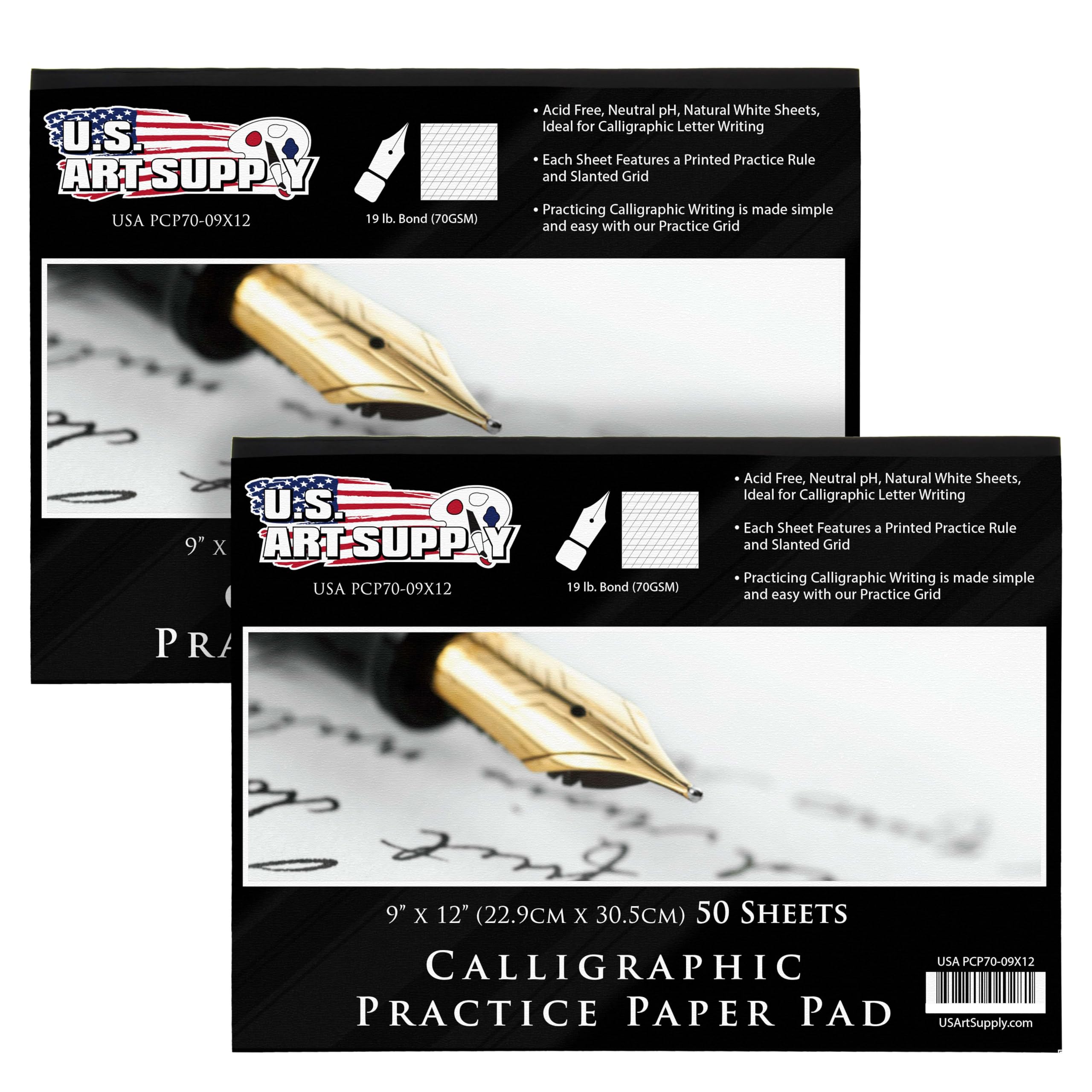
The grid-lined beginner pad that hands you 100 sheets to burn through.
This is the sheet most people picture when they think “calligraphy paper” — natural white, smooth, and covered in a printed practice rule plus a slanted grid. The two-pad pack gives you 100 total sheets of 70 gsm (19-pound bond) paper, which is thick enough for everyday practice without worrying about tearing. Each pad holds 50 sheets, making it easy to grab one for class and leave the other at home.
The acid-free, neutral pH construction means your practice sheets won’t yellow and crumble in a drawer. Owners praise the helpful guidelines and the value for money, calling it the right tool for practicing the basics. It is lightweight and portable, so it slips into a tote alongside your nib holder and ink.
The honest limitation is bleed resistance. The same reviews that love the guides note that wet ink can bleed through when you apply heavy pressure or a saturated nib. Use it with drier ink and lighter strokes, and it is a genuinely pleasant surface. The crowd consistently calls it “Great quality of paper” with guidelines that make practice simple.
Why beginners like it
- Printed slanted grid keeps letter size and spacing consistent
- Two pads = 100 sheets of practice room
- Acid-free neutral pH so pages stay white
Where it falls short
- Ink bleeds through with very wet nibs
- No slant guide variety — one grid only
Best if: you are learning the fundamentals and want printed guides on every sheet.
Think twice if: you work with heavily loaded pointed pens that lay down pools of ink.
4. JapanBargain Japanese Sumi Rice Paper
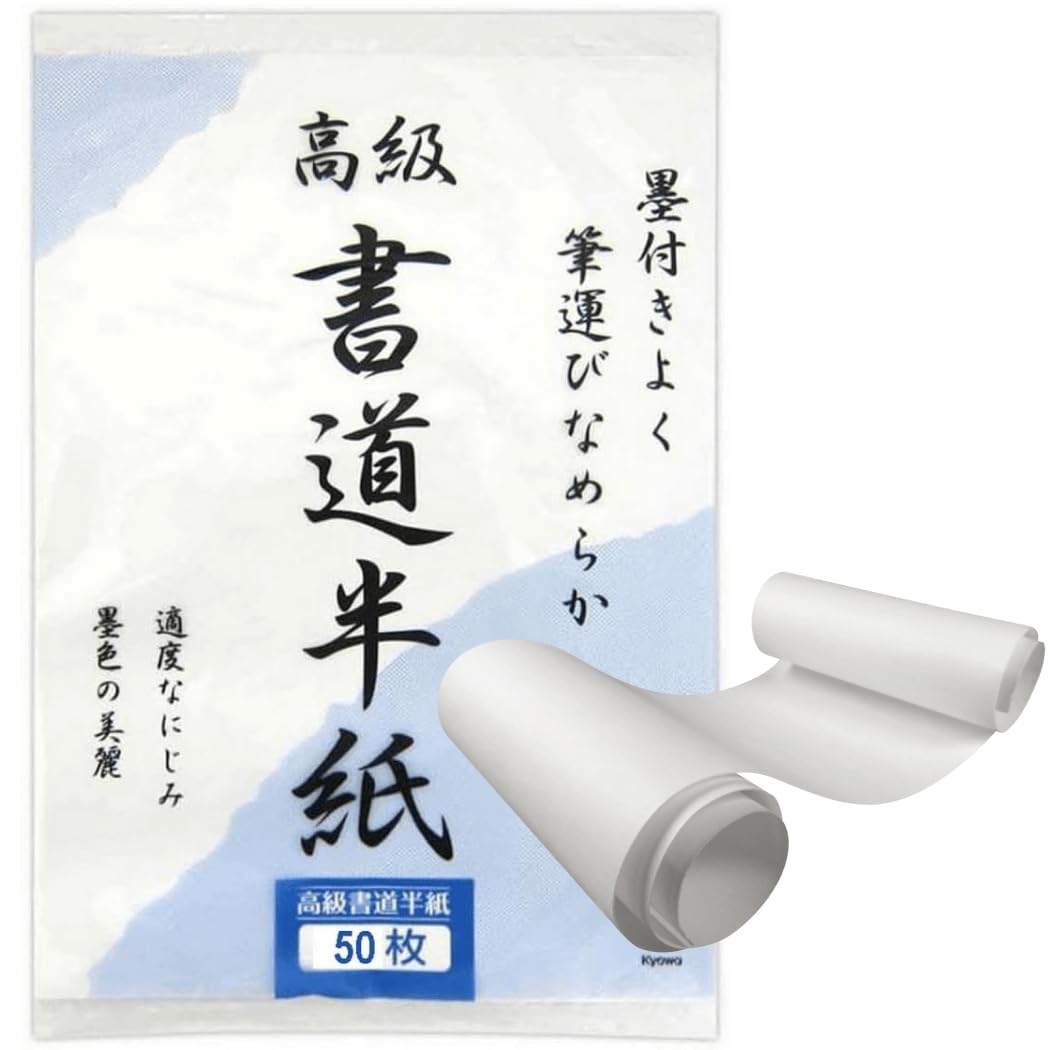
Made-in-Japan sheets that keep brush strokes crisp without feathering.
You get the largest working area of any practice paper here: 100 loose sheets at 9.5 x 13 inches, which is about 12 percent longer on one side than the MEGREZ sheets. The surface is designed for smooth brush movement, so your strokes stay crisp and resist smudging and uncontrolled feathering (ink bleeding into the fibers). At 80 weight (a measure of paper thickness), it is sturdier than the raw xuan papers, which helps when you practice character formation repeatedly without tearing the sheet.
The crowd’s verdict is strong on paper quality, and owners happily use it for everything from kanji practice to cardmaking and classroom work. It is compatible with sumi ink, watercolor, and stamping, so one pack covers multiple projects. Several reviewers specifically note it works well for gel plate printing if you let the paint dry completely before pulling.
The catch is thickness — feedback is genuinely mixed, with some calling it perfectly thin and others finding it too sheer for their needs. If you want to practice bold, wet strokes that pool on the surface, this may feel too delicate. For brush practice and general art projects, it is a reliable mid-range workhorse that ships in a two-pack.
Versatility win: sumi ink, watercolor, stamping, and even gel prints all work on this one sheet.
Fit note: those who prefer a heavier, more opaque sheet for wet washes should look at the Yasutomo pad instead.
5. Flmouce Xuan Paper with Grid

The grid-guided rice paper that keeps every character the same size.
Chinese calligraphy practice has a secret weapon — a pre-printed pink grid that shows you exactly where each character sits. This Flmouce pad marks a 7.5 cm grid across 100 sheets of smooth, absorbent rice paper, so beginners can nail consistent character size and spacing without a ruler. At 30 weight, it is heavier than raw xuan sheets, giving it more body for repeated practice.
The surface is uncoated and absorbent, which owners confirm takes ink well on the brush. Daily practice is the clear use case — several customers note they write on it every single day, and the 100-sheet count supports months of consistent work. It works for both Chinese and Japanese calligraphy, so it is not locked to one tradition.
The trade-off: the pink grid is printed directly onto the sheet, so you cannot frame a finished piece without the lines showing. This is purely a practice paper — buy it to drill your strokes, not for presentation work. For that specific job, at 100 sheets and 80 weight, it is a strong value.
Built for drilling
- 7.5 cm grid trains consistent character size
- 100 sheets support daily practice for months
- Smooth absorbent surface takes ink well
Not for framing
- Pink grid lines stay visible on finished work
- Single grid size — no variety for different script scales
Choose it for: structured daily practice where consistent character size matters more than a blank canvas.
Pass if: you want finished pieces — the grid never disappears.
6. MEGREZ Raw Xuan Rice Paper

The raw sheng xuan that soaks up ink for authentic wet-on-wet effects.
If you want the traditional feel, this raw sheng xuan paper (an unsized, highly absorbent rice paper) is made from renewable bamboo pulp with a natural, clear texture. It drinks up ink, so it is built for cursive script and traditional Chinese painting where the ink should spread and bloom. You get 100 sheets at 13.4 x 13.4 inches, and at 20 weight they are noticeably lighter than the JapanBargain pack above, making them the airier, more porous option.
Quality is the top praise, with owners calling it comparable to — or better than — other Chinese papers they have used. The smooth yet toothy surface holds strokes without bleeding, and the visible fibers give it an organic, handmade character. It is a top-tier student paper at a very reasonable price, suitable for framing once the ink dries.
Because it is raw rather than sized, it is more porous — ink spreads faster and deeper. That is a feature for wet-on-wet washes, but it also means the sheet is fragile when wet and easy to tear. A few owners note it is not thick enough for heavy abuse. Treat it as a disciplined practice surface, not a rugged workhorse.
The authentic option: raw xuan’s high absorbency delivers the ink spread that processed papers cannot replicate.
Handle with care: fragile when wet — this is not the sheet for heavy-handed beginners.
7. IXUECAT Chinese Calligraphy Tracing Copybook
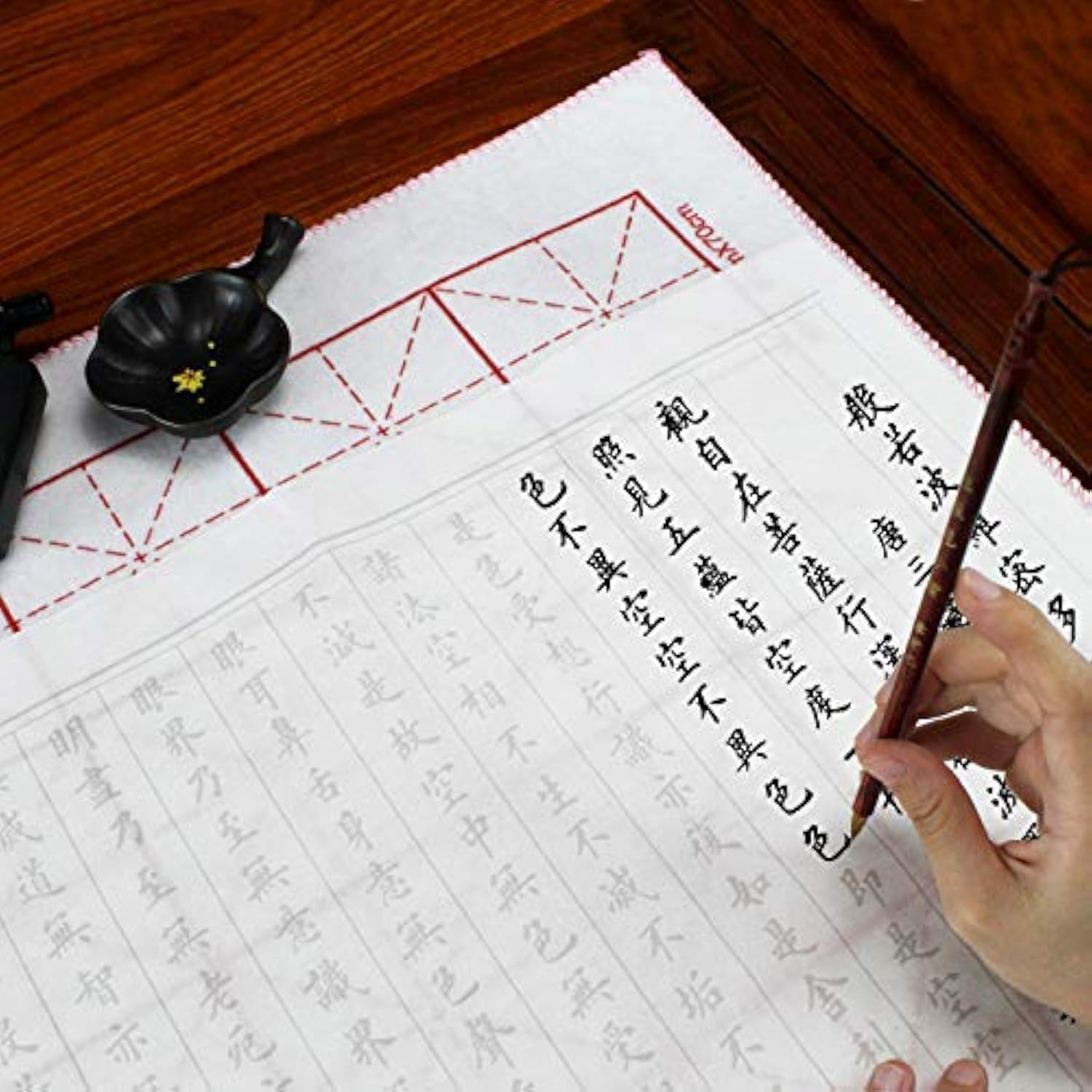
The luxury tracing book that lets you write directly over classic texts.
This is a different beast — a tracing copybook, not a blank pad. It contains 20 sheets of translucent tracing paper, split between the Heart Sutra and Lan Ting Xu, two of Chinese calligraphy’s most famous texts. The characters are printed in light gray at 1.5 cm, and you write directly on top of them with a brush, following the strokes. The sheets are large at roughly 35 x 70 cm, giving you a generous canvas for each passage.
Owners describe it as a beautiful piece of practical art — the gray characters are clear and well-defined, and the translucent paper accepts ink nicely. It is frequently bought as a gift for teachers, students, and friends, and several buyers frame the finished sheets as decorative pieces. For mindfulness practice, tracing these classic texts is a calming, focused exercise.
The premium price buys you the convenience of pre-printed texts, but it is the most expensive per-sheet option here by a wide margin. A few owners feel the 20 sheets do not justify the cost, especially when blank rice paper is so cheap. It is also a one-time use format — once you trace a sheet, it is done. If you want endless freeform practice, a blank pad serves you better.
What justifies the price
- Classic texts printed in traceable light gray
- Large 35 x 70 cm sheets for long passages
- Framable finished pieces
Where value drops
- Only 20 sheets — each is single-use
- High cost per sheet vs. blank practice pads
Splurge on it for: tracing the Heart Sutra as a meditative practice or as an elegant gift.
skip it if: you want volume practice — this is a finishing tool, not a drill pad.
Understanding the Specs
Paper Weight: gsm and lb bond
Paper weight tells you how thick and dense the sheet is. Heavier paper (higher gsm or lb bond) resists bleed-through and holds up to wetter ink, making it the safest choice for pointed pens and liquid calligraphy ink. Lighter paper absorbs ink fast and is ideal for brush work where you want the ink to spread — but it goes translucent and tears easily when wet. Match weight to ink: heavy for dip pens, light for sumi brushes.
Raw Sheng vs. Sized Xuan
Treated (sized) xuan paper has a coating that keeps ink on the surface with less spread. Raw sheng xuan has no sizing, so ink sinks in and blooms naturally — the authentic choice for wet-on-wet painting and cursive script. The trade-off is control: raw paper spreads ink unpredictably and is more fragile. Beginners often find sized paper easier to manage, while traditionalists prefer raw for its organic effects.
FAQ
What is the difference between raw sheng and semi-raw xuan paper?
Will calligraphy ink bleed through a 70 gsm practice pad?
Can I use this paper for gel plate printing?
What are deckle edges and do they matter?
How do printed grids help me learn calligraphy faster?
Is thin rice paper a defect or a feature?
Can I frame calligraphy practice paper?
What is the best paper for a beginner using a pointed pen?
Final Thoughts: The Verdict
The best all-round Calligraphy Paper is the Yasutomo Hosho Pad because it spans brush ink, gel prints, marbling, and lettering without forcing you into one discipline. If you are learning pointed-pen scripts with printed guides, grab the Brause Lined Pad. And for authentic Chinese brush practice with a filling 100-sheet count, the MEGREZ Raw Xuan is the one traditionalists reach for.
How We Picked
We do not accept paid placement. Every pick is matched to a real buyer and a real use-case; we do not hands-on test units.
Sources & Methodology
Specifications: manufacturer listings and product documentation. Review insights: verified customer reviews, as of August 2026. Pricing: not shown on this page (it changes often); check the current price via the retailer link.
As an Amazon Associate, Gadgets Feed earns from qualifying purchases. This does not affect which products we feature.