
Eyeballing portions and guessing calorie counts is the fastest way to sabotage a diet or fitness plan. A dedicated nutrition scale strips away the guesswork, giving you precise gram weights and instant macro breakdowns so every meal aligns with your goals. The right tool turns meal prep from a chore into a data-driven system that actually works.
I’m Min — the co-founder and writer behind Gadgets Feed. I’ve spent hundreds of hours cross-referencing food databases, analyzing app integrations, and comparing sensor accuracy across the current market to separate the real performers from the gimmicks.
After extensive research, I’ve refined the field to the top contenders for the best calorie counter device that actually delivers reliable data without slowing down your kitchen workflow.
How To Choose The Best Calorie Counter Device
A nutrition scale is only as valuable as its accuracy, its database depth, and how seamlessly it fits into your routine. Understanding the specs that separate a toy from a legitimate tracking tool is the difference between reaching your goal and falling off the wagon within a week.
Sensor Accuracy and Weight Capacity
Look for a device with at least four high-precision sensors and a 1-gram resolution. A scale that reads in 2-gram increments or uses a single sensor can miss significant macro differences, especially when weighing dense ingredients like nuts or cheese. The sweet spot for most kitchens is a 5 kg (11 lb) capacity, which handles bulk meal prep while staying sensitive enough for single servings of protein powder or spices.
Food Database Size and Entry Method
A device with a million-plus food database from a provider like Nutritionix or a proprietary source saves you from manually entering each ingredient. Barcode scanning is the gold standard for packaged foods, but a built-in code book with pre-programmed ingredients is a solid fallback for whole foods. The faster you can log a meal, the more likely you are to stick with tracking long-term.
Nutrient Depth and Goal Customization
If you only need calorie counts, a basic scale suffices. For macro-focused diets like Keto or bodybuilding, choose a device that tracks at least 19 nutrients, including protein, carbs, fat, fiber, sodium, and cholesterol. The best models let you set daily goals for calories, protein, carbs, and fat directly on the scale or via the companion app, updating your remaining allowance in real time as you add food.
Quick Comparison
On smaller screens, swipe sideways to see the full table.
| Model | Category | Best For | Key Spec | Amazon |
|---|---|---|---|---|
| Cosori Smart Food Kitchen Scale | Premium | App-first AI tracking with barcode scan | 1M+ food database, USB-C rechargeable | Amazon |
| Etekcity Smart Food Kitchen Scale | Mid-Range | Stainless steel durability with 19-nutrient tracking | 304 stainless steel, 4 sensors | Amazon |
| KUAIVO Smart Nutrition Food Scale | Mid-Range | TFT screen with built-in 50-food presets | Color TFT display, 23 nutrients | Amazon |
| Eat Smart Digital Nutrition Food Scale | Mid-Range | Standalone code book without app reliance | 999 pre-programmed foods, code book | Amazon |
| Ultrean Smart Food Scale | Mid-Range | AI scan and 20-nutrient analysis on a budget | 33 lb capacity, 20 nutrients | Amazon |
| Fitbit Inspire 3 | Premium | Wearable all-day calorie burn estimation | 10-day battery, 24/7 heart rate | Amazon |
| Google Fitbit Air | Premium | Screenless wearable for distraction-free tracking | 7-day battery, 5-min fast charge | Amazon |
In‑Depth Reviews
1. Cosori Smart Food Kitchen Scale
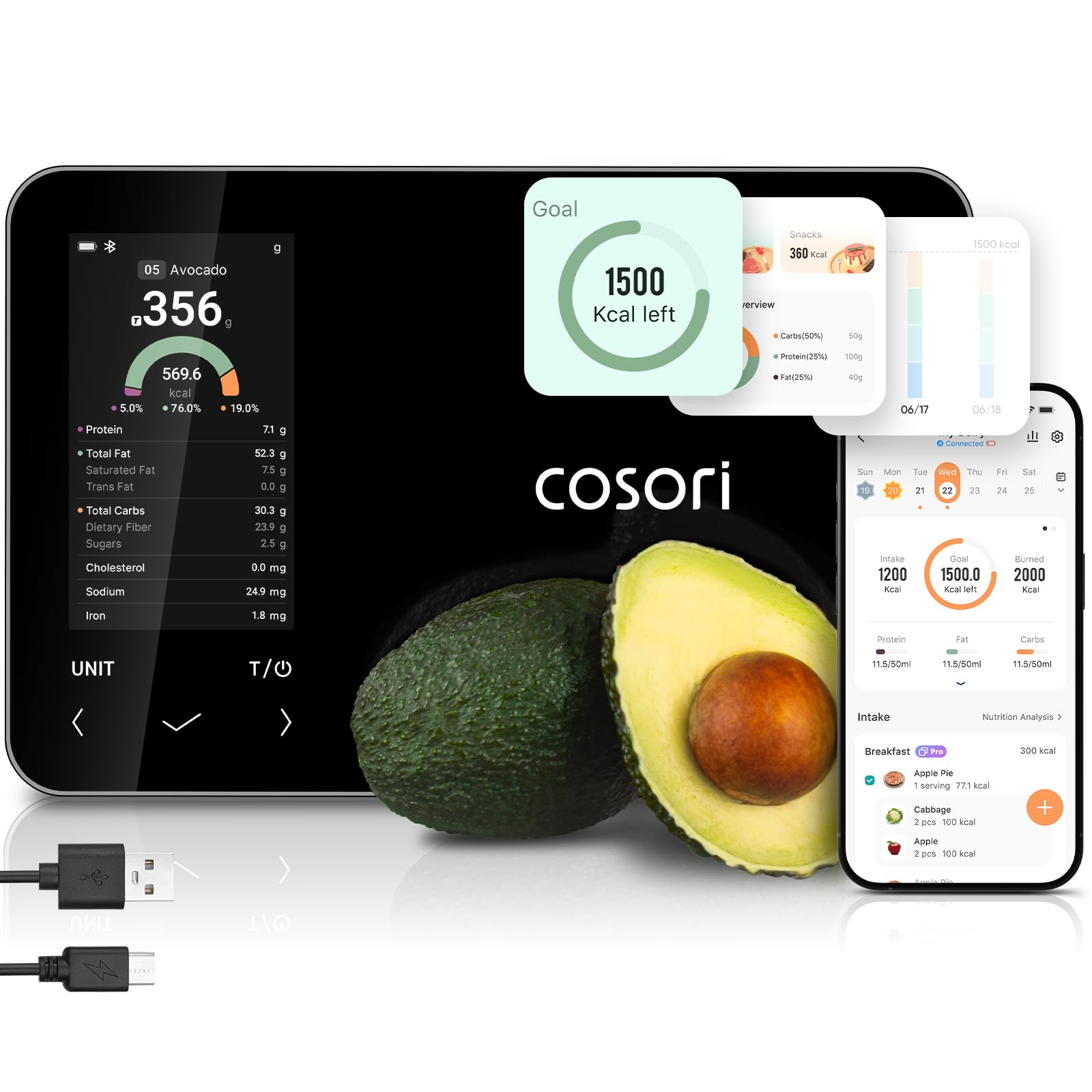
The Cosori leads the field with its VeSync app integration that tracks 19 essential nutrients and updates your daily goals in real time as you weigh ingredients. The 1M+ food database combined with AI barcode scanning means you can identify packaged foods in seconds without manual entry, which makes logging consistent meals much less tedious.
Under the hood, its four high-precision sensors deliver 1-gram increments across a 5 kg (11 lb) capacity, matching the best in class for accuracy. The USB-C rechargeable battery is a welcome upgrade over the AAA batteries most competitors still rely on, and recharge time is negligible when you plug it in during meal prep.
On-screen nutrient display shows calories, protein, carbs, and fat directly on the scale, so you can check your progress without pulling out your phone. The auto-scan feature for food barcodes works reliably with US products, and the companion app offers weekly and monthly trend analysis that helps you spot weak spots in your diet.
Why it’s great
- USB-C charging eliminates battery swaps
- AI barcode scanning logs packaged foods instantly
- 19-nutrient tracking sets it apart from basic calorie-only scales
Good to know
- Requires the VeSync app for full functionality
- Cannot combine multiple ingredients into a single dish’s total in the app
2. Etekcity Smart Food Kitchen Scale

Etekcity’s model has been a staple in the nutrition tracking space for good reason — the 304 food-grade stainless steel platform is both durable and easy to sanitize, surviving daily meal prep without staining or retaining odors. The four high-precision sensors deliver consistent 1-gram readings from 3 g all the way up to 5 kg.
The free VeSync app integration gives you access to the Nutritionix database, which holds roughly 1 million food entries. You can track 19 different nutrients per ingredient, from fiber and cholesterol to Vitamin A and iron, and the app syncs with Apple Health and Fitbit for a unified health dashboard.
On the scale itself, the LCD display is clear and supports unit switching between g, oz, lb:oz, and ml for water and milk. The tare function is responsive, and the auto shut-off saves battery life — though some users note that battery life is shorter than expected with frequent app connectivity.
Why it’s great
- Stainless steel platform is hygienic and easy to clean
- Access to Nutritionix database with nearly 1 million foods
- Syncs with Apple Health and Fitbit for consolidated metrics
Good to know
- Battery life drains faster with regular Bluetooth use
- Display could be brighter in direct kitchen lighting
3. KUAIVO Smart Nutrition Food Scale
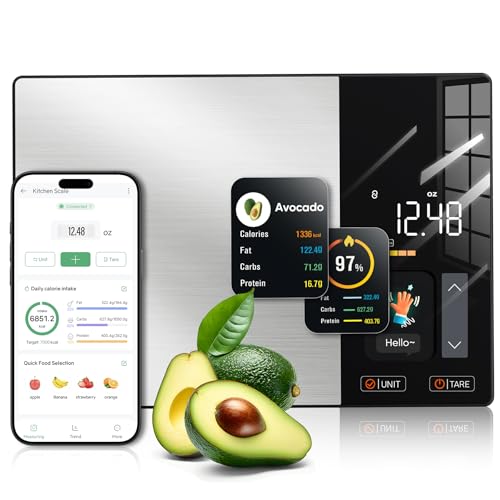
What immediately sets the KUAIVO apart is its vibrant full-color TFT display, which shows calories, protein, carbs, and fat in a graphical layout that’s much easier to digest at a glance than a traditional monochrome LCD. The screen also renders daily progress bars that update automatically as you add ingredients, giving you a live view of your remaining macro allowance.
It tracks 23 nutrients per food item — deeper than most competitors in this price bracket — and includes 50 pre-programmed foods built directly into the scale for offline use. The companion app records your intake by day, week, and month, and offers personalized guidance based on your eating patterns.
Weighing capacity reaches 5 kg with 1-gram readability, and the dual-scale design (small surface for precise medication or spice weighing, larger surface for bowls of produce) is genuinely useful for multi-purpose kitchens. Touch buttons are responsive, and the tare function zeroes out containers reliably.
Why it’s great
- Color TFT display provides instant nutritional feedback
- 50 pre-programmed foods work without an internet connection
- Dual-scale design handles both small and large portions
Good to know
- Touch buttons can be overly sensitive to palm contact
- App cannot log food independently without the scale
4. Eat Smart Digital Nutrition Food Scale
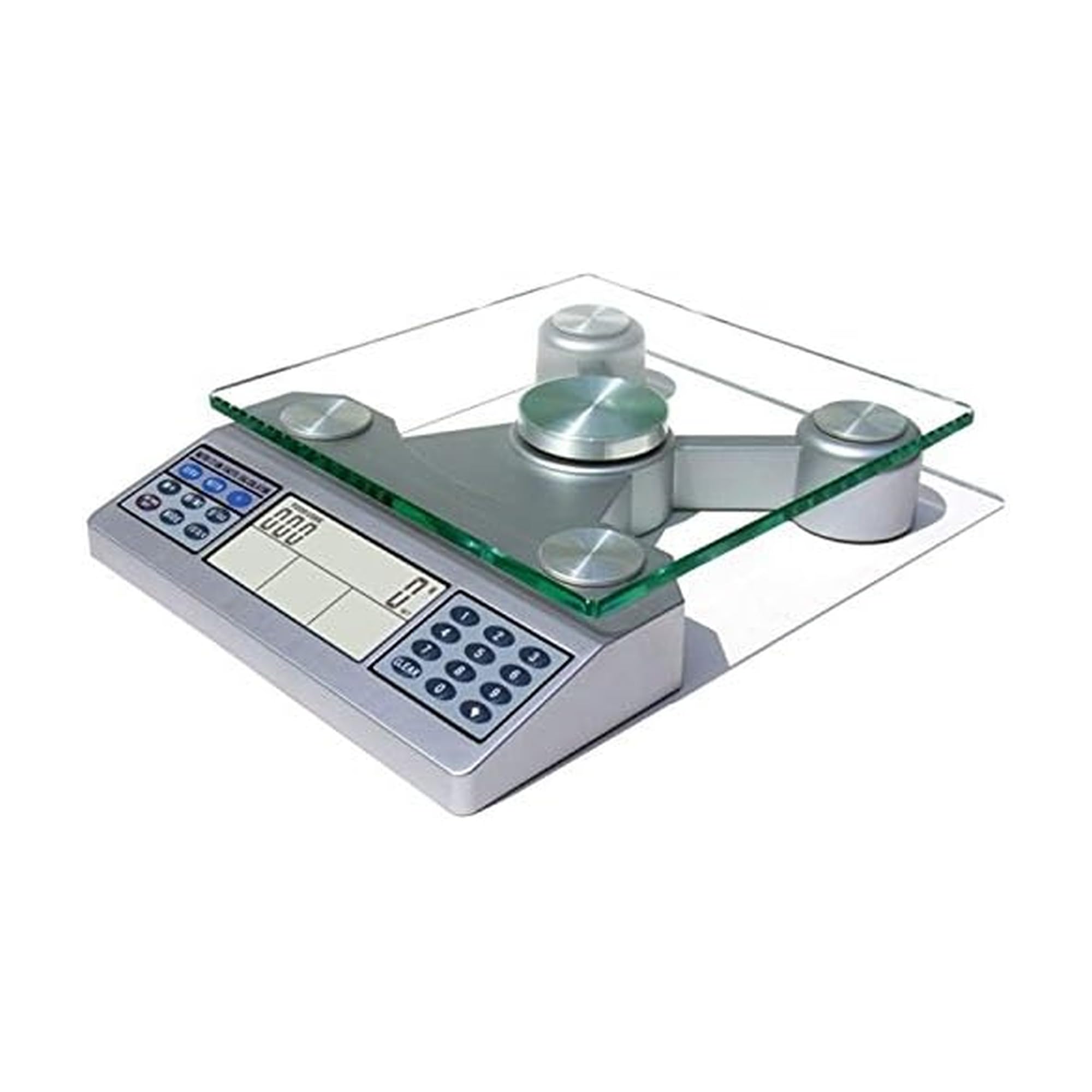
The Eat Smart is a refreshing throwback for users who want nutritional data without pairing to a phone. Its code book contains 999 pre-programmed ingredients and processed foods — you punch in a three-digit code, weigh the portion, and the large backlit LCD displays calories, carbs, fat, protein, fiber, sodium, and several micronutrients instantly.
It tracks calcium, potassium, magnesium, Vitamin K, and cholesterol alongside the standard macros, which is uncommon in non-connected scales. The memory mode stores up to 99 entries for daily or weekly tracking, and an integrated USDA tool allows you to add custom foods when the code book comes up short.
The max capacity tops out at 11 lb with 1-gram resolution in grams and 0.1 oz in ounces. The tare function works as expected, and the glass platform is easy to wipe down. The included physical guidebook is genuinely useful for learning portion sizes without staring at a screen.
Why it’s great
- 999 pre-programmed foods work completely offline
- Backlit LCD shows multiple nutrients on one screen
- Memory mode stores up to 99 daily entries
Good to know
- Database is heavier on meat/dairy than fruits and vegetables
- Glass tray can develop wobble after extended use
5. Ultrean Smart Food Scale
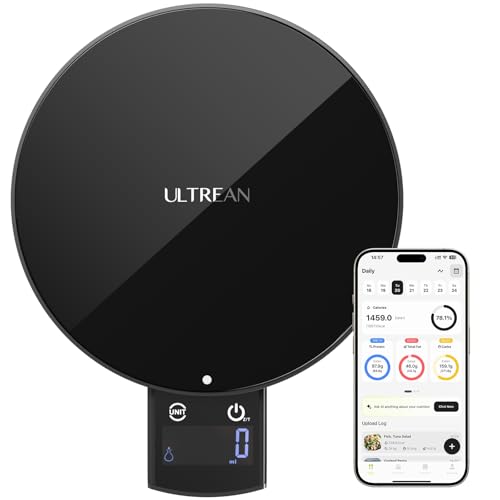
The Ultrean delivers surprising depth for its price point, offering analysis of 20 nutrients per food item through the NutriScale app. The barcode scanner works with US products to pull up nutrition facts instantly, and the app backs this with a multi-million food database for manual searches.
Its four high-precision sensors measure accurately from 1 g to 15 kg (33 lb), which is double the capacity of most competitors. This makes it uniquely suited for heavy meal prep sessions where you’re weighing entire batches of ingredients at once. The tempered glass surface is easy to clean and the slim 0.79-inch profile tucks away neatly in a drawer.
The app generates daily, weekly, and monthly reports with AI insights that highlight trends like sodium intake spikes or protein deficiencies. It uses 3 AAA batteries, which is less convenient than USB-C, but the battery life is solid with normal use. The tare function and unit switching between g, oz, lb:oz, and ml work without issue.
Why it’s great
- 33 lb capacity handles bulk meal prep with ease
- AI-driven insights in the app help identify diet patterns
- Tempered glass surface is easy to clean and durable
Good to know
- Barcode scanner is currently limited to US products
- Runs on AAA batteries rather than rechargeable cells
6. Fitbit Inspire 3

The Fitbit Inspire 3 takes a fundamentally different approach to calorie tracking — instead of weighing individual ingredients, it estimates your total daily energy expenditure using 24/7 heart rate monitoring, movement patterns, and 40+ exercise modes. This gives you a calorie budget rather than an intake log, which some users find more sustainable than weighing every gram.
The 10-day battery life is excellent for a device this slim, and the color AMOLED touchscreen is bright enough to read outdoors. Sleep tracking provides a daily Sleep Score with breakdowns of light, deep, and REM stages, and the Stress Management Score helps contextualize how your day-to-day habits affect your overall energy balance.
For calorie counter purposes, the Inspire 3 works best in tandem with a food scale — you log meals through the Fitbit app using barcode scanning and manual entry, and the tracker adjusts your remaining calorie allowance based on your activity. The companion app includes a food database, though it’s not as deep as dedicated nutrition scale apps.
Why it’s great
- 10-day battery life between charges is best-in-class
- 24/7 heart rate provides accurate calorie burn estimates
- Slim form factor wears comfortably 24/7 including sleep
Good to know
- Proprietary charging cable can wear out over time
- Not a standalone food scale — requires separate logging
7. Google Fitbit Air
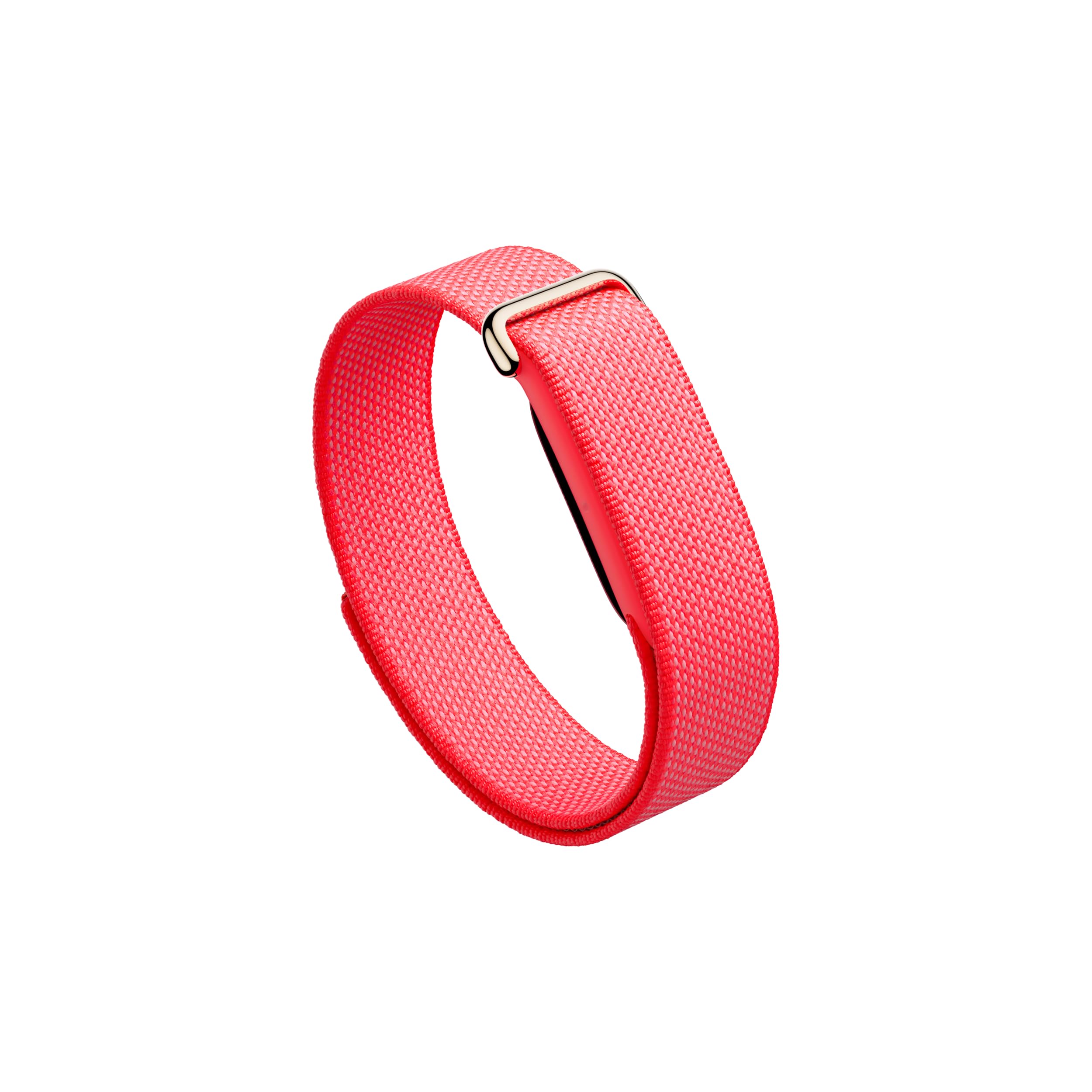
The Fitbit Air is a screenless activity tracker that prioritizes distraction-free calorie burn tracking over screen time. Its optical heart rate sensor runs 24/7 and feeds data into the Google Health app, which uses AI coaching to adjust your daily activity and calorie targets based on your actual performance rather than static goals.
Battery life stretches up to seven days, and a five-minute fast charge delivers a full day of use — a practical convenience for users who forget to charge overnight. The micro-adjustable woven band fits wrists from 130 mm to 210 mm and is comfortable enough for sleep tracking, which measures HRV, SpO2, and sleep stages automatically.
For calorie counter purposes, the Air relies on the Google Health Premium subscription for deeper coaching and meal logging integration. Without the subscription, it functions as a solid step counter and heart rate tracker, but the real value emerges when you pair it with a food scale and use the AI coaching to correlate your intake with your activity data over weeks.
Why it’s great
- Screenless design means no distractions during workouts
- 5-minute fast charge delivers a full day of use
- Advanced sensors track HR, SpO2, and HRV 24/7
Good to know
- Premium subscription needed for full AI coaching features
- Distance tracking during runs is less accurate than dedicated GPS
FAQ
Can a single calorie counter device replace both a food scale and a fitness tracker?
How often do I need to calibrate a smart nutrition scale?
What is the difference between AI scan barcode and a pre-programmed code book?
Final Thoughts: The Verdict
For most users, the best calorie counter device is the Cosori Smart Food Kitchen Scale because it combines USB-C rechargeability, a million-entry database, and on-screen 19-nutrient tracking in a sleek package that works equally well for Keto dieters and macro-focused athletes. If you want a stainless steel option with deeper Apple Health integration, grab the Etekcity Smart Food Kitchen Scale. And for offline use without a phone, nothing beats the Eat Smart Digital Nutrition Food Scale and its code-book system that puts all 999 foods at your fingertips.