
Standard camcorders fall apart the moment the sun dips below the horizon. The sensor noise spikes, autofocus hunts endlessly, and the footage dissolves into a grainy mess. A true night-vision camcorder solves this with infrared illuminators, high-sensitivity sensors, or thermal detection, delivering usable footage where conventional cameras see nothing but black.
I’m Min — the co-founder and writer behind Gadgets Feed. I’ve spent hundreds of hours dissecting sensor specs, IR wavelength ranges, and low-light SNR data to separate marketing fiction from real-world performance in this specialized category.
Whether you need to document nocturnal wildlife, patrol a property perimeter, or produce content after dark, finding the right tool means understanding sensor size, lux rating, and IR throw distance. This guide breaks down the best camcorder for night vision across every serious use case.
How To Choose The Best Camcorder For Night Vision
Night vision camcorders are not all built the same. The gap between an IR-only budget model and a true starlight sensor can mean the difference between a recognizable shape at 50 meters and a crisp, color-accurate image at 150 meters. Here are the specific factors that matter.
Sensor Size and Pixel Pitch
A 1-inch CMOS sensor like the one in the DJI Osmo Pocket 3 collects significantly more light per pixel than the tiny 1/2.3-inch sensors found in most budget camcorders. Larger pixels mean better signal-to-noise ratio in low light — the single most important hardware spec for night performance. Avoid models that brag about high megapixel counts without disclosing sensor size; tiny pixels packed densely create noise, not detail, in darkness.
Illuminator Type and Range
IR-based camcorders rely on built-in or accessory LED illuminators. The key spec is the IR wavelength (typically 850nm or 940nm) and the effective throw distance in meters. 850nm illuminators produce a visible red glow but reach farther; 940nm is completely covert but yields shorter range and dimmer illumination. For thermal imagers like the MiLESEEY TNV10 PRO, there is no illuminator — the sensor reads heat signatures directly, making it usable in complete optical darkness.
Refresh Rate and Lag
For handheld or moving subjects, a 50Hz or 60Hz sensor refresh rate is the minimum for smooth footage. Budget units often operate at 30Hz or lower, producing a choppy, stroboscopic effect when panning. The MiLESEEY TNV10 PRO’s 50Hz refresh rate and 800×600 OLED display make it one of the smoothest options in the thermal category for dynamic outdoor use.
Quick Comparison
On smaller screens, swipe sideways to see the full table.
| Model | Category | Best For | Key Spec | Amazon |
|---|---|---|---|---|
| Sony FDR-AX43 | Premium Camcorder | General low-light video | 1/2.5″ Exmor R sensor | Amazon |
| Canon VIXIA HF G70 | Premium Camcorder | 4K UHD with time stamp | 1/2.3″ 4K UHD sensor | Amazon |
| Canon XA70 Pro | Professional Camcorder | Pro audio & low-light | 1″ CMOS sensor | Amazon |
| DJI Osmo Pocket 3 | Compact Gimbal | Vlogging & travel | 1″ CMOS, 4K/120fps | Amazon |
| SiOnyx Aurora PRO | Starlight NV | Color night vision | 2 millilux sensitivity | Amazon |
| SiOnyx Aurora Black Kit | Starlight NV | Rugged outdoor use | IP67, color NV | Amazon |
| MiLESEEY TNV10 PRO | Thermal Monocular | Heat detection | 320×240 IR sensor | Amazon |
| ABJURNJ 6K Camcorder | Budget IR Camcorder | Entry-level night video | IR night vision, 64MP | Amazon |
| Acuvar 6K Camera | Budget IR Camcorder | Kit with accessories | IR night, LED fill light | Amazon |
In‑Depth Reviews
1. Canon XA70 Pro Camcorder

The Canon XA70 Pro is built for shooters who refuse to compromise on low-light quality. Its 1-inch CMOS sensor — significantly larger than the 1/2.3-inch sensors found in most camcorders at its tier — gathers substantially more light per pixel, translating to cleaner, less noisy footage at dusk and under artificial lighting. The DIGIC DV6 processor handles the data stream without introducing perceptible lag, even when recording 4K UHD at 160Mbps.
Beyond sensor performance, the XA70 Pro offers professional audio via two XLR inputs on the detachable handle, dual SD card slots for relay or simultaneous recording, and UVC-based HD live streaming over USB Type-C. The 15x optical zoom lens covers a usable range from wide to telephoto, and the optical image stabilization keeps handheld shots steady when you’re working in dim conditions without a tripod.
The infrared night vision mode in the XA70 Pro uses Sony’s NightShot-style IR cut filter removal, allowing the sensor to see into the near-infrared spectrum when paired with an external IR light source. This makes it a viable choice for covert wildlife or surveillance work. The 3.5-inch touchscreen and tiltable OLED EVF give you two ways to frame shots, though some users note the monitor resolution could be sharper for critical focus checks in bright light.
Why it’s great
- Large 1-inch sensor delivers exceptional low-light SNR
- Dual XLR audio inputs for professional sound capture
- IR night vision mode with external illuminator support
- UVC live streaming without capture card
Good to know
- Monitor resolution is lower than ideal for critical focus
- ND filter implementation may have quality variance
- Requires manual settings knowledge for best results
2. Sony FDR-AX43 Handycam

Sony’s FDR-AX43 brings the company’s Exmor R back-illuminated sensor technology to a consumer-friendly 4K Handycam. The 1/2.5-inch sensor may be smaller than the XA70’s 1-inch chip, but the back-illuminated architecture improves light collection efficiency by repositioning the wiring layer behind the photodiodes, reducing noise in dim conditions. The Balanced Optical SteadyShot system uses a built-in gimbal mechanism to physically stabilize the lens block, delivering smooth footage even when walking or panning at night.
The 20x optical zoom and 30x Clear Image Zoom in 4K mode give you genuine reach without resorting to grainy digital cropping. Fast Intelligent AF tracks subjects reliably in moderate light, though it does hunt more aggressively than the XA70’s Dual Pixel system in very low light. The camcorder also includes built-in Wi-Fi and NFC for remote control and file transfer via the Sony Imaging Edge Mobile app.
For night vision specifically, the FDR-AX43 includes Sony’s built-in IR mode with an integrated IR LED that illuminates subjects up to several meters. The IR footage is monochrome and has moderate grain at longer distances, but for close-range observation or event recording in complete darkness, it works adequately. The battery life is solid, and you can power the camcorder via USB while recording, making it suitable for long-duration stationary setups.
Why it’s great
- Built-in gimbal stabilization for smooth low-light footage
- Exmor R sensor improves low-light performance
- 20x optical zoom with usable 30x 4K Clear Image Zoom
- Integrated IR LED for basic night vision
Good to know
- IR range is limited to a few meters
- No XLR audio inputs
- Date/time resets quickly when battery is removed
3. Canon VIXIA HF G70

The VIXIA HF G70 is Canon’s answer to the mid-range 4K camcorder market, pairing a 1/2.3-inch CMOS sensor with the DIGIC DV 6 image processor. While the sensor is smaller than the XA70’s 1-inch chip, the G70 compensates with excellent color science and an 8-blade aperture that produces pleasing cinematic bokeh. The 20x optical zoom lens is sharp across its range, and the advanced image stabilization system handles moderate shake well in low-light shooting scenarios.
A standout feature for professional users is the On-Screen Display Time Stamp recording, which embeds date, time, timecode, and other metadata directly into the video file — critical for evidentiary or documentation work. The G70 also supports UVC livestreaming over USB, allowing direct connection to a PC or Mac for HD streaming without additional hardware. The Hybrid AF system with face detection keeps subjects sharp in most conditions, though it can struggle with fast-moving objects in dim light.
Low-light performance on the HF G70 is decent for its class. The sensor can handle gain up to roughly +4dB before noise becomes noticeable, and +10dB before the image softens significantly. This makes it a capable camera for well-lit indoor events or dusk exterior work, but it falls short in true starlight or moonless conditions. The camcorder lacks a dedicated IR night vision mode, so for complete darkness, you would need an external IR illuminator paired with the camera’s low-light gain mode.
Why it’s great
- 8-blade aperture for cinematic highlight rendering
- Time Stamp OSD recording for documentation
- UVC livestreaming without capture card
- Dual SD card slots for relay recording
Good to know
- No built-in IR night vision mode
- Low-light performance is average for the price tier
- 4K autofocus can exhibit background jitter
4. DJI Osmo Pocket 3 Creator Combo
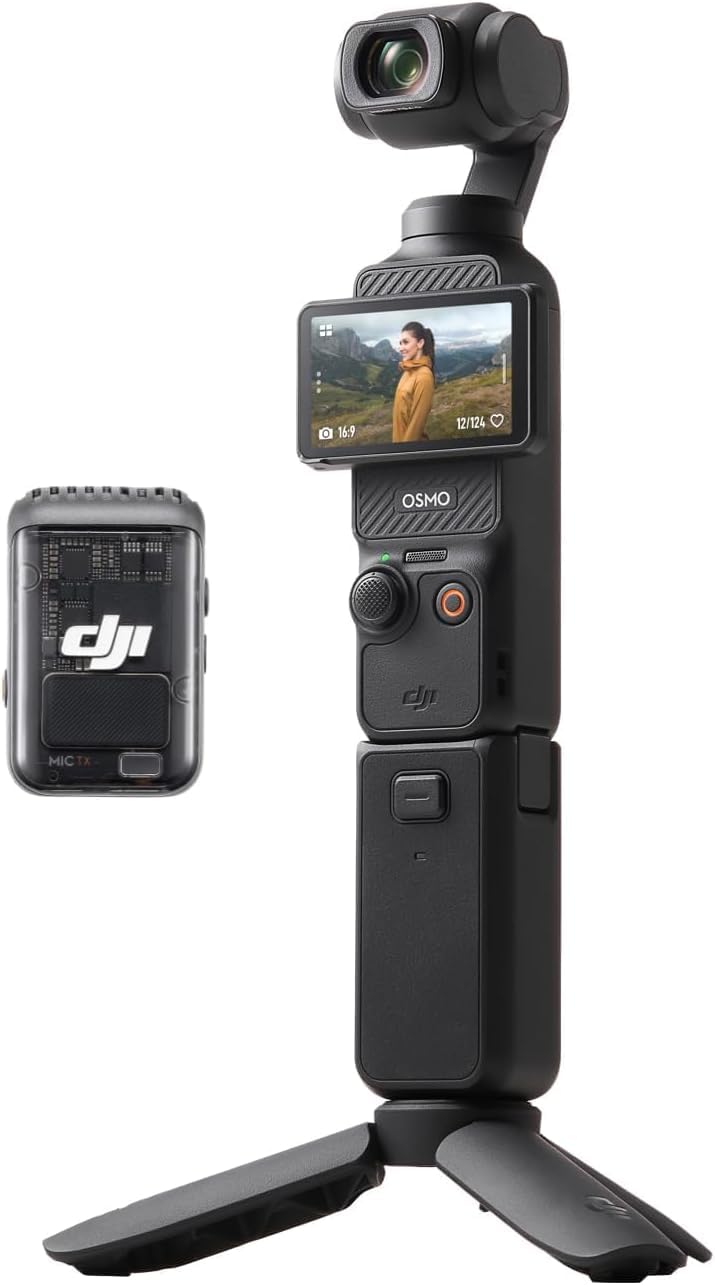
The DJI Osmo Pocket 3 packs a full 1-inch CMOS sensor into a package smaller than most candy bars. This sensor size, typically reserved for premium still cameras or large camcorders, gives the Pocket 3 a massive advantage in low-light recording over any smartphone or action camera. At 4K/120fps, it captures smooth slow-motion footage with minimal noise, even in dusk and twilight conditions. The 3-axis mechanical gimbal stabilization is class-leading — handheld night walking shots look like they were on a dolly.
The Creator Combo adds the DJI Mic 2 wireless transmitter for clean audio capture, a wide-angle lens for expanded field of view, a battery handle for extended runtime, and a mini tripod for hands-free operation. ActiveTrack 6.0 locks onto subjects reliably, making it an excellent tool for solo vloggers or content creators who need to move freely while remaining in frame. The 2-inch rotating touchscreen lets you switch between horizontal and vertical shooting instantly, optimized for multi-platform content workflows.
While the Pocket 3 does not include a dedicated IR night vision mode, its 1-inch sensor is sensitive enough to record usable color footage in very dim conditions where smaller sensors would produce only noise. For pitch-black environments, the high-gain mode with a portable LED panel is the practical workaround. The integrated stereo microphones record immersive audio, but the DJI Mic 2 included in the Creator Combo delivers significantly better clarity in windy or noisy environments.
Why it’s great
- 1-inch sensor delivers outstanding low-light performance
- 3-axis mechanical gimbal for ultra-smooth handheld footage
- 4K/120fps slow-motion in dim conditions
- Compact, pocketable form factor
Good to know
- No built-in IR night vision
- Fixed lens with 2x digital zoom only
- Gimbal is fragile and requires careful handling
5. SiOnyx Aurora PRO

The SiOnyx Aurora PRO is a dedicated digital night vision camera, not a camcorder with a night vision mode tacked on. Its proprietary sensor achieves 2 millilux sensitivity — meaning it can produce a usable color image in light equivalent to a moonless, overcast night. This is a fundamentally different technology from IR-based systems: the Aurora PRO amplifies ambient visible light rather than relying on an infrared illuminator, which means you see the scene in natural-appearing color instead of the green or black-and-white typical of IR cameras.
The camera offers multiple viewing modes including standard color, night color, and black-and-white, with the latter being the most sensitive. It records 720p HD video at 30fps and captures 0.9 MP stills, which is modest by modern camcorder standards but sufficient for identification and documentation. GPS and compass metadata are embedded in files, making it a useful tool for field researchers and outdoor guides who need geo-tagged evidence of nocturnal observations.
The Aurora PRO body is compact and runs on two included rechargeable batteries, each lasting about 2 hours of continuous recording. A 32GB microSD card is included in the box. The device lacks built-in optical image stabilization, so tripod mounting is recommended for stable long-duration recording. The Pro model’s 44-degree field of view is wider than the base Aurora, providing better situational awareness. Some users report the image quality is excellent in suburban conditions with moderate ambient light but becomes grainy in absolute darkness without supplemental IR illumination.
Why it’s great
- True color night vision without IR illumination
- 2 millilux sensitivity outperforms most consumer NV
- GPS and compass metadata for field documentation
- Compact and battery-swappable design
Good to know
- 720p resolution is lower than typical 4K camcorders
- No optical image stabilization
- Grainy in complete darkness without supplemental light
6. SiOnyx Aurora Black Kit

The SiOnyx Aurora Black shares the same core 2 millilux starlight sensor technology as the Aurora PRO but wraps it in a significantly more rugged housing. The IP67 rating means the camera is fully dust-tight and can be submerged in up to 3 feet of water for 30 minutes — a critical feature for boaters, fishermen, and outdoor professionals who operate near water. The operating temperature range of -20°C to +50°C and 1-meter drop resistance make it suitable for harsh environments where standard camcorders would fail.
The kit comes with two rechargeable batteries, a dual charger, a 32GB microSD card, and a waterproof protective case. It also includes an IR illuminator with its own batteries and rail mount, giving you the option to boost performance in total darkness. The camera has 3x digital zoom and records 720p video, same as the Aurora PRO, but the IP67 sealing and included hard case make this the better choice for environments where exposure to the elements is guaranteed.
Color night vision quality is comparable to the Aurora PRO — excellent in moonlit or starlit conditions, transitioning to grayscale and becoming grainier as light drops further. The IR illuminator extends usable range into complete darkness but at the cost of losing the natural color advantage. The camera connects to the SiOnyx mobile app for Wi-Fi streaming and remote control, though some users report the app connectivity can be unreliable. For pure night vision recording in wet, dusty, or cold conditions, the Aurora Black Kit delivers capabilities no standard camcorder can match.
Why it’s great
- IP67 water and dust resistance
- Color night vision in moonlit conditions
- Includes IR illuminator for total darkness
- Comes with protective hard case and dual chargers
Good to know
- 720p video resolution only
- Mobile app has connectivity issues
- Limited to 2 hours of battery life per charge
7. MiLESEEY TNV10 PRO Thermal Monocular

The MiLESEEY TNV10 PRO is a thermal monocular that records video, not a camcorder in the traditional sense. However, its ability to capture MP4 video at 400×300 resolution with a 50Hz refresh rate makes it a valid option for users who need to document heat signatures in complete darkness. The 320×240 native infrared sensor (not software-upscaled) combined with a 12μm pixel pitch delivers sharp thermal contrast, and the 800×600 OLED display provides a clear viewfinder experience.
The five viewing palettes — White Hot, Black Hot, Red Hot, Iron, and Jungle — allow you to optimize contrast for different environments. The Hotspot Tracking feature automatically locks onto the warmest object in the frame, making it easier to follow moving animals or people. The 4x digital zoom is adequate for the thermal category, though image clarity degrades predictably at maximum zoom. The 32GB of built-in memory stores hours of thermal footage without needing a separate SD card.
Battery life is exceptional at up to 12 hours of continuous runtime from the 4500mAh battery, and the IP65 rating protects against rain and dust. The device operates reliably from -20°C to 60°C. While the 400×300 video resolution is low compared to visible-light camcorders, thermal cameras are valued for contrast and temperature discrimination, not fine detail. The TNV10 PRO represents the best balance of thermal resolution, refresh rate, and durability at its price point, outperforming cheaper units that use lower-spec 160×120 sensors.
Why it’s great
- True 320×240 native thermal sensor
- 50Hz refresh rate for smooth live view
- 12-hour battery life
- Hotspot Tracking for moving targets
Good to know
- 400×300 video resolution is very low
- No visible-light or IR night vision mode
- Butterfly-style focus ring requires practice
8. ABJURNJ 6K Camcorder Video Camera

The ABJURNJ 6K Camcorder brings infrared night vision to the budget segment, making it accessible for beginners who need a simple all-in-one solution. The built-in IR LEDs switch on automatically in low light, allowing the camera to capture black-and-white footage in complete darkness at close to moderate range. The 4-inch touchscreen makes menu navigation straightforward, and the included handheld stabilizer improves handheld footage quality at the cost of added bulk.
Specs list 6K resolution at 30fps and 4K at 60fps, though real-world output is more comparable to interpolated HD in terms of actual sensor detail. The 18x digital zoom works best at standard zoom levels — pushing to maximum digital zoom significantly reduces clarity. The kit is generous: you get a 4500mAh battery, external microphone, 2.4G wireless remote, lens hood, 64GB SD card, and a carrying bag, covering most accessories a new creator would need.
The IR night vision on this camcorder is functional for indoor and close-range outdoor use — think recording a child sleeping, monitoring a campsite, or shooting a short film with IR effects. The 4500mAh battery claims up to 4.5 hours of recording time, and the ability to charge while recording is a practical bonus. Build quality is plastic but adequate for careful home use. For anyone on a tight budget who wants a dedicated camcorder rather than relying on a smartphone, the ABJURNJ delivers the essential IR night vision feature without breaking the bank.
Why it’s great
- Built-in IR night vision works in total darkness
- Generous accessory kit included
- 4500mAh battery with charging-while-recording
- Easy-to-use touchscreen interface
Good to know
- 6K and 4K claims are interpolated, not native
- Digital zoom degrades quality significantly
- Plastic build may not handle heavy use
9. Acuvar 4K/6K Video Camera Camcorder

The Acuvar 6K camcorder competes directly with the ABJURNJ, offering a similar feature set with a few twists. The key differentiator is the inclusion of both an IR night vision mode and a physical LED fill light. The IR mode handles complete darkness, while the LED fill light provides supplemental visible illumination that can improve color video quality when some ambient light is present. This dual approach gives you flexibility: use IR for covert observation, or switch to the LED fill when you want to retain some color information.
The kit is the most comprehensive in the budget tier, packing two 64GB SD cards, two 4500mAh batteries, a dual charger, a 50-inch tripod, external microphone, LED light, card reader, lens cleaning kit, and a carrying case. This is essentially a starter studio in a box — you won’t need to buy anything else except perhaps a hard drive for longer shoots. The smart auto focus system is a welcome upgrade over manual-focus-only budget camcorders, though it can hunt in low-light conditions.
Like its competitor, the 6K and 4K specifications should be taken with a grain of salt — the effective video resolution is closer to 1080p in real-world low-light conditions. The image struggles with lighting transitions and shows significant quality loss when zooming in. The external microphone included in the kit is better than the internal stereo mic but still produces thin audio compared to dedicated shotgun mics. For absolute beginners on a minimal budget who need IR night vision capability, the Acuvar kit offers the most accessories per dollar spent.
Why it’s great
- IR night vision plus LED fill light for versatility
- Most comprehensive accessory kit in the budget tier
- Smart auto focus system
- Two rechargeable batteries included
Good to know
- Video quality does not match 4K/6K claims
- Image degrades quickly with digital zoom
- Microphone audio quality is mediocre
FAQ
What is the difference between digital night vision and thermal imaging?
How far can a typical IR night vision camcorder see?
Can I use a regular camcorder at night without IR?
Final Thoughts: The Verdict
For most users, the best camcorder for night vision winner is the Canon XA70 Pro because its 1-inch sensor, IR mode, and professional audio give it the most versatility across both low-light and total-darkness scenarios. If you want true color night vision in a rugged package, grab the SiOnyx Aurora Black Kit. And for detecting heat signatures at long range in complete darkness, nothing beats the MiLESEEY TNV10 PRO.