
Our readers keep the lights on and my morning glass full of iced black tea. As an Amazon Associate, I earn from qualifying purchases.
Specs are compiled from manufacturer listings and verified buyer reviews and can change over time — please confirm the key details on the product page before buying.
The biggest enemy of ski footage isn’t the cold — it’s the shake. A camera strapped to your helmet or chest picks up every bump, carve, and speed wobble, turning what felt like a smooth run into unwatchable chaos. The fix is choosing a camera built to lock the horizon and steady the frame while you focus on the line ahead.
I’m Min — the founder and writer behind Gadgets Feed. This guide is built by comparing the manufacturers’ published specifications and the patterns across verified customer reviews, so you get each pick’s real strengths and trade-offs instead of marketing spin.
Here’s the plain-English breakdown of what actually holds up on a mountain, starting with the camcorder for skiing that gives you the most control over your footage after the run is over.
Our Picks at a Glance


How To Choose The Best Camcorder For Skiing
Every camera on this list survives the mountain, but they handle the job differently. You need to match the tool to how you actually ski and what you plan to do with the footage.
Stabilization is the whole game
On a slope, your head and body bounce constantly. A camera with strong electronic stabilization (software that smooths out the shake) keeps the video level and watchable. Look for terms like Horizon Lock or 360° Lock — these keep the horizon straight even when you rotate the camera fully.
Waterproof depth equals confidence
Snow is just water in another form, and crashes can bury a camera in slush. A camera rated for deep water without a case — like 33ft or 39ft — means a face-plant into powder won’t kill it. Snow won’t penetrate a sealed body easily, so deeper ratings give you confidence, not just specs.
Battery life is shorter than you think in the cold
Cold temperatures drain lithium batteries fast. A camera that claims hours of recording in a warm room might die after a couple of runs on the mountain. Check for cold-resistant batteries or models with a proven long runtime, and always plan to carry a spare.
Resolution and sensors set the ceiling
More megapixels and larger sensors capture more detail and handle low light better — which matters on overcast days or late-afternoon runs. A larger sensor (measured in inches, like 1/1.3″) lets in more light, producing clearer footage in flat, grey ski conditions.
Quick Comparison
| Model | Best For | Video Resolution | Still Photos | Waterproof Depth | Amazon |
|---|---|---|---|---|---|
| Insta360 X5★ Best Overall | Reframing shots later | 8K30 360° | 72 MP | Waterproof | Amazon |
| AKASO Brave 7 LEBudget Champion | Budget all-day battery | 4K30 | 20 MP | 131ft (with housing) | Amazon |
| SJCAM C400Longest Runtime | All-day recording | 4K UHD | — | 30M | Amazon |
| AKASO Brave 8 Lite | Fast action & zoom | 4K60 | 48 MP | 33ft | Amazon |
| Xtra Edge Pro | Night skiing | 4K60 | — | 65ft | Amazon |
| DJI Osmo Action 5 Pro | Cold-weather reliability | 4K/120fps | 8.3 MP | 20m (IP68) | Amazon |
| Insta360 Ace Pro 2 | Low-light & Leica color | 8K30 | — | 39ft | Amazon |
| GoPro HERO12 Black | Pro-grade stability | 5.3K HDR | 27 MP | 33 feet | Amazon |
| GoPro HERO13 Black | 8x slow-motion | 5.3K60 | 27 MP | 33′ | Amazon |
In‑Depth Reviews
1. Insta360 X5
Our pick — over 4.5★ from 2,000+ verified ratings; the strongest balance of quality and price.
The camera that lets you point anywhere and frame the run after you stop.
You never have to commit to one angle before you drop in. The Insta360 X5 captures the entire mountain around you in 360° at up to 8K30fps (8K resolution, 30 frames per second), so you ski your line and later use AI-assisted reframing (software that automatically picks the best view) to pull the perfect shot — including a third-person view that hides the selfie stick completely. You choose the composition back at the lodge, not at the top of the lift.
Action footage stays smooth thanks to FlowState Stabilization plus a full 360° Horizon Lock, which keeps the horizon level even during bumps or full rotations — no gimbal required. The dual 1/1.28″ sensors and triple AI chip design handle dim or night conditions with advanced noise reduction, so a grey, overcast ski day still produces crisp, vibrant footage. Audio gets attention too: a new 4-mic array with a built-in Wind Guard cuts wind interference and hones in on your voice, which matters when you’re narrating a run at speed.
What makes this camera unusually ski-friendly is the rugged build. The lenses are fully replaceable — you can swap a scratched or cracked lens in seconds, a huge relief if a crash sends the camera into ice. It’s waterproof, and the battery averages 208 minutes of life. Buyers report professional-quality results, with the crisp 8K footage and low-light performance earning the most praise. The consistent refrain is that it excels in dark conditions and delivers drone-like angles from a simple pole.
Why the mountain crowd loves it
- Shoots 360° so you never miss the angle you wanted
- Replaceable lenses survive crashes without a full replacement
- Horizon Lock keeps footage level through full rotations
The trade-offs to know
- 208-minute battery is solid but not the class leader
- Requires editing time to reframe your best shots
Grab this if: you want the freedom to shoot everything and pick your favorite angles later, with a camera that takes a beating.
Look elsewhere if: you want the longest single-charge runtime on the list — the SJCAM C400 outlasts it at 460 minutes vs 208.
2. AKASO Brave 7 LE
A starter-friendly action cam with an all-weather body and a battery that refuses to quit.
New to filming your skiing and don’t want to overspend? The AKASO Brave 7 LE skips the painful learning curve. It shoots 4K at 30fps (4K resolution, 30 frames per second) and captures 20MP photos (20 megapixels), with an IPX7 water-resistant design (meaning it survives rain, snow, and splashes) — and with the included waterproof housing, you can take it down to 131FT/40M, far deeper than any skier will ever need. It’s weatherproof by design, built to handle the full range of filming scenarios.
The defining feature here is the dual color screens. A vivid front screen makes self-filming easy, and the 2-inch back touchscreen simplifies navigation. It’s a compact, rugged package, with the 6-axis Electronic Image Stabilization (EIS) providing gimbal-like stability for fast-moving footage. The kit arrives with 2 rechargeable batteries, a remote, and a full set of mounting kits, so you have everything you need for a helmet or chest mount right from the start.
Battery life is where this camera surprises people. Owners mention the battery lasting 6 hours — enough for 10 short videos plus photos — before it hits red. That’s the kind of all-day endurance you want on a mountain, where stopping to swap batteries in the cold is a chore. The quality earns strong praise for the price, though a few note the camera needs natural light and has a slight learning curve. The front screen, dual-battery setup, and waterproof housing make it a phenomenal value for a first action camera.
Real-world endurance: The 6-hour battery life in real use beats the spec sheet expectations — a rare case of a budget camera outlasting models that cost three times as much.
Keep in mind: It’s at its best in good light; low-light performance is not this camera’s strength.
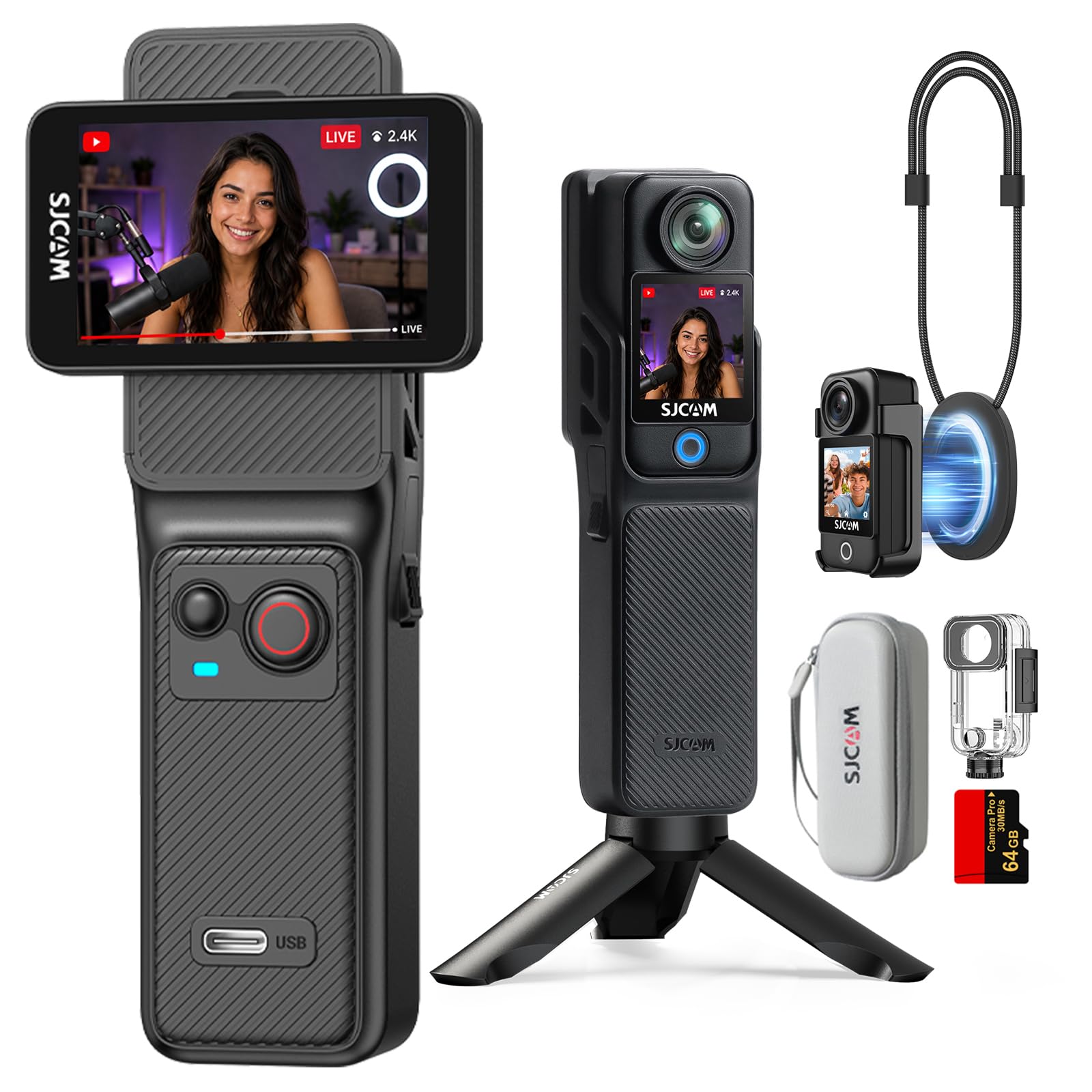
3. SJCAM C400
The one camera that records from first chair to last without a battery swap.
Battery anxiety is the real enemy of a full ski day, and the SJCAM C400 eliminates it. This camera packs a 460-minute (7-hour) continuous shooting capacity — that’s a massive 2.2x gap over the Insta360 X5’s 208 minutes — so you can start recording at sunrise and still have power for the final run. It’s the most reliable compact option for creators who need non-stop recording and don’t want to dig in their pockets for a spare battery on a freezing lift.
For ski footage, it brings a 154° distortion-free wide-angle lens with an f/2.0 large aperture, which captures expansive landscapes while improving low-light performance. The 6-axis Electronic Image Stabilization (EIS) with horizon correction keeps things smooth during intense action. The 2.29″ rotatable touchscreen flips to face you for easy framing, and the wireless control lets the handheld controller detach from the body — so you can preview footage and adjust settings from a distance. It comes with a waterproof kit rated to 30M, plus a handlebar mount and helmet base.
Beginners will appreciate the 5G WiFi for fast 4K transfers to a phone and a dedicated app that handles remote control and real-time sharing. The camera quality and value for money are praised most, and it ships with a 64GB memory card and tripod in the box. Image quality does draw mixed feedback — a few found the 4K at 30fps softer than brand-name 2K footage — and the 15-minute file limit means you’ll edit clips together. For a first-time vlogger who wants to film skiing and family days all day long, this is a solid, user-friendly choice.
What stands out
- 7-hour battery outlasts every camera on this list
- 154° wide-angle lens captures the full mountain view
- Detachable controller for wireless preview and control
Worth noting
- Mixed feedback on 4K sharpness compared to pricier brands
- 15-minute file segments require stitching in editing
Reach for this if: you want maximum recording time per charge and a beginner-friendly bundle with a memory card included.
Think twice if: you need top-tier image sharpness — the AKASO Brave 8 Lite and GoPro models deliver crisper 4K.
4. AKASO Brave 8 Lite
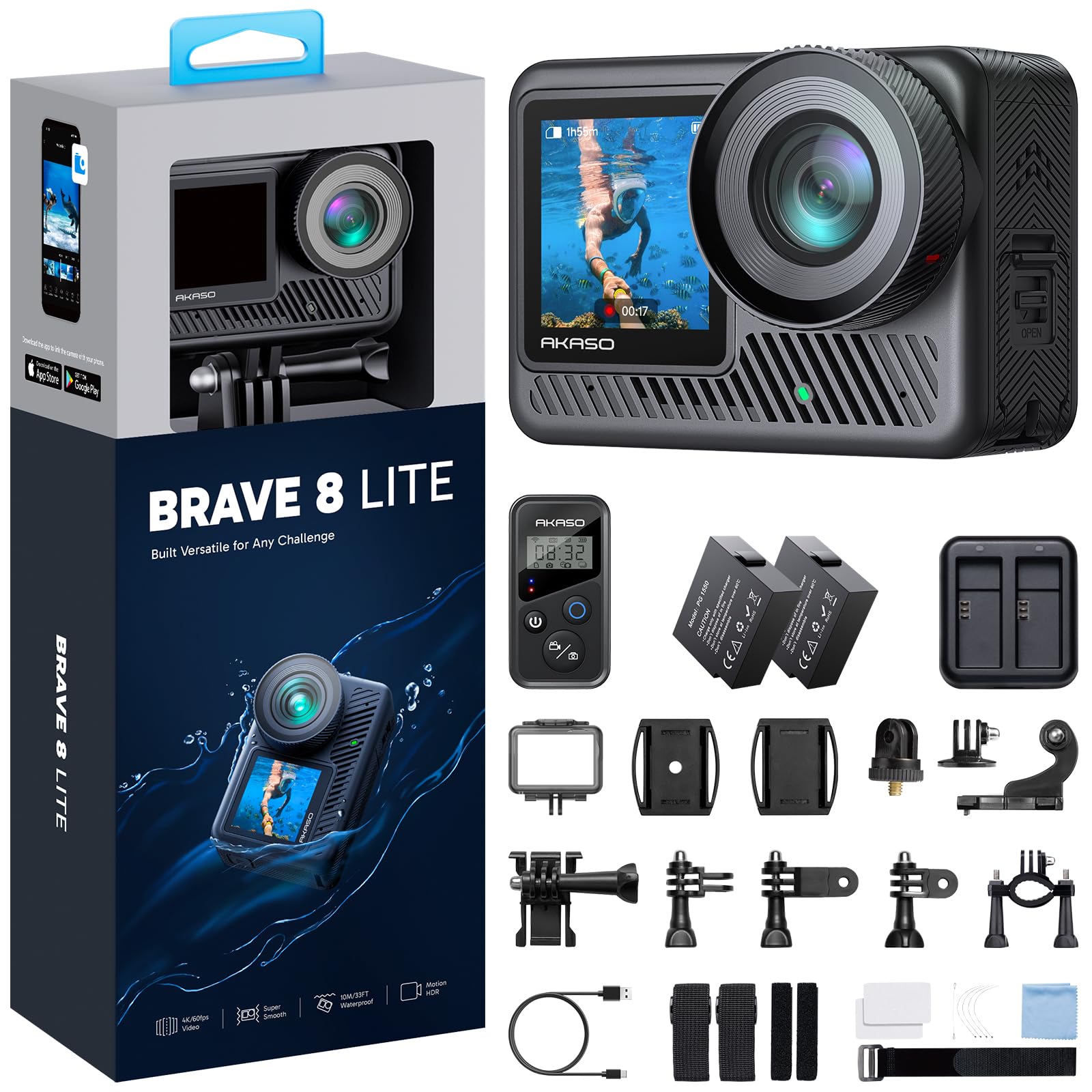
Silky-smooth 4K60 video with a zoom that pulls distant skiers into frame.
Speed is the name of the game on the Brave 8 Lite. It captures 4K60 UHD video (4K resolution at 60 frames per second) and 48MP photos (48 megapixels) on a 1/2-inch CMOS sensor (a light-capturing chip), with HDR technology (high dynamic range) that preserves detail in both bright snow and dark shadows for a balanced picture. Its “Supersmooth” 2-in-1 stabilization combines a built-in anti-shake component with an auto-smoothing algorithm, delivering silky footage even when you’re carving hard — this is the camera to grab if you want your powder turns to look as fluid as they feel.
The 5X digital zoom is a standout for skiing, letting you pull distant subjects closer when you can’t physically move — spot a friend in the lift line or a skier ahead on the ridge. Combined with 8X slow motion, you can replay fast action in ultra-slow motion and catch every frame of the action. The dual-screen design with a visual remote control makes self-recording easy, whether you’re strapping it to a helmet or holding it for a quick POV shot.
It’s waterproof to 33ft without a case, perfect for unexpected snow, slush, or a surprise dip. The kit includes 2 rechargeable 1550mAh batteries, each recording 4K30fps video up to 140 minutes, plus a visual remote, bike handlebar clamp, and helmet accessories. The video quality and picture quality earn the most praise, with owners calling it a great value that’s easy to use and reliable for occasional trips. Battery life and reliability get mixed feedback, and a couple of owners had trouble with app connectivity — so treat the app as a bonus, not a core feature.
The case for it: The 4K60 frame rate plus HDR is a combination that punches above this price tier, smoothing out fast action better than most budget options.
The catch: The 5X zoom is digital, so it crops into the sensor — expect some softness when fully zoomed.
5. Xtra Edge Pro
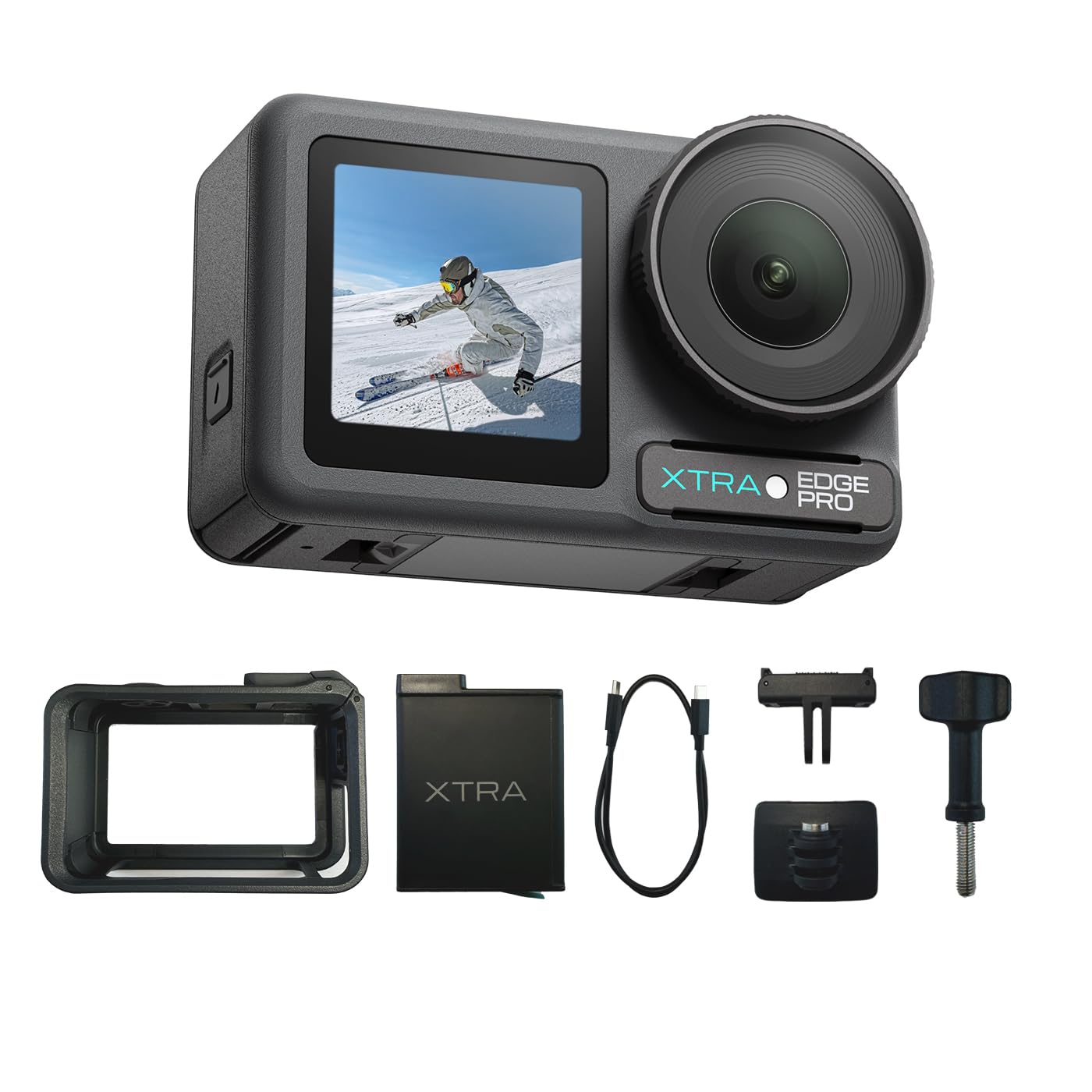
The big-sensor camera that stays sharp when the sun drops behind the ridge.
This camera is built for the hour most action cams give up on: dusk. The large 1/1.3″ sensor captures clearer videos and photos even in tricky light, which is exactly what you face skiing at dusk when the shadows get long. A Night View Mode brightens low-light scenes, so you can get usable footage on evening runs, campouts, or late drives home from the mountain. It shoots smooth 4K video at 60fps, making fast-paced skiing footage look professional.
Stability is fully automatic with 360 Lock, TiltGuard, and MotionMaster features working together to tackle shakes and bumps — whether you’re skiing, boarding, or off-roading. The ultra waterproof body works to 65ft without a case, more than enough for snow, slush, or snorkeling in the summer. The bundle includes a Dual-Facing Mount Adapter, a Cold-Resistant Battery, and a Dual-Orientation Protective Frame, which is a thoughtful touch for winter shooting.
Owners praise the sharp footage and detailed shots, calling it reliable and easy to use with built-in Wi-Fi and Bluetooth connectivity. The bundle is compatible with DJI Action 5 accessories, which saves money versus buying DJI-brand gear. Battery life reports are split — some see amazing endurance, others find a ~90-minute runtime at 4K — so carrying the included cold-resistant spare is smart. It’s a versatile option for anyone who skis late in the day and wants a camera that doesn’t go blind at sunset.
Where it shines
- Large 1/1.3″ sensor excels in low-light conditions
- Waterproof to 65ft without a case
- Includes a cold-resistant battery for winter
Watch for
- Real-world 4K battery runtime runs shorter than the 240-minute claim
- Works with DJI accessories, not included standard mounts
Choose this for: night skiing and low-light runs where a bigger sensor gives you a real advantage over smaller-sensor rivals.
skip it if: you need a full day of recording on one charge — the 240-minute claim runs shorter in practice at 4K.
6. DJI Osmo Action 5 Pro
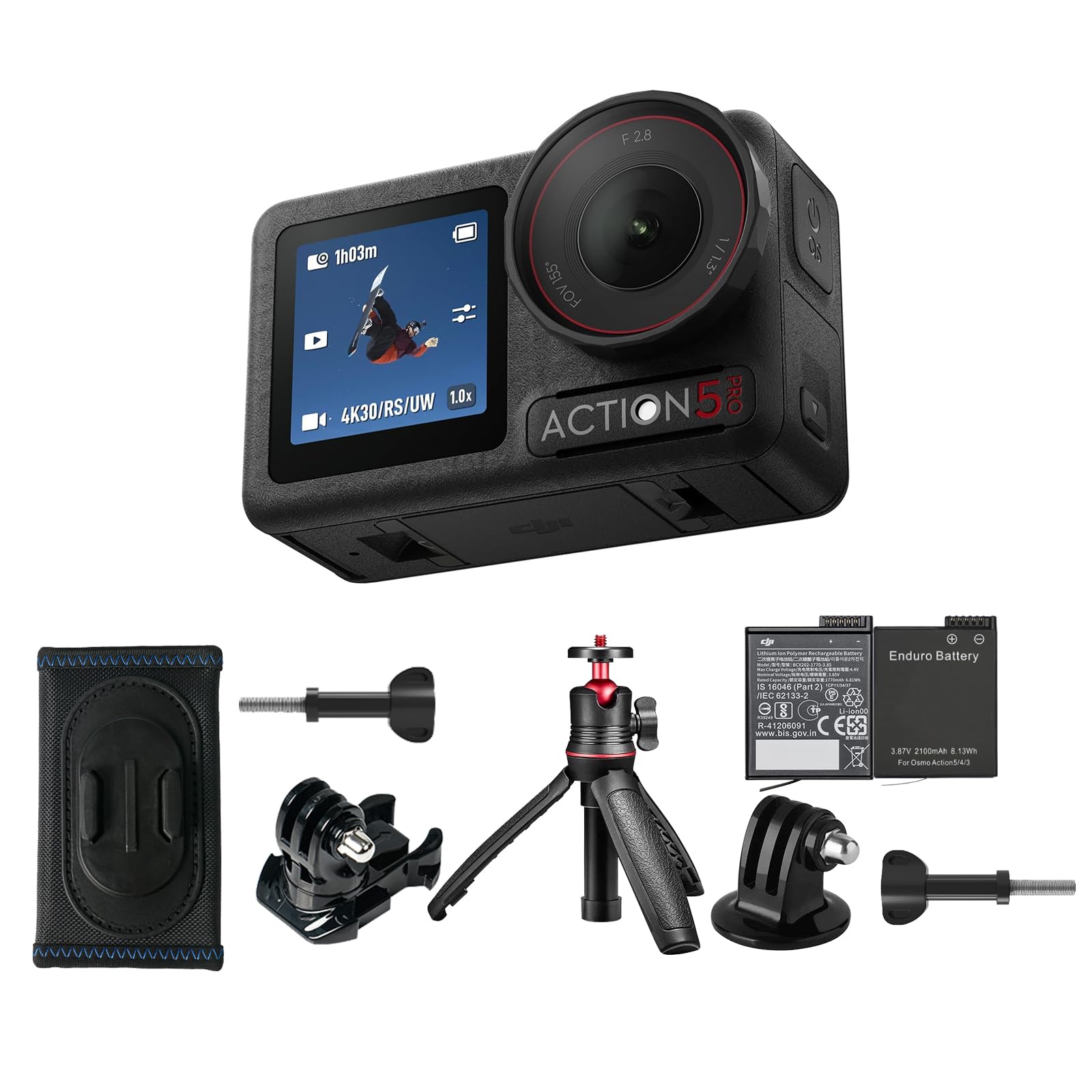
A cold-weather workhorse that keeps filming when temperatures drop to minus four.
This is the camera for skiers who treat their gear like gear. The DJI Osmo Action 5 Pro is rated IP68 for 20m underwater use (meaning it’s dust-tight and survives submersion), and it’s specifically engineered for cold: the high-capacity 1950mAh battery (1950 milliampere-hours) delivers up to 4 hours of recording, and it holds 3.6 hours at -20°C (-4°F) — a figure that matters enormously on a freezing mountain morning. Most cameras die in that cold; this one keeps rolling. Its 1/1.3″ sensor with 2.4µm large pixels (2.4 micrometers, for better light capture) and 13.5-stop dynamic range (the span between darkest and brightest details) delivers pro-grade low-light performance and clarity.
Stabilization is the headline feature: 360° HorizonSteady eliminates roll-axis shakes and keeps your horizon level through the messiest runs. The advanced 4nm chip keeps fast-moving subjects perfectly centered in 16:9 or 9:16 framing, ideal for capturing a skier friend or just your own line. Dual ultra-bright OLED touchscreens on the front and rear make framing and playback easy without removing the camera, and voice control that’s always on standby lets you capture moments hands-free at speed.
For vloggers, the audio story is strong: it connects directly to DJI Mic 2 or Mic mini transmitters with no receiver needed, perfect for solo skiing vlogs. A color temperature sensor delivers true-to-life color automatically — no filters needed. The Hiking Bundle adds an extra battery, a mini extension rod, and a backpack strap mount. Owners rave about the video quality and stabilization, with the rock-steady mode and easy interface drawing particular praise. A few note that water resistance and reliability have mixed reports, so treat it well and it’ll treat you well.
Why it’s a top-tier choice
- 3.6 hours of recording at -20°C keeps it alive in deep winter
- 360° HorizonSteady locks the horizon through full rotations
- Dual OLED touchscreens simplify on-mountain control
Before you buy
- 8.3MP stills trail the 27MP+ rivals if photos matter to you
- Premium price positions it above most action cams
This is the one if: you ski in genuinely cold places and want a camera rated to keep recording through it, with class-leading stabilization.
Look elsewhere if: still photography is a priority — the HERO13’s 27MP shots leave it behind.
7. Insta360 Ace Pro 2
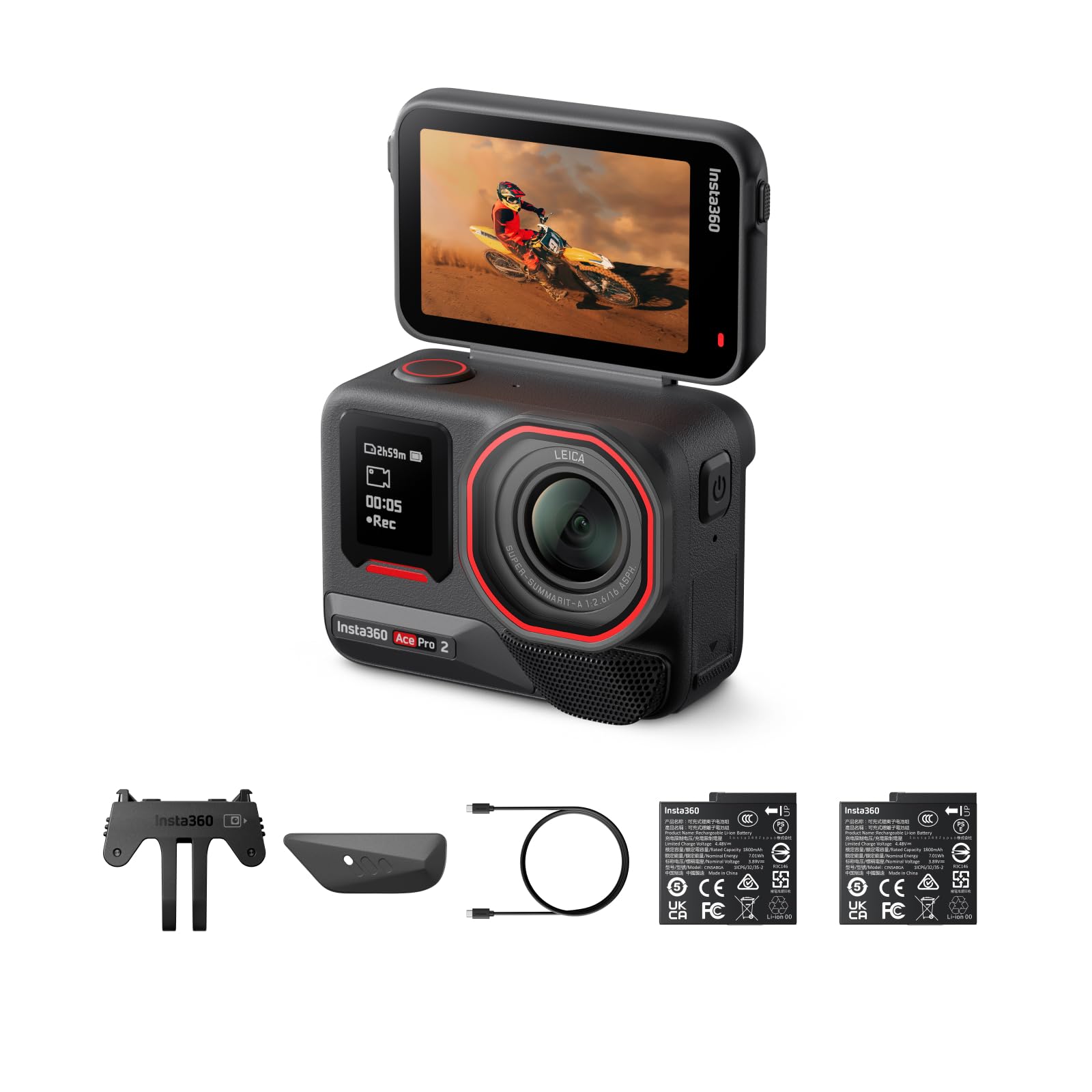
Leica-tuned colors and 8K clarity that make powder look like a film set.
If you want your ski footage to look cinematic rather than just recorded, the Insta360 Ace Pro 2 is the camera to beat. Co-engineered with Leica, it pairs a new 1/1.3″ 8K sensor with a Leica Summarit lens, delivering 13.5 stops of dynamic range and a 2.4µm equivalent pixel size. The result is 8K30fps video and 4K60fps Active HDR with exclusive Leica color profiles that give footage a signature, elegant look. It’s the camera for skiers who care about color grading and visual storytelling.
A dual AI chip setup — a dedicated Pro Imaging Chip for noise reduction plus a 5nm AI Chip — delivers 100% more computing power than the previous Ace Pro. PureVideo Mode pushes low-light excellence up to 4K60fps with AI noise reduction and enhanced brightness, so a flat, overcast day at the resort still yields crisp, detailed shots. The all-new Wind Guard snaps on to minimize wind noise while you narrate a run, and FlowState Stabilization keeps shots rock-solid through any adventure.
It’s built for winter sports and rated waterproof to 39ft (12m), handling temperatures as cold as -4°F (-20°C). The 2.5″ flip touchscreen stays visible even in bright sunlight. The Dual Battery Bundle includes 2 batteries, a standard mount, and a mic cap. Owners describe it as outperforming GoPro and DJI on image quality, low-light performance, and build — the durable, tank-like construction draws specific praise. It’s a premium investment, and the compact form means no optical zoom, but for committed skiers who want the best-looking footage, it’s a worthy splurge.
The creative edge
- Leica color profiles infuse footage with cinematic tones
- Waterproof to 39ft and rated to -4°F for winter
- PureVideo Mode excels in low-light conditions
Fair warnings
- No optical zoom due to the compact body
- Mixed reports on long-term durability after heavy use
Buy this for: the most cinematic, color-rich footage you can get from an action cam, especially on overcast or dark days.
Pass if: you want optical zoom or a budget-friendly price — this is a premium, image-first investment.
8. GoPro HERO12 Black

Award-winning HyperSmooth 6.0 keeps your ski run silky even when you’re not.
The GoPro HERO12 Black is the proven crowd favorite for action sports, and this bundle gives you a purpose-built kit. It shoots 5.3K HDR video and 27MP photos with a 1/1.9″ image sensor, capturing detail in shadows and highlights that flat-light days usually eat. The star feature is HyperSmooth 6.0 stabilization — an award-winning system that smooths footage with minimal cropping, so your skis, bikes, and skateboards all look professionally shot. HyperView and Horizon Lock redefine what’s possible when the camera rotates.
It’s fully waterproof to 33 feet without a housing, with a water-repelling lens cover that reduces reflections and artifacts. The Enduro battery offers up to 2.5 hours in the lowest FHD 30fps setting, or 90 minutes at 5.3K30fps. New Bluetooth audio support works with AirPods and other headphones as wireless mics, so you can capture crisp commentary while skiing. It also functions as a webcam and live-streams directly, making it versatile beyond the mountain.
The 50-piece accessory kit and 64GB microSDXC card make it ready to mount on a helmet, chest, or pole immediately. Owners call the image quality superior and praise the stabilization, ease of use, and build quality over budget cameras. The Horizon Lock detail impresses, and sticky mounts hold well on helmets through motorcycle rides. Low-light performance without a light source is the recurring weak spot, and some find the accessory kit a mixed bag — but the camera itself is a reliable, high-performing workhorse. For the well-traveled skier who also bikes, hikes, and dives, this is the safest bet.
What wins people over
- HyperSmooth 6.0 delivers industry-leading stabilization
- 5.3K HDR captures detail in bright snow and dark shadows
- Bluetooth audio lets wireless earbuds act as mics
Honest drawbacks
- Weak in low-light without an external light source
- Battery at 5.3K resolution runs about 90 minutes
Reach for it if: you want the most reliable, best-stabilized all-rounder with a full accessory kit included.
Think twice if: you regularly ski at dusk — the HERO13 and Xtra Edge Pro handle low light better.
9. GoPro HERO13 Black

Shoots 5.3K60 with 8x slow-motion so every powder spray is frame-perfect.
For the skier who loves replaying their best turns in dramatic slow motion, the GoPro HERO13 Black is built around that exact passion. It captures up to 5.3K60 video, and records UHD 5.3K60, 4K120, or a jaw-dropping 2.7K240 for 8x slow-motion playback. That 2.7K240 mode turns a fast carve into a buttery, frame-by-frame replay where you can count the snowflakes. The 1/1.9″ sensor, HDR/HLG options, and advanced GP-Log color depth make it a serious tool for pros and enthusiasts.
HyperSmooth 6.0 with AutoBoost keeps footage steady in extreme conditions, and 360 Horizon Lock keeps your video level no matter how much the camera rotates — essential for downhill runs with lots of turning. A 1900mAh Enduro battery provides up to 1.5 hours of 5.3K video recording, and the camera is waterproof to 33′ without a housing. Bluetooth audio lets you connect wireless mics or headphones, while Wi-Fi 6 support enables fast wireless file transfers to the GoPro Quik app.
The bundle includes a 50-piece accessory kit and a 64GB microSDXC card, so it’s ready for a helmet or chest mount instantly. Owners praise the quality and dependability, calling it a reliable companion in all weather and environmental situations. The camera’s color science shines even underwater — one traveler captured beautiful shots while swimming with sea turtles in Hawaii. Durability has some mixed feedback, and a few note the tripod accessory is flimsy, but the camera itself gets consistent praise for its build. For versatile creators who film skiing plus a full spectrum of adventures, the HERO13 is a forward-looking investment.
The standout features
- 2.7K240 slow-motion captures 8x playback for dramatic replays
- Wi-Fi 6 makes wireless file transfers much faster
- AutoBoost smooths footage with minimal cropping
Things to know
- 1.5-hour battery at 5.3K means carrying a spare is wise
- Bundle accessories vary in quality — the camera is the star
Get this if: slow-motion replay is your favorite part of sharing ski footage, and you want the newest GoPro feature set.
pass on it if: you’re on a tighter budget — the HERO12 delivers most of the core experience for less.
Understanding the Specs
Image Stabilization & Horizon Lock
Stabilization is software (or hardware) that removes the shake from your footage. Electronic Image Stabilization (EIS) uses the sensor and gyroscope to smooth out jumps and bumps. Horizon Lock goes a step further — it keeps the horizon perfectly level even when the camera rotates a full 360°, which is essential when you’re tumbling or carving aggressively. Look for cameras that offer some form of horizon lock for the cleanest ski footage.
Waterproof Depth Ratings
The depth rating tells you how deep the camera can go underwater without a housing. For skiing, you don’t need deep ratings — snow and slush are shallow threats. A camera rated for 33ft or more without a case means the seals are solid enough to handle repeated impacts with powder and ice. Deeper ratings (like 65ft or 131ft with a housing) give extra confidence but also make the camera more versatile for summer snorkeling.
Battery Life & Cold Performance
Battery life is measured in minutes or hours of continuous recording. Cold air drains lithium batteries much faster than warm rooms, so a camera that claims 208 minutes in the lab might only deliver half that on a freezing mountain. Some brands include cold-resistant batteries or rate their performance at -20°C, which is a genuine advantage for winter sports. Always carry a spare battery, and check if the camera’s cold-weather performance is documented.
Sensor Size & Resolution
The sensor is the camera’s light-capturing surface, measured in inches (like 1/1.3″ or 1/1.9″). A larger sensor collects more light, which means cleaner footage in low-light conditions — critical for overcast ski days and dusk runs. Video resolution (4K, 5.3K, 8K) determines how much detail is recorded; higher resolution gives you more flexibility to crop and zoom in post-production without losing sharpness.
FAQ
Why does my action camera die so fast in the cold?
What is the difference between EIS and Horizon Lock?
Do I need a waterproof housing for skiing?
Is 4K resolution enough for ski footage?
Which camera is better for filming skiing, a GoPro or a DJI?
How do 360° cameras work for skiing?
What does the waterproof depth rating actually mean?
Can I use wireless headphones as a microphone for skiing?
Do I need a high-speed memory card for 4K or 8K video?
Final Thoughts: The Verdict
For most skiers, the top pick for a camcorder for skiing is the Insta360 X5 because its 360° capture and replaceable lenses free you from choosing a single angle before a run. If you want the longest battery life for all-day recording, grab the SJCAM C400. And for deep-cold reliability and class-leading stabilization, the DJI Osmo Action 5 Pro is the one to reach for.
How We Picked
We do not accept paid placement. Every pick is matched to a real buyer and a real use-case; we do not hands-on test units.
Sources & Methodology
Specifications: manufacturer listings and product documentation. Review insights: verified customer reviews, as of August 2026. Pricing: not shown on this page (it changes often); check the current price via the retailer link.
As an Amazon Associate, Gadgets Feed earns from qualifying purchases. This does not affect which products we feature.