
Chasing that grainy, warm, nostalgic film aesthetic doesn’t require a time machine or a bulky 90s shoulder-cam. The modern camcorder market has responded with a fascinating split: dedicated handhelds that deliver authentic 1080p Handycam grain, and modern action cams packing retro filters that mimic Kodak and Fuji film stocks in-camera. The challenge is navigating the noise to find a camcorder whose sensor, lens, processing engine, and color science actually serve your vision—without breaking your back or your budget.
I’m Min — the co-founder and writer behind Gadgets Feed. I’ve spent the last decade dissecting sensor sizes, bitrates, optical zoom ratios, and stabilization algorithms to separate genuine vintage-capable hardware from marketing fluff. This guide is built from that research, not speculation.
Whether you’re shooting street photography, music videos, or vlogs with a 2000s edge, finding the right camcorder for vintage look means understanding which specs—like manual exposure controls, resolution trade-offs, and optical zoom—actually deliver that timeless texture without post-processing headaches.
How To Choose The Best Camcorder For Vintage Look
The vintage look is a moving target. Some creators want the blown-out highlights and chromatic aberration of a 1990s Handycam, while others aim for the warm, film-like grain of Super 8 or classic 35mm cinema. Your choice of camcorder—specifically its sensor, lens, and built-in color profiles—will either accelerate or destroy that aesthetic. Here are the concrete specs that matter.
Sensor Size and Resolution Trade-offs
A small 1/5.8″ CMOS sensor at 1080p naturally produces the noise and limited dynamic range characteristic of old camcorders. That’s authentic. In contrast, a 1-inch sensor like the one in the Panasonic HC-X20 offers cleaner, more flexible footage that can be graded to vintage in post, but it won’t look retro out-of-the-box. Decide whether you want in-camera nostalgia or a pristine canvas for LUTs.
Optical Zoom vs. Digital Zoom
Optical zoom—measured in mm equivalent (e.g., 26.8mm to 804mm)—uses the lens glass to magnify the scene, preserving the analog compression and subtle barrel distortion that old zooms are famous for. Digital zoom just crops and sharpens pixels, killing the organic feel. Look for at least 20x optical zoom, and ignore any camera that brags about “250x digital zoom” for vintage work.
In-Camera Color Profiles and Filters
Some camcorders now ship with dedicated retro filter modes. The Insta360 GO 3S Retro Bundle has Positive and Negative Film presets that mimic specific film stocks. Older Sony Handycams include Picture Effects like “Old Movie” that simulate sepia and soft focus. If you want a vintage look without a computer, this is your most important check: does the camera have a film simulation mode, or do you need to grade raw footage?
Quick Comparison
On smaller screens, swipe sideways to see the full table.
| Model | Category | Best For | Key Spec | Amazon |
|---|---|---|---|---|
| Sony FDR-AX43 | Premium | Balanced Optical SteadyShot with gimbal | 20x optical zoom, Zeiss lens | Amazon |
| Panasonic HC-X20 | Pro | Professional 4K 60p with 1-inch sensor | 20x optical zoom, Dual SD slots | Amazon |
| Canon VIXIA HF G10 | Prosumer | Manual control with HD CMOS Pro | 10x optical zoom, 32GB internal | Amazon |
| Canon VIXIA HF R700 | Mid-Range | Long 57x zoom with image stabilization | 57x Advanced Zoom, touch LCD | Amazon |
| Insta360 GO 3S Retro | Action | Hands-free POV with retro filters | 4K30fps, 128GB, Film Presets | Amazon |
| Sony HDRCX405 | Entry | Ultra-compact 1080p with 30x zoom | 30x optical zoom, 1080p60 | Amazon |
| OBSBOT Tail Air | Streaming | AI tracking PTZ for live streams | 4K30, NDI, 23mm f/1.8 lens | Amazon |
| Minolta Camcorder | Budget | Entry-level 4K with night vision | 16x digital zoom, 3″ touchscreen | Amazon |
| FlyFrost 8K | Budget | Multipurpose vlogging with 8k | 18x digital zoom, Wi-Fi, 88MP | Amazon |
In‑Depth Reviews
1. Sony FDR-AX43 UHD 4K Handycam Camcorder

The Sony FDR-AX43 combines a 1/2.5-inch Exmor R CMOS sensor with a built-in gimbal—Balanced Optical SteadyShot—that mechanically stabilizes the lens element. This is the same stabilization tech found in Sony’s pro camcorders, and for vintage-style shooting, it means you can run-and-gun at full 20x optical zoom without the micro-jitter that kills the handheld 90s look. The Zeiss Vario-Sonnar T lens (26.8mm wide-end) delivers that characteristic Zeiss contrast and warm color science.
For the vintage aesthetic, shoot at 4K then downscale to 1080p in post—you’ll retain more latitude for film grain and color grading. The Fast Intelligent AF tracks subjects relentlessly, which is a double-edged sword: it keeps you in focus, but can feel too clinical for a casual, nostalgic vibe. You can drop it into manual focus for that slightly soft, dreamy edge.
Wi-Fi and NFC connectivity make it easy to control from your phone, and the external mic input is critical for capturing that lo-fi audio texture without DSLR-style adapters. The only real compromise here is the small sensor—it won’t give you the cinematic shallow depth of field of a GH5, but for a purebred Handycam with gimbal-level stabilization, it’s unmatched.
Why it’s great
- Built-in gimbal stabilization is industry-leading for video.
- 20x optical zoom with Zeiss lens elements.
- 4K recording with Fast Intelligent AF.
Good to know
- No internal memory; requires U3 Micro SD card.
- Small 1/2.5″ sensor limits shallow depth of field.
2. Panasonic HC-X20 Professional 4K 60p Camcorder

If you need to capture pristine 4K 60p 4:2:2 10-bit footage that can be graded to look like anything—vintage film included—the Panasonic HC-X20 is the only professional camcorder on this list. The 1.0-inch 15-megapixel MOS sensor is a game-changer: it offers significantly more dynamic range and low-light capability than the 1/2.3-inch or 1/2.5-inch sensors found in consumer camcorders. This headroom lets you apply aggressive film LUTs without crushing blacks or blowing out highlights.
The 24.5mm wide-angle Leica Dicomar lens (24.5–490mm equivalent) with 20x optical zoom gives you the flexibility to shoot wide street scenes or compressed close-ups with genuine optical barrel distortion at the wide end—exactly what you want for an organic, analog look. The 5-Axis HYBRID O.I.S. stabilizes footage independently of the lens, which is vital for handheld run-and-gun where vintage authenticity requires slight movement without being unwatchable.
Dual SD card slots allow simultaneous recording or relay, and the XLR audio input with phantom power means you can pair this with a vintage ribbon mic for authentic lo-fi audio. The trade-off is size and weight: at over 1.3kg, it’s a full-sized camcorder body, not a pocket companion. It’s built for news, interviews, and events where image fidelity is the only priority.
Why it’s great
- 1-inch sensor delivers superior dynamic range for grading.
- 20x optical zoom with 24.5mm wide-angle.
- 4K 60p 4:2:2 10-bit internal recording.
Good to know
- Auto balance can darken image in strong light (fixable in manual).
- Heavy professional body—not for pocket carry.
3. Canon VIXIA HF G10 Full HD Camcorder

The Canon VIXIA HF G10 is a time capsule—a 1080p-only, HD CMOS Pro sensor camcorder released in 2011 that still outperforms many 4K consumer camcorders in image quality for vintage work. The HD CMOS Pro sensor is a back-illuminated design that captures exceptional 1080p detail with natural grain, not digital noise. Its 32GB internal flash memory plus dual SDXC slots mean you can record hours of footage without swapping cards.
The genuine Canon 10x HD video lens features an 8-blade iris—this is rare in consumer camcorders. An 8-blade iris produces rounder, more organic bokeh and sunstars than the 5- or 6-blade irises found in cheaper lenses. For a vintage look, especially at night or in soft backlight, that round bokeh is instantly recognizable. The manual focus ring with hard stops lets you pull focus precisely, mimicking the tactile feel of an old film camera.
Dynamic SuperRange OIS corrects low-frequency shakes and high-frequency vibrations simultaneously. Battery life with the included standard battery is only about 30 minutes, which is a significant limitation—plan on buying aftermarket high-capacity batteries. The touchscreen requires a firm press, but the menu system becomes intuitive after a few outings. For pure 1080p vintage grain with professional tools, the HF G10 is a hidden gem.
Why it’s great
- 8-blade iris produces round bokeh and organic out-of-focus highlights.
- HD CMOS Pro sensor creates natural filmic grain at 1080p.
- 32GB internal memory plus dual SD slots.
- Manual focus ring with hard stops for accurate pulls.
Good to know
- Standard battery only lasts ~30 minutes; buy spares.
- Touchscreen requires firm presses.
4. Canon VIXIA HF R700 Camcorder

The Canon VIXIA HF R700 is a mid-range 1080p camcorder that packs a massive 57x Advanced Zoom (32.5–1853mm equivalent). For vintage-looking telephoto shots—think old-school sports, wildlife, or paparazzi-style street photography—this lens range is unbeatable at its price point. The long end compresses perspective dramatically, flattening depth exactly like 1990s broadcast zoom lenses.
The SuperRange Optical Image Stabilizer does a decent job of keeping the 57x end steady, but you’ll still want a tripod for any locked-off vintage shot. The DIGIC DV 4 processor records at 1920 x 1080 in MP4 format, and the 3.0-inch capacitive touch panel LCD flips forward for vlogging—useful for recreating that early-2010s YouTube aesthetic. An external mic jack is included, which is rare at this tier.
Low-light performance is the HF R700’s weakness: the 3.28MP 1/5.8-inch CMOS sensor needs good light. In dim conditions, it pushes ISO and introduces visible noise—which, ironically, some creators might want for a gritty vintage look. If you’re after grainy, lo-fi footage that looks like an old miniDV tape, the HF R700 delivers it straight out of the box. Just know that controlled, clean vintage grading requires better light.
Why it’s great
- 57x Advanced Zoom for dramatic compressed telephoto.
- SuperRange OIS for steady long shots.
- External mic jack for audio upgrade.
- Flip-out LCD for self-recording.
Good to know
- Weak low-light performance; needs plenty of ambient light.
- Menu system can be clunky for quick manual adjustments.
5. Insta360 GO 3S Retro Bundle Special Edition 128GB
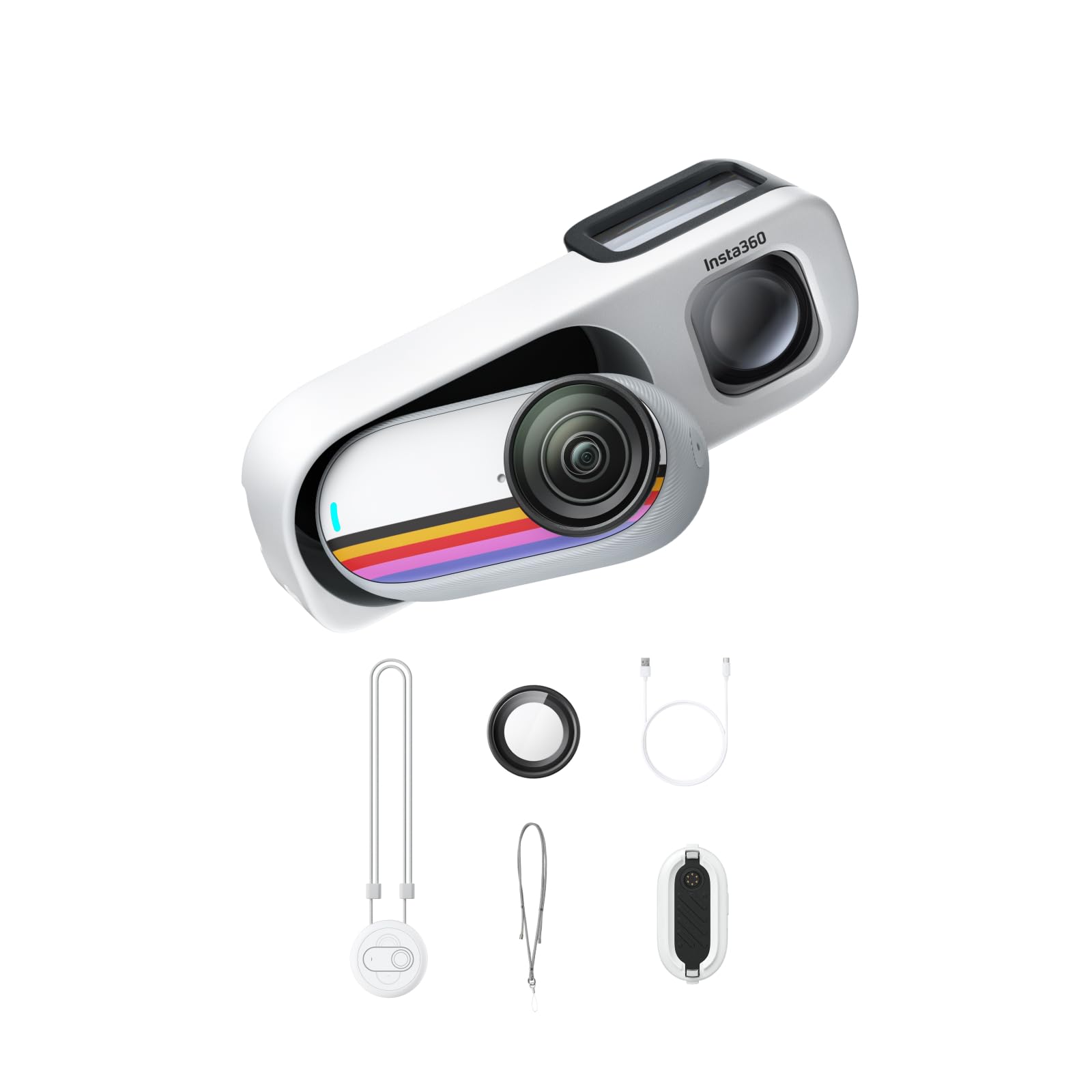
The Insta360 GO 3S Retro Bundle is the most transparently ‘vintage’ device here—it ships with a Retro Viewfinder accessory and built-in Positive and Negative Film color profiles designed to mimic the look of a classic analog point-and-shoot. The camera itself is a thumb-sized 39-gram body that clips, hangs, or mounts magnetically, making it ideal for hands-free POV street photography where the act of shooting should feel spontaneous.
Video records at 4K30fps with FlowState Stabilization (three levels), and the 128GB internal storage holds roughly 5-6 hours of 4K footage. The film presets are applied in-camera, meaning the JPEG/MP4 files look ready to share without any desktop grading—perfect for creators who want instant nostalgia for social media. The wide-angle f/1.8 lens captures a 110-degree FOV with minimal distortion for an action cam.
Battery life is the critical trade-off here: the standalone camera runs about 38 minutes. The included Battery Pack extends that to 76 minutes total, but it adds bulk. The magnetic mounting system is clever but occasionally unreliable in high-vibration scenarios (cycling, running). For casual daily shooting with an instant vintage aesthetic, the GO 3S Retro is brilliant; for serious filmmaking, it’s a secondary cam at best.
Why it’s great
- Dedicated Positive/Negative Film presets for in-camera retro look.
- Ultra-compact 39g form for hands-free wear.
- 128GB internal storage included.
- FlowState Stabilization for smooth POV footage.
Good to know
- Standalone battery lasts ~38 minutes; 76 min with pack.
- WiFi connection can be finicky with some smartphones.
6. Sony HDRCX405 HD Handycam

The Sony HDRCX405 is a literal definition of the vintage Handycam experience: it’s a small, lightweight, 1080p-only camcorder with a 30x optical Zeiss zoom lens and a built-in USB charging cable in the hand strap—exactly the kind of simple, functional design that defined the mid-2010s. The 26.8mm wide-angle end is useful for getting that slightly distorted perspective characteristic of early digital camcorders.
It records XAVC S at 50Mbps (1080p60), which is clean enough to withstand a bit of grading, but the real magic is in the small 1/5.8-inch sensor: it naturally produces a narrow dynamic range that clips highlights and pushes contrast. This is what makes it look instantly like an old Sony Handycam tape. The Optical SteadyShot with Active mode is surprisingly effective for a camera this small.
The downside is the lack of an external microphone input, so audio is limited to the built-in stereo mic. The 2.7-inch LCD is small and low-resolution by modern standards. Intelligent Auto handles exposure and focus without fuss, which is great for beginners but may frustrate anyone wanting manual control over the vintage look. For an authentic no-frills Handycam experience, it’s hard to beat.
Why it’s great
- 30x optical Zeiss zoom in a pocketable body.
- Small sensor naturally produces vintage-looking contrast and highlight roll-off.
- Built-in USB cable for charging and transfer.
Good to know
- No external mic input—audio is internal only.
- Tiny 2.7″ low-res display.
7. OBSBOT Tail Air NDI Streaming Camera 4K

The OBSBOT Tail Air is a 4K PTZ streaming camera first—its primary purpose is AI tracking, 320° pan, and NDI/H.265 streaming for live production. For vintage look enthusiasts, its value comes from the ability to stream or record in 1080p60 with a fast f/1.8 lens that delivers a shallow depth of field rare in PTZ cameras. You can attach a vintage anamorphic adapter or screw-on filter (with the right step-up ring) to alter the optical character.
The AI tracking system is remarkably refined: it can follow humans, animals, or objects via gesture control or mobile app. This means you can program motion paths that simulate a classic Steadicam or dolly shot, lending a physical, analog feel to your footage. The 23mm wide-angle lens provides a field of view similar to a classic 35mm prime lens on a Super 35 sensor—compressed and cinematic.
The critical issue is reliability: multiple reports indicate the battery is non-replaceable, and after 12-13 months, the camera can become a brick if the battery fails since it won’t function without a working battery. Additionally, the NDI license key is sold separately. For live-streaming creators who want a retro vibe without a full camera crew, it’s visionary—but be aware of the long-term power architecture risk.
Why it’s great
- AI auto-tracking for hands-free vintage-style movement.
- 23mm f/1.8 lens for shallow DOF in a PTZ form.
- Multiple connectivity: HDMI, USB-C, Ethernet, NDI.
Good to know
- Battery is non-replaceable; failure can brick the camera after warranty.
- NDI license key is an additional purchase.
8. Minolta Camcorder 4K Ultra HD 30MP

The Minolta camcorder is an entry-level 4K camera that includes IR night vision, time-lapse, anti-shake, and a 32GB memory card in the box—everything you need to start shooting immediately. For the vintage look, the 16x digital zoom is purely digital (no optical zoom), which means it crops and pixelates the image identically to how early 2000s camcorders handled zoom. That artificial pixelation and loss of detail is precisely the aesthetic some creators chase.
The 3-inch IPS touchscreen and included remote control make it easy to frame shots from a distance, and the accessory shoe supports external accessories. The CMOS sensor captures 4K UHD (3840×2160) at 24fps, though reviewers note visible dithering at color boundaries in 4K mode—an artifact that actually enhances the early-digital, low-bitrate camcorder look. 1080p at 60fps also exhibits edge softening.
Build quality and reliability are the primary concerns: some units have stopped working within months, and the IR night vision is effective only within ~6 feet. If you’re willing to accept short-term durability in exchange for that raw, early-digital texture, it’s a valid experimental tool. For reliable daily shooting, look elsewhere.
Why it’s great
- Very affordable entry point with full accessory kit.
- 16x digital zoom creates authentic early-digital pixelation.
- Includes 32GB card, remote, and pouch.
Good to know
- No optical zoom—only digital.
- Some units have reported reliability issues within months.
9. FlyFrost 8K Video Camera Camcorder 88MP UHD WiFi

The FlyFrost 8K camera is a budget vlogging camcorder that claims 8K resolution (7680×4320 at 15fps) and 88MP stills, but the real story for vintage-look enthusiasts is the IR night vision, external microphone input, lens hood, and handheld stabilizer included in the box. The 18x digital zoom (no optical) crops aggressively, producing that characteristic pixelated, artifact-heavy look of early consumer digital cameras.
Built-in WiFi allows remote control and file transfer via the iSmart DV2 app, though some users report connection issues. The 3-inch touchscreen rotates 270° for self-recording, and the included 2.4G remote works up to 60 feet. For creators who want to replicate the look of a 2008 miniDV camcorder without dealing with tape, the FlyFrost’s low-bitrate 8K footage (downscaled to 1080p) naturally exhibits the compression artifacts and color fringing that define that era.
The main frustrations are software-based: the USB file transfer can crash File Explorer on Windows, and the WiFi app has poor reviews on Android. Additionally, 8K at 15fps is practically unusable for anything other than timelapse or extreme slow-motion experiments. For the price, it’s a toy for creative tinkering, not a reliable tool for consistent vintage output.
Why it’s great
- Extremely affordable with a pro-looking accessory kit (mic, stabilizer, lens hood).
- Aggressive digital zoom creates authentic early-digital artifacts.
- WiFi remote control via smartphone app.
Good to know
- USB and WiFi file transfer can be unreliable.
- 8K mode is 15fps only—essentially a timelapse mode.
FAQ
Can a modern 4K camcorder really look like a vintage 90s Handycam?
What is the difference between optical zoom and digital zoom for vintage aesthetics?
Is it better to shoot in 4K and downscale to 1080p for a vintage look?
Final Thoughts: The Verdict
For most users, the camcorder for vintage look winner is the Sony FDR-AX43 because it combines a built-in gimbal stabilizer, 20x optical Zeiss zoom, and 4K recording that grades beautifully into any vintage look—all in a compact, single-hand body. If you want instant in-camera retro film presets without editing, grab the Insta360 GO 3S Retro Bundle. And for pure, authentic 1080p Handycam grain straight out of the box, nothing beats the Sony HDRCX405 at its price tier.