
The difference between a blurry streak and a trophy-winning print of a quarterback releasing the ball or a striker connecting mid-air comes down to two things: the speed of your autofocus and the responsiveness of your glass. Sports photography demands gear that tracks erratic motion, locks focus in milliseconds, and handles punishing light shifts from bright stadiums to overcast fields — without hesitation. Picking the wrong body or lens means missing the peak of the action, frame after frame.
I’m Min — the co-founder and writer behind Gadgets Feed. This guide is the result of hundreds of hours spent poring over technical specifications, cross-referencing real-world field reports, and stress-testing autofocus systems and burst rates to separate the gear that delivers from the gear that disappoints when the game is on the line.
Whether you’re covering a sideline, a pitch, or a ring, you need a setup that keeps pace with professional athletes. This is your definitive playbook for choosing the best camera and lens for sports photography based on real specs and performance data.
How To Choose The Best Camera And Lens For Sports Photography
Sports photography is one of the most demanding disciplines — the subject moves fast, the light changes, and you get one chance to capture the moment. Buying the wrong body or lens means missed focus, blurry frames, and a bag full of gear that can’t keep up. Focus on these three pillars to make the right investment.
Autofocus Speed and Coverage
The autofocus system is the heart of any sports camera. Phase-detection points across a wide portion of the frame are essential — look for coverage of 90% or more, with dedicated AI-based tracking for people, animals, and vehicles. Cameras with 693 or more AF points (like the Sony a7 III) offer the kind of dense grid that keeps a running back in focus even as they cut across the field. Dual Pixel CMOS AF (Canon) and 3D tracking (Nikon) are also strong performers for erratic movement. For lenses, ultrasonic motor (USM) or Nano USM drive systems deliver the near-instantaneous focus pulls required when a player changes direction mid-stride.
Burst Rate and Buffer Depth
Frames per second (fps) determines how many chances you get to capture the peak moment. A 15 fps mechanical shutter (Canon EOS R7) or 30 fps electronic shutter gives you a spray of frames around the contact point. But raw frame rate is useless if the buffer fills after one second — buffer depth at full resolution is the real spec. A camera that can hold 50+ RAW frames at 20 fps is a workhorse. For lenses, a wide aperture like f/2.8 allows faster shutter speeds in lower light, letting you freeze motion without pushing ISO into destructive noise territory.
Telephoto Reach and Low-Light Performance
You can’t always stand on the 50-yard line. Telephoto zoom lenses in the 70-200mm or 100-400mm range are the standard for field sports. An APS-C sensor (like the Canon R7’s 32.5MP) adds a 1.6x crop factor, turning a 100-400mm lens into an effective 160-640mm — massive reach for distant action. However, full-frame sensors (Sony a7 III, Nikon D850) offer superior high-ISO performance (clean images at ISO 6400+), which matters for night games or indoor arenas where light is scarce. Pairing a fast f/2.8 telephoto with a full-frame body is the gold standard for low-light sports.
Quick Comparison
On smaller screens, swipe sideways to see the full table.
| Model | Category | Best For | Key Spec | Amazon |
|---|---|---|---|---|
| Canon EOS R7 | Mirrorless Body | High-speed APS-C reach | 32.5MP, 15fps mech / 30fps elec | Amazon |
| Canon RF 70-200mm f/2.8L | Telephoto Lens | Constant f/2.8 low-light zoom | 5-stop IS, Dual Nano USM AF | Amazon |
| Sony a7 III | Full-Frame Body | Low-light full-frame performance | 24.2MP BSI, 693 AF points | Amazon |
| Canon EF 100-400mm f/4.5-5.6L | Telephoto Lens | Extended reach with IS | 100-400mm, 2-mode IS | Amazon |
| Nikon D850 | DSLR Body | Ultra-high resolution + speed | 45.7MP, 9fps, 153 AF points | Amazon |
| Canon EOS R5 | Full-Frame Body | Pro-grade hybrid sports | 45MP, 12fps mech, Eye Control AF | Amazon |
| Nikon Z 7II | Mirrorless Body | High-res wildlife & field sports | 45.7MP, 493 AF points, 10fps | Amazon |
| Sony FX2 | Cinema Camera | High-end sports video | 33MP FF, 15+ stops DR, 759 AF | Amazon |
| Panasonic HC-X20 | Camcorder | Dedicated sports video recording | 1″ sensor, 20x optical zoom | Amazon |
| Panasonic Lumix S1RII | Mirrorless Body | 8K hybrid with AI AF | 44.3MP, 8K video, 40fps AFC | Amazon |
| Fujifilm X100VI | Compact Camera | Travel and sideline casual | 40MP APS-C, 23mm f/2 fixed | Amazon |
| Insta360 Luna Ultra | Gimbal Camera | All-in-one stabilized 8K vlog | Dual Leica, 1″ sensor, 3-axis gimbal | Amazon |
| Veo Cam 3 | Sports Camera | AI auto-tracking team sports | 1080p, weatherproof, auto-capture | Amazon |
In‑Depth Reviews
1. Canon EOS R7 Mirrorless Camera (Body Only)

The Canon EOS R7 is a purpose-built action machine. Its 32.5-megapixel APS-C sensor gives you a 1.6x crop factor that turns any telephoto lens into a longer reach weapon — perfect for field sports where you’re stuck on the sideline. The Dual Pixel CMOS AF II covers approximately 100% of the frame with 651 zones, locking onto a sprinter’s eyes or a soccer jersey faster than most cameras at this level.
At 15 fps mechanical and 30 fps electronic (with a 1/2-second pre-burst RAW mode), you’ll catch the exact micro-moment of impact. The 5-axis IBIS works seamlessly with RF glass, enabling sharper handheld panning shots at slower shutter speeds. Dual UHS-II card slots keep the buffer flowing during a 60-frame burst, and the LP-E6NH battery easily outlasts a full match.
For sports photographers migrating from DSLRs, the ergonomic grip and intuitive control layout feel familiar, while the EVF offers near-zero blackout. Pair it with the RF 70-200mm f/2.8L or the RF 100-400mm, and you have a lightweight rig that delivers pro-level results without the full-frame price tag.
Why it’s great
- Industry-leading 30fps burst with subject AF tracking.
- 1.6x crop factor boosts telephoto reach for distant action.
- Excellent IBIS combined with RF lens stabilization for steady pans.
Good to know
- APS-C sensor means less low-light headroom than full-frame.
- Electronic shutter can exhibit rolling shutter on fast horizontal pans.
2. Canon RF 70-200mm F2.8 L IS USM Lens

The RF 70-200mm f/2.8L is the gold standard for field sports on Canon’s mirrorless system. The constant f/2.8 aperture lets you shoot at faster shutter speeds in overcast or twilight conditions, keeping ISO manageable while freezing a fastball or a breakaway run. Dual Nano USM motors deliver near-silent, instantaneous autofocus — critical for following a receiver sprinting down the sideline.
Optical image stabilization provides up to 5 stops of shake correction, making handheld shooting from the sidelines viable even at 200mm. The lens is also remarkably compact for an f/2.8 telephoto zoom — it extends internally when zooming, maintaining balance even on smaller bodies like the EOS R7. Weather sealing handles dust and light rain, so you don’t have to pack up when the weather turns.
At 200mm f/2.8, the background separation is creamy enough to isolate a single player against a blurred stadium crowd. It works flawlessly with Canon’s RF extenders, giving you 280mm f/4 or 400mm f/5.6 options for tighter framing of half-field action.
Why it’s great
- Constant f/2.8 for superior low-light action freezing.
- Incredibly fast and silent Dual Nano USM autofocus.
- Weather-sealed build for outdoor field conditions.
Good to know
- Extending barrel design can creep when pointed downward.
- High investment; entry-level shooters may prefer the f/4 version.
3. Sony a7 III Full-Frame Mirrorless Camera with 28-70mm Lens

The Sony a7 III remains a benchmark for full-frame sports performance on a budget. Its 24.2MP back-illuminated sensor delivers exceptional dynamic range — 15 stops — and clean high-ISO output up to ISO 12,800, making it a beast for night football or indoor basketball. The 693 phase-detection AF points cover 93% of the frame, with Real-time Eye AF for humans and animals that sticks to subjects like glue.
Silent or mechanical shutter at 10 fps is adequate for most sports, and the buffer can handle over 50 compressed RAW frames before slowing down. The 28-70mm f/3.5-5.6 kit lens is decent for starting out, but serious shooters will pair this body with a Sony 70-200mm f/2.8 GM II or a Tamron 70-180mm f/2.8 for proper sideline reach. Battery life is outstanding — the NP-FZ100 can last a full day of shooting (over 700 shots per charge).
The body is compact for a full-frame camera, making it easy to handle during long games. In-body image stabilization adds 5 stops of shake correction, giving you a safety net when panning without a monopod. It’s the smartest entry point into full-frame sports photography.
Why it’s great
- Excellent high-ISO performance for evening and indoor sports.
- Massive 693-point AF coverage with reliable Eye Tracking.
- Class-leading battery life for all-day tournament shoots.
Good to know
- Kit lens is too short for telephoto field work — budget for separate glass.
- 10fps burst is adequate but not class-leading for ultra-fast action.
4. Canon EF 100-400mm f/4.5-5.6L IS USM Telephoto Zoom Lens

The EF 100-400mm f/4.5-5.6L IS USM is a legendary workhorse for sideline and wildlife sports shooters. The 100-400mm range gives you the flexibility to frame a full-court press at the wide end and isolate a pitcher’s release at the telephoto end. On an APS-C body (like the Canon R7 with an EF-RF adapter), it becomes an effective 160-640mm — massive reach for distant action.
Optical image stabilization offers two selectable modes: Mode 1 for general handholding and Mode 2 for panning, where it stabilizes in the vertical axis while allowing natural horizontal motion. The ring-type USM autofocus motor is snappy and quiet, crucial for tracking a receiver running a deep route. Build quality is L-series pro — dust and moisture resistant, with a durable white barrel that reflects heat during sunny day games.
At 400mm f/5.6, sharpness remains good, though the sweet spot is around f/8 for maximum crispness. The variable aperture (f/5.6 at the long end) means you’ll need good ambient light or higher ISO settings. It’s a hefty lens (3 pounds), but the push-pull zoom mechanism becomes intuitive with practice.
Why it’s great
- Massive 400mm reach on full-frame, 640mm effective on APS-C.
- Dual-mode optical IS adapts well to panning scenarios.
- Pro-grade L-series weather sealing for outdoor reliability.
Good to know
- Variable f/4.5-5.6 aperture demands good light or higher ISO.
- Push-pull zoom mechanism can draw dust into the lens barrel over time.
5. Nikon D850 FX-Format Digital SLR Camera Body

The Nikon D850 is arguably the best DSLR ever made for sports. Its 45.7MP back-illuminated full-frame sensor delivers incredible cropping flexibility — you can shoot wide and crop into a tight shot and still retain print-quality detail. The 153-point autofocus system (99 cross-type) with 3D tracking locks onto moving subjects with legendary Nikon precision, even in low light.
Shooting at 9 fps with full AF tracking is enough for most sports, and the buffer can handle 51 RAW frames before slowing. The optical viewfinder offers zero blackout — a distinct advantage over some EVF systems when tracking a fast-moving subject. The tilting touchscreen is useful for low-angle sideline shots, and the battery performance is exceptional at over 1,800 shots per charge.
4K video at 30fps and 1080p slow-motion at 120fps provide video backup options. The weather-sealed magnesium alloy body can handle rain, dust, and cold sidelines. Pair it with the Nikon 70-200mm f/2.8E FL ED VR or the 200-500mm f/5.6 for a pro sports rig that still competes with modern mirrorless systems in AF speed.
Why it’s great
- 45.7MP sensor allows massive cropping from wide shots.
- 153-point AF with 3D tracking is pro-level reliable.
- Class-leading battery life for marathon events.
Good to know
- Large RAW files require significant storage and processing.
- Video autofocus is weaker than dedicated mirrorless competitors.
6. Canon EOS R5 Mirrorless Camera (Body Only)

The Canon EOS R5 is a full-frame hybrid that excels at both high-resolution stills and cinema-grade 8K video, making it the ultimate tool for sports content creators who need both. The stacked 45MP CMOS sensor with DIGIC X processor enables up to 12 fps with the mechanical shutter or 20 fps with the electronic shutter — silent and fast enough to capture a knockout punch or a game-winning goal.
Canon’s Dual Pixel CMOS AF II with 1,053 points delivers nearly 100% frame coverage, and the Eye Control AF feature lets you select focus points simply by looking at them — a genuinely useful trick when tracking a players’ eyes through the viewfinder. The AF system uses deep learning to recognize people, animals, and vehicles, making it incredibly sticky for cycling, motorsports, or field events.
In-body image stabilization provides up to 8 stops of correction, which is remarkable for a high-resolution body. The 8K RAW video capability is overkill for most sports uses, but the 4K 120fps mode is perfect for slow-motion replay analysis. Build quality is pro-grade with extensive weather sealing, though battery life (~320 shots with EVF) is notably weaker than the D850.
Why it’s great
- 45MP gives immense cropping power for tight action crops.
- Eye Control AF is a unique and intuitive focusing method.
- 8-stop IBIS for rock-steady handheld and panning shots.
Good to know
- Battery life is lower than DSLR counterparts — carry spares.
- 8K video can trigger thermal management protection in extreme heat.
7. Nikon Z 7II Full-Frame Mirrorless Camera

The Nikon Z 7II delivers 45.7 megapixels of resolving power with a readout speed and buffer depth that make it viable for slower-action sports like golf, track and field, or baseball. The 493-point phase-detection AF system covers 90% of the frame and includes reliable subject tracking for people and animals, with 3.3x more buffer capacity than the original Z 7.
Continuous shooting at 10 fps is lower than the Canon R7 or R5, so it’s not the first choice for frantic team sports, but the dual card slots (CFexpress/XQD + UHS-II SD) provide flexibility and peace of mind for important assignments. The 4K 60p video output is clean and oversampled from the sensor, making it a strong hybrid option for sports that don’t require extreme burst rates.
In-body stabilization works with the growing line of NIKKOR Z lenses (including the Z 70-200mm f/2.8 VR S) to deliver sharp handheld shots. USB-C power delivery means you can shoot timelapses of stadium construction or long-duration events without worrying about battery swaps.
Why it’s great
- 45.7MP sensor allows massive cropping for distant subjects.
- Dual card slots provide redundancy for event work.
- Excellent IBIS rated to 5 stops for steadier shooting.
Good to know
- 10fps burst is not competitive for ultra-fast team sports.
- Subject tracking lags behind Sony and Canon pro bodies in backlit scenarios.
8. Sony FX2 Full-Frame Cinema Camera (Body Only)

The Sony FX2 is a full-frame cinema camera built for videographers who shoot sports professionally. Its 33MP Exmor R sensor and BIONZ XR processor deliver 15+ stops of dynamic range in S-Log mode, preserving highlight detail in sunny stadiums and shadow detail in dimly-lit arenas. The dual base ISO (800/4000) lets you switch from daylight to indoor lighting without unwanted noise creep.
The 759-point phase-detection AF system provides reliable focusing on fast-moving subjects, and the “Big 6” interface gives you direct access to essential settings — aperture, shutter, ISO, ND, white balance and audio. The angle-adjustable EVF is useful for shooting from awkward bottom-rail positions on a monopod. It records 4K 120fps for beautiful slow-motion replays of critical plays.
Compatible with Sony’s E-mount lens ecosystem, you can pair it with the FE 70-200mm f/2.8 GM II or the FE 100-400mm f/4.5-5.6 GM OSS for full-frame reach. It’s a pure video tool rather than a stills hybrid, so stills photographers should look at the a7 IV or a9 III instead.
Why it’s great
- 15+ stops of dynamic range handles harsh stadium lighting.
- Dual base ISO (800/4000) for clean low-light video.
- 4K 120fps output for high-quality slow-motion action replay.
Good to know
- No mechanical shutter — not designed for high-volume stills.
- Does not shoot 8K video; limited to 4K 60p in standard modes.
9. Panasonic HC-X20 4K 60p Professional Camcorder

The Panasonic HC-X20 is a traditional camcorder purpose-built for recording sports events, news, and interviews. Its 1-inch, 15-megapixel MOS sensor delivers excellent 4K 60p video with a wide 24.5mm equivalent wide-angle and a massive 20x optical zoom (32x i.Zoom in FHD). This means you can capture a wide shot of the entire field and zoom in tight on a player without changing lenses.
The 5-axis Hybrid O.I.S. keeps footage steady even when shooting handheld from a crowded sideline, and the 4K High Precision AF system with Face Detection ensures subjects stay sharp as they move. For professional audio, dual XLR inputs let you attach a wireless lav for the referee or a shotgun mic for ambient crowd noise. It supports live streaming over Wi-Fi or Ethernet (with adapter) — useful for streaming games directly.
With a manual triple ring (focus, zoom, iris), the HC-X20 gives you the tactile control that action videographers prefer over menu-diving mirrorless cameras. It records in MOV, MP4 and AVCHD formats, and the HEVC codec saves space while maintaining quality. This is the right tool for dedicated video over hybrid stills/video.
Why it’s great
- 20x optical zoom from a single integrated lens system.
- 5-axis O.I.S. for smooth handheld sports video.
- Dual XLR inputs for professional broadcast-quality audio.
Good to know
- 1-inch sensor has less shallow depth-of-field than full-frame setups.
- Not a hybrid — stills are limited compared to mirrorless cameras.
10. Panasonic Lumix S1RII Full-Frame Mirrorless Camera (Body Only)

The Panasonic Lumix S1RII is a cutting-edge hybrid that pushes 44.3 megapixels of full-frame detail with LUMIX’s first 8K video recording. The high-speed sensor enables AFC 40fps burst shooting — one of the fastest continuous rates in this tier — making it a serious contender for wildlife and sports photography where speed and resolution both matter.
Phase Hybrid AF with advanced AI technology improves subject recognition for humans and animals, keeping focus locked during dynamic multi-person intersections common in team sports. The camera records 8K video with wide dynamic range Log, giving video editors maximum flexibility to grade for cinematic sports films. 4K slow-motion modes capture those extended replay moments.
The robust body includes false color for exposure, 32-bit float audio support (with optional adapter), and the LUMIX Camera Flow app for remote control. It’s a heavy-duty tool for professionals who straddle the line between studio-quality stills and broadcast-quality video.
Why it’s great
- 40fps burst with AFC is elite-level for capturing peak action.
- 8K video recording opens up ultra-high-res post-capture reframing.
- Advanced AI subject detection is reliable for cluttered field scenarios.
Good to know
- Some units have reported overheating during extended 8K recording.
- L-Mount lens ecosystem is smaller than Sony E or Canon RF.
11. Fujifilm X100VI Digital Camera (Silver)

The Fujifilm X100VI is a unique entry for sports shooters who prioritize portability and IQ over interchangeable lenses. The fixed 23mm f/2 lens (35mm equivalent) makes it a natural for sideline candids, pre-game portraits, or court-side documentary style where you work with the environment rather than reach for distant action. The 40MP X-Trans CMOS 5 HR sensor delivers remarkable sharpness and Fujifilm’s legendary film simulations for beautiful straight-out-of-camera colors.
It’s not a burst-speed monster, but the 6-stop IBIS and fast f/2 aperture make it viable for indoor sports at close range. The hybrid viewfinder (optical + electronic) is a pleasure for composition, and the compact body slides into a small bag easily. For photographers covering lifestyle sports or travel-based athletic events, the X100VI is an alternative tool to a traditional body-and-telephoto combo.
Subject detection for animals, birds, and cars works well, but the fixed 23mm lens means you must physically move to frame the action. It’s a specialist’s choice for creative, tight-court sports coverage.
Why it’s great
- Class-leading 40MP APS-C resolution with beautiful color reproduction.
- Compact, discreet design for unobtrusive sideline shooting.
- 6-stop IBIS helps with low-light close-quarters photography.
Good to know
- Fixed 35mm-equivalent lens limits you to close-range action.
- Autofocus speed is not competitive with sports-oriented mirrorless bodies.
12. Insta360 Luna Ultra Endurance Bundle

The Insta360 Luna Ultra is a pocket gimbal camera with dual Leica lenses — a 1-inch main sensor and a dedicated telephoto lens for up to 6x lossless zoom. It shoots 8K HDR video with Dolby Vision, making it a super-compact option for vloggers covering sports events from a first-person perspective or capturing fan reactions and atmospheric B-roll.
The 3-axis mechanical stabilization combined with AI subject tracking keeps a moving subject centered and in focus — useful for following a player running drills or a coach walking the sideline. The detachable 2-inch OLED touchscreen gives you remote control up to 20 meters, enabling unique angles (like a tripod-mounted view of a goal mouth). Battery life reaches up to 4 hours with fast charging to 80% in 23 minutes.
This is not a replacement for a proper interchangeable-lens sports camera, but it’s an excellent secondary rig for mobile, stabilized, cinema-quality video content. The Leica color profiles deliver a pleasing look with minimal grading effort.
Why it’s great
- 8K HDR video with Dolby Vision in a truly pocketable form factor.
- 3-axis gimbal delivers silky-smooth movement for mobile B-roll.
- Detachable touchscreen enables creative remote camera placements.
Good to know
- Limited zoom range compared to dedicated telephoto systems.
- Some units have reported screen or contact pin reliability issues.
13. Veo Cam 3 – 1080HD AI Sports Camera (Subscription Required)
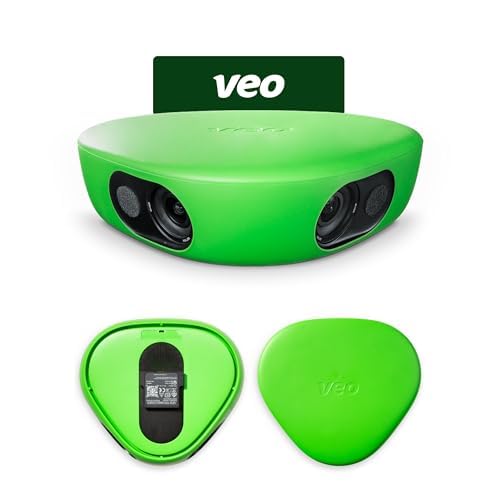
The Veo Cam 3 is a dedicated sports camera designed for teams and coaches who need automated game recording without a dedicated videographer. The AI-powered auto-tracking system follows the ball and players across the field, freeing you to focus on coaching. It records in 1080HD with a wide enough lens to cover the whole pitch or court.
Setup is simple: mount the camera on the included tripod, turn it on, and it begins autonomously capturing the game. It is weatherproof from -10°C to 45°C (14°F to 113°F), so it can handle rain and snow. The footage is uploaded to Veo’s cloud platform for playback, analysis, and sharing. A subscription is required to access the cloud features, which includes AI-powered editing and game analysis tools.
While the resolution is limited to 1080p (not 4K), the value proposition is the automation — it’s ideal for youth soccer, basketball, and volleyball teams that want high-quality game footage without a dedicated operator. The battery is not included, so you’ll need to provide power for extended tournaments.
Why it’s great
- AI auto-tracking eliminates the need for a dedicated camera operator.
- Weatherproof design allows use in rain, snow, and extreme temperatures.
- Cloud-based storage and AI editing tools streamline game analysis.
Good to know
- Limited to 1080p video; no 4K option for higher-quality footage.
- Requires ongoing subscription for full functionality.
FAQ
How many frames per second do I actually need for professional sports work?
Why do many sports photographers prefer f/2.8 telephoto zooms over f/4 or f/5.6 lenses?
Is a full-frame or APS-C sensor better for field sports photography given the reach vs. noise trade-off?
Final Thoughts: The Verdict
For most users, the camera and lens for sports photography winner is the Canon EOS R7 paired with the Canon RF 70-200mm f/2.8L because the R7’s 30fps burst, 1.6x crop reach, and excellent AF tracking combine to form a lightweight, field-dominant rig that freezes action across a wide range of sports. If you want full-frame low-light performance for evening games, grab the Sony a7 III with a fast telephoto zoom. And for a no-compromise video and stills hybrid that handles 8K and 45MP cropping, nothing beats the Canon EOS R5.