
Our readers keep the lights on and my morning glass full of iced black tea. As an Amazon Associate, I earn from qualifying purchases.
The gap between a smartphone snapshot and a real photograph is measured in sensor area and glass. A dedicated camera captures light, detail, and depth that phone computational photography can only simulate. The decision isn’t about convenience—it’s about control over the final image.
I’m Min — the co-founder and writer behind Gadgets Feed. I’ve spent hundreds of hours analyzing sensor types, lens equivalents, stabilization methods, and autofocus systems to map exactly what each model in this price bracket delivers for the serious enthusiast or first-time buyer.
Whether you are chasing wildlife with a superzoom, framing portraits with bokeh, or building a kit for travel photography, finding the right camera below $500 means matching the tool to the subject and the environment where you’ll shoot most.
How To Choose The Best Camera Below $500
Choosing a camera under five hundred dollars means prioritizing the features that matter most for your specific photography style. This budget sits at an intersection: entry-level interchangeable lens cameras, capable bridge superzooms, and vlogging-focused compacts all compete here. Understanding the tradeoffs between sensor size, zoom range, stabilization, and system expandability is critical to avoid buyer’s remorse.
Sensor Size and Image Quality
A larger sensor collects more light, which directly translates to better low-light performance, less noise at higher ISO, and greater potential for background blur (bokeh). In this price tier, you will encounter 1/2.3-inch sensors in bridge cameras, 1-inch sensors in premium compacts like the Sony ZV-1F, APS-C sensors in entry-level DSLRs and mirrorless models, and Micro Four Thirds sensors in cameras like the Panasonic G85. The physical size difference between a 1/2.3-inch sensor and an APS-C sensor is roughly 10x in surface area—a massive gap that dictates image quality ceiling.
Zoom Reach vs. Lens Interchangeability
Bridge cameras (Kodak AZ528, Minolta MN40Z, Panasonic FZ80D) offer extraordinary optical zoom—often 40x to 60x—pulling distant subjects into frame without carrying multiple lenses. The tradeoff is a smaller sensor and fixed lens, meaning you cannot swap optics for wider apertures or specialized uses. Interchangeable lens cameras (DSLRs and mirrorless) start with a basic kit zoom (typically 18-55mm or 12-60mm) but let you add lenses over time. Your choice depends on whether you need reach immediately or prefer to build a system slowly.
Stabilization for Sharp Handheld Shots
At telephoto focal lengths, even tiny hand movements create blur. Optical Image Stabilization (OIS) corrects this optically inside the lens, while In-Body Image Stabilization (IBIS) moves the sensor itself. The Panasonic G85 stands out in this class with its 5-axis IBIS working in tandem with lens OIS, enabling sharp handheld shots at shutter speeds several stops slower than unstabilized cameras. Bridge cameras typically include OIS, but its effectiveness varies. For vlogging, digital stabilization crops the frame and reduces sharpness—optical or IBIS solutions are superior for video.
Quick Comparison
On smaller screens, swipe sideways to see the full table.
| Model | Category | Best For | Key Spec | Amazon |
|---|---|---|---|---|
| Sony ZV-1F | Vlogging Compact | Content Creators | 1-inch Sensor, 20mm f/2.0 | Amazon |
| Canon EOS R100 | Mirrorless | System Builders | APS-C 24.1MP, RF Mount | Amazon |
| Panasonic LUMIX G85 | Mirrorless | Hybrid Photo/Video | 5-Axis IBIS, Micro Four Thirds | Amazon |
| Canon EOS 2000D Bundle | DSLR | First-Time DSLR Users | APS-C 24.1MP, 9-Point AF | Amazon |
| Nikon D3100 (Renewed) | DSLR | Budget DSLR Entry | APS-C 14.2MP, EXPEED 2 | Amazon |
| Panasonic LUMIX FZ80D | Bridge Superzoom | Wildlife & Distant Subjects | 60x Optical Zoom, 20-1200mm | Amazon |
| Kodak PIXPRO AZ528 | Bridge Superzoom | Value Superzoom | 52x Optical Zoom, 16MP BSI | Amazon |
| Minolta MN40Z | Bridge Superzoom | Budget Superzoom | 40x Optical Zoom, Wi-Fi | Amazon |
| Sony Alpha a3000 | Mirrorless | Budget APS-C Mirrorless | APS-C 20.1MP, Sony E Mount | Amazon |
In‑Depth Reviews
1. Sony ZV-1F Vlog Camera

The Sony ZV-1F is designed from the ground up for content creators who prioritize video over stills. Its 1-inch Exmor RS sensor is significantly larger than the 1/2.3-inch sensors found in bridge cameras, giving it a genuine advantage in low-light video and depth-of-field separation. The fixed 20mm f/2.0 wide-angle lens is perfectly suited for selfie-style vlogging at arm’s length, and the 3-capsule directional microphone captures clear audio even in moderately windy outdoor environments.
Eye-AF and real-time tracking autofocus keep subjects sharp during movement, and the side-articulating touchscreen simplifies framing for solo recording. The Product Showcase mode is a clever touch for review creators—it instantly racks focus to an object held up to the lens. Video quality at 4K is excellent in good light, though the lack of optical zoom and reliance on digital stabilization for walking shots are the primary compromises. Battery life is limited to roughly 45 minutes of continuous recording, typical for compact cameras in this class.
For creators who shoot mostly stationary talking-head content, unboxings, or indoor vlogs, the ZV-1F delivers image quality that outclasses everything else at this price point. The fixed lens means you are locked into one field of view, but the sensor’s headroom and the audio quality make it a focused, purpose-built tool rather than a jack-of-all-trades.
Why it’s great
- Class-leading 1-inch sensor for video
- Excellent built-in 3-capsule directional mic
- Side-articulating touchscreen for self-framing
Good to know
- No optical zoom; fixed 20mm wide lens
- Battery life is short for extended shoots
- Digital stabilization crops the frame
2. Canon EOS R100 Mirrorless Camera

The Canon EOS R100 is the most affordable entry point into Canon’s RF mirrorless system, and it brings the image quality advantages of a 24.1MP APS-C sensor into a compact body that weighs just over 300 grams body-only. The Dual Pixel CMOS AF system covers 143 zones and includes human face and eye detection, animal detection, and vehicle detection—a feature set that rivals cameras costing twice as much. Continuous shooting at 6.5 fps is adequate for most action, and the DIGIC 8 processor enables 4K video at 24p.
The included RF-S 18-45mm f/4.5-6.3 IS STM kit lens is compact and optically stabilized, but its maximum aperture is relatively slow, limiting low-light performance without raising ISO. The electronic viewfinder and rear LCD are functional but not high-resolution, and there is no in-body stabilization—relying instead on lens-based IS. The R100 uses the LP-E17 battery, which delivers roughly 300 shots per charge, sufficient for a day of casual shooting.
What the R100 offers that bridge cameras cannot is a path forward. The RF mount opens access to Canon’s growing library of lenses, from the affordable RF 50mm f/1.8 STM for portraits to ultrawide and telephoto options. For a beginner who wants to learn photography and eventually grow their kit, the R100 represents the best long-term investment in this price range.
Why it’s great
- Excellent Dual Pixel CMOS AF with eye detection
- Small and lightweight body for travel
- Complete RF mount system for future lens upgrades
Good to know
- No in-body stabilization; relies on lens IS
- Kit lens has a slow maximum aperture
- Viewfinder and LCD have modest resolution
3. Panasonic LUMIX G85 with 12-60mm Lens

The Panasonic LUMIX G85 is a mirrorless camera built around a 16MP Micro Four Thirds sensor with no low-pass filter, designed to maximize fine detail resolution. Its standout feature is the 5-axis In-Body Image Stabilization that works in concert with the lens-based Power O.I.S., enabling handheld video and telephoto shots at shutter speeds that would be impossible on unstabilized cameras. The system is remarkably effective—you can push to 1/8 second handheld with careful technique and still get sharp stills.
The kit includes the 12-60mm f/3.5-5.6 Power O.I.S. lens, which offers a 24-120mm equivalent field of view, making it a versatile everyday walkaround zoom. The body features magnesium alloy construction with weather sealing, a 2.36M-dot OLED viewfinder, and a fully articulating 3-inch touchscreen. 4K video is available at 30fps, and the 4K Photo mode lets you extract 8MP stills from video clips. Autofocus is contrast-detect with DFD technology, which is snappy in good light but can hunt in dim conditions, especially during video.
The G85 is heavier than the Canon R100, but the inclusion of IBIS and weather sealing justifies the weight for photographers who shoot in variable conditions or want to use vintage adapted lenses. The Micro Four Thirds lens ecosystem is vast and relatively affordable, spanning compact primes to professional zooms. For hybrid shooters who split time evenly between photo and video, the G85’s stabilization and build quality make it the most capable all-arounder in this tier.
Why it’s great
- Outstanding 5-axis in-body stabilization
- Weather-sealed magnesium alloy body
- 4K video and 4K Photo extraction
Good to know
- Heavier than competing mirrorless options
- No headphone jack for video monitoring
- Contrast-detect AF hunts in low light
4. Canon EOS 2000D / Rebel T7 Essential Bundle

The Canon EOS 2000D (Rebel T7) is a entry-level DSLR that pairs a 24.1MP APS-C sensor with the DIGIC 4+ processor, delivering image quality that easily matches modern smartphones in good light and surpasses them in low light when using a fast lens. The optical viewfinder provides a real-time, lag-free view of the scene, and the 9-point autofocus system with a center cross-type point offers reliable phase-detection focusing. Burst shooting at 3 fps is modest but sufficient for stationary subjects and slow action.
This bundle includes the EF-S 18-55mm f/3.5-5.6 DC III zoom lens, a 64GB memory card, LED video light, case, and tripod—everything a beginner needs to start shooting immediately. The camera records Full HD 1080p video at 30fps, and Canon’s EOS Webcam Utility turns it into a high-quality USB webcam for streaming. The 2.7-inch LCD screen has 230k dots, which is noticeably lower resolution than the competition, making critical focus checks difficult without the viewfinder.
For absolute beginners who want a complete kit out of the box and the tactile feedback of an optical viewfinder, the 2000D bundle removes the friction of buying accessories separately. The EF/EF-S lens ecosystem is enormous and inexpensive on the used market. The DIGIC 4+ processor is dated—no 4K video, slower processing—but the sensor itself is still capable of excellent 24MP stills.
Why it’s great
- Complete bundle with all essential accessories
- 24.1MP APS-C sensor for high-quality stills
- Optical viewfinder for real-time framing
Good to know
- Low-resolution 2.7-inch LCD screen
- No 4K video recording
- Burst rate limited to 3 fps
5. Nikon D3100 DSLR (Renewed)

The Nikon D3100 is a discontinued entry-level DSLR that, in its renewed form, offers a cost-effective path to interchangeable-lens photography with a large APS-C sensor. Its 14.2MP CMOS sensor, paired with the EXPEED 2 processor, captures images with good color accuracy and low noise up to ISO 1600, with usable results at ISO 3200. The 11-point autofocus system is basic by modern standards but reliable in good light, and the 3-inch LCD has 230k dots—functional for review, less so for critical composition.
The kit includes the AF-S DX 18-55mm f/3.5-5.6 VR zoom lens with Vibration Reduction, which helps stabilize handheld shots at slower shutter speeds. The D3100 was the first Nikon DSLR to offer Full HD 1080p video recording at 24fps, with full-time AF-F focus mode for smoother tracking during video capture. The optical viewfinder uses a pentamirror design with 0.8x magnification, providing a clear, real-time view that is unaffected by battery life.
As a renewed product, condition varies, and buyers should expect a fully functional but pre-owned camera. The D3100 lacks built-in Wi-Fi, touchscreen, and the faster processors of newer models. It uses SD/SDHC/SDXC cards and a proprietary EN-EL14 battery. For the photographer who wants a simple, durable DSLR with a huge lens ecosystem (Nikon F-mount has decades of compatibility) and is comfortable buying renewed, this is a strong entry point at a budget price.
Why it’s great
- Large APS-C sensor for low-light stills
- Broad Nikon F-mount lens compatibility
- Low cost of entry in renewed condition
Good to know
- Renewed product with no original warranty
- No touchscreen or Wi-Fi connectivity
- 14.2MP resolution is lower than modern sensors
6. Panasonic LUMIX FZ80D Point and Shoot

The Panasonic LUMIX FZ80D is a bridge camera that puts an astonishing 60x optical zoom lens (20-1200mm equivalent) into a compact, lightweight body. This reach is unmatched by any interchangeable-lens kit at this price—you can fill the frame with a distant mountain peak, a bird at 100 meters, or the moon’s craters. The Power O.I.S. stabilization is effective at suppressing hand shake at the telephoto end, though beyond 800mm equivalent, a monopod or tripod is still recommended for critically sharp results.
The FZ80D records 4K video at 30fps and features Panasonic’s 4K Photo mode, which lets you extract 8MP stills from 4K video clips—a useful trick for capturing fast action where perfect timing is difficult. The Post Focus feature allows you to select the focus point after the shot is taken, a clever implementation of the camera’s high-speed contrast-detect AF. The 2.36M-dot electronic viewfinder with 0.74x magnification is bright and clear, making composition easy even in direct sunlight.
The 1/2.3-inch sensor is the FZ80D’s primary limitation. Compared to APS-C or 1-inch sensors, it produces noticeable noise above ISO 800 and has limited dynamic range, meaning images in challenging light can look soft or grainy. The autofocus system, while fast in good light, uses contrast detection and can hunt in low contrast or low-light situations. For daylight wildlife, travel, and family events where reach is paramount, the FZ80D is remarkably capable. For pixel peepers or low-light shooters, the small sensor will frustrate.
Why it’s great
- 60x optical zoom covers 20-1200mm reach
- Power O.I.S. stabilization works at telephoto
- 4K video and 4K Photo extraction
Good to know
- Small 1/2.3-inch sensor limits low-light quality
- Contrast-detect AF hunts in dim conditions
- No Wi-Fi for wireless image transfer
7. Kodak PIXPRO Astro Zoom AZ528
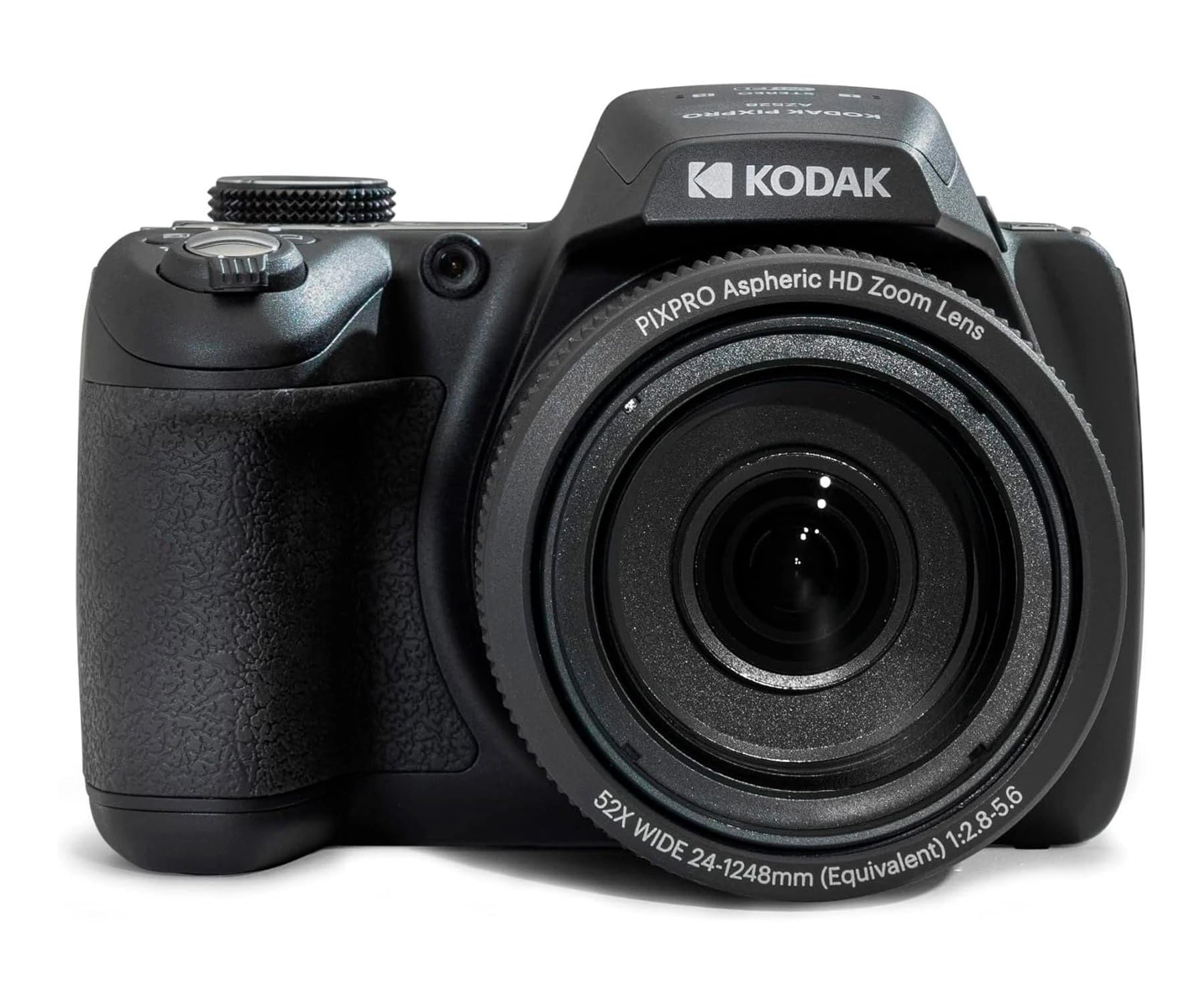
The Kodak PIXPRO AZ528 offers a 52x optical zoom lens (24-1248mm equivalent) at a price that undercuts most bridge cameras in this class. The 16MP BSI CMOS sensor is a backside-illuminated design, which improves light gathering compared to traditional front-illuminated sensors at the same size, giving a slight edge in noise performance at higher ISOs. Optical Image Stabilization helps keep telephoto shots steady, though users report that at maximum zoom, a tripod or high shutter speed is necessary to avoid blur from hand shake.
The camera shoots 6 fps burst in continuous mode, allowing you to capture sequences of fast action like birds in flight or sports. Full HD 1080p video recording is standard, and built-in Wi-Fi lets you transfer images to a smartphone for instant sharing. The 3-inch LCD screen is adequate for framing and review, and the camera supports SD cards up to 512GB. The rechargeable Li-Ion battery is replaceable and charges via USB-C, a welcome modern convenience.
Image quality is typical of a 1/2.3-inch sensor bridge camera—daylight photos look crisp and vibrant, but noise becomes apparent at ISO 800 and above. The autofocus uses contrast detection with 25 points, which is slower than phase-detect systems and can struggle in low contrast. The body is lightweight plastic and reports suggest it scuffs relatively easily. For the price, the AZ528 provides remarkable zoom reach and basic Wi-Fi connectivity, making it a strong option for budget-conscious users who need extreme range in good light.
Why it’s great
- 52x optical zoom (24-1248mm equivalent)
- BSI CMOS sensor for slightly better low light
- Built-in Wi-Fi for easy image transfer
Good to know
- Small sensor limits high-ISO performance
- Contrast-detect AF can be slow
- Plastic body scuffs easily
8. Minolta MN40Z Digital Camera

The Minolta MN40Z is a budget-focused bridge camera that delivers a 40x optical zoom lens and a 20MP CMOS sensor in a compact, lightweight body. Its primary strengths are portability and reach—the 24-960mm equivalent zoom range covers landscapes at the wide end and distant wildlife at the telephoto end. The built-in Wi-Fi connects to a smartphone app for remote control and image transfer, and the 3-inch LCD screen provides standard framing and playback.
The camera shoots Full HD 1080p video at 30fps and includes face, smile, and blink detection for portrait photography. The ISO range spans 100 to 3200, with the best image quality in the ISO 100-400 range. The MN40Z runs on standard AA batteries (four required), which is a double-edged sword—you can buy batteries anywhere, but the cost of rechargeable AAs adds up and battery life is shorter than dedicated Li-Ion packs, especially with heavy zoom use.
Image quality is adequate for daylight outdoor photography and social media sharing, but the small sensor and relatively modest stabilization mean indoor and low-light shots will show noticeable noise. Some users report the camera freezing during mode or zoom switching, requiring battery removal to reset. The autofocus is slow for action subjects. For users who want a camera with extreme zoom for day trips and budget is the primary constraint, the MN40Z offers the basic feature set. For anyone who can stretch the budget, the Panasonic FZ80D or Kodak AZ528 are more reliable alternatives.
Why it’s great
- 40x optical zoom in a compact body
- Uses universally available AA batteries
- Wi-Fi connectivity for remote sharing
Good to know
- AA batteries have shorter life than Li-Ion
- Reports of freezing during mode changes
- Weak stabilization at full zoom
9. Sony Alpha a3000 Mirrorless Digital Camera

The Sony Alpha a3000 is an older mirrorless camera that pairs a 20.1MP APS-C Exmor sensor with the Sony E mount, giving it a sensor size advantage over bridge cameras and access to Sony’s extensive E-mount lens lineup. The body is surprisingly DSLR-like—it has a prominent grip and an electronic viewfinder (EVF) built into a hump, making it comfortable to hold and shoot. Image quality is very good up to ISO 1600, with the APS-C sensor producing cleaner, more detailed images than any 1/2.3-inch bridge camera at the same ISO.
The included 18-55mm f/3.5-5.6 OSS lens has optical SteadyShot stabilization, which helps with handheld video and stills. Full HD video recording at 1080p is standard, and the camera supports both Sony E and FE lenses. The battery charges via USB, which is convenient in theory but means no external charger. The a3000 uses contrast-detect autofocus with 25 points, which is noticeably slower and less accurate than the phase-detect systems found in most modern Sony Alpha bodies, particularly for moving subjects.
The primary compromises are in the user experience. The EVF has a low resolution (about 200k dots), making it difficult to manually focus with precision. The rear LCD screen is also low-resolution. The camera powers on slowly compared to modern bodies. Battery life is poor—expect 20-30% drain per hour of active use. For someone who wants to buy into the Sony E-mount ecosystem at the lowest possible cost and is willing to work around the autofocus and display limitations, the a3000 is a capable stills camera.
Why it’s great
- APS-C sensor for excellent image quality
- Access to Sony E-mount lens ecosystem
- Comfortable grip and DSLR-like handling
Good to know
- Very low-resolution EVF and rear LCD
- Slow contrast-detect autofocus system
- Poor battery life; no external charger included
FAQ
Is a used DSLR or a new bridge camera a better buy under $500?
What does the “x” zoom number really mean for a bridge camera?
Can I use a camera under $500 for professional work?
Final Thoughts: The Verdict
For most users, the camera below $500 winner is the Sony ZV-1F because its 1-inch sensor and optimized video features dominate the category for content creators who shoot primarily indoors or in controlled lighting. If you want to build a lens system and grow your photography skills, grab the Canon EOS R100. And for hybrid photo-video versatility with best-in-class stabilization, nothing beats the Panasonic LUMIX G85.