
Our readers keep the lights on and my morning glass full of iced black tea. As an Amazon Associate, I earn from qualifying purchases.
You want to watch birds up close without sitting outside for hours, but a camera feeder that blurs the video in low light or dies in two days defeats the whole point. The right one sends crisp clips straight to your phone, runs for months on solar, and tells you exactly which species just landed — all without turning birdwatching into a tech support project.
I’m Min — the founder and writer behind Gadgets Feed. This guide is built by comparing the manufacturers’ published specifications and the patterns across verified customer reviews, so you get each pick’s real strengths and trade-offs instead of marketing spin.
If you are looking for a reliable way to identify backyard birds and watch them in high definition without constantly fiddling with charging or Wi-Fi, this roundup of the best camera bird feeder models breaks down which ones actually deliver clear video, accurate species recognition, and long battery life straight out of the box.
Quick Picks
- NAVFS BF04 Bird Feeder with Camera — Best Overall
- ZUPIROL G33 Smart Bird Feeder with Camera — Top Performer
- Faddial G02 Smart Bird Feeder with Camera — Best Value
- Gyozol B1 Bird Feeder with Camera — Compact Pick
- HARYMOR Q8 Bird Feeder with Camera — Best Capacity
- wansview F1 Bird Feeder with Camera — Best Accessories
- PeckCam G02 Bird Feeder with Camera — Premium Pick
How To Choose The Best Camera Bird Feeder
A camera bird feeder is a seed hopper with a motion-activated Wi-Fi camera built in. It sends live video, instant alerts, and often AI-powered species identification straight to an app on your phone. Picking the right one means balancing video quality, power system, and the ongoing cost of its smart features.
Video Resolution: 1080p vs 2K
The camera resolution determines how sharp the image is when you zoom in on a bird’s feathers or read a leg band. 1080p (full HD, or 1920 x 1080 pixels) delivers clear daytime footage and works for general identification. 2K (roughly 2560 x 1440 pixels) gives you about 78% more detail — especially important at night when the image is darker. A 2K sensor paired with color night-vision LEDs (lights that show natural colors instead of gray) helps you see species like owls or cardinals after sunset without them looking like gray blobs.
Power System: Solar Panel and Battery Capacity
Most solar-powered feeders include a built-in rechargeable battery — typically 5,000 to 5,200 mAh (milliampere-hours, a unit of electrical charge capacity) — and a small solar panel, usually 3 watts. A higher mAh number means the feeder can run longer between top-ups when the sun hides for several days. In real use, a 5,000 mAh battery with a 3W panel can keep a feeder going for months in direct sun. If your feeder sits in heavy shade, expect to manually recharge it every two to three weeks.
AI Bird Identification and Subscription Costs
Built-in AI (artificial intelligence software) claims to identify anywhere from 10,000 to 11,000 species automatically. The catch is that almost every brand gives you a free trial — usually 30 days — and then requires a monthly or annual subscription — roughly to per month or to per year — to keep the identification feature active. If you pause the subscription, the feeder still records video and sends alerts, but you lose the species list tied to each visitor. Factor that ongoing cost into your budget from day one.
Wi-Fi Standard: Why Only 2.4GHz Works
Every camera bird feeder operates exclusively on 2.4GHz Wi-Fi (a radio frequency that travels farther than the faster 5GHz band). 2.4GHz signals pass more easily through walls, trees, and outdoor obstacles — which matters when the feeder is at the far end of your yard. Before buying, check your home router. If it runs a blended “dual-band” network, make sure the 2.4GHz channel is active and that your phone can connect to it during setup.
Quick Comparison
On smaller screens, swipe sideways to see the full table.
| Model | Best For | Resolution | Battery | Capacity | Amazon |
|---|---|---|---|---|---|
| NAVFS BF04 | Overall value & accuracy | 1080p HD | 5200mAh | 1.8L | $39.99$99.99PrimeAmazon |
| ZUPIROL G33 | 2K clarity & mounting flexibility | 2K HD | 5000mAh | — | $47.49$49.99PrimeAmazon |
| Faddial G02 | Budget-friendly 2K experience | 2K HD | 5000mAh | 1.25L | $51.67$82.99PrimeAmazon |
| Gyozol B1 | Compact design & multiple mounts | 2K HD | 5000mAh | 1.3L | $54.99$84.99PrimeAmazon |
| HARYMOR Q8 | Largest seed capacity & add-ons | 2K HD | — | 2L | $59.96$79.99Limited time dealAmazon |
| wansview F1 | Best accessory kit (suet/nectar) | 2K HD | — | 1.25L | $79.99Amazon |
| PeckCam G02 | Full kit & dual solar panels | 2K HD | — | — | $69.99$79.99PrimeAmazon |
In‑Depth Reviews
1. NAVFS BF04 Bird Feeder with Camera
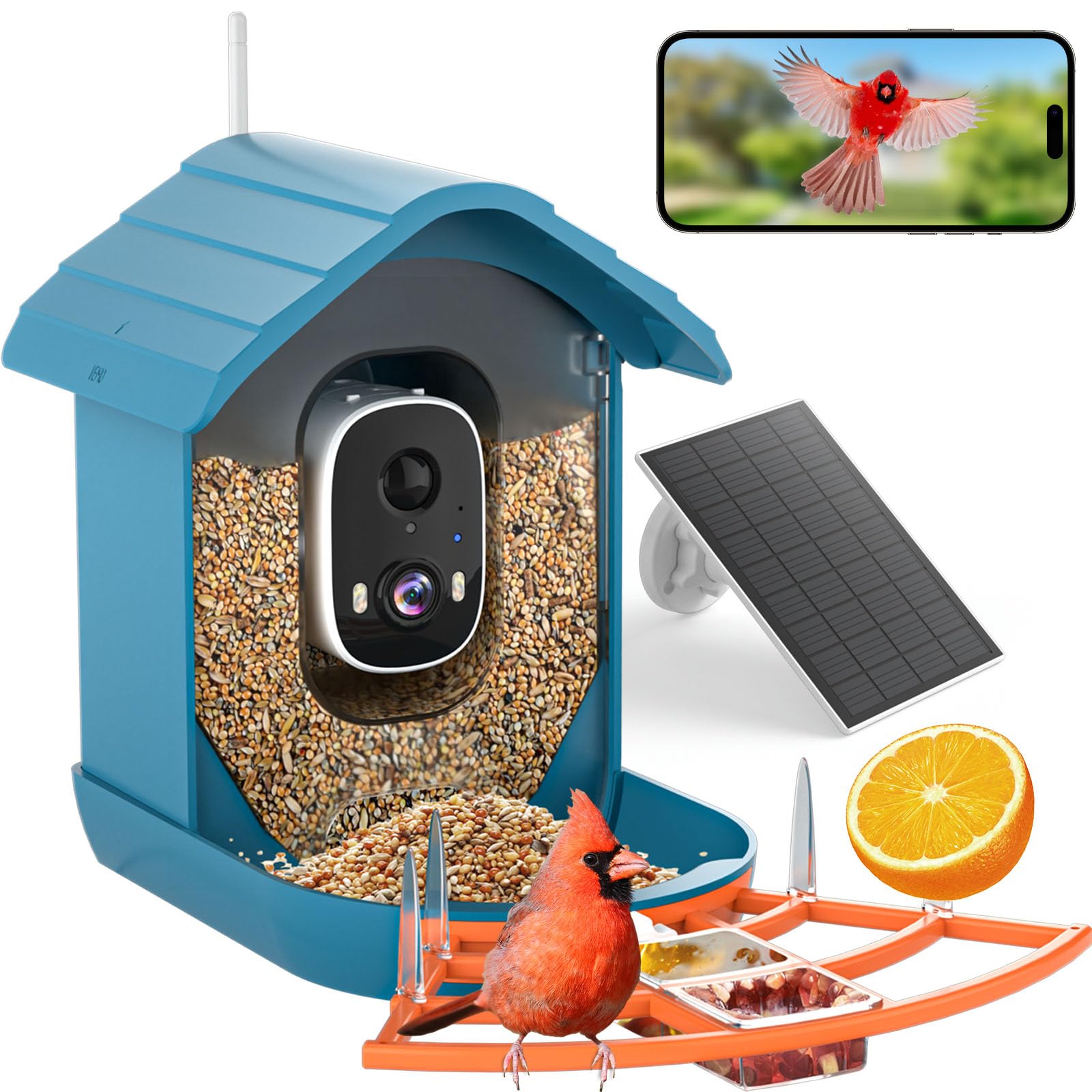
The most balanced blend of long battery life, accurate AI, and large seed capacity in a single feeder.
You see birds in 1080p HD (full high definition) through a 160-degree ultra-wide lens — wide enough to catch visitors landing from any direction. The 5200mAh battery paired with a 3W solar panel runs for up to six months between charges, according to NAVFS. That is a 4% larger battery than the 5000mAh cells in most competitors like the ZUPIROL G33, so you get a small edge when cloudy days stack up. The AI identifies over 10,000 bird species and works with a 30-day free trial before a subscription is needed. Buyers report that the AI identifies birds with greater than 90% confidence and is mostly accurate, though one reviewer noted it sometimes confuses squirrels for birds. The 1.8-liter seed hopper is the largest in this lineup, meaning fewer refills for you.
Unlike the Faddial G02 which uses a plastic feeder body, the NAVFS uses ABS (a durable hard plastic) and carries an IP65 weatherproof rating — meaning it stands up to direct rain and snow without the camera fogging. The two-way audio lets you chirp back at birds or scare away squirrels with a built-in speaker and light. It is bulkier than some, measuring 12 inches wide, and only works on 2.4GHz Wi-Fi networks. The downside for the extra battery capacity and larger hopper is a weight of 2.7 pounds, which requires a sturdy tree branch or post mount.
For a family or retiree wanting a low-maintenance feeder with reliable species ID and enough seed to last through a long weekend, this is the most balanced pick. The trade-off is that you get 1080p video instead of the 2K offered by most rivals — the image stays clear for daytime identification but looks slightly softer when you zoom in on distant perches.
Why it’s great
- Largest battery (5200mAh) and seed capacity (1.8L) in this roundup
- Buyers confirm AI bird ID is >90% accurate; includes fruit/jelly feeder attachments
- IP65 waterproof rating and sturdy ABS build for all-weather outdoor use
Good to know
- 1080p resolution, not 2K — fine for ID but less detail when zooming
- Subscription required after 30-day free trial for AI and cloud storage
- At 12 inches wide and 2.7 pounds, it needs a solid mounting point
Best for: Anyone who wants the best blend of large battery, accurate AI identification, and big seed capacity at a fair price.
Skip if: You need maximum feather detail at night — 1080p is good but the 2K models below show more definition in darkness.
2. ZUPIROL G33 Smart Bird Feeder with Camera
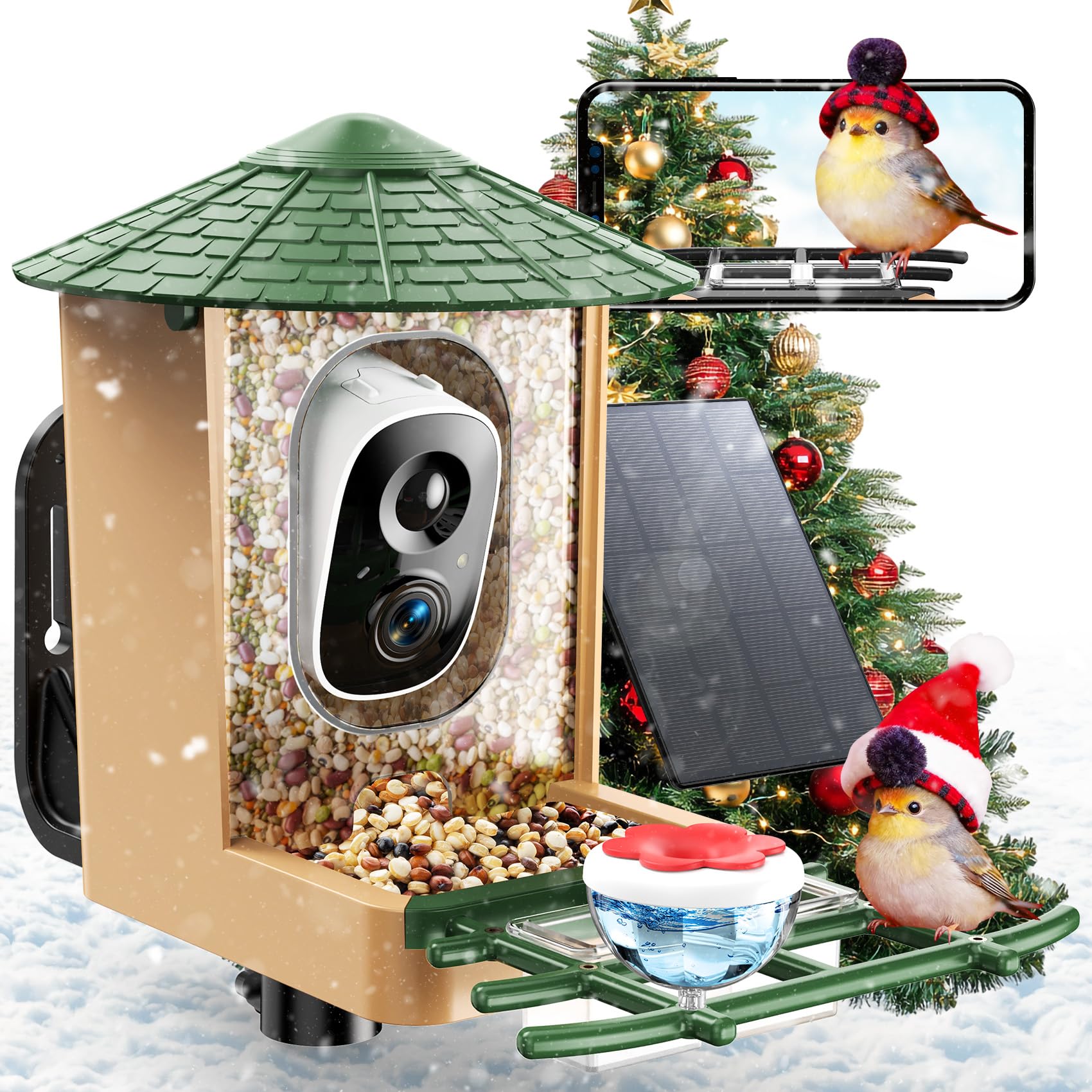
Sharper 2K video than the NAVFS BF04, plus a chew-proof cable that survives squirrel attacks.
This feeder captures 2K HD (roughly 2560 x 1440 pixel) video through a 160-degree wide-angle lens, delivering noticeably more feather detail than the NAVFS BF04’s 1080p image — especially during dawn and dusk when contrast is low. The 5000mAh battery and 3W solar panel match the standard across this category, but the ZUPIROL stands out with a chew-proof wire covering and a mounting kit that includes pole, tree, and wall options. One buyer mentioned that birds took months to arrive at first, while another said the camera attracted nearly 20 different species within weeks once the feeder found its spot. The app sends instant alerts and provides a direct link to an encyclopedia page for each identified bird.
The 2K clarity here beats the 1080p feed of the NAVFS by a clear margin when you zoom into a still image, but the battery is 4% smaller at 5000mAh versus 5200mAh, so you may have to recharge slightly sooner in poor weather. The AI identifies over 11,000 species — the highest count in this list — but relies on a paid subscription after a 30-day trial. A nice bonus is the included hummingbird feeder attachment, which helps attract species the seed-only feeders miss. One catch: the solar panel is separate from the feeder body, so you have a small cord to route if you want the panel in direct sun while the feeder hangs in the shade.
The main caution is that one owner reported tree motion occasionally triggering false alerts — something to consider if your feeder hangs on a branch that sways in the wind. If the sharper image and tough cable are your priorities over battery size, this is the one to pick over the NAVFS.
Why it’s great
- 2K HD video provides sharper daytime and night images than 1080p rivals
- Chew-proof wire covering protects against squirrels and raccoons
- Includes pole, tree, and wall mounts plus a mini hummingbird feeder
Good to know
- 5000mAh battery is slightly smaller than the NAVFS at 5200mAh
- Wind or tree motion can trigger occasional false motion alerts
- Detached solar panel requires routing a cable between feeder and panel
Best for: Birders who want 2K picture quality and flexible mounting without risking chewed cables.
Skip if: You have only partial sun in your yard — the separate solar panel adds a cable routing step that some buyers find fiddly.
3. Faddial G02 Smart Bird Feeder with Camera
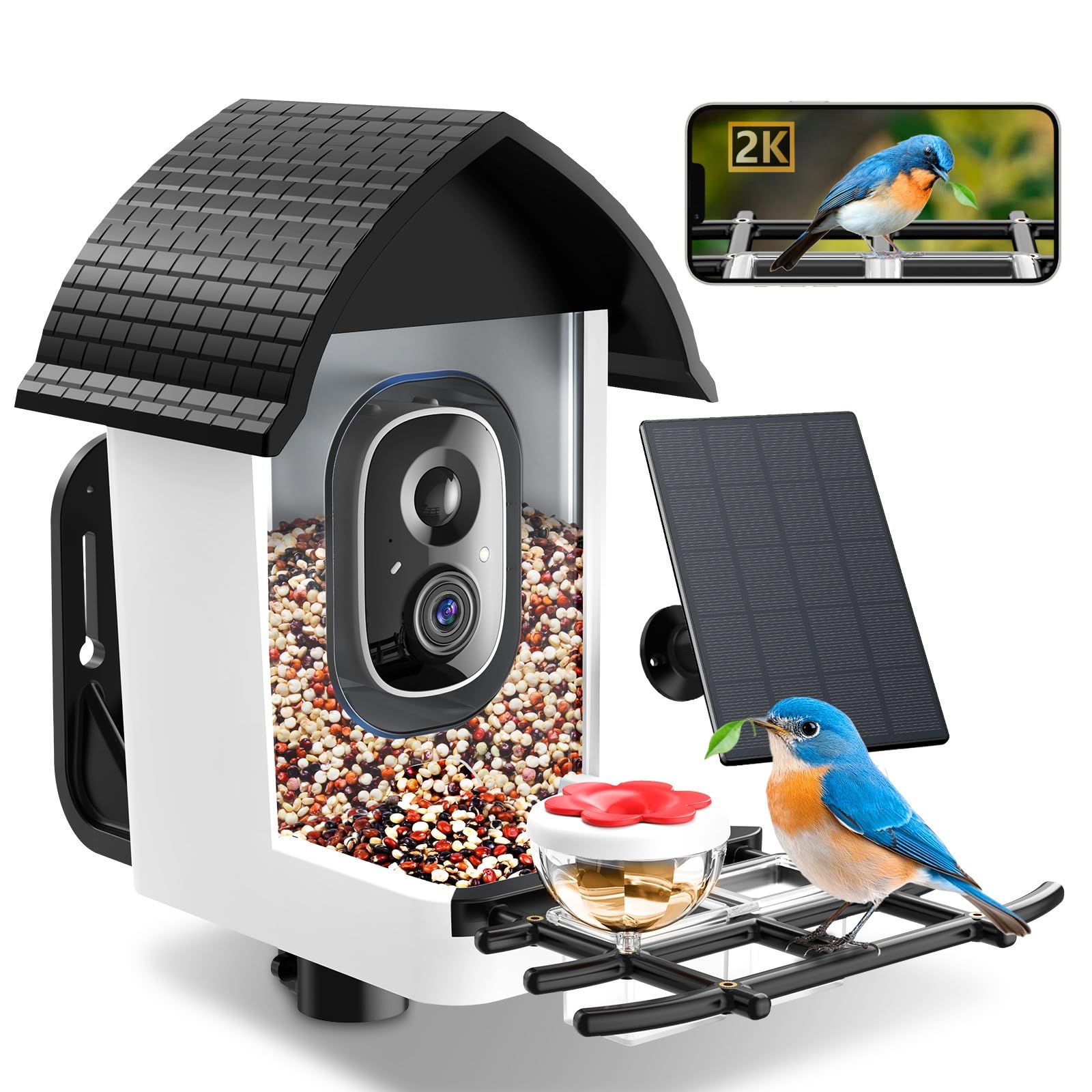
Entry-level pricing puts a 2K sensor and solar charging within reach without sacrificing the sharp image you get on pricier feeders.
The 3W solar panel and IP65 waterproofing (dust-tight and rain-safe) match the same class as models that cost more, so you get year-round outdoor operation without worrying about rain damage. One reviewer described it as a plastic feeder with a 16-ounce (approximately 1.25-liter) capacity and a removable top for easy filling. The AI identifies over 10,000 species with a 30-day free trial, after which the subscription costs roughly per year — about the same as most competitors. Owners mention the camera is clear for close-up bird viewing but note that the app can take some time to learn.
One limitation is build quality: the plastic body feels less substantial than the ABS builds of the NAVFS or wansview models, and the 1.25-liter capacity is smaller than the 1.8-liter hopper on the NAVFS, so you will refill more often if you have a busy feeder. Setup requires some patience with the 2.4GHz Wi-Fi connection, as a few reviewers mentioned the app connectivity could be smoother. On the plus side, the Faddial includes a fruit fork and jelly feeder, helping attract orioles and other fruit-eaters that ignore plain seed.
If your budget is tight and you still want 2K video and AI identification rather than settling for 1080p, this is the smartest compromise. The lighter, less robust build is the honest trade-off — expect a feeder that works perfectly when mounted in a sheltered spot.
Why it’s great
- 2K HD camera at a budget-friendly price point — sharpness rivals feeders costing more
- Solar powered with IP65 rating; runs 365 days in decent sun
- Includes fruit fork and jelly attachments for attracting orioles and other fruit-eaters
Good to know
- Plastic build feels lighter and less premium than ABS models
- 1.25L capacity means more frequent refills compared to the 1.8L NAVFS
- App setup and Wi-Fi pairing can be fussy according to some reviews
Best for: Budget-conscious birders who refuse to drop to 1080p and want the detail of 2K video.
Skip if: You want a heavy-duty build that can take the occasional bump from a squirrel or a falling branch — this one is best in a protected spot.
4. Gyozol B1 Bird Feeder with Camera
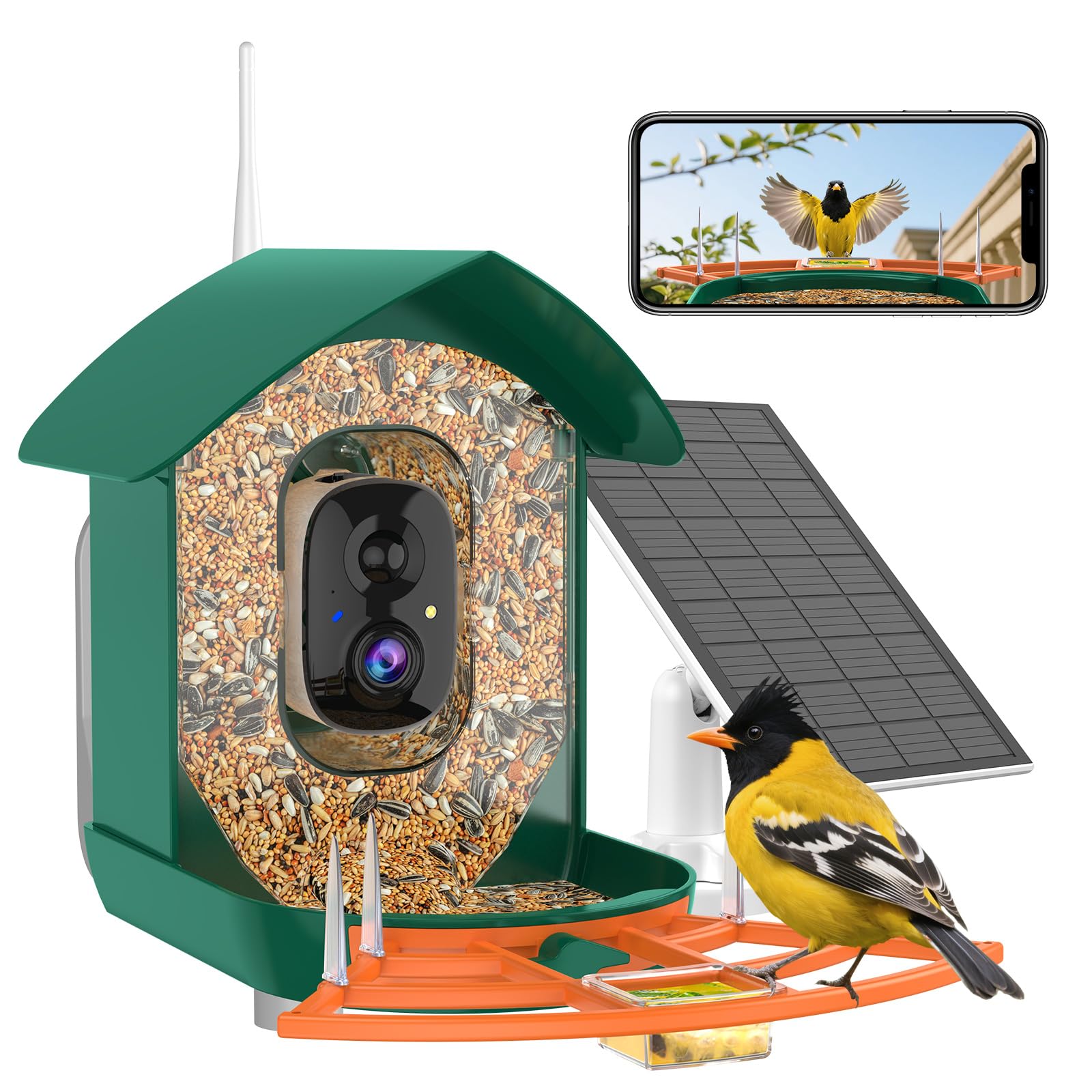
The smallest footprint on this list fits into tight garden spots without cutting the 2K image quality.
Measuring 8.95 inches wide and just 6.6 inches deep, the Gyozol B1 is the most space-efficient feeder here — it fits neatly on a narrow fence post or a small balcony railing where the 12-inch NAVFS would overhang. Despite the compact frame, it still packs a 2K HD camera, a 5000mAh battery, and a 3W solar panel. The mount connects to any standard birdhouse pole with a 1-inch diameter, and the feeder also supports hanging, stake, and freestanding options. One review highlighted that after two years of use, the unit stopped connecting to Wi-Fi — a durability concern note if you plan to leave it out year-round.
The 1.3-liter capacity is slightly smaller than the Faddial’s 1.25L and well behind the NAVFS’s 1.8L, but the compromise is a feeder that practically disappears into your landscaping. The AI subscription model is the same as the others — per month after a 30-day free trial, or roughly per year for a phone-only service plan. Buyers rave about the “crystal clear pics n videos with audio” and the crisp night vision. Unlike the ZUPIROL, which has a separate solar panel, the Gyozol’s panel is built into the lid, so there is no extra cable to hide. It only supports 2.4GHz Wi-Fi like every other feeder on this list.
If your yard space is limited or you want a feeder that does not stick out like a tech gadget, this is your best bet. The single durability complaint about long-term Wi-Fi connectivity is the honest flag — treat it as a solid mid-range buy rather than a decade-long investment.
Why it’s great
- Compact 8.95-inch design fits small balconies, narrow posts, and tight garden corners
- 2K HD sensor with crisp night vision — buyers call the picture quality “superb”
- Multiple mounting types (hanging, stake, freestanding, pole) in one kit
Good to know
- 1.3L seed capacity is small — expect to refill every couple of days with frequent visitors
- One review reported the feeder stopped connecting to Wi-Fi after two years
- AI and cloud storage subscription costs /month after the free trial
Best for: Apartment dwellers or anyone mounting a feeder on a narrow fence or small balcony.
Skip if: You want the lowest-maintenance refill schedule — the 1.8L NAVFS holds 38% more seed.
5. HARYMOR Q8 Bird Feeder with Camera
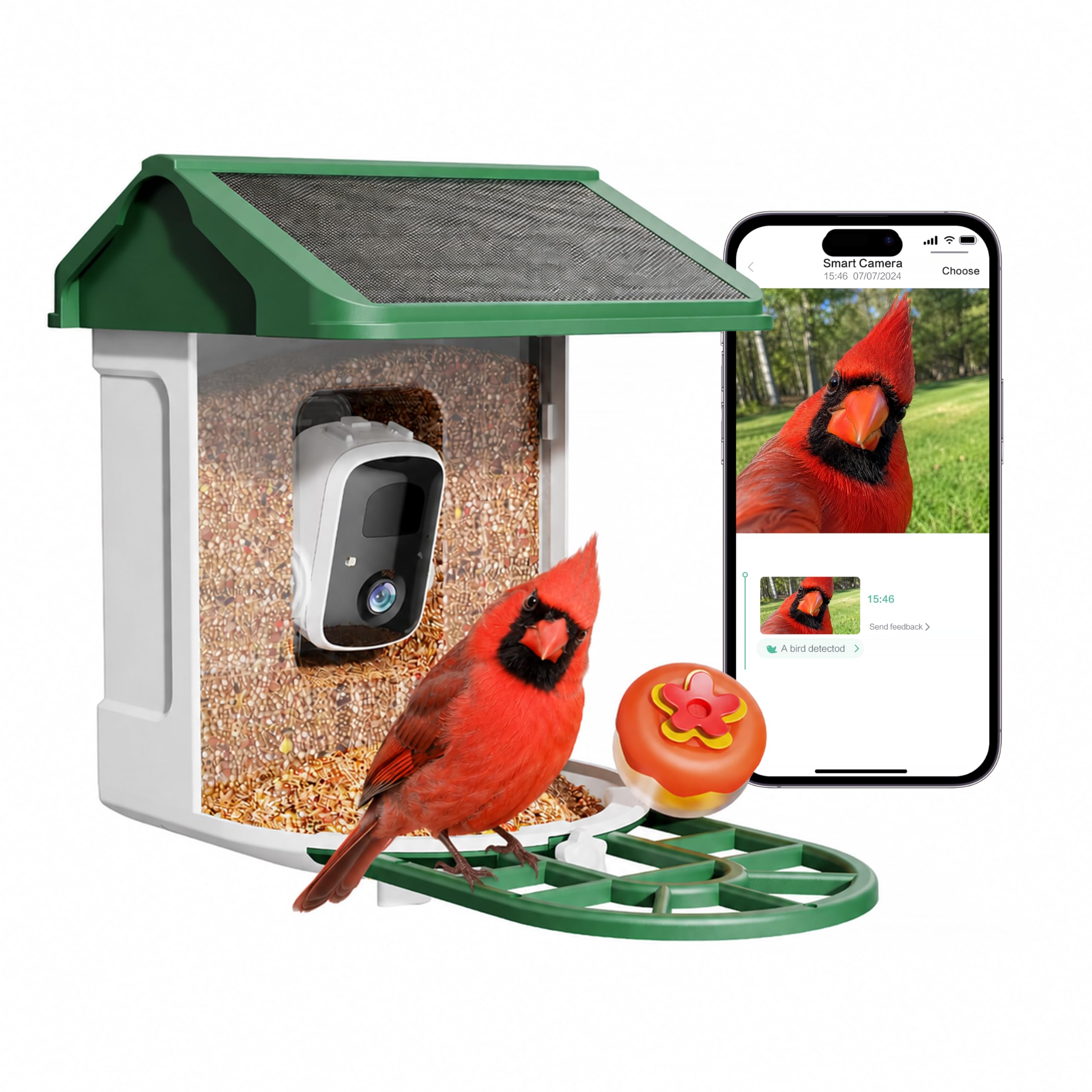
The 2-liter hopper and included hummingbird feeder mean you refill less and attract more species than the NAVFS BF04 can.
The 2K HD sensor includes a 3x digital zoom and full-color night vision, so you see feather colors — not just gray silhouettes — after dark. A detachable mini hummingbird feeder comes in the box, giving you dual feeding options from a single mounting point. One customer observed that the flexible mounting bracket caused the camera image to oscillate slightly in windy conditions, which is worth checking if your feeder sits in an exposed location. The feeder uses the Vicohome app, supports 4 users simultaneously, and offers 3-day free cloud storage for up to two years.
The power system relies on a built-in solar panel, though the battery capacity is not specified in the listing. The 5dB high-gain antenna provides a more stable 2.4GHz connection than some competitors — useful if your feeder is at the far edge of your yard. Buyers confirm the setup is straightforward enough for seniors, with one calling it a “unique gift for the couple who has everything.” The AI identifies over 10,000 species but, like the others, requires a subscription after the 30-day trial. The two-way audio lets you scare off squirrels or simply listen to bird calls in real time.
If you have a busy feeder that empties in a day or you want to attract hummingbirds alongside seed-eaters without buying a second feeder, this is the clear winner. The oscillation issue with the flexible bracket is the one thing to solve — swapping to a rigid pole mount fixes it completely.
Why it’s great
- Largest seed hopper (2L) in this roundup — fewer refills than any other pick
- Includes a detachable hummingbird feeder for dual-attract capability
- 2K HD with full-color night vision and 3x digital zoom for detailed feather identification
Good to know
- Flexible mounting bracket can cause image wobble in strong winds
- Battery capacity is not listed — unclear how it compares to the 5000-5200mAh standard
- At 2.28 kg (about 5 pounds), it is the heaviest feeder here
Best for: Heavy-traffic feeder stations where you want to minimize seed refills and attract both seed-eaters and hummingbirds.
Skip if: Your feeder hangs from a thin branch — the extra weight and flexible bracket can lead to swaying video.
6. wansview F1 Bird Feeder with Camera
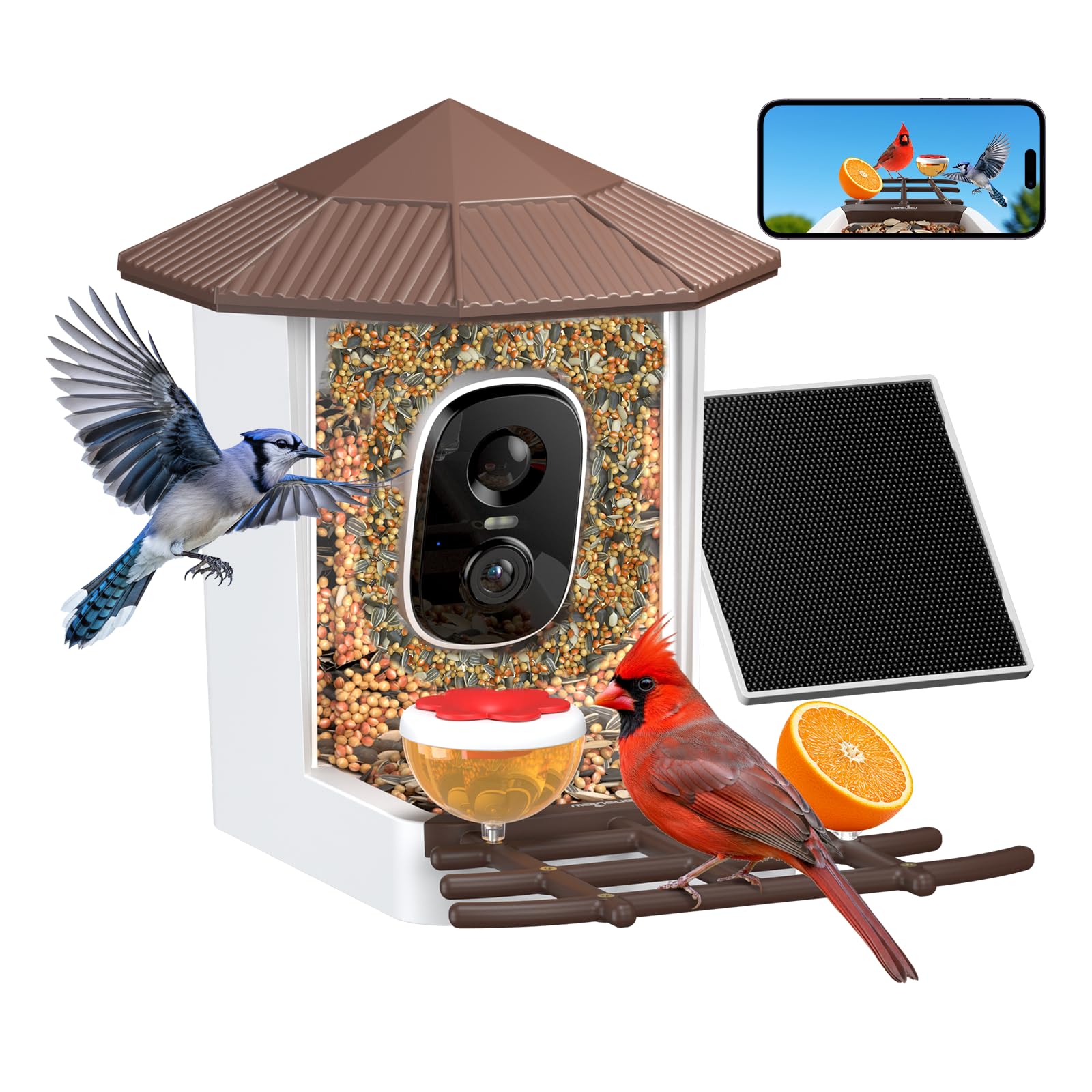
The only feeder that ships with honey, suet, and jelly feeders — so you attract woodpeckers, orioles, and hummingbirds from day one.
The wansview F1 goes beyond the standard seed hopper by including a jelly box, a suet feeder (for suet, a high-energy fat block that woodpeckers love), and a honey feeder kit right in the box — accessories that would cost extra with most other models. This means you can attract orioles, woodpeckers, and hummingbirds alongside finches and cardinals from day one. The camera shoots 2K HD video with a 135-degree wide-angle lens and uses two LED lights for color night vision — one user highlighted that the solar panel kept the battery charged “very well” and that the camera quality is good enough to read species instantly. The wansview AI Bird Plan unlocks detailed encyclopedia entries for each species. The body is built from ABS and polycarbonate, a blend that feels sturdier than the all-plastic Faddial while weighing 3.7 pounds.
The 135-degree lens is narrower than the 160-degree view on the NAVFS and ZUPIROL, so you get a tighter frame that works well for close-up portrait shots but may miss birds landing on the far edges of the tray. The seed capacity is 1.25 liters — about average for this list — but the accessory bundle gives you flexibility that no other feeder matches without buying separate parts. Buyers warn that house finches tend to dominate the feeder, while gold finches may avoid it depending on seed mix. The 2.4GHz-only Wi-Fi and IP65 rating are standard. One reviewer pointed out that the pole mount is the best option because it defeats squirrels better than hanging.
If you want to experiment with different food types — suet for woodpeckers, jelly for orioles, nectar for hummingbirds — this is the most complete starter kit you can buy. The narrower camera angle is the real limit: you trade a wide panorama for a tighter, more detailed close-up.
Why it’s great
- Comes with jelly box, suet feeder, and honey feeder — the most complete accessory kit
- 2K HD with dual-LED color night vision provides sharp images in the dark
- ABS and polycarbonate hybrid body feels more durable than competing plastics
Good to know
- 135-degree lens is narrower than the 160-degree view on the NAVFS and ZUPIROL
- At 3.7 pounds, it is heavy enough that a pole mount is strongly recommended over hanging
- Some birds (like gold finches) may avoid the feeder depending on seed type
Best for: Birders who want one feeder that handles seed, nectar, suet, and jelly without buying add-on accessories.
Skip if: You need the widest possible camera view — the 135° lens misses the edges compared to 160° models.
7. PeckCam G02 Bird Feeder with Camera
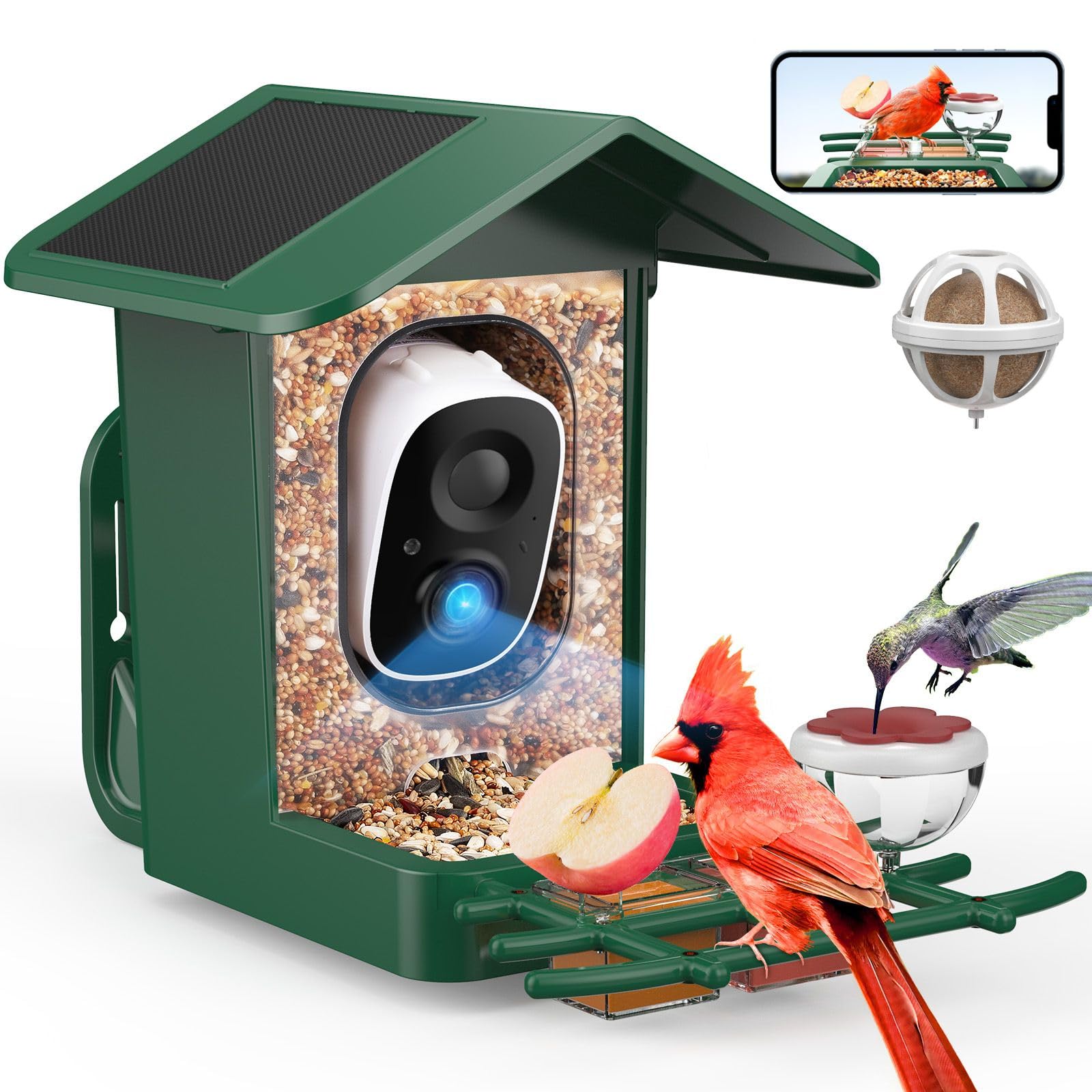
Two 2W solar panels (4W total) charge faster in partial shade than any single-panel competitor — the most reliable power system in this list.
PeckCam equips the G02 with two 2-watt solar panels (4W total) rather than the single 3W panel found on every other feeder here, giving it an edge in overcast conditions or partially shaded yards. The camera delivers 2K HD video with full-color night vision, and the built-in 5dB internal antenna helps maintain a stable 2.4GHz connection. The feeder includes suet ball, honey, fruit fork, and water feeders — a broad accessory kit second only to the wansview F1. Buyers love the “clear picture, good night view” and the fact that the solar panels keep the battery running for months; one shopper added that a replacement unit was shipped quickly after a pole attachment broke. The app supports up to 4 simultaneous users and offers 3-day cloud loop storage for two years.
The dual solar panels are the standout feature here, but they add weight — the G02 weighs 3.5 pounds, making it one of the heaviest in this roundup. It uses ABS and polycarbonate like the wansview, so the build feels tough and weather-resistant. One caution from a buyer: the charging wire was chewed through by what they suspected was a squirrel after just one week, so you may need a wire protector if rodents are common in your yard. The AI identifies over 10,000 species with a paid subscription (free trial included), and the two-way audio includes a light and alarm feature to scare off unwanted visitors. The dimensions are a compact 8 inches square, so it fits well on a post or tree mount without looking oversized.
If your yard gets dappled sunlight or you simply want the most reliable solar charging system possible, the dual-panel setup on the PeckCam is genuinely different from anything else on this list. The exposed wire is the one weak point — a cheap spiral cable wrap solves it, but it is an extra step.
Why it’s great
- Dual 2W solar panels (4W total) outperform all single 3W-panel competitors in low-light conditions
- Compact 8-inch square design with a robust ABS + PC build at 3.5 pounds
- Broad accessory kit (suet, honey, fruit, water) supports diverse bird species
Good to know
- Charging wire is exposed and could be chewed by squirrels — consider a protective wrap
- Heavier than smaller feeders, so a solid post or wall mount is recommended
- AI identification and full cloud features require a paid subscription after the trial
Best for: Yards with partial sun or heavy tree cover where a single solar panel may not keep the battery topped up.
Skip if: Squirrels are a serious problem in your yard — the exposed wire needs extra protection before installation.
Understanding the Specs
Video Resolution (1080p vs 2K)
This is the sharpness of the image the camera captures. 1080p (1920 x 1080 pixels) is clear enough for daytime identification of common species. 2K (roughly 2560 x 1440 pixels) holds roughly 78% more pixels, which matters most when you zoom in on the image afterward — you can read a leg band or spot a subtle feather pattern that 1080p would blur into a solid color. For night viewing, 2K combined with color night-vision LEDs makes the difference between a gray shape and a recognizable bird.
Battery Capacity (mAh)
Measured in milliampere-hours (mAh), this number tells you how much electrical charge the built-in battery holds. Most camera feeders use a 5000mAh to 5200mAh battery. In real terms, a 5000mAh battery paired with a 3W solar panel can run the feeder for several months in direct sun without a manual recharge. If your feeder is in a shaded spot, expect to bring it inside for a charge every two to four weeks, depending on how many motion alerts the camera processes each day.
AI Bird Identification
Artificial intelligence software built into the feeder’s app compares the shape, color, and size of each bird against a database — typically 10,000 to 11,000 species. It is not perfect: birds photographed from odd angles or in poor light can be misidentified, and non-native species sometimes confuse the algorithm. Every brand offers a free trial (usually 30 days) and then charges a subscription (roughly to per month) to keep the ID and cloud storage active. Without the subscription, the feeder still records clips but will not tag them with species names.
Wi-Fi Compatibility (2.4GHz Only)
Every camera bird feeder on the market works exclusively on the 2.4GHz frequency band, not the faster 5GHz band your phone might use. This is deliberate: 2.4GHz signals travel farther and punch through walls and foliage better, which is critical when the feeder sits at the far end of a yard. During setup, your phone must be connected to the same 2.4GHz network as the feeder. If your router broadcasts both bands under one name, you may need to temporarily disable the 5GHz band in your router settings or use a guest network locked to 2.4GHz.
IP65 Weatherproof Rating
An IP65 rating means the feeder is fully protected against dust ingress (the “6”) and against low-pressure water jets from any direction (the “5”). In plain terms, it can handle rain, snow, and even a gentle hose spray without water getting inside the electronics. It does not mean the feeder can survive being submerged in water or blasted with a pressure washer. For regular outdoor use under eaves or in uncovered backyards, IP65 is enough.
Solar Panel Wattage
The wattage (W) of the solar panel determines how quickly it recharges the battery in sunlight. Almost all feeders use a 3W panel, which provides a trickle charge sufficient to keep the battery topped up during sunny days. A 4W panel — like the dual 2W panels on the PeckCam — charges faster in partial shade or overcast weather. If your feeder has access to direct sunlight for at least four hours a day, a 3W panel is adequate. In heavy shade, a higher-wattage or dual-panel setup extends the interval between manual recharges.
FAQ
Will a camera bird feeder work without a subscription?
How often do I need to recharge a solar-powered bird feeder?
Can I use a camera bird feeder if my house has only 5GHz Wi-Fi?
Do camera bird feeders scare birds away?
How does the AI identify bird species?
Can I share the live feed with family members?
What happens if the memory card fills up?
How do I keep squirrels from chewing the camera or wires?
Can the feeder handle winter temperatures and snow?
Is the camera always recording, or only when triggered by motion?
Final Thoughts: The Verdict
For the majority of shoppers, the best camera bird feeder you should buy is the NAVFS BF04 because it balances the largest battery (5200mAh), the biggest seed capacity (1.8L), accurate AI species ID, and a proven build that buyers consistently praise. If you want sharper 2K video and the best mounting flexibility, grab the ZUPIROL G33. And for the lowest refill frequency plus hummingbird capability, the standout is the HARYMOR Q8 with its 2-liter hopper and included mini hummingbird feeder.
How We Picked
We do not accept paid placement, and we did not hands-on test every unit. Instead, we match each pick to a real buyer and use-case by comparing the manufacturers’ published specifications against the patterns in verified customer reviews — so you get each pick’s real strengths and trade-offs instead of marketing copy.
Sources & Methodology
Specifications: manufacturer listings and product documentation. Review insights: verified customer reviews, as of June 2026. Pricing: not shown on this page (it changes often); check the current price via the retailer link.
As an Amazon Associate, Gadgets Feed earns from qualifying purchases. This does not affect which products we feature.
Product prices and availability are accurate as of the date/time indicated and are subject to change. Any price and availability information displayed on Amazon at the time of purchase will apply to the purchase of this product. As an Amazon Associate I earn from qualifying purchases.
CERTAIN CONTENT THAT APPEARS ON THIS SITE COMES FROM AMAZON. THIS CONTENT IS PROVIDED "AS IS" AND IS SUBJECT TO CHANGE OR REMOVAL AT ANY TIME.
Amazon and the Amazon logo are trademarks of Amazon.com, Inc. or its affiliates.