
Our readers keep the lights on and my morning glass full of iced black tea. As an Amazon Associate, I earn from qualifying purchases.
Specs are compiled from manufacturer listings and verified buyer reviews and can change over time — please confirm the key details on the product page before buying.
Buying a camera drone that actually delivers smooth footage and a long flight time without needing to re-register with the FAA or spend a fortune is harder than it should be. You want one that lifts off easily, captures crisp 4K video, and comes back home before the battery dies — no lost drones, no choppy feeds, no fiddly phone setup that takes ten minutes every flight. This guide cuts through the specs and the marketing spin to show you ten camera drones that genuinely balance price, performance, and ease of use for 2025.
I’m Min — the founder and writer behind Gadgets Feed. This guide is built by comparing the manufacturers’ published specifications and the patterns across verified customer reviews, so you get each pick’s real strengths and trade-offs instead of marketing spin.
Whether you are a first-time flier or a seasoned creator looking for a sub-250g travel companion, these recommendations cover the full spectrum of what a modern camera drone should do — from obstacle avoidance that works at night to a gimbal that keeps your shot silky through a breeze.
Our Picks at a Glance

How To Choose The Best Camera Drone
You want a gimbal that isolates the camera from wind, obstacle sensors that stop you from hitting a tree, and a return-to-home feature that works even when you lose the signal. Here are the three specs that matter most.
Gimbal Axis Count — The Difference Between Cinema and Seasickness
A 3-axis gimbal counteracts tilt, roll, and yaw, which means the camera stays level even when the drone banks hard or fights a gust. A 2-axis gimbal is cheaper but lets the frame twist, so pans look wobbly. If you want footage you can use without heavy editing, look for the words “3-axis mechanical gimbal.”
Weight and FAA Registration — The 249-Gram Border
Drones that weigh under 249 grams (including the battery and propellers) do not need to be registered with the FAA for recreational use in the United States. This makes them the best travel companions — you pull them out of a backpack, calibrate the compass, and lift off without paperwork. Heavier models deliver larger sensors and longer flight times but require a registration sticker and a Quick Start TRUST certificate.
Transmission System — Why Wi-Fi Drones are a Gamble
A dedicated digital transmission system (often called OcuSync, SkyBridge, or a proprietary “digital feed”) gives you a stable live view at 1080p/60fps over miles. Wi-Fi-based drones lose signal behind a single tree or at a few hundred feet. If you plan to fly more than 1,000 feet away, avoid any drone that relies on Wi-Fi for its video feed.
Quick Comparison
| Model | Best For | Flight Time | Max Range | Gimbal | Amazon |
|---|---|---|---|---|---|
| Bwine F7MINI★ Best Overall | Extended flight sessions | 96 min (3 batts) | 20,000 ft | 3-Axis Mechanical | Amazon |
| Skyrover S1 MiniBest Value 4K/60fps | Budget-friendly 4K/60fps | 40 min (1 batt) | 7.45 mi | 3-Axis Mechanical | Amazon |
| Holy Stone HS600Best Entry-Level GPS | Entry-level GPS reliability | ~28 min (2 batts) | 10,000 ft | 2-Axis + EIS | Amazon |
| Bwine F7GB2 Pro | High-altitude farm patrol | 75 min (3 batts) | 10,000 ft | 3-Axis Mechanical | Amazon |
| DJI Flip | Palm-launch convenience | 31 min (1 batt) | 13 km | 3-Axis Mechanical | Amazon |
| Ruko 4K UHD | All-in-one starter kit | 96 min (3 batts) | 20,000 ft | 3-Axis Brushless | Amazon |
| Skyrover X1 | DJI alternative with 360° sensors | 32 min (1 batt) | 9.32 mi | 3-Axis Mechanical | Amazon |
| Karuisrc K600PRO | Built-in touchscreen controller | 55 min (1 batt) | 15 km | EIS (electronic) | Amazon |
| DJI Mini 5 Pro | Omnidirectional obstacle avoidance | 36 min (1 batt) | 13 km | 3-Axis Mechanical | Amazon |
| DJI Mavic 4 Pro | Professional tri-camera work | 51 min (1 batt) | 30 km | 360° Infinity Gimbal | Amazon |
In‑Depth Reviews
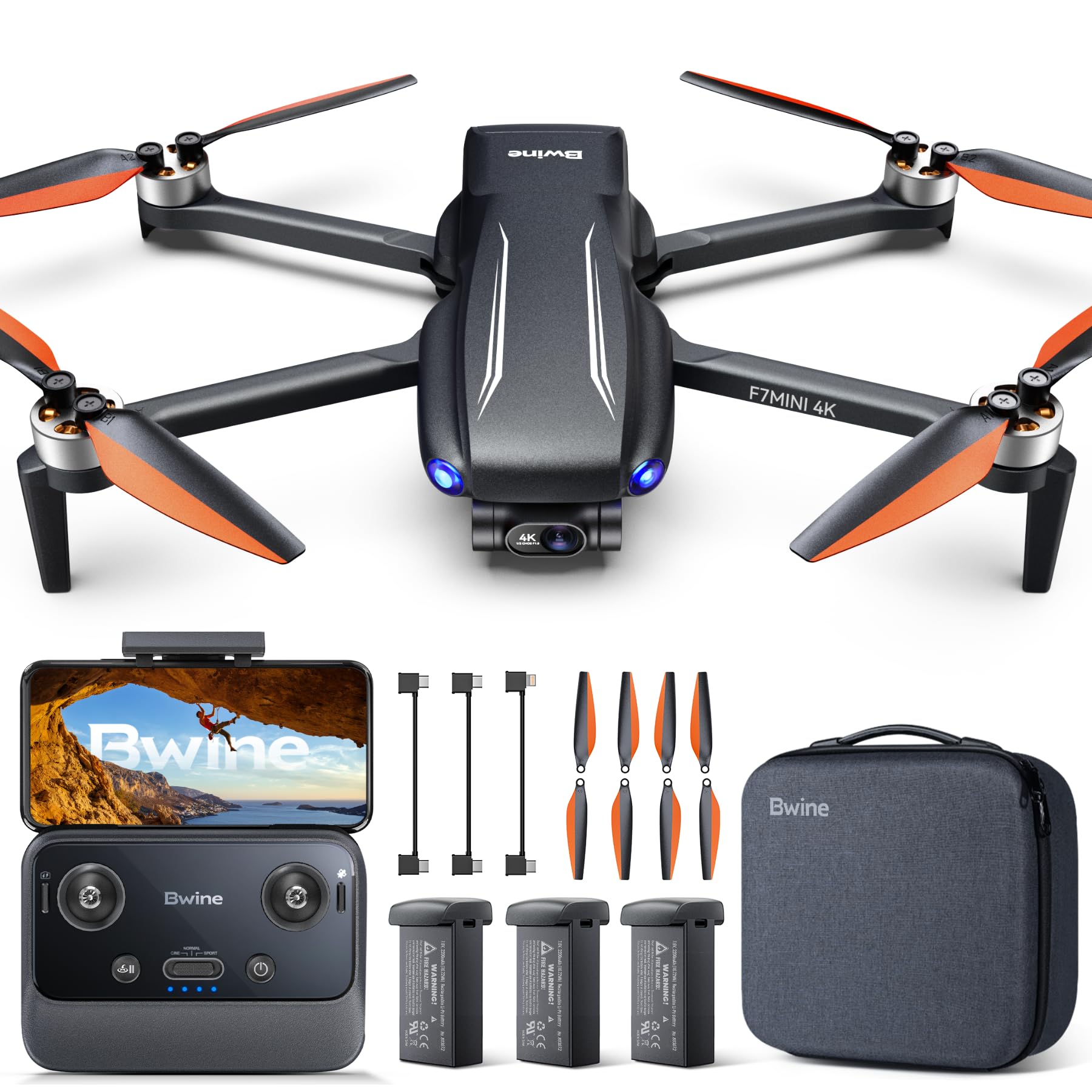
1. Bwine F7MINI
Our pick — over 4.5★ from 350+ verified ratings; the strongest balance of quality and price.
The 249-gram marathon runner that stays airborne for 96 minutes across three batteries.
This is the drone that you pack for a full day of shooting without worrying about recharging. The F7MINI packs a 3-axis mechanical gimbal and a 48MP 1/2-inch CMOS sensor, so your 4K/30fps video stays steady even in a Level 5 wind (that is about 31 mph gusts). The crowd favorite — 4.6 stars across 350+ owners — raves about the quality and ease of use more than anything else. Most owners say the built-in 5.5-inch touchscreen on the controller is their favorite feature; you never need to connect your phone.
What really separates it from the SKYROVER S1 below is the total flight time — at 96 minutes vs 40 minutes, you get nearly 2.4x more airborne time. The batteries use PD 3.0 fast charging, so topping them up between flights takes about an hour. Buyers report “range 3000 feet no issues,” which is conservative given the 20,000-foot Maximum Range spec, and the Smart Return-to-Home with a 120dB locator buzzer means even a novice can retrieve it if the signal drops.
Why it wins the top spot: The combination of a 3-axis mechanical gimbal, a built-in screened controller, and three fast-charging batteries for under 250g is class-leading in this price tier. Enough flight time to cover a whole property inspection or a beach vacation on one charging session.
The honest trade-off: The 4K/30fps ceiling is a mild cap for creators who want ultra-smooth 60fps slow motion. Also, a small number of owners flagged mixed reliability — treat this as a durable beginner-to-intermediate drone, not an indestructible pro tool.
Grab it if: You want to fly for nearly two hours total without reaching for a power outlet and you like having the flight screen built into the controller, not your phone.
Look elsewhere if: You specifically need 4K/60fps video or omnidirectional obstacle sensing — those live in the higher-priced picks below.
2. Skyrover S1 Mini
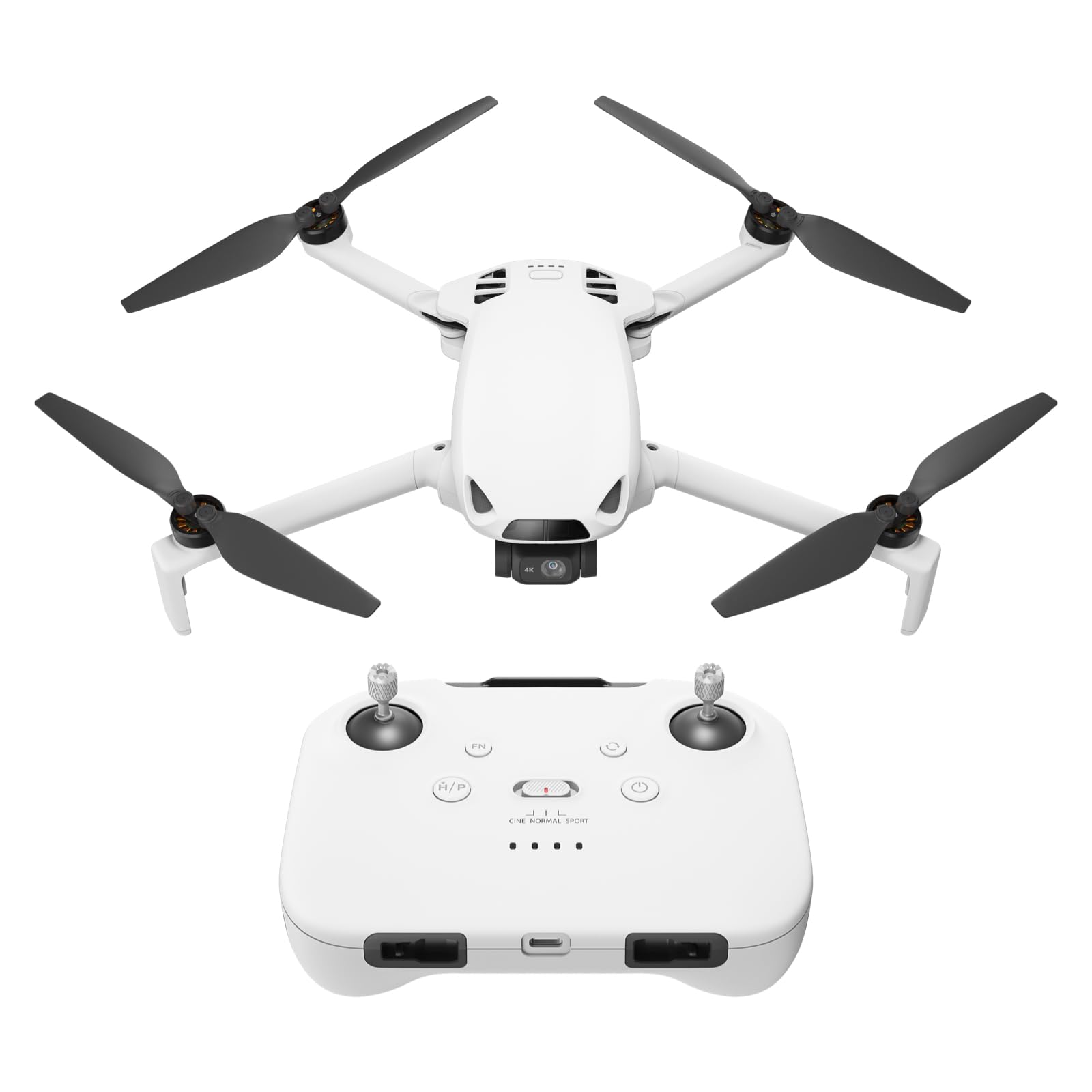
A tiny white drone that records 4K/60fps video and talks to the controller from 7.45 miles away.
If smooth slow-motion aerial footage matters more to you than having three batteries in the box, the S1 Mini is the value pick to beat. Its 1/2-inch Sony CMOS sensor captures 4K/60fps video and 8K stills (via firmware update), and the 3-axis mechanical gimbal keeps the frame stable enough to use in a breeze. Forward obstacle avoidance and Smart Return-to-Home make it surprisingly forgiving for a first-time owner — setup took about 15 minutes according to the consensus in owner feedback.
Where it truly pulls ahead of the Bwine F7MINI is the transmission system. This Skyrover reaches a 39,000-foot / 7.45-mile range, which is far beyond the Bwine’s 20,000 feet and more than enough to explore a whole coastline in one flight. Its 2560mAh battery is 16% larger than the F7MINI’s 2200mAh cells, though you only get one battery (40 minutes of flight) compared to the Bwine’s triple-pack. Many owners describe it as a “prosumer alternative to DJI Mini” thanks to features like vertical 2.7K filming ready for TikTok and Instagram Reels.
What wins people over
- 4K/60fps HDR video that feels buttery smooth — smoother than the 4K/30fps ceiling on the Bwine above.
- 7.45-mile video transmission means you can fly far out over a lake or canyon without losing the feed.
- Weighs under 249g and includes the FAA-friendly stamp; no registration needed.
- Auto Track and one-tap cinematic moves via the SmartGo app appeal to solo creators.
The catch
- Only one battery included — 40 minutes per flight is good, but you feel the single-pack limit on a long day of shooting.
- Stability and performance are rated “Mixed” by a meaningful segment of owners; a few report gimbal wobble in stronger wind.
Reach for this if: You shoot for social media and need 60fps slow motion plus the freedom to fly far without upgrading the antenna.
Think twice if: You want a full day of battery life without buying spare packs — the single battery means you stop flying after 40 minutes unless you recharge.
3. Holy Stone HS600
The gateway drug to aerial photography — easy setup, solid GPS lock, and a 4K camera that punches above its price.
The HS600 is the most-reviewed entry-level camera drone on this list, with almost 1,000 owners weighing in. It uses a 2-axis gimbal paired with electronic image stabilization (EIS) to shoot 4K/30fps video through a Sony sensor, and it is one of the few in this price range that ships with built-in FAA Remote ID compliance — no extra module to buy.
At 541 grams, the HS600 is heavier than the sub-250g competition, but that also means it handles wind better. The brushless motors and Level 6 wind resistance keep it stable on breezy days when a lighter drone would be fighting the gusts. Most owners praise the “excellent stability with GPS lock” and the clear camera output for the money. The caveat: the 2-axis gimbal lacks roll compensation, so fast turns introduce a slight wobble that a 3-axis gimbal would cancel out.
Who it fits: A first-time buyer who wants a forgiving drone with GPS follow, waypoint mode, and a reliable return-to-home that actually brings the drone back to the launch pad. The “34-minute flight time” the manual cites translates to roughly 20-25 minutes of aggressive flying per battery — pack the included second battery for an hour total.
The honest limitation: The camera exposure can bloom in bright scenes, and there is no manual ISO or RAW control, so this is more a “capture the moment” drone than a cinema-grade tool. Owners mention using a USB-A to C cable for the controller because the USB-C to C method does not work for charging both units.
Start here if: You want the lowest barrier to entry with the largest safety net — GPS-assisted return, beginner-friendly controls, and an included carrying case.
skip it if: You need true 3-axis mechanical stabilization for professional-looking pans or you want to fly beyond 10,000 feet.
4. Bwine F7GB2 Pro

Built to fly at 2,000 meters altitude and return home, every time.
The F7GB2 Pro is the Bwine F7MINI’s bigger, stronger sibling. Where the F7MINI focuses on ultra-portability (249g), this one weighs 550g and uses a 1806 brushless motor backed by a Level 6 wind resistance test report, making it stable in thin mountain air. The 3-axis mechanical gimbal and 120° FOV lens with 5x digital zoom deliver 4K/30fps footage, and the 2600mAh batteries (three included) give a total of 75 minutes of flight time, which trails the F7MINI’s 96 minutes but comes with higher altitude capability — the spec sheet says 2,000 meters.
Quality is the most-discussed aspect by far, with over 110 owners calling it exceptional, and the second-most praised feature is ease of use. The Bwine Mini app includes six filters and ten background music tracks so you can edit and share to social media directly from the app. The FAA Remote ID is printed on the drone arm, so compliance is from the start. A recurring point in the feedback: the controller screen is hard to see in direct sunlight, and the drone requires a FAT32-formatted 128GB SD card — not something new fliers always know.
Standout strengths
- Certified for high-altitude flight up to 2,000 meters — ideal for mountain cabins, alpine farms, or ski slope inspections.
- Three 2600mAh batteries deliver 75 minutes total flight, and they comply with UL 2054 safety certification.
- GPS Follow, Waypoint, and Orbit modes make hands-free cinematic shots easy even for a novice.
Watch out for
- Heavier than the F7MINI at 550g — you lose the sub-250g FAA exemption and feel the bulk in a backpack.
- The app-based control can be confusing; connectivity is the one aspect that draws mixed feedback.
Best suited for: Property owners, hikers, or inspectors who regularly fly at elevation and need a drone that does not lose performance in thinner air.
Not ideal for: Travelers who want to slip a drone into a jacket pocket — the carrying shell case takes up a quarter of a carry-on.
5. DJI Flip

Launches from your palm, flies with carbon-fiber protection, and talks to the controller over 13 kilometers.
DJI’s Flip is the lightest entry into the DJI ecosystem — 249 grams, full-coverage carbon fiber propeller guards, and a 1/1.3-inch CMOS sensor that captures 4K/60fps HDR video. The 3-axis mechanical gimbal ensures steady footage, and the O4 transmission system (13 km range) is a generation ahead of the WiFi-based controllers on cheaper drones. It operates via the DJI Fly app, which means you can fly hands-free with voice commands or use the RC-N3 controller for a dedicated link.
The Flip is a beginner’s drone first and a creator’s tool second. Subject tracking works like a personal cinematographer, following a hiker or a child running through a park. The battery capacity is 3110mAh (a clear step up from the 2200mAh cells on the Bwine models) and yields a genuine 31-minute flight time. The overwhelming feedback from nearly a thousand owners is positive: stable in 15 mph wind, excellent photo sharpness, and the palm-launch feature means you never need to find a flat surface for takeoff. A small number of customers note connectivity hiccups — the DJI Fly app had a brief removal from Google Play, so verifying the download source is essential.
Why it stands out: The 1/1.3-inch sensor captures more light than the 1/2-inch sensors on the Bwine and Skyrover drones, so dusk and overcast scenes look cleaner. The carbon fiber arm guards also make this the safest drone to fly around people — the blades cannot hit skin or furniture.
The trade-off: Only front-facing obstacle avoidance is included. If you fly backwards or sideways, a tree branch will not be detected. The bump in price over the Skyrover S1 is noticeable, but you get DJI’s mature ecosystem, including update support and a huge aftermarket parts pool.
Choose this if: You want a drone that lives in your daypack, launches from your palm, and gives you DJI’s trustworthiness in a sub-250g frame. Great for family vacations, casual hikes, and social-media reels.
Pass on it if: You need full 360-degree obstacle avoidance — that feature arrives on the Mini 5 Pro and Mavic 4 Pro further down the list.
6. Ruko 4K UHD
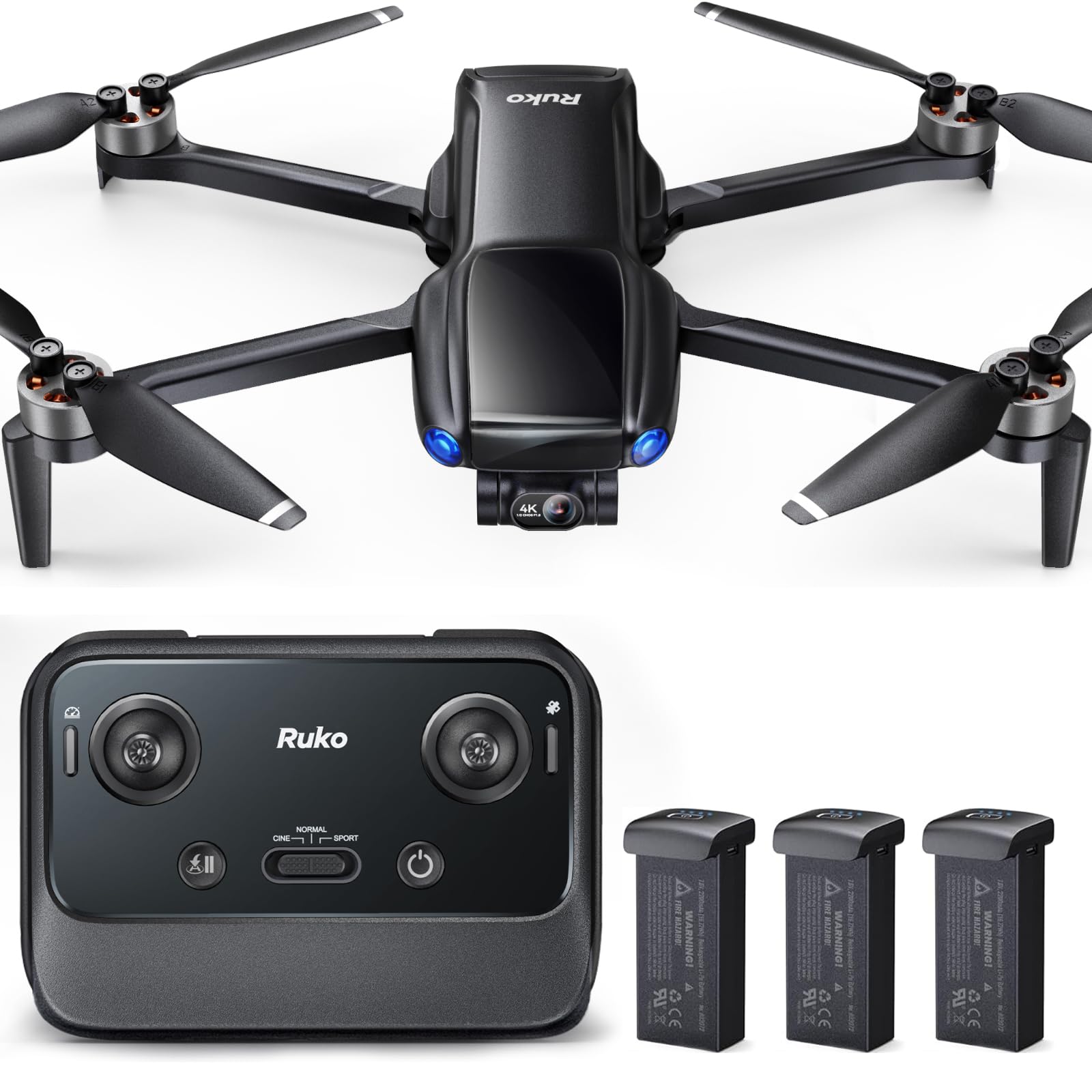
A 249-gram starter bundle that gives you three batteries, a carrying case, and a 20,000-foot digital feed.
Ruko’s entry into the sub-250g category packs nearly everything a beginner could want: a 3-axis brushless gimbal for smooth 4K/30fps video, the ability to capture 8K still photos via the 48MP CMOS sensor, and a dedicated R2 digital system that streams a 1080p live view over 20,000 feet without the interference of consumer Wi-Fi. The AI takeoff and landing system uses quadruple positioning (GPS, barometer, TOF, and optical flow) to hover within inches of the spot you chose, even indoors.
The value pitch is hard to ignore: three 2200mAh batteries give 96 minutes total, plus a hard-shell carrying case and a full set of spare propellers and screws. The crowd-praising feedback majority highlights the quality and ease of use, and a significant number of owners mention excellent customer support. The recurring hiccup is battery reliability — a handful of units arrived with a defective cell, though customer service replaced them quickly. Compared to the Skyrover S1 above, the Ruko’s 4K/30fps video lacks 60fps smoothness, but it makes up for it with a third battery in the box.
What it does well
- Triple batteries in the bundle — no need to buy spares for a full day of exploring.
- AI takeoff and landing with quadruple positioning makes this among the most stable beginner hoverers in the price range.
- Under 249g with FAA exemption — palm-sized foldable design fits in a jacket pocket.
What to note
- Video tops out at 4K/30fps; you cannot get 60fps slow motion.
- Performance and battery life have a “Mixed” rating segment — a small batch of owners received faulty batteries.
Ideal for: A brand-new drone pilot who wants everything in one box, ready to fly out of the case, with enough battery endurance to learn without frustration.
Consider another pick if: You already own spare batteries or you specifically want 4K/60fps for action sports.
7. Skyrover X1
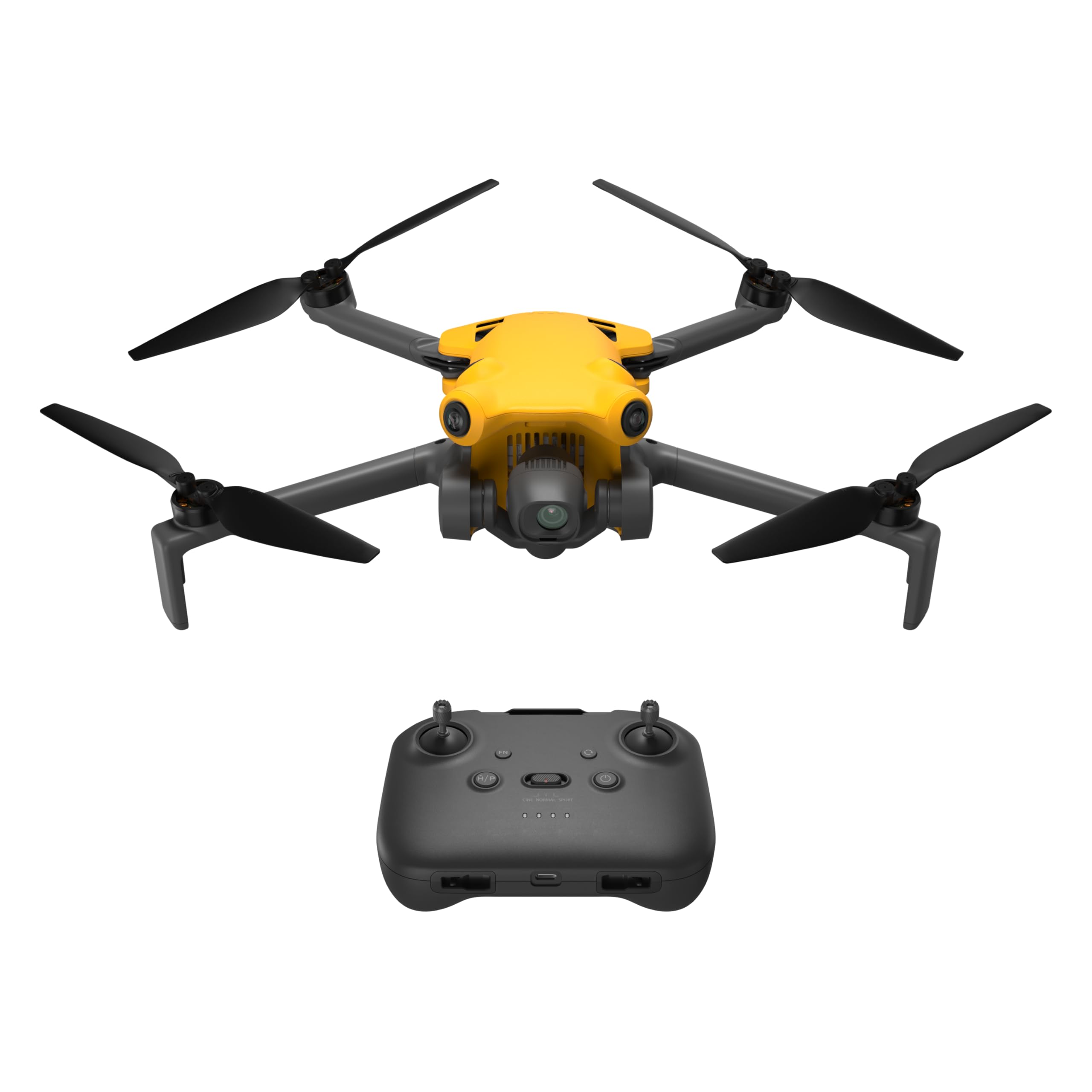
Yellow, sub-250g, and surrounded by sensors that see obstacles in every direction.
The Skyrover X1 is the first mini drone on this list that offers 360-degree obstacle sensing — a feature normally reserved for the DJI models. That means you can fly forward, backward, and sideways through a forest trail, and the drone will stop before hitting a branch. It records 4K/60fps HDR video via a 1/1.32-inch CMOS sensor with an f/1.7 aperture, which pulls in more light for cleaner dusk footage than the f/1.8 sensors on the Bwine models. The 3-axis mechanical gimbal handles the stabilization.
The X1 also introduces an AI Night Mode that improves low-light shooting, plus 4K/100fps slow-motion capture — a feature absent from every other sub-250g drone here. Its SkyBridge transmission system reaches 9.32 miles (about 50,000 feet), putting it just behind the S1 Solo in range. Owner feedback is overwhelmingly positive about the number of features for the price, and many compare it directly to a DJI Mini 4 Pro clone at a lower price. The only physical complaint is the controller phone holder — it is too tight for a large phone like the iPhone Pro Max series.
Why this deserves your attention: 360-degree obstacle sensing at this price point changes how confident you feel flying near trees, buildings, or crowds. Combined with 4K/60fps HDR, 4K/100fps slo-mo, and a 10-bit SRlog color profile, this is the most feature-dense mini drone we have seen from a non-DJI brand.
Best for: A pilot who wants DJI-level obstacle protection without paying DJI prices, especially if you often fly in tight spaces like wooded trails or urban parks.
Not for you if: You plan to use an iPhone Pro Max with a case — the controller may not fit.
8. Karuisrc K600PRO
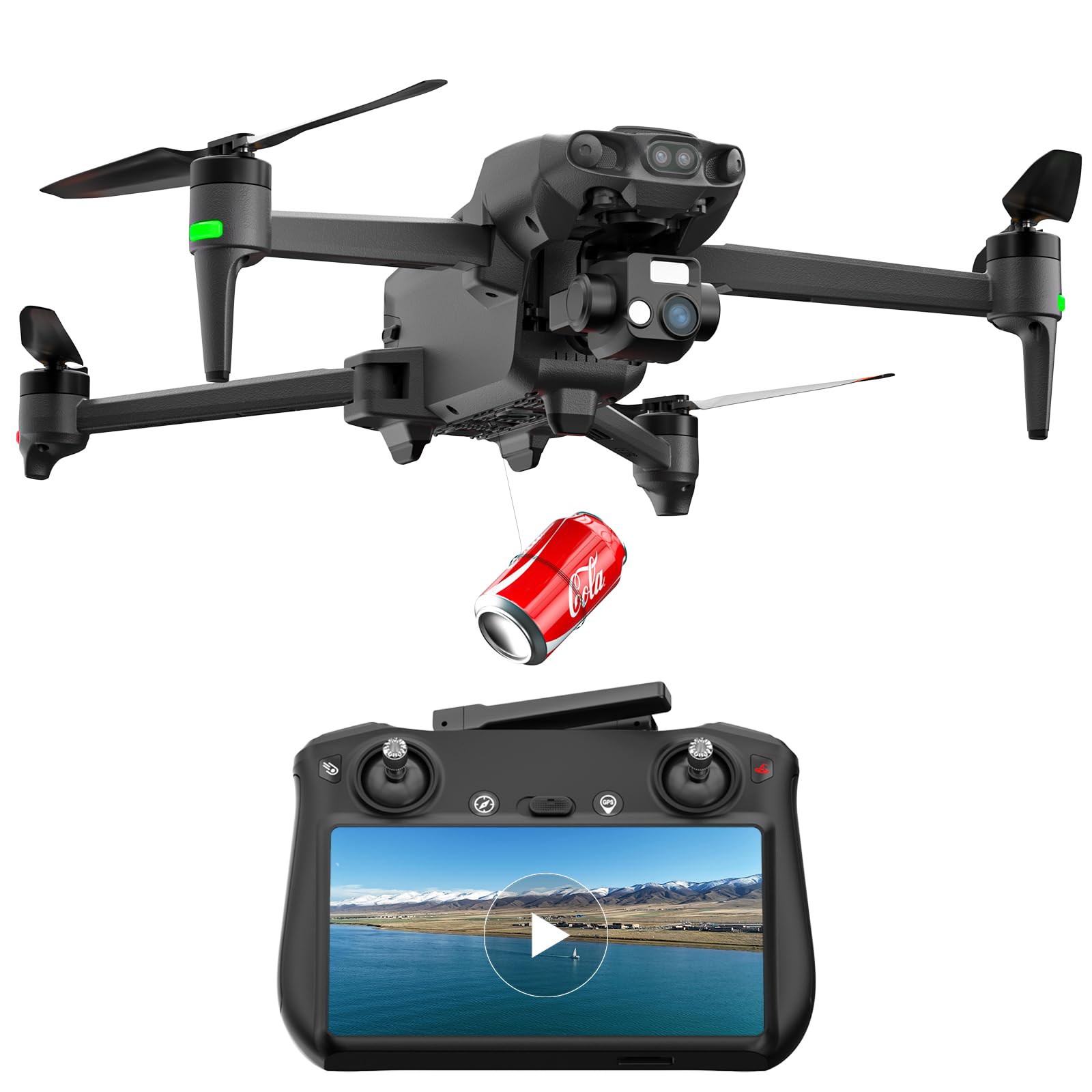
A controller with a 5.5-inch screen so bright you never need your phone.
The K600PRO skips the phone-dependent approach entirely. The remote has a built-in 5.5-inch touchscreen that shows the 4K live feed at 15 km range, which is a feature usually reserved for premium DJI remotes that cost on their own. The drone itself uses a brushless motor and an 11.1V 3500mAh battery — the highest single-battery capacity on this list — for 55 minutes of flight time. Electronic image stabilization (EIS) smooths out the 4K video, though it is not as effective as a mechanical gimbal at cancelling high-frequency vibration.
Where the K600PRO excels is ease of use and value — over 100 owners call it “easy to use” and over 100 call the camera quality good. The touchscreen handles GPS follow, orbit, and waypoint modes directly without navigating a phone app. The 50x digital zoom (30x optical plus digital) lets you get closer without physically moving the drone, though beyond 15x the image degrades noticeably. A noteworthy detail from the feedback: the controller can be paired quickly, but the accompanying app requires some setup time to open up all the manual shutter controls.
Advantages
- No phone needed — the 5.5-inch screen is bright enough for outdoor use and shows the FPV feed without latency.
- 55-minute battery life from a single 3500mAh battery is the longest per-battery time on the list.
- 15 km transmission range with a built-in 16 GB SD card slot for direct recording.
Compromises
- EIS is electronic stabilization; it reduces shake but cannot match a mechanical 3-axis gimbal that counters physical motion.
- The drone weighs 730 grams, which requires FAA registration and limits portability compared to the sub-250g models.
Reach for it if: You hate fiddling with a phone mount and phone cable pre-flight — just turn on the controller and fly. Also a strong choice for a new pilot who wants a dedicated control screen in a mid-range package.
Skip if: Mechanical gimbal stabilization is non-negotiable for your footage — the EIS here will not eliminate micro-jitters during fast yaw turns.
9. DJI Mini 5 Pro
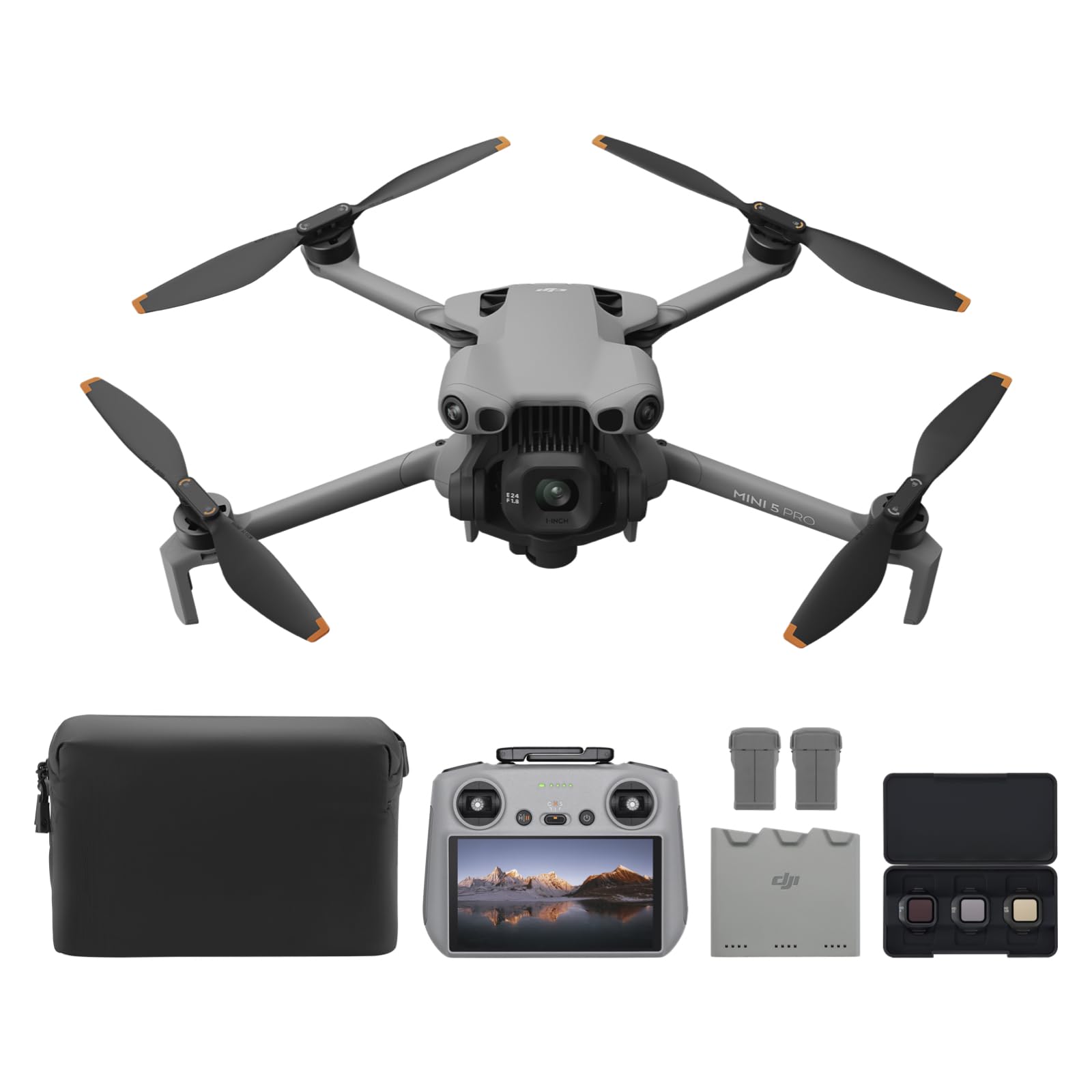
A 249-gram drone with a 1-inch sensor and sensors that see left, right, front, back, up, and down.
The DJI Mini 5 Pro is the first sub-250g drone that offers true omnidirectional obstacle sensing — forward-facing LiDAR plus six vision sensors that guard every axis. Paired with a 1-inch CMOS sensor (the largest in this class, compared to the 1/1.3-inch or 1/2-inch sensors on competitors), it captures 4K/60fps HDR video with noticeably better dynamic range and low-light performance. The gimbal rotates 225° for true vertical filming, which means no cropping a horizontal frame for TikTok or Instagram Reels.
The Fly More Combo includes three batteries (36 minutes each), a two-way charging hub, ND filters, and a shoulder bag. ActiveTrack 360° can follow a cyclist through a wooded path while maintaining a safe distance, and the 42GB internal storage means you can fly without an SD card for the first few sessions. A huge number of owners call it the best drone they have owned, praising the image quality and stability even in high winds. The big price gap relative to the Skyrover X1 is tangible: the 1-inch sensor produces richer color and cleaner shadows, and DJI’s flight software is more polished, with automatic OTA updates.
Why it leads the premium mini category
- 1-inch CMOS sensor is a full step up in quality — captures more light and detail than any sub-250g competitor here.
- Omnidirectional obstacle sensing covers every side, giving you confidence in tight spaces and at night.
- Fast charging charges three batteries in about 115 minutes via the hub — no long waits between flights.
What holds it back
- The price is more than double the Skyrover X1, and the X1 offers similar obstacle sensing for less.
- A small number of owners reported a gimbal issue on the first unit, which was resolved through a replacement.
Perfect for: A serious hobbyist or semi-professional who wants the best image quality in a portable, FAA-exempt package and is willing to pay for the 1-inch sensor and full-coverage safety.
Look to the Mavic 4 Pro below if: You need a larger sensor (4/3 CMOS) for professional deliverables and are comfortable with a heavier, registered drone.
10. DJI Mavic 4 Pro

Three cameras, a 100MP Hasselblad main sensor, and a 360-degree gimbal that spins any direction.
The Mavic 4 Pro is the drone for professionals who need multiple focal lengths in one flight. The primary camera houses a 4/3 CMOS Hasselblad sensor that captures 100MP stills and 6K/60fps HDR video — a resolution no other drone on this list can touch. It also includes dual tele cameras for crisp zoom shots, and the 360° Infinity Gimbal means the camera can rotate fully without obstruction, enabling smooth overhead tracking shots that a conventional gimbal cannot achieve.
For safety, DJI’s Nightscape Omnidirectional Obstacle Sensing works at 0.1 Lux, which is essentially moonlight — detecting branches and power lines in conditions that would blind other sensors. The O4+ video transmission system streams a 10-bit HDR signal over 30 km (18.6 miles), and the 6654mAh battery yields 51 minutes of flight time. The feedback from owners is clear: the image quality and flight performance are top-tier. The trade-off is weight — at 2,372 grams, this is not a pocket drone; it requires FAA registration and a dedicated case. A small number of owners questioned reliability and value for money, with a few reporting bricked controllers, though most call it the best drone DJI has made.
Who this is built for: Real estate photographers, film crews, and commercial inspectors who need the flexibility of a wide, medium, and tele lens in one flight, plus the ability to shoot in raw 6K for post-production color grading. The 360° gimbal enables smooth overhead tracking shots that a conventional gimbal cannot achieve.
The honest reality check: At over, it is a serious investment. The 30 km range is overkill for most users, and the 2.3 kg weight limits airline carry-on due to battery restrictions. Owner feedback also notes that DJI’s US-facing support can be difficult given the current geopolitical climate around Chinese-manufactured drones.
Get it if: You produce professional-grade aerial content for clients and need a single drone that handles every shot — wide landscape, medium portrait, and tele close-up — without swapping lenses.
Stick with the Mini 5 Pro if: You occasionally shoot for personal projects and prefer portability over having three lenses on board.
Understanding the Specs
3-Axis vs 2-Axis Gimbal
A 3-axis mechanical gimbal counteracts pitch, roll, and yaw for smooth footage; a 2-axis gimbal lets the camera twist, causing wobble. A 3-axis mechanical gimbal uses motors to counteract pitch (nodding), roll (tilting), and yaw (twisting). A 2-axis gimbal covers pitch and roll but lets the camera twist freely, so fast turns produce a wobble.
Transmission Range and System
This is how far you can fly before the video feed drops. A dedicated digital system (like DJI’s O4 or Skyrover’s SkyBridge) streams a crisp 1080p/60fps live view over miles. Wi-Fi-based transmission loses signal within a few hundred feet and cannot penetrate a single tree. If your flying involves exploring beyond the park you are standing in, opt for a drone that specifies its transmission system as “digital” rather than “Wi-Fi.”
FAQ
Do I need to register my camera drone with the FAA?
How long does a 250g drone battery actually last in real-world flying?
Can I fly a sub-250g drone in national parks?
What does “3-axis mechanical gimbal” mean for video quality?
Is 4K/30fps good enough, or should I pay for 4K/60fps?
How important is obstacle avoidance for a beginner?
Can I use my smartphone as a screen, or do I need a separate controller?
What is the difference between a 1/2-inch sensor and a 1-inch sensor?
How does the DJI Flip compare to the DJI Mini 5 Pro?
What accessories should I buy with my first camera drone?
Final Thoughts: The Verdict
For the majority of shoppers, the winner in the camera drone category is the Bwine F7MINI because it packs a 3-axis gimbal, a built-in controller screen, and 96 minutes of battery life into a sub-250g body without a premium price tag. If you want the best 4K/60fps value for social media content, grab the Skyrover S1 Mini. And for a professional-grade drone that covers wide, medium, and tele shots in one flight, the DJI Mavic 4 Pro is the one to reach for.
How We Picked
We do not accept paid placement. Every pick is matched to a real buyer and a real use-case; we do not hands-on test units.
Sources & Methodology
Specifications: manufacturer listings and product documentation. Review insights: verified customer reviews, as of July 2026. Pricing: not shown on this page (it changes often); check the current price via the retailer link.
As an Amazon Associate, Gadgets Feed earns from qualifying purchases. This does not affect which products we feature.