
Our readers keep the lights on and my morning glass full of iced black tea. As an Amazon Associate, I earn from qualifying purchases.
A DSLR body in your hands is a promise of control. The weight of the chassis, the optical viewfinder pressed to your eye, the decisive click of the mirror — these sensations are absent from every smartphone and most mirrorless cameras. The category endures because it delivers a direct, mechanical connection between your intent and the final exposure, free from the latency and electronic abstraction that creeps into modern imaging.
I’m Min — the co-founder and writer behind Gadgets Feed. For this guide, I’ve spent dozens of hours parsing sensor readout speeds, AF point layouts, dynamic range measurements, and real-world customer experiences across the full spectrum of DSLR bodies to identify which models actually deliver on the promise of photographic control.
Whether you are stepping up from a kit lens or building a professional kit from scratch, selecting the right body is the single most critical gear decision you will make. This guide cuts through the marketing noise to present the only camera dslr for photography that earns a place in your bag.
How To Choose The Best Camera DSLR For Photography
A DSLR is not a single-purpose gadget; it is a system. The body you choose determines which lenses, flashes, and accessories will work for the next decade. Picking the wrong format or AF system locks you into compromises that no lens upgrade can fix. Focus on these three pillars first.
Sensor Format: Full-Frame vs APS-C
The sensor is the canvas. Full-frame sensors (36mm x 24mm) deliver roughly 2.5x the light-collecting area of APS-C sensors. This translates directly into roughly one to two stops better high-ISO noise performance, shallower depth of field for portrait separation, and wider true focal lengths from any given lens. APS-C bodies are smaller, lighter, and extend the effective reach of telephoto lenses by a 1.5x (Nikon) or 1.6x (Canon) crop factor — a genuine advantage for wildlife and sports photographers on a budget.
Autofocus System: Points, Cross-Types, and Coverage
Not all AF points are equal. A 9-point system with a single center cross-type point, like the one in entry-level Rebels, locks focus reliably only on a static central subject. A 51-point system with 15 cross-type sensors, as found in the Nikon D7500, tracks an erratically moving subject across the frame. A 153-point system with 99 cross-type sensors, like the one in the Nikon D500, delivers the same AF performance as the brand’s professional full-frame bodies. Never buy an AF system weaker than the action you intend to shoot.
Burst Rate, Buffer Depth, and Shutter Durability
Frames per second (fps) tells only half the story. A camera that shoots 7 fps but buffers after 10 raw frames is useless for a five-second sequence of a race car passing. Professional-grade bodies like the Nikon D500 sustain 10 fps for 200 consecutive raw frames. The mechanical shutter rating matters too: entry-level shutters are rated for roughly 100,000 actuations, while pro bodies like the Canon 5D Mark IV are rated for 150,000 or more. If you shoot events, wildlife, or sports, prioritize buffer depth and shutter life over megapixel count.
Quick Comparison
On smaller screens, swipe sideways to see the full table.
| Model | Category | Best For | Key Spec | Amazon |
|---|---|---|---|---|
| Canon EOS 5D Mark IV | Full-Frame | Studio & Portrait | 30.4MP | 61 AF Points | Amazon |
| Nikon D850 | Full-Frame | High-Res Studio & Landscape | 45.7MP | 153 AF Points | Amazon |
| Nikon D500 | APS-C | Wildlife & Action | 20.9MP | 153 AF Points | 10 fps | Amazon |
| Canon EOS 6D Mark II | Full-Frame | Entry-Level Full-Frame | 26.2MP | 45 AF Points | Amazon |
| Nikon D7500 | APS-C | Versatile Mid-Range | 20.9MP | 51 AF Points | 8 fps | Amazon |
| Canon EOS Rebel T7 | APS-C | Complete Beginner Bundle | 24.1MP | 9 AF Points | Amazon |
| Canon EOS 2000D (Rebel T7) Renewed | APS-C | Budget-Entry Bundle | 24.1MP | 9 AF Points | Amazon |
In‑Depth Reviews
1. Canon EOS 5D Mark IV (Body Only)
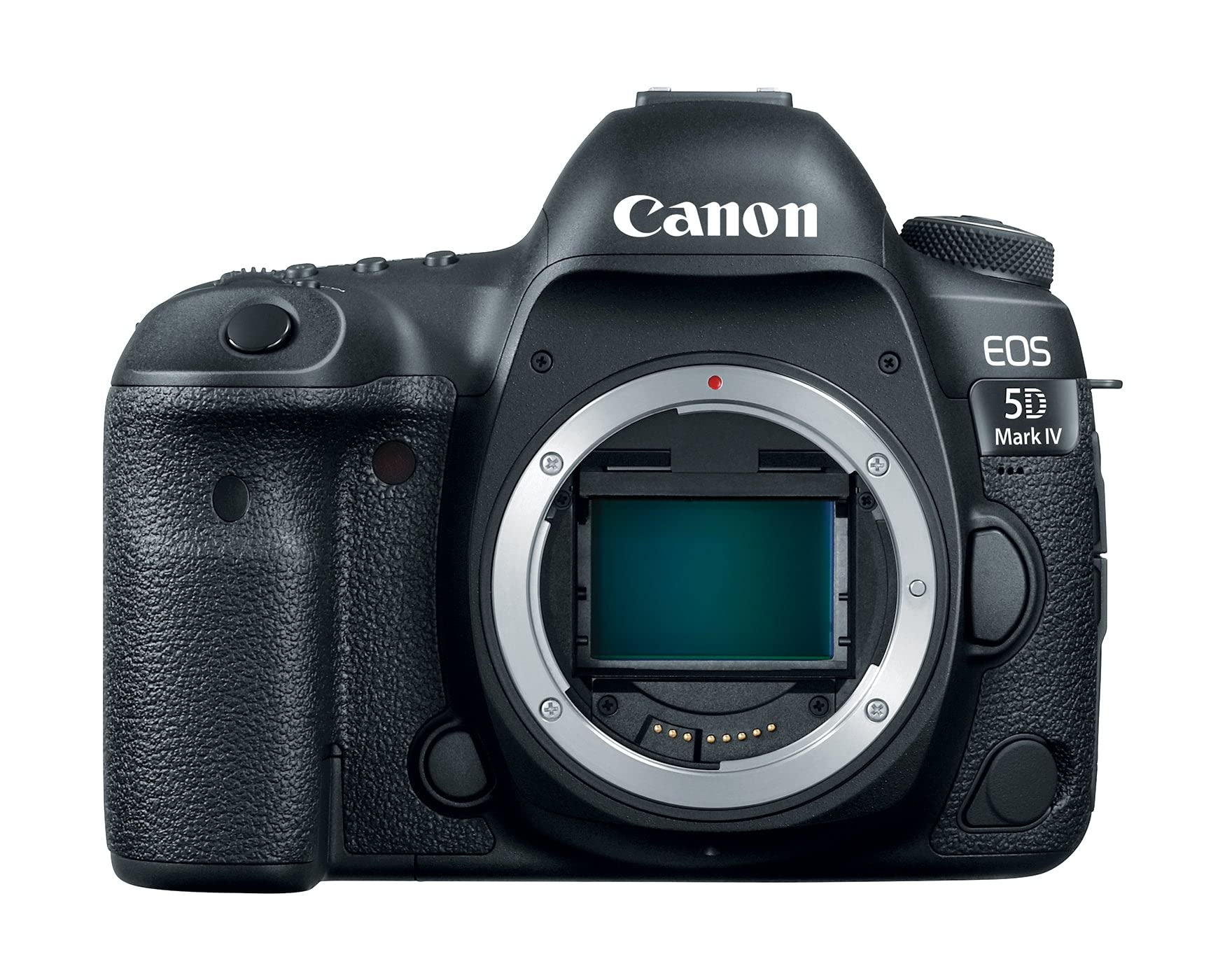
The 5D Mark IV is the definitive workhorse of the Canon DSLR lineup, and for good reason. Its 30.4MP full-frame sensor paired with the DIGIC 6+ processor delivers a dynamic range that recovers deep shadow detail without introducing banding, a trait that sets it apart from earlier 5D generations. The 61-point AF system, with 41 cross-type sensors, locks onto subjects even in low-contrast indoor lighting, and the touchscreen interface makes AF point selection instantaneous during live view.
Dual Pixel CMOS AF provides smooth, phase-detect autofocus during video recording, making the 5D Mark IV a legitimate hybrid tool for event photographers who also shoot interviews or behind-the-scenes clips. The body is weather-sealed against dust and moisture, and the shutter is rated for 150,000 actuations — a number that professional wedding shooters will hit comfortably within a few years of heavy use.
Customer feedback highlights that the autofocus is “faster, more accurate, and more customizable” than the Mark III, and that dynamic range improvement is dramatic enough to reduce the need for fill flash in high-contrast scenes. Battery life easily covers a full day of shooting on a single LP-E6N pack, provided GPS is turned off. The 7 fps continuous shooting is adequate for portraits and general action but not optimized for high-speed sports.
Why it’s great
- Excellent dynamic range with clean shadow recovery at ISO 100
- 61-point AF system with 41 cross-type sensors for reliable tracking
- Weather-sealed magnesium alloy body rated for 150,000 shutter actuations
Good to know
- 4K video is Motion JPEG with a 1.74x crop factor
- GPS drains the battery noticeably if left active
2. Nikon D850 FX-Format (Body Only)

The D850 is widely regarded as the most versatile high-resolution DSLR ever manufactured. Its back-side illuminated (BSI) 45.7MP sensor delivers extraordinary resolution without an optical low-pass filter, and the lack of moiré means landscape and studio photographers can print at massive sizes with no artifacts. The sensor’s native ISO range extends to 25,600, and reviewers consistently report workable image quality up to ISO 12,800 — a remarkable feat for a sensor with this many pixels.
The Multi-CAM 20K autofocus module with 153 points (99 cross-type) is the same unit found in the flagship Nikon D5 and D6. It provides subject acquisition that is instantaneous even in near-dark conditions. The tilting 2.36M-dot touchscreen enables precise focus point selection for tripod work, and the focus shift shooting mode automates focus stacking for macro and still-life photography — a feature that saves hours of post-processing.
From real-world use, the D850 earns praise for its 9 fps shooting speed (with the MB-D18 battery grip) and the ability to output 8K time-lapse sequences in-camera. Reviewers note that the SnapBridge wireless connection requires a specific setup procedure to work reliably, and that the body is heavy at 1,005 grams with battery. However, the combination of resolution, dynamic range, AF performance, and build quality has led many to call it “the best DSLR ever made.”
Why it’s great
- 45.7MP BSI sensor with no OLPF for maximum sharpness and detail
- 153-point AF module inherited from the Nikon D5 flagship
- In-camera focus shift stacking and 8K time-lapse capabilities
Good to know
- SnapBridge app has cumbersome pairing and transfer speeds
- Large raw files require significant storage and processing power
3. Nikon D500 DX-Format (Body Only)

The Nikon D500 is the only APS-C DSLR that borrows its autofocus system directly from a professional full-frame flagship — the D5. The Multi-CAM 20K module with 153 AF points (99 cross-type) combined with the EXPEED 5 processor delivers 3D tracking that maintains focus lock on birds in flight or cars on a racetrack across the entire frame. The 10 fps continuous shooting speed with a buffer depth of 200 raw frames means you can hold the shutter for six seconds without ever experiencing a slowdown.
The 20.9MP DX sensor is not about megapixel bragging rights; it is about pixel density for telephoto reach. With Nikon’s 1.5x crop factor, a 200mm lens effectively becomes a 300mm lens, making the D500 a cost-effective body for photographers who primarily shoot wildlife, airshows, or field sports. High ISO performance is genuinely impressive — usable noise levels at ISO 10,000 are achievable with current noise-reduction software, and ISO 25,600 is passable for web and social media output.
Real-world feedback from users who upgraded from the D7100 or D7200 reveals that the D500’s handling is significantly better, with a deeper grip, backlit buttons, and a tilting 2.36M-dot touchscreen that is invaluable for low-angle wildlife shots. The main criticism is that the SnapBridge wireless connectivity is unreliable and drains the battery when active. Turning off Wi-Fi and Bluetooth when not needed resolves the issue.
Why it’s great
- 153-point D5-level AF with 99 cross-type sensors for extreme tracking
- 10 fps continuous shooting with a 200-frame raw buffer
- 1.5x crop factor maximizes effective reach of telephoto lenses
Good to know
- Wireless SnapBridge functionality is buggy and drains the battery
- 20.9MP resolution limits large-format print capability
4. Canon EOS 6D Mark II (Body Only, Renewed)

The 6D Mark II is the most affordable entry point into Canon’s full-frame ecosystem. The 26.2MP sensor uses the DIGIC 7 processor to produce color-accurate, low-noise images up to ISO 6400, with acceptable results at ISO 12800. The 45-point all-cross-type AF system is a marked upgrade over the 9-point system in entry-level Rebel cameras, covering a much wider area of the frame and handling off-center subjects with confidence.
The vari-angle 3.0-inch touchscreen LCD is a standout feature for photographers who shoot overhead or from waist level, and the Dual Pixel CMOS AF ensures smooth and fast focusing in live view. The built-in Wi-Fi, NFC, and Bluetooth compatibility with the Canon Camera Connect app allow for easy image transfer and remote camera control from a smartphone. The body is relatively lightweight at 765 grams, making it a sensible companion for travel or day-long walkaround shooting.
Renewed unit buyers consistently report that the camera arrives in excellent condition, often with a battery charger, multiple batteries, and an SD card included. The autofocus is described as “great” and the battery endurance exceeds official ratings. One important caveat is that Amazon Renewed units are not eligible for Canon’s manufacturer warranty — the coverage is provided by Asurion. A single report of an Err 20 issue was resolved through Asurion after an initial misdirection to Canon.
Why it’s great
- Entry-level price for full-frame dynamic range and shallow depth of field
- 45-point all-cross-type AF system covers the frame widely
- Vari-angle touchscreen provides flexible shooting angles in live view
Good to know
- Single SD card slot limits backup and storage flexibility
- Renewed units lack Canon manufacturer warranty — Asurion coverage applies
5. Nikon D7500 with AF-S DX NIKKOR 18-140mm f/3.5-5.6G ED VR

The D7500 is Nikon’s most balanced APS-C DSLR, borrowing the 20.9MP sensor and EXPEED 5 processor from the flagship D500. The metering system is the same 180,000-pixel RGB sensor, ensuring accurate exposures even in challenging mixed lighting. The 51-point AF system with 15 cross-type sensors is responsive and pairs well with the 8 fps continuous shooting speed — enough to capture fast action without the buffer cost of the D500’s 10 fps rate.
The bundled AF-S DX NIKKOR 18-140mm f/3.5-5.6G ED VR lens is a standout kit option. Its 7.8x zoom range covers wide-angle to telephoto in a single lens, and the Vibration Reduction system compensates for roughly four stops of hand shake. Real-world feedback confirms that this lens is “excellent at all focal lengths” and that the combination with the D7500 “impresses for fast action shots.”
Reviewers who purchased the D7500 as an upgrade from the D7100 or D7200 note that the handling improvements — deeper grip, dedicated ISO button, and tilting 3.2-inch touchscreen — make this a more comfortable camera to hold and use for extended periods. The single SD card slot is a compromise from the previous D7200’s dual slots, but the D7500 gains 4K UHD 30fps video with power aperture control, auto ISO for video, and 4K time-lapse. Battery life using the EN-EL15a is excellent, often exceeding 800 shots per charge.
Why it’s great
- D500-grade image sensor and metering in a more affordable body
- 18-140mm kit lens offers versatile range with effective vibration reduction
- 51-point AF with 15 cross-type sensors provides reliable subject tracking
Good to know
- Single SD card slot is a downgrade from the previous D7200
- No built-in AF motor compatibility for older D-series lenses
6. Canon EOS Rebel T7 Bundle (18-55mm IS II + Accessories)
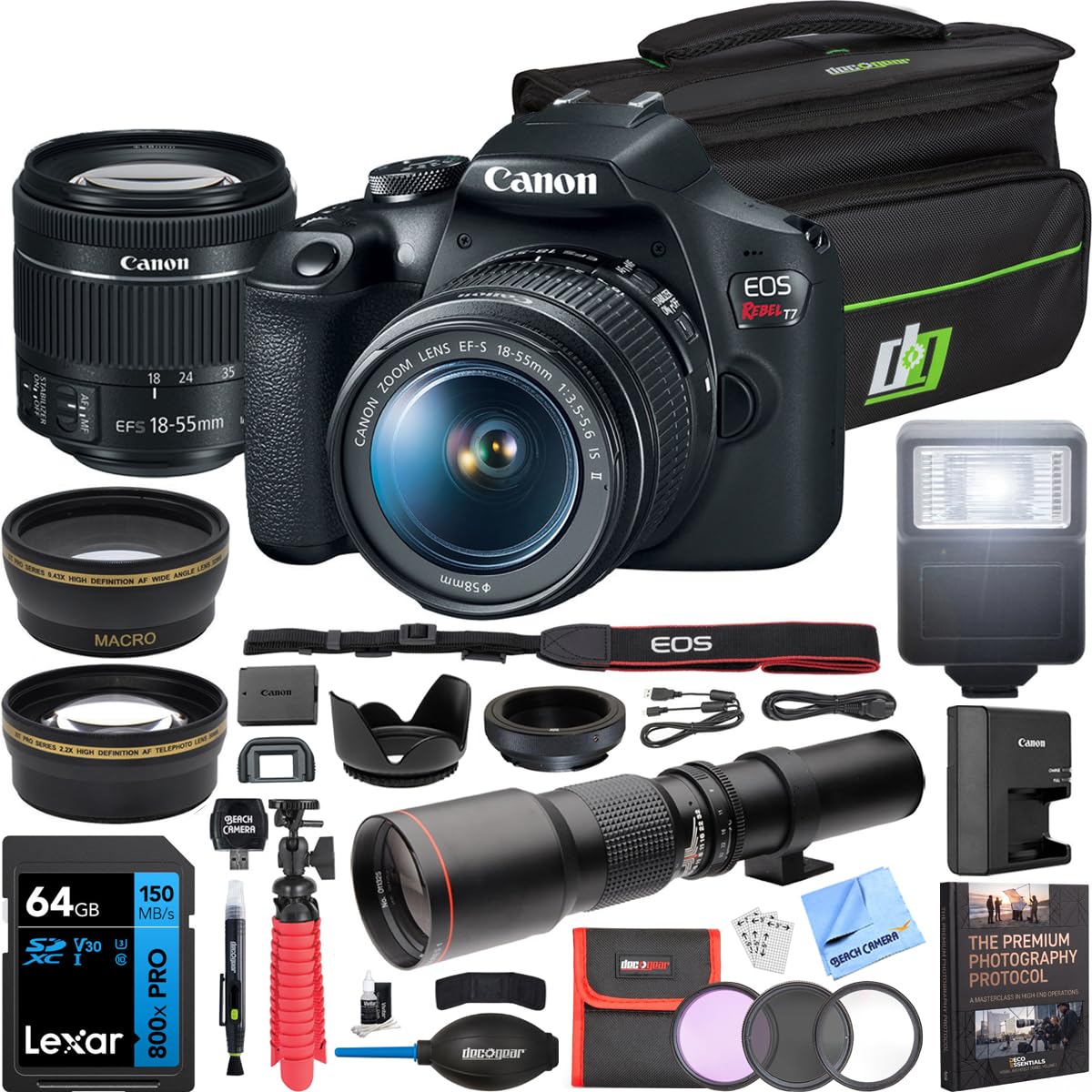
The Canon EOS Rebel T7, also known as the EOS 2000D, is the textbook entry-level DSLR. Its 24.1MP APS-C CMOS sensor with the DIGIC 4+ processor produces solid 16:9 images for print and social media. The 9-point AF system with a single center cross-type point gets the job done for static subjects in decent light, and the Scene Intelligent Auto mode handles exposure decisions for complete beginners.
This specific bundle is what justifies the purchase for a first-time buyer. It includes the EF-S 18-55mm f/3.5-5.6 IS II kit lens (with Image Stabilization), a 500mm f/8 preset telephoto lens for wildlife reach, a 0.43x wide-angle and 2.2x telephoto screw-on attachments, a Deco Gear camera bag, a Lexar 64GB 800x SDXC memory card, an external flash, a tabletop tripod, and a filter kit. The sheer volume of accessories means new photographers can experiment with telephoto, macro, and wide-angle effects without any additional investment.
Customer opinions split between the camera itself and the bundled accessories. The camera is described as “easy to use” and “one of the best investments” for learning photography. The accessories, however, draw mixed reviews: the bag is cramped for the full bundle, and the battery has been reported to drain rapidly — one user reported only 8 photos from a full charge, which suggests a defective unit rather than a systemic flaw. Buyers should budget for a spare LP-E10 battery regardless.
Why it’s great
- Comprehensive accessory bundle provides telephoto, wide-angle, and flash
- 24.1MP sensor delivers Instagram-quality images with minimal processing
- Scene Intelligent Auto mode enables out-of-box shooting for absolute beginners
Good to know
- 9-point AF system struggles with fast-moving or off-center subjects
- Battery life is below average; a spare is necessary for a full day out
7. Canon EOS 2000D (Rebel T7) Renewed Bundle

The Canon EOS 2000D is the exact same camera as the EOS Rebel T7 — the only difference is the regional product label. The 24.1MP APS-C sensor and DIGIC 4+ processor are identical hardware. The included EF-S 18-55mm f/3.5-5.6 DC III lens (non-IS version) produces acceptable results for web photography, though the lack of Image Stabilization means shutter speeds must be kept higher than the IS II version to avoid blur.
This renewed bundle includes the camera and lens, a camera bag, a 32GB SD memory card, and a TopKnotch accessory kit. The value proposition is clear: a full DSLR system for the price of a single lens for a premium body. The 3.0-inch 920k-dot LCD is adequate for image review, and the built-in Wi-Fi with NFC enables quick transfer to a smartphone for sharing. The optical viewfinder provides 95% frame coverage — sufficient for composition without the battery drain of an EVF.
Buyers consistently rate this bundle highly, with many describing it as “excellent value for the money” and “a perfect beginner camera.” The accessories, however, are noted as cheap — the tripod is flimsy, and the flash unit lacks durability. The fact that this is a renewed unit (International Version) means that parts and accessories can be harder to source locally. One reviewer gave only 3 stars specifically because finding locally compatible accessories proved difficult.
Why it’s great
- Lowest cost of entry for a complete interchangeable-lens camera system
- Built-in Wi-Fi/NFC for fast image sharing to a smartphone
- Optical viewfinder provides zero-latency composition without battery drain
Good to know
- Accessories in the bundle are low quality — tripod and flash may need immediate replacement
- Kit lens lacks Image Stabilization, requiring faster shutter speeds at telephoto
FAQ
Is a 24.1MP sensor from a Rebel T7 enough for professional prints?
Why do full-frame cameras cost more than APS-C models with the same feature set?
Can I use my old Canon EF or Nikon F lenses on a modern DSLR body?
Final Thoughts: The Verdict
For most users, the camera dslr for photography winner is the Canon EOS 5D Mark IV because it delivers the best combination of full-frame dynamic range, professional-grade 61-point autofocus, and proven durability at a price that makes sense for working photographers. If you want the highest possible resolution for landscape or studio work, grab the Nikon D850 for its stunning 45.7MP BSI sensor. And for wildlife or sports shooters who need elite-level autofocus tracking and 10 fps burst speed without paying full-frame prices, nothing beats the Nikon D500.