
The jump from smartphone photography to a dedicated DSLR or mirrorless camera is measured in sensor surface area, not megapixels. That single APS-C or full-frame sensor dwarfs the tiny imager in any phone, capturing more light, more detail, and significantly more creative control. Choosing the right body and lens combination determines whether your images have that professional depth or fall flat.
I’m Min — the co-founder and writer behind Gadgets Feed. I’ve spent countless hours analyzing optical formulas, autofocus systems, and sensor architectures to bring you a guide that cuts through the marketing speak and focuses on what actually matters for your photography.
After evaluating sensor resolution, autofocus point density, burst rates, and video capabilities across eleven distinct models, this guide will help you find the best camera dslr for your specific needs and budget.
How To Choose The Best DSLR Camera
Your first decision separates the entire market into two worlds: APS-C (crop sensor) and full-frame. APS-C bodies are lighter and cheaper, and the crop factor gives you free telephoto reach — a 200mm lens behaves like a 300mm on most crop bodies. Full-frame sensors offer wider dynamic range, better high-ISO noise performance, and shallower depth of field at the same aperture. The choice hinges on whether you prioritize portability and reach (APS-C) or ultimate image quality and low-light mastery (full-frame).
Autofocus Performance and Coverage
A camera with 9 autofocus points clustered in the center will frustrate you when you try to compose off-center subjects. Look for at least 45 cross-type AF points that cover a wider area of the frame. Phase-detect autofocus is faster than contrast-detect, especially in low light — and modern hybrid systems with Dual Pixel technology give you smooth, silent focus during video recording. For wildlife or sports, autofocus tracking algorithms and burst rate (fps) matter as much as the sensor.
Video Recording and Codec Quality
If video matters, do not settle for a camera that only shoots 1080p at 30fps. Look for 4K UHD at 30fps minimum, ideally with no crop factor and with a 10-bit color depth option for grading flexibility. Bitrates of 100 Mbps or higher indicate less compression and better detail retention. A microphone input jack and headphone monitoring port are non-negotiable for serious audio work.
Quick Comparison
On smaller screens, swipe sideways to see the full table.
| Model | Category | Best For | Key Spec | Amazon |
|---|---|---|---|---|
| Nikon D850 | Full-Frame DSLR | High-Resolution Stills | 45.7 MP BSI Sensor | Amazon |
| Sony Alpha 7 IV | Full-Frame Mirrorless | Hybrid Photo/Video | 33 MP, 4K 60p 10-bit | Amazon |
| Canon EOS R6 Mark II | Full-Frame Mirrorless | Action & Low Light | 24.2 MP, 40fps e-shutter | Amazon |
| Canon EOS R7 | APS-C Mirrorless | Wildlife & Sports | 32.5 MP, 30fps e-shutter | Amazon |
| Canon 5D Mark IV | Full-Frame DSLR | Professional Studio Work | 30.4 MP, 61 AF Points | Amazon |
| Canon EOS 80D | APS-C DSLR | Versatile Photography | 24.2 MP, 45 Cross-Type AF | Amazon |
| Nikon D7500 | APS-C DSLR | Enthusiast Upgrade | 20.9 MP, 51 AF Points | Amazon |
| Canon EOS RP | Entry Full-Frame | Travel & Vlogging | 26.2 MP, 4K Time-Lapse | Amazon |
| Nikon D3200 | Entry-Level DSLR | Beginner Learning | 24.2 MP, Guide Mode | Amazon |
| Canon Rebel T7 Bundle | Entry-Level DSLR | All-In-One Kit | 24.1 MP, Wi-Fi + NFC | Amazon |
| Canon EOS 4000D Bundle | Budget DSLR | Ultra-Budget Starter | 18 MP, 19 AF Points | Amazon |
In‑Depth Reviews
1. Nikon D850 FX-Format Digital SLR Camera Body

The Nikon D850 remains the benchmark for high-resolution DSLRs, pairing a back-side illuminated (BSI) full-frame sensor with 45.7 megapixels and no optical low-pass filter. The result is extraordinary detail capture with virtually zero risk of moiré, while the BSI architecture improves light-gathering efficiency for cleaner shadows at base ISO.
You get a 153-point autofocus system with 99 cross-type sensors, delivering industry-leading subject acquisition in both single-shot and continuous modes. The optical viewfinder is large and bright, and the tilting touchscreen makes live-view composition practical for tripod work and focus stacking. At 9 fps with the battery grip, it keeps pace with most mirrorless options.
Video is a secondary consideration here — 4K UHD at 30fps with no pixel binning and support for 8K time-lapse — but the real strength remains stills photography. The body is weather-sealed and built to professional standards, though the weight is substantial. RAW files are massive, so invest in fast CFexpress or XQD media and a capable workflow.
Why it’s great
- Unmatched resolution and dynamic range for a DSLR
- Exceptional 153-point AF with excellent low-light sensitivity
- Focus shift shooting built-in for macro and product work
Good to know
- Very heavy body — not ideal for casual travel
- No built-in flash; expensive proprietary XQD/CFexpress cards required
- Video autofocus is inferior to mirrorless competitors
2. Sony Alpha 7 IV Full-frame Mirrorless Camera

The Sony Alpha 7 IV sits in a sweet spot few cameras hit: a 33-megapixel full-frame back-illuminated sensor paired with a BIONZ XR processor that delivers 4K 60p video in 10-bit 4:2:2 with full pixel readout. That means no crop and no line-skipping at 4K 30p, while the 60p mode uses a Super 35 crop that still holds excellent quality.
Real-time Eye AF for humans, animals, and birds is among the fastest and most reliable in any mirrorless camera under . The 693-point phase-detect array covers nearly the entire sensor area, and the improved menu system finally makes Sony bodies less intimidating. The grip is deeper than previous Alpha models, and weather sealing is robust.
Dual card slots — one CFexpress Type A / SD UHS-II and one SD UHS-II — give you flexible workflow options. The electronic viewfinder is a 3.69-million-dot OLED with 120 fps refresh. Battery life exceeds 2,000 shots per charge in Eco mode. The only real compromise is the crop at 4K 60p; if uncropped 4K 60p is essential, look at the A7S III or the Canon R6 Mark II.
Why it’s great
- Excellent hybrid performance — top-tier stills and video in one body
- Fast, reliable Real-Time Eye AF with wide coverage
- 10-bit 4:2:2 internal recording with S-Cinetone color profile
Good to know
- 4K 60p is cropped to Super 35 format
- No built-in flash; requires external trigger
- Menu system improved but still has a learning curve for new users
3. Canon EOS R8 Mirrorless Camera Body

The Canon EOS R8 is essentially the sensor and processor from the R6 Mark II packaged into a lighter, more affordable body. It uses a 24.2-megapixel full-frame CMOS sensor with the DIGIC X processor, enabling uncropped 4K 60p oversampled from 6K, plus Full HD recording at up to 180 fps for slow-motion work.
Autofocus is where this camera punches well above its price. Dual Pixel CMOS AF II covers 100% of the frame with 1,053 zones and deep learning subject detection for people, animals, and vehicles including aircraft and trains. The 40fps electronic shutter with continuous AF is a genuine pro-level feature for capturing fast action.
The trade-offs are clear: no in-body image stabilization (IBIS), a small LP-E17 battery that lasts around 500 shots, and a single SD UHS-II card slot. The mechanical shutter tops out at 6 fps. This is not a rugged workhorse — it is a lightweight, high-performance body ideal for studio, street, and travel shooters who prioritize speed and image quality over durability.
Why it’s great
- Incredible value for full-frame speed: 40fps e-shutter with full AF
- Uncropped 4K 60p with C-Log 3 and 10-bit HDR PQ
- Class-leading Dual Pixel AF II subject detection
Good to know
- No IBIS — relies on lens-based stabilization
- Small battery — carry spares for a full day of shooting
- Single SD card slot limits professional redundancy
4. Canon EOS R7 Mirrorless Camera (Body Only)

The Canon EOS R7 is the most capable APS-C body in the RF mount ecosystem, packing a 32.5-megapixel CMOS sensor with 651 AF zones and a 5-axis in-body image stabilization system that delivers up to 7 stops of shake correction. For wildlife and sports photographers, the 1.6x crop factor turns standard lenses into telephoto powerhouses without the weight of full-frame glass.
Burst shooting is exceptional: 15 fps with the mechanical shutter and a blistering 30 fps with the electronic shutter, both with full autofocus tracking. The Raw Burst Mode with 0.5-second pre-capture ensures you never miss the decisive moment. The Dual Pixel CMOS AF II system with deep learning subject detection locks onto animals, birds, and vehicles with zero hesitation.
The body is compact with a deep, comfortable grip and dual SD UHS-II card slots. The LP-E6NH battery is rated for over 500 shots, but real-world use often exceeds that. Video recording hits 4K 60p oversampled from 7K, with no recording time limit. The biggest drawback is the RF-S lens lineup — it is still young, so expect to use an adapter for EF-S glass.
Why it’s great
- Exceptional burst rate (30fps) for action and wildlife photography
- Excellent IBIS system with coordinated control IS
- Dual SD card slots with fast UHS-II support
Good to know
- RF-S lens ecosystem is limited — adapter needed for EF-S glass
- Electronic viewfinder resolution is modest relative to competitors
- No built-in flash; hotshoe only
5. Canon EOS 5D Mark IV Digital SLR Camera (Body Only)
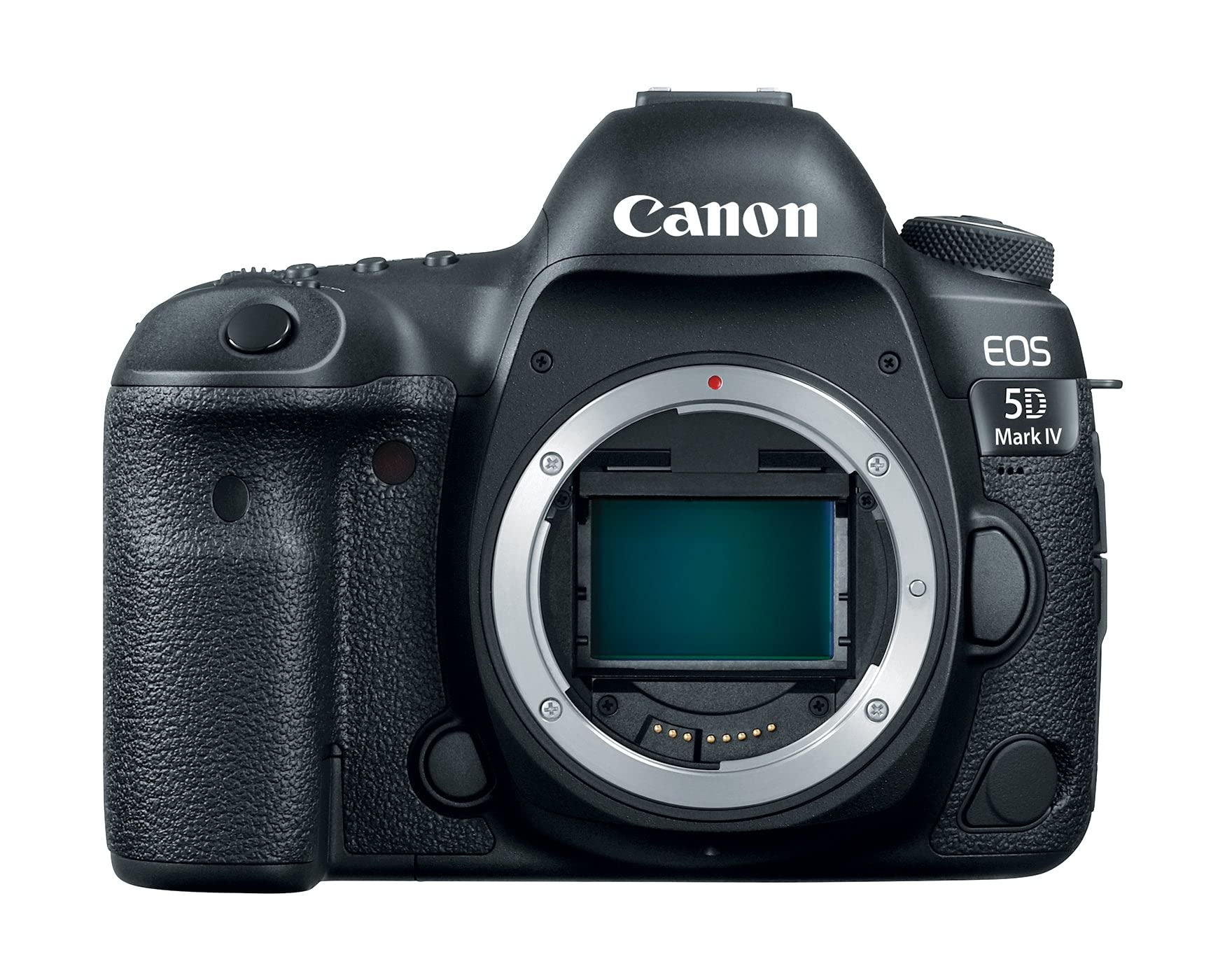
The Canon 5D Mark IV is the professional DSLR that wedding, portrait, and commercial photographers have trusted for years. Its 30.4-megapixel full-frame CMOS sensor delivers a perfect balance of resolution and file manageability, while the DIGIC 6+ processor enables 7 fps continuous shooting with a 61-point AF system — all 41 cross-type sensors are sensitive to EV -3 for reliable focusing in dim light.
The optical viewfinder is large and clear, and the Dual Pixel CMOS AF in Live View mode provides smooth, accurate focus for video and tripod work. It records 4K Motion JPEG at 30/24 fps, though the files are large and the codec is not as efficient as modern H.265 implementations. The built-in GPS geotags every image automatically, which is invaluable for travel and landscape photography.
The body is dust- and weather-sealed to a professional standard, and the LP-E6N battery lasts well over 800 shots on a single charge. The 3.2-inch touchscreen has 1.62 million dots and is responsive. The main downside is that the 4K video capability feels dated compared to newer mirrorless options, and the built-in flash is absent — you are expected to carry an external Speedlite.
Why it’s great
- Trusted professional build quality and weather sealing
- Excellent dynamic range and high-ISO performance for its generation
- Built-in GPS geotagging for location-aware shooting
Good to know
- 4K video uses Motion JPEG codec — large files, limited editing flexibility
- No flip-out or vari-angle touchscreen
- Expensive for a DSLR in a mirrorless-dominated market
6. Canon Digital SLR Camera Body EOS 80D with EF-S 18-135mm Lens

The Canon EOS 80D remains a compelling buy for enthusiasts who prefer an optical viewfinder and do not need 4K video. It uses a 24.2-megapixel APS-C CMOS sensor with Dual Pixel CMOS AF, giving you smooth and fast focus in Live View and video. The 45-point all-cross-type AF system through the viewfinder is responsive and works reliably even in moderate low light.
The bundled EF-S 18-135mm f/3.5-5.6 IS USM lens is a capable all-in-one travel zoom with Nano USM for fast, silent focusing. Image stabilization gives you about four stops of hand-holdability. The 7 fps burst rate is adequate for most action scenarios, and the 1080p 60fps video output is clean with no overheating issues even in warm conditions.
The build quality is a step above entry-level bodies — partially weather-sealed, with a deep grip and intuitive control layout. The LCD is a fully articulating touchscreen with 1.04 million dots. The Intelligent Viewfinder displays AF points, grid lines, and a horizontal electronic level. The main drawback is the lack of 4K video, which is a dealbreaker if you shoot video alongside stills.
Why it’s great
- Excellent 45-point all-cross-type AF system for the price
- Dual Pixel CMOS AF for smooth video and Live View focusing
- Fully articulating touchscreen with intuitive controls
Good to know
- No 4K video recording — 1080p only
- Weight is on the heavier side for an APS-C DSLR
- Intelligent Viewfinder adds info but can be cluttered
7. Nikon D7500 with AF-S DX NIKKOR 18-140mm VR Lens

The Nikon D7500 inherits the metering and processing engine from the flagship D500, giving it class-leading image quality for an APS-C DSLR. The 20.9-megapixel sensor has excellent dynamic range and low noise up to ISO 3200, and the EXPEED 5 processor drives an 8 fps burst rate with a deep buffer that can handle 50 RAW frames before slowing.
The 51-point AF system includes 15 cross-type sensors and supports group-area AF, which is effective for tracking erratically moving subjects like birds in flight. The 3.2-inch tilting touchscreen has 922,000 dots and works well for live view composition. The bundled 18-140mm f/3.5-5.6 VR lens offers a 7.8x zoom range, making it a true one-lens travel solution.
Unlike the D7200, the D7500 uses a single SD UHS-I card slot and a smaller EN-EL15a battery, which still manages over 950 shots per charge. It records 4K UHD at 30fps with stereo sound and power aperture control. The body is weather-resistant but not fully sealed. The crop sensor ensures compatibility with virtually every NIKKOR F-mount lens ever made, including affordable manual-focus glass.
Why it’s great
- D500-derived metering and processor for superior image quality
- Fast 8 fps burst rate with deep RAW buffer
- Excellent multi-lens compatibility with the F-mount ecosystem
Good to know
- Single SD card slot limits professional backup options
- No microphone input for video (requires external adapter)
- Tilting screen is not fully articulating for self-recording
8. Canon EOS RP Full-Frame Mirrorless Camera + RF24-105mm Lens Kit

The Canon EOS RP is the most affordable way to enter the full-frame RF mount system. Its 26.2-megapixel CMOS sensor delivers a notable jump in image quality over any APS-C sensor — wider dynamic range, better high-ISO performance, and genuine shallow depth-of-field control. The body is remarkably compact at just 485 grams, making it ideal for travel and vlogging.
The bundled RF 24-105mm f/4-7.1 IS STM lens offers optical stabilization rated at up to 5 stops, which effectively compensates for the EOS RP’s lack of in-body stabilization. The Dual Pixel CMOS AF system provides reliable face and eye tracking in both stills and video. The fully articulating touchscreen is excellent for self-recording and low-angle compositions.
Video capabilities are modest: 4K at 24p with a 1.7x crop and a 30-minute recording limit. 1080p at 60fps is better but still lacks the flexibility of newer bodies. The battery is the small LP-E17, rated for around 250 shots. For stills-focused photographers who want the look of full-frame without the premium cost, this is a solid pick. The kit lens is sharp in the center but soft at edges — plan to upgrade to faster primes for optimal results.
Why it’s great
- Most affordable entry point to full-frame imaging
- Lightweight and compact — easy to carry daily
- Excellent Dual Pixel AF for reliable eye tracking
Good to know
- 4K mode has a significant 1.7x crop and 30-minute limit
- Small battery requires carrying spares
- Kit lens is soft at edges — upgrade recommended
9. Nikon D3200 24 Megapixel DSLR Camera Kit with 2 Lenses

The Nikon D3200 is the textbook entry-level DSLR for anyone serious about learning photography from the ground up. Its 24.2-megapixel DX-format sensor still produces images that compete with modern cameras, especially in good light. The built-in Guide mode walks you through aperture, shutter speed, and ISO adjustments with simple overlays — not a dumbed-down auto mode.
The 11-point autofocus system with 3D tracking is basic but functional for static and slow-moving subjects. When you attach AF-S lenses, autofocus is reliable. The 3.0-inch LCD with 921,000 dots is crisp, though it is fixed and not touch-sensitive. The camera body is light at 455 grams with a comfortable grip for smaller hands.
This bundle includes both the 18-55mm f/3.5-5.6 VR lens and the 55-200mm f/4-5.6 non-VR lens. The absence of VR on the telephoto means you will need higher shutter speeds to avoid motion blur at the long end. Full HD 1080p video at 30fps is adequate, but the lack of a microphone input limits audio quality. The D3200 is not weather-sealed, and the plastic build is budget-grade, but the image quality and learning tools are outstanding for the price.
Why it’s great
- Excellent Guide mode teaches manual photography fundamentals
- Sharp 24.2 MP sensor with good dynamic range for the class
- Two-lens kit covers wide to telephoto focal lengths
Good to know
- 55-200mm lens lacks vibration reduction — prone to shake at telephoto end
- No microphone input for video recording
- Fixed screen with no touch functionality
10. Canon EOS Rebel T7 DSLR Camera Bundle with 18-55mm + 500mm Telephoto
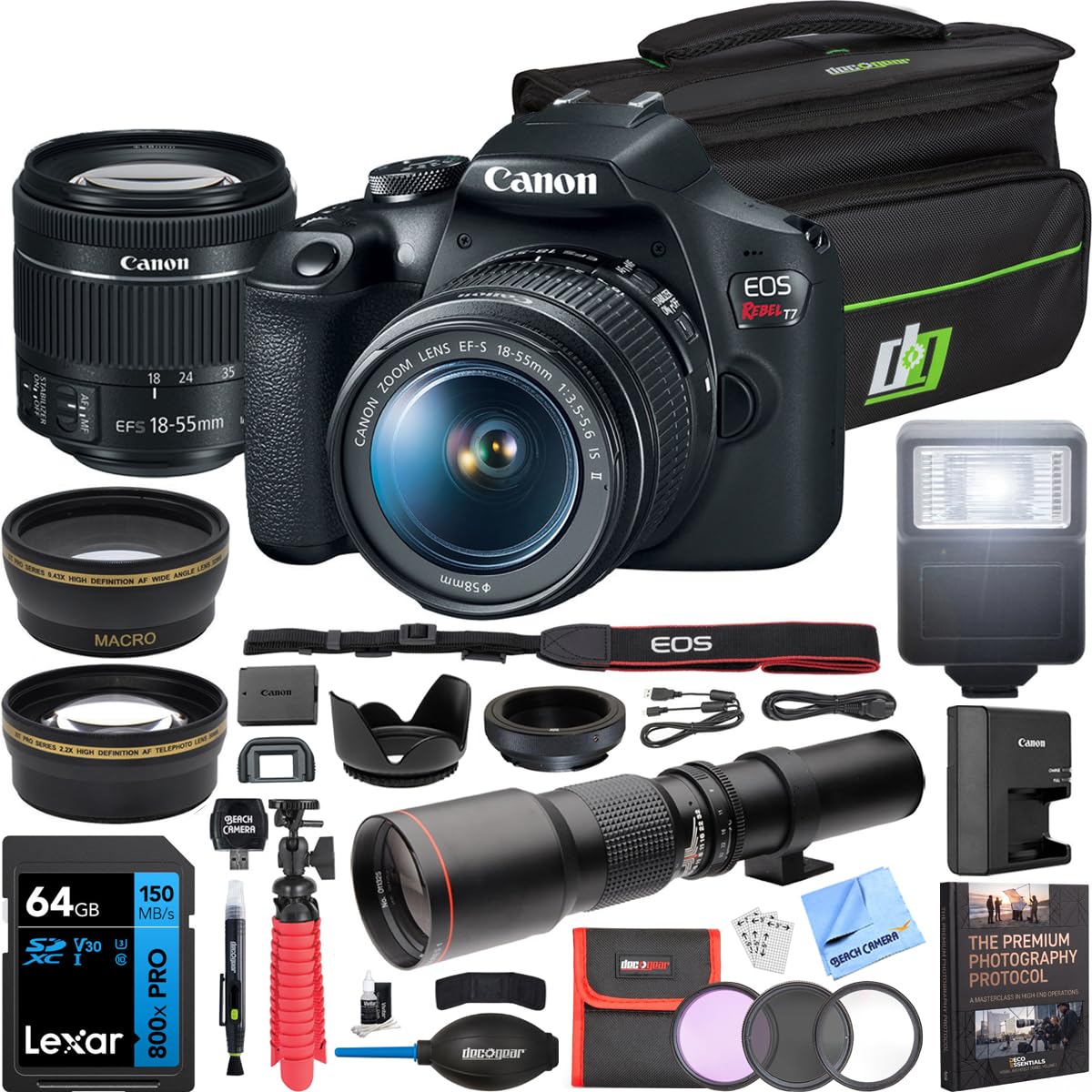
The Canon EOS Rebel T7 is the most popular entry-level DSLR on the market, and this bundle extends its value with a 500mm f/8 preset telephoto lens, wide-angle and 2.2x telephoto converters, a flash, and a tripod. The camera itself uses a 24.1-megapixel APS-C sensor with a DIGIC 4+ processor — a capable combination for everyday photography and learning.
The 9-point AF system with AI Servo tracking works for slow-moving subjects, but it is noticeably less responsive than the 45-point system in the 80D. The optical viewfinder covers 95% of the scene. Built-in Wi-Fi and NFC let you transfer images to your phone and remotely control the camera using the Canon Camera Connect app. The Scene Intelligent Auto mode handles exposure decisions well for beginners who want to focus on composition.
The 500mm telephoto lens gives you significant reach for birdwatching and wildlife, but it is a preset f/8 lens with no autofocus — you must focus manually. The bundled bag is small for the full kit, and the battery reportedly drains faster than expected. For someone who wants a single box with everything needed to start shooting, this bundle delivers. Serious photographers will quickly outgrow the kit and should budget for a better lens.
Why it’s great
- 13-item bundle includes telephoto lens, filters, flash, and tripod
- Built-in Wi-Fi and NFC for easy smartphone image transfer
- Scene Intelligent Auto simplifies settings for beginners
Good to know
- 500mm lens is manual focus only and requires fast shutter speeds
- Battery drains quickly — carry a spare
- Kit bag is too small for the full bundle contents
11. Canon EOS 4000D DSLR Camera with 18-55mm Lens — Pixi Advanced Bundle

The Canon EOS 4000D is the most budget-friendly way to get into a DSLR system. Its 18-megapixel APS-C sensor is older tech — you get about 19x more sensor surface area than most smartphones, which immediately improves dynamic range and low-light performance over any phone camera. The 18-55mm f/3.5-5.6 III lens is the bare minimum kit lens but is functional for learning.
The Pixi Advanced Bundle adds wide-angle and telephoto screw-on adapters, a bag, a tripod, a UV filter, and a microfiber cloth. The camera features a 9-point AF system with contrast detection in Live View, a built-in flash, and a 2.7-inch LCD with 230,000 dots — noticeably lower resolution than any other camera on this list. The body is entirely plastic but light at 436 grams.
Video is limited to 1080p at 30fps with no microphone input. The lack of Wi-Fi means you will need a card reader to transfer images. The learning curve is steeper than the D3200 because there is no Guide mode. For someone whose budget is extremely tight and who wants to learn the fundamentals before upgrading, the 4000D works. For anyone with even a modest flexible budget, the D3200 or Rebel T7 are significantly better investments.
Why it’s great
- Absolute lowest entry price to a DSLR system
- Large sensor produces better images than any smartphone
- Compatible with all Canon EF and EF-S lenses
Good to know
- Low-resolution 2.7-inch LCD makes menu navigation difficult
- No Wi-Fi, no microphone input, no touchscreen
- 18 MP sensor is a generation behind entry-level competitors
FAQ
Is a 24-megapixel sensor enough for professional print work?
What is the difference between optical viewfinder (OVF) and electronic viewfinder (EVF)?
Do I need a full-frame camera for portrait photography?
What do cross-type autofocus points mean and why do they matter?
Can I use my old Canon/Nikon lenses on a new mirrorless camera?
Final Thoughts: The Verdict
For most users, the best Camera DSLR winner is the Nikon D850 because no other DSLR combines 45.7 megapixels of resolution with 9 fps burst speed and a 153-point AF system. If you prefer a mirrorless hybrid that excels at both stills and video, grab the Sony Alpha 7 IV. And for a compact, high-frame-rate wildlife camera, nothing beats the Canon EOS R7 with its 30fps electronic shutter and APS-C crop factor reach.