
Our readers keep the lights on and my morning glass full of iced black tea. As an Amazon Associate, I earn from qualifying purchases.
Specs are compiled from manufacturer listings and verified buyer reviews and can change over time — please confirm the key details on the product page before buying.
A filter can be the cheapest lens upgrade you’ll make, but the wrong one ruins sharpness and adds color casts. This guide explains coating layers and thread sizes so you can pick the right filter for your lens.
I’m Min — the founder and writer behind Gadgets Feed. This guide is built by comparing the manufacturers’ published specifications and the patterns across verified customer reviews, so you get each pick’s real strengths and trade-offs instead of marketing spin.
You’ll see what a UV filter, a circular polarizer, and a macro set each do, then match the right one to your lens thread size. camera filters improve your photos more per dollar than almost any other accessory you can buy.
Our Picks at a Glance


How To Choose The Best Camera Filters
Start with the number printed on the front rim of your lens, right next to a Ø (diameter) symbol. That millimeter figure, like Ø77mm, is the only spec that actually decides which filter screws on, and every pick here lists its size clearly.
Decide What Job the Filter Does
A UV filter sits on your lens full-time as a cheap scratch shield and cuts the blue haze UV rays add on sunny days. A circular polarizer is the creative tool that deepens blue skies and kills reflections on water and glass, but it darkens your image by about two stops. Macro close-up filters screw on for detail shots without needing a dedicated macro lens.
Read the Coating Count
More coating layers usually mean less reflection and higher light transmission, which keeps your photos sharp. A filter with 10 layers passes roughly 98% of light, while a 28-layer design can hit 99.6% transmission, and that difference shows up as cleaner color and contrast in bright scenes.
Quick Comparison
| Model | Best For | Filter Size | Coating | Weight | Amazon |
|---|---|---|---|---|---|
| K&F CONCEPT 77mm UV★ Best Overall | Full-time lens protection | 77mm | 28-layer | 81 g | Amazon |
| Amazon Basics 58mm CPLBest Value | Budget glare control | 58mm | 16-layer | 20.68 g | Amazon |
| X-SweetDream 58mm Macro KitMacro Pick | Close-up detail shots | 58mm | Multi-coated | — | Amazon |
| NEEWER 46mm 3-in-1 Kit | Compact all-in-one kit | 46mm | Multi-coated | — | Amazon |
| Tiffen 77mm CPL | Trusted landscape polarizing | 77mm | Multi-coated | 30 g | Amazon |
| HOYA 62mm NXT Plus UV | Premium protective glass | 62mm | 10-layer HMC | — | Amazon |
| K&F CONCEPT 82mm Variable ND | Creative light control | 82mm | 28-layer | 65 g | Amazon |
| Breakthrough X4 77mm CPL | Color-neutral mastery | 77mm | MRC16 nano | 4.54 g | Amazon |
In-Depth Reviews
1. K&F CONCEPT 77mm MC UV Protection Filter
Our pick — over 4.5★ from 800+ verified ratings; the strongest balance of quality and price.
A slim 77mm UV filter that protects without vignetting on wide lenses.
It blocks UV haze and guards the front element with 28-layer coated glass. It blocks UV rays to clear away the blue haze in sunny scenes, but the real prize is the 81-gram tempered glass barrier standing between your front element and everything your bag throws at it.
What makes it special is the 28-layer coating on both sides, which passes 99.6% of light while killing reflections from the ground and the glass itself. Buyers report it stays optically invisible even at f/1.8 on a fast Sigma prime, so you get solid protection with zero sharpness or contrast loss.
The slim 3.3mm frame means no vignetting, even at 18mm on wide glass, and the ribbed edges give your fingers a solid grip when twisting it on. The one quirk to expect is those same ribs catching on a lens cap as you remove it, a minor trade-off for a filter that rarely needs to come off at all.
Why it earns the top spot
- 99.6% light transmission keeps images crisp
- Slim 3.3mm frame avoids vignetting on wide-angle lenses
- Repels water, oil, and fingerprints for easy cleaning
- Twist-on design fits fingers firmly on ribbed edges
What to expect in daily use
- Ribbed edges can catch on a lens cap when removing it
- You’ll want to avoid over-tightening the threads
- Verify you need 77mm before ordering
Reach for this if: you shoot with a 77mm lens and want permanent, invisible protection you never second-guess.
Look elsewhere if: your lens uses a smaller thread size like 58mm or 62mm, since those need a different filter.
2. Amazon Basics 58mm Circular Polarizer
A 58mm CPL that deepens skies and removes glare for under.
Owners mention this is the single best cheap upgrade you can bolt onto a 58mm lens, with one flatly stating it “completely up my camera game” for less than twenty dollars. It deepens blue skies and strips reflections and glare off water, glass, and leaves for richer outdoor color.
The 16-layer coating keeps reflections off the glass itself, and at 20.68 grams it is featherlight compared to the 81-gram K&F UV above, a 3.9x gap that you feel instantly on a small mirrorless body. It handles both auto-focus and non-auto-focus cameras without issue.
Expect a few mixed notes: some owners find images soften slightly and polarizing can look uneven, so treat this as a brilliant introduction to CPL filters rather than a freelance-grade tool. The rotating ring turns smoothly, and for the price the anti-reflection coating performs surprisingly close to the big brands.
Sharp verdict: the color pop and reflection removal make this the best first polarizer money can buy.
Honest trade-off: a few owners see softness at long telephoto lengths, so it shines for everyday and social shooting over paid gigs.
3. X-SweetDream 58mm Close-up Filter Kit
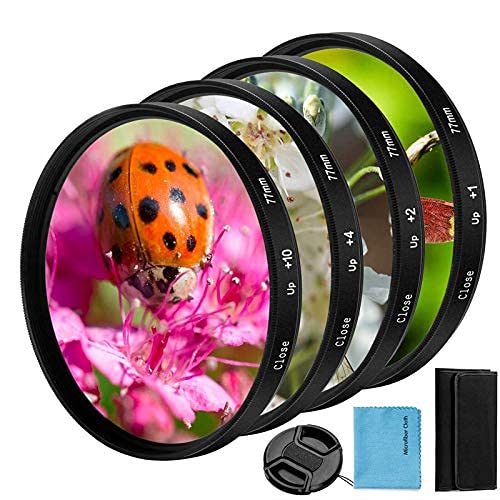
A 58mm set of +1, +2, +4, and +10 close-up filters for macro shots.
Rather than spend hundreds on a true macro lens, this set screws four close-up filters onto a 58mm lens: +1, +2, +4, and +10. Customers note it is a “cheap macro alternative for Nikon D750,” with the +4 letting you focus as close as 6-7 inches on a Nikon Zf 40mm.
Each filter is double-threaded, so you can stack them to reach +3, +5, +6, +7, and beyond, or combine a +1 with a +4 to get +5. The set arrives in a padded nylon pouch with a lens cap and microfiber cloth, everything you need for flower, coin, and insect detail shots.
The honest caveat from owners is that autofocus can hunt, so plan on manual focus for the best results, and the +1 and +2 are subtle while +10 delivers the fun magnification. Sharpness holds up in the center, and for occasional macro work this saves you a fortune over dedicated glass.
Choose this when: you shoot details occasionally and want four magnification levels in one padded kit.
skip it if: you need edge-to-edge professional sharpness or autofocus that never hesitates.
4. NEEWER 46mm UV/CPL/ND Filter Kit

A 46mm kit with UV, CPL, and ND4 filters in a hard shell case.
This trio squeezes three jobs into one compact kit built for the small prime lenses on Sony, Canon, Nikon, and Fujifilm cameras with a 46mm thread. The UV filter guards the glass, the CPL kills reflections on water and glass for richer contrast, and the ND4 cuts incoming light by 2 stops so you can blur motion on bright days.
Your filters stay safe and easy to grab: the aluminum alloy frames mount securely on solid threads, and the hard shell case has individual slots so they never clatter together in your bag. Reviewers point out the fit is spot-on, one calling it a must-have that fits a Sony a4100 perfectly and adds genuine lens protection.
Expect a touch of flaring in harsh backlight, which is normal at this tier, but color stays accurate and the ND works well for its class. The felt-lined pouch and cleaning cloth make it a genuinely complete kit for a 46mm shooter.
Why it wins: the hard shell case and three distinct functions make it the most travel-friendly set here.
The catch: a little flaring can appear in harsh light, minor for the price.
5. Tiffen 77mm CPL Circular Polarizing Filter
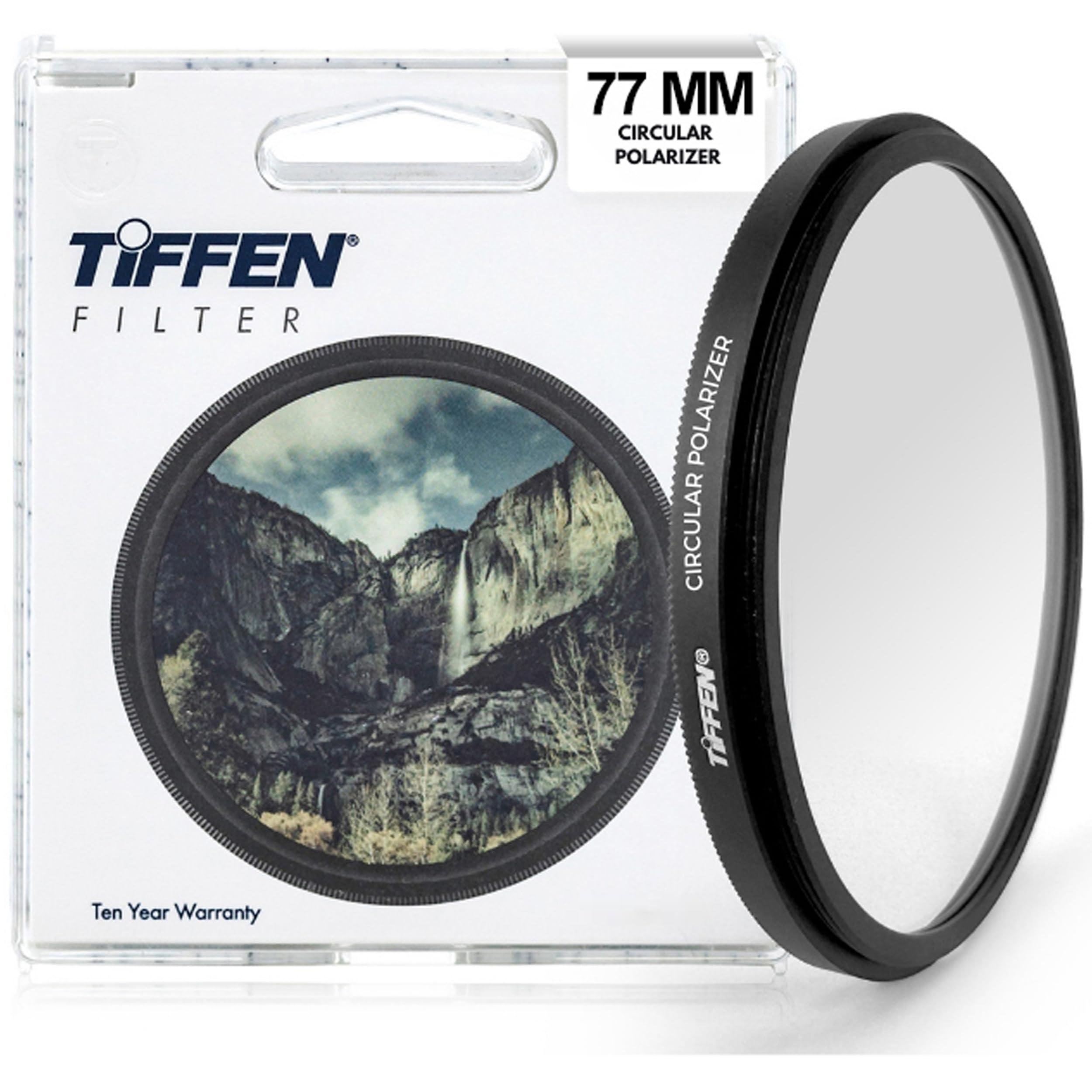
A 77mm CPL with Schott B270 glass for natural, non-aggressive polarization.
This is the CPL that landscape shooters have trusted for decades, built with premium Schott B270 optical glass and a slim screw-in frame at just 30 grams. Rotate the ring while looking through the viewfinder and you control reflections on water, glass, and non-metallic surfaces with precise, visible feedback.
Owners note its polarization is mild rather than aggressive, so it works as a daily lens protector without darkening scenes like competing filters, one comparison noting Hoya and Heliopan options turn out too dark. The metal anodized rings feel durable, and the padded black nylon pouch keeps it safe between shoots.
The grip is thin, which means it can be easy to mount but harder to unscrew, and rotating it can sometimes loosen the base ring. Bring it for lakes, city skylines, mountain vistas, and storefront windows, and you will see natural colors that reflected light had been hiding.
The strong points
- Schott B270 optical glass keeps images sharp and clear
- Mild polarization ideal for daily lens protection
- Padded pouch included for safe transport
The quirks to know
- Ring can be hard to remove without a good grip
- Rotating the filter may loosen the base ring
Best for: 77mm landscape and travel shooters who want a trusted brand with natural, non-aggressive polarization.
Think twice if: you need heavy light reduction, since this frames itself as a protector first.
6. HOYA 62mm NXT Plus UV Filter

Japanese optical heritage that turns your lens into a protected instrument.
Hoya built its name as Japan’s first specialty optical glass maker, and this 62mm NXT Plus filter carries that pedigree with 10 layers of anti-reflective coating passing 98% of light. It shields your lens from dust, scratches, and minor impacts while adding no visible sharpness loss, the definition of a premium protector.
The Schott B270 clear glass delivers natural color accuracy, and the low-profile aluminum frame prevents vignetting so it pairs cleanly with wide-angle glass and lens hoods. Owners describe it as the filter you replace instead of the lens, a scratched one proving it had done its job protecting the expensive glass behind it.
The waterproof top coat repels smudges and fingerprints, making it genuinely easy to wipe clean, and the fit is snug and reassuring.
The verdict: the 98% transmission and easy-clean coating make this the protective filter for owners who value their 62mm glass.
The trade-off: premium glass costs more up front, though buyers agree it beats replacing a lens.
7. K&F CONCEPT 82mm Variable ND4-64 Filter

One twist of a lever swaps you from cloudy day to blazing noon.
This 82mm filter combines a variable neutral density and a circular polarizer into one aluminum alloy frame, so a single purchase handles both creative light control and glare removal. The ND side gives you 2 to 6 stops of light reduction, enough to blur water or shoot at wide apertures even in harsh midday sun.
The putter-style adjustable lever lets you switch between the 5 marked stops from Min at ND4 to Max at ND64, and the imported AGC glass carries 28 multi-layer coatings for waterproof, scratch-resistant durability. Shoppers say it works superbly for sunny midday wedding portraits and cinematic shots in bright conditions, with vivid blues and greens for ocean scenes.
K&F engineered out the “X” cross pattern that plagues many variable NDs on wide-angle lenses, though a deep vignette can still appear at the 5-6 stop range. The 65-gram frame feels solid, and buyers report it is a little tight at first but loosens up with use.
Reach for this if: you shoot video or long exposures on an 82mm lens and need quick light control without carrying multiple filters.
Look elsewhere if: you shoot mostly at max stop on ultrawide glass, where vignetting can creep in.
8. Breakthrough Photography X4 77mm CPL

The polarizer engineered to vanish from your image entirely.
Most CPL filters add a yellow cast because their transmission spikes near 650nm into infrared, but the X4 is built to control that curve for warm, lively images with no apparent colorcast. That color neutrality is the headline reason serious shooters pay for this glass along with a unique serial number laser-engraved on the interior frame for the 25 Year Ironclad Guarantee.
The SCHOTT Superwhite B270 glass is made in Germany and pairs with MRC16 and nanotec coatings for excellent transmission across ultraviolet, visible, and infrared spectrums. Owners mention superb clarity with no perceivable loss of contrast, excellent results on water and snow, and frame markings that help you set the same polarization angle every time.
The notable trade-off is mounting: the thin profile means a rubber band can help when removing it, and opinions split on ease of use. Compared to a cheaper alternative, buyers find the X4 equals sharpness and polarization while beating it on neutral color and grip, justifying the premium for those who demand the best.
The standout: 25 years of support and truly neutral color make this the polarizer for perfectionists.
The hurdle: a thin frame that can be stubborn to remove without extra grip.
Understanding the Specs
Filter Thread Size
This is the millimeter number next to a Ø symbol on your lens front rim, and it is the one spec you cannot guess. A 77mm filter, like the K&F UV, will not fit a 58mm lens, which is why every pick here lists its size explicitly. Match this number exactly before ordering anything.
Coating Layers and Transmission
Coating layers cut reflection and ghosting while raising light transmission. The HOYA NXT uses 10 layers for 98% transmission, while the K&F UV hits 28 layers for 99.6%, and the difference shows up as cleaner color and contrast. Waterproof top coats also make smudges and fingerprints easier to wipe away.
Polarizer vs UV vs ND
A UV filter blocks haze and protects the lens full-time, a CPL deepens skies and kills reflections while darkening the scene, and an ND reduces incoming light to enable motion blur in bright conditions. The NEEWER kit packs all three into one case, while the K&F variable ND merges ND and CPL into one adjustable frame.
ND Stops
Stops measure how much light a neutral density filter blocks, where more stops mean darker images. The NEEWER ND4 cuts light by 2 stops, while the K&F variable ND4-64 spans 2 to 6 stops across 5 marked positions on its frame, giving you a range of creative control in a single accessory.
FAQ
How do I find my camera’s filter thread size?
What does a UV filter actually do for my photos?
Can I stack multiple polarizer and ND filters?
Why does my circular polarizer make photos darker?
Is a variable ND filter better than a fixed ND?
Do cheap filters ruin image sharpness?
How do macro close-up filters compare to a real macro lens?
Will a filter cause vignetting on my wide-angle lens?
What is the difference between a CPL and a UV filter?
How do I clean a coated camera filter safely?
Final Thoughts: The Verdict
For most shooters, the camera filters winner is the K&F CONCEPT 77mm UV because 28 layers of coating deliver 99.6% transmission in an invisible slim frame that protects your glass all day. If you want richer outdoor color and glare-free water shots, grab the Amazon Basics 58mm CPL as the smartest budget polarizer you can own. And for creative light control on sunny days, the K&F CONCEPT 82mm Variable ND4-64 is the one to reach for when a single twist needs to handle everything from gentle clouds to blazing noon.
How We Picked
We do not accept paid placement. Every pick is matched to a real buyer and a real use-case; we do not hands-on test units.
Sources & Methodology
Specifications: manufacturer listings and product documentation. Review insights: verified customer reviews, as of August 2026. Pricing: not shown on this page (it changes often); check the current price via the retailer link.
As an Amazon Associate, Gadgets Feed earns from qualifying purchases. This does not affect which products we feature.