
Capturing a fully immersive 360-degree video used to mean stitching together multiple camera angles in post-production, a process so tedious it killed most creative momentum. Modern 360 cameras solve that with dual fisheye lenses that record the entire sphere around you in one shot, letting you reframe footage after the fact and find the perfect angle you didn’t have time to compose in the moment. The real challenge isn’t capturing the sphere anymore—it’s choosing between sensor sizes, bitrates, stabilization algorithms, and editing ecosystems that vary wildly between models.
I’m Min — the co-founder and writer behind Gadgets Feed. I’ve spent hundreds of hours combing through technical datasheets, customer benchmarks, and real-world footage comparisons to find the best picks across every budget tier for spherical video capture.
Whether you’re recording motorcycle lap sessions, ski descents with a selfie stick, or virtual property tours, finding the right camera for 360 video depends on navigating sensor size, resolution, stabilization quality, and battery endurance without getting lost in marketing hype.
How To Choose The Best Camera For 360 Video
A 360 video camera is defined by its dual-lens system, but the decisions that separate a great purchase from a regretful one are rooted in sensor size, resolution, stabilization architecture, battery endurance, and software ecosystem. Here’s what actually matters.
Sensor Size: The Low-Light Decider
The single most impactful spec for 360 video quality—especially in dim conditions like indoor venues, twilight rides, or shaded forests—is the sensor area. Standard action camera 360 sensors hover around 1/2.3-inch, while premium models jump to 1-inch sensors that gather roughly four times more light. Larger sensors deliver less noise, better dynamic range, and richer color gradation. If you shoot mostly outdoors in bright sun, smaller sensors suffice. If you shoot at golden hour, in forests, or at indoor events, the 1-inch sensor premium is worth every penny.
Resolution and Bitrate: The Reframing Reserve
Since 360 video is reframed into a traditional flat video, the spherical resolution determines how much pixel detail remains after you crop. A 5.7K sphere leaves enough resolution for clean 1080p reframes but looks soft at 4K. An 8K sphere provides a comfortable 4K output with some headroom for zoom and pans. Higher bitrates (100 Mbps or more) reduce compression artifacts in fast-moving scenes. For professional or semi-professional use, target 8K spherical capture.
Stabilization Beyond Gimbals
360 cameras rely on electronic stabilization algorithms that estimate movement from the gyroscope and warp the sphere to keep the horizon level. The best systems—FlowState from Insta360, HyperSmooth from GoPro, and DJI’s RockSteady derivative—achieve gimbal-like smoothness without extra hardware. The critical differentiator is Horizon Lock, which keeps the horizon locked regardless of camera rotation, enabling dramatic rotating shots without disorienting the viewer. Budget models offer basic stabilization that works for walking but fails during aggressive motion.
Battery Life and Hot-Swappability
360 video processing drains batteries faster than standard action cameras. Typical endurance ranges from 50 minutes to 3 hours depending on resolution and stabilization settings. Cameras with user-replaceable batteries let you extend a shoot by carrying spares. Internal-only batteries mean you must stop and charge. For all-day shoots—motorcycle touring, hiking, event coverage—prioritize models with replaceable batteries.
Software and Editing Workflow
Reframing 360 footage requires dedicated software. The best ecosystems—Insta360 Studio, DJI Mimo, GoPro Quik—offer mobile and desktop apps with AI-assisted reframing, subject tracking, and one-tap exports. Some models require cloud subscriptions for certain features. The Ricoh Theta ecosystem integrates with Lightroom Classic and PTGui for professional virtual tour stitching. Evaluate whether the camera’s editing pipeline matches your hardware (phone vs. computer) and your tolerance for manual reframing.
Quick Comparison
On smaller screens, swipe sideways to see the full table.
| Model | Category | Best For | Key Spec | Amazon |
|---|---|---|---|---|
| DJI Osmo 360 Essential Combo | Premium | Best overall 1-inch sensor 8K | 1-inch sensor, 8K/30fps, 105GB internal | Amazon |
| Insta360 X5 Essentials Bundle | Premium | Best low-light action 360 | Dual 1/1.28″ sensors, triple AI chip | Amazon |
| GoPro MAX2 | Premium | Best dual-mode (360 + Hero) | True 8K spherical, 6 mics, replaceable glass lenses | Amazon |
| Ricoh Theta Z1 51GB | Premium | Best still image quality for virtual tours | Dual 1-inch BSI CMOS, 23MP, 51GB internal | Amazon |
| Ricoh Theta X | Premium | Best for 11K stills with GPS tagging | 11K stills (60MP), 5.7K video, built-in GPS | Amazon |
| DJI Osmo 360 Standard Combo | Mid-Range | Entry-level 1-inch sensor excellence | 1-inch sensor, 8K/30fps, 105GB internal | Amazon |
| Xtra 360 Camera | Mid-Range | Best budget 8K with built-in storage | 1-inch sensor equivalent, 8K video, 105GB | Amazon |
| AKASO 360 Action Camera | Budget | Best entry-level 5.7K 360 action | Dual 1/2″ 48MP sensors, 5.7K video | Amazon |
| NexiGo Meeting 360 Ultra | Business | Best all-in-one conference room 360 | 8K capture, 8 mics, AI auto-framing | Amazon |
In‑Depth Reviews
1. DJI Osmo 360 Essential Combo
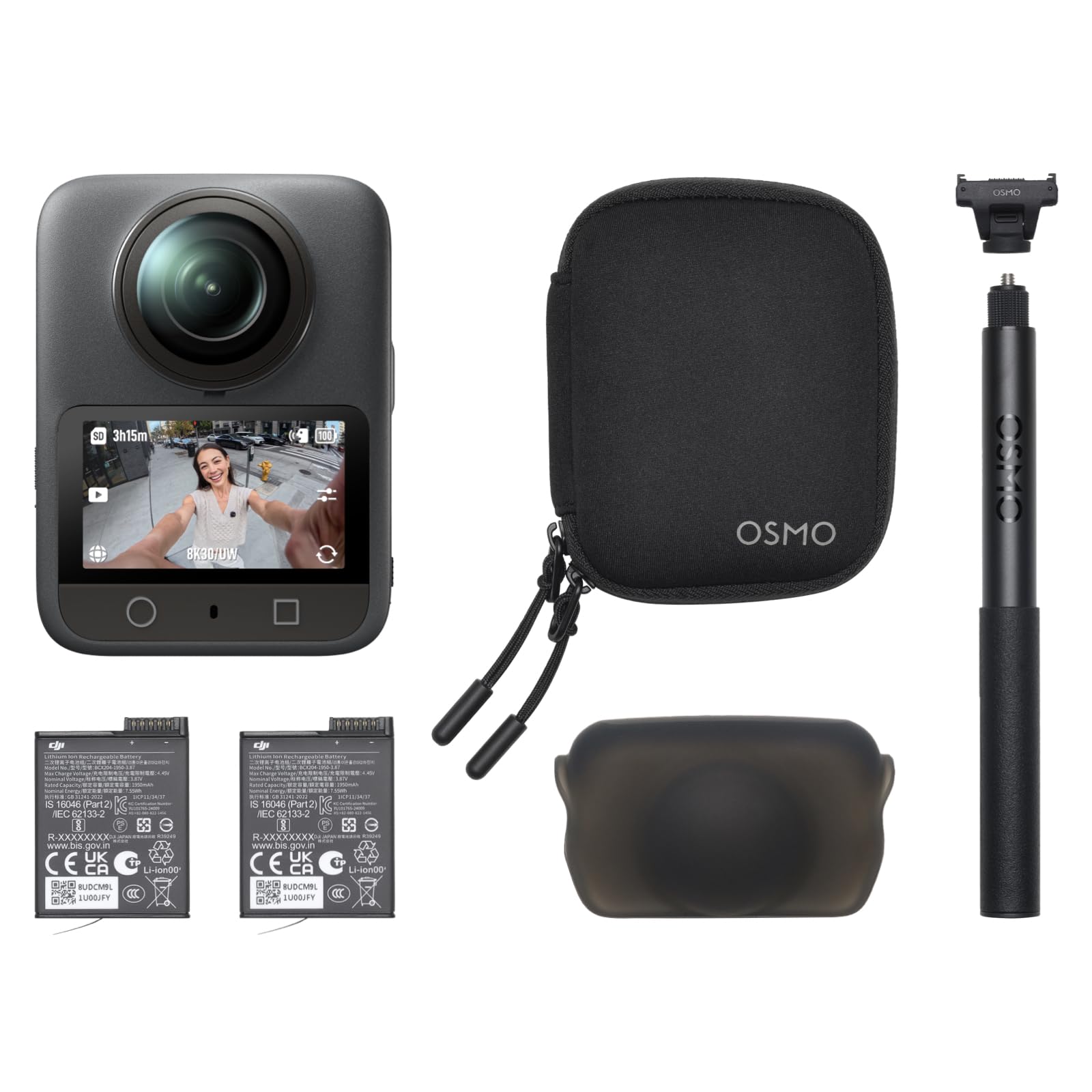
The DJI Osmo 360 pairs a genuine 1-inch sensor with native 8K/30fps spherical capture, delivering clean, detailed footage even in challenging light. The 105GB of built-in storage means you never scramble for a microSD card mid-shoot, and the included 1.2m invisible selfie stick enables those iconic third-person angles with zero pole artifacts. The Essential Combo adds a second 1950mAh battery and the carrying case, pushing practical runtime well beyond the single-battery standard combo.
The DJI Mimo app streamlines reframing with Pano Dewarp and Pano Pro Color Grading, making it easy to pull cinematic 4K output from the 8K sphere. The 360-degree Horizon Lock keeps the horizon perfectly level regardless of camera spin, which is crucial for dynamic ski or bike shots. Four internal microphones capture ambisonic spatial audio, and the 1/4-inch thread on the bottom works with tripods directly.
Battery life hits around 100 minutes in 8K mode per battery, and the magnetic quick-release adapter allows instant swapping between the selfie stick and helmet mounts. The only meaningful limitation is the learning curve for editing 360 footage in the app—expect a few hours to get comfortable with reframing. For the combination of sensor quality, storage, battery, and stabilization, this is the most complete package available.
Why it’s great
- Genuine 1-inch sensor delivers best-in-class low-light 360 video
- 105GB internal storage eliminates need for SD cards
- Included 1.2m invisible selfie stick and dual batteries
- 360-degree Horizon Lock stays level through full rotations
Good to know
- Editing 360 footage requires learning DJI Mimo app workflow
- No external microphone input without using DJI wireless system
- Camera body heats up during extended 8K recording sessions
2. Insta360 X5 Essentials Bundle

The Insta360 X5 uses dual 1/1.28-inch sensors combined with a triple AI chip architecture that processes advanced noise reduction in real time. This hardware stack makes the X5 the best low-light 360 action camera on the market—footage captured at dusk or in shaded forest trails retains color accuracy and detail that smaller-sensor cameras lose entirely. The 8K/30fps spherical output reframes cleanly to 4K without visible pixelation.
FlowState Stabilization with full 360-degree Horizon Lock handles aggressive motion—mountain bike descents, motorcycle leans, and rapid panning—without introducing fisheye warping or jitter. The new replaceable lens design uses scratch-resistant glass that swaps in seconds, which is a significant durability upgrade over fixed-lens competitors. The 114cm invisible selfie stick is included in the Essentials Bundle, along with the Utility Fast Charge Case that brings the battery from zero to 80% in 20 minutes.
Battery life is rated at 208 minutes in standard modes, though real-world 8K recording runs closer to 150 minutes. The Insta360 app offers AI-assisted reframing with one-tap export, which dramatically reduces editing time. The biggest caveat is the microSD card requirement—the X5 has no internal storage, so a high-speed card is mandatory. For action sports shooters who need reliable low-light performance and rapid editing, this is the strongest option.
Why it’s great
- Triple AI chip enables class-leading low-light 360 videos
- Replaceable scratch-resistant lenses reduce long-term cost
- Fast charging reaches 80% in 20 minutes
- AI-assisted one-tap reframing saves editing hours
Good to know
- No built-in storage—requires a UHS-II microSD card
- Battery life in 8K mode is shorter than marketed 208-minute claim
- Wind Guard improves audio but still needs quiet environments for best results
3. GoPro MAX2
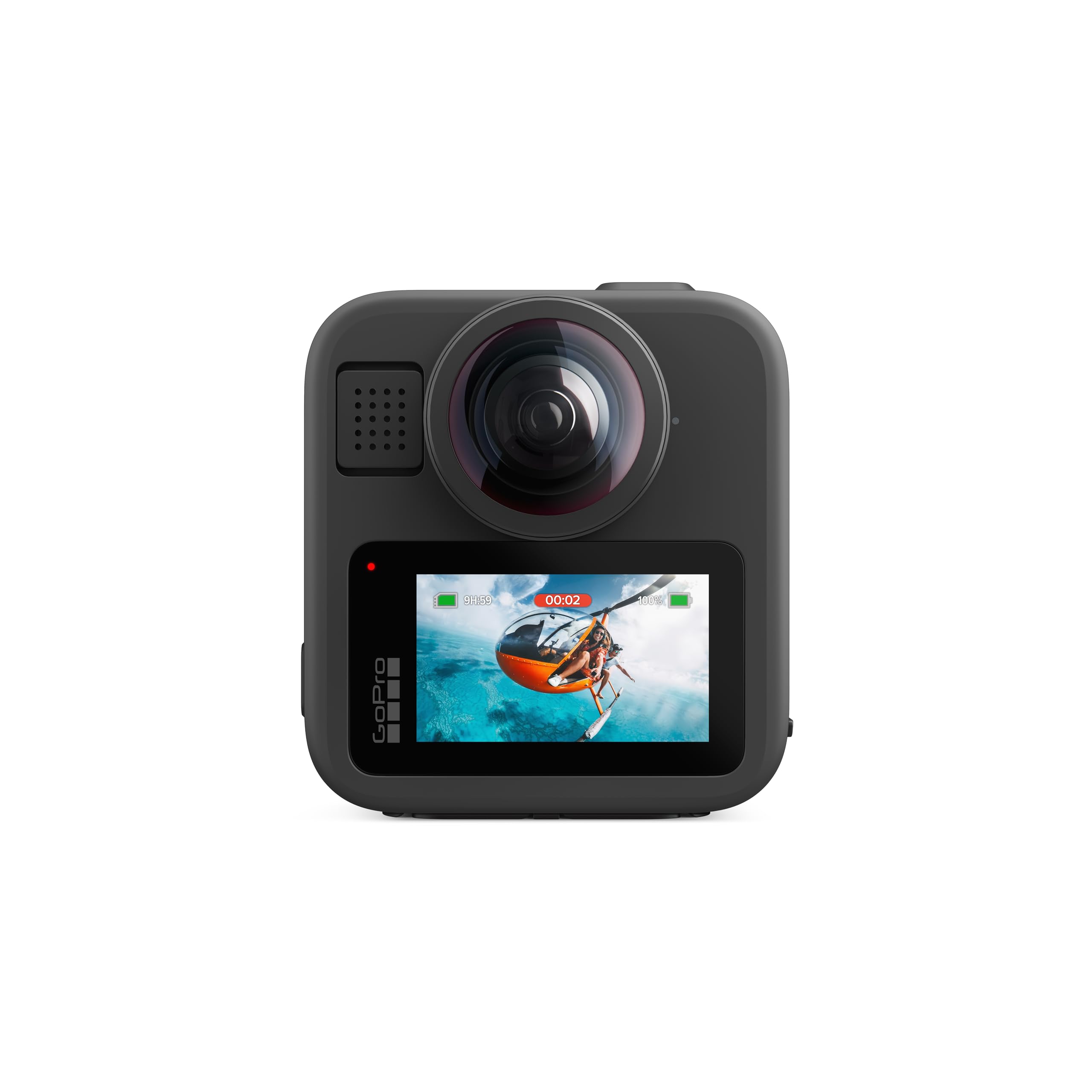
The GoPro MAX2 delivers True 8K spherical video with 21% more resolution than the previous generation, making reframed 4K output noticeably sharper. The standout feature is its dual-mode capability—you can switch between 360-degree capture and traditional Hero mode for standard action camera footage, turning one camera into two. The replaceable glass lenses use a water-repelling coating and swap out if scratched, a significant durability advantage for extreme sports.
HyperSmooth stabilization with Horizon Lock keeps footage level through 360-degree spins, and the 6-microphone array captures ambisonic spatial audio that shifts perspective with reframing. The 1960mAh Enduro battery is cold-resistant and manages about 80 minutes of 8K recording. The GoPro Quik app reframes footage on mobile easily, though the desktop experience is less polished than Insta360’s Studio suite.
The 1/4-20 mounting thread on the bottom works with standard selfie sticks, and the curved adhesive mount is included. Some users report heat buildup during extended 8K recording, which can trigger thermal shutdown in hot environments. The MAX2 also runs slightly heavier than pure-360 competitors due to the dual-mode hardware. For users who want one camera for both 360 and traditional POV shooting, this is the most versatile choice.
Why it’s great
- True 8K spherical with 21% higher resolution than MAX
- Replaceable glass lenses with water-repelling coating
- Dual-mode allows 360 and standard Hero shooting
- 6-microphone ambisonic spatial audio capture
Good to know
- Heats up during extended 8K recording in warm conditions
- Heavier than pure 360 cameras due to dual-mode hardware
- Desktop editing software is less feature-rich than mobile app
4. Ricoh Theta Z1 51GB

The Ricoh Theta Z1 remains the gold standard for 360 still image quality, using dual 1-inch back-illuminated CMOS sensors that capture 23MP spherical images with exceptional dynamic range. The 51GB internal memory stores approximately 900 RAW+JPEG pairs, and the magnesium alloy body feels substantial in hand. The f/2.4 aperture lenses suppress ghosting and flare better than most competitors.
4K/30fps video capture with image stabilization is adequate for virtual tours and real estate showcases, but the Z1’s real strength is still photography—RAW (HDR-DNG 16-bit) output integrates directly with Adobe Lightroom Classic CC and the RICOH THETA Stitcher plugin for precise stitching. The 4-channel microphone captures immersive spatial audio, and the USB 3.0 Type-C connection transfers files quickly.
Battery life is the primary weakness—around 45 minutes of active use with the touchscreen on, and the battery is not user-replaceable without tools. The lack of a built-in touchscreen means all previewing requires the smartphone app, which connects reliably via Wi-Fi but adds friction. For professional real estate photographers, construction documentation, and virtual tour creators who prioritize image quality over video features, the Z1 is unmatched.
Why it’s great
- Dual 1-inch BSI sensors produce best-in-class 360 stills
- 51GB internal storage with no SD card needed
- RAW HDR-DNG support for professional Lightroom workflow
- Magnesium alloy body is durable and premium-feeling
Good to know
- Battery life is under 50 minutes with screen on
- Non-user-replaceable battery limits extended shooting
- No touchscreen—requires phone app for preview and settings
5. Ricoh Theta X

The Ricoh Theta X captures 11K (60-megapixel) spherical still images—the highest resolution available in a consumer 360 camera. This resolution headroom is essential for virtual tours where clients zoom into details; window views, signage, and textures remain sharp even at high magnification. The 5.7K/30fps video is adequate for standard virtual tours and walkthroughs but falls short of the 8K competitors for action footage.
The 2.25-inch OLED touchscreen is a major usability improvement over the Z1, allowing full preview and settings control without a phone. The built-in GPS (QZSS + A-GPS) embeds precise location data into images, which is useful for creating Google Street View Blue Line tours. The user-replaceable battery and microSD expansion mean you can shoot all day, unlike the Z1.
Image stitching between the two lenses shows noticeable blur along the seam in certain lighting conditions, and the auto exposure can struggle with high-contrast scenes, blowing out highlights. Battery life with the screen active runs around 30 minutes per charge. For real estate photographers who need the highest still resolution and GPS tagging for street-view workflows, the Theta X justifies its premium. For video-first creators, the 5.7K ceiling is a limiting factor.
Why it’s great
- 11K (60MP) stills offer unrivaled zoom-in detail for virtual tours
- Built-in GPS for automatic Google Street View tour creation
- Large OLED touchscreen for camera operation without phone
- User-replaceable battery and microSD expansion
Good to know
- 5.7K video is a step down from 8K competition
- Visible seam blur in some lighting conditions
- Short battery life—around 30 minutes with screen active
6. DJI Osmo 360 Standard Combo
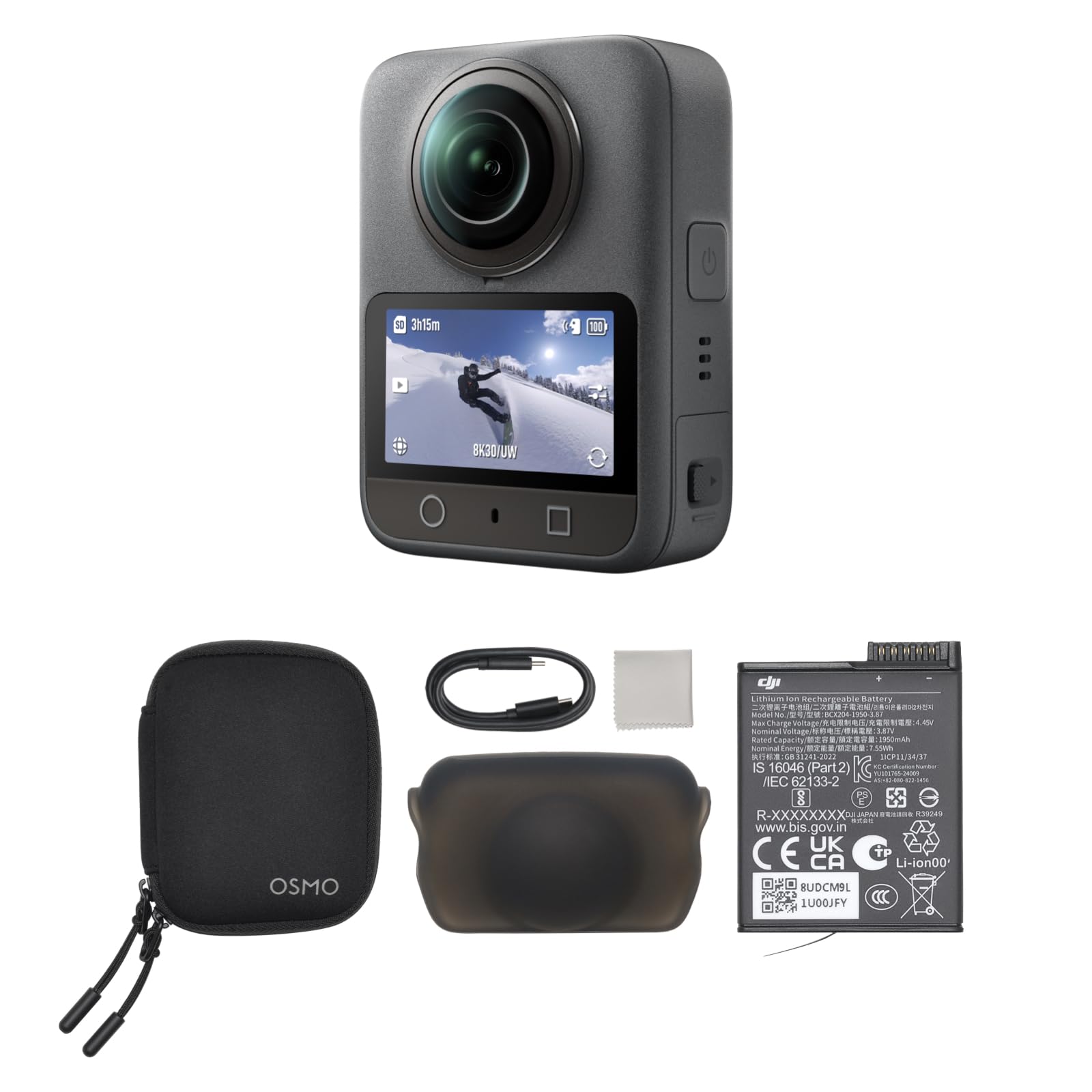
The standard DJI Osmo 360 combo delivers the same 1-inch sensor and 8K/30fps spherical capture as the Essential Combo but with a single battery and no selfie stick. This makes it the entry point for users who already own mounting accessories and want the best sensor quality without the bundle extras. The 105GB built-in storage and USB-C 3.1 transfer speed remain the same.
The 360-degree Horizon Lock and 4K/120fps slow-motion reframed output are identical to the flagship model, as is the four-microphone spatial audio. The magnetic quick-release mount works with the Osmo Action ecosystem, and the 1/4-inch thread handles standard tripods. The app experience remains the same—DJI Mimo provides Pano Dewarp and color grading tools for desktop-grade reframing.
The single-battery runtime is about 100 minutes in 8K mode, and the camera does not ship with a carrying case. For users on a tighter budget who still demand the 1-inch sensor advantage, the Standard Combo offers the same core imaging hardware at a lower upfront cost. The only real downsides are the lack of a second battery and selfie stick, which many buyers will need to purchase separately.
Why it’s great
- Same 1-inch sensor and 8K quality as the Essential Combo
- 105GB built-in storage eliminates memory card costs
- Compatible with all DJI Action accessories
- 4K/120fps slow-motion reframe from 8K sphere
Good to know
- Includes only one battery—extended sessions need a spare
- No selfie stick or carrying case in the box
- Higher per-battery cost compared to buying the combo bundle
7. Xtra 360 Camera
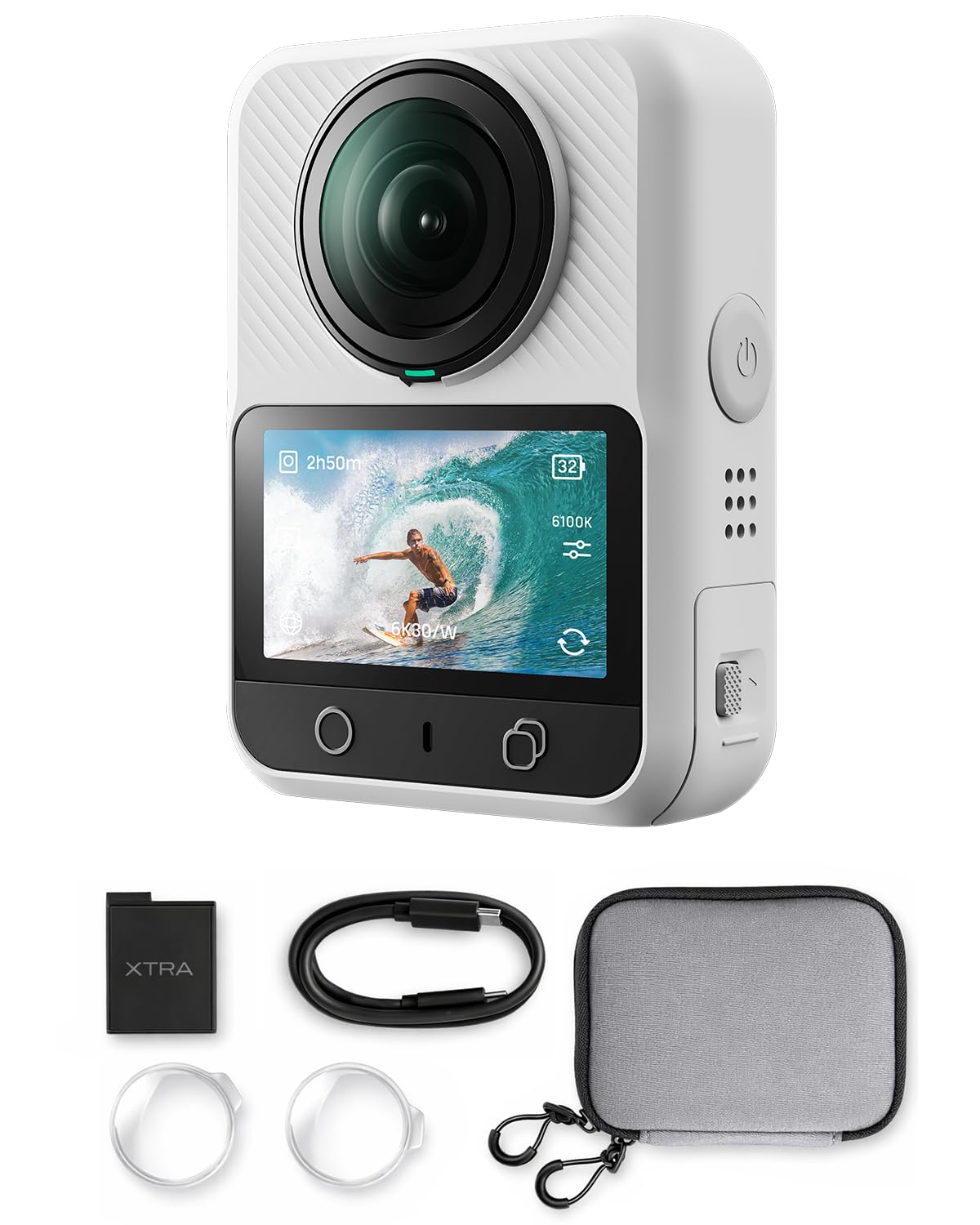
The Xtra 360 Camera offers an 8K panoramic video capture with a 1-inch sensor equivalent—a spec combination typically found in cameras costing significantly more. The 105GB built-in storage means you can start shooting immediately without buying a microSD card, and the magnetic quick-release system accepts standard action camera mounts and selfie sticks. The 100MP panoramic photo mode provides high-resolution stills for immersive documentation.
The camera includes a 1900mAh cold-resistant battery rated for about 90 minutes of recording, and the waterproof design handles rain, snow, and splashes without a housing. The bundled carrying case and lens protector add practical value. The image quality in daytime is very good, with natural color reproduction and solid dynamic range for a mid-range sensor.
The primary weakness is the software ecosystem—the companion app is functional but lacks the AI reframing tools and one-tap exports of Insta360 or DJI. Video creators who need to export individual 360 clips for use in Final Cut Pro will find the current software too limited. The Xtra 360 is best suited for recreational users who want 8K 360 footage for social media and don’t need professional desktop integration.
Why it’s great
- 8K panoramic video with 1-inch sensor equivalent at attractive price
- 105GB built-in storage—no SD card purchase required
- Waterproof design handles weather without housing
- Magnetic quick-release for easy mounting
Good to know
- Software lacks AI reframing and one-tap export tools
- Cannot export individual 360 clips for desktop NLE software
- App connectivity can be inconsistent with some smartphones
8. AKASO 360 Action Camera Creator Combo
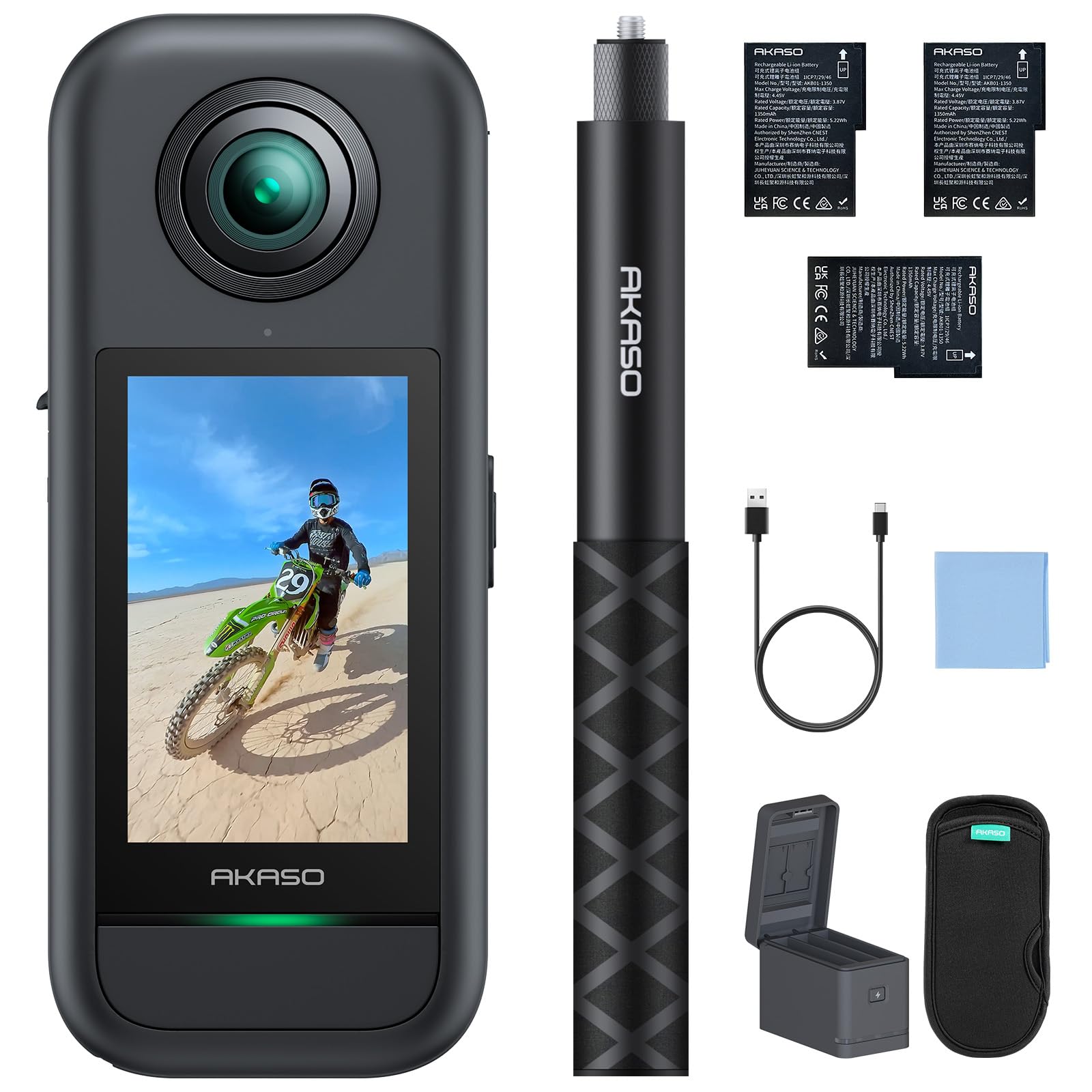
The AKASO 360 delivers 5.7K 360 video using dual 1/2-inch 48MP sensors, positioning it as the most affordable entry point for immersive spherical capture. The Creator Combo includes the invisible selfie stick, a charging case, and a USB-C cable, removing the most common hidden costs of 360 ownership. The 360-degree Horizon Lock and advanced in-app stabilization algorithms smooth out walking and biking motion without a gimbal.
The 72MP 360 photo mode and DNG8 RAW support provide flexibility for stills, and the AI Subject Tracking keeps a detected person centered during movement. The app is functional for reframing and exporting 1080p clips, though it lacks the advanced color grading and one-tap AI reframing of premium ecosystems. The touchscreen on the camera body allows basic settings without the phone app.
Battery life around 54 minutes in 5.7K mode is the biggest limitation—all-day shooters will need multiple spare batteries. Low-light performance is average, with visible noise in dim conditions. The weatherproof design handles splashes but the touchscreen becomes unresponsive in rain. For budget-conscious buyers who want to experiment with 360 video before investing in premium gear, the AKASO 360 is a solid starting point.
Why it’s great
- Lowest entry price for functional 360 video capture
- Includes invisible selfie stick, charging case, and USB-C cable
- 360-degree Horizon Lock works without gimbal
- DNG8 RAW support for still photo editing
Good to know
- 54-minute battery life in 5.7K mode
- Low-light performance is noisy and loses detail
- App lacks AI reframing and one-tap export tools
- Touchscreen unresponsive when wet
9. NexiGo Meeting 360 Ultra (Gen 3)
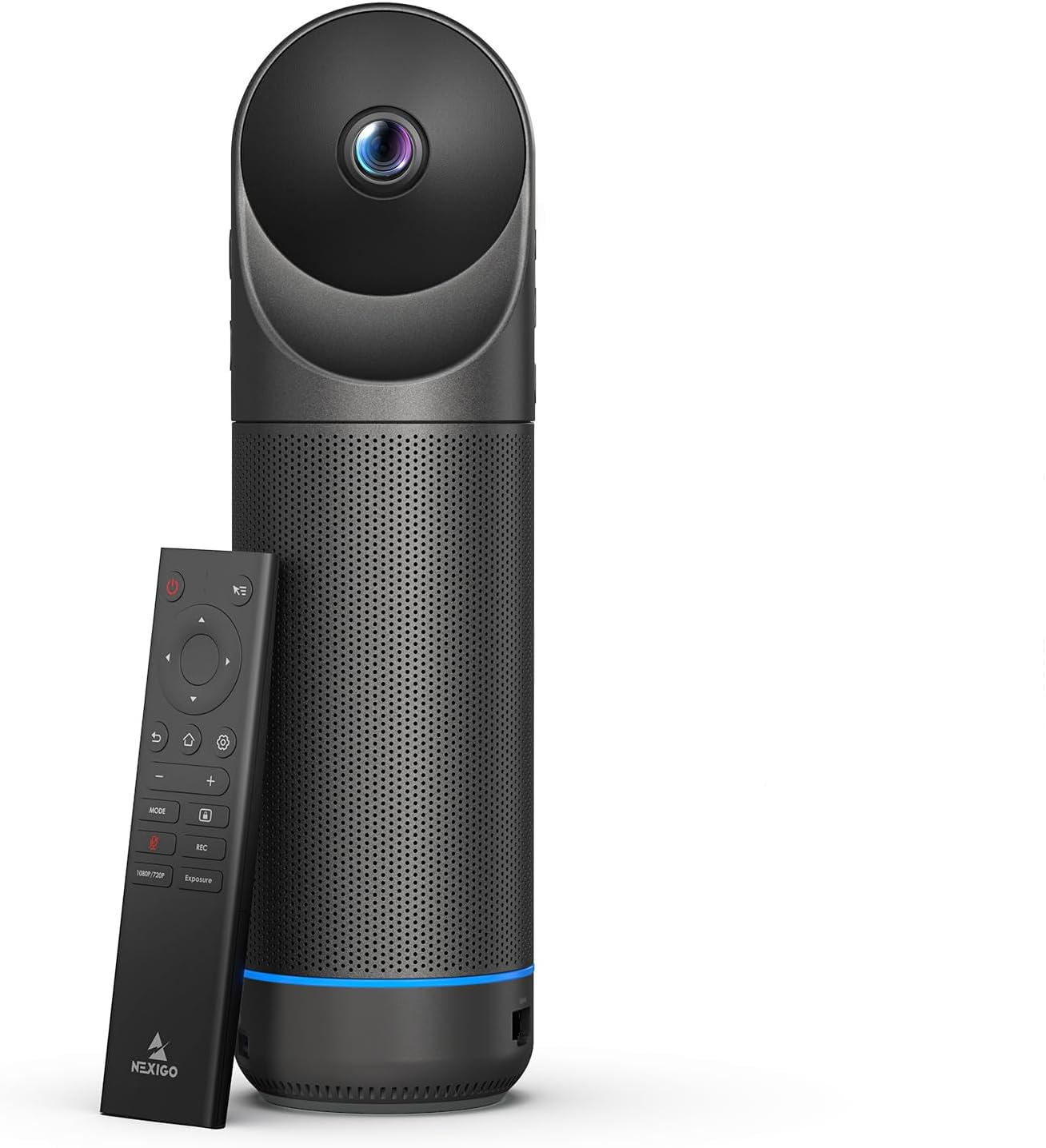
The NexiGo Meeting 360 Ultra is designed for a completely different use case than the action-oriented 360 cameras above—it’s a conference room all-in-one system that captures a full 360-degree view of meeting participants. Dual 195-degree lenses capture 8K panoramic video with AI-powered auto-framing that automatically detects and follows the active speaker. The built-in operating system supports Zoom, Google Meet, Microsoft Teams, and other major platforms directly on a TV screen without a connected computer.
Eight omnidirectional microphones pick up voices up to 18 feet away while filtering out background noise, and the integrated Hi-Fi speakers deliver clear bi-directional audio. The privacy cover over the lenses ensures security when not in use. The multi-camera feature allows daisy-chaining up to four units for very large rooms with U-shaped tables or long conference layouts.
The video output tops out at 8K panoramic capture with 1080p output for the reframed speaker view. The effective still resolution is only 8MP, meaning this is not suitable for photography. The setup is plug-and-play via USB-C or HDMI, and three connection methods (PC, TV, or router) make it flexible. For medium to large meeting rooms, the NexiGo Meeting 360 Ultra eliminates the need for multiple fixed cameras and manual switching.
Why it’s great
- 8K 360-degree capture eliminates blind spots in meeting rooms
- AI auto-framing and speaker tracking works without a PC
- Eight-mic array with 18-foot pickup range
- Built-in OS supports all major video conferencing platforms
Good to know
- Not designed for action or outdoor 360 video
- Effective still resolution is only 8MP
- Requires proper room lighting for best speaker tracking
FAQ
Can I use a 360 camera without a smartphone app?
How much storage do I need for 8K 360 video?
Is 5.7K 360 video enough for YouTube or Instagram?
How does the invisible selfie stick effect work?
Can 360 cameras be used for live streaming?
Final Thoughts: The Verdict
For most users, the camera for 360 video winner is the DJI Osmo 360 Essential Combo because its 1-inch sensor, 8K spherical capture, 105GB internal storage, and dual-battery kit provide the best balance of image quality, stamina, and workflow simplicity across all use cases. If you shoot action sports and need the best low-light performance, grab the Insta360 X5 Essentials Bundle for its triple AI noise processing and fast charging. And for professional real estate or virtual tour stills, nothing beats the Ricoh Theta Z1 51GB for its dual 1-inch BSI sensors and RAW HDR-DNG integration with Lightroom Classic.