
Our readers keep the lights on and my morning glass full of iced black tea. As an Amazon Associate, I earn from qualifying purchases.
Specs are compiled from manufacturer listings and verified buyer reviews and can change over time — please confirm the key details on the product page before buying.
Your YouTube camera determines how much time you spend editing and how professional your videos look. You want a camera that keeps your face sharp while you talk, steadies your handheld shots, and records crisp 4K — without a film-school education in menus. For talking-head vlogs, travel content, or live streams, prioritize autofocus, stabilization, and audio inputs.
I’m Min — the founder and writer behind Gadgets Feed. This guide is built by comparing the manufacturers’ published specifications and the patterns across verified customer reviews, so you get each pick’s real strengths and trade-offs instead of marketing spin.
This guide covers every serious option for a camera for a youtube channel, from pocket gimbals to full-frame powerhouses, so you can match a camera to your exact filming style.
Our Picks at a Glance



How To Choose The Best Camera For A Youtube Channel
Start by asking what you film most. A sit-down talking-head channel has different needs than an action-sports channel, and the camera that excels at one can frustrate you at the other.
Autofocus That Actually Tracks
When you talk to the lens, your face should stay locked in focus even as you move. Look for eye and face detection that works in real time. The best systems track your eyes across the frame, so you never step out of focus mid-sentence.
Stabilization For Handheld Shots
Shaky footage undermines even the sharpest sensor, so stabilization is non-negotiable. You have two main options: a built-in 3-axis gimbal that physically steadies a small camera, or in-body stabilization inside a mirrorless body that works with your lens. Both keep walking shots smooth.
Microphone Inputs And Audio Quality
Bad audio drives viewers away faster than average video quality. A camera with a 3.5mm jack or XLR input lets you plug in a proper microphone, which matters far more than an extra megapixel. Some pocket cameras now include a wireless mic in the box, which simplifies solo filming.
Quick Comparison
| Model | Best For | Video Resolution | Stabilization | Sensor Size | Amazon |
|---|---|---|---|---|---|
| Canon EOS R5★ Best Overall | Hybrid pro work | 8K / 4K up to 120fps | In-body (IBIS) | Full-frame 45MP | Amazon |
| Xtra MuseBest Value | Budget gimbal vlogging | 4K / 120fps | 3-axis gimbal | 1-inch CMOS | Amazon |
| DJI Osmo Pocket 3Top Performer | Pocket creator vlogs | 4K / 120fps | 3-axis gimbal | 1-inch CMOS | Amazon |
| OBSBOT Tail Air | AI tracking livestreams | 4K | Digital + PTZ | 50MP stills | Amazon |
| GoPro HERO13 | Action and travel | 5.3K60 / 4K120 | HyperSmooth 6.0 | 1/1.9-inch 27MP | Amazon |
| Insta360 Luna Ultra | Zoom-heavy vlogging | 8K30 HDR | 3-axis gimbal | 1-inch + telephoto | Amazon |
| Blackmagic Pocket 4K | Cinematic narrative | 4K DCI | None (manual) | 4/3-inch | Amazon |
| Nikon Z50 II | Hybrid with kit lenses | 4K UHD 60p | Electronic VR | APS-C 20.9MP | Amazon |
| Canon EOS R8 | Lightweight full-frame | 4K 60p (6K oversampled) | None (lens-based) | Full-frame 24.2MP | Amazon |
| Sony Alpha a6700 | Fast-tracking hybrid | 4K 120p | In-body (IBIS) | APS-C 26MP | Amazon |
| Sony Alpha 7 IV | Full-frame all-rounder | 4K 60p 10-bit | In-body (IBIS) | Full-frame 33MP | Amazon |
In‑Depth Reviews
1. Canon EOS R5 Mirrorless Camera (Body Only)
Our pick — over 4.5★ from 750+ verified ratings; the strongest balance of quality and price.
The full-frame hybrid that shoots 8K and never misses your eye
If you want one camera that handles both cinematic YouTube videos and professional photography without compromise, the R5 is the ceiling of this list. Its 45MP full-frame sensor and DIGIC X processor deliver 8K RAW video, and it drops to 4K at up to 120fps for buttery slow motion. Buyers report “~650 shots/battery, double CIPA,” so a full day of shooting is realistic on one charge.
Its eye and face tracking keeps subjects locked even with distractions like a bird crossing the frame. In-body stabilization steadies handheld videos so smoothly that you can shoot at slow shutter speeds. Clean high-ISO performance keeps indoor talking-head videos noise-free without extra lighting.
It is expensive, and that is the honest trade-off. Some find the value hard to justify unless video is your full-time income. It is also a body-only camera, so you will need to budget for an RF lens separately.
The beast case
- 8K RAW and 4K up to 120fps internal recording
- Rock-steady in-body image stabilization
- Fast, accurate eye detection autofocus
The honest catches
- Premium price that only pros will justify
- Body only — lens sold separately
- Battery drains faster than its predecessor
Reach for it if: you shoot professionally and want a single camera for 8K video and high-res stills.
Think twice if: you are just starting out and a lens + body budget is not there yet.
2. Xtra Muse Vlogging Camera
A pocket gimbal camera that rivals a premium brand at a friendlier price
The Xtra Muse puts a 1-inch CMOS sensor in a pocket-sized body that records 4K at 120fps, giving you crisp slow-motion without carrying a heavy rig. Its defining trick is the 3-axis gimbal stabilizer, which keeps your walking shots smooth while you dance, run, or hike. The expansive 2-inch touchscreen flips for horizontal or vertical shooting, so your TikTok and YouTube edits come from the same device.
Buyers describe it as near-identical to a well-known competitor at roughly half the price, and the face and object tracking keeps you centered in the frame even when you move. The 10-bit X-Log color mode captures up to one billion colors for flexible grading in post. Its compact size slips easily into a small handbag for on-the-go vlogging.
Battery life runs about 161 minutes, which is a hair shorter than the top pocket pick, and a minority of owners mention overheating during longer clips. Treat it as a strong value option rather than a true all-day workhorse.
Who it fits: beginner vloggers who want gimbal-smooth 4K slow motion without the premium sticker price.
Who should pass: anyone shooting long continuous takes in hot environments, since heat management is its weak spot.
3. DJI Osmo Pocket 3 Creator Combo
The pocket camera that replaced a phone for video, with the mic in the box
The Osmo Pocket 3 is the crowd favorite for creators who want studio-like quality that fits in a pocket. It records 4K at 120fps on a 1-inch CMOS sensor, and its 3-axis mechanical stabilization delivers buttery smooth footage while you walk, dance, or chase a pet. The rotating 2-inch touchscreen flips between horizontal and vertical in seconds, so you are never locked into one aspect ratio.
ActiveTrack 6.0 keeps you centered in the frame as you jump and spin on a tripod, and the included DJI Mic 2 transmitter solves the audio problem instantly — no separate recorder needed. Customers note stunning low-light footage that beats a flagship phone, and several say they have stopped using their phone for video entirely. Battery life hits 166 minutes, which edges out the closest budget rival.
The gimbal is delicate, so treat it gently, and the price climbs once you select the Creator Combo. It is not a full-frame substitute, but for solo vlogging it is the most capable small package here.
The pick for: travel vloggers and solo creators who want smooth 4K plus quality audio straight from the start.
The trade-off: the exposed gimbal head demands careful handling, and a full-frame rig still wins on low-light extremes.
4. OBSBOT Tail Air NDI Streaming Camera

A PTZ camera that tracks you across the room while you present
If your channel is live streaming or presentations rather than talking-head vlogs, the Tail Air is built for exactly that. It is a PTZ camera — meaning it pans and tilts on its own — with a 320° horizontal and 180° vertical rotation, so it follows you around the room while you move. The 23mm f/1.8 lens keeps you sharp in low light, and the AI tracking covers humans, animals, and objects.
It offers four connection options — Micro HDMI, USB-C, Ethernet, and wireless — plus RTMP, RTSP, and VISCA protocols, so you can stream directly to YouTube, Twitch, or Facebook. Buyers praise the crisp broadcast-quality video and the gesture control that starts and stops recording with a hand wave. It also records to a microSD card, and a remote control with a laser pointer is a handy extra for teaching.
Reliability is the recurring note: some reviewers point out connectivity hiccups, and a single unit died when its non-replaceable battery failed. It is a specialized tool, not a general-purpose vlog camera.
Ideal for streamers: multi-angle tracking on a budget, made for live shows rather than cinematic b-roll.
The catch: the built-in battery is not user-serviceable, so longevity over years is the open question.
5. GoPro HERO13 Black Bundle

The rugged action camera that goes underwater and still levels the horizon
For a channel built on outdoor adventures, the HERO13 Black records up to 5.3K60 video and 27MP photos from a 1/1.9-inch sensor. HyperSmooth 6.0 stabilization with AutoBoost keeps footage steady in extreme conditions, and the 360 Horizon Lock holds your horizon level no matter how much the camera rotates. It is waterproof to 33 feet without a housing, so underwater shots are part of the package.
The bundle adds a 64GB memory card and a 50-piece accessory kit, which covers mounts and attachments for nearly any scenario. Bluetooth audio lets you pair wireless mics or headphones for better sound, and Wi-Fi 6 makes file transfers fast. Buyers praise the durability across weather and environmental conditions, calling the build reliable.
Some of the bundled accessories are noticeably cheap, and durability reviews split between “very durable” and a tripod that breaks. It is the right pick for action, but not the tool for sit-down studio videos.
What wins people over
- 5.3K60 video with 8x slow-motion at 2.7K240
- Waterproof to 33 feet without a housing
- HyperSmooth 6.0 with 360 Horizon Lock
What to expect
- Some bundle accessories feel flimsy
- Battery averages 1.5 hours at 5.3K
Grab it for: action, travel, and underwater content where a mirrorless camera would never survive.
Look elsewhere if: you film mostly indoors talking to a camera, where a gimbal or mirrorless body wins.
6. Insta360 Luna Ultra
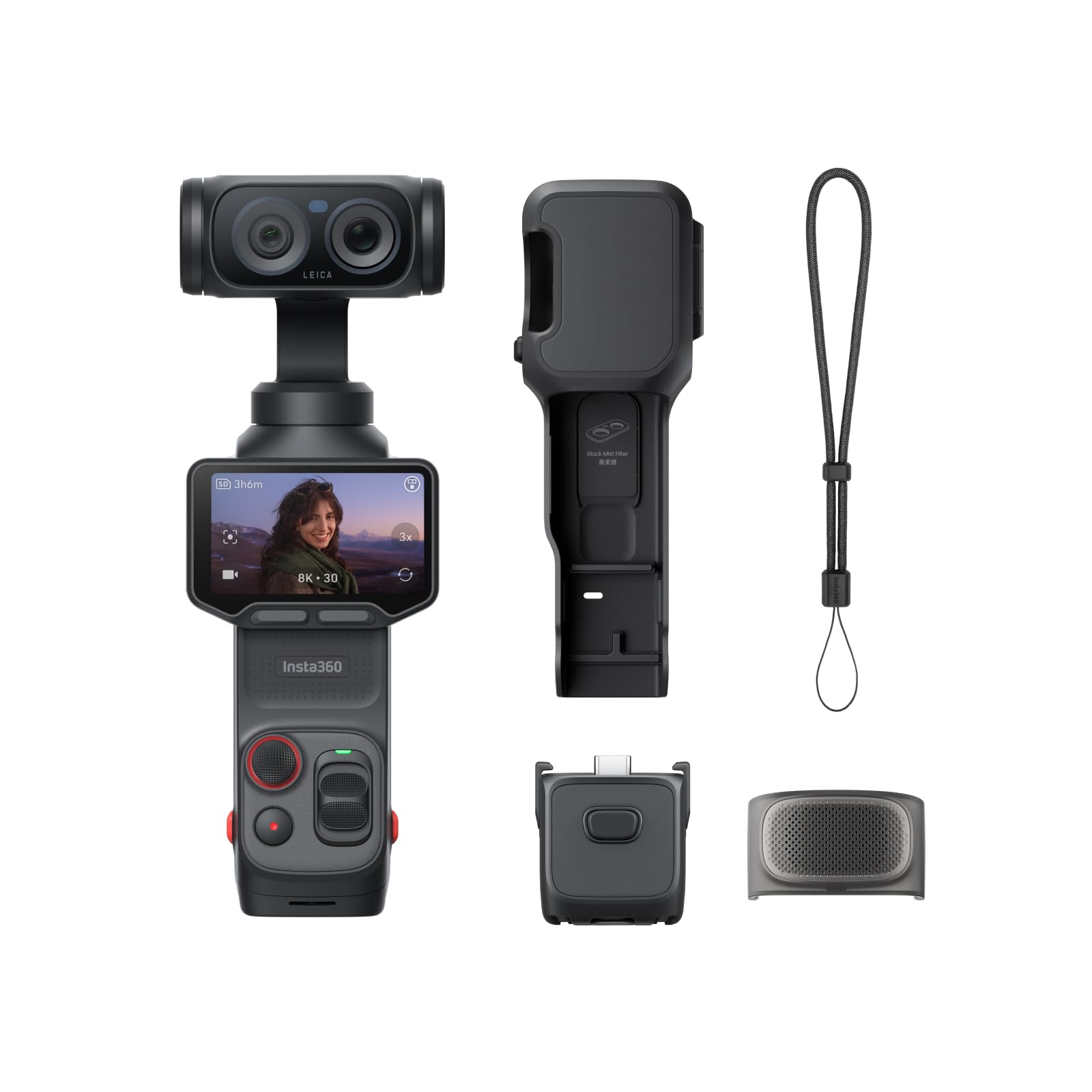
The 8K gimbal camera with a detachable screen and true optical zoom
The Luna Ultra stands out for its dual Leica lenses — a 1-inch main sensor plus a telephoto lens — giving you up to 6x lossless zoom and a 12x zoom range with real optical background blur. It records 8K30 footage with Dolby Vision, and the 14 stops of dynamic range hold detail from bright skies to deep shadows. In low light, the AI noise reduction and 4K60 PureVideo mode keep night scenes clean.
The detachable 2-inch OLED touchscreen works as a live preview and remote control up to 20 meters away, which makes solo framing and group shots easier. Three-axis mechanical stabilization keeps handheld walking shots smooth, and the battery stretches to 4 hours with fast charging to 80% in 23 minutes. Buyers praise the build quality and note it holds its own against far pricier cinema cameras.
There is a reliability split, with a few owners reporting glitches and screen blackouts. It also lacks a webcam mode, so it is not the tool for livestreaming directly.
Buy it for: zoom-heavy vlogging and travel where a single pocket device covers wide and telephoto shots.
Be aware: a small share of units ship with software glitches, so buy from a seller with easy returns.
7. Blackmagic Design Pocket Cinema Camera 4K

A true cinema camera that records to cheap SSDs and grades beautifully
For narrative films, documentaries, or interviews, the Pocket Cinema Camera 4K is the closest you get to a real movie camera at this price. It uses a 4/3-inch sensor with 13 stops of dynamic range and dual gain ISO up to 25,600, so it captures remarkable detail across highlights and shadows. The MFT lens mount works with a huge range of affordable and vintage lenses.
The defining feature is direct recording to an external SSD via USB-C, which keeps storage costs low and makes massive 12-bit Blackmagic RAW files easy to handle. It records Apple ProRes up to 4K, includes a DaVinci Resolve Studio activation key, and the large 5-inch LCD screen on the body removes the need for a separate monitor. Owners call the quality studio-grade, noting it quickly pays for itself.
There is no autofocus to speak of, no image stabilization, and the battery lasts around 30 minutes — this is a manual, rig-building camera. It is not for vlogging or run-and-gun shooting; it is for people who want to control every frame.
Perfect for: filmmakers who want cinema-grade dynamic range and don’t mind manual focus.
skip it if: you need autofocus or plan to film yourself walking around, since this camera is built for a tripod and a crew.
8. Nikon Z50 II with Two Lenses

A two-lens mirrorless kit that makes color grading as easy as a preset
The Z50 II is a compact APS-C mirrorless camera that comes with two lenses — a 16-50mm and a 50-250mm zoom — so you have wide and telephoto coverage from day one. Its 20.9-megapixel DX-format sensor is several times larger than a phone’s, which gives you lifelike colors and real background blur. The standout feature is the Picture Control button: 31 built-in presets let you pick a look on the spot, so you spend less time grading in post.
Autofocus detects and tracks nine subject types, including people, dogs, cats, birds, and vehicles, with dedicated bird and airplane modes for extra accuracy. It records 4K UHD at 60p, has in-camera 120p slow-motion in Full HD, and a built-in electronic VR to steady handheld clips. The SnapBridge app sends photos and video to your phone in seconds, which makes quick uploads painless.
A few shoppers say external flash compatibility issues and, less commonly, autofocus stopping after a few weeks. It is a versatile beginner-to-intermediate hybrid that rewards you for learning the manual controls.
The easy-life list
- Two sharp VR kit lenses included
- 31 one-press color presets
- 9-subject autofocus tracking
The honest notes
- External flash issues reported by some
- Occasional autofocus stop after weeks of use
Best suited for: hybrid shooters who want cinematic color without learning complex grading.
Not for: anyone who needs a long zoom beyond 250mm or relies on third-party flash gear.
9. Canon EOS R8 Mirrorless Camera Body

Canon’s lightest full-frame body, with the R6 II’s sensor at a friendlier price
The R8 is the entry point to Canon’s full-frame RF system, packing a 24.2MP sensor and DIGIC X processor into the lightest full-frame body Canon makes. It records uncropped 4K at up to 60fps, oversampled from 6K for extra detail, and captures Full HD slow motion at up to 180fps. The Dual Pixel CMOS AF II covers the full frame with 1,053 AF zones and uses deep learning to detect people, animals, vehicles, and even aircraft.
Buyers call it the “R6 Mark II without the price” — the same sensor, autofocus, and video features in a smaller, lighter body that is ideal for travel and street shooting. Its low-light performance is exceptional, keeping images clean at high ISO, and the vari-angle touchscreen helps you frame yourself when vlogging solo. It also works as a UVC/UAC webcam for streaming.
The trade-offs are real: a single SD card slot, a smaller battery, and no in-body stabilization, so you need stabilized lenses or a tripod for handheld work. It is a brilliant value, but not the rugged workhorse of the R6 line.
The value line: full-frame 4K 60p and pro-grade autofocus in a body that is a joy to carry all day.
The reality check: you trade a second card slot, battery life, and IBIS for that light weight and lower price.
10. Sony Alpha a6700 with 18-135mm Lens

An APS-C hybrid with AI-powered autofocus that sticks to moving subjects
The a6700 keeps your face locked in focus while you move, thanks to a dedicated AI processor paired with a 26MP APS-C Exmor R sensor (a large sensor that captures more light for better low-light video). Real-time Recognition uses 759 autofocus points to track people, pets, and cars so reliably that owners call it “sticky” — so you can walk toward the camera and stay sharp. It records 4K at up to 60fps oversampled from 6K (meaning it uses extra pixels for sharper detail), plus high frame rate 4K 120p for slow motion, all in 10-bit 4:2:2 color (which gives you more color data for editing) with log shooting and LUT handling for flexible color grading.
The bundled 18-135mm zoom covers most everyday situations from wide scenes to closer shots, making it a solid all-in-one travel kit. In-body stabilization helps your low-light handheld footage, and the camera is compact and light enough for all-day carrying. Owners also love the AI-based subject modes for insects and birds, which take the guesswork out of tricky shots.
It has a single SD slot and a small viewfinder, and it can overheat after about 40 minutes of 4K 60fps recording. For most hybrid vloggers that is a manageable limit, not a dealbreaker.
What it nails
- AI subject tracking that locks onto people and pets
- 4K 120p plus 10-bit log footage
- One-lens travel kit from 18-135mm
Where it trips
- Overheats near 40 minutes of 4K 60fps
- Single SD slot and a small EVF
Pick it if: you shoot motion-heavy content — kids, pets, or events — and want autofocus you can trust.
Pass if: you plan long 4K 60fps recordings, since the heat limit will interrupt you.
11. Sony Alpha 7 IV Full-frame Mirrorless Camera

The do-everything full-frame body with 33MP stills and cinematic 4K video
The Alpha 7 IV is the all-rounder that serious hybrid shooters land on, combining a 33MP full-frame Exmor R sensor with the next-generation BIONZ XR processor. It records 4K 60p in 10-bit 4:2:2 with full pixel readout, and 7K oversampling delivers 4K 30p with no pixel binning for maximum detail. The S-Cinetone color profile gives you beautiful, filmic color straight out of the camera — no heavy grading required.
The autofocus is superb in tricky light, with face and eye detection that owners describe as reliable and accurate, supported by 693 phase-detection points. In-body stabilization keeps your handheld shots steady, and the switchable photo/video mode dial makes it easy to move between stills and clips. Dual card slots — one CFexpress Type A and one SD — mean you never worry about running out of storage mid-shoot.
Buyers report over 2,000 shots per battery, and the weather-sealed body feels solid rather than plasticky. The 60-120p modes use a crop, and the menu depth creates a learning curve for beginners, but the payoff is a camera that grows with you.
The verdict: the full-frame benchmark for channels that mix high-end stills with cinematic video in one body.
The caveat: expect a real learning curve, and the sensor crop at high frame rates is a small compromise.
Understanding the Specs
Sensor Size and Resolution
The sensor is the light-capturing heart of the camera. A larger sensor — like full-frame or a 1-inch type — gathers more light, which means cleaner footage in dim rooms and a more natural background blur behind you. Resolution tells you how much detail the camera can record, with 4K (around 3840 pixels wide) being the standard for YouTube today and 8K the current high-end ceiling.
Stabilization Systems
Stabilization keeps your footage from looking shaky. A 3-axis gimbal is a physical motorized mount that holds a small camera steady as you move. In-body stabilization (IBIS) is built into a mirrorless camera body and works with your lens to counteract hand movement. For walking vlogs, you want one or the other; for tripod work, you can skip it entirely.
Autofocus and Subject Tracking
Autofocus systems today use deep learning to recognize faces, eyes, animals, and vehicles. The best ones lock onto your eye and keep it in focus even as you move toward or away from the lens. This matters most if you vlog solo without a camera operator, because you can’t check focus while you are on camera.
Color Depth and Log Profiles
Bit depth and log profiles determine how much color information the camera records and how flexibly you can grade it later. A 10-bit image holds up to one billion colors, which gives editors far more room to adjust exposure and color before the image degrades. Log profiles like S-Log or I-Log flatten the image on purpose to preserve highlight and shadow detail for post-production.
FAQ
Do I need a full-frame camera for a YouTube channel?
What does 4K 120fps mean for my videos?
Is a gimbal stabilizer better than in-body stabilization?
How important is a microphone input on a vlogging camera?
Will a pocket gimbal camera overheat during long recordings?
What is a log profile and do I need it?
Can I use a camera with a webcam mode for livestreaming?
Is the Blackmagic Pocket Cinema Camera 4K good for beginners?
How does the Canon R5 compare to the Sony Alpha 7 IV for YouTube?
What battery life should I expect from these cameras?
Final Thoughts: The Verdict
For most people, the camera for a youtube channel winner is the DJI Osmo Pocket 3 because it packages 4K 120fps video, a 3-axis gimbal, and a wireless mic into a pocketable body that makes solo vlogging easy. If you want maximum image quality and cinematic control in a larger rig, the Canon EOS R8 brings full-frame 4K 60p to a lightweight, more affordable package. And for action-heavy channels that need to survive harsh conditions, the GoPro HERO13 is the one to reach for. With 4.5 stars across 6,700+ owners, the Osmo Pocket 3 is the crowd favorite for out-of-the-box satisfaction.
How We Picked
We do not accept paid placement. Every pick is matched to a real buyer and a real use-case; we do not hands-on test units.
Sources & Methodology
Specifications: manufacturer listings and product documentation. Review insights: verified customer reviews, as of August 2026. Pricing: not shown on this page (it changes often); check the current price via the retailer link.
As an Amazon Associate, Gadgets Feed earns from qualifying purchases. This does not affect which products we feature.