
Capturing the Milky Way, a distant nebula, or the intricate details of the Andromeda Galaxy pushes a general-purpose camera to its absolute limit. The core problem isn’t your skill; it’s the hardware — standard sensors struggle in near-total darkness, produce thermal noise during long exposures, and lack the spectral sensitivity to record the faint hydrogen-alpha emissions that make deep-sky imagery spectacular.
I’m Min — the co-founder and writer behind Gadgets Feed. The hours I’ve spent cross-referencing quantum efficiency curves, read noise measurements, and dark current specs across cooled astronomy cameras and modified mirrorless bodies have shaped this guide into a data-driven map through a technically demanding landscape.
Whether you are after a smart telescope for instant gratification or a high-end body for obsessive detail, this guide rigorously compares every critical spec to help you select the absolute best camera for astrophotography.
How To Choose The Best Camera For Astrophotography
The biggest mistake beginners make is buying a standard consumer camera and expecting it to perform miracles on deep-sky objects. Astrophotography demands a camera that can handle long exposures (often several minutes) without cooking its sensor, and that is sensitive to the specific wavelengths of light emitted by nebulas. The choice largely boils down to a dedicated astronomy camera versus a modified or high-end mirrorless camera. Let’s break down the essential factors.
Cooled vs. Uncooled Sensors
A cooled camera uses a thermoelectric cooler (TEC) to drop the sensor temperature by 30°C to 45°C below ambient. This single feature is the most critical for deep-sky astrophotography because it suppresses thermal noise (dark current) to near zero. Without cooling, a 5-minute exposure on a warm summer night will be covered in speckles of noise, and subtracting dark frames only partially fixes the problem. Cooled astronomy cameras (like the SVBONY SV405CC and ZWO ASI183MC Pro) are the standard for anyone serious about faint structure.
Sensor Sensitivity: Quantum Efficiency and the Ha Line
Quantum efficiency (QE) measures the percentage of incoming photons that the sensor converts into an electrical signal. A QE of 80% is excellent, 60% is average for astro. More critical for color cameras is sensitivity to the Hydrogen-alpha (Ha) emission line at 656.3 nm — the deep red glow from emission nebulas. Back-illuminated sensors (like the IMX294 in the SV405CC) physically wire the photodiodes on the top layer of the silicon, improving QE across the spectrum, especially at those deep red wavelengths. A standard DSLR has a filter that blocks this red light, making it a poor choice for nebulas.
Tracking and Mounts: The Axis of the Universe
You cannot do long-exposure astrophotography without a motorized mount that tracks the Earth’s rotation. A standard tripod leaves stars trailing into lines after a few seconds. The tracking method defines your imaging scale: a star tracker (like the Sky-Watcher Star Adventurer GTi) is perfect for a camera body with a regular telephoto lens; a go-to equatorial mount (EQ mount) is required for a telescope. Smart telescopes like the Dwarf 3 handle all the tracking internally with an alt-azimuth mount, removing the complexity for the user.
Quick Comparison
On smaller screens, swipe sideways to see the full table.
| Model | Category | Best For | Key Spec | Amazon |
|---|---|---|---|---|
| Dwarf 3 Smart Telescope | All-in-One | Instant deep-sky views, all ages | 4K auto-tracking, cloud processing | Amazon |
| Canon EOS R8 | Full-Frame Mirrorless | Versatile day/night hybrid shooting | 24.2MP, 4K60p, 1053 AF zones | Amazon |
| Sony a7 III | Full-Frame Mirrorless | Low-light landscapes and star trails | BSI sensor, 15-stop dynamic range | Amazon |
| Nikon Z 7II | High-Res Mirrorless | Ultra-high res mosaics and wide fields | 45.7MP, dual card slots, IBIS | Amazon |
| Nikon D850 | DSLR | High-res with optical viewfinder | 45.7MP BSI sensor, 9 fps burst | Amazon |
| Canon EOS R5 | Hybrid Mirrorless | 8K video and hi-res stills | 45MP stacked sensor, 8K RAW | Amazon |
| SVBONY SV405CC | Dedicated Astro Cam | Deep-sky with two-stage TEC | 11.7MP IMX294, cooled -30°C | Amazon |
| ZWO ASI183MC Pro | Dedicated Astro Cam | High-res planetary and lunar | 20.1MP, 2.4 micron pixels, cooled | Amazon |
| Sony a6400 | APS-C Mirrorless | Compact star-trail and timelapse | 24.2MP, 0.02 sec AF, flip screen | Amazon |
| Panasonic LUMIX G85 | M4/3 Mirrorless | Budget, requires star tracker | 16MP, 5-axis IBIS, 4K video | Amazon |
| Sky-Watcher Star Adventurer GTi | Star Tracker Mount | Portable tracking for camera/lens | GoTo mount, 11 lb payload, WiFi | Amazon |
In‑Depth Reviews
1. DWARFLAB Dwarf 3 Smart Telescope
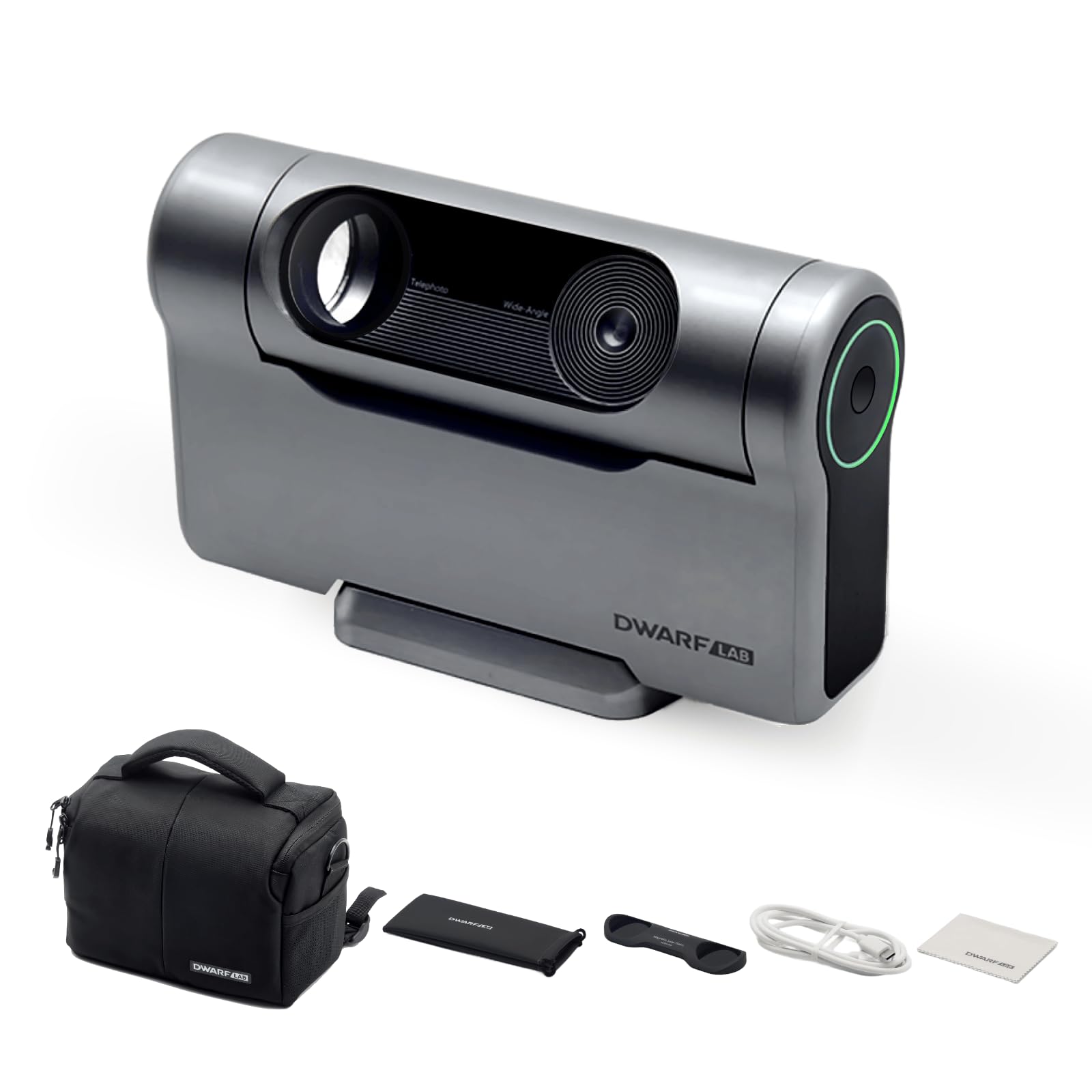
The Dwarf 3 completely redefines what a portable astrophotography rig can be. Weighing just three pounds and fitting into a standard backpack, this smart telescope packs a dual-lens imaging system: a telephoto sensor for deep-sky objects and a wide-angle lens for capturing the full Milky Way arch. The 4K auto-tracking system locks onto celestial targets and follows them across the sky without any user intervention.
Beyond its hardware, the integrated cloud-powered processing pipeline is a standout feature. The companion app handles live stacking, denoising, and even star removal with a single tap — turning raw light frames into a finished astrophoto in minutes. The built-in EQ mode allows for longer exposures, and user reports confirm sharp captures of galaxies and nebulas even from light-polluted suburbs (Bortle 7 and above).
The alt-azimuth mount is inherently limited for very long single exposures (beyond 60 seconds) without field rotation, but for 95% of what a beginner wants to image, this limitation is academic. The dual-band filter effectively cuts through light pollution, making it the best gateway device for anyone who wants stunning results without learning polar alignment.
Why it’s great
- Ultra-light and portable at just 3 pounds
- In-app live stacking with cloud processing
- Dual camera for deep-sky and Milky Way
- Excellent light pollution rejection
Good to know
- App can have glitchy connectivity at first
- Not suitable for single exposures over 60 seconds
- Requires a sturdy tripod for EQ mode
2. Canon EOS R8 Mirrorless Camera

The EOS R8 brings the same DIGIC X processor and AF engine found in the R6 Mark II into the lightest full-frame body Canon has ever made. For astrophotography, its 24.2-megapixel sensor delivers excellent signal-to-noise ratio at high ISOs (up to ISO 102,400 expanded), and the lack of an optical low-pass filter preserves fine stellar detail. The vari-angle LCD is critical for framing shots when the camera is strapped to a star tracker.
The uncropped 4K 60p video, oversampled from 6K, allows for stunning timelapse sequences and high-resolution star-trail videos. Canon Log 3 provides the latitude to pull out bright core details in M42 while preserving faint outer nebulosity without clipping. Users report the AF is fast enough for lunar imaging, though deep-sky work is always manual focus via peaking.
The main trade-offs are the small LP-E17 battery (expect ~300 shots on a cold night) and the lack of in-body image stabilization (IBIS). For astrophotography, the mount is the stabilizer, so IBIS is irrelevant here. The single UHS-II SD slot is a minor concern, but the camera’s lightweight nature makes it a dream to pair with a 200mm-400mm telephoto lens on a portable tracker.
Why it’s great
- Excellent high-ISO performance for low noise
- Lightest full-frame body for easy tracking
- Uncropped 4K 60p with Canon Log 3
- Fast, reliable autofocus for terrestrial use
Good to know
- Battery life is poor, bring spares
- No IBIS for wide-field handheld shots
- Single card slot is limiting for long sessions
3. Sony a7 III Full-Frame Mirrorless

The a7 III remains the benchmark for low-light full-frame performance, and its 35mm back-illuminated sensor is the key reason. The 15-stop dynamic range allows you to pull out the faintest nebulosity without blowing out the star cores — a critical advantage for processing wide-field images of the Milky Way. The 693-point phase-detection sensor covers 93% of the frame, making autofocus for lunar and planetary work effortless.
The camera’s internal intervalometer timelapse feature is a boon for star-trail sequences, and the excellent battery life (Z-series battery, ~710 photos per charge) means you can run an entire night without swapping. The silent shutter eliminates mechanical vibration that can blur long exposures, though for deep-sky with a tracker, you will use the mechanical or electronic shutter on a timer.
The menu system is notoriously complex, but once configured for astro shooting (Manual mode, RAW, long-exposure noise reduction off), it rarely needs changing. The 24.2-megapixel resolution is a sweet spot — high enough for detailed prints but not so high that it overwhelms processing or requires perfect focus beyond what a standard tracker can deliver.
Why it’s great
- Exceptional 15-stop dynamic range for astro
- Long battery life for all-night shoots
- Back-illuminated sensor for high QE
- Silent electronic shutter eliminates shake
Good to know
- Complex menu layout
- Kit lens has slow f/3.5-5.6 aperture
- No built-in intervalometer (needs app)
4. Nikon Z 7II Mirrorless Camera

When resolution is the priority, the 45.7-megapixel sensor of the Z 7II is the clear leader among mainstream mirrorless cameras. This pixel count makes it ideal for creating ultra-high-resolution mosaics of large sky areas or cropping deep into rich star fields like the Cygnus region. The 493-point phase-detect AF system and 5-axis IBIS stabilize handheld wide-field shots, but for real astro work, it lives on a tracker.
Nikon’s N-Log and 4K 60p video capability allow for advanced astro timelapses, and the 10-bit output retains the dynamic range necessary to grade the Milky Way’s subtle color shifts. The built-in intervalometer with exposure smoothing is a godsend for flicker-free timelapses. Users report the 45MP sensor produces noise-free file at low-ISO base, and with moderate stacking, the results rival medium-format clarity.
The primary drawback is file size — a single RAW can exceed 80 MB, requiring significant storage and a powerful computer for stacking and processing. The battery life is modest (~400 shots), so an external battery grip is highly recommended for all-night exposures. The Z-mount lens lineup, while growing, still lacks the affordable astro-specific primes available in Sony E-mount.
Why it’s great
- 45.7MP for massive printable resolution
- Built-in intervalometer with flicker reduction
- IBIS for handheld wide-field scenes
- Excellent build quality and weather sealing
Good to know
- Very large file sizes require heavy storage
- Limited native fast Z-mount astro lenses
- Battery life is average for mirrorless
5. Nikon D850 FX-Format DSLR

The D850 is widely considered the best DSLR ever made, and for astrophotography, its back-side illuminated (BSI) 45.7-megapixel full-frame sensor delivers exceptional low-noise performance with zero risk of moiré. The lack of an optical low-pass filter further enhances sharpness on stellar point sources. The 153-point AF system is excellent for daytime use, and for astro, the live view mode with focus peaking (in newer firmware) simplifies star focus.
The built-in intervalometer and focus shift shooting capability allow for advanced timelapse and deep-sky sequences without additional hardware. The tilting touchscreen makes it far easier to compose shots when the camera is mounted overhead on a telescope or star tracker. The mechanical shutter is rated for 200,000 cycles, and the dedicated XQD slot writes at lightning speed for clearing the buffer.
The optical viewfinder is a disadvantage for astro focus compared to mirrorless EVF magnification, and the camera’s weight (1 kg body only) is substantial for portable setups. However, the massive F-mount lens ecosystem offers some of the best astro-specific glass ever made, like the Nikon 14-24mm f/2.8 and 20mm f/1.8 lenses, which can be found at budget-friendly prices used.
Why it’s great
- Best-in-class DSLR for resolution and dynamic range
- Awesome F-mount lens selection, very affordable
- Built-in intervalometer and focus stacking
- Excellent build and weather sealing
Good to know
- Heavy and bulky compared to mirrorless
- Optical viewfinder is not ideal for critical focus
- Requires expensive high-speed cards
6. Canon EOS R5 Mirrorless Camera

The stacked back-illuminated 45-megapixel sensor in the R5 is the crown jewel of Canon’s mirrorless lineup, offering the fastest readout speed of any camera on this list. This eliminates rolling shutter distortion entirely, making it the best choice for capturing the fastest-changing atmospheric phenomena like lunar occultations or the International Space Station transit. The 20 fps electronic shutter with continuous focus is unmatched.
The 8K RAW video capability is overkill for most astrophotography, but it does allow you to extract 33.2-megapixel still frames from the video stream — effectively creating a high-speed imaging burst. The in-body IS (IBIS) works in conjunction with lens IS, allowing for sharp handheld shots of the moon. The Eye Control AF feature, where you look at a focus point through the EVF, speeds up manual focusing with adapted lenses on a telescope.
The overheating narrative around the R5 is largely overblown for stills photography; it mainly affects 8K video recording. For a single night of astro shooting, the camera will never have a chance to overheat. The main cost is the body itself, which sits at the premium end. The RF lens ecosystem is excellent but relatively expensive, though EF lenses work perfectly with the Canon adapter.
Why it’s great
- Fastest sensor readout for eliminating rolling shutter
- 45MP stacked sensor for extreme detail
- 8K video for extracting high-res frames
- Top-tier build and autofocus system
Good to know
- Very high cost of entry
- Can overheat during extended 8K video
- Native RF lenses are expensive
7. SVBONY SV405CC Cooled Telescope Camera

The SV405CC uses the same Sony IMX294 back-illuminated sensor found in cameras that cost twice as much, making it the best budget entry into dedicated cooled astrophotography. The 11.7-megapixel resolution (4144 x 2822) with 4.63 micron pixels strikes a perfect balance between resolution and sensitivity for deep-sky targets. The two-stage TEC cooler reduces the sensor to 30°C below ambient, effectively eliminating thermal noise from 5-minute exposures.
The USB 3.0 interface delivers 16 fps at full 11.7MP resolution in RAW16, allowing for smooth electronic assisted astronomy (EAA) without lag. The 256 MB DDR3 buffer ensures no dropped frames during high-speed capture. The HCG mode automatically kicks in at gain 120, reducing read noise while maintaining full dynamic range, which is critical for preserving faint detail in galaxies and nebulas.
Some users report a buffer timing issue with NINA plate solving where the camera displays the previous frame instead of the current one. SVBONY has been slow to address this. The camera is also sensitive to USB cable length and may require a powered USB hub in a complex rig. For the price, the image quality is outstanding and largely matches the ZWO ASI294MC Pro.
Why it’s great
- Excellent value, nearly identical to premium ZWO model
- Two-stage TEC cooling reduces noise drastically
- 256 MB buffer for stable high-speed capture
- Large 4/3″ IMX294 sensor with big pixels
Good to know
- May have NINA buffer timing issues
- Requires 12V power supply for cooling
- USB cable length sensitivity
8. ZWO ASI183MC Pro Color Astronomy Camera

The ASI183MC Pro is the high-resolution specialist in ZWO’s lineup, packing 20.1 megapixels into a 1-inch (13.2mm diagonal) sensor with 2.4 micron pixels. The small pixel pitch makes it ideal for lunar and planetary imaging, where you need fine detail over the small area of a planet or the moon’s surface. The 1-inch sensor also offers a tight field of view that matches well with long focal length telescopes like an 8-inch or larger SCT.
The TEC cooling drops the sensor to 45°C below ambient, making it one of the most aggressive coolers in its class, which is necessary to control the noise from such small pixels during long exposures. The USB 3.0 interface delivers up to 19 fps at full resolution. The camera is fully compatible with ZWO’s ASIAIR ecosystem, making it a seamless addition to an automated astrophotography rig.
The amp glow from this camera is more pronounced than larger sensor models, though it calibrates out cleanly with dark frames. The 2.4 micron pixels are extremely demanding on tracking accuracy and seeing conditions — an 8-inch telescope needs exceptional guiding to avoid star bloating. For beginners, the larger pixel cameras (like the SV405CC) are more forgiving. The windowed mode allows for incredibly high frame rates on small targets like Mars.
Why it’s great
- Highest resolution dedicated astro camera at 20.1MP
- Aggressive TEC cooling to -45°C
- Excellent for planetary and lunar detail
- Fully integrates with ASIAIR ecosystem
Good to know
- Small pixels are demanding on tracking
- Strong amp glow requires darks
- 1-inch sensor has small field of view
9. Sony Alpha a6400 Mirrorless Camera

The a6400 is a compact and capable APS-C camera that performs well for wide-field astrophotography when paired with a fast lens like the Sigma 16mm f/1.4. The 24.2-megapixel sensor with 425 phase-detect AF points covers 84% of the frame, providing fast and accurate locking for lunar and terrestrial focus. The flip-up touchscreen is excellent for vlogging and for low-angle astro compositions.
The camera’s 4K video capture at 30 fps, oversampled from the full sensor width, produces excellent timelapse material. The built-in intervalometer app (via PlayMemories) allows for star-trail and timelapse sequences. The compact size makes it a dream for backpacking trips where weight is critical. At under a pound for the body, it is one of the lightest options for a multi-day night photography hike.
APS-C sensors produce more noise at high ISOs than full-frame, making the a6400 less suitable for deep-sky imaging without aggressive stacking. The lack of in-body stabilization means you must use a tripod or gimbal for any night work. The rolling shutter in 4K is noticeable for fast panning in timelapse, and the menu system is dense.
Why it’s great
- Extremely compact and lightweight
- Fast and reliable autofocus system
- 4K video oversampled from full sensor
- Wide range of affordable E-mount lenses
Good to know
- APS-C sensor more noisy than full-frame
- No IBIS, requires tripod for night
- Poor touchscreen implementation
10. Panasonic LUMIX G85 Mirrorless Camera

The G85 is a solid entry-level mirrorless that, while not optimized for deep-sky, works well for wide-field Milky Way shots when paired with a fast M4/3 lens like the Laowa 7.5mm f/2 or the Panasonic 12mm f/1.4. The 5-axis in-body stabilization actually helps for handheld star-scape shots, though any exposure longer than a few seconds will still require a tripod. The 16-megapixel sensor without an OLPF gives a slight resolution boost.
The 4K video (3840 x 2160) is excellent, and Panasonic’s colors are considered very pleasing for timelapse. The kit lens (12-60mm) provides a 24-120mm full-frame equivalent zoom range, which covers everything from landscapes to tight telephoto views. The fully articulating touchscreen is a big plus for awkward angles. The 4K Post Focus feature can be used to extract crisp frames from a 30fps burst.
For deep-sky astrophotography, the M4/3 sensor’s smaller area is a significant handicap. The pixel count is low, and the dynamic range is limited compared to APS-C or full-frame. There is no intervalometer built in, requiring an external device. The low-pass filter removal in this model does not help with Ha sensitivity since the stock filter stack blocks deep red light.
Why it’s great
- Best value for a weather-sealed mirrorless
- Excellent 5-axis IBIS for video and night
- Fully articulating touchscreen for composition
- Versatile kit lens included
Good to know
- Small M4/3 sensor struggles in low light
- No built-in intervalometer
- Stock filter blocks Ha deep-red light
11. Sky-Watcher Star Adventurer GTi Mount Kit

While not a camera, the Star Adventurer GTi is arguably the most important piece of gear for full-frame and APS-C astrophotographers who want to use camera lenses. This GoTo star tracker uses a built-in WiFi module and the SynScan app to perform polar alignment and automatically slew to any object in the sky. The payload capacity of 11 pounds is sufficient for a full-frame body and a 200mm f/2.8 lens.
The tracking accuracy, when properly balanced, allows for unguided exposures of up to 3 minutes with a lens, and 5 minutes or more with a guide scope. The illuminated polar scope makes alignment straightforward, even for beginners. The kit includes the tripod, pier extension, and counterweight bar, so it is a complete solution. Users report excellent results with the RedCat 51 and similar compact refractors.
GoTo accuracy can be unreliable if you cannot find three suitable alignment stars due to horizon obstructions. The battery cover and polar scope cover have been reported to pop off easily. The plastic thread in the battery compartment is a known weak point. For the price, it is the best way to turn a regular camera into a deep-sky imaging machine.
Why it’s great
- Portable GoTo tracking for camera lenses
- Achieves 3-5 minute unguided exposures
- Illuminated polar scope for quick alignment
- Complete kit with tripod and counterweight
Good to know
- GoTo accuracy limited by alignment stars
- Flimsy battery and polar scope covers
- 11 lb payload limits telescope options
FAQ
Can I use a standard DSLR for deep-sky astrophotography?
What is the difference between an alt-azimuth and an equatorial mount?
What does “live stacking” mean and why is it important?
Final Thoughts: The Verdict
For most users, the camera for astrophotography winner is the Dwarf 3 Smart Telescope because it removes every technical barrier — tracking, stacking, and light pollution — delivering stunning deep-sky images in minutes without any experience. If you want full-frame sensor versatility for both day and night shooting with excellent high-ISO performance, grab the Canon EOS R8. And for those building a permanent observatory kit dedicated purely to deep-sky science, nothing beats the SVBONY SV405CC for cooled, high-sensitivity imaging at a price that does break the budget.