
Our readers keep the lights on and my morning glass full of iced black tea. As an Amazon Associate, I earn from qualifying purchases.
Specs are compiled from manufacturer listings and verified buyer reviews and can change over time — please confirm the key details on the product page before buying.
The hardest part of picking a camera for backpacking is not the sensor or the megapixels — it is the weight on your hip and whether the thing survives a downpour. Every pick below was chosen because it is genuinely light and compact enough to carry over distance, and because it is sealed or rugged enough to come back working.
I’m Min — the founder and writer behind Gadgets Feed. This guide is built by comparing the manufacturers’ published specifications and the patterns across verified customer reviews, so you get each pick’s real strengths and trade-offs instead of marketing spin.
You will see pocketable point-and-shoots, a 360° action cam, and two mirrorless bodies. Each entry names the exact spec that matters for the trail — waterproof depth, battery hours, or body weight — so you can match a camera to your route. This breakdown of the top camera for backpacking covers every trade-off that decides the right body for your pack weight.
Our Picks at a Glance


How To Choose The Best Camera For Backpacking
On a day hike you can carry almost anything. On a multi-day backpacking trip, every extra ounce gets multiplied by every mile, and a camera that quits after one splash has cost you the whole point of carrying it. Here is what actually decides whether a camera earns its place in your pack.
Waterproof Depth Ratings Mean More Than “Weather Resistant”
A waterproof depth rating is the maximum water pressure a camera can take before water gets in. A rating of 15 meters means the camera is sealed against rain, river spray, and an accidental slip into a stream without you touching a dry bag. That matters on a backpacking route because weather changes faster than your packing plan.
Battery Life In Hours, Not Shot Counts
A camera that runs for 208 minutes lets you shoot a full day of trail footage and still have charge for camp. A camera that runs for 2 hours is a half-day companion unless you carry spares. On a long route with no outlet, hours of runtime per charge is the number that decides how you pack.
Body Weight And Where It Hangs
A 12.5 oz body clips to a shoulder strap and you forget it. A heavier body pulls on your neck by hour four. If you plan to shoot constantly, a light body with a compact lens is what keeps the camera accessible instead of buried in your pack.
Quick Comparison
| Model | Best For | Waterproof Depth | Battery Life | Weight / Format | Amazon |
|---|---|---|---|---|---|
| Insta360 X5★ Best Overall | 360° trail footage | Waterproof body | 208 minutes | 360° action cam | Amazon |
| Kodak PIXPRO WPZ2Budget Champion | Budget underwater shots | 15 m (49 ft) | — | Compact point-and-shoot | Amazon |
| PENTAX WG-1000Field-Ready Pick | Field work and rough handling | 15 m (1 hour) | — | Compact point-and-shoot | Amazon |
| PENTAX WG-90 | Cold-weather trips | 14 m (2 hours) | 2.5 hours | Compact point-and-shoot | Amazon |
| Ricoh WG-80 | Macro and close-up work | 14 m (2 hours) | — | Compact point-and-shoot | Amazon |
| OLYMPUS Tough TG-6 | Sensor-packed trail shooting | Underwater rated | — | Compact point-and-shoot | Amazon |
| OM SYSTEM Tough TG-7 | Macro and durability | 15 m (50 ft) | — | Compact point-and-shoot | Amazon |
| OM SYSTEM OM-5 Mark II | Interchangeable-lens travel | Weather sealed | — | Mirrorless body | Amazon |
| FUJIFILM X-M5 | Best image quality per ounce | — | 2 hours | 12.5 oz mirrorless | Amazon |
In‑Depth Reviews
1. Insta360 X5 Waterproof 8K 360° Action Camera
Our pick — over 4.5★ from 2,500+ verified ratings; the strongest balance of quality and price.
Film the whole ridge in one take, then pick your angle back at camp.
Most backpacking cameras force you to choose a direction and commit. The Insta360 X5 does the opposite. Two 1/1.28″ sensors (the light-catching chips inside the lens) capture everything around you at once in 8K30fps, so you shoot the entire summit panorama in a single take and decide later which slice becomes the photo you keep.
Battery is the real story for multi-day trips. The X5 runs 208 minutes per charge — that is roughly three and a half hours, or a full hiking day of clips with margin left over for camp. Buyers report USB-C fast charging refills it in about an hour. Weigh that against the rugged, waterproof body and replaceable lenses, and you have a camera that survives being shoved in a pack side pocket.
The catch: 360° footage is heavy on storage and demands editing time most point-and-shoots skip entirely. If you want photos straight off the card with no reframing step, this is not your camera. If you want one device to capture the trail from every angle at once, it is.
What the trail rewards
- 8K30fps 360° video from dual 1/1.28″ sensors — capture the whole scene, crop later.
- 208-minute battery life per charge, enough for a full hiking day.
- Waterproof, rugged body with replaceable scratch-resistant lenses.
- FlowState Stabilization and full 360° Horizon Lock keep footing-rough footage level.
Where it asks more of you
- 360° files eat storage and require editing before you have a flat, shareable clip.
- Battery life is the most-debated spec in owner reviews — heavy shooters will want a spare.
Reach for this if: you want one camera that records the entire trail and lets you choose the frame afterward, with optional extra batteries covering long routes.
Look elsewhere if: you shoot stills in bursts and want photos ready off the card, no reframing required.
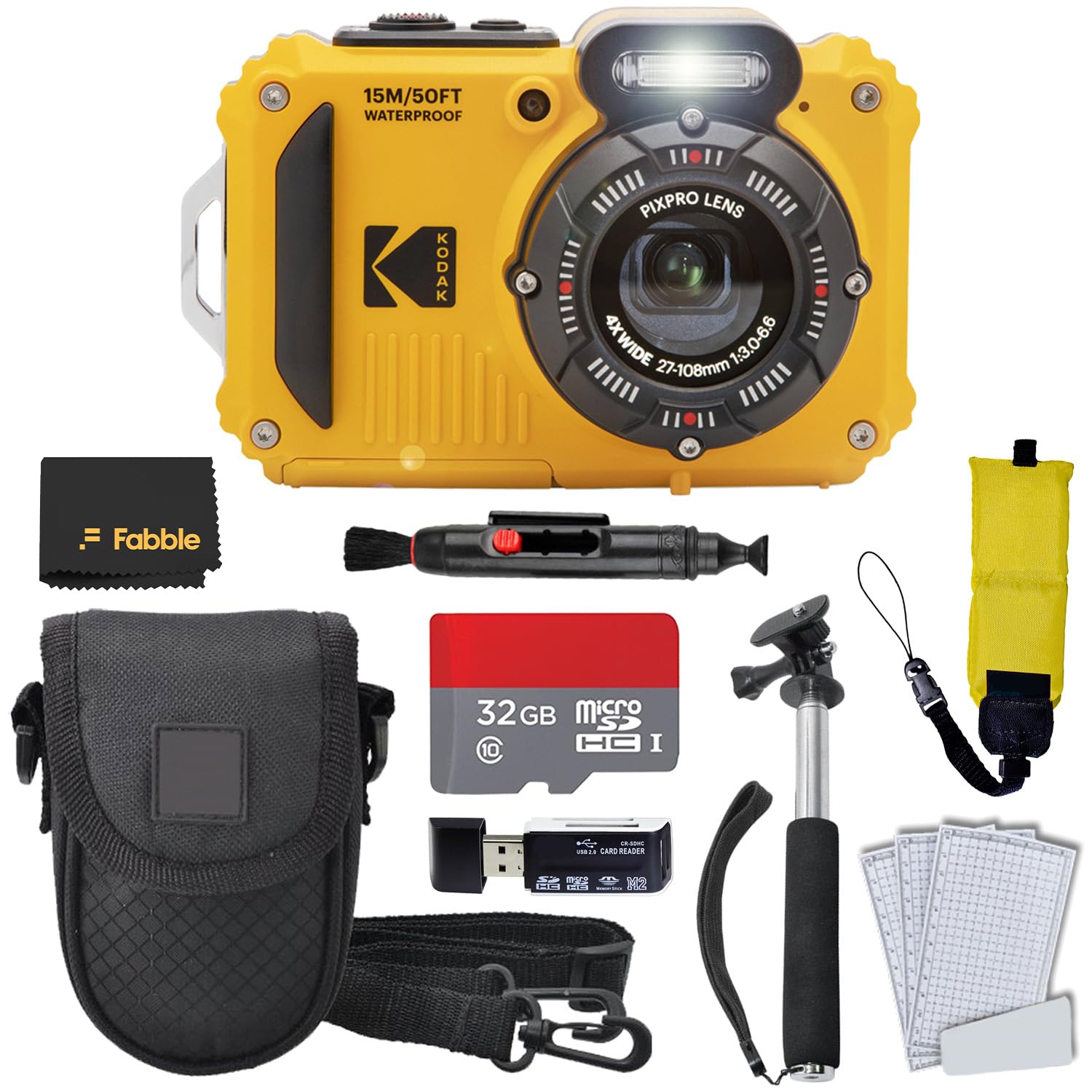
2. Kodak PIXPRO WPZ2 Rugged Waterproof Digital Camera Bundle
A fully sealed shooter that shrugs off water, sand, and a drop onto rock.
For a river crossing or a beach day, the Kodak PIXPRO WPZ2 is the entry-level answer. It is waterproof to 15 meters (49 feet) and shockproof against a fall from 2 meters (6.56 feet), so a slip on wet rock or a wave over the gunwale is a non-issue. The 16MP sensor and 4X optical zoom take detailed shots without you wading into the splash zone.
The bundle adds real value — camera, case, lens pen, monopod, USB card reader, screen protector, cleaning cloth, memory card with adapter, and wrist strap. Owners note the included buoyant strap keeps the camera afloat, and the kit fits a cargo pocket or clips to a pack. It takes 6 frames per second and pauses only 0.17 seconds between shots.
Honest limit: this is a point-and-shoot, not a low-light specialist. Some owners mention fiddly wireless connectivity, and one camera failed after years of water use. For a youth group trip or a casual river run, the waterproofing and the kit accessories are what you are paying for.
Built for the wet stuff: 15-meter waterproofing plus a shockproof 2-meter drop rating means you can hand it to a teenager on a kayak and not worry.
Best for: first-time backpackers and families who want a waterproof camera every member of the trip can use without anxiety.
Keep in mind: expect point-and-shoot output, and a few owners have found the wireless connectivity fussy.
3. PENTAX WG-1000 Olive Waterproof Digital Compact Camera
The all-weather body that clips onto your pack and just keeps going.
The WG-1000 Olive is waterproof to 15 meters for up to one hour of continuous underwater operation, and shockproof against a fall from 2 meters. The O-ST180 carabiner strap (included) clips it to your backpack webbing, so the camera rides within reach on a climb instead of buried in a top pocket.
Its 27mm wide-angle setting captures expansive backcountry landscapes. In the control department, you get seven capture modes including Auto, Manual, Underwater, and Scene, plus 20 color modes (Black and White, Sepia, and various film-style looks). ISO sensitivity tops out at 3200 for low light. One thing owners like is the rubberized body — it stays grippy in wet conditions and the carabiner aids stabilization.
Be honest about the trade-offs going in. Image quality draws a mixed-to-negative read from buyers, and a couple found the on-screen interface unclear without transferring photos to a computer. If you want a rugged field camera where straightforward utility and grip matter more than pixel-peeping, it earns its place on the strap.
Where it stands out: the carabiner strap and rubberized body make it a hands-free carry that stays clean and grippy in dust, sand, and rain.
Worth knowing: owner sentiment on image quality is split, and the screen is small — you may want to check shots on a phone or laptop.
Suits you if: you want a rugged camera physically tethered to your pack, with grip and weather sealing valued over pixel count.
skip it if: image quality tops your priority list and you would rather carry a larger-sensor body.
4. PENTAX WG-90 Blue Waterproof Digital Camera

Built for the shoulder seasons when the water is cold and the light is dim.
Late-season backpacking means freezing mornings and low light. The WG-90 handles both. It is waterproof to 14 meters for up to two hours of continuous operation, shockproof against a 1.6-meter drop, and freeze-proof down to -10°C. That freeze-proof rating is the standout spec here — most point-and-shoots slow down or quit in sub-zero cold, and this one is specced to keep firing.
Inside, a back-illuminated 16-megapixel CMOS sensor (a chip designed to gather more light) and high-performance imaging engine push sensitivity up to ISO 6400, so dim forest trails and dusk campsites stay usable. The 5x optical zoom lens reaches a 25mm focal length, and six LED Macro Lights ring the lens barrel to light close-up shots uniformly. Battery life is rated at 2.5 hours per charge.
The one thing to note: there is no built-in flash on this model, so it leans on that high ISO ceiling for low light rather than a flash burst. On a trail where you shoot landscapes and the occasional close-up of moss or minerals, that is a fair trade for the cold-weather hardening.
Why cold-weather hikers like it
- Freeze-proof to -10°C, so a sub-zero morning does not stop it.
- Waterproof to 14 meters for two continuous hours.
- ISO 6400 ceiling with back-illuminated 16MP sensor for dim light.
- Six LED Macro Lights make close-ups easy in low light.
The real limitation
- No built-in flash — you rely on the ISO ceiling for low light.
- Zoom tops out at 5x optical, so distant subjects need footwork.
Go with this: if your backpacking calendar runs into cold weather and you need a camera that works below freezing.
Reconsider if: you shoot a lot of distant wildlife — you will want more zoom reach than 5x.
5. Ricoh WG-80 Orange Waterproof Digital Camera

The orange tank that gets you close enough to shoot what nobody else notices.
Six LED Macro Lights are positioned all the way around the lens barrel on the WG-80, which is unusual — most cameras put one light in a corner. That ring means even, shadow-free illumination for close-up shots of a wildflower, a mineral sample, or a mushroom, and it is the feature that separates this camera from the rest of the rugged pack. The orange shell is claimed to help you find it again if you set it down on a dark campsite surface.
It is waterproof to 14 meters for up to two hours and shockproof, so it handles the harshest conditions the trail throws at it. Inside sits a back-illuminated 16MP CMOS sensor with a 5x optical zoom lens spanning 28-140mm equivalent, with an f/3.5-f/5.5 aperture range. The Underwater and Underwater Movie modes tune color and contrast from real underwater data.
Owners who have run this camera for years in rough field conditions cite its durability and macro capability. The trade-offs are the same as its rugged cousins — no image stabilization, one autofocus point, and a slower overall shooting cadence than a modern mirrorless. For close-up specialists on the trail, the ring-light macro advantage outweighs those limits.
The case for it: ring-mounted macro illumination is a genuine differentiator for anyone shooting detail shots on the trail.
Choose it when: close-up detail work — plants, geology, texture — is what you actually shoot on backpacking trips.
Pick something else when: fast autofocus and instant shots matter more than macro lighting.
6. OLYMPUS Tough TG-6 Waterproof Camera Bundle

The tough body with the field built for macro detail and quick bursts.
The TG-6 pairs a 12MP BSI CMOS sensor with the TruePic VIII image processor, and the combination delivers low-light performance up to ISO 12800 and fast 20-fps continuous shooting. On the trail that means you can catch the instant a marmot pops out of the rocks, or push ISO indoors when weather drives you into a hut, without waiting on shutter lag.
The 4x optical zoom spans 25-100mm equivalent with an f/2 maximum aperture — an unusually wide aperture for a rugged compact, and one that helps in early-morning shade. The Field Sensor System is the specialty feature: GPS, a manometer, a compass, and a thermometer work together to log where you were and what the environment was like, then embed that into the photos. The camera is rated for underwater use, tested against falls and crushing, and hermetically sealed against dust and moisture.
What sets this camera apart for close-up shooters is a micro setting with focus stacking — 10 photos at various focal lengths stitched together for deep depth of field. Note that you may get a body in a different color than you ordered, and One buyer received a defective unit from a third-party seller, so check the listing before you buy.
What it does better: focus stacking in the micro setting is a rare feature — it produces stack-sharp macro images that most cameras cannot manage without post-processing.
Buy this for: a rugged camera with high-ISO headroom and built-in focus stacking when you want sharp, close-in detail on the trail.
Look at other models if: you want the widest zoom range or a larger sensor for maximum image quality.
7. OM SYSTEM Tough TG-7 Black Underwater Camera

The rugged one that takes a beating on the trail and comes back for more.
Durability is measurable here, and the TG-7 measures up. Waterproof to 15 meters (50 feet), crushproof to 100 kilogram-force (220 pound-force), shockproof to 2.1 meters (7 feet), freeze-proof to -10°C (14°F), plus dustproof and anti-fog. That crushproof rating means you could sit on it, drop it under a loaded pack, or leave it under a rock scramble and it survives.
The lens reaches macro shots as close as 1 centimeter from the end of the lens — 4 macro modes in total, and 5 underwater modes including underwater microscope and underwater HDR. It shoots 4K at 120fps slow-motion and includes a vertical video mode for phone-first publishing. Owners praise the high-speed burst and customization options, and the body fits a hip-belt pocket on the move.
Real limits to know: the LCD scratches easily in sandy environments and sand can jam the dials, so a case is worth carrying in beach conditions. Some owners also note poor low-light stills and a zoom toggle that sticks a little. Those are the trade-offs of a fully sealed body — but for pure durability over a long route, this one sets the bar.
Where the toughness pays off
- Crushproof to 100 kgf — the most armor-like rating in this lineup.
- Macro shooting down to 1 centimeter with 4 macro modes.
- 4K and 120fps slow motion for creative trail footage.
- Freeze-proof to -10°C for shoulder-season trips.
What to watch out for
- The LCD scratches on sand and grit can get into the dials — carry a pouch.
- Low-light stills are modest compared to larger sensors.
Great choice for: backpackers who want the highest physical-abuse rating money can buy and plan to shoot macro and slow-motion on the move.
Think twice if: you shoot a lot of dim shots or hate cleaning fine grit out of camera controls.
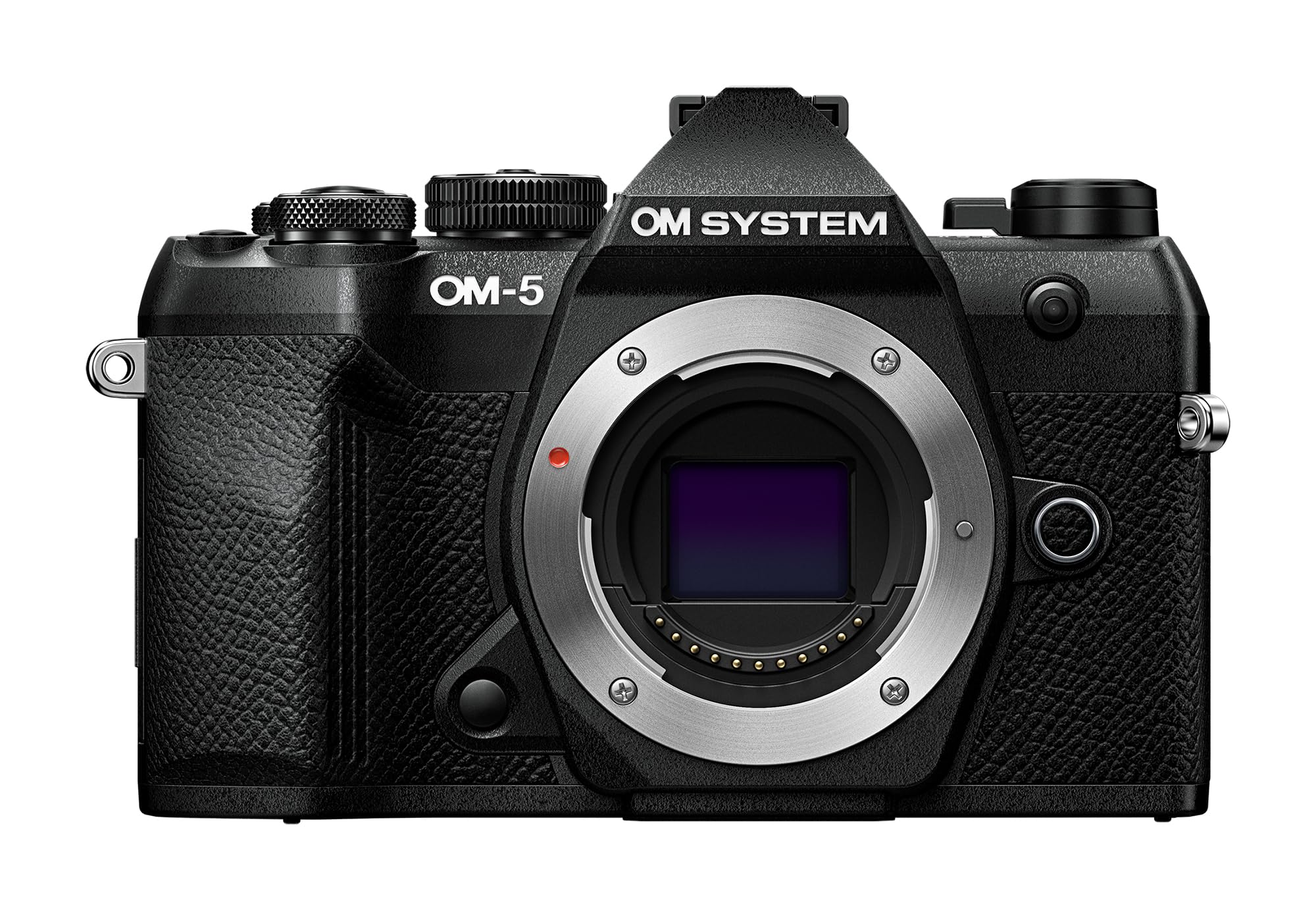
8. OM SYSTEM OM-5 Mark II Body Black Weather Sealed Mirrorless Camera
The step up to a real lens system — sealed, pocketable, and built for the trail.
If a fixed lens eventually stops being enough, the OM-5 Mark II is the natural step. The body is weather sealed for the trail, and it uses the Micro Four Thirds mount (an interchangeable lens standard with a broad lens catalog built around compact size). It offers 121 autofocus points, dual contrast-detection and phase-detection focusing, and unlimited 4K video recording.
The spec that matters most on a backpacking route is size and weight. This is a compact lightweight body designed for exactly this use case. Owners who switched from larger DSLRs cite the compact size as the reason and the lens options as the payoff. The addition of a dedicated computational photography button lets you trigger multi-shot features from one place.
The honest caveat: a body-only listing means you need to budget for a lens separately, and this camera will show best results paired with a weather-sealed lens to match the body’s sealing. One reviewer found image quality behind higher-resolution competitors, so for maximum resolution look at the Fujifilm X-M5 instead.
Why it is worth a look: the combination of weather sealing and a full, established lens system is the reason people carry this on multi-day routes.
The honest caveat: the body is sold without a lens, so the true cost of getting the setup trail-ready is higher than the sticker on this listing suggests.
Buy this if: you want a weather-sealed camera system you can grow with as your lens collection grows.
Think again if: you prefer a single, fully sealed unit with no separate lens purchase to plan for.
9. FUJIFILM X-M5 Mirrorless Digital Camera with XC15-45mm Lens Kit

Trail photos with a bigger-sensor look in a body that weighs barely anything.
Weight is the quiet killer on a long backpacking route, and the X-M5 fights back. At just 12.5 oz, it is the lightest body in this lineup, yet it packs a 26.1MP APS-C X-Trans 4 CMOS sensor — the same chip that Fujifilm built into its popular X100V. That means rich colors and strong low-light performance without carrying a heavy rig.
The X-Processor 5 keeps autofocus fast and operation smooth, and the camera records 6K video for creators who want footage alongside stills. On the trail, the compact body slips into a pack pocket or pairs with a small prime for a walk-around setup. Continuous shooting reaches 20 frames per second, so you can catch fast movement without missing a beat. Battery life is rated at 2 hours per charge, and there are 20 Fujifilm Film Simulations on tap for shooting looks straight out of the camera.
The one honest caveat: the camera does not ship with a charger or a printed manual — you charge it via USB-C cable, so if you want to shoot the moment it arrives, order a separate charger or top it up before your trip. The body takes microSD cards, and the kit includes the 15-45mm zoom, so you have everything you need for stills on day one.
Why it earns its spot
- 26.1MP APS-C X-Trans 4 CMOS sensor in a 12.5 oz body.
- 20 Fujifilm Film Simulations for in-camera looks.
- 6K video plus X-Processor 5 for fast autofocus.
- 20fps continuous shooting.
The catch
- No charger in the box — you must charge via USB-C and supply a cable.
- 2-hour battery life means multi-day trips need a power bank or spare cell.
- No weather sealing mentioned in the spec listing, so handle rain with care.
Grab it when: you want the best image quality per ounce and you are happy to bring a power bank for longer trips.
Pass on it when: weather sealing is non-negotiable or you need a camera that travels with zero extras.
Understanding the Specs
Waterproof Depth Versus Weather Sealing
When a camera is described as “waterproof to 15 meters,” it has passed an immersion test at that depth and can be dropped in a stream without damage. “Weather sealed” is a weaker claim — it means the seams and gaskets resist rain and dust, but the camera is not built for full immersion. Backpackers who cross streams or get caught in a downpour should look for an actual depth rating; those who mostly shoot in dry conditions can get away with weather sealing.
Battery Life In Hours And What It Means On Trail
Manufacturers rate battery life differently — some in minutes, some in hours, some in shots. A camera rated at 208 minutes runs roughly three and a half hours of active shooting per charge. A 2-hour rating is a half-day of intermittent use. On a multi-day trip where you cannot recharge, multiply the rating by the number of spare batteries you plan to carry and decide if that covers your shooting plan.
Body Weight And Sensor Size
A bigger sensor usually means better low-light performance and richer colors, but it also tends to mean a bigger, heavier body. The trick for backpacking is finding the smallest body that still has the sensor size you want. A 12.5 oz camera with a larger sensor lets you carry pro-quality optics without paying the weight penalty that bigger bodies impose.
Rugged Ratings Explained
Rugged cameras list several numbered ratings. Shockproof numbers (for example 2.1 meters) describe the drop height the camera survived in testing. Freeze-proof ratings (for example -10°C) tell you the lowest temperature the camera is rated to operate at. Crushproof ratings (for example 100 kilogram-force) describe the pressure the body can withstand. Combining these ratings shows how much abuse a camera takes before it stops working on a rough trail.
FAQ
Do I need a waterproof camera for backpacking or is weather sealing enough?
How many spare batteries should I carry on a multi-day backpacking trip?
Is a 360° action camera better than a traditional point-and-shoot for backpacking?
Will my camera survive a drop onto rocks during a scramble?
How cold can a camera get before it stops working?
Can I macro-photograph plants and rocks with a rugged camera?
Do the mirrorless options need a separate lens or can I shoot straight from the start?
Which sensor size gives the best backpacking image quality without adding much weight?
Will the LCD screens on rugged cameras survive a sandy beach or desert trip?
Final Thoughts: The Verdict
For most backpackers, the camera for backpacking winner is the Insta360 X5 because it records the whole trail in one take, charges fast via USB-C, and its 208-minute runtime covers a full day of shooting without a mid-trail recharge. If cold-weather performance is your priority, grab the PENTAX WG-90 and its -10°C freeze-proof rating. And for the best image quality per ounce, the FUJIFILM X-M5 is the one to reach for — just bring a power bank for multi-day routes.
How We Picked
We do not accept paid placement. Every pick is matched to a real buyer and a real use-case; we do not hands-on test units.
Sources & Methodology
Specifications: manufacturer listings and product documentation. Review insights: verified customer reviews, as of September 2026. Pricing: not shown on this page (it changes often); check the current price via the retailer link.
As an Amazon Associate, Gadgets Feed earns from qualifying purchases. This does not affect which products we feature.