
The jump from a smartphone to a dedicated camera is the single biggest leap in image quality a new photographer can make, but the sheer number of sensor sizes, lens mounts, and autofocus systems can paralyze a first-time buyer. The right body for you hinges not on megapixel count alone, but on how well its autofocus system, ergonomics, and lens ecosystem match your specific shooting scenario — whether that is candid portraits, travel landscapes, or learning the exposure triangle.
I’m Min — the co-founder and writer behind Gadgets Feed. The research behind this guide involved cross-referencing hundreds of real user experiences across multiple generations of mirrorless and DSLR bodies, analyzing autofocus point coverage, burst rates, and stabilization performance to separate the cameras that genuinely accelerate a beginner’s learning curve from those that add unnecessary complexity.
These picks span entry-level DSLRs, compact mirrorless bodies, and full-frame options that offer a clear upgrade path. This guide breaks down the technical jargon to help you confidently choose the best camera for beginner photography that matches your creative ambitions and budget.
How To Choose The Best Camera For Beginner Photography
Selecting your first interchangeable-lens camera is a balance of immediate usability and room to grow. The body is a long-term investment into a lens system, so the decision should weigh ergonomics, autofocus capability, and the availability of affordable lenses more heavily than a single spec number.
Autofocus System Depth
A beginner benefits most from an autofocus system that can reliably track a moving subject. Phase-detection autofocus points (PDAF) cover a larger sensor area and lock focus faster than older contrast-detection systems. Look for a minimum of 100 phase-detection points on mirrorless bodies, which enables face and eye tracking that works even when your subject is off-center — a critical feature for portrait and candid photography.
Sensor Size and Lens Ecosystem
APS-C sensors offer the best balance of image quality, body size, and lens affordability for most beginners. A larger full-frame sensor provides superior low-light performance and shallower depth of field but comes with significantly higher lens costs. Micro Four Thirds sensors, found in Panasonic and Olympus bodies, offer smaller, lighter camera systems with excellent image stabilization, but the smaller sensor means higher noise levels in dim lighting compared to APS-C.
Image Stabilization Priority
In-body image stabilization (IBIS) compensates for hand shake across every lens you mount, allowing you to shoot at shutter speeds two to four stops slower than you could without it. For a beginner shooting in low light without a tripod, a body with IBIS — common in Micro Four Thirds and many mid-range APS-C mirrorless cameras — dramatically increases the number of usable shots you bring home.
Quick Comparison
On smaller screens, swipe sideways to see the full table.
| Model | Category | Best For | Key Spec | Amazon |
|---|---|---|---|---|
| Canon EOS R100 | Mirrorless | Best overall starter mirrorless | 24.1MP APS-C, Dual Pixel CMOS AF | Amazon |
| Panasonic LUMIX G85 | Mirrorless | Video hybrid with IBIS | 16MP MFT, 5-Axis IBIS, 4K Video | Amazon |
| OM SYSTEM E-M10 Mark IV | Mirrorless | Compact travel companion | 20MP MFT, 5-Axis IBIS | Amazon |
| Canon EOS R50 | Mirrorless | Vloggers and content creators | 24.1MP APS-C, Dual Pixel AF II | Amazon |
| Nikon Z50 II | Mirrorless | Two-lens kit versatility | 20.9MP APS-C, 231 AF Points | Amazon |
| Canon EOS RP | Mirrorless | Entry-level full-frame | 26.2MP Full-Frame, 4K UHD | Amazon |
| Sony Alpha A6100 | Mirrorless | Fastest AF performance | 24.2MP APS-C, 425 AF Points | Amazon |
| Panasonic LUMIX S5II | Mirrorless | Pro-level hybrid beginner | 24.2MP Full-Frame, Phase Hybrid AF | Amazon |
| Canon EOS M200 | Mirrorless | Ultra-compact vlogging | 24.1MP APS-C, 180° Flip Screen | Amazon |
| Nikon D5200 | DSLR | Budget-friendly entry DSLR | 24.1MP DX, 39 AF Points | Amazon |
| Sony Alpha a3000 | Mirrorless | Lowest-cost entry point | 20.1MP APS-C, EVF | Amazon |
In‑Depth Reviews
1. Canon EOS R100

The Canon EOS R100 delivers the most cohesive beginner experience in its price bracket, pairing a 24.1-megapixel APS-C sensor with the mature Dual Pixel CMOS AF system that covers 143 zones with face and eye detection. The DIGIC 8 processor enables 6.5 fps continuous shooting with One-Shot AF, which is fast enough to catch a dog mid-jump or a child running through a park — a critical capability for a first camera aimed at capturing life as it happens rather than posed still life.
Body weight of roughly 350 grams with the kit lens makes it the lightest entry in the EOS R series, and the accompanying RF-S 18-45mm f/4.5-6.3 IS STM lens provides optical stabilization that compensates for up to four stops of shake. The 3-inch LCD offers 180-degree tilt for selfies, though its relatively modest 1.04-million-dot resolution can feel dated when reviewing images in bright sunlight.
Real-world reviews consistently praise the GUI that explains camera modes in plain language, a touch that dramatically shortens the learning curve for someone who has never ventured beyond smartphone auto modes. The one catch is that battery charging requires a separate LP-E17 charger, as no in-camera USB charging is supported, so an external charger should be budgeted for day trips.
Why it’s great
- Excellent Dual Pixel AF with face/eye tracking for portraits
- Lightweight body with a clear, beginner-friendly menu system
- Kit lens includes optical stabilization for steadier handheld shots
Good to know
- No in-camera USB charging requires a separate battery charger
- 4K video is capped at 24 fps, limiting video flexibility
- Single SD slot with no UHS-II support for high-speed cards
2. Panasonic LUMIX G85

The Panasonic LUMIX G85 is a mirrorless Micro Four Thirds body that punches well above its price point, primarily due to its class-leading 5-axis in-body image stabilization. The 16-megapixel sensor lacks a low-pass filter, which resolves approximately 10 percent more fine detail than earlier 16MP MFT sensors, and when combined with the Dual I.S. 2 system from the kit 12-60mm Power O.I.S. lens, you can realistically handhold shots at shutter speeds as slow as half a second.
The magnesium-alloy front frame and weather sealing provide a build quality rarely found at this price level, making the G85 a viable companion for damp morning shoots or dusty trails. The 2.36-million-dot OLED live viewfinder is bright and responsive, and the rear 3-inch touch LCD tilts to accommodate high and low angles — useful for composition practice without contorting your body.
Where the G85 truly shines is 4K video capture and its 4K Photo mode, which lets you extract 8-megapixel stills from a 30-fps burst, a fantastic tool for a beginner learning to timing action shots. The autofocus system, while reliable in good light, does hunt noticeably in dim indoor scenes, and the 49 contrast-detection points are no match for phase-detection AF in fast-paced sports scenarios.
Why it’s great
- 5-axis IBIS delivers 4+ stops of stabilization for any lens
- Weather-sealed magnesium-alloy build for outdoor durability
- 4K Photo mode teaches timing without high-speed burst waste
Good to know
- Autofocus struggles in low light with 4K video
- 16MP sensor resolves less detail than rival APS-C competitors
- No headphone jack for video audio monitoring
3. OM SYSTEM Olympus E-M10 Mark IV

The OM SYSTEM E-M10 Mark IV packs a 20-megapixel Live MOS Micro Four Thirds sensor into a body that, paired with the collapsible 14-42mm EZ pancake lens, fits into a jacket pocket — a form factor that removes the friction of carrying a dedicated camera daily. The 5-axis in-body stabilization earns 4.5 shutter speed steps of compensation, meaning a beginner can shoot clear indoor candids without flash in lighting conditions that would render many entry-level DSLR shots hopelessly blurry.
The flip-down monitor activates a dedicated selfie mode, and the body includes 16 art filter types (31 variations total), including Instant Film for a nostalgic look that encourages creative experimentation without post-processing. The 121 contrast-detection autofocus points cover the frame densely, though without phase-detection pixels, tracking a fast-moving child or pet remains a challenge.
User reviews highlight the value-for-money proposition at sale price, noting the camera’s ability to keep up with enthusiasts who later pair it with pro lenses like the OM 12-45mm f/4. The lack of a USB-C port and the requirement to use a proprietary battery charger are common pain points, and the OI Share app’s Wi-Fi transfer speed is noticeably slower than Canon or Sony implementations.
Why it’s great
- Almost pocketable with pancake zoom for daily carry
- 5-axis IBIS enables handheld night shots without tripod
- Creative art filters encourage experimentation beyond auto mode
Good to know
- Contrast-detection AF lacks tracking speed for action scenes
- No USB-C charging requires separate battery charger
- Wi-Fi transfer via OI Share app is slow
4. Canon EOS R50
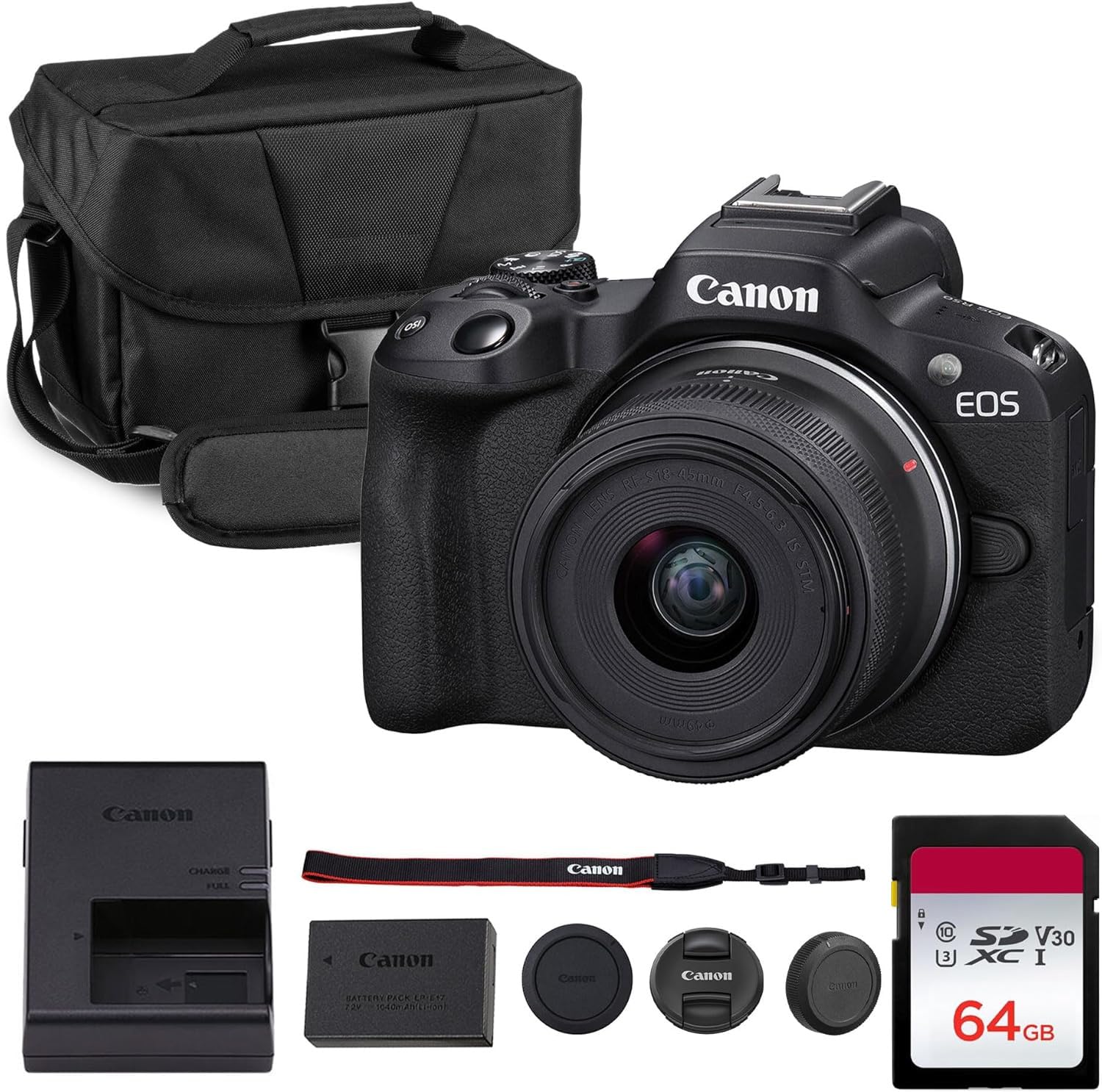
The Canon EOS R50 brings the second generation of Dual Pixel CMOS AF to a beginner-friendly body, with 99 phase-detection points that enable reliable subject tracking for both humans and animals. The oversampled 4K video (up to 24 fps) is sharp and clean, and the vari-angle touchscreen flips out to face forward for vlogging, making the R50 a dual-purpose tool for a creator who wants to master both still photography and video content.
Creative Assist mode offers in-camera guides that adjust background blur, brightness, and color tone using simple sliders — a visual approach that teaches aperture, shutter speed, and ISO relationships without overwhelming the user with manual mode terminology. Vertical video support and built-in Wi-Fi/Bluetooth for quick smartphone transfer mean your first images are shareable within seconds of capture.
Bundled with a shoulder bag and 64GB UHS-I memory card, the kit provides everything required to start shooting immediately. The RF-S 18-45mm f/4.5-6.3 IS STM lens is optically stabilized and compact, though the narrow maximum aperture at the telephoto end limits low-light performance. Users note the battery charges quickly via USB-C, a modern convenience the R100 lacks.
Why it’s great
- Dual Pixel AF II with reliable animal and vehicle detection
- Vari-angle touchscreen perfect for vlogging and self-framing
- USB-C charging for convenient power on the go
Good to know
- Kit lens aperture is slow at the telephoto end
- 4K video limited to 24 fps, no 60p option
- Single UHS-I card slot limits write speed
5. Nikon Z50 II

The Nikon Z50 II arrives as a 20.9-megapixel APS-C mirrorless camera that packs 231 hybrid autofocus points with nine distinct subject detection categories, including dedicated bird and airplane modes. The 31 built-in Picture Control presets allow real-time aesthetic preview while shooting, letting a beginner experiment with mood — from vivid to monochrome — before pressing the shutter, which builds an understanding of how color grading affects storytelling.
The dual-lens kit includes the NIKKOR Z DX 16-50mm f/3.5-6.3 VR and the 50-250mm f/4.5-6.3 VR, covering a 35mm-equivalent focal range of 24-375mm. This range spans true wide-angle to substantial telephoto, enabling first-time shooters to try landscape, portrait, and wildlife photography without buying additional glass. Both lenses are VR-equipped, though the body lacks in-body stabilization, so higher shutter speeds or steady hands are required with non-VR lenses.
4K UHD video at 60 fps with in-camera 120p slow-motion in Full HD provides serious video capability, and the built-in pop-up flash handles indoor fill-light situations that would otherwise require an external unit. The flip-out LCD drains battery faster than expected, and the kit only includes one battery, so a spare LP-E17 is a sensible early purchase for full-day outings.
Why it’s great
- Two-lens kit covers 24-375mm zoom range for diverse practice
- 31 Picture Control presets build aesthetic understanding
- Bird and airplane detection AF for outdoor enthusiasts
Good to know
- No in-body stabilization relies on lens VR only
- Flip-out LCD reduces battery life noticeably
- Kit includes only one battery, spare recommended
6. Canon EOS RP

The Canon EOS RP offers the lowest barrier to full-frame ownership, combining a 26.2-megapixel CMOS sensor with the versatile RF 24-105mm f/4-7.1 IS STM kit lens in a body that weighs just 485 grams. The full-frame sensor delivers substantially better dynamic range and high-ISO performance than any APS-C competitor at this price level, meaning a beginner shooting indoor birthday parties can avoid flash entirely while still capturing clean, detailed images.
Dual Pixel CMOS AF covers a wide area with phase-detection points, and the 5-stop optical image stabilization in the kit lens does the heavy lifting for steady handheld shots. The RP is not built for fast sports or bird photography — its burst rate is modest and the kit lens aperture darkens to f/7.1 at the telephoto end — but for landscapes, architecture, portraits, and travel, the image quality is a step above any APS-C alternative in the same price bracket.
Users coming from crop-sensor Canon bodies (like the T3i or T7) report the full-frame upgrade transforms their photography, with superior depth of field control and significantly less grain at ISO 3200. The battery life is adequate with a spare pack, and the camera can be used as a high-quality webcam via USB. The kit lens lacks a physical AF/MF switch, requiring a dive into the menu to toggle manual focus.
Why it’s great
- Full-frame sensor for best-in-class low-light and dynamic range
- Lightweight body for a full-frame interchangeable-lens camera
- RF lens mount with adapter compatibility to Canon EF/EF-S glass
Good to know
- Kit lens is slow at telephoto end, soft at edges
- 4K video has a significant crop and limited utility
- Burst rate is too slow for fast action photography
7. Sony Alpha A6100

The Sony Alpha A6100 holds the fastest autofocus claim among entry-level mirrorless cameras at 0.02-second acquisition speed, backed by 425 phase-detection and 425 contrast-detection points that cover 84 percent of the 24.2-megapixel APS-C sensor. Real-time Eye AF for humans and animals works continuously, making this the best option for a beginner who wants to photograph active pets or toddlers without missing the decisive moment.
The kit bundles two zoom lenses — the 16-50mm f/3.5-5.6 OSS and the 55-210mm f/4.5-6.3 OSS — providing a total focal range of 24-315mm equivalent. The 180-degree tiltable 3-inch touchscreen enables vlogging, and touch tracking allows you to tap a subject on screen to lock continuous autofocus. The 11-fps burst rate at full resolution with autofocus tracking is unprecedented at this price tier, capturing fast action without dropping frames.
Users note the menu system is Sony’s older, less intuitive interface, which requires time to learn compared to Canon’s GUI. The electronic viewfinder is a lower-resolution 1.44-million-dot unit that some find dim, but for the price, the A6100 delivers professional-tier autofocus performance that shortens the learning curve dramatically for action photography. The lack of full-frame flexibility is a consideration for long-term growth, but for immediate results, this camera is exceptional.
Why it’s great
- World’s fastest AF at 0.02s with 425 points and eye tracking
- Two-lens kit provides wide-to-telephoto versatility
- 11 fps burst with full-time AF for action sequences
Good to know
- Menu system is less intuitive than Canon or Nikon competitors
- EVF resolution is low at 1.44M dots
- APS-C sensor limits lens ecosystem compared to full-frame
8. Panasonic LUMIX S5II
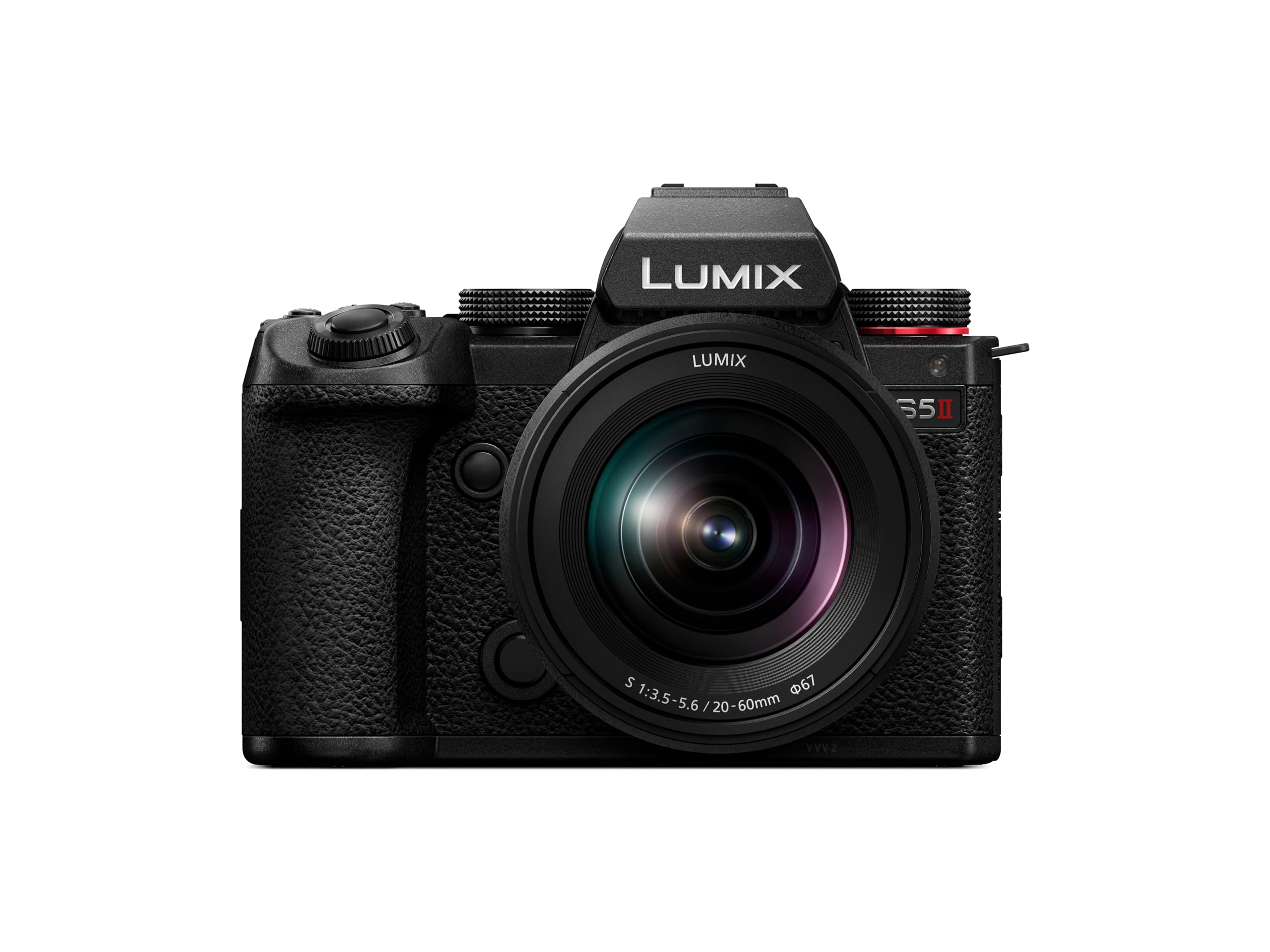
The Panasonic LUMIX S5II redefines the entry-level ceiling with a 24.2-megapixel full-frame sensor paired with Phase Hybrid autofocus — Panasonic’s first mainstream use of phase-detection pixels in a mirrorless body, solving the autofocus hesitation that plagued earlier S-series cameras. The 20-60mm f/3.5-5.6 kit lens provides a versatile starting range, and the 14+ stop V-Log capture offers a color-grading learning playground for a beginner who wants to master video.
The Active I.S. technology stabilizes walking footage so effectively that a gimbal becomes optional for most run-and-gun scenarios, and the internal fan enables unlimited 4:2:2 10-bit recording without overheating. REAL TIME LUT allows in-camera color grading with custom look-up tables, a feature that directly teaches color science principles as you shoot rather than requiring post-processing knowledge.
For a beginner willing to invest in a system that grows with them for years, the S5II offers capabilities — unlimited recording, professional color tools, and robust stabilization — that exceed most YouTubers’ needs. The battery life is a genuine weakness, often requiring a grip with an extra pack for a full day of shooting, and the body’s square design and rubber port caps feel less refined than the price suggests.
Why it’s great
- Phase Hybrid AF finally solves Panasonic’s autofocus reputation
- Active I.S. eliminates gimbal requirement for walking video
- REAL TIME LUT teaches color grading during shooting
Good to know
- Battery life is below average, grip recommended for full days
- High ISO output degrades noticeably above 51000
- L-mount long telephoto lens selection remains limited
9. Canon EOS M200

The Canon EOS M200 represents the smallest and most affordable entry into Canon’s mirrorless EF-M system, packing a 24.1-megapixel APS-C sensor into a body that weighs 299 grams with the 15-45mm kit lens. The 180-degree flip-up touchscreen enables one-handed vlogging, and Dual Pixel CMOS AF with eye detection keeps self-portraits sharp even at close focusing distances.
4K video and 4K time-lapse are supported, though the 143 contrast-detection AF points operate in a different mode during 4K recording that can be less confident than the phase-detection system in stills. The EF-M lens mount has a smaller range of native lenses than Canon’s RF or EF systems, but the lenses that do exist — particularly the EF-M 22mm f/2 pancake — are optically excellent and very compact.
Reviews praise the camera’s image quality, which far exceeds a smartphone, and the automatic image transfer via Bluetooth ensures photos appear on your phone without manual intervention. The grip is shallow, making extended one-handed use less comfortable, and the burst buffer fills quickly if you shoot RAW continuously. The camera also lacks USB-C charging, relying on the older Micro-USB standard.
Why it’s great
- Extremely compact body for daily carry and one-handed vlogging
- Dual Pixel AF with eye detection for sharp selfies
- Auto image transfer simplifies sharing to smartphone
Good to know
- EF-M lens ecosystem is limited compared to RF and EF mounts
- Slow burst buffer fills quickly in continuous RAW shooting
- Micro-USB charging instead of modern USB-C standard
10. Nikon D5200

The Nikon D5200 is a refurbished 24.1-megapixel DSLR with a 39-point autofocus system (9 cross-type sensors) and a 3-inch vari-angle LCD that teaches composition through an optical viewfinder — the traditional learning instrument for exposure and depth of field. The DX-format sensor delivers excellent image quality for its generation, and the 5 fps continuous shooting is adequate for general family photography and landscape work.
The optical viewfinder is a double-edged sword: it offers zero lag and a bright, natural view of the scene, but what you see is not exactly what the sensor will capture, requiring a beginner to learn exposure compensation and histogram reading more quickly than with an EVF. The 1080p video at 30 fps is functional but lacks the resolution and frame rate options of modern mirrorless bodies in this price tier.
As a refurbished unit, the value proposition depends heavily on the specific unit’s shutter count and battery health — one reviewer noted a 1090 shutter count and battery life of only around 150 shots, far below the claimed 500. The D5200 offers no in-body stabilization and no Wi-Fi built-in (both available via optional adapters), but for a learner on a tight budget who wants a true DSLR experience, the fundamentals are solid.
Why it’s great
- Optical viewfinder teaches true exposure and composition
- 24.1MP DX sensor produces very good image quality
- Vari-angle LCD useful for high and low-angle shooting
Good to know
- Refurbished unit condition varies (battery life, shutter count)
- No built-in Wi-Fi or image stabilization
- Video limited to 1080p 30fps with no fast frame rates
11. Sony Alpha a3000

The Sony Alpha a3000 is an older-generation 20.1-megapixel APS-C mirrorless camera with a built-in electronic viewfinder and a solid grip that mimics a DSLR body shape. The 25 contrast-detection autofocus points cover the frame competently for non-action stills, and the included 18-55mm OSS lens provides optical stabilization — a welcome feature at this entry level.
The EVF is low-resolution (approximately 230K dots) and has been criticized by many users as nearly unusable for manual focus or critical composition, while the 3-inch LCD also sits at a low resolution that makes reviewing images for sharpness a guessing game. RAW capture is supported (ARW format), and the camera offers full manual exposure control, making it a functional tool for learning the exposure triangle despite the dated display technology.
Battery life is a significant weakness, with one user reporting 20-30 percent drain per hour, and the camera charges via USB over approximately five hours — a long wait compared to modern standards. At its price point, the a3000 delivers image quality that matches cameras costing significantly more, but the viewing experience and slow wake-from-sleep times make it a challenging daily driver for a beginner expecting modern mirrorless responsiveness.
Why it’s great
- Excellent image quality from 20.1MP APS-C sensor
- Built-in EVF for outdoor shooting in bright light
- Comfortable DSLR-style grip for extended use
Good to know
- Very low-resolution EVF and LCD make focusing difficult
- Poor battery life with slow USB charging
- Sluggish wake-from-sleep and menu navigation
FAQ
Should I buy a DSLR or a mirrorless camera as a beginner?
How many megapixels does a beginner really need?
Do I need in-body image stabilization as a beginner?
Final Thoughts: The Verdict
For most users, the best camera for beginner photography winner is the Canon EOS R100 because it combines a modern Dual Pixel AF system, a compact RF-mount body, and a beginner-friendly GUI that explains camera modes without assuming prior knowledge. If you want to prioritize video versatility and in-body stabilization, grab the Panasonic LUMIX G85. And for the lowest barrier to full-frame image quality, nothing beats the Canon EOS RP.