
Starting a video journey means making one critical decision: which camera body will be your creative foundation for months or years. The wrong pick leaves you fighting poor autofocus, short recording limits, or excessive bulk that kills your motivation to shoot daily.
I’m Min — the co-founder and writer behind Gadgets Feed. My market research involves combing through hundreds of spec sheets, real user reports, and side-by-side sensor analyses to find the body that actually serves a beginner videographer without demanding a professional’s budget.
For anyone stepping into video content, choosing the optimal camera for beginner videography depends on balancing autofocus reliability, stabilization, and lens system growth.
How To Choose The Best Camera For Beginner Videography
Finding the right body for your first video setup means prioritizing features that the spec sheet alone won’t tell you. Beginners often over-index on megapixels while ignoring the autofocus system, stabilization type, and recording limits that define the daily shooting experience.
Autofocus Reliability For Moving Subjects
While stills shooters can manually focus, videographers rely on continuous autofocus that tracks a face or eye without hunting. Phase-detection systems with dedicated eye-tracking algorithms (like Sony’s Real-Time Eye AF or Canon’s Dual Pixel CMOS AF) drastically reduce unusable footage where the subject drifts in and out of focus.
Stabilization: IBIS vs Digital vs OIS
Handheld video is the default for most beginners. In-Body Image Stabilization (IBIS) shifts the sensor to counteract shake, producing smooth footage without a gimbal. Optical Image Stabilization (OIS) inside the lens helps but is less effective. Digital stabilization crops into the frame and can introduce jitter — best avoided as the primary solution.
Recording Limits And Bit Depth
Some cameras impose a 30-minute recording limit or overheat during extended 4K clips. For a beginner creating interviews, vlogs, or tutorials, look for a body that records 4K without a hard cutoff. 8-bit color is standard at this level, but 10-bit internal recording opens up color grading flexibility as skills improve.
Quick Comparison
On smaller screens, swipe sideways to see the full table.
| Model | Category | Best For | Key Spec | Amazon |
|---|---|---|---|---|
| Sony ZV-E10 | Mirrorless | Vlogging & YouTube | 24.2MP APS-C / 4K 30p | Amazon |
| Canon EOS R10 | Mirrorless | Fast Action Tracking | 24.2MP APS-C / 15fps | Amazon |
| Nikon Z 30 | Mirrorless | Streaming & Vlogging | 20.9MP DX / 4K 30p | Amazon |
| Canon EOS RP | Full-Frame | Full-Frame Entry | 26.2MP Full-Frame / 4K 24p | Amazon |
| Panasonic G85 | Mirrorless | Handheld Stability | 16MP MFT / 5-Axis IBIS | Amazon |
| OM System E-M10 IV | Mirrorless | Compact Travel | 20MP MFT / 5-Axis IBIS | Amazon |
| Sony ZV-1F | Fixed Lens | Arm’s Length Vlogging | 20.1MP 1″ / 20mm f/2.0 | Amazon |
| Panasonic G100 | Mirrorless | Built-In Audio | 20.3MP MFT / Tracking Mic | Amazon |
| Canon EOS R100 | Mirrorless | Budget RF System Entry | 24.1MP APS-C / 4K 24p | Amazon |
| Canon EOS Rebel T7 | DSLR | Budget Still & Video Hybrid | 24.1MP APS-C / 9 AF Points | Amazon |
| Sony A3000 | Mirrorless | Budget Interchangeable Lens | 20.1MP APS-C / EVF | Amazon |
In‑Depth Reviews
1. Sony Alpha ZV-E10

The ZV-E10 is the gold standard for beginner videography because it gets the core basics right: a 24.2MP APS-C sensor that oversamples 4K from a 6K readout, giving you visibly sharper video than most rivals at this level. The Real-Time Eye AF locks onto human and animal eyes with the tenacity of cameras costing twice as much, which eliminates the single biggest source of ruined takes for a new filmmaker: missed focus.
Its Product Showcase mode transitions focus from your face to an object you hold up — a killer feature for tutorial and unboxing content. The flip-out screen is fully articulated for selfie framing, and the single USB cable streaming setup means you can go live without a capture card. The Background Defocus button instantly blurs the background with one press, removing the need to understand aperture priority just yet.
The biggest trade-off is the lack of in-body stabilization. You will need a gimbal or rely on OSS lenses for smooth walking shots. Battery life runs about 25 minutes of continuous 4K, so a two-pack of spares is essential. The 8-bit internal recording limits grading flexibility, but for YouTube and social media straight out of camera, the colors are excellent.
Why it’s great
- Outstanding autofocus with Real-Time Eye tracking.
- 4K oversampled from 6K delivers exceptional detail.
- Product Showcase and Background Defocus are genuinely useful.
Good to know
- No in-body stabilization requires a gimbal for smooth walking shots.
- Battery life is short during 4K recording.
- 8-bit color depth limits heavy color grading.
2. Canon EOS R10

Canon’s EOS R10 brings the DIGIC X processor and a 24.2MP APS-C sensor into a compact body that punches well above its weight for video. The Dual Pixel CMOS AF II covers the entire sensor area with 651 autofocus points, providing responsive tracking that works with people, animals, and vehicles. This makes it an excellent choice if your video work includes active subjects like pets or sports.
The 18-150mm kit lens offers an 8.3x zoom range in a single package, which is rare at this price tier and eliminates the immediate need for a second lens. You get 4K 30p from the full sensor width without a crop, and the oversampled 4K from 6K readout produces clean, detailed footage. The camera supports UHS-II SD cards for faster write speeds, and the menu system is refreshingly straightforward for someone new to mirrorless.
The absence of in-body stabilization is noticeable, though the kit lens includes optical IS. The 18-150mm lens is heavier than the camera body itself, making it front-heavy for gimbal use. Battery life runs about a day of casual use, but heavy 4K recording will drain it faster. The LP-E17 battery is the same as the older DSLRs, so spares are inexpensive.
Why it’s great
- Dual Pixel CMOS AF II with 651 points is fast and reliable.
- 18-150mm kit lens offers incredible range.
- 4K oversampled from 6K without crop.
Good to know
- No IBIS requires stabilization from lens or gimbal.
- Kit lens is heavy for its size.
- Single UHS-II slot limits backup workflow.
3. Nikon Z 30

Nikon designed the Z 30 specifically for the vlogging and streaming audience, stripping away the viewfinder to keep the body tiny and affordable without sacrificing the foundation of good video. The 20.9MP DX sensor with phase-detection autofocus delivers sharp 4K 30p with eye-tracking for people and pets. The flip-out screen faces you perfectly for selfie recording, and a red tally light on the front tells you when the camera is rolling.
The built-in stereo microphone offers adjustable sensitivity via the menu, which is rare at this level and gives you usable audio without an external mic for quiet indoor shoots. Plug-and-play USB-C 4K 30p streaming works with no additional software, making it one of the easiest bodies to use for live content. The unlimited 4K recording time means you can shoot a full lecture or interview without worrying about a hard cutoff.
The lack of a viewfinder is the defining compromise — if you shoot any stills, you’ll rely entirely on the LCD, which can be tough in bright sunlight. The kit 16-50mm zoom is compact but has a variable aperture that dims at the telephoto end. The EN-EL25 battery is rated for about 75 minutes of video recording, so a second battery is recommended for longer days.
Why it’s great
- Unlimited 4K recording with no time limit.
- Excellent built-in stereo mic with adjustable sensitivity.
- Very compact and lightweight for travel.
Good to know
- No electronic viewfinder for stills photography.
- Kit lens aperture narrows at telephoto.
- Battery life is modest for extended shoots.
4. Canon EOS RP

The EOS RP is the most affordable path to full-frame video, and that sensor size gives you a tangible advantage in low-light performance and background separation over any APS-C or Micro Four Thirds body at a similar price. The 26.2MP sensor paired with Canon’s Dual Pixel CMOS AF delivers smooth, reliable focus transitions that look natural in video. The RF 24-105mm kit lens includes 5-stop optical stabilization, which helps compensate for the lack of IBIS.
The full-frame depth of field means you can achieve a professional-looking blurry background without needing expensive fast primes. The body is remarkably lightweight for a full-frame camera — barely larger than many APS-C models. The electronic viewfinder and fully articulating touchscreen make it versatile for both video and stills, and the camera works as a high-quality webcam over USB using Canon’s utility software.
The 4K video has a 1.6x crop factor (making it closer to APS-C size when recording 4K), and it’s limited to 24p and 30 minutes of continuous recording. The 1080p 60p footage is clean and sharp, and many videographers find the 1080p output from this sensor superior to native 4K from cheaper bodies. The battery life is adequate but benefits from a spare for full-day shoots.
Why it’s great
- Full-frame sensor for superior low light and bokeh.
- Lightweight and compact for a full-frame body.
- Excellent Dual Pixel AF with smooth transitions.
Good to know
- 4K video has a 1.6x crop factor.
- 30-minute 4K recording limit.
- No IBIS, relies on lens stabilization.
5. Panasonic LUMIX G85

If smooth handheld footage is your priority, the G85’s 5-axis in-body stabilization is the MVP. This system works with any lens you mount, producing gimbal-like walking shots that are otherwise impossible at this price without extra gear. The 16MP Micro Four Thirds sensor lacks an optical low-pass filter, which actually boosts fine detail rendering beyond what the pixel count suggests.
The magnesium alloy body is weather-sealed, so you can shoot in light rain or dusty conditions without worry — a rare spec for beginner-level bodies. The 12-60mm kit lens also has Power OIS that works in tandem with the IBIS, creating an incredibly stable shooting platform. The tilting touchscreen and eye-level OLED viewfinder give you flexibility for any shooting angle.
The 16MP sensor is lower resolution than the competition, and for stills shooters, this shows in cropping ability. Autofocus uses contrast detection, which can hunt in low-light video situations compared to phase-detection systems. Battery life is average, and the lack of a headphone jack means you can’t monitor audio during recording. The 4K 30p video is excellent for social media delivery.
Why it’s great
- Class-leading 5-axis IBIS for smooth handheld footage.
- Weather-sealed magnesium alloy body.
- Excellent value for the feature set.
Good to know
- Contrast-detect AF can hunt in low light.
- 16MP sensor limits crop flexibility.
- No headphone jack for audio monitoring.
6. OM SYSTEM Olympus E-M10 Mark IV

The E-M10 Mark IV combines a 20MP Micro Four Thirds sensor with class-leading 5-axis IBIS in a body that is almost pocketable with its kit lens. The stabilization is so effective you can shoot sharp video handheld at shutter speeds that would blur on most cameras, and the dedicated selfie mode flips the monitor down and activates touch control automatically — a thoughtful touch for the vlogging beginner.
The retro design is genuinely enjoyable to use, with physical dials for shutter speed and exposure compensation that teach you the exposure triangle as you shoot. The 14-42mm EZ pancake lens collapses into the body, making the whole kit small enough to fit in a jacket pocket. Bluetooth connectivity keeps the camera constantly linked to your phone for quick transfer of short clips.
The contrast-detect autofocus system is not as snappy as phase-detect rivals, especially in lower light or for tracking moving subjects during video. The 4K 30p video is good but lacks the sharpness of oversampled footage from APS-C sensors. The micro USB charging is dated, and the OI Share app requires WiFi for wireless transfers, which is slower than Bluetooth-based alternatives.
Why it’s great
- Exceptional 5-axis IBIS for handheld shooting.
- Extremely compact with collapsible kit lens.
- Dedicated selfie mode with flip-down screen.
Good to know
- Contrast-detect AF can be sluggish in low light.
- 4K video lacks oversampling detail.
- Micro USB charging is outdated.
7. Sony ZV-1F

The ZV-1F simplifies everything for a beginner who wants to vlog without learning lens systems or mounts. The fixed 20mm f/2.0 ultra-wide lens captures your face and a generous background even with your arm fully extended, which means no more cutting your head off in selfie mode. The 1-inch sensor is larger than any phone sensor and delivers genuine shallow depth of field with the one-press background defocus button.
The directional 3-capsule microphone with the included windscreen captures clear vocal audio that dramatically improves upon camera built-in mics from even five years ago. The side-articulating touchscreen tracks touch focus smoothly, and the Eye-AF system keeps you sharp even as you move around the frame. Product Showcase mode is excellent for review creators.
There is no optical zoom — the 20mm lens is fixed, so you can’t zoom in without using digital zoom, which degrades quality. The digital stabilization works for static or slow pans but introduces a wobble effect during walking shots. Battery life is around 45 minutes of recording, and the body is notably fragile; a drop can misalign the autofocus system.
Why it’s great
- 20mm ultra-wide lens is perfect for arm’s length vlogging.
- Excellent built-in audio with windscreen.
- Very simple operation for absolute beginners.
Good to know
- Fixed lens with no optical zoom.
- Digital stabilization wobbles during walking.
- Battery life is limited, body is fragile.
8. Panasonic LUMIX G100

The G100 puts audio front and center with a built-in microphone that uses tracking technology — it actually adjusts its pickup pattern based on where the subject is in the frame. This is the only camera at this price that solves the “subject moves off-mic” problem without an external microphone. The 20.3MP Micro Four Thirds sensor and 12-32mm collapsible kit lens make for a very compact package.
The frame marker feature overlays social media aspect ratios on the screen, so you can compose for Instagram or TikTok while shooting in 16:9. The 5-axis Hybrid I.S. (a combination of digital and optical stabilization) works surprisingly well for handheld static shots. The camera works as a UVC/UAC webcam over USB for streaming without drivers.
The 4K video recording is severely limited — many users report the camera stops recording at around 5 to 10 minutes. The contrast-detect autofocus is not as reliable as phase-detect systems for video, especially with moving subjects. The menu system can be confusing for a beginner, and the body lacks a headphone jack for audio monitoring.
Why it’s great
- Innovative tracking microphone follows the subject.
- Compact and lightweight with collapsible kit lens.
- Frame marker for social media aspect ratios.
Good to know
- 4K recording cuts off after a very short time.
- Contrast-detect AF struggles with moving subjects.
- No headphone jack for audio monitoring.
9. Canon EOS R100

The R100 is the smallest and lightest body in Canon’s EOS R series, making it an easy carry for a beginner who values portability. The 24.1MP APS-C sensor with the DIGIC 8 processor captures sharp 4K 24p video, and the Dual Pixel CMOS AF with human face and eye detection provides reliable focus that is far better than the 9-point systems in older DSLRs at this price.
The RF-S 18-45mm kit lens is compact and retracts for storage, making the entire setup very pocketable. The 143-zone autofocus system covers a wide area and works for animal and vehicle detection as well, which is impressive for an entry-level body. The high-speed shooting at 6.5 fps is useful for capturing action moments both in stills and in video frame grabs.
The 4K video is limited to 24p, which is fine for cinematic work but less smooth for fast-moving content. The lack of a fully articulating screen means selfie shooting requires guesswork. The kit lens is slow at f/4.5-6.3, so low-light video will require a faster prime lens purchase. The single SD slot only supports UHS-I speeds, which limits write performance.
Why it’s great
- Smallest and lightest EOS R series body.
- Dual Pixel CMOS AF with face and eye detection.
- Good image quality for the price point.
Good to know
- 4K limited to 24p only.
- No fully articulating screen for selfies.
- Kit lens is slow in low light.
10. Canon EOS Rebel T7
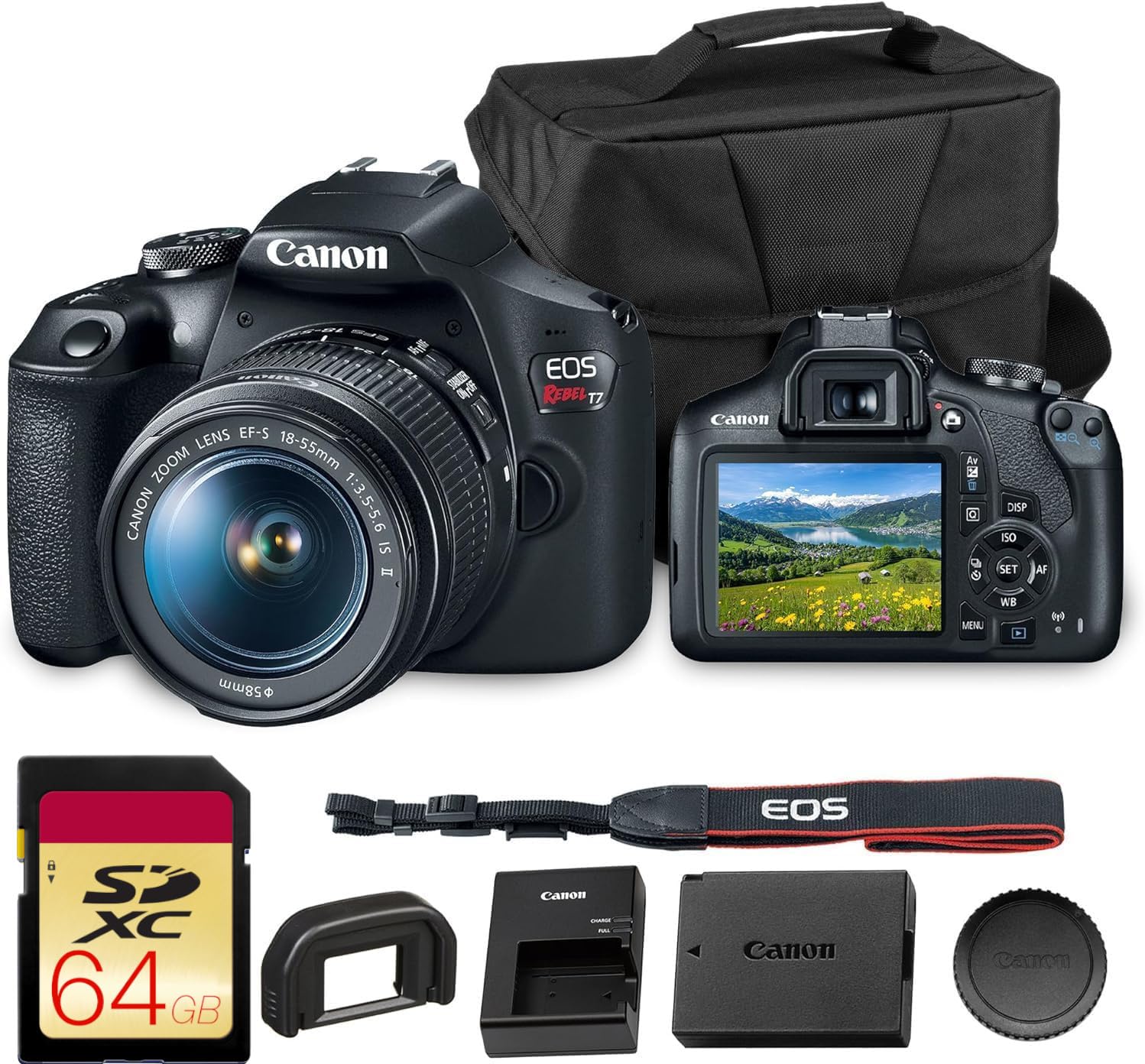
The Rebel T7 is a traditional DSLR that offers a familiar learning path for beginners who want to understand photography fundamentals before moving to mirrorless. The 24.1MP APS-C sensor with the DIGIC 4+ processor delivers respectable still image quality, and the built-in Wi-Fi and NFC allow easy photo transfer to a smartphone for sharing. The kit includes a bag and 64GB card, making it a true all-in-one starter package.
The optical viewfinder offers a lag-free, clear view that many beginners prefer over electronic viewfinders. The 9-point autofocus system is basic but works reliably in good light for both photos and video. The three-button setup for ISO, drive mode, and flash adjustment is intuitive, and the camera feels solid and grippy in the hand.
The video capabilities are limited: 1080p at 30fps is the maximum, and there is no 4K option at all. The 9-point AF system is not suitable for video tracking of moving subjects. The DIGIC 4+ processor is quite old, resulting in more noise at higher ISOs compared to modern cameras. The optical viewfinder is useless for video composition.
Why it’s great
- Classic DSLR learning experience with optical viewfinder.
- Complete starter kit with bag and memory card.
- Built-in Wi-Fi for easy sharing.
Good to know
- Only 1080p video, no 4K capability.
- 9-point AF is very basic for video.
- DIGIC 4+ processor is outdated.
11. Sony Alpha a3000

The a3000 is an entry-level mirrorless camera that offers the benefit of a 20.1MP APS-C sensor with Sony’s E-mount system, giving you access to a vast library of lenses as you grow. The DSLR-style body provides a dependable grip for steady handheld shooting, and the 18-55mm OSS lens includes optical stabilization to reduce handheld shake in video. The full HD 60p video is smooth for standard YouTube content.
The 25-point contrast-detect autofocus system is basic but reliable for static shots and slow pans. The electronic viewfinder, while low resolution, helps frame shots in bright daylight where the LCD washes out. The ability to shoot in RAW (ARW) format gives beginners room to learn editing without switching cameras. The price point makes it the most affordable path to a dedicated interchangeable lens system.
The electronic viewfinder and LCD are both very low resolution, making fine manual focus difficult. Battery life is poor — many users report 20-30% drain per hour of operation, and the camera charges via USB only with no included external charger. The 3.5 fps burst rate is slow for action video or stills. The a3000 is a legacy model with an older processor, resulting in higher noise above ISO 800.
Why it’s great
- Interchangeable E-mount for lens upgrades.
- APS-C sensor with good image quality for its age.
- Included OSS lens for stabilization.
Good to know
- Very low-resolution EVF and LCD screen.
- Poor battery life with USB-only charging.
- Outdated processor with noise above ISO 800.
FAQ
Is 4K 24fps or 4K 30fps better for beginner videography?
How important is IBIS for a beginner video camera?
Do I need an external microphone for my first video camera?
Final Thoughts: The Verdict
For most users, the camera for beginner videography winner is the Sony Alpha ZV-E10 because it combines excellent 4K quality, industry-leading autofocus, and vlogging-friendly features in a single body. If you want smooth handheld footage without a gimbal, grab the Panasonic LUMIX G85. And for the most compact all-in-one package for arm’s length vlogging, nothing beats the Sony ZV-1F.