
Our readers keep the lights on and my morning glass full of iced black tea. As an Amazon Associate, I earn from qualifying purchases.
Specs are compiled from manufacturer listings and verified buyer reviews and can change over time — please confirm the key details on the product page before buying.
You want a camera for your car that does one thing above all else: capture a license plate clearly enough to matter after an accident. Everything else—app polish, parking modes, voice commands—is secondary to that single moment of truth. This guide sorts through the real-world strengths and trade-offs of nine front-and-rear systems so you can pick the one that fits how you actually drive.
I’m Min — the founder and writer behind Gadgets Feed. This guide is built by comparing the manufacturers’ published specifications and the patterns across verified customer reviews, so you get each pick’s real strengths and trade-offs instead of marketing spin.
You need a dash cam that captures clear footage day and night, installs without a headache, and stores clips reliably—whether you commute, drive for rideshare, or park overnight. The picks below deliver on those three fronts, with each model earning its spot for a specific reason.
Our Picks at a Glance
How To Choose The Best Camera For Car
Dash cams look similar on a spec sheet, but the differences decide whether you get a usable plate number at night or a blurry mess. Focus on the recording quality of the front lens first, then check whether the rest of the package supports it.
Front Camera Resolution and Sensor
The front camera is your primary witness, so its resolution dictates how much detail you can zoom into later. True 4K (3840×2160P) captures far more usable detail than 1080P when you need to read a plate 50 feet ahead. The sensor underneath matters just as much — Sony STARVIS 2 sensors are built to perform in low light, which is when most hit-and-runs seem to happen.
Field of View and Lens Quality
A wider field of view covers more lanes, but it can distort edges. Lenses spanning 140° to 170° are common; wider angles capture more context at intersections, while the aperture (like F1.6 or F1.8) controls how much light hits the sensor at night. A larger aperture opening means better footage after dark, plain and simple.
Storage and Loop Recording
Every camera here overwrites old footage when the card fills up — that is loop recording. The included card size and the maximum supported capacity tell you how much history you keep before it starts erasing. The G-sensor (a small motion detector) locks the current clip when it feels a bump, so a crash doesn’t bury the evidence under newer files.
Parking Mode and Power
If you want the camera watching your car while it’s parked, you need to know how it gets power. Most units require a separate hardwire kit (sold separately) to run 24/7. Some use a supercapacitor instead of a battery, which handles summer heat far better and lasts longer in extreme temperatures.
Quick Comparison
| Model | Best For | Front/Back Res | Max Storage | View Angle | Amazon |
|---|---|---|---|---|---|
| TERUNSOUl 4K 3-Channel★ Best Overall | Cabin coverage & 4K clarity | 4K + 1080P + 1080P | 512 GB | 170° Front | Amazon |
| WOOLAACOO C5Best Value | Budget dual-channel | 4K + 1080P | 256 GB | — | Amazon |
| FAIMEE 4KWide-Angle Pick | Six-lane coverage | 4K + 2K | 256 GB | 170° | Amazon |
| 70mai A800SE | Adjustable rear lens | 4K + 1080P | 512 GB | 140° | Amazon |
| 70mai A810 Lite | Heat-resistant compact | 4K + 1080P | 512 GB | 140° | Amazon |
| REDTIGER F7NA | Touchscreen control | 4K + 1080P | 512 GB | 160° Front | Amazon |
| REDTIGER F17 Elite | Full interior coverage | 4K + 2.5K + 1080P | 512 GB | — | Amazon |
| ROVE R2-4K DUAL PRO | 1TB storage headroom | 4K + 2K | 1 TB | 150° Front | Amazon |
| THINKWARE U3000 PRO | Radar parking protection | 4K + 2K | 512 GB | 147.2° | Amazon |
In‑Depth Reviews
1. TERUNSOUl 4K Dash Cam Front and Rear
Our pick — over 4.5★ from 400+ verified ratings; the strongest balance of quality and price.
The triple-lens setup that watches the road, the car behind, and the cabin all at once.
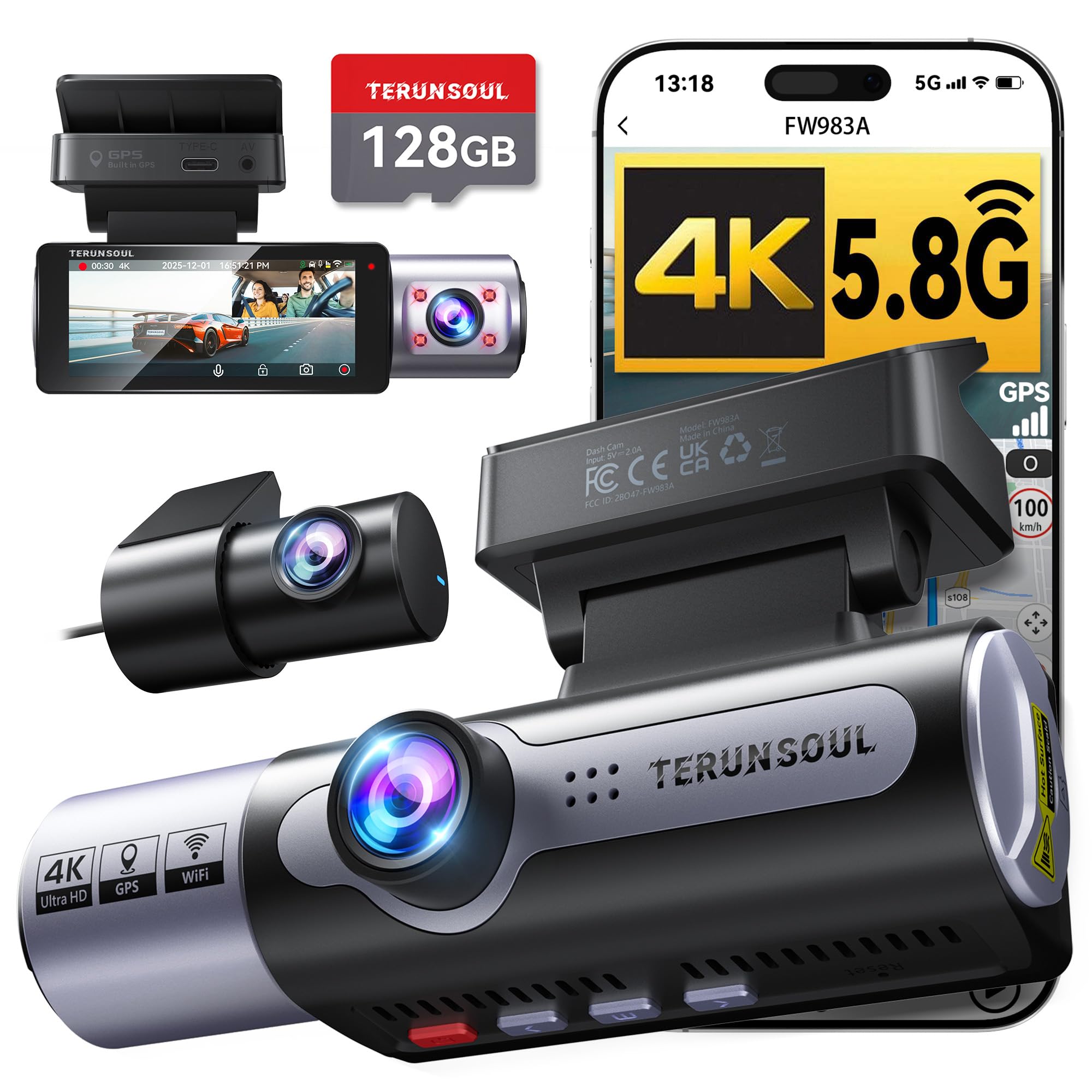
This is the pick for rideshare drivers and families who want near-360° coverage from a single unit. The front camera records in UHD 4K, while the rear and cabin cameras each capture 1080P simultaneously — a rare triple-channel setup that covers your passengers and the car behind you in one go. Three separate channels mean you are not choosing between protecting yourself from a rear-end collision and documenting what happened inside.
The front lens spans a 170° ultra-wide angle, with the rear and cabin cameras each offering 165°, so you capture broad road views and in-car details together. What makes it feel complete is the bundle: a 128GB memory card comes pre-installed, GPS data embeds directly into footage, and the 5.8GHz Wi-Fi pushes downloads at 20MB/s through the free app. Owners praise the sturdy build and 10-minute installation, so you get protection without a half-day project.
That GPS layer is the quiet hero here — it records your route, real-time speed, location, compass, and timestamp straight into the video. If you ever need to prove where you were and how fast you were going, the free GPS player for Windows and Mac lays it all out. The 3.16″ IPS screen keeps the view clear while driving, and the collision sensor locks footage automatically on severe impact.
Why Owners Stay Happy
- True triple-channel recording covers road, rear, and cabin
- 128GB card included, expandable to 512GB
- Starlight night vision with an F1.6 aperture handles low light
The Fine Print
- Parking mode needs a separate hardwire kit to run 24/7
- At 5.07″ wide it is bulkier than single-lens rivals
The crowd favorite: this is the one to beat — 4.6 stars across 400+ owners, with quality and easy installation leading the praise.
Reach for it if: you carry passengers or drive for work and want every angle documented.
Look elsewhere if: you want the smallest possible footprint on your windshield.
2. WOOLAACOO C5 Dash Cam Front and Rear
A featherweight dual-cam that slides behind the mirror without blocking your view.
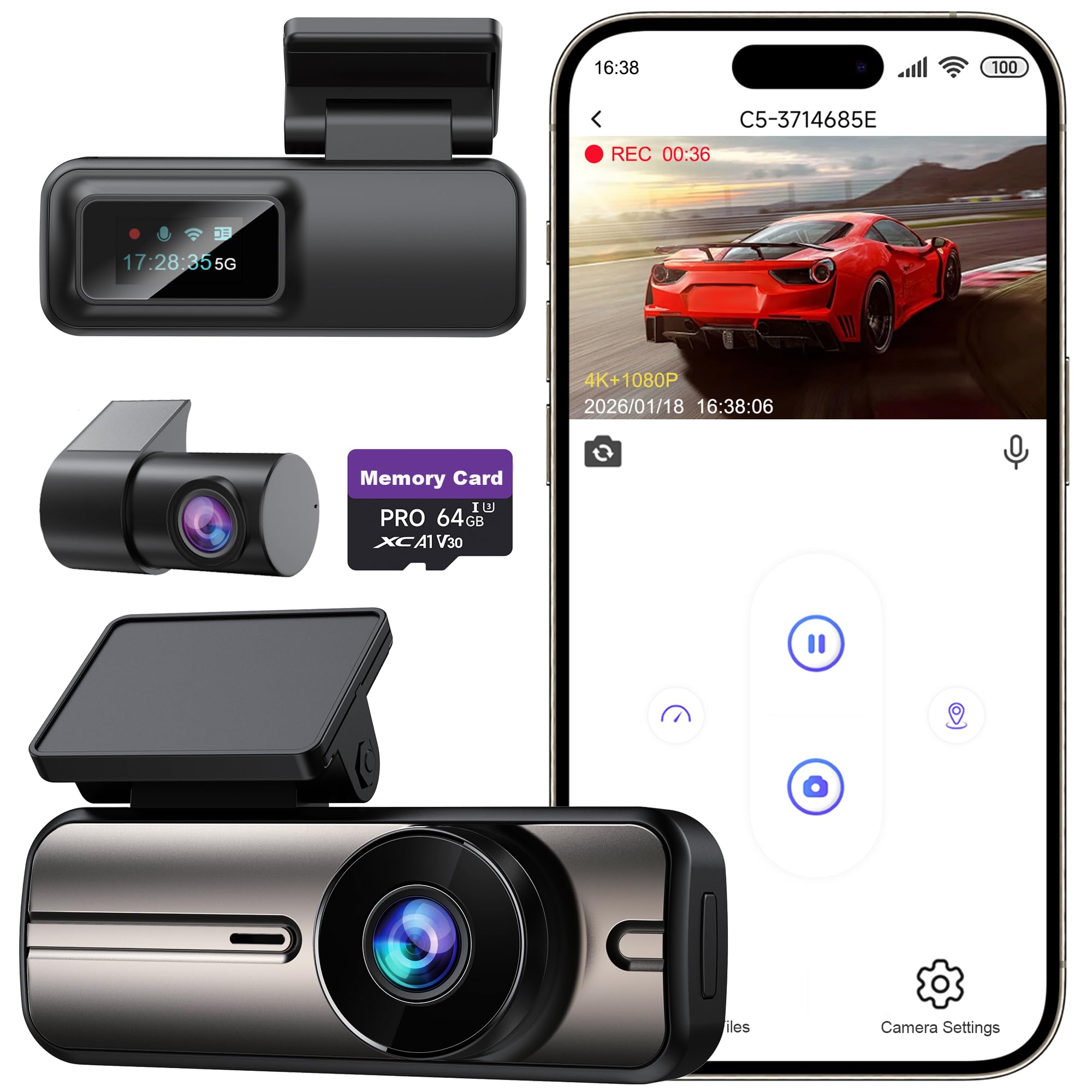
Not every driver needs cabin coverage, and this compact unit is proof that a focused front-and-rear setup can still deliver 4K where it counts. The front camera records 4K ultra-high-definition while the rear handles 1080P — enough to read road signs, license plates, and lane markings for accident evidence. It weighs just 65 g and measures a slim 3.35″ wide, so it tucks discreetly behind the rearview mirror.
You get a 64GB SD card in the box, so you can start recording immediately without buying extra storage. One buyer wrote: “This is an amazing dash cam. Installation was breeze and the video quality and features are top notch.” The 5GHz Wi-Fi (a faster wireless band for transferring files) and the companion app let you pull footage without removing the card, but the connection only reaches 3-5 meters—so you will need to stand close to the car to grab clips.
The F1.8 aperture and enhanced night vision keep details readable after dark or in rain. An extra USB port lets you charge your phone while recording, a thoughtful touch for long drives. Loop recording overwrites old files when the card fills, and the G-sensor auto-locks footage when it detects a collision — stored separately so it cannot be overwritten.
Smart money move: you get dual 4K-class recording plus a card included, at an entry-level price that is hard to argue with.
Who this suits: budget-conscious drivers who want solid evidence capture without cabin coverage or premium extras.
Who should pass: anyone needing 24/7 parking mode — that requires the separately sold 3-Lead Hardwire Kit.
3. FAIMEE 4K Dash Cam Front and Rear
The 170-degree lenses that sweep across six lanes of traffic in crisp 4K.
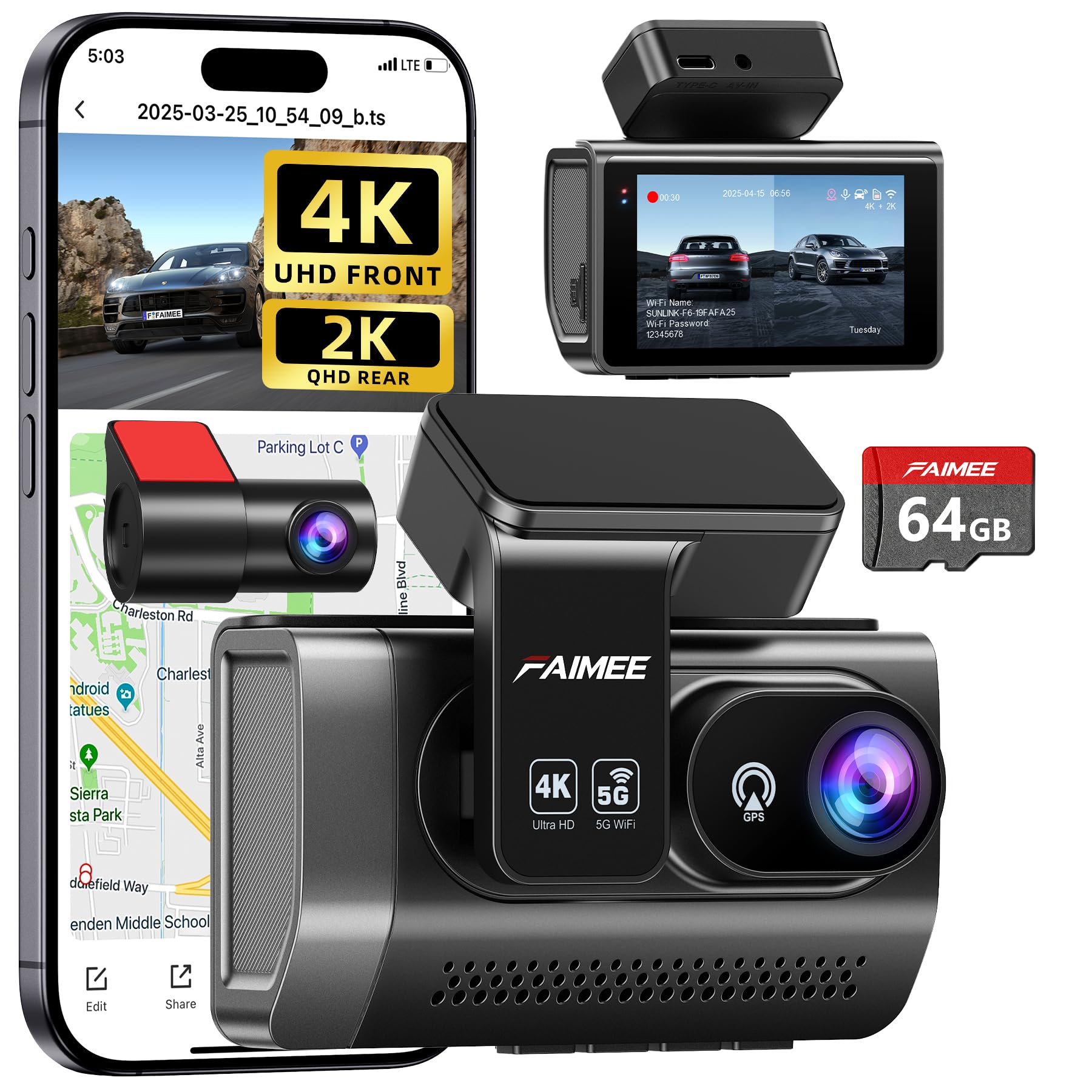
If you drive highways with heavy merging, the FAIMEE’s unusually wide coverage is its calling card. The front camera shoots 4K UHD (3840×2160P) while the rear captures 2K (2304×1296P) — a rear resolution that beats the common 1080P and keeps details sharp when someone rear-ends you. Both lenses span a 170° field of view, which the brand says covers up to six lanes of traffic.
A 64GB high-endurance card comes ready from the start, and you can expand to 256GB if you want more history before loop recording overwrites the oldest clips. The built-in GPS logs real-time speed, route history, and location coordinates, which is invaluable for verifying incidents or retracing a trip. Dual-band Wi-Fi (5.8GHz/2.4GHz) connects to the FAIMEE app for live view and quick downloads.
Heat tolerance gets real-world praise here — one month of use through 100°F+ heat produced no major issues, which is more than some pricier units can claim. The F1.8 aperture plus enhanced WDR (wide dynamic range, balancing bright and dark areas) and night vision keep footage balanced in low-light or high-contrast scenes. Time-lapse parking mode runs at low power for continuous 24-hour surveillance when hardwired.
Owner wisdom: crash detection can trigger on hard bumps, so expect the occasional locked file from a rough pothole rather than a real collision.
The takeaway: six-lane coverage and a sharper rear camera make this a highway driver’s ally for the money.
4. 70mai A800SE 4K Dash Cam Front and Rear
The flexible rear cam that swings from the back window to the cabin in seconds.
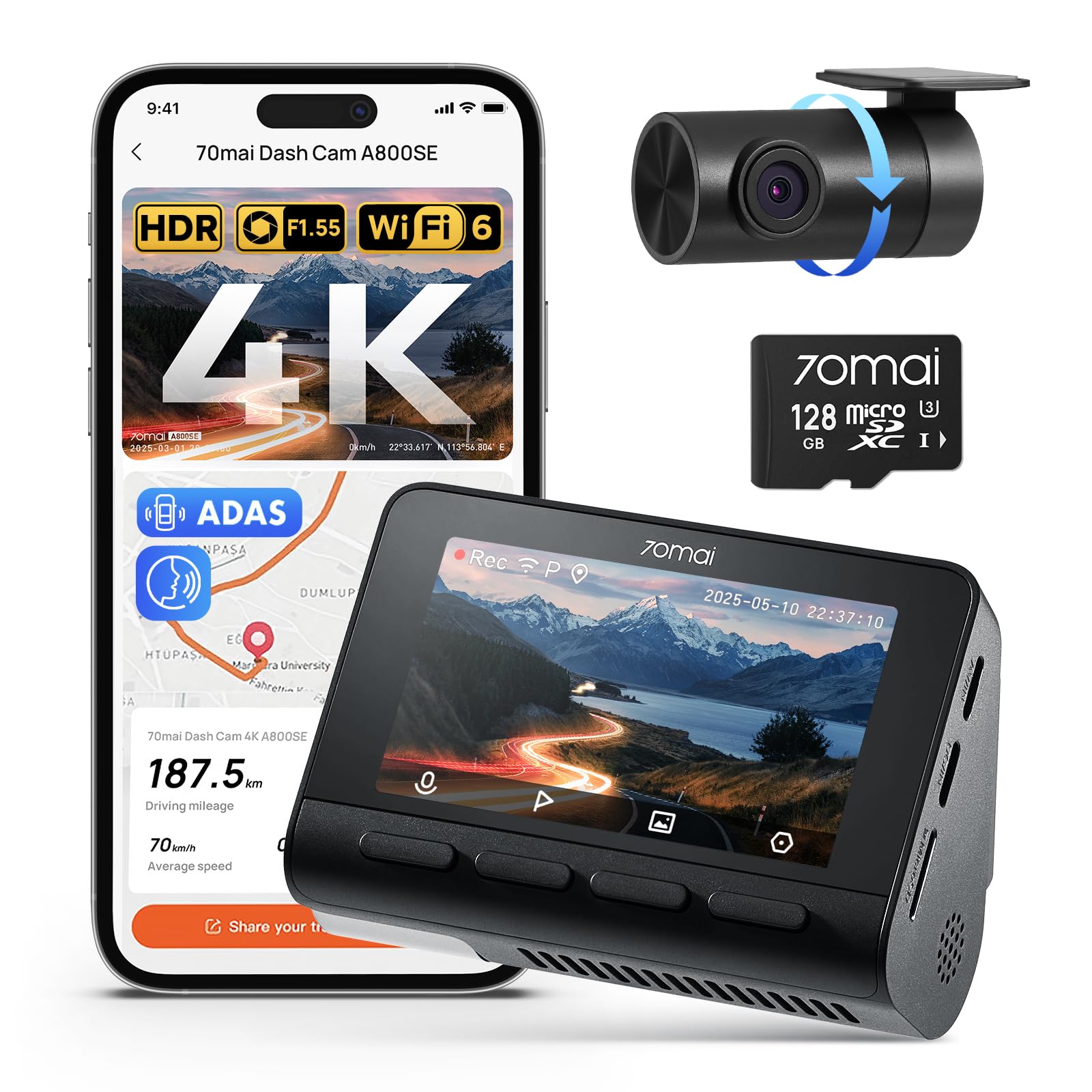
This is the shape-shifter of the group. The 1080P rear camera has an adjustable lens, so you can point it out the back window on a normal day, then rotate it to face the cabin for rideshare shifts. That flexibility makes the A800SE a genuine two-in-one for drivers whose needs change throughout the week. The front camera holds true 4K, and owners say daytime footage is sharp enough to read plates of oncoming cars clearly.
Night performance gets a serious boost from the F1.55 aperture and dual HDR (high dynamic range) — the 7-layer glass lens pulls in more light for tunnels, rain, and glare. The free 128GB microSD card is included, and you can expand up to 512GB. Wi-Fi 6 transfer speeds run up to 5× faster than traditional Wi-Fi dash cams, so pulling a clip to your phone for a police report takes seconds rather than minutes.
The ADAS system (Advanced Driving-Assistance System) adds lane-departure and forward-collision voice alerts, turning the camera into a light safety copilot. It auto-records the moment your car starts, so there is nothing to remember each trip. An 18-month warranty and optional in-person installation at New York and California service centers round out the support story.
The Strong Suit
- Rotating rear lens covers road or cabin on demand
- Wi-Fi 6 makes phone downloads genuinely fast
- ADAS alerts add lane-departure warnings
Honest Caveats
- Night footage is solid but softer than daytime clarity
- Some owners found the cable length and connectivity finicky
The balanced all-rounder: 4.5-star pedigree with quality and video clarity leading owner sentiment.
Reach for this if: you alternate between personal driving and rideshare and want one camera for both.
5. 70mai A810 Lite 4K Dash Cam Front and Rear
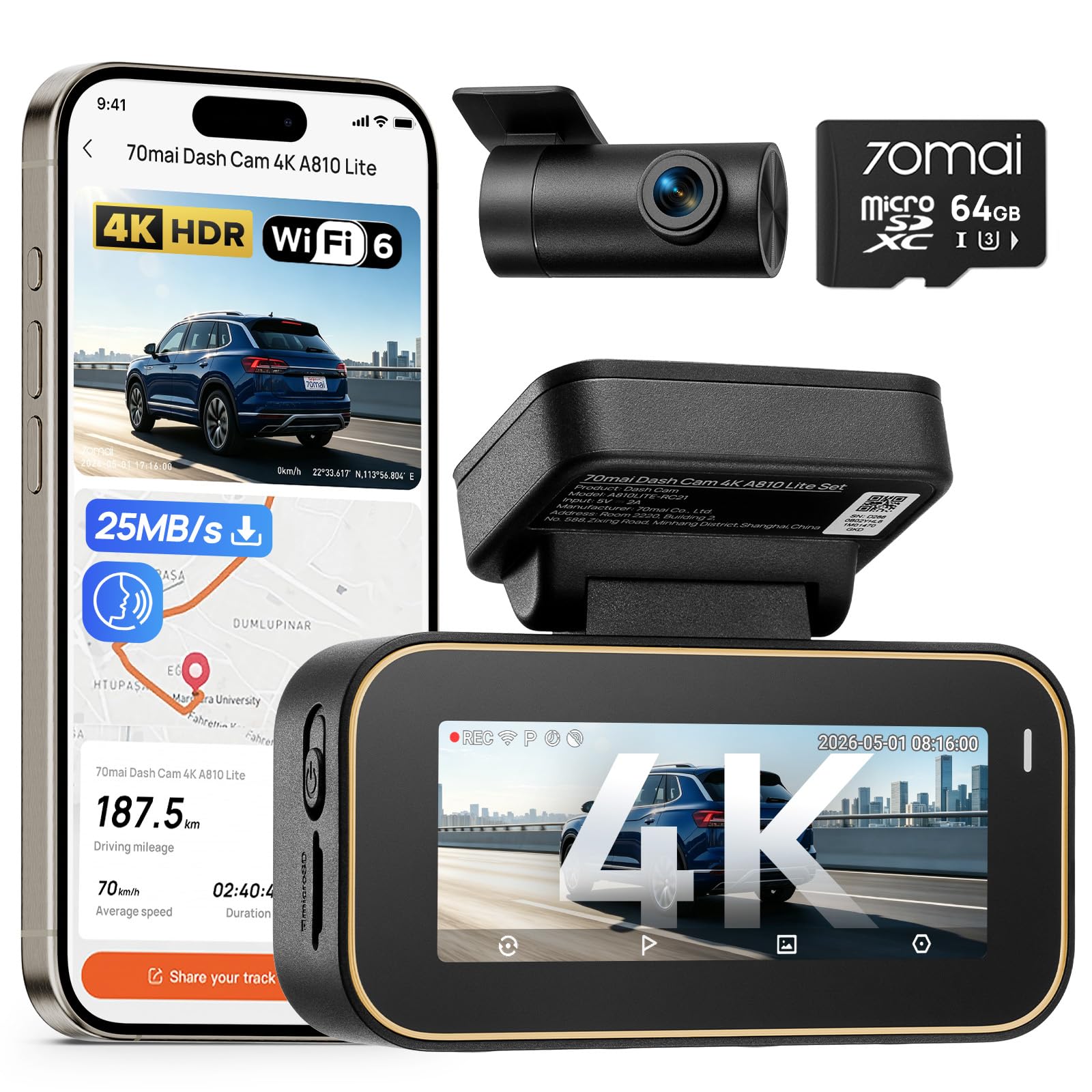
A credit-card-sized camera built for hot climates that refuses to quit.
Heat is the silent killer of dash cams, and the A810 Lite attacks that problem at the source. Instead of a lithium battery that degrades in high temperatures, it runs on a supercapacitor — a component that handles extreme heat far better and lasts longer in seasonal temperature swings. For anyone in Phoenix, Texas, or anywhere summers bake a parked car, this design choice matters more than any resolution number.
The front camera records 4K at 3840×2160P with an F1.55 aperture and HDR, while the 1080P rear cam handles the back. A 64GB microSD card is included, expandable to 512GB. The compact, credit-card-sized body tucks behind the rearview mirror without blocking your view, and owners consistently note how unobtrusive it feels once installed.
Wi-Fi 6 transfers clips at up to 25MB/s to the 70mai app, and voice control lets you keep hands on the wheel. The 3-mode GPS (GPS + GLONASS + BDS) records speed, route, and location for playback. Built-in low-voltage protection helps prevent battery drain during overnight parking, and loop recording keeps coverage continuous.
Built to Last
- Supercapacitor shrugs off extreme heat where batteries fail
- Voice commands keep your hands on the wheel
- Compact body disappears behind the mirror
What to Know
- No built-in battery — the camera powers off with the car unless hardwired
- Advanced parking features need extra adapters sold separately
The hot-climate specialist: if your car bakes in the sun daily, this supercapacitor design is the smarter long-term bet.
Who it fits: owners who park outdoors and want set-and-forget recording without battery anxiety.
6. REDTIGER F7NA 4K Dash Cam Front and Rear
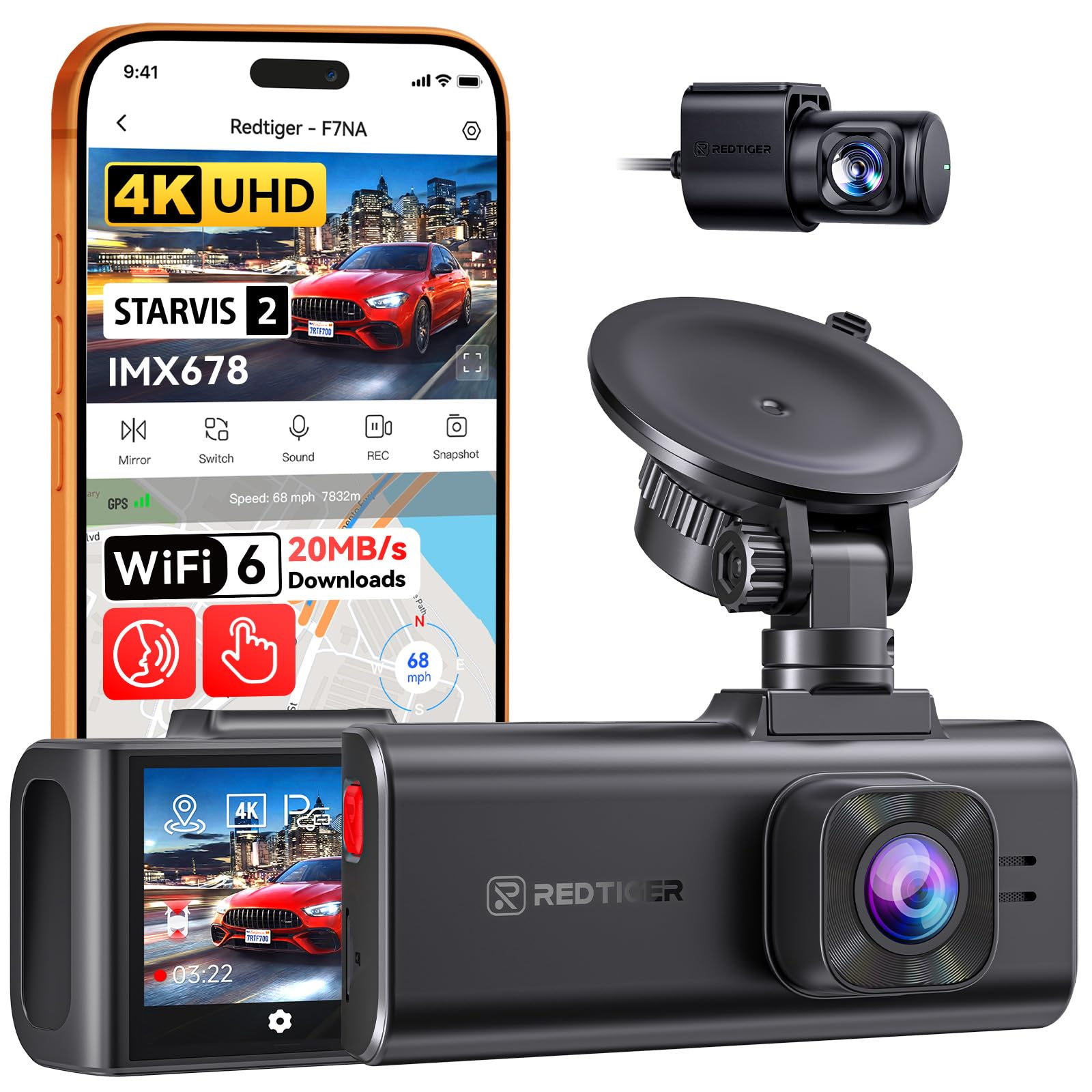
The touchscreen-controlled 4K cam with a suction mount that skips the windshield glue.
For drivers who hate committing to a permanent adhesive mount, the F7NA’s 360° suction cup is a breath of fresh air. You can move the front camera between vehicles in seconds — a real advantage for households sharing one car or anyone who wants to transfer it to a rental on trips. The touchscreen controls make changing settings far more intuitive than hunting through button menus.
Under the hood sits the Sony STARVIS 2 IMX678 sensor, capturing true 4K UHD (3840×2160P) front footage at 30fps. That sensor is the same class used in much pricier units, and buyers report very clear pictures front and rear. The 160° front and 140° rear wide angles reduce blind spots in multi-lane traffic, and HDR/WDR processing balances high-contrast scenes.
A built-in supercapacitor rated for -4°F to 158°F keeps it reliable across seasons, and voice commands like “Lock Video” work hands-free in an emergency. Built-in GPS logs speed and location, while 5GHz Wi-Fi transfers clips at up to 20MB/s — under 10 seconds for a typical clip. Note that no SD card is included, so budget for a high-endurance card, ideally from REDTIGER’s recommended list.
What owners applaud: the suction mount avoids permanent windshield adhesive, and the touchscreen makes daily operation genuinely pleasant.
The honest trade-off: no card included, and a couple of owners found voice response inconsistent — you will lean on the touchscreen more than your voice.
7. REDTIGER F17 Elite 4K Dash Cam 3 Channel
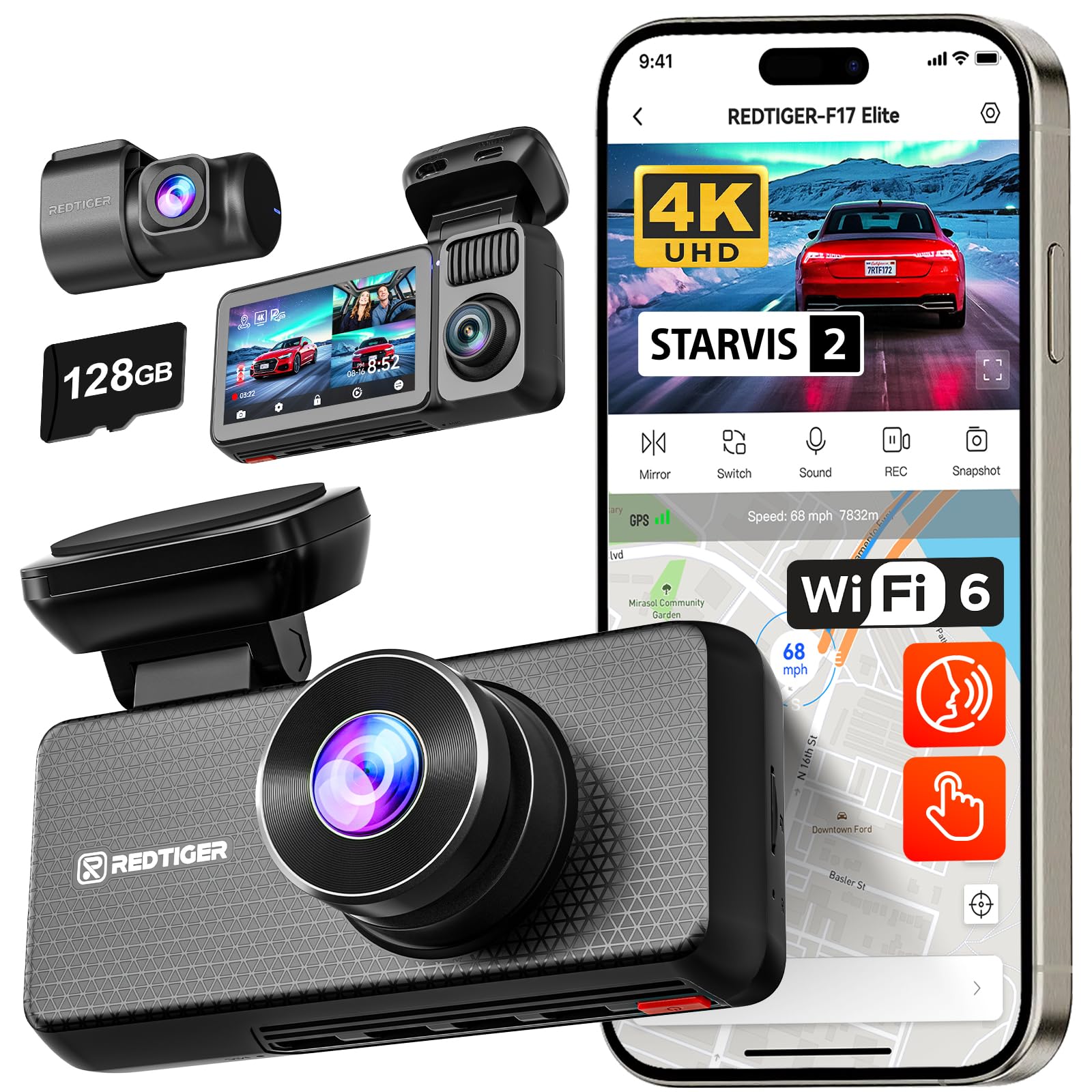
The triple-cam flagship that keeps full color at night instead of grainy black-and-white.
Most dash cams switch to black-and-white infrared at night, which makes identifying a face or plate color nearly impossible. The F17 Elite is different — it delivers full-color night vision on both the front and cabin cameras, powered by dual STARVIS 2 sensors. The front uses an 8MP IMX678 while the rear runs a 4MP IMX675, capturing true 4K front, 2.5K rear, and 1080P cabin recording simultaneously.
This is the setup for rideshare drivers who need to document passengers clearly, even after dark. A customizable in-car camera toggle gives you privacy control — flip the cabin view off when you are not working. The 128GB card is pre-installed and expandable to 512GB, and the 5.8GHz Wi-Fi 6 pushes downloads at 30MB/s through the REDTIGER Cam app.
Voice commands and a touchscreen handle control, while the supercapacitor ensures stable power in extreme temperatures. GPS logs location, speed, and route on every clip. The 18-foot rear camera cable gives most vehicles plenty of reach for a clean install, and owners consistently praise how sharp all three cameras are, especially at night.
The Premium Payoff
- Full-color night vision on front and cabin cameras
- True 4K front with 2.5K rear and 1080P interior
- 128GB card included, expandable to 512GB
Fair Warning
- Heat shutdowns when parked in extreme conditions with windows closed
- Voice commands demand precise phrasing to trigger
The professional-grade choice: if documenting passengers matters as much as the road ahead, this full-color triple cam is the one.
Think twice if: you park in brutal summer heat without shade — a few owners mention thermal shutdowns that require the AC running to avoid.
8. ROVE R2-4K DUAL PRO Dash Cam Front and Rear
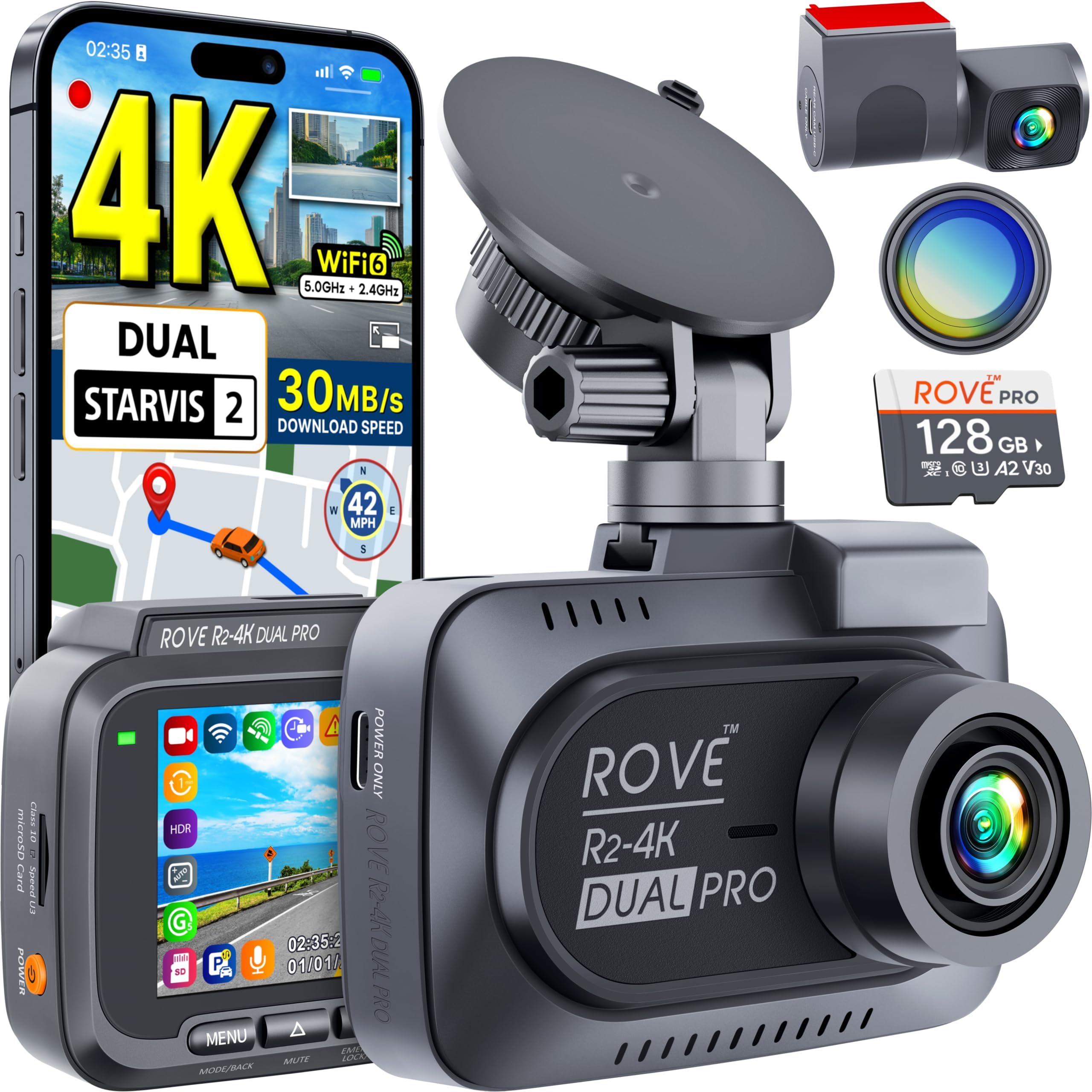
Dual STARVIS 2 sensors and 1TB support for drivers who never want to delete a clip.
For the data hoarders among us, the R2-4K DUAL PRO offers something no other pick here matches: support for up to 1TB microSD cards. Pair that with the included 128GB ROVE PRO card and you have serious recording headroom before loop recording ever touches your oldest footage. Both front and rear cameras use Sony’s STARVIS 2 sensors — IMX678 (8MP) up front and IMX675 (5MP) in the rear.
The front captures true 4K (3840×2160P) at 30fps while the rear records 2K (2560×1440P) at 30fps, with F1.7 front and F1.55 rear apertures pulling in light for dusk and night driving. A sweeping 150° front and 140° rear angle keeps both directions covered. Customers note plates readable from 10-20 feet away, the real-world test that matters.
The bundle is unusually generous: an included CPL filter reduces windshield glare, quad-mode GPS (GPS, BEIDOU, GALILEO, GLONASS) tracks your route, and dual-band Wi-Fi 6 transfers 4K videos at up to 30MB/s. The 24-hour parking mode offers three options — time-lapse, motion detection, and collision detection — and delivers a voice alert when you return to the car if something triggered a recording.
Why It Stands Out
- 1TB maximum storage is the largest of any pick here
- Dual STARVIS 2 sensors front and rear for night clarity
- CPL filter and 128GB card included in the box
What to Weigh
- No voice control — button and app only
- Hot parking-lot shutdowns reported by a few owners
The long-haul choice: massive storage headroom and dual STARVIS 2 sensors make this ideal for road-trippers who log serious miles.
Who should look elsewhere: drivers who want hands-free voice commands — this unit skips that feature entirely.
9. THINKWARE U3000 PRO Dash Cam 4K Front and 2K Rear
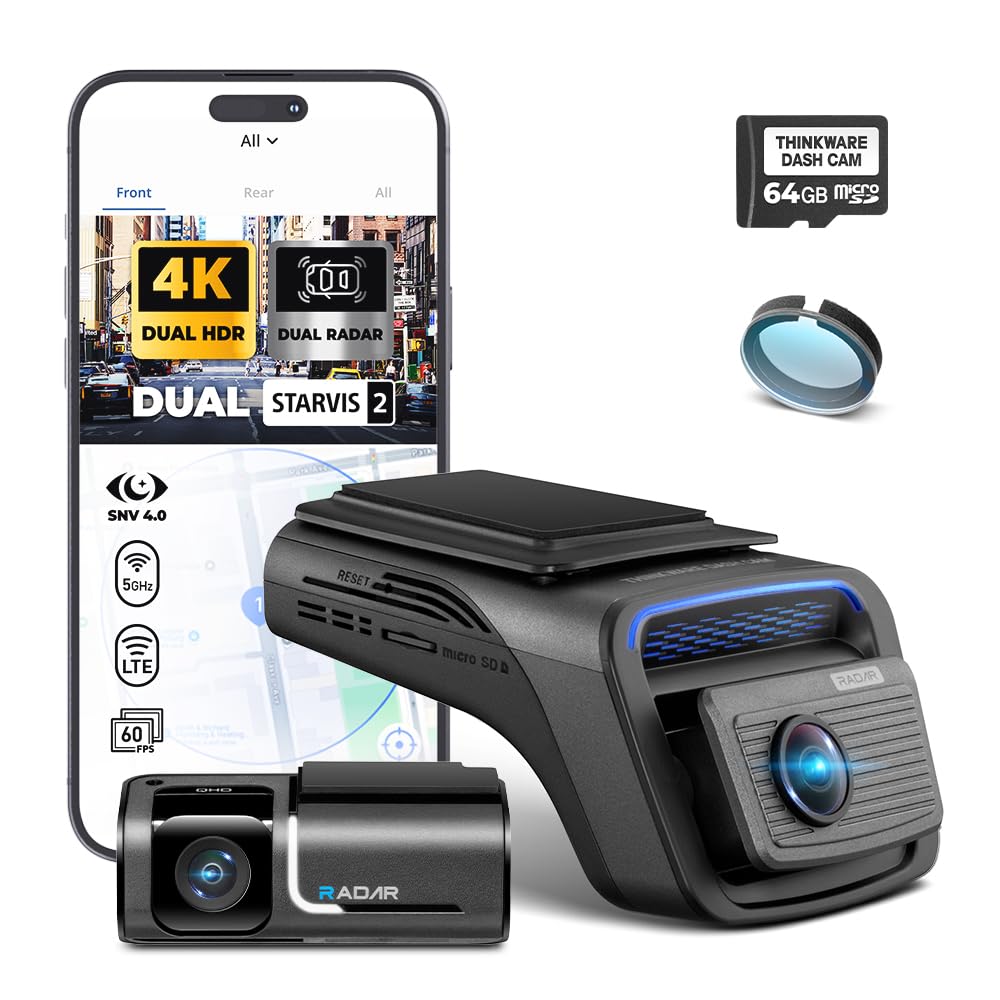
The radar-equipped sentinel that wakes up to record before an impact even happens.
This is the top-shelf pick for drivers who park in public lots and want the smartest possible protection. Instead of recording constantly while parked, the U3000 PRO uses radar to detect motion and wake the camera, recording a 20-second clip only when something approaches. That energy-saving approach extends coverage dramatically without draining your car battery — one rideshare and EV owner noted the battery lasted days on a single charge cycle.
The front camera records 4K while the rear handles 2K, both built on Sony STARVIS 2 sensors with an Ambarella CPU and WDR for balanced, natural images. Owners call the video the best they’ve owned, with Super Night Vision 4.0 reading plates in low light. A streamlined, low-profile body with no screen keeps it discreet on the windshield.
Event capture is genuinely thoughtful: motion and impact sensors trigger 20-second files that include 10 seconds before and 10 seconds after the incident, preserving full context rather than just the moment of impact. Built-in GPS provides speed-camera notifications, forward-collision warnings, and lane-departure alerts. A 64GB card is included and expandable to 512GB, with dual-band Wi-Fi for quick app access.
The flagship trade-off: premium engineering demands a premium price, and the app setup has drawn some mixed owner feedback — expect a learning curve.
The bottom line: if you want parking protection that uses radar (a sensor that detects motion around the car) and the clearest night footage on this list, this system justifies its higher cost—it is the most advanced pick here.
Understanding the Specs
4K Resolution and Sensors
4K (3840×2160P) is the gold standard for front cameras because it captures roughly four times the detail of 1080P. That extra detail is what lets you zoom in and read a license plate or road sign after the fact. The sensor — like Sony STARVIS 2 — determines how well the camera performs in low light; a good sensor with a wide aperture (F1.6 or F1.8) is what separates usable night footage from grainy darkness.
Parking Mode and Power Sources
Parking mode lets the camera watch your car while it is off, but it needs a constant power source to work. Most manufacturers sell a hardwire kit separately that taps into your car’s fuse box. Some cameras use a supercapacitor instead of a battery — this component handles extreme heat far better and lasts longer in seasonal temperature swings, making it the safer choice for hot climates.
FAQ
What resolution do I actually need to read license plates?
Does parking mode require a hardwire kit?
What is the difference between a battery and a supercapacitor?
How does a G-sensor protect my footage?
What does Wi-Fi transfer speed really mean for me?
Is a 3-channel camera worth it over a dual-channel?
Can I use any microSD card in a dash cam?
What is the difference between a suction cup and adhesive mount?
Final Thoughts: The Verdict
For most drivers, the best camera for car is the TERUNSOUl 4K 3-Channel because triple-channel coverage with a 128GB card included delivers the most complete protection per dollar. If you want a flexible rear lens for rideshare, the 70mai A800SE rotates between road and cabin views on demand. And for hot climates where batteries fail, the supercapacitor design of the 70mai A810 Lite is the durable pick that keeps recording when the sun beats down.
How We Picked
We do not accept paid placement. Every pick is matched to a real buyer and a real use-case; we do not hands-on test units.
Sources & Methodology
Specifications: manufacturer listings and product documentation. Review insights: verified customer reviews, as of September 2026. Pricing: not shown on this page (it changes often); check the current price via the retailer link.
As an Amazon Associate, Gadgets Feed earns from qualifying purchases. This does not affect which products we feature.