
Our readers keep the lights on and my morning glass full of iced black tea. As an Amazon Associate, I earn from qualifying purchases.
Specs are compiled from manufacturer listings and verified buyer reviews and can change over time — please confirm the key details on the product page before buying.
A multi-day ski expedition punishes cameras in ways a resort day never will — deep cold sapping battery life, blowing snow finding every crevice, and the constant dread of a lens scratch ruining day three’s footage. The real test is whether the camera still turns on at -20°C on the second morning. This guide cuts through spec-sheet noise to find rugged cameras that survive the whole trip, backed by battery strategy and durability.
I’m Min — the founder and writer behind Gadgets Feed. This guide is built by comparing the manufacturers’ published specifications and the patterns across verified customer reviews, so you get each pick’s real strengths and trade-offs instead of marketing spin.
Whether you’re chasing powder or filming the hut-to-hut traverse, the right camera for documenting a multi day ski expedition balances cold-weather battery life, rugged sealing, and footage you’ll actually want to edit weeks later.
Our Picks at a Glance


How To Choose The Best Camera For A Ski Expedition
On a multi-day ski expedition, a camera that impresses on day one is worthless if it dies on day three. Your choice depends on how you actually shoot: launching off cliffs demands a stabilized action cam, while a long traverse with wide views rewards a compact with a zoom lens. Pick the body that fits your shooting style, not the specs a brand prints on the box.
Battery Life in the Cold is King
Lithium batteries drain faster in freezing temperatures, so a camera that dies after one run at -20°C is a paperweight with a lens. Look for a camera with a stated cold-weather recording time — not just a warm-room spec — and choose one with swappable batteries (or an external battery case) so you can keep shooting while a spare warms inside your jacket.
Rugged Sealing: Waterproof vs. Weatherproof
Snow is water in another shape, and it will find its way into any unsealed seam. A fully waterproof camera rated for a specific depth of submersion gives you confidence for creek crossings and surprise slush pits, while a merely weatherproof body might not survive a full day of wet snow. Match the rating to how damp your expedition can get.
Lens Strategy: Action Cam vs. Rugged Compact
You’re choosing between two philosophies: action cam stabilization or rugged compact zoom. An action camera gives you rock-solid stabilization and a wide field of view for first-person POV — perfect for filming your own descent. A rugged compact with an optical zoom lets you capture a friend’s line from the ridge without cropping into mush. Decide which moments matter most before you pick.
Quick Comparison
| Model | Best For | Battery Life | Effective Resolution | Waterproof Depth | Amazon |
|---|---|---|---|---|---|
| DJI Osmo Action 5 Pro★ Best Overall | All-day rugged POV | 4 hours (3.6 at -20°C) | 40 MP | 20m (IP68) | Amazon |
| Kodak PIXPRO WPZ2Best Value | Budget-friendly travel | 4+ hours | 16 MP | 15m | Amazon |
| GoPro Hero12 BlackTop Performer | High-res action clips | 70 min at 5.3K60 | 27 MP | 10m | Amazon |
| PENTAX WG-1000 | Entry-level waterproof | 2 hours | — | 15m | Amazon |
| Ricoh WG-80 | Harsh-condition macro | — | 16 MP | 14m | Amazon |
| Insta360 X4 Air | Ski-specific 360 POV | — | 29 MP | — | Amazon |
| GoPro HERO13 Black | Pro-level versatility | 1.5 hours at 5.3K | 27 MP | 10m | Amazon |
| OM System TG-7 | Macro and rugged travel | — | — | 15m | Amazon |
| Insta360 X5 | Low-light 360 filming | 3 hours | 20 | — | Amazon |
In‑Depth Reviews
1. DJI Osmo Action 5 Pro Adventure Combo
Our pick — over 4.5★ from 900+ verified ratings; the strongest balance of quality and price.
The expedition workhorse that keeps filming after your friends’ cameras have surrendered to the cold.
For a multi-day trip, nothing matters more than being able to shoot on day two, and the Adventure Combo gives you a serious edge: it ships with three 1950mAh batteries plus a multifunctional battery case, so you can hot-swap on the lift instead of waiting for a charge. DJI rates the single battery at 4 hours of recording in normal conditions, and crucially, it holds on for 3.6 hours at -20°C — that negative-20 figure is exactly what your alpine morning looks like.
The camera body is rated IP68 waterproof down to 20 meters, which means snowmelt and creek splashes are simply not a concern. At 40 MP effective still resolution, it also captures far more detail than the Kodak’s 16 MP — a gap that shows when you crop into a distant ridge line. Owners who have used it for hundreds of hours across two years report “2 years, hundreds of hours, zero failures,” so the reliability has been tested in the field.
The dual OLED touchscreens make framing easy even in bright snow glare, and the 360° HorizonSteady stabilization keeps your horizon level no matter how much you rotate the camera. The 4nm chip powers subject tracking that holds a fast-moving skier in the center of the frame — useful when you’re the one behind the lens.
Why It Leads the Wardrobe
- 3-battery kit with case keeps you shooting all day
- Genuine 4-hour battery, even 3.6 hours at -20°C
- IP68 rated to 20m for total snow/water confidence
Where It’s Soft
- Generates noticeable heat after several minutes of recording
- Extension rod lacks a shutter button — you’ll use the DJI Mimo app for photos
Your expedition partner: This is the pick for skiers who want one camera that handles POV descents, scenic landscape shots, and daily vlogging without ever dying mid-run.
Keep in mind: The bundle’s 1.5m extension rod needs the DJI Mimo app to trigger photos when extended, so plan your selfie-stick shots ahead.
2. Kodak PIXPRO WPZ2 Rugged Waterproof Digital Camera
A budget-friendly rugged compact that packs an optical zoom, waterproof body, and a full accessory bundle.
Not every expedition needs a flagship; some trips just need a camera that survives the chaos. The WPZ2 is waterproof to 15 meters and shockproof against a 2-meter drop, so it shrugs off the kind of bumps a ski pole swing can inflict. With a 4X optical zoom covering 27-108mm, you can pull in a friend’s line across the bowl without walking closer — something no fixed-lens action camera can do.
The 16 MP sensor records 1080P Full HD video, and the included bundle (black compact case, floating strap, monopod, screen protector, and more) means you won’t need to buy any accessories before departure. The floating strap is a quiet hero: if you fumble it over a creek crossing, it stays visible instead of sinking. Owners heading to Jamaica for snorkeling found the audio shutter useful through a foggy mask, and battery reports hold up — “Battery lasted 4+ hours over 3 days” of intermittent shooting.
Compared to the higher-megapixel DJI above, the still resolution drops to 16 MP against 40 MP, so large prints won’t match the action cam’s detail. But for a grab-and-go companion that trades pure spec for simplicity and value, it’s a genuinely smart budget pick.
Who it beats: The WPZ2 beats a phone in wet conditions and beats pricier compacts on included accessories, making it a strong “good enough, always there” travel cam for skiers who don’t need 8K.
Reach for it if: You want an affordable, fully-accessorized rugged camera where the optical zoom matters more than ultimate resolution.
One trade-off: Its 16 MP stills trail the 40 MP top pick substantially, and owners note crisp shots need a steady hand.
3. GoPro Hero12 Black
The name skiers trust, delivering 5.3K clarity and Emmy-winning stabilization in a waterproof body.
When visibility gets flat and the terrain gets rough, the Hero12 Black’s HyperSmooth 6.0 stabilization keeps your footage watchable — the same in-camera stabilization tech that earned the company an Emmy. It’s waterproof to 33 feet (10 meters) without a housing, so a full day of snow spray needs no extra effort. Video tops out at 5.3K60, which gives you 91% more resolution than 4K when you want to crop into the action.
The 1720mAh Enduro battery is the key for cold days, delivering up to 70 minutes of continuous 5.3K60 recording. Owners note it runs warm to the touch during longer sessions but avoids the overheating that plagues other models, and battery life holds up for a day of intermittent clips. The dual screens and responsive touchscreen make it easy to switch from vertical to horizontal capture depending on where the footage is headed.
Bluetooth audio connectivity lets you pair wireless mics for clearer wind-filtered commentary, and the E-commerce Package includes an Enduro battery, curved adhesive mount, buckle, and thumb screw to get you rolling immediately. Owners love the value of this package — it’s the same camera as retail with less fancy packaging.
Stabilization leader: For raw, shake-free action footage straight from the start, nothing else here matches the Hero12’s combination of 5.3K resolution and HyperSmooth 6.0.
Best for: Skiers who prioritize silky smooth POV descents and 5.3K detail over long continuous recording sessions.
Think twice if: You plan to record hours of continuous video between charges — 70 minutes at top quality means carrying spare Enduro batteries.
4. GoPro HERO13 Black with 50-Piece Accessory Kit

A complete expedition-ready kit that adds 50 accessories and a big Enduro battery to GoPro’s best imaging.
This kit version of the HERO13 Black is built for the skier who doesn’t want to buy anything else. It bundles a 50-in-1 accessory kit plus a 64GB microSDXC card, so you have mounts, straps, and storage ready before you leave the parking lot. The 1900mAh Enduro battery pushes recording to 1.5 hours of continuous 5.3K video — a real step up from the Hero12’s 70-minute ceiling.
The 27MP photos and 5.3K60 video look crisp and cinematic, with HDR/HLG options and GP-Log color depth for editors who want to grade their footage. Owners took it to Hawaii and captured vivid underwater scenes with sea turtles, and report it’s “reliable under all weather and environmental situations” — exactly the confidence you need in a multi-day alpine setting. Wi-Fi 6 support means those 64GB of clips transfer to your phone quickly at day’s end.
HyperSmooth 6.0 with 360 Horizon Lock keeps your video level even when you rotate the camera fully, which is huge for creative shots on a mogul field. Owners note some of the included accessories feel cheap, but the quality of the camera body itself earns universal praise.
What the Bundle Buys You
- 50-in-1 accessory kit covers every mount scenario
- 1.5 hours of 5.3K on one charge
- 64GB card included for immediate storage
What to Expect
- Some cheaper bundle accessories feel less durable than the camera
- Continuous 5.3K still benefits from spare batteries for all-day use
Grab it for: Skiers who want a turnkey kit — camera, storage, and every mount — with the longest GoPro battery on this list.
Expect to: Replacing a couple of the cheaper third-party accessories over time; the camera itself is built like a tank.
5. OM System OLYMPUS Tough TG-7 Red

A rugged compact that pairs 15m waterproofing with a macro system that reveals ice crystals like never before.
The TG-7 is arguably the most feature-dense rugged compact on the market, and it’s a favorite for skiers who love close-up detail. The variable macro system offers 4 macro modes that capture subjects as close as 1 centimeter from the lens — frost on a pine needle, glint on a ski edge — while 5 underwater modes, including underwater HDR, keep colors rich in the snowmelt creeks. It’s waterproof to 15 meters, shockproof against a 2.1-meter fall, crushproof to 100 kgf, and freezeproof down to -10°C, which covers most of what an expedition throws at it.
Video hits 4K, and there’s a 120 fps high-speed mode for smooth slow-motion of powder sprays. The F2.0 lens lets in serious light for a compact, with a 4x optical zoom to reach distant peaks. Owners call it “superior to phones and GoPros” for optical zoom, raw control, and a powerful built-in flash — tools that matter when the sun drops behind the ridge. Salt-water use needs a fresh-water rinse afterward to prevent sticky buttons, a fair trade for the rugged build.
Its 4:3 aspect ratio and extensive physical button layout can intimidate beginners; this is a camera for someone who enjoys dialing in settings.
The macro master: No other camera here gets within 1 centimeter of its subject, making the TG-7 the standout for documenting the small details of a ski expedition.
Choose it if: You value optical zoom, raw photo control, and extreme close-up capture in a waterproof body that fits a jacket pocket.
Be ready for: A learning curve with its many buttons, and carry a spare battery since it can die without much warning.
6. Insta360 X4 Air Ski Bundle
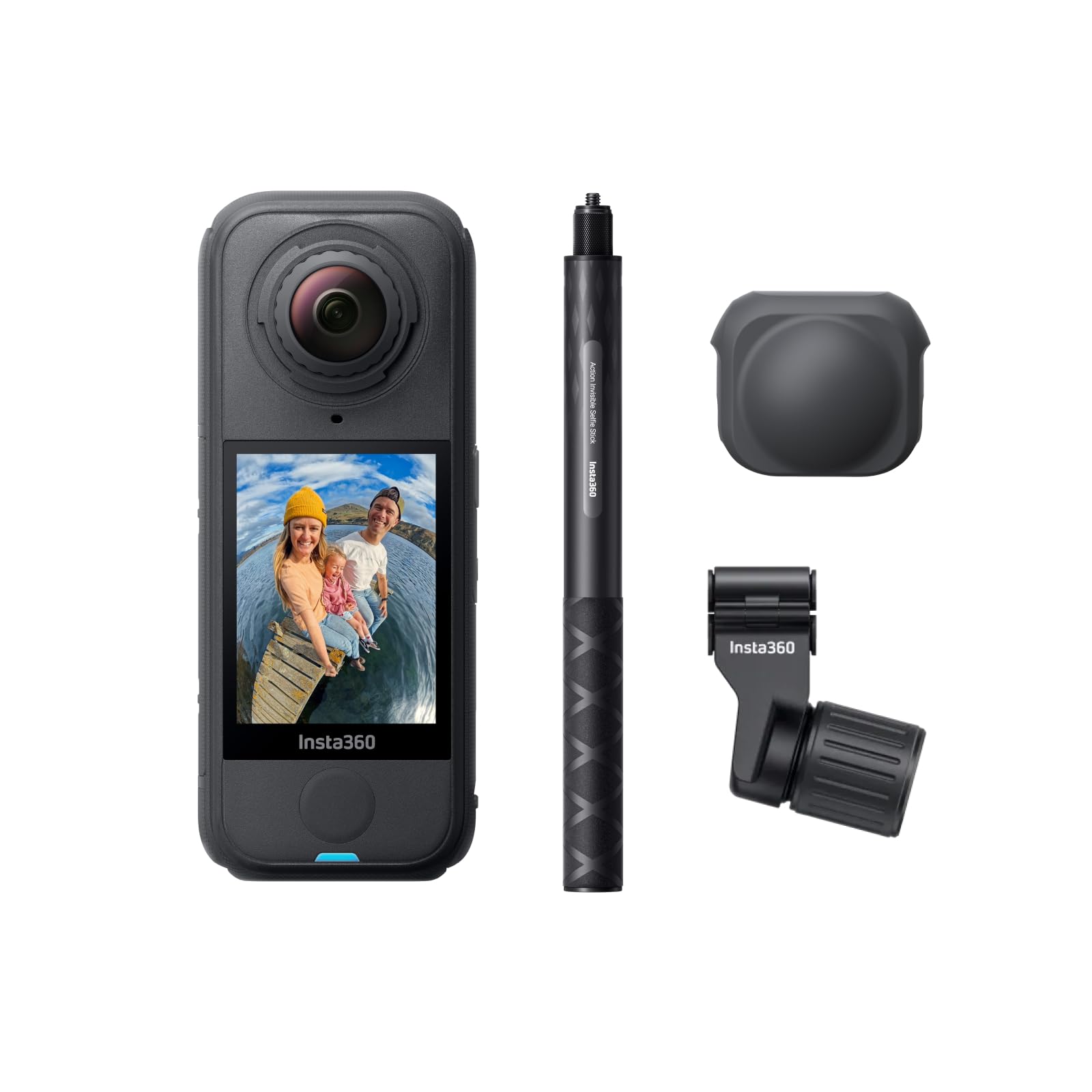
A featherweight 360 camera that mounts to your ski pole and captures angles no action cam can see.
This Ski Bundle is purpose-built for the slopes: it includes a ski pole mount and an invisible selfie stick, so you can film third-person shots while carving. The camera itself weighs just 165g — light enough to forget it’s on your pack — and captures 8K30fps 360 video with dual lenses. The “shoot first, frame later” workflow means you focus on the descent, not the framing; you pick the best angle in the Insta360 app afterwards.
Owners say it’s “capable of producing incredible ski footage,” and the FlowState stabilization with 360° Horizon Lock keeps shots perfectly level even when you rotate the camera completely. The built-in wind guard helps audio stay clean on fast descents. The replaceable lenses are a huge expedition win: if you scratch a lens on day one, you swap it instead of writing off the trip.
The easy reframing in the app and one-tap templates make sharing simple after a long day in the hut. Low-light performance is a known weakness — expect noise and clarity loss when the sun goes — so lean on it for clear-sky runs rather than night shoots.
But wait — it’s not the strongest for: Low-light filming. The X4 Air’s dual lenses need good lighting for sharp 360 footage, so keep night shooting to a minimum.
Pick this for: Skiers who want the iconic invisible-selfie-stick effect and who enjoy choosing camera angles during editing, not during the run.
One thing to know: The phone app is required for initial setup, and its small batteries are specific to this model — check compatibility before buying spares.
7. Insta360 X5
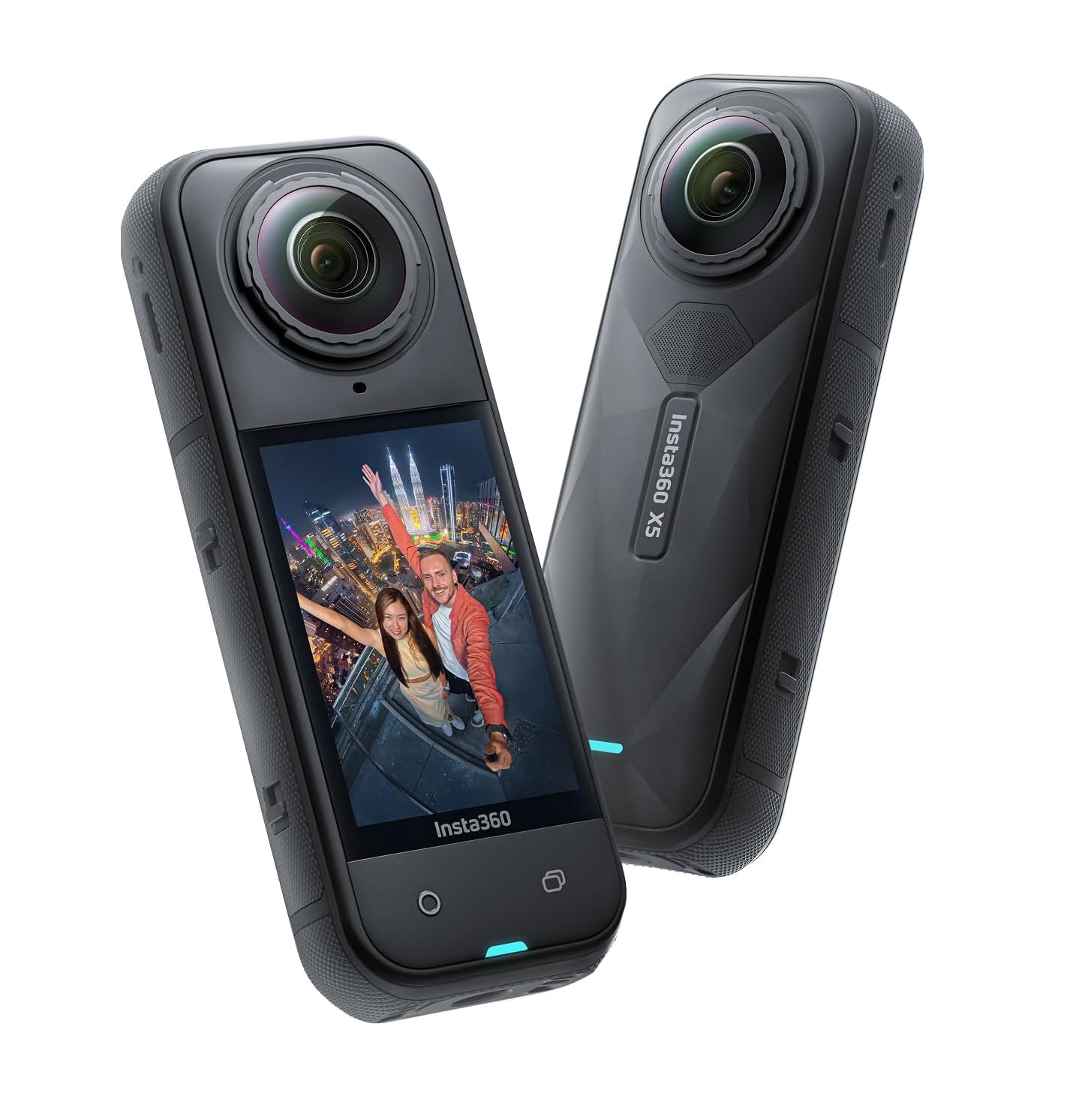
The 360 camera that takes on twilight runs, with a triple AI chip and a 3-hour battery for long days.
Where the X4 Air struggles in dim light, the X5 makes low-light a headline feature. Its triple AI chip design powers advanced noise reduction, so evening runs and overcast days stay crisp where other 360 cameras turn to grain. Dual 1/1.28″ sensors record up to 8K30fps with better clarity, color, and dynamic range than the X4 Air — a meaningful upgrade when the weather turns moody, which it will on a multi-day trip.
The 3-hour battery is the standout expedition spec here — it’s the longest continuous runtime on this list and roughly double what most action cams deliver. That’s a full morning of filming without touching your pack. The lenses are fully replaceable and scratch-resistant, so a crash against a rock face doesn’t end your documentation. The invisible selfie stick effect works as expected, and InstaFrame mode gives you a ready-to-share flat video instantly if you’d rather skip editing.
A “leading low light” promise from the maker is worth taking with a grain of salt, but the hardware — dual large sensors and triple AI — is the right recipe for decent dusk footage.
What Stands Out
- 3-hour battery covers most of a ski day
- Replaceable, scratch-resistant lenses reduce trip-ending risk
- Triple AI chip gives usable low-light 360 footage
Where It’s Rough
- Requires fast SDXC cards to avoid recording failures
- App software feels restrictive; Wi-Fi only for editing
Your pick if: You want the longest-running 360 camera that still shoots solid low-light video through a full day of touring.
Plan around: The app demands Wi-Fi for transfer and editing, and you’ll want a high-speed memory card from day one.
8. PENTAX WG-1000 Gray Waterproof Compact
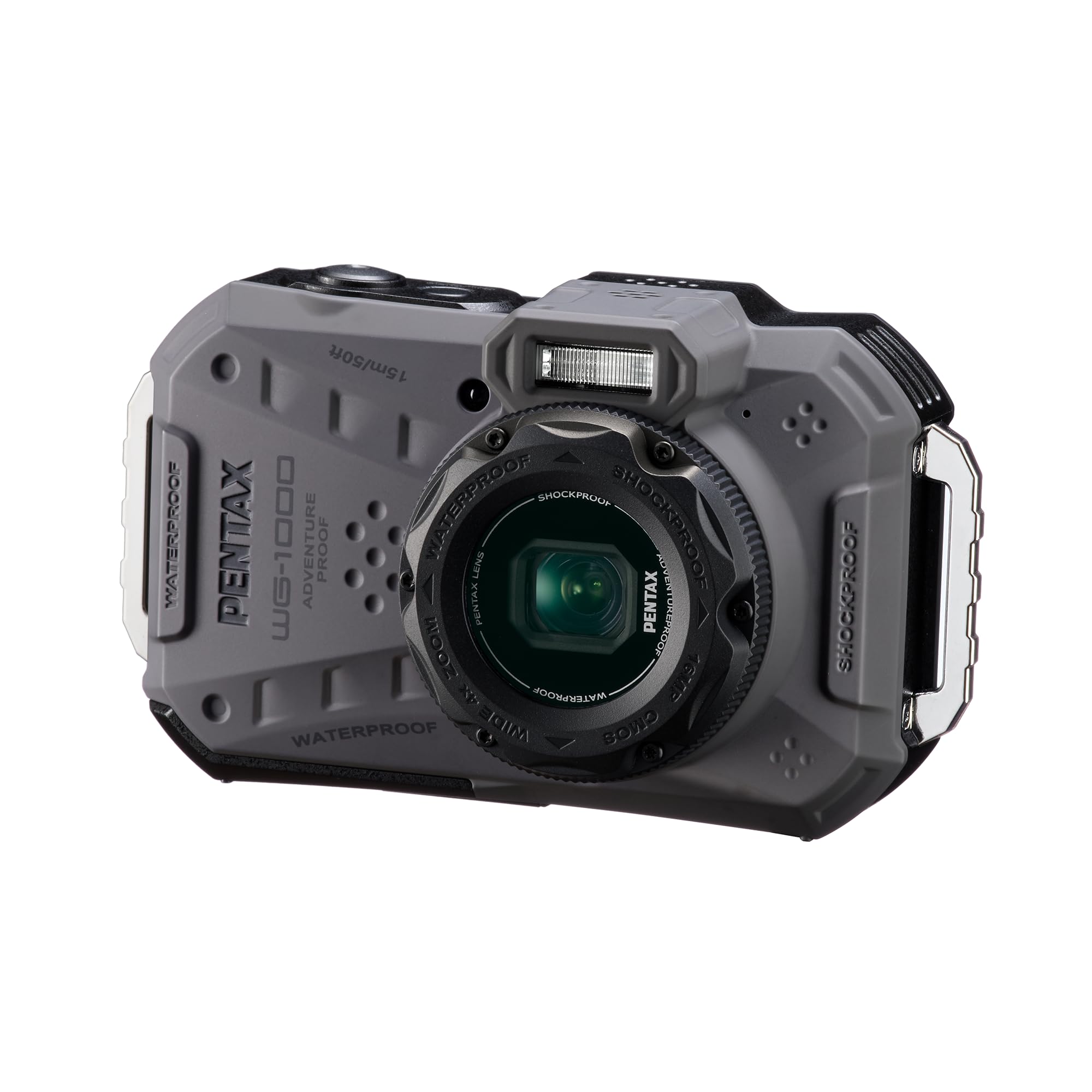
A no-frills waterproof compact that keeps the essentials simple for beginner expedition shooters.
The WG-1000 is the most approachable camera here, and it’s designed for the skier who wants waterproof confidence without a steep learning curve. It’s waterproof down to 15 meters for up to one hour, shockproof against a two-meter fall, and dustproof — enough protection for wet snow and the inevitable park bench drop. Its 4x optical zoom lens with 27mm wide-angle coverage handles classic scenic shots, and the ISO 3200 sensitivity helps keep images sharp when the light goes flat in the trees.
Seven capture modes, including Auto, Manual, Underwater, and Scene, let you dial things in without hunting through menus. The 2-hour battery life is modest — the shortest on this list — so a spare battery is near-essential for a full expedition day. Owners also note the included silicone cover protects the body but makes the buttons harder to press, so it’s best used for transport rather than shooting.
Its 3.6-star rating comes with mixed reliability chatter; some report an occasional lens error after a year of hard use, and one owner traced a water-damage failure back to a battery door that wasn’t fully latched.
The honest read: The WG-1000 is a fair entry-level value for casual slopeside shooting, but its shorter battery and reported long-term durability issues push expedition-minded buyers toward the DJI above.
Reach for it if: Your expedition is occasional, your budget is tight, and you want a simple waterproof camera for basic scenic shots.
Look elsewhere if: You need all-day battery life or will be filming in truly frigid conditions day after day.
9. Ricoh WG-80 Orange Waterproof Digital Camera

A rugged workhorse proven on harsh job sites, with six macro lights for close-up detail in any light.
The WG-80 is freezeproof, crushproof, and waterproof down to 14 meters for up to two hours — a spec sheet built for exactly the kind of abuse a multi-day expedition dishes out. It’s the camera owners say they’ve used on harsh construction sites for 5+ years without complaint, which speaks to a durability that pure numbers can’t fully convey. The bright orange body is a practical touch: on a white slope, you won’t lose it in a drift.
Its back-illuminated 16 MP CMOS sensor delivers decent detail, and the 5x optical zoom covers a wider range than the Kodak’s 4x — handy for spotting terrain features ahead. The six dedicated LED Macro Lights around the lens make close-up shots of gear, ice formations, or avalanche transceiver readings bright and uniform, even in shade. There’s a dedicated Underwater shooting mode that tune color and contrast, a bonus for creek inspections at the bottom of the run.
Owners note individual controls respond a bit slowly, and the lens lacks image stabilization, so you’ll want a steady hand for crisp telephoto shots.
Field-proven: If the lens had image stabilization and snappier controls, the WG-80 would be the top rugged compact; as it stands, it’s a dependable, battle-tested choice.
Best for: Skiers who’ve watched cheaper cameras die on past trips and want a tank-like body with a built-in ring light for macro details.
Expect: A slightly slower response time between shots and the need to brace for zoomed shots without stabilization.
Understanding the Specs
Cold-Weather Battery Life
This is the first number to check for an expedition, not the last. Batteries lose capacity as they chill, so look for a rating that tells you how long the camera records at freezing temperatures — like the DJI’s 3.6 hours at -20°C — rather than just a warm-room figure. A camera with swappable batteries or a battery case lets you keep the spares warm in your inner pocket while one is in the camera.
Waterproof and Freezeproof Ratings
These tell you where a camera can safely go. A waterproof rating measured in meters (like 15m or 20m) means the body is sealed against submersion, which handles snowmelt and creek splashes easily. Freezeproof ratings show the lowest temperature where the internals keep working — critical when your summit day starts at -10°C or colder. Match these numbers to the worst conditions you can actually encounter.
FAQ
What does the waterproof depth rating mean for a ski expedition?
How does cold weather affect the camera’s battery life?
Is a 360 camera better than an action camera for skiing?
What is the benefit of an optical zoom on a rugged compact?
How long should the battery last for a full day of skiing?
What does shockproof and crushproof protect against?
Do I need a camera with a replaceable lens?
Is a smartphone good enough for a ski expedition?
What does the megapixel count actually mean for my footage?
How does image stabilization help on skis?
Final Thoughts: The Verdict
For the majority of shoppers, the camera for documenting a multi day ski expedition winner is the DJI Osmo Action 5 Pro because its 4-hour battery, 3.6-hour cold-weather rating, and 3-battery kit mean the camera is still rolling on day three. If you want a stabilized 5.3K action cam with industry-leading smoothness, grab the GoPro Hero12 Black. And for close-up detail or 360 creativity on the slopes, the OM System TG-7 and Insta360 X4 Air each cover angles no other pick can match.
How We Picked
We do not accept paid placement. Every pick is matched to a real buyer and a real use-case; we do not hands-on test units.
Sources & Methodology
Specifications: manufacturer listings and product documentation. Review insights: verified customer reviews, as of August 2026. Pricing: not shown on this page (it changes often); check the current price via the retailer link.
As an Amazon Associate, Gadgets Feed earns from qualifying purchases. This does not affect which products we feature.