
Our readers keep the lights on and my morning glass full of iced black tea. As an Amazon Associate, I earn from qualifying purchases.
Specs are compiled from manufacturer listings and verified buyer reviews and can change over time — please confirm the key details on the product page before buying.
Choosing a camera for family videos is about preserving the look on a kid’s face when they blow out candles, not chasing specs. The real trick is finding one stable and simple enough to stay out of the way, so you’re living the moment, not fiddling with buttons. Below you’ll find nine picks that do exactly that — ranked by what matters most to a busy parent.
I’m Min — the founder and writer behind Gadgets Feed. This guide is built by comparing the manufacturers’ published specifications and the patterns across verified customer reviews, so you get each pick’s real strengths and trade-offs instead of marketing spin.
if you need a pocket-friendly vlogger or a dedicated camcorder for concerts and recitals, the best camera for family videos keeps your moments sharp, steady, and frustration-free, so you can focus on the fun instead of the gear.
Our Picks at a Glance



How To Choose The Best Camera For Family Videos
Three specs separate the cameras you’ll actually use from the ones that stay in a drawer. Here is the short version of what to look for.
The Stabilization Factor
This is the biggest difference between a watchable video and a queasy one. A camera with good optical or gimbal-based stabilization compensates for your hand-shake and movement, so footage from a walk in the park or a kid’s race looks smooth rather than bouncy. Without it, you’ll need a tripod or a very steady grip for every clip.
Sensor Size and Low Light
The sensor is the part of the camera that captures light. A larger sensor, like the 1-inch type found in many premium compact cameras, captures more light and detail. That translates directly to clearer, less grainy video in typical family settings — a dim living room, an evening birthday party, or a school play.
Zoom Reach and Stabilization
Optical zoom refers to the lens physically extending to bring a distant subject closer without losing quality — measured in a multiplier like 20x or 52x. Digital zoom is just cropping the image, which makes it blurry. For family use at a park or a concert, an optical zoom of 20x to 30x is a balance, but it must be paired with strong stabilization or the image will shake too much to watch.
Quick Comparison
| Model | Best For | Stabilization Type | Sensor Size | Max Video Resolution | Amazon |
|---|---|---|---|---|---|
| Sony FX30★ Best Overall | Cinematic family films | In-body (IBIS) | Super 35 (APS-C) | 4K 120fps | Amazon |
| DJI Osmo Pocket 3Top Performer | Pocket-ready vlogging | 3-axis gimbal | 1-inch CMOS | 4K 120fps | Amazon |
| Canon VIXIA HF G50Premium Pick | Traditional camcorder feel | Intelligent 5-axis | 1/2.3-inch | 4K 30p | Amazon |
| Sony FDR-AX43 | Long zoom events | Balanced Optical SteadyShot | 1/2.5-inch Exmor R | 4K | Amazon |
| Canon EOS Rebel T7 | Learning photography + video | Lens-based only | APS-C (24.1 MP) | 1080p Full HD | Amazon |
| Xtra Muse Pocket Camera | Budget gimbal video | 3-axis gimbal | 1-inch CMOS | 4K 120fps | Amazon |
| Panasonic LUMIX ZS99 | Travel and concerts | Hybrid (lens-based) | 1/2.3-inch | 4K 30p | Amazon |
| Panasonic LUMIX FZ80D | Extreme zoom reach | Power O.I.S. | 1/2.3-inch MOS | 4K | Amazon |
| KODAK PIXPRO AZ528 | Entry-level superzoom | Optical Image Stabilization | 1/2.3-inch BSI CMOS | 1080p Full HD | Amazon |
In‑Depth Reviews
1. Sony Cinema Line FX30 Super 35 Camera
Our pick — over 4.5★ from 550+ verified ratings; the strongest balance of quality and price.
Pro-grade family footage without the pro-grade price tag.
This is the pick for parents who want their home videos to look like small movies. The FX30 packs a 20.1 MP Super 35 (APS-C) sensor and records 4K video that is oversampled from 6K data, delivering incredible detail and rich colors straight out of the camera with S-Cinetone technology. Its 495 phase-detection autofocus points (a very high number that means the camera locks onto moving kids and keeps them sharp without hunting) works smoothly, saving you from missed focus during the big moments.
The 14-bit depth here gives you tremendous flexibility to adjust exposure and color in editing without breaking the image — you can fix a shot that is a bit too dark or bright and still see smooth transitions between shades. Compared to the KODAK AZ528’s 25 autofocus points and 8-bit depth, the FX30 offers a massive advantage in precision and editing latitude. The trade-off is battery life; owners note it runs about 1 to 2 hours on a charge, so you will want an external battery pack for a full day at a party.
Cinematic Clarity: The image quality — 29 owners specifically praised it — is the star here, delivering video that feels polished and professional without needing a film school degree.
Real-World Downside: Battery life is the catch; you need to plan for external power on longer outings.
Reach for this if: you want the absolute best image quality for your family archive — first steps, recitals, holiday gatherings — and are willing to buy an extra battery.
Think twice if: you want a grab-and-go camera with all-day battery life, or if a body is too big an investment for casual clips.
2. DJI Osmo Pocket 3 Creator Combo
Buttery smooth video that slips right into your pocket.
This is the camera that makes chasing a toddler feel like you are on a movie set. The 1-inch CMOS sensor captures bright, detailed 4K video even at 120fps, so slow-motion shots of a kid jumping into leaves look fluid and sharp. The headline feature is its advanced 3-axis mechanical gimbal — a tiny motorized arm that physically holds the camera steady — which delivers footage that is virtually shake-free, whether you are walking, running, or just holding the camera in one hand.
The 2-inch rotating touchscreen switches between horizontal and vertical shooting with a twist, a brilliant feature for parents who share clips on social media. The battery lasts a practical 166 minutes, and the Creator Combo includes a DJI Mic 2 transmitter, which pairs directly for crisp, clear audio of your kids talking. The only catch is the fixed wide-angle lens; for a stage performance, you must be fairly close.
Gimbal Glory: Quality and video quality are the two most praised aspects by far, and the stabilization means you never need a tripod for a walk in the park.
The Limitation: The non-interchangeable lens means you can’t zoom in for distant subjects without some digital cropping.
Best for: parents who want a grab-and-go, pocket-sized camera that delivers stunningly smooth video and good audio without any setup.
Look elsewhere if: you need a powerful optical zoom for sports or stage performances from a distance.
3. Canon VIXIA HF G50 4K30P Camcorder
The dedicated camcorder that feels right at home on family day.
If you grew up using a camcorder, this will feel instantly familiar — but with modern guts. The Canon VIXIA HF G50 shoots true 4K UHD video at 30p and offers a genuine Canon 20x optical zoom lens with a wide 29.3mm angle of view, meaning you can capture the whole room at a party and then zoom in on the cake-cutting without losing any quality. Its Intelligent 5-axis image stabilization does a solid job smoothing out handheld shake.
It also doubles as a high-quality webcam via its clean HDMI output, a useful bonus for work calls or virtual family events. Video quality is the top praise from owners, calling it “crisp” and versatile enough for church services and travel. The main feedback is that the stabilization, while good, isn’t gimbal-level; if you plan to walk and shoot a lot, you may see some shakiness.
Traditional Feel, Modern Tech: The physical zoom ring and comfortable grip make it feel like a proper camcorder for parents who prefer physical controls over touchscreens.
A Consideration: The stabilization is mixed in reviews — great for stationary shots, less effective for active walking footage.
Reach for this if: you want a dedicated, ergonomic camcorder with a powerful zoom for sports, recitals, and trips, and you appreciate a classic form factor.
skip it if: you need gimbal-smooth running footage or prioritize maximum portability.
4. Sony FDR-AX43 UHD 4K Handycam Camcorder

A powerful zoom with a built-in gimbal for steady shots at a distance.
This camcorder bridges the gap between a pocket camera and a cinema rig. It features a 1/2.5-inch Exmor R low-light CMOS sensor that performs well in the tricky lighting of a living room or school auditorium. The standout is the Balanced Optical SteadyShot — Sony’s term for a built-in gimbal system that floats the sensor — which keeps your 20x optical zoom shots (and up to 40x for HD) remarkably steady even at full reach.
It also offers a Fast Intelligent AF that tracks focus reliably on moving subjects. The Amazon reviews praise it for being “very easy to operate” and “sturdy without being too heavy.” A real-world note from owners is that the battery protrudes from the back, making it slightly awkward for selfie sticks, and it has no internal memory, so you must buy a memory card immediately.
Zoom Without The Wobble: The gimbal-based stabilization is a huge advantage over lens-only stabilizers, making this a great choice for grandparent-grandkid walks.
One Thing to Know: The protruding battery design may not be comfortable for everyone, especially in a small bag.
Ideal for: recording school plays, soccer games, and family events from the bleachers where you need a steady 20x zoom.
Not for you if: you need a compact, pocketable device or plan to use it on a selfie stick extensively.
5. Canon T7 EOS Rebel DSLR Camera Bundle
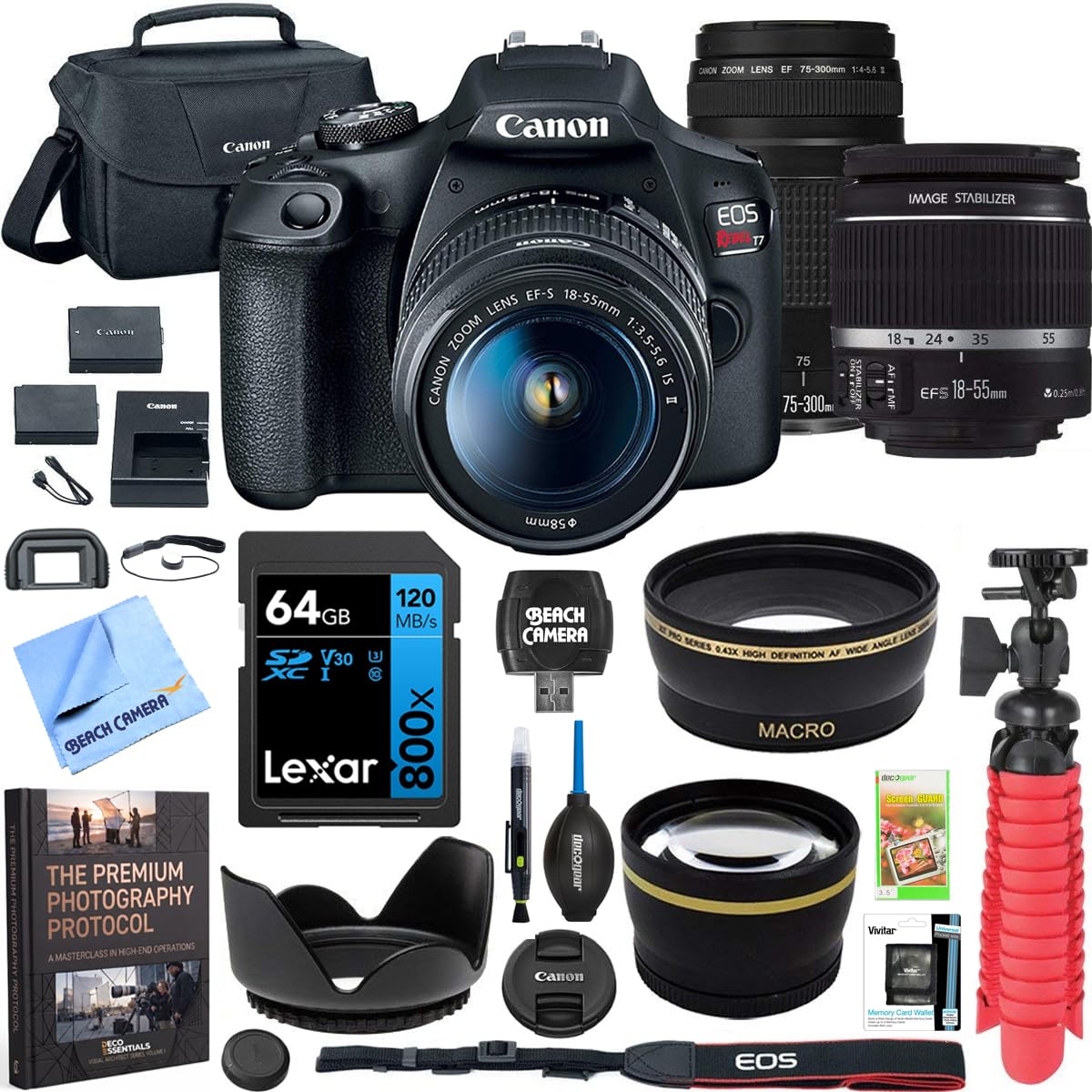
A classic DSLR bundle that teaches you photography while capturing video.
The Canon T7 is a great choice for families who want one tool for still photos and video. The 24.1 megapixel APS-C sensor delivers excellent, detailed images, and the DIGIC 4+ processor handles 1080p Full HD video. This particular bundle includes both an 18-55mm general-purpose lens and a 75-300mm telephoto lens, giving you the reach for distant subjects at a park. It is a true DSLR, meaning you look through an optical viewfinder and can learn about aperture, shutter speed, and ISO.
The bundle comes with a tripod, extra battery, memory card, and case, making it a complete starter package. Quality is the most-praised aspect among 87 positive mentions, and owners find it “very easy to use” for beginners. The limitation for video is clear: it records 1080p, not 4K. While that is still crisp for home movies, it is less future-proof than a 4K camera. Its video autofocus with just 9 points is also far less advanced than newer mirrorless cameras.
Learn As You Go: This is more than a video camera — it is a full photography education in a box, perfect for families who want to improve their skills.
The Video Trade-off: No 4K and a basic 9-point autofocus mean it is not as suited for fast-moving family action as a modern camcorder.
Best for: parents who want to learn photography seriously, want the flexibility of interchangeable lenses, and value still-image quality over 4K video.
Think twice if: 4K video is a must, or you want a lightweight, dedicated video shooter without the bulk of a DSLR.
6. Xtra Muse Vlogging Camera with 1-inch CMOS

A pocket-sized gimbal camera that offers incredible value for smooth family clips.
The Xtra Muse directly challenges the DJI Pocket 3, offering a very similar feature set at a lower price point. It packs a 1-inch CMOS sensor capable of 4K resolution at 120fps for slow-motion video. Its built-in 3-axis gimbal stabilizer effectively smooths out walking or running footage, while face and object tracking ensures your child stays in focus as they play. The 2-inch touchscreen lets you frame shots easily and switch between horizontal and vertical formats.
Overall quality and video quality are the two most-mentioned positive aspects from owners, who praise its construction and intuitive interface. Owners note it is a “near-identical to competitor at half the price.” Battery life is rated at 161 minutes, but some buyers report mixed performance in real-world use, and the microphone connectivity has also received mixed feedback. The battery life is rated at 161 minutes, but some owners mention mixed performance in real-world use.
Gimbal Quality on a Budget: The built-in stabilizer makes this a fantastic option for parents who hate shaky video but don’t want to spend top dollar.
The Caveat: Microphone connectivity is a mixed point in reviews — if audio quality is critical, you may need an external mic adapter.
Grab this if: you want pro-level stabilization and 4K 120fps video for under and love the pocket form factor.
Look elsewhere if: smooth, high-quality audio capture from the start is your priority, or if you need an optical zoom.
7. Panasonic LUMIX TZ/ZS99 Point and Shoot Camera

A travel-ready compact with a Leica lens that brings distant moments close.
This is the camera for the family trip where you need to capture both the panoramic beach shot and a close-up of your kid building a sandcastle three dunes away. The Panasonic ZS99 features a 24-720mm Leica lens with a 30x optical zoom — that is the amount of optical reach that would require a massive lens on a DSLR — packed into a body that is small enough to slide into a jacket pocket. It records 4K video at 30p and offers 4K PHOTO burst mode.
The 1,840k-dot tiltable touchscreen is great for awkward angles, like holding the camera above your head at a concert. User-friendliness is the top praise from 8 reviewers, who find it intuitive and easy to use. It also features built-in Bluetooth 5.0 for easy sharing to your phone. Image quality is the aspect most mentioned, but it is a mixed point — it is excellent in good light but weaker in low light compared to a larger sensor camera.
Zoom King in a Tiny Body: The 30x Leica zoom range is class-leading in this size class, perfect for travel and concerts where you can’t get close.
Understand Its Limits: The picture quality is mixed, especially in low light, so it’s not the best for dim birthday parties without a flash.
Best for: families who value an incredible zoom in a portable, easy-to-use camera and shoot mostly outdoors in good light.
Not for: those who need excellent low-light performance or expect DSLR-quality images in a pocketable body.
8. Panasonic LUMIX FZ80D Point and Shoot

A superzoom bridge camera that sees everything from your seat in the back row.
For the family that lives at the ballpark or loves backyard birdwatching, the FZ80D brings a massive 60x optical zoom (20-1200mm equivalent) to the table. That means you can capture a sharp, recognizable video of a grandchild’s first home run from the top of the bleachers. It shoots 4K video and features a Post Focus mode that lets you tap on the screen to change the focus point after you have taken the shot, a clever way to ensure you never miss the perfect moment.
The Power O.I.S. (Optical Image Stabilizer) does a solid job compensating for the shake that comes with such a powerful zoom, and the 2,360K-dot Live View Finder (the viewfinder you hold to your eye) is bright enough to use in direct sunlight. Quality and Zoom are the most praised aspects. The trade-off is that the smaller 1/2.3-inch sensor means image quality drops noticeably in low light. It also lacks built-in WiFi, so you need a card reader to move files.
Incredible Reach: The 60x zoom is the easiest way to get close-up video of shy wildlife or distant stage performances without spending a fortune.
The Reality Check: Picture quality in low light is a common (and valid) mixed point from owners — this is a daylight and stadium camera, not one for evening indoor solo.
Reach for this if: your family videos are mostly from the sidelines of outdoor sports, parks, or wildlife, and you need extreme zoom on a budget.
pass on it if: you shoot a lot of indoor evening events or need WiFi for instant sharing to your phone.
9. KODAK PIXPRO AZ528 16MP Digital Camera

An entry-level superzoom that makes long-distance shots affordable.
The KODAK PIXPRO AZ528 is the most affordable bridge camera here, offering a massive 52x optical zoom and a 24mm wide-angle lens for under. It records 1080p Full HD video and features a 16-megapixel BSI CMOS sensor with Optical Image Stabilization to help keep telephoto shots steady. It is a great choice for a first-time camera buyer or a family on a tight budget who wants a camera that can reach far away subjects.
Camera quality is the most praised aspect by 51 owners, who find it “easy to use” and a great value. Its burst mode captures 6 frames per second, useful for sports. The 25 autofocus points and 8-bit depth are significantly less capable than the Sony FX30’s 495 points and 14-bit depth, but the price difference is also massive. The recurring note from owners is that when zoomed all the way in, “you have to have steady hands or it is very blurry.”
class-leading Value for Reach: The 52x zoom at this price is genuinely impressive, making it the most accessible way to get into superzoom photography.
Honest Limitations: Image quality is mixed in low light, and the 1080p video is a step behind 4K options. Steady hands are essential at full zoom.
Best for: a beginner or budget-conscious family who needs a cheap, easy way to get decent zoomed-in videos of birds, sports, or distant subjects in good daylight.
Not for: anyone who needs sharp, 4K video, reliable low-light performance, or a camera that tolerates unsteady hands at maximum zoom.
Understanding the Specs
Image Stabilization (IBIS, Gimbal, OIS)
This spec determines if your video looks like it was shot by a professional or a ship’s captain in a storm. In-body stabilization (IBIS) physically moves the sensor to counter your shakes. A gimbal is a motorized arm that floats the camera. Optical Image Stabilization (OIS) uses moving elements inside the lens. For family videos, a camera with a 3-axis gimbal or good IBIS is ideal for walking and running shots, while OIS helps keep still shots and moderate zooms steady.
Sensor Size (1-inch vs APS-C)
The sensor is the engine. A 1-inch CMOS sensor (found in the DJI Pocket 3 and Xtra Muse) captures more light than the tiny 1/2.3-inch sensors in most budget superzooms, meaning better video when you are indoors or at dusk. An APS-C sensor (like in the Sony FX30) is even larger and captures even more light and detail, but it comes in a larger, more expensive body. Bigger sensors also create a nicer “blurry background” look in your videos.
Autofocus Points and Tracking
This number tells you how many zones the camera divides the frame into to find focus. The Sony FX30’s 495 points cover the frame very densely, so it can track a running child across the scene smoothly. A camera with 9 or 25 points (like the Canon T7 or KODAK) has coarser coverage and may struggle to keep a fast mover sharp. For family videos, look for a camera with “phase detection” autofocus and as many points as your budget allows for stress-free recording.
Frame Rate (fps) and Resolution
“4K” means the video has roughly four times the pixels of standard 1080p HD, giving you sharper, more detailed clips that look great on big TVs. A camera that shoots 4K at 120fps (frames per second) can also slow down the action to a smooth quarter-speed slow motion. Most family cameras shoot 4K at 30fps or 60fps. Unless you plan to crop heavily or make slow-motion videos, good 1080p video from a camera with a large sensor and great stabilization is often more practical than mediocre 4K.
FAQ
Should I buy a camcorder or use my smartphone for family videos?
What is the difference between optical zoom and digital zoom?
Is 4K video necessary for home movies?
How important is image stabilization for filming kids?
What does a 1-inch CMOS sensor do for me?
Can I use a DSLR for family videos?
How long should the battery last for a day out?
What is the advantage of a built-in gimbal?
Do I need a separate microphone for good audio?
What does ‘bridge camera’ mean?
Final Thoughts: The Verdict
For most people, the best camera for family videos is the DJI Osmo Pocket 3 Creator Combo because it delivers pro-style, gimbal-stabilized 4K video in a pocketable package that you can pull out instantly. If you want the absolute best image quality for a serious passion project, grab the Sony FX30. And for a budget-friendly entry point with a huge zoom, the KODAK PIXPRO AZ528 is the one to reach for.
How We Picked
We do not accept paid placement. Every pick is matched to a real buyer and a real use-case; we do not hands-on test units.
Sources & Methodology
Specifications: manufacturer listings and product documentation. Review insights: verified customer reviews, as of July 2026. Pricing: not shown on this page (it changes often); check the current price via the retailer link.
As an Amazon Associate, Gadgets Feed earns from qualifying purchases. This does not affect which products we feature.