
Our readers keep the lights on and my morning glass full of iced black tea. As an Amazon Associate, I earn from qualifying purchases.
Specs are compiled from manufacturer listings and verified buyer reviews and can change over time — please confirm the key details on the product page before buying.
The biggest challenge with filming sports isn’t the speed of the game — it’s keeping the camera steady and the subject in frame when everything is moving fast. A 4K action camera with high frame rates (60fps or more) is the real solution, but the flood of specs like stabilization modes and sensor sizes can make choosing feel like a full-time job. This guide breaks down the best options for capturing everything from a soccer goal to a mountain bike run.
I’m Min — the founder and writer behind Gadgets Feed. This guide is built by comparing the manufacturers’ published specifications and the patterns across verified customer reviews, so you get each pick’s real strengths and trade-offs instead of marketing spin.
if you need a rugged body for helmet-mounted POV or a mirrorless workhorse for professional coverage, the right camera for filming sports depends on how you shoot, what you shoot, and where you shoot it.
Our Picks at a Glance


How To Choose The Best Camera For Filming Sports
The right sports camera depends on your shooting style: helmet-mounted POV, tripod sideline setup, or professional mirrorless rig. You should first decide between a rugged, waterproof action camera and a larger, more capable mirrorless body.
Frame Rate is King
For slow-motion replay of fast plays, you want a camera that records at 60fps or 120fps at 1080p or 4K. A higher frame rate (frames per second) gives you more detail in every moment of the action when you slow it down later.
Stabilization Keeps Shots Smooth
Mounting a camera on a helmet or bike handlebar introduces constant vibration. Electronic stabilization (like HyperSmooth or HorizonSteady) or a physical gimbal cancels out that shake, so your footage looks like it was filmed from a tripod even when you’re running.
Battery Life and Durability
Sports events can run for hours. A camera with swappable batteries and a waterproof or weather-sealed body handles long days in rain, dust, or on the field without shutting down.
Quick Comparison
| Model | Best For | Video Resolution | Frame Rate | Stabilization | Amazon |
|---|---|---|---|---|---|
| DJI Osmo Action 5 Pro★ Best Overall | All-day POV filming | 4K | 120fps | 360° HorizonSteady | Amazon |
| Nikon Z 8Top Performer | High-end hybrid pro work | 8K | 60p / 120p | 5.5-Stop 5-Axis IBIS | Amazon |
| Sony Alpha FX3Premium Pick | Cinema-grade video production | 4K | 120p | — | Amazon |
| GoPro HERO11 Black Mini | Compact helmet cam | 5.3K | 60fps | HyperSmooth 5.0 | Amazon |
| GoPro MAX2 | 360° rich capture | 8K 360 | — | HyperSmooth + Horizon Lock | Amazon |
| DJI Osmo Action 4 | Low-light action | 4K | 120fps | 3 Stabilization Modes | Amazon |
| Xtra Muse | Vlogging with smooth gimbal | 4K | 120fps | 3-Axis Gimbal | Amazon |
| XbotGo Chameleon | AI team sports tracking | 4K | 60fps | Gimbal (phone-based) | Amazon |
| GoPro HERO13 Black | Complete ready-to-shoot bundle | 5.3K | 60fps | HyperSmooth 6.0 | Amazon |
| Insta360 X5 | 8K 360 creative footage | 8K 360 | 30fps | FlowState + 360° Horizon Lock | Amazon |
| Canon EOS R7 | Professional action stills & video | 4K | — | 5-Axis IBIS (7 stops) | Amazon |
In‑Depth Reviews
1. DJI Osmo Action 5 Pro Adventure Combo
Our pick — over 4.5★ from 900+ verified ratings; the strongest balance of quality and price.
The action cam that outlasts the game with a battery that keeps rolling.
This DJI action camera captures 4K video at 120fps using a 1/1.3-inch sensor with 2.4 µm large pixels, which means the footage stays crisp and clear even when the sun dips below the field lights. The 40 megapixel effective still resolution (versus the 24.7 MP GoPro HERO11 Black Mini) lets you pull high-quality frames out of your video without losing detail. The three-battery system in the Adventure Combo totals a 1950mAh capacity per cell, and owners consistently report that the battery life is outstanding — a 7 a.m. fill is still going strong late in the day.
Subject tracking powered by a 4nm chip keeps fast-moving players centered in the frame whether you’re filming in 16:9 or 9:16, so the camera does the panning work for you. The 360° HorizonSteady stabilization eliminates roll-axis shake entirely, making the footage look like it was tracked on rails even when you’re sprinting alongside the action. Buyers also love the IP68 waterproofing down to 20 meters, meaning rain or splash zones never stop a session.
The main real-world trade-off is that the camera generates some heat after a few minutes of continuous 4K recording, but the crowd consensus is that it runs noticeably cooler than comparable GoPro models. The DJI Mic 2 integration without needing an external receiver is a major convenience for sideline interviews, though you’ll want the Mimo app for remote control since the extension rod lacks a shutter button.
Why it’s the crowd favorite
- Three-battery system powers all-day shooting without scrambling for an outlet
- 4K/120fps combined with 40 MP frame grabs gives you both slow-mo and stills from one clip
- 360° HorizonSteady locks the horizon flat even during full body spins
The honest trade-off
- Extension rod has no shutter button — you rely on the app or voice control
- Internal heat builds after extended 4K/120fps recording, though less than rivals
Reach for this if: you want an action camera that lasts through a full tournament day and delivers smooth, color-accurate footage straight from the start.
Hold back if: you absolutely need a shutter button on the selfie stick — the Mimo app fills the gap, but it is an extra step.
2. Nikon Z 8
A full-frame hybrid that shoots 8K video and 20 RAW frames per second.
For pro sports coverage, the Nikon Z 8 pairs a 45.7MP stacked CMOS sensor with the EXPEED 7 processor, giving you 8K/60p and 4K/120p video internally, plus 20fps RAW bursts for stills. The autofocus algorithm uses deep learning to detect and track subjects including people, dogs, cats, birds, cars, bikes, motorcycles, trains, and planes — so a fast-breaking soccer player or a cycling sprinter stays locked the entire run. The 5.5-stop 5-axis in-body image stabilization (IBIS) cancels out lens shake, which is a lifesaver for handheld footage on a long sideline shoot.
Buyers report that the AF is so reliable it “surpasses Lumix S5IIX” after firmware updates, and the bird recognition update worked fantastically for wildlife action. The 4K120p recording has no crop, meaning you keep the full wide-angle view you framed. On the downside, the camera is very power-hungry — you will need four or more batteries for a full match day, and the CFexpress Type B cards are expensive.
The shutterless design uses an adjustable electronic sound, so there is no mechanical wear, but some users note shorter 8K record times than the Z9 due to heat dissipation. If you are a professional who needs the absolute maximum resolution and speed, this body delivers where action cams cannot reach.
The pro-grade pick: The Z 8 brings Z9-level AF and 8K internal recording into a smaller body, making it a top choice for professional sports videographers and hybrid shooters.
The real catch: It chews through batteries fast — budget for at least four spares and a fast CFexpress card for a full day of 8K or 4K120p work.
Best for: pros who need a single body that delivers both 8K video and 20fps RAW stills for commercial sports coverage.
Think twice if: you want a single-battery solution or a lightweight walk-around — the power appetite and card costs are real.
3. Sony Alpha FX3
A cinema-grade body built for uninterrupted sports video production.
The Sony FX3 is a full-frame cinema line camera purpose-built for video, with a 4K sensor delivering 15+ stops of dynamic range and high sensitivity that handles harsh stadium lighting or dusk games beautifully. It shoots 4K 120p in 10-bit 4:2:2 with full pixel readout in all modes, so every slow-motion replay has the color depth and detail you expect from a professional production. An in-body cooling fan allows uninterrupted 4K 60p recording, which is a critical advantage over mirrorless bodies that overheat during long games.
Buyers praise the S-Cinetone color science inspired by the VENICE cinema camera, giving skin tones and field colors an expressive, cinematic look without heavy grading. The compact cage-free design includes ¼”-20 mounting points and an XLR top handle, making it easy to rig for a tripod or shoulder mount on the sidelines. The autofocus uses 627 phase-detection points and is described as strong and reliable for tracking fast movement.
The trade-offs are the price, the expensive CFexpress Type A media, and a rolling shutter that is noticeable with very fast lateral movement. If you need strong stills performance, the FX3 is video-first and weak on photography, so keep a separate body for photos.
Cinema in a compact: The FX3’s cooling fan and 15+ stop dynamic range make it a reliable choice for long-form sports video where overheating would ruin a take.
The cost of entry: Between the body, CFexpress Type A cards, and media, the investment is serious — but the output is broadcast-quality.
Ideal for: videographers who need a dedicated video rig with Sony’s color science and reliable autofocus for live sports production.
skip it if: stills are equally important — the FX3 is strictly a video-first tool with weak photo capabilities.
4. XbotGo Chameleon AI Auto Sports Action Camera
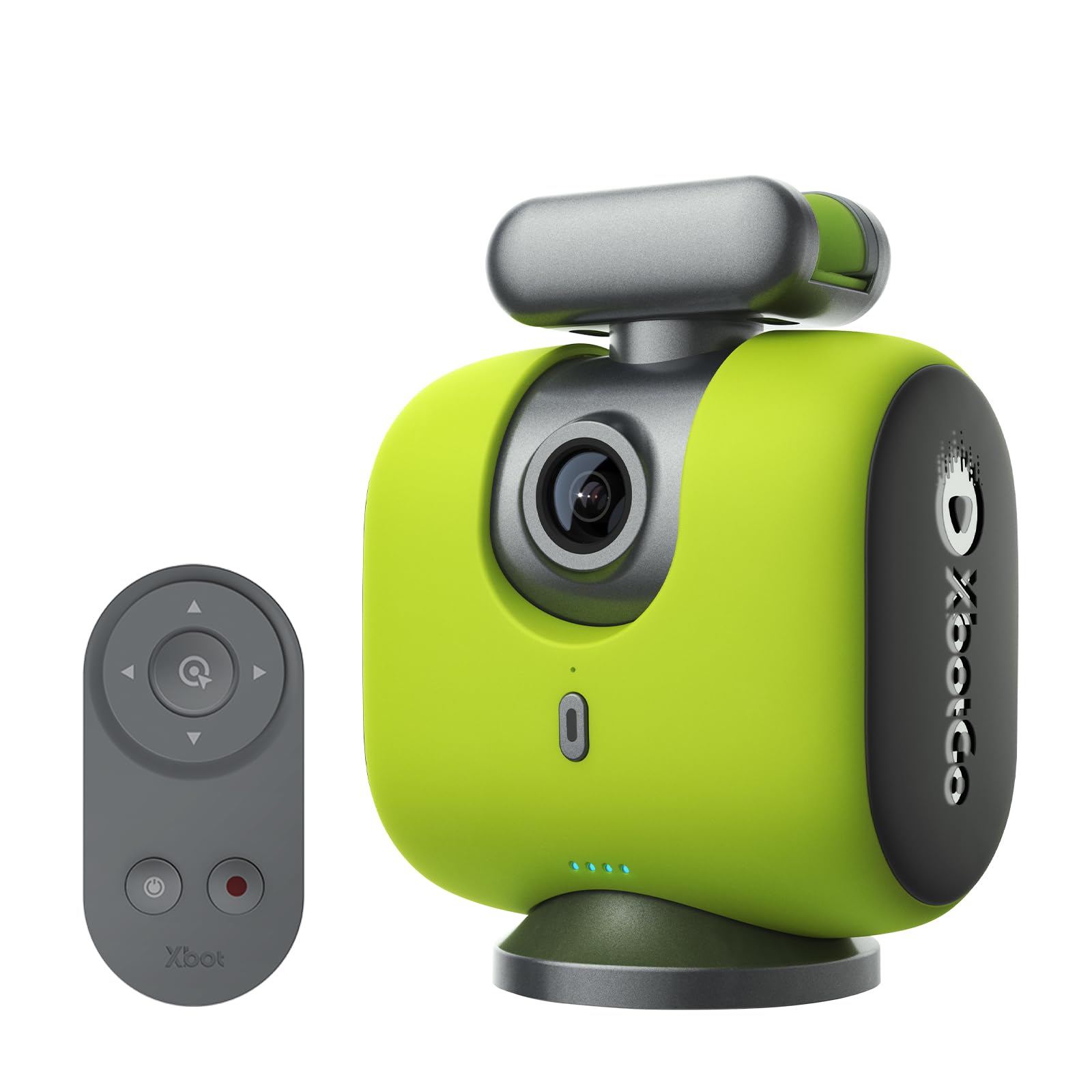
An AI-powered phone mount that follows the game so you can watch it live.
This is not a standalone camera — the XbotGo Chameleon is a motorized gimbal mount for your smartphone that uses AI to automatically track the entire team during soccer, basketball, football, or tennis. It records in 4K at 60fps with a 120° wide-angle lens and can stream live to YouTube, Facebook, or TikTok without any subscription fee, plus 20GB of free cloud storage. The camera quality is the most-praised aspect, with well over 100 owners calling out the professional-grade 4K video, while the AI tracking itself is the most-discussed topic overall — and it gets mixed marks for consistency.
Owners mention that the setup is easy and the tracking works well for soccer and basketball, especially when you use a second phone to overlay a live scoreboard. The Bluetooth remote lets you start and stop recording from the sideline, and the FollowMe mode can spotlight an individual player. The 8-hour battery life is enough for a full tournament, and the camera quality is described as “excellent” even for live broadcasts.
The honest caveat is that the AI tracking can get stuck occasionally, and the gimbal tilt may not be high enough for hockey or fast near-side action. Some owners found the manual lacking clear instructions and the learning curve steep. This is a tool built for parents and coaches who want to sit back and watch, not a professional broadcast solution.
The standout feature
- AI auto-tracking lets you enjoy the game live instead of filming it
- No subscription fees and 20GB free cloud storage keep ongoing costs at zero
- 4K 60fPS recording with a 120° wide-angle lens captures the whole field
The one thing to know
- AI tracking is the most-discussed feature and it gets mixed reviews — it can lose the action or get stuck
- Gimbal tilt range is limited for low-angle sports like hockey
Perfect for: soccer and basketball parents who want to capture the game hands-free and stream it live to family.
Not for: hockey or fast sideline-to-sideline sports where the gimbal tilt and tracking consistency fall short.
5. Xtra Muse Vlogging Camera

A pocket-sized camera with a gimbal built right into the body.
The Xtra Muse packs a 1-inch CMOS sensor and a 3-axis gimbal stabilizer into a body that fits in your jacket pocket, shooting 4K video at 120fps with no external rig needed. The built-in gimbal eliminates shake during running, hiking, or fast sideline movement, and the Master Follow mode keeps a subject centered in the frame even when you pivot or spin. The 2-inch touchscreen allows easy switching between horizontal and vertical shooting, and the 10-bit X-Log color mode captures up to one billion colors for flexible post-production.
Buyers describe the gimbal stabilization as “excellent” and note that the face and object tracking is reliable and fast. The compact size makes it a natural for vlogging your own sports experience — post-game commentary, training runs, or travel to events — without carrying a full camera bag. The battery life averages 161 minutes, which covers most sessions, though the battery life and microphone connectivity get mixed reviews from owners who pushed the limits.
The big draw is the value: owners call it a budget-friendly alternative to the DJI Pocket 3 that delivers near-identical quality and it is compatible with Pocket 3 accessories. The main shortfall is that the microphone connectivity is not universally praised — some owners found the audio connection finicky, and the included USB-C cable is the only charging method, so plan for a power bank on long shoots.
The gimbal-in-a-pocket: At 4K/120fps with a 1-inch sensor and 3-axis stabilization, the Xtra Muse delivers smooth, cinematic sports vlogs without the bulk of a separate gimbal.
The one caution: Microphone connectivity gets mixed marks — test your external mic setup before game day.
Ideal for: content creators who want smooth 4K slow-mo footage of their own training or travel without a gimbal rig.
Think twice if: reliable external audio is a must — some owners experienced finicky mic connections.
6. DJI Osmo Action 4 Adventure Combo

The previous-gen champion that still punches hard in low light.
The DJI Osmo Action 4 uses the same 1/1.3-inch sensor with 2.4µm pixel size as its successor, delivering exceptional low-light performance for dusk games and indoor arenas. It records 4K video at 120fps with a 155° ultra-wide field of view and minimal cropping, so your footage feels rich rather than zoomed in. The Adventure Combo includes three 1770mAh batteries and a multifunctional battery case, giving you up to 150 minutes per cell — enough for a full match without rushing to recharge.
Buyers overwhelmingly praise the image quality and video quality — these are the top two mentioned aspects — and call the stabilization “rocksteady” and “superb.” The camera is waterproof to 18 meters without a housing, and the magnetic quick-release system lets you switch from horizontal to vertical in seconds. The DJI OsmoAudio feature connects directly to a DJI Mic 2 transmitter without an external receiver, simplifying audio for interviews or commentary.
The honest note from owners is that saltwater submersion can be a weakness — beach soccer or ocean-side shoots should use the included lens hood or a housing. The 10-megapixel effective still resolution is lower than the Action 5’s 40 MP, so if you rely on frame grabs for social media, the extra resolution of the newer model is worth the upgrade.
Why it’s still a top pick
- Superior low-light performance thanks to the 2.4µm pixel size and large sensor
- Three-battery Adventure Combo gives you 450+ minutes of total record time
- Magnetic quick-release mount makes switching from horizontal to vertical easy
The trade-off vs newer models
- 10 MP effective still resolution is low for high-quality frame grabs — the Action 5’s 40 MP is a big step up
- Not ideal for saltwater use without a dedicated housing; rinse thoroughly after beach shoots
Best for: budget-conscious buyers who shoot primarily after sunset or in indoor sports facilities — the low-light performance here is class-leading for the price.
Skip if: you need high-resolution stills from video — the 10 MP frame grabs will feel limiting for social media.
7. Insta360 X5
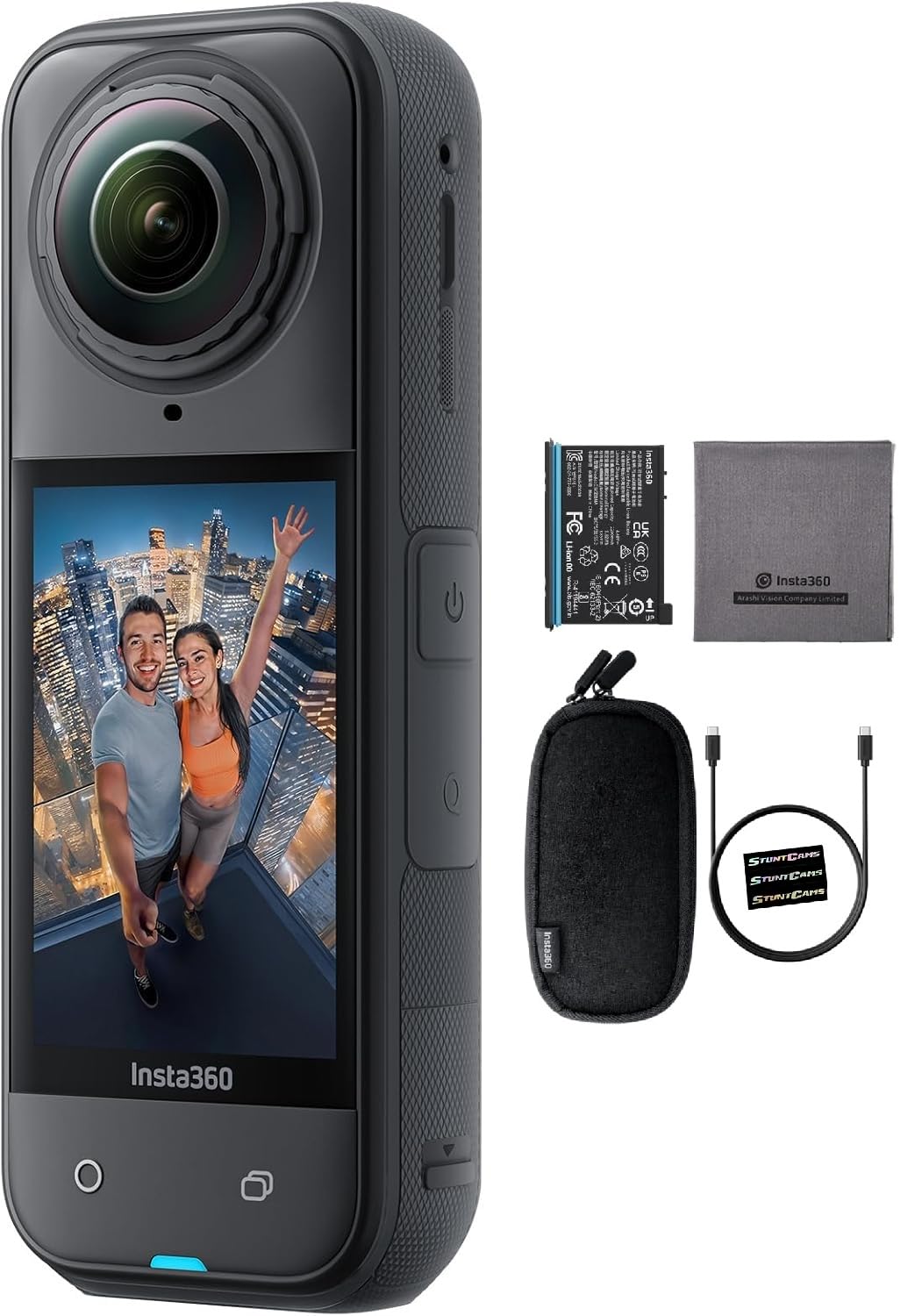
Shoot everything in 360°, then pick the angle you want after the play.
The Insta360 X5 captures 8K 360° video at 30fps using dual 1/1.28-inch sensors, meaning you never have to aim the camera — just mount it and capture the entire field. The 72-megapixel effective still resolution (a big jump from the Action 5’s 40 MP, for comparison) means you can reframe later and still print high-quality shots. The FlowState stabilization and full 360° Horizon Lock keep footage buttery-smooth even during full spins or bumpy rides, and the invisible selfie stick creates third-person shots that look like another person is filming you.
Buyers love the creative freedom — one long-time 360° photographer called it his favorite camera so far, and the InstaFrame mode lets you export a ready-to-share flat video instantly. The new replaceable glass lenses are scratch-resistant and water-repelling, so you can swap them in seconds if a mountain bike crash scuffs one up. A 4-mic array with an advanced Wind Guard reduces wind interference for clearer vlogs and narration during outdoor sports.
The catch is that 8K 360° is effectively two 4K cameras stitching together, so the per-lens resolution is lower than a dedicated 4K action cam if you crop in tight. The 185-minute battery life is solid, but the battery is not included in the box, which is an odd omission for a premium camera. The Insta360 app is essential for reframing, so factor in the time to edit after the game.
The creative machine: 360° capture means you never miss a moment — point the camera anywhere and choose the perfect angle in post.
The workflow reality: You need the app to reframe every clip, and the per-lens resolution is lower than a dedicated 4K camera when zoomed in.
Perfect for: content creators who want to capture cinematic “impossible” angles — drone-like follow shots or invisible selfie sticks — from a single mount.
Think twice if: you want maximum detail in a single direction — a traditional 4K action cam will outresolve a 360° crop at telephoto range.
8. GoPro HERO13 Black Action Camera

The most complete out-of-box shooting kit for instant action.
The HERO13 Black delivers 5.3K video at 60fps and 27MP stills, powered by HyperSmooth 6.0 stabilization that keeps even the roughest mountain bike or ATV footage silky smooth. It can also extract 24.7MP stills directly from your 5.3K video, which is useful for sharing a single frame from a game-winning play without pausing the recording. This bundle comes ready to shoot with a Handler floating grip, head strap mount, 64GB SanDisk microSD card, a carrying case, and a USB 3.0 OTG card reader — plus a 1-year warranty.
Buyers are uniformly positive, calling the stability “amazing” and the videos “incredible.” The camera is waterproof to 33 feet (10m) without additional housing, so rain or a splash from a water bottle never stops a take. The 2-hour battery life per Enduro battery is the standard for action cams at this resolution, and the bundle includes two batteries so you can swap mid-game.
The main limitation is that the 2-hour battery life per cell means you will want both batteries charged for a full tournament day. The 5.3K60 mode chews through storage fast — the included 64GB card holds roughly 45 minutes of high-bitrate footage, so budget for a larger card if you plan to film a full match.
Instant value: The comprehensive bundle — grip, head strap, dual batteries, 64GB card, case, and card reader — means you can film your first game right from the start without extra purchases.
The storage note: 5.3K60 fills a 64GB card in under an hour, so buy a 256GB or 512GB card for uninterrupted match coverage.
Best for: first-time buyers who want everything included — no separate battery or memory card purchase needed.
Who should look elsewhere: marathon event shooters — two 2-hour batteries may not cover a full tournament day without recharging.
9. Canon EOS R7 Mirrorless Camera

A crop-sensor mirrorless built to chase fast-moving subjects.
The Canon EOS R7 is a mirrorless body with a 32.5-megapixel APS-C CMOS sensor that gives you powerful telephoto reach — the crop factor means a 100mm lens effectively becomes a 160mm field of view, perfect for sideline sports where you cannot get close to the action. It fires 15fps with the mechanical shutter and 30fps with the electronic shutter, with a RAW Burst Mode that captures half a second before you fully press the shutter. The Dual Pixel CMOS AF system uses up to 651 AF zones that cover approximately 100% of the frame width and height, and customers note the autofocus can lock onto a bird’s eye — so tracking a running player is easy.
Owners praise the image quality as incredible and the shooting speed as smooth, noting that the 5-axis IBIS (up to 7 stops of shake correction) makes handheld telephoto shots usable without a monopod. The camera records 4K video with Movie Servo AF and subject tracking, and the two UHS-II SD card slots give you redundancy during critical shoots. The battery life is better than typical mirrorless cameras, according to multiple owners, and the compact size makes it easy to pack alongside a second body.
The honest downside: some reviewers point out focus issues when using non-Canon lenses like the Sigma 150-600mm, so stick to RF or adapted EF glass for reliable performance. The rolling shutter effect is mentioned as mixed in reviews, meaning fast panning can warp vertical lines. This is a semi-pro body — it lacks the full-frame low-light reach of the Nikon Z 8 or Sony FX3 but costs a fraction and delivers incredible value for wildlife and field sports.
The sports photographer’s choice
- 32.5MP APS-C sensor provides a 1.6x telephoto reach — perfect for distant field action
- 30fps electronic shutter with pre-shooting RAW Burst captures the exact moment of impact
- In-body stabilization up to 7 stops keeps telephoto shots sharp without a monopod
One thing to plan for
- Autofocus reliability drops with third-party lenses — stick to Canon RF or adapted EF glass for best results
- Rolling shutter can warp lines during fast pans, though most owners rarely notice it
Reach for this if: you photograph field sports from the stands and want maximum telephoto reach from a lightweight, fast-firing body.
Hold back if: you rely on third-party lenses for telephoto — the AF struggles with non-Canon glass like Sigma or Tamron.
10. GoPro HERO11 Black Mini

A stripped-down, lightweight action cam for minimal helmet setups.
The HERO11 Black Mini is the smallest GoPro in the lineup, designed for one-button simplicity on a helmet or handlebar where space and weight are at a premium. It shoots 5.3K video at 60fps and lets you grab 24.7-megapixel photos from your video using the GoPro Quik app — so you can snap a frame from a replay without stopping the recording. The Emmy Award-winning HyperSmooth 5.0 stabilization includes Horizon Lock and AutoBoost, keeping your POV footage silky smooth even on rough terrain.
Buyers who love the Mini call it “basic, simple, small” with crisp video and praise its lightweight, miniature size for helmet mounting. The fold-away metal mounts are clever for quick attachment. On the flip side, the most-discussed topics among owners are reliability and battery life — both rated negative in reviews — with multiple reports of the camera stopping working suddenly and the non-replaceable battery dying after short use. The battery only lasts about 45 minutes in real-world use, and the camera is reported to overheat.
This is a polarizing camera: when it works, owners love its simplicity and compact design. But the reliability concerns and sealed battery make it a higher-risk pick than the HERO13 Black or DJI alternatives. If you are dead-set on the smallest possible helmet camera and can manage the battery limitations, it delivers fantastic image quality for short sessions.
The lightest POV option: At the smallest size in the GoPro lineup with 5.3K60 and HyperSmooth 5.0, the Mini is perfect for minimal helmet rigs where every gram counts.
The big risk: Battery life averages only 45 minutes and is not replaceable — once it degrades, the whole camera is affected.
Best for: short, intense POV sessions — a single downhill run or a short dirt bike lap — where ultra-compact size outweighs battery concerns.
Avoid if: you need more than 45 minutes of continuous recording or worry about a non-serviceable battery.
11. GoPro MAX2

True 8K 360 capture that reframes into traditional 4K later.
The GoPro MAX2 records true 8K 360 video using replaceable glass lenses that are water-repelling and scratch-resistant. The key benefit is the “never aim” approach — you hit record and capture everything around you, then use the GoPro Quik app to reframe your 360 footage into standard 4K clips after the action is over. The invisible mounting means a pole disappears from the frame, giving you drone-like follow shots or selfies that look like a second person is recording you.
Buyers praise the video quality as professional-grade and note that the HyperSmooth horizon leveling is flawless even when spinning the camera. The 6-microphone array captures ambisonic audio with perspective shift, so the sound follows the direction you look in the final edit. The dual 360/Hero modes let you switch to traditional action camera mode instantly, and the camera is waterproof without a housing.
The trade-off is the heat — shoppers say the MAX2 gets hot during extended 8K recording, and the battery life is shorter than hoped. One owner returned it for a HERO13 Black because of the heat issues. The large 8K file sizes also require significant cloud or local storage. If you are not committed to the reframing workflow, a standard action cam is simpler and cooler-running.
The no-miss shot: 8K 360 capture means you never aim the camera — every angle is captured and can be reframed later into a 4K clip.
The heat reality: Extended 8K recording can overheat the camera, and battery life is shorter than traditional action cams in 360 mode.
Ideal for: creative athletes and filmmakers who want to capture rich 360° POV and then reframe the perfect shot in post.
Not for: long continuous recording sessions — the heat and battery limits make it better for short, dynamic clips.
Understanding the Specs
Frame Rate (fps)
Frames per second (fps) is how many individual images the camera captures each second. For sports, 60fps is the baseline for smooth slow-motion — it captures twice the information of standard 30fps video. At 120fps, you can slow the final playback to 25% speed and still see every detail of a goal kick or a sprint finish. Action cameras often advertise “4K/120fps,” which is the balance for sports filming.
Stabilization
A camera’s stabilization system compensates for your movement — walking, running, or bumpy vehicle rides. Electronic stabilization (like GoPro’s HyperSmooth or DJI’s HorizonSteady) crops the sensor slightly and uses gyroscopic data to smooth out the frame. Some cameras add Horizon Lock, which keeps the horizon perfectly level even if the camera rotates a full 360 degrees. A physical gimbal (like the Xtra Muse’s 3-axis stabilizer) uses motors to physically hold the camera steady.
Sensor Size
The sensor is the part of the camera that captures light. A larger sensor (like a 1/1.3-inch or full-frame) lets in more light, so footage stays clean and less grainy in low-light situations like evening games or indoor arenas. The “megapixel” count (MP) tells you the resolution of still images and video frames — a 40 MP sensor gives you very high-resolution frame grabs, while a 10 MP sensor is more limited for cropping or printing stills.
Waterproofing
Waterproof ratings like “IP68” or “waterproof to 10m/33ft” tell you how deep the camera can go without a separate housing. For outdoor sports in rain, snow, or mud, any waterproof action camera is sufficient. For surfing, diving, or intense water sports, you need either a dedicated waterproof housing or a camera rated for the depth you plan to use. Saltwater requires rinsing the camera in fresh water after every use to prevent corrosion.
FAQ
What does 4K/120fps mean for filming sports?
Is an action camera or a mirrorless camera better for filming sports?
How important is image stabilization for sports video?
Can I use a smartphone to film sports instead of a dedicated camera?
What is the difference between 360 video and traditional action camera video?
What type of memory card do I need for 4K or 5.3K sports video?
Can I use an external microphone with an action camera for sports filming?
How long does a battery last when filming sports at high frame rates?
What is the best camera for filming soccer from the sideline?
Can an action camera overheat during long sports filming sessions?
Final Thoughts: The Verdict
If you want one dependable pick, the best camera for filming sports is the DJI Osmo Action 5 Pro Adventure Combo because it combines 4K/120fps video, a 40-megapixel sensor, and a three-battery system that outlasts any tournament day without overheating. If your budget allows and you need the highest possible resolution for professional video work, the Nikon Z 8 is the top-tier choice with 8K/60p and class-leading autofocus tracking. And for parents and coaches who want to capture the game without holding a camera, the XbotGo Chameleon is a clever AI-powered solution that tracks the action automatically and streams it live.
How We Picked
We do not accept paid placement. Every pick is matched to a real buyer and a real use-case; we do not hands-on test units.
Sources & Methodology
Specifications: manufacturer listings and product documentation. Review insights: verified customer reviews, as of July 2026. Pricing: not shown on this page (it changes often); check the current price via the retailer link.
As an Amazon Associate, Gadgets Feed earns from qualifying purchases. This does not affect which products we feature.