
Our readers keep the lights on and my morning glass full of iced black tea. As an Amazon Associate, I earn from qualifying purchases.
Specs are compiled from manufacturer listings and verified buyer reviews and can change over time — please confirm the key details on the product page before buying.
A camera for your front door needs to do one thing above all else — reliably show you who is there and what they are doing, day or night, without lag or constant battery anxiety. The wrong pick leaves you with blurry faces at night, notifications that arrive too late, or a dead battery right when a package gets dropped off. This guide compares seven of the most popular options side-by-side, using real specs and real owner experiences, so you can pick the one that actually fits your door, your tech setup, and your patience for subscriptions.
I’m Min — the founder and writer behind Gadgets Feed. This guide is built by comparing the manufacturers’ published specifications and the patterns across verified customer reviews, so you get each pick’s real strengths and trade-offs instead of marketing spin.
After weighing video resolution, field of view, night vision quality, battery life, and smart-home compatibility across dozens of verified owners’ reports, these seven models represent the clear standouts for anyone shopping for a camera for front door.
Our Picks at a Glance
How To Choose The Best Camera For Front Door
Finding the right camera for your front door starts with matching a few key specs to your actual door setup and your Wi-Fi network. Here are the three things that matter most before you click buy.
Video Resolution and Field of View
Higher video resolution (2K or 4K) means you can zoom in on a delivery label or a visitor’s face and still read the detail. But resolution alone does not tell you how much of your porch you can see — that is the field of view, measured in degrees. A 150° to 166° wide view shows a person head to toe and catches packages sitting right against the door, while a narrower view may miss things at the edges. The trade-off is that a wider field can distort edges slightly, so look for a model that balances width and sharpness.
Battery Life vs. Wired Power
Battery-powered doorbells let you install anywhere without existing doorbell wiring, but you will need to recharge or replace the batteries on a schedule — some models last two years on lithium AA cells, while rechargeable packs may need a top-up every one to six months. Wired models give you constant power and no battery anxiety, but they require existing low-voltage doorbell wiring and typically disable your mechanical chime, so you may need a separate Wi-Fi chime. If you rent or have no doorbell wires, a battery model with a long-lasting pack is your only option.
Subscriptions and Local Storage
Many front door cameras require a monthly subscription to open up video recording, person detection, or package alerts. Others let you record to a local microSD card (sold separately) with zero monthly fees. Before choosing, decide if you are willing to pay to per month per camera for cloud storage and AI alerts. If the answer is no, look for a model that explicitly says “no subscription required” for local recording — but double-check that it supports a microSD card and that the card format (FAT32, exFAT) matches your computer.
Quick Comparison
| Model | Best For | Video Resolution | Field of View | Power Type | Amazon |
|---|---|---|---|---|---|
| Blink Video Doorbell + Outdoor 4★ Best Overall | Battery life champs | 1080p HD | Head-to-toe | Battery | Amazon |
| Google Nest Doorbell (Wired, 3rd Gen)Also Great | Google ecosystem users | 2K HDR | 166° | Wired | Amazon |
| Ring Battery Doorbell Pro | Best 4K resolution | 4K | Wide-angle | Battery | $249.99Amazon |
| Wyze Battery Video Doorbell | Value with free local storage | 1536×1536 HD | 150° x 150° | Battery/Wired | $65.98Amazon |
| Tapo 2K Wireless Smart Video Doorbell D205 | No-subscription local recording | 2K | 160° | Battery | $49.99Amazon |
| Chamberlain myQ Video Doorbell | Garage integration | 2K | 150° | Battery/Wired | $47.93$99.99Amazon |
| Ring Wired Doorbell | Budget wired pick | 2K | Wide-angle | Wired | Amazon |
In‑Depth Reviews
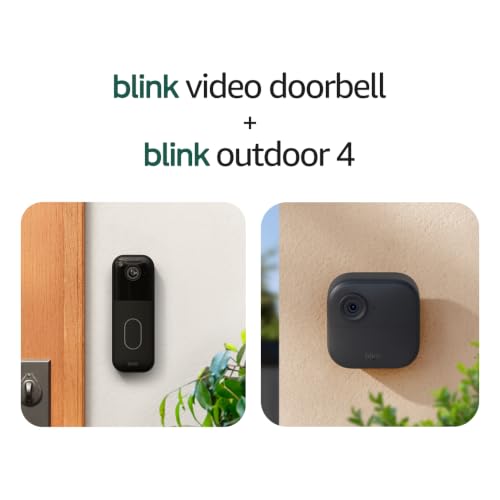
1. Blink Video Doorbell + Outdoor 4
Our pick — 4.5★ from 900+ verified ratings; the strongest balance of quality and price.
The set-and-forget system that runs for two years on standard AA batteries.
This bundle includes both a Video Doorbell and an Outdoor 4 camera, giving you two viewpoints for the price of one. The headline spec is the two-year battery life on both devices using included AA Energizer lithium batteries — no recharging, no cables, just replace the cells after two years. The Video Doorbell offers a head-to-toe HD view while the Outdoor 4 adds a wider field and dual-zone motion detection that alerts you faster, making this a solid whole-housefront setup rather than just a single doorbell.
Buyers consistently praise the easy five-minute setup and the reliability of the two-year battery claim, calling it “crisp security monitoring with phenomenal battery life.” The catch is that the Sync Module Core (included) is essential for connectivity, and the free 30-day trial of the Blink Subscription Plan expires — after that, cloud storage costs extra. The video is 1080p, which is fine for daytime but not as sharp as the 2K or 4K competitors, and the field of view is narrower than the Nest or Tapo.
Compared to the Wyze below, the Blink system gives you two cameras versus the Wyze’s one and vastly longer battery life (two years vs the Wyze’s claimed six months). But the Wyze offers free local SD recording, while Blink’s free storage is limited to the trial period. If you hate the idea of recharging a doorbell and want multi-camera coverage, this system handles the chore for years.
Why it wins
- Two-year battery life on standard AA Energizer lithium cells — no recharging ever
- Bundle includes both a doorbell and a second outdoor camera for dual-angle coverage
- 1080p HD video with infrared night vision provides clear daytime and nighttime viewing
- Head-to-toe view on the doorbell captures packages on the ground
- Blink Sync Module Core is included for local connectivity
Where it falls short
- 1080p resolution is lower than every other model here — less detail when you zoom in
- Requires a Blink Subscription Plan for cloud storage beyond the 30-day trial
- No local microSD card slot for free local recording
- Field of view is narrower than the Nest, Tapo, or Wyze options
- Some buyers find the Blink app slower than competitors
Best for: anyone who wants to install a doorbell camera and forget about charging it for years — especially if you want a second outdoor camera bundled in.
skip it if: you need 2K or 4K video to read small details, or you refuse to pay for cloud storage after the first month.
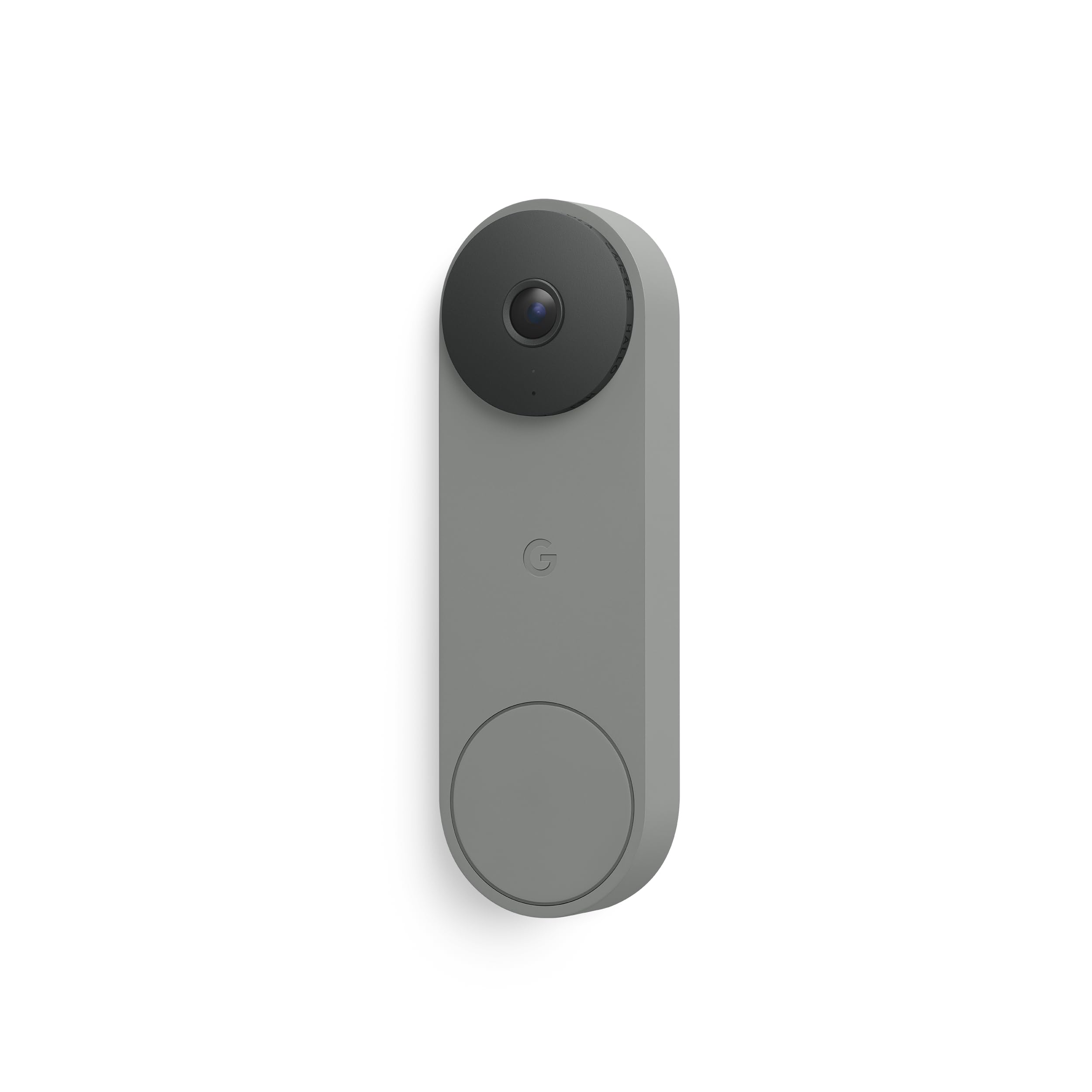
2. Google Nest Doorbell (Wired, 3rd Gen)
The wired performer that keeps watching without ever asking for a charge.
This model is best for anyone already living inside Google’s ecosystem — it speaks directly to Google Home and Gemini, and the wired power means you never touch a battery. The 2K HDR video delivers the highest resolution Nest has offered yet, and the expanded 166° field of view is the widest in this list, so you see not just your visitor but also packages set down at your feet. Buyers report the night vision is excellent and that the Gemini integration distinguishes between people, packages, and vehicles with very few false alarms.
The catch is the subscription. Without a Google Home Premium plan, you lose smart alerts like “person with flowers” and detailed event summaries. Also, because it is wired, it requires existing low-voltage doorbell wiring and a transformer that can handle it — a few reviewers needed a transformer upgrade during installation. At 0.31 pounds and 5.16 x 1.65 x 1.14 inches, it is notably smaller than the Ring wired model, so it fits tighter door frames.
Compared to the Ring Battery Doorbell Pro below, the Nest trades the freedom of battery placement for a constant power feed and a wider field of view (166° vs wide-angle). If your door already has wires and you want the widest possible porch coverage without recharging, this is the pick.
What stands out
- 2K HDR delivers crisp video that lets you read labels and identify faces — owners mention it is a clear upgrade over the previous generation
- 166° field of view is the widest of any model here, so you see head to toe and packages against the door
- No battery to recharge — wired power runs continuously
- Gemini smart alerts recognize unfamiliar faces, packages, and vehicles
- Encrypted video storage and two-step verification keep your footage secure
What to watch for
- Requires a Google Home Premium subscription (sold separately) for the most useful AI alerts
- Wired-only — you cannot install it where no doorbell wires exist
- 1:1 aspect ratio means vertical video; the image is square, not widescreen
- No built-in chime — you will need a Google Nest Hub or similar device for in-home ringing
- Some buyers found the app menu less intuitive than other brands
Reach for this if: your door has working wires, you are already in the Google Home ecosystem, and you want the widest view available with no battery chores.
Look elsewhere if: you do not want to pay for a subscription after the first year, or you have no doorbell wiring at your front door.
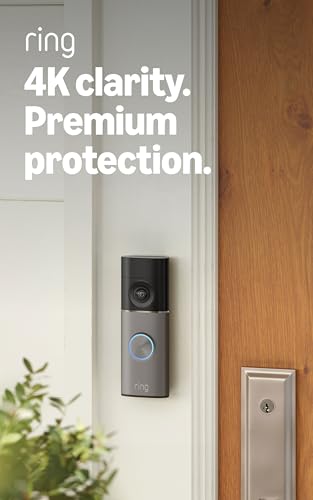
3. Ring Battery Doorbell Pro (newest model)
The highest-resolution battery doorbell that zooms in on details from across the porch.
This is the only model in the lineup with Retinal 4K video, and the 10x Enhanced Zoom means you can read a license plate or a shipping label from a solid distance away. Customers note that the video is sharp both day and night, and the Night Vision keeps color visible longer before switching to black-and-white in total darkness. The radar-powered 3D Motion Detection gives you real-time phone alerts that are more precise than standard PIR (passive infrared) sensors — it knows not just that something moved but roughly where and how fast.
The trade-off is battery life. While the Quick Release Ultra Battery Pack is the fastest-charging Ring battery yet — you can swap it out in seconds — multiple reviewers point out that 4K video and radar processing drain it faster than standard Ring doorbells. The model also requires a Ring Protect subscription (sold separately) to record and review past footage. It is also the most expensive pick here, so this is aimed squarely at buyers who prioritize the absolute best image quality over keeping costs low.
Compared to the Google Nest above, the Ring Pro gives you battery freedom (no wires needed) and a 4K image that is literally double the pixel count of the Nest’s 2K. But it trades the wider 166° view for a narrower wide-angle lens, and it demands more frequent recharging. If your front door has no wiring and you want the sharpest zoom available, this is your call.
The strong points
- 4K video is the highest resolution available — read small print from across the porch
- 10x digital zoom lets you inspect faces and package details after capture
- Quick Release Ultra Battery Pack swaps in seconds without tools
- Audio+ provides clearer two-way talk than standard Ring models
- Radar-based 3D motion detection reduces false alerts from leaves or passing cars
The weak points
- Battery life takes a hit from the 4K sensor — shoppers say needing to recharge more often than with 1080p models
- Requires a Ring Protect subscription to record and review video history
- No local microSD slot — all storage is cloud-only
- Price is the highest in this lineup
- Mount screws feel less secure than previous Ring generations, per some owners
Grab it for: the best video clarity of any battery doorbell — ideal if you need to zoom in on a delivery label or identify a face from across a long driveway.
Pass if: you are not willing to pay a monthly subscription for recording, or you need a wide field of view to capture packages at the sides of your door.
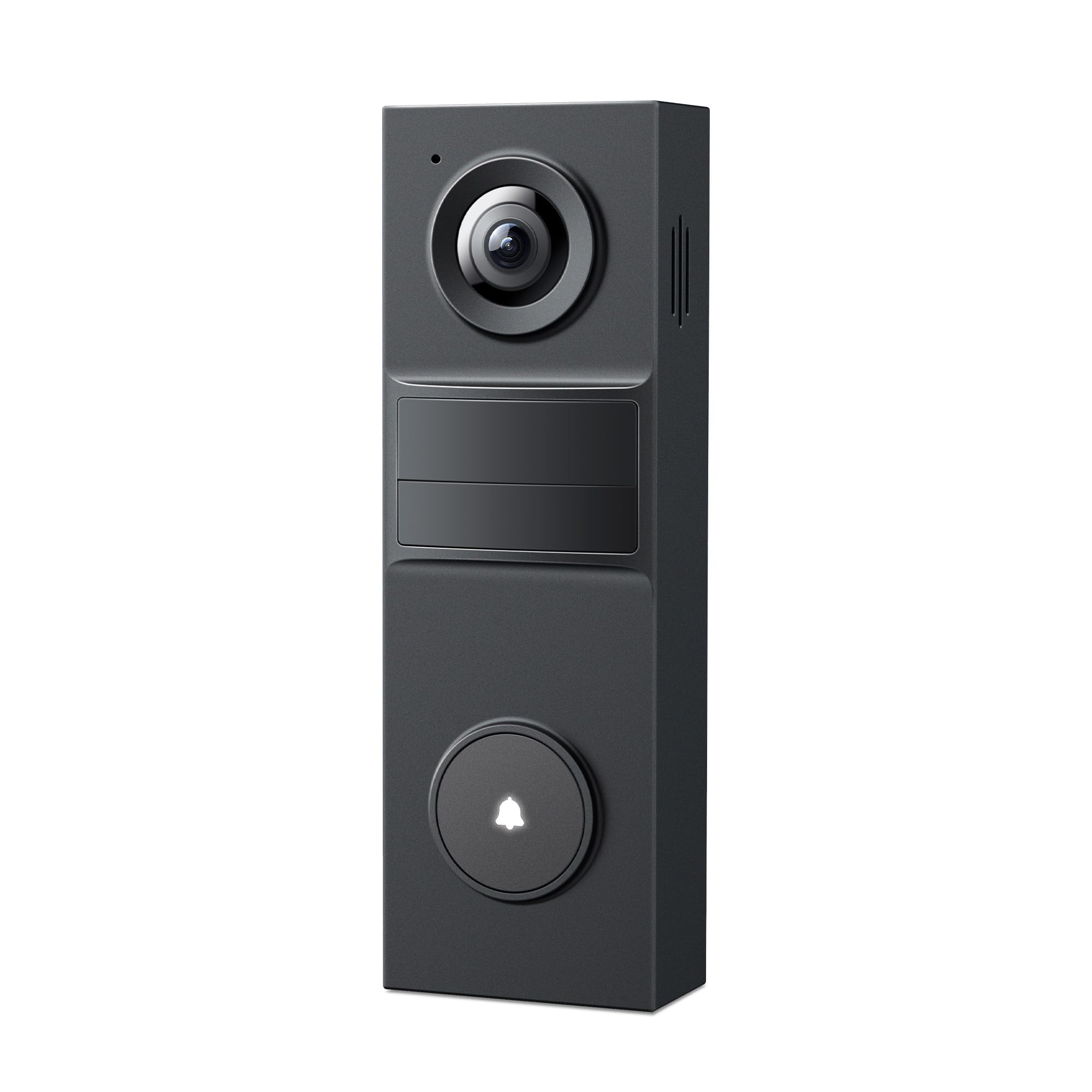
4. Tapo 2K Wireless Smart Video Doorbell D205
The no-subscription doorbell that records to a microSD card for zero monthly fees.
This model stands out because it lets you store recordings on a microSD card (sold separately, supports up to 512GB) with absolutely no monthly fee — the built-in AI person detection and alerts are also free. The 2K resolution is sharp, and the 160° field of view is wider than the Chamberlain myQ’s 150° below, giving you a wider view of your entryway. Buyers report the picture is crisp, the night vision works well, and the battery lasts about five months per charge on the 5,200mAh rechargeable pack — one owner specifically called out “battery lasts ~5 months per charge.”
The main limitation is that the chime is not included — you need to buy a compatible Tapo chime separately if you want an audible indoor ring. Also, battery-powered design means you cannot run RTSP (real-time streaming protocol) streams for advanced home automation systems like Home Assistant or Scrypted, which some reviewers found disappointing. The IP54 weather resistance handles rain and dust, so it can stay on the door year-round.
Compared to the Chamberlain myQ below, the Tapo offers a wider field of view (160° vs 150°) and free local recording without a subscription. The Chamberlain, however, integrates with the myQ garage door opener app and offers color night vision. If avoiding monthly fees is your priority, the Tapo is the better route.
What gives it an edge
- Free local recording on microSD card up to 512GB — no subscription required
- 2K resolution provides clear video for identifying visitors and reading labels
- 160° ultra-wide field of view
- IP54 weather-resistant casing handles rain and dust
- Built-in AI person detection is free — no subscription fees for smart alerts
- Custom activity zones let you monitor specific areas of your porch
Where it compromises
- Chime is not included in the box — you need to buy a separate Tapo chime
- Battery-powered design prevents RTSP streaming for advanced home automation setups
- Two-way audio gets muffled beyond five to six feet, per reviewers
- No wired power option — you will recharge every five months
Choose it for: free local recording with no monthly bills, a wide 160° view, and a reliable five-month battery cycle.
Avoid it if: you need an indoor chime included in the box or you rely on Home Assistant integrations that require RTSP support.
5. Wyze Battery Video Doorbell
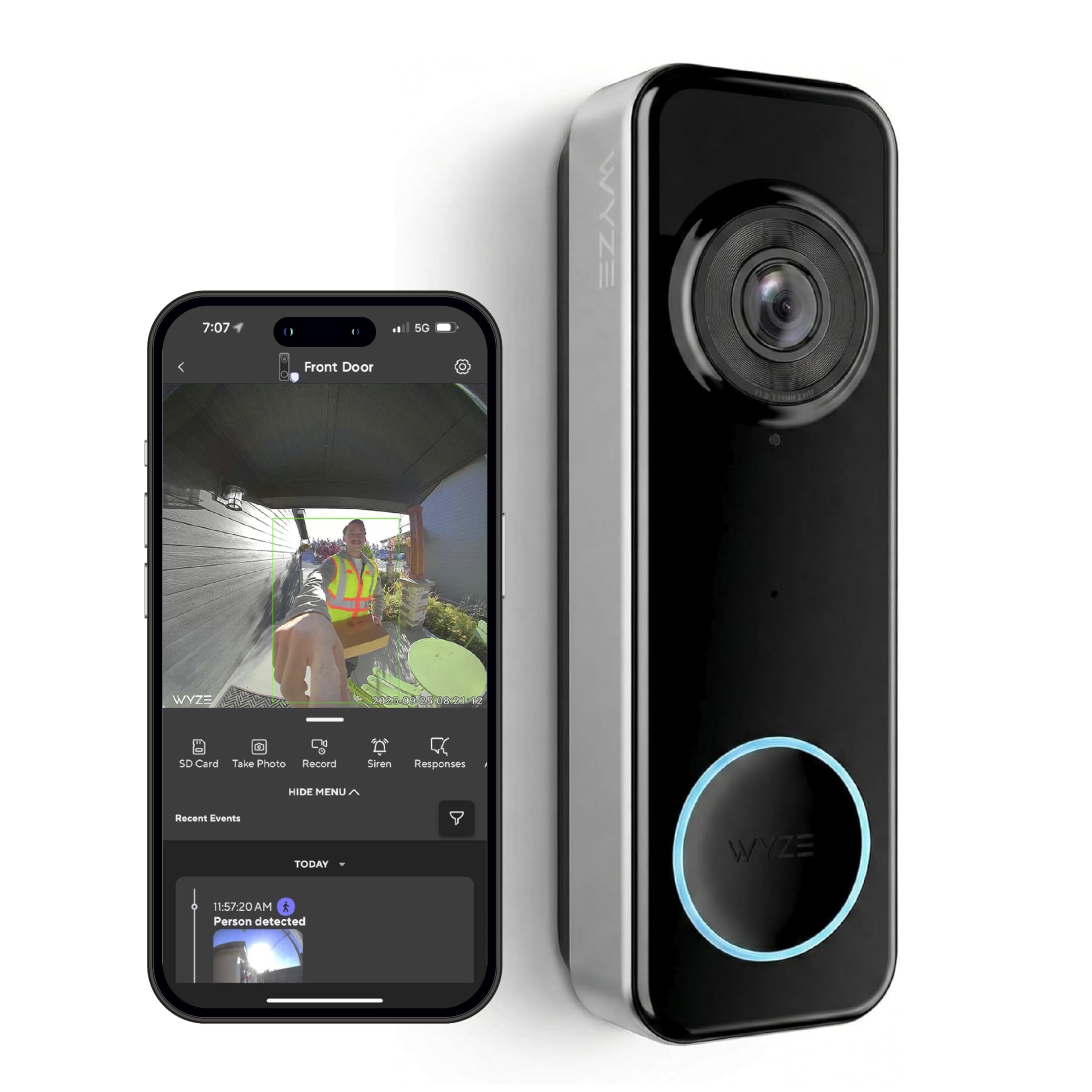
The square-format doorbell that shows everything head to toe, packages included.
Wyze takes a different approach by using a 1:1 square aspect ratio (1536×1536 HD) instead of the typical widescreen rectangle. The 150° x 150° ultra-wide field of view sees equally in both dimensions, which means you capture a visitor’s full height and packages right on your doorstep without the fisheye distortion that widescreen lenses sometimes produce. The built-in starlight sensor amplifies low light to deliver color images at night, and you can store recordings locally on a microSD card (sold separately, up to 256GB) without paying any monthly fee.
Buyers found the setup easy — “another Wyze winner” one reviewer called it — but a handful reported that the battery falls well short of the claimed six months, with some seeing a 35% drain in just one month. The motion detection also struggles when facing through a window, and the camera attachment is not especially secure, so someone could easily remove the unit from the mount.
Compared to the Tapo above, the Wyze gives you a square video shape that is better for catching packages at ground level, but the Tapo’s 2K resolution is sharper for zooming in on faces. The Wyze also offers both battery and wired power options, while the Tapo is battery-only. If you want a flexible power choice and a head-to-toe square view with free local storage, the Wyze packs a lot of value.
Why it works
- 1:1 square format captures visitors head to toe and packages on the ground
- Free local recording on microSD card up to 256GB — no subscription needed
- Starlight sensor provides color night vision in low light
- Can be used wire-free on battery or hardwired for continuous power
- Instant Bluetooth setup with no screws required
Where it disappoints
- Battery life is significantly less than the claimed six months — some owners mention 35% drain in one month
- Camera unit is not securely attached to the mount, making it easy to remove
- No sound detection for audio-based alerts
- Alexa doorbell integration does not work reliably per some reviewers
- Slow video retrieval from cloud storage when using the app
Best for: buyers who want free local SD storage with a square image that catches both the person and the package at their feet.
Pass if: you need reliable six-month battery life or a securely locking mount that prevents the camera from being swiped.
6. Chamberlain myQ Video Doorbell
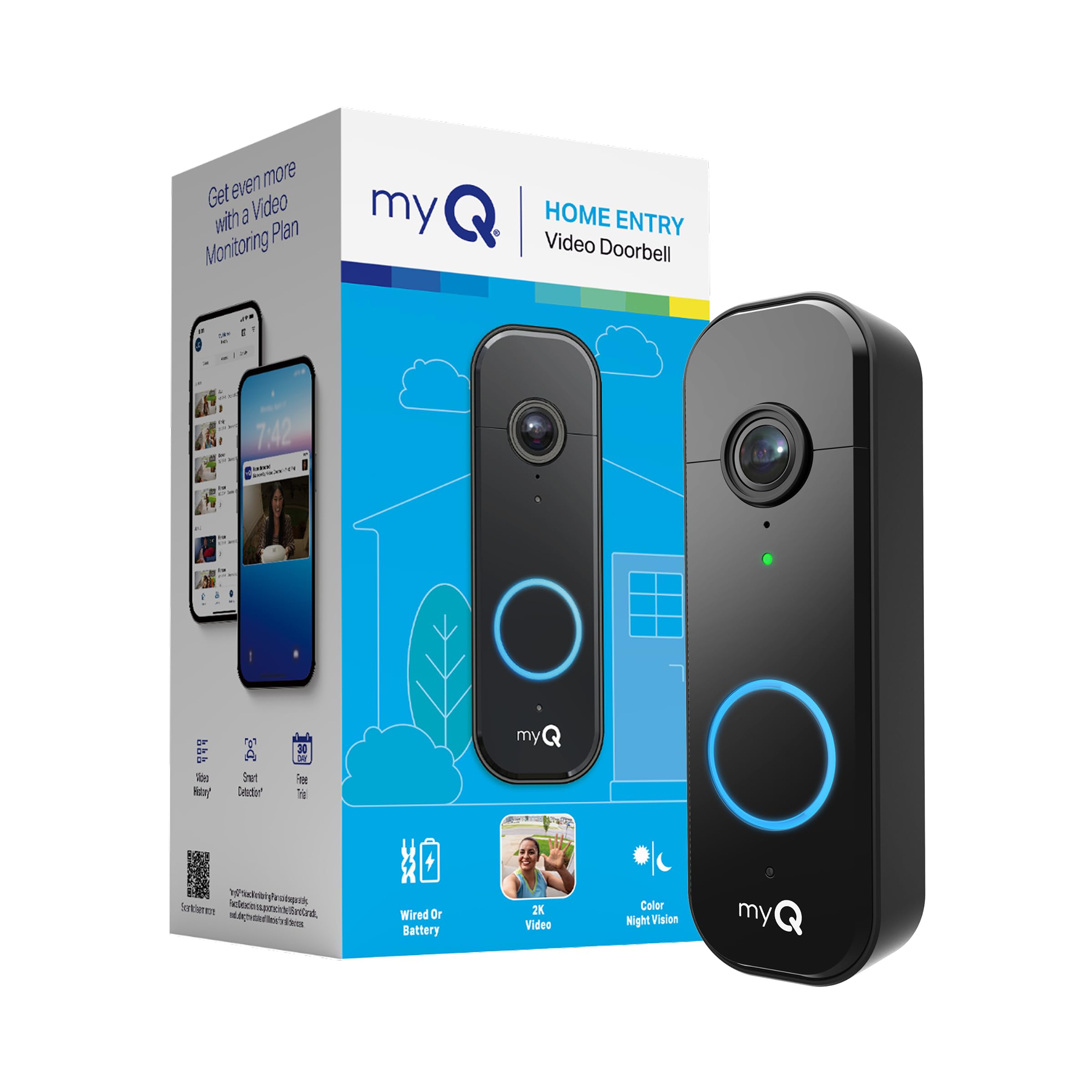
The doorbell that talks to your garage opener, but demands a subscription to record.
If you already have a myQ smart garage opener, this doorbell integrates with the same myQ app, letting you see who is at your front door and check your garage door from one screen. The 2K video with Color Night Vision captures detail around the clock through a 150° wide-angle lens — that is 7% narrower than the Tapo’s 160° view, but still wide enough to see the full visitor and nearby packages. It can run on battery or be hardwired to your existing chime, giving you flexibility based on your door’s wiring situation.
The catch is significant. Without a myQ Video Monitoring Plan (sold separately, around per year), the doorbell only sends a motion notification — it does not record any video at all, so you cannot rewatch what happened. Buyers also report a “major delay: 3+ sec audio lag, 5+ sec notification lag,” which is poor for real-time conversation or catching a delivery person who moves fast. Setup requires a 2.4GHz Wi-Fi connection and will not work with 5GHz networks, which is not clearly disclosed in the specs.
Compared to the Tapo above, the Chamberlain myQ offers color night vision and garage integration, but the Tapo beats it on field of view (160° vs 150°), offers free local recording, and has better real-time response. If you do not own a myQ garage opener, there is little reason to pick this over the competition.
What it does well
- Integrates with myQ smart garage openers for unified app control of door and garage
- Color Night Vision provides detailed images even in very low light
- Can be used as battery-powered or hardwired to an existing chime
- 2K resolution offers sharp video for visitor identification
- AI alerts can recognize familiar faces with the paid subscription
What holds it back
- Requires a /year subscription for any video recording — without it, you get only motion notifications
- Significant audio delay (3+ seconds) and notification delay (5+ seconds), per reviewer reports
- Setup only works on 2.4GHz Wi-Fi, not 5GHz — not clearly stated in product specs
- At 5.71 x 1.89 x 1.34 inches, it is slightly larger than the Tapo (5.51 x 1.81 x 1.19 inches)
- No local microSD storage option
Consider it if: you already own a myQ garage opener and want to manage your door and garage from one app.
pass on it if: you want real-time talk without lag, free recording without a subscription, or you hate being locked into 2.4GHz-only Wi-Fi.
7. Ring Wired Doorbell (newest model)
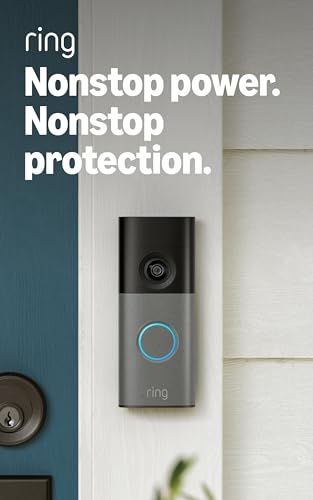
The budget wired option that leans heavily on a subscription for full features.
This is the most affordable wired option in the lineup, connecting directly to your home’s existing doorbell wiring so you never deal with battery recharging. The Retinal 2K resolution with up to 6x Enhanced Zoom provides a clear view of your front door area, and Live View plus Two-Way Talk lets you speak to visitors in real time through the Ring app. It works with Alexa for hands-free announcements — Echo Dot can call out “someone is at the front door” and Echo Show can display the live feed.
The fine print is that the full feature set, including video recording history and AI-powered alerts, requires a Ring Protect subscription sold separately. Buyers also report that it disables your existing mechanical chime — you will need to either buy a separate Ring Chime for in-home ringing or rely on phone notifications. Some customers note it is bulky, needing 2 to 3 inches of depth, and the lack of a wire cavity means you have to seal the gap with silicone to keep out moisture.
Compared to the Google Nest Doorbell above (also wired), the Ring Wired gives you a lower price point and 6x zoom versus the Nest’s 166° wider view. The Nest offers crisper HDR video and deeper Google Home integration, but it comes at a higher cost. If you want a wired doorbell on a tight budget and already use Alexa, this is the most accessible entry point.
What works
- Wired power means no battery to recharge, ever
- Retinal 2K video with up to 6x zoom captures faces clearly
- Alexa integration provides hands-free announcements on Echo devices
- Real-time Live View and Two-Way Talk work immediately
- Angled mounting plate included for positioning on perpendicular walls
What does not
- Disables your existing mechanical chime — requires a separate Ring Chime (sold separately) for in-home ringing
- Requires Ring Protect subscription for video recording and AI alerts
- Bulky design needs 2 to 3 inches of clearance; gap around the base requires silicone sealing
- Night vision image quality is worse than the previous Ring model, per some reviewers
- No local storage option — all video is cloud-only
Go for it if: you have existing doorbell wiring, you use Alexa, and you want the lowest-priced wired option that still offers 2K video.
Avoid it if: you do not want to pay for a second Ring Chime, or you need to keep your existing mechanical doorbell chime working.
Understanding the Specs
Video Resolution
Resolution determines how much detail you can see when you zoom in on a face or a package label. Standard HD (1080p) is clear enough for daytime identification. 2K offers noticeably sharper detail — enough to read a name badge or tracking number. 4K goes further, letting you make out small text from across a wide porch. Higher resolution also uses more bandwidth and storage, so factor in your home Wi-Fi speed and whether you plan to record locally or to the cloud.
Field of View
Field of view is measured in degrees and controls how much of your porch you can see. A 150° to 160° range is standard and captures a visitor from head to toe plus packages on the ground. Wider views (166°) give you more peripheral coverage but may introduce slight fisheye distortion at the edges. Square-format doorbells (like the Wyze 150° x 150°) provide equal vertical and horizontal coverage, which is especially useful for catching packages tucked right against the bottom of the door.
Battery Life vs. Wired Power
Battery-powered doorbells offer flexible installation but need recharging on a schedule — lithium AA batteries can last up to two years in low-draw models, while rechargeable packs typically need a top-up every one to six months depending on temperature and activity. Wired models offer constant power but require existing doorbell wiring and may disable your mechanical chime, meaning you will need a separate Wi-Fi chime. Check your doorframe for wires before deciding.
Storage and Subscription
Some doorbells record locally onto a microSD card (sold separately) with no monthly fee — the Tapo D205 and Wyze Battery Video Doorbell support this. Others require a cloud subscription to store and review video, which can cost to per month per camera. If you do not want ongoing costs, choose a model that explicitly advertises free local recording. Also verify the max SD card size your doorbell supports (often 256GB to 512GB) and the file format it requires (FAT32 or exFAT).
FAQ
Do I need existing doorbell wiring to install a front door camera?
How often will I need to recharge the battery on a front door camera?
Can I use a front door camera without paying a monthly subscription?
What field of view do I need to see packages on my doorstep?
Will a front door camera work with my existing doorbell chime?
What is the difference between 2K and 4K for a front door camera?
Does a front door camera record all the time?
Can I view my front door camera on an Amazon Echo Show or Google Nest Hub?
Will a metal or thick door frame block my doorbell’s Wi-Fi signal?
How does motion detection work on a front door camera?
Final Thoughts: The Verdict
For the majority of shoppers, the camera for front door winner is the Google Nest Doorbell (Wired, 3rd Gen) because it combines the widest 166° field of view with crisp 2K HDR video and deep Google Home integration, all powered by a constant wired connection that eliminates battery anxiety. If you want no monthly fees and free local recording with sharp 2K video, grab the Tapo 2K Wireless Smart Video Doorbell D205. And for the absolute highest 4K video quality with 10x zoom and the flexibility of battery placement, the standout is the Ring Battery Doorbell Pro.
How We Picked
We do not accept paid placement. Every pick is matched to a real buyer and a real use-case; we do not hands-on test units.
Sources & Methodology
Specifications: manufacturer listings and product documentation. Review insights: verified customer reviews, as of July 2026. Pricing: not shown on this page (it changes often); check the current price via the retailer link.
As an Amazon Associate, Gadgets Feed earns from qualifying purchases. This does not affect which products we feature.
Related Guides
Product prices and availability are accurate as of the date/time indicated and are subject to change. Any price and availability information displayed on Amazon at the time of purchase will apply to the purchase of this product. As an Amazon Associate I earn from qualifying purchases.
CERTAIN CONTENT THAT APPEARS ON THIS SITE COMES FROM AMAZON. THIS CONTENT IS PROVIDED "AS IS" AND IS SUBJECT TO CHANGE OR REMOVAL AT ANY TIME.
Amazon and the Amazon logo are trademarks of Amazon.com, Inc. or its affiliates.