
For photographers, a headshot is more than just a portrait — it’s a professional handshake, a first impression frozen in time. The difference between a usable corporate headshot and a standout one comes down to the interplay of skin tone accuracy, depth of field control, and the resolving power of the sensor. A body that nails eye-tracking autofocus and pairs it with reliable face detection saves hours in post-production and earns you repeat clients.
I’m Min — the co-founder and writer behind Gadgets Feed. I’ve spent countless hours researching and comparing sensor performance, autofocus speed, and lens ecosystems to separate the gear that delivers consistent, flattering portraits from the ones that fall short for headshot-specific work.
This guide dissects the top mirrorless and DSLR options available today, detailing the sensor resolution, autofocus intelligence, and ergonomic factors that matter most when the subject is inches away from the lens. Whether you are building a studio kit or upgrading for client work, this breakdown of the best camera for headshots will help you match the right tool to your specific workflow.
How To Choose The Best Camera For Headshots
Selecting the right tool for professional headshots is different from general-purpose photography. You need a combination of resolution for fine detail, reliable autofocus that locks onto the subject’s eye instantly, and a lens system that allows you to flatter facial features with the right compression. Here are the deciding factors.
Sensor Resolution: 24MP vs 45MP
More megapixels give you room to crop into a composition without sacrificing detail, which is critical when working to a specific head-and-shoulders frame. A 24MP sensor, like the one in the Sony a7 III, delivers excellent results when you nail the initial composition. A 45MP sensor, found in the Nikon D850 or Canon EOS R5, gives you deeper latitude for recomposing in post-production. For retouching, higher resolution also means finer blemishes are more visible — but also more precisely correctable. If you are shooting tethered in a studio environment, the higher resolution files demand faster computers and more storage, so weigh this against your post-production pipeline.
Autofocus: Eye Detection and Tracking
In headshot work, the subject’s eye must be the sharpest point in the frame. Cameras with robust Eye-AF systems — human-specific, not just face detection — let you focus on the eye once and then recompose the shot without losing lock. The Sony a7 V uses AI-assisted pose estimation to recognize not just the eye but the body and head position, maintaining lock even when the subject turns slightly. Canon’s Dual Pixel AF II on the EOS R5 covers nearly 100 percent of the frame, giving you consistent, accurate focus across the entire composition. For headshot photographers shooting wide open at f/1.4 or f/1.8, reliable eye AF is non-negotiable.
Lens Ecosystem: Compression and Focal Length
The classic headshot lens sits between 85mm and 135mm on a full-frame body. This range provides pleasing facial compression without distorting features. Cameras with deep, native lens lineups — Canon’s RF system, Sony’s E-mount, and Nikon’s Z mount — give you access to these primes. The Panasonic LUMIX S1RII uses the L-mount alliance, which has a growing selection of portrait lenses. If you are on a tighter budget, the OM System E-M10 Mark IV sensor cropping factor (2x) means a 42mm lens behaves like an 84mm equivalent. That compact system reduces gear weight but limits the shallow depth of field look that a full-frame sensor naturally achieves.
Quick Comparison
On smaller screens, swipe sideways to see the full table.
| Model | Category | Best For | Key Spec | Amazon |
|---|---|---|---|---|
| Canon EOS R8 | Mid-Range | Lightweight full-frame entry | 24.2 MP / 4K60 Video | Amazon |
| Nikon Z 6II | Mid-Range | Versatile hybrid shooting | 24.5 MP / 4K60 Video | Amazon |
| Sony a7 III | Mid-Range | All-around value performer | 24.2 MP / 10 fps | Amazon |
| OM System E-M10 IV | Mid-Range | Budget-friendly portable kit | 20 MP / 5-Axis IBIS | Amazon |
| Tamron 28-200mm Lens | Mid-Range | Versatile All-in-one zoom | f/2.8-5.6 / 28-200mm | Amazon |
| Nikon D850 | Premium | High-res studio DSLR | 45.7 MP / 9 fps | Amazon |
| Fujifilm X100VI | Premium | Compact street portrait camera | 40.2 MP / 23mm f/2 Fixed | Amazon |
| Canon EOS R5 | Premium | High-resolution hybrid power | 45 MP / 8K Video | Amazon |
| Sony a7 V | Premium | AI-assisted precision autofocus | 33 MP / 30 fps | Amazon |
| Panasonic LUMIX S1RII | Premium | High-res 8K hybrid studio camera | 44.3 MP / 8K Video | Amazon |
| Leica Q2 | Premium | Fixed 28mm luxury compact | 47 MP / 28mm f/1.7 | Amazon |
In‑Depth Reviews
1. Canon EOS R8

The Canon EOS R8 brings the core autofocus engine and sensor technology of the flagship R6 II into a lighter, more affordable body. With 1,053 AF zones covering nearly 100 percent of the frame and deep-learning subject detection for people, animals, and vehicles, the eye-tracking performance is fast and reliable — exactly what headshot photographers need when shooting wide open at f/1.8.
The 24.2 MP full-frame CMOS sensor paired with the DIGIC X processor delivers excellent dynamic range and low-light noise control. Oversampled 4K video at 60 fps gives you the option to pull high-quality still frames from video for corporate and editorial headshots. The vari-angle touchscreen is practical for above and below eye-line compositions.
The main trade-offs are the lack of in-body image stabilization (IBIS) and the smaller LP-E17 battery, which gets about 500 shots per charge. In a studio setting with controlled lighting, the missing IBIS is less of a factor, but the battery life means you should keep spares close. For the price, the image quality and autofocus performance make it a strong entry point into full-frame headshot work.
Why it’s great
- Fast, intelligent dual pixel autofocus with excellent eye detection for portraits.
- Oversampled 4K60 video allows frame extraction for high-res stills.
- Lightweight body reduces fatigue during long tethered shooting sessions.
Good to know
- No in-body image stabilization, requiring steady hands or a tripod in low light.
- Small LP-E17 battery requires spare cells for extended studio sessions.
- Single card slot limits redundancy for client work.
2. Nikon Z 6II

The Nikon Z 6II uses a backside-illuminated 24.5 MP sensor that excels in low light — a significant advantage when shooting headshots in natural or mixed lighting conditions. The BSI architecture gathers more light per pixel, producing clean skin tones with minimal noise even at higher ISO values. The 273-point phase-detect autofocus system with improved eye-detection over the original Z 6 is reliable for keeping the subject’s eye in sharp focus.
For headshot photographers working on assignment, the dual card slots (CFexpress/XQD plus UHS-II SD) offer redundancy and peace of mind. The USB-C constant power and charging capability means that during a full day of tethered studio work, you can keep shooting without battery swaps. The 4K UHD video at 60 fps with full pixel readout is useful for capturing high-quality video headshots.
The Z 6II lacks a fully articulating flip-forward screen for self-filming, which is more relevant for vloggers than headshot photographers. The Z mount also supports a growing lineup of NIKKOR Z portrait primes and compatibility with F-mount lenses via the FTZ adapter. The combination of low-light performance and solid build quality makes this camera a reliable workhorse for mid-range headshot kits.
Why it’s great
- BSI full-frame sensor provides excellent low-light performance and clean skin tones.
- Dual card slots offer professional redundancy for client headshot shoots.
- USB-C constant power enables long untethered studio sessions.
Good to know
- Screen does not flip forward for self-filming or vlogging.
- AF tracking can lose subjects in fast-paced event scenarios.
- CFexpress/XQD cards require additional investment in reader hardware.
3. Sony a7 III

The Sony a7 III remains a relevant choice for headshot photography because of its balanced combination of resolution, dynamic range, and battery life. The 24.2 MP backside-illuminated sensor delivers 15 stops of dynamic range, giving you the flexibility to retain shadow and highlight detail in studio lighting setups. The 693 phase-detection and 425 contrast-detection AF points cover 93 percent of the image area, providing reliable eye tracking across the frame.
One of the strongest advantages for a headshot photographer is the NP-FZ100 battery, which consistently delivers around 710 shots per charge. That eliminates the need for constant battery swaps during a full day of client sessions. The compact body makes it easy to handle when shooting at downward angles or in tight studio spaces with a tripod.
The kit lens (28-70mm f/3.5-5.6) is functional for general use but is not optimal for headshots — you will want to pair it with a fast prime like the Sony FE 85mm f/1.8 for proper shallow depth of field. The menu system is dense and requires memorization, but the core shooting experience and image quality remain excellent for the price tier.
Why it’s great
- Excellent battery life (710 shots) keeps you shooting through long studio days.
- 15-stop dynamic range provides flexibility for lighting skin tones.
- Hybrid AF with 693 points delivers reliable eye tracking for portraits.
Good to know
- Kit lens is not ideal for headshots; budget for a fast prime lens.
- Menu system is dense and has a significant learning curve.
- Weather sealing may not be robust enough for harsh outdoor environments.
4. OM System E-M10 Mark IV

The OM System E-M10 Mark IV uses a Micro Four Thirds sensor with a 2x crop factor, which means a 42mm lens provides an 84mm equivalent field of view — close to the classic headshot focal length. The 5-axis in-body image stabilization is rated for 4.5 shutter speed steps, making it easier to shoot sharp headshots handheld at slower shutter speeds without introducing motion blur.
The 20 MP Live MOS sensor delivers good image quality for web and small print headshots. The flip-down monitor and dedicated selfie mode are useful for photographers who need to set up shots from low angles or work with subjects who want to see their frame. The compact body, combined with the 14-42mm EZ pancake kit lens, fits inside a jacket pocket, making it an ultra-portable headshot kit for location work.
The Micro Four Thirds system produces a deeper depth of field at equivalent apertures compared to full-frame sensors, which makes achieving razor-thin focus falloff more challenging. The kit lens is decent for outdoor use, but for dedicated headshot work, upgrading to a lens like the OM System 12-45mm f/4 PRO or a fast prime will improve sharpness and background separation. For entry-level or travel headshot work, this is a capable and affordable starting point.
Why it’s great
- Ultra-compact body with 5-axis IBIS allows sharp handheld shots at slow speeds.
- Crop sensor factor converts a short lens into a portrait-length equivalent.
- Affordable entry point with exposure room to grow into manual controls.
Good to know
- MFT sensor produces deeper depth of field than full-frame at equivalent apertures.
- App and WiFi connection can be slow for transferring images.
- Does not include external charger; requires separate purchase.
5. Tamron 28-200mm f/2.8-5.6 Di III RXD

While this is a lens and not a camera body, the Tamron 28-200mm f/2.8-5.6 Di III RXD deserves a place in this guide because it turns any Sony full-frame E-mount camera into a headshot-ready system. The 28-200mm range covers the classic portrait focal lengths of 85mm, 100mm, and 135mm, giving you the flexibility to compose head-and-shoulders shots without changing lenses. The f/2.8 aperture at the wide end provides subject-background separation at equivalent portrait distances.
The RXD stepping motor is quiet, which is beneficial when shooting in silent studio environments or during video headshot sessions. The lens weighs only 20.3 ounces and measures 4.6 inches in length, making it compact enough for a small camera bag along with a prime for additional low-light work. The moisture-resistant construction and fluorine coating add durability for location shoots.
The lack of optical stabilization means the body’s IBIS must do all the work — on cameras like the Sony a7 III without IBIS, slower shutter speeds require a tripod. The autofocus can be slower on distant subjects, but for headshot work, where the subject is relatively close, the AF is generally reliable. For photographers who want one versatile lens for both headshots and wider environmental portraits, this is a solid all-in-one solution.
Why it’s great
- Wide aperture at the wide end (f/2.8) helps create shallow depth of field for portraits.
- Zoom range covers classic headshot focal lengths (85-135mm) in one lens.
- Lightweight and compact, making it easy to carry alongside a prime.
Good to know
- No optical stabilization; rely on camera body IBIS for handheld shots.
- Autofocus can be slow on distant objects, though close subjects are fine.
- Does not provide the same sharpness as a dedicated 85mm or 135mm prime lens.
6. Nikon D850

The Nikon D850 is widely considered one of the greatest DSLRs ever made, and for headshot photographers, its 45.7 MP BSI full-frame sensor sets a benchmark for detail extraction. With no optical low-pass filter, the sensor renders micro-contrast in skin pores, eyelashes, and threads of fabric with extreme fidelity. This resolution gives you generous cropping ability to frame tight headshots without losing usable detail.
The 153-point phase-detect autofocus system is supported by a tilting touchscreen that allows you to select focus points directly on the display. The focus shift shooting mode enables automated depth of field bracketing, useful for full-body shots that need edge-to-edge sharpness. The optical viewfinder provides an instant, lag-free view of your composition, which many headshot photographers still prefer for its natural exposure preview.
At nearly 2 pounds for the body alone, the D850 is heavier than most mirrorless options, which can be a factor during long tethered studio shoots. The XQD card slot is fast but expensive, and the camera lacks a second XQD slot — using the SD slot alongside it works, but the speed mismatch can slow data transfer. For photographers who demand the highest resolution and are comfortable with a DSLR workflow, the D850 remains a powerful tool for commercial headshots.
Why it’s great
- 45.7 MP BSI sensor captures extraordinary detail for precise retouching and cropping.
- No optical low-pass filter maximizes sharpness and prevents moiré in patterned fabrics.
- Tilting touchscreen with touch-to-focus simplifies composition from various angles.
Good to know
- DSLR body is heavier than most mirrorless options, causing fatigue over long sessions.
- XQD card slot is fast but the media format is expensive.
- Video autofocus is poor, requiring manual focus for video headshots.
7. Fujifilm X100VI

The Fujifilm X100VI is a fixed-lens APS-C camera that uses a 40.2 MP X-Trans CMOS 5 HR sensor, delivering the highest pixel density in this guide. The 23mm f/2 lens, which equates to roughly 35mm in full-frame terms, is not the traditional portrait focal length, but for environmental headshots that include context around the subject, it offers a unique look. The film simulations, including the new REALA ACE, produce stunning out-of-camera JPEGs that save time on color grading.
The in-body image stabilization provides up to 6 stops of compensation, allowing handheld shooting at slower shutter speeds. The built-in 4-stop ND filter is useful for shooting wide open in bright conditions, letting you achieve the shallow depth of field that separates the subject from the background. The tactile dials for aperture, shutter speed, and ISO encourage deliberate shooting, which can improve your headshot workflow.
The fixed 23mm lens forces you to get closer to the subject for tight headshots, which can be uncomfortable for some subjects and produces wider-angle perspective distortion. The autofocus can be inconsistent compared to competitors from Sony and Canon, especially in low light. For environmental headshots or street portraits where the subject is in context, the X100VI delivers a unique aesthetic that sets it apart from traditional studio setups.
Why it’s great
- High-resolution 40.2 MP sensor provides ample cropping ability.
- Film simulations produce beautiful out-of-camera JPEGs for fast client turnaround.
- Compact build with tactile controls encourages a deliberate, thoughtful shooting approach.
Good to know
- Fixed 23mm lens is wider than ideal for traditional headshots, demanding close proximity.
- Autofocus inconsistently acquires and retains eye lock in challenging light.
- Fixed lens means no zoom versatility; composition changes require physical movement.
8. Canon EOS R5

The Canon EOS R5 is a high-megapixel hybrid that uses a stacked 45 MP full-frame CMOS sensor with the DIGIC X image processor, producing images with exceptional dynamic range and noise control. For headshot work, the 1,053-point Dual Pixel CMOS AF II system, combined with Eye Control AF, allows you to select focus points simply by looking at them through the electronic viewfinder — a game-changer for composing portraits quickly.
The in-body image stabilization system works with RF lenses to provide up to 8 stops of shake correction, enabling sharp handheld headshots at surprisingly slow shutter speeds. The 8K video capability is overkill for most headshot needs, but the oversampled 4K quality is exceptional for video headshots or pulling high-res stills from a video sequence. The build quality with weather sealing makes it suitable for location shoots outside the studio.
The EOS R5 body is significantly more expensive than the R8 and requires a deep investment in RF glass to maximize its potential. The battery life is shorter than the Sony a7 III, requiring spare batteries or external power for all-day shoots. The overheating concerns with 8K video capture are largely mitigated for standard 4K recording, which is more relevant for headshot work. For commercial headshot photographers who need the highest resolution and advanced video capabilities, the R5 is a complete tool.
Why it’s great
- 45 MP stacked sensor offers phenomenal detail and dynamic range for retouching headshots.
- Eye Control AF lets you select focus points by looking at the subject through the EVF.
- 8 stops of IBIS enable sharp handheld headshots at slower shutter speeds.
Good to know
- Higher cost requires a significant investment in the RF lens system.
- Battery life is shorter than competitors, requiring spares or external power for all-day shoots.
- 8K video recording may trigger overheating in extended recording sessions.
9. Sony a7 V
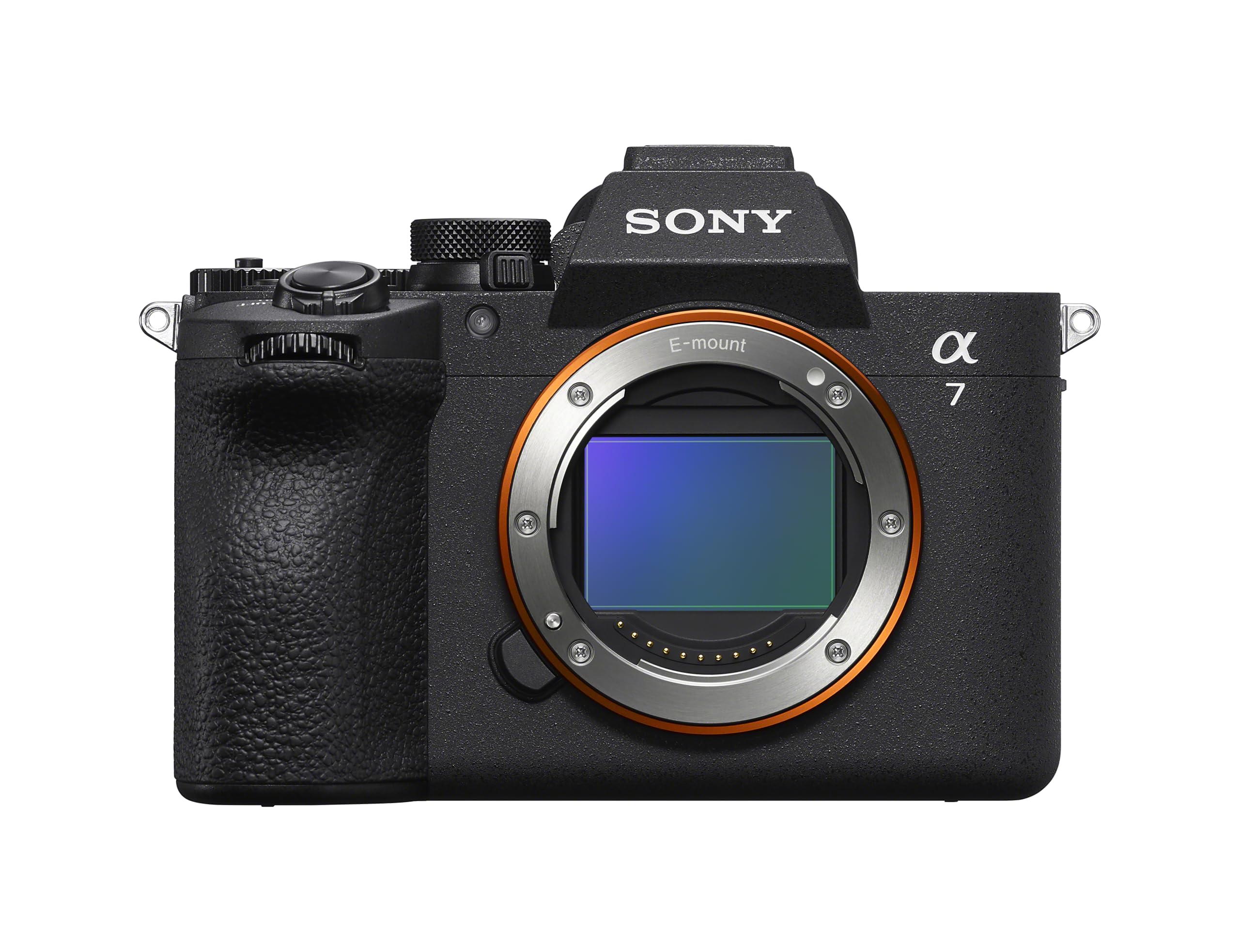
The Sony a7 V introduces a partially stacked 33 MP sensor with the BIONZ XR2 processing engine, delivering burst speeds of 30 fps with blackout-free shooting and AI-assisted autofocus. The human pose estimation technology uses 759 phase-detect points to track the subject’s body and eye position simultaneously, maintaining focus lock even when the subject turns their head away and back. For headshot photographers, this means you can focus on directing the subject and trust the camera to maintain eye tack-sharpness.
The 7.5-stop central and 6.5-stop peripheral in-body stabilization is class-leading for handheld shooting, making it practical to shoot headshots at slower shutter speeds without a tripod. The 33 MP sensor provides a balanced resolution — enough detail for high-quality headshot prints and commercial use, while keeping file sizes manageable compared to 45 MP bodies. The dual USB-C ports support simultaneous charging and data transfer, ideal for tethered studio workflows.
The a7 V represents a significant investment and requires the purchase of quality Sony E-mount lenses to realize its potential. The menu system, while improved, still has a learning curve for new users. For headshot photographers who demand the best autofocus tracking available and need a reliable hybrid system for both stills and video, the a7 V is the most advanced option at its price tier.
Why it’s great
- AI-assisted eye and body tracking maintains focus lock when the subject turns away.
- 30 fps blackout-free burst shooting captures the perfect expression in a single frame.
- Dual USB-C ports simplify tethered studio setups without battery anxiety.
Good to know
- Requires investment in quality E-mount lenses for optimal optical performance.
- Menu system retains some complexity despite generational improvements.
- Extra batteries needed for extended video recording sessions.
10. Panasonic LUMIX S1RII

The Panasonic LUMIX S1RII uses a 44.3 MP full-frame sensor and is Panasonic’s first mirrorless camera to record 8K video internally. For headshot work, the high-resolution sensor provides the flexibility to crop and recompose frames while retaining excellent detail. The phase hybrid autofocus with advanced AI boosts human recognition accuracy, with 399 AF points that keep focus when multiple people intersect in the frame.
The camera supports AFC 40 fps burst shooting with the electronic shutter, which is faster than many competitors and allows capturing micro-expressions in a quick sequence during a headshot session. The wide dynamic range log recording and false color function are useful tools for video headshots, allowing you to expose skin tones precisely. The handheld high-resolution mode expands creative possibilities by combining multiple frames for even higher effective resolution.
Early user reports indicate potential overheating during extended video recording sessions, which could be a concern for photographers who need long-duration video headshot capture. The lens selection for the L-mount system is still growing compared to the more mature Canon RF, Sony E, and Nikon Z ecosystems. For photographers who want a high-resolution body with 8K video capability and are willing to navigate platform maturity issues, the S1RII offers an impressive spec sheet.
Why it’s great
- 44.3 MP sensor enables heavy cropping without losing detail for tight headshot compositions.
- 40 fps burst shooting captures micro-expressions during portrait sessions.
- 8K video and color tools suit professional video headshot workflows.
Good to know
- L-mount lens ecosystem is less developed than Sony, Canon, or Nikon mounts.
- Potential overheating during extended video recording sessions.
- Some early units reported quality control issues with internal dust seals.
11. Leica Q2

The Leica Q2 combines a 47 MP full-frame sensor with a fixed Summilux 28mm f/1.7 ASPH lens in a compact, weather-sealed body. The 28mm field of view produces a distinct look that sits between traditional environmental portraiture and close-up headshots, requiring the photographer to compose carefully to avoid wide-angle perspective distortion. The 47 MP sensor provides massive cropping headroom, allowing you to effectively tighten a headshot in post.
The camera emphasizes simplicity with physical dials for aperture, shutter speed, and ISO, allowing you to adjust settings without diving into menus. The Leica FOTOS app provides reliable wireless connectivity for image transfer. The build quality is outstanding, providing confidence when shooting in varied environmental conditions.
The fixed 28mm lens is not the flattering focal length for traditional headshots — 85mm or 135mm is typically preferred for compression. The 49-point contrast-detect autofocus system is slower and less sophisticated than modern phase-detect systems from Sony, Canon, and Nikon. For photographers who value the Leica aesthetic and shooting experience and are willing to work with the 28mm field of view or crop heavily, the Q2 offers a unique, premium tool for headshot work.
Why it’s great
- 47 MP sensor provides generous cropping ability for tight headshot compositions.
- Compact, weather sealed body is durable for location shooting.
- Exceptional Summilux lens optical quality with wide f/1.7 aperture.
Good to know
- 28mm fixed lens is wide for traditional headshots; requires close proximity and careful composition.
- Contrast-detect autofocus is slower than phase-detect alternatives for fast-paced shooting.
- High price point places it firmly in the luxury category with fewer features than lower-cost alternatives.
FAQ
What is the ideal focal length for professional headshots?
Do I need a full-frame camera for headshot photography?
How many megapixels do I need for headshot work?
Is IBIS important for headshot photography?
Final Thoughts: The Verdict
For most users, the best camera for headshots winner is the Canon EOS R8 because it delivers the powerful autofocus engine and image quality of Canon’s higher-end bodies at a more accessible price point, with a lightweight body that reduces fatigue during long studio sessions. If you want the absolute best autofocus tracking and hybrid video capability, grab the Sony a7 V. And for photographers who need maximum resolution for large prints and extensive cropping, nothing beats the Nikon D850.