
A home inspection isn’t a guess — it’s a clinical diagnosis of a structure’s health. Whether you’re chasing a plumbing leak, verifying insulation integrity, or scanning a breaker panel for hot spots, the difference between a correct call and an expensive callback comes down to the imaging tool in your hand. A dedicated inspection camera, whether thermal or visual borescope, translates hidden conditions into actionable data the moment you see them.
I’m Min — the co-founder and writer behind Gadgets Feed. After sifting through hundreds of hours of field reports and technical spec sheets across thermal imagers, sewer crawlers, and borescopes, I’ve zeroed in on the models that actually hold up in crawl spaces, attics, and wet trenches without costing you a second chance.
This guide ranks the nine most capable options on the market right now, breaking down each tool’s real-world strengths so you can buy the right camera for home inspections on your first try, not your third.
How To Choose The Best Camera For Home Inspections
Inspection work falls into three physical domains — above ground (walls, ducts, panels), confined wet spaces (pipes, sewer lines), and thermal anomalies invisible to the naked eye. No single camera covers all three perfectly, which is why you need to prioritize your scope before you buy.
Thermal Resolution and Sensor Sensitivity
An infrared camera’s sensor resolution (measured in pixels, like 160×120 or 256×192) defines how small a temperature difference you can detect at a distance. Higher pixel counts let you spot subtle moisture boundaries behind drywall or a single overheated breaker in a crowded panel. Pair resolution with thermal sensitivity (mK rating) — lower mK values mean the sensor can distinguish finer temperature gaps, critical for finding latent water intrusion before mold starts.
Probe Diameter, Length, and Stiffness
Borescope and sewer cameras live by their probes. A 0.21-inch (5.5mm) borescope slips past spark plug holes and wall penetrations, while a thicker 7mm fiber-optic sewer cable handles the torque of a 100-foot push through a clay line. Semi-rigid cables that hold their shape (like the Teslong) make navigating P-traps and vent stacks far easier than floppy rope-style probes that collapse on every turn. Always check IP rating — IP67 for wet borescope work, IP68 for submerged sewer runs.
Display Quality and Workflow Integration
Your screen is how you make the call. A 5-inch 720p IPS panel beats a smaller 3.5-inch display for seeing fine hairline cracks in a drain line, but a high-resolution thermal imager with MSX overlay may be more important for diagnosing wall moisture. Consider whether you need on-board DVR recording (essential for report generation), Wi-Fi or USB transfer to a phone or PC, and battery life that survives a full day of inspections without a recharge.
Quick Comparison
On smaller screens, swipe sideways to see the full table.
| Model | Category | Best For | Key Spec | Amazon |
|---|---|---|---|---|
| Thermal Master Thor 002 | Thermal Imager | High-res thermal diagnostics | 512×384 upscaled IR, 25Hz refresh | Amazon |
| TOPDON TC005 | Thermal Imager | Pro thermal analysis | 512×384 TISR IR, 64GB storage | Amazon |
| TOPDON TC004 | Thermal Imager | Value thermal inspections | 512×384 TISR IR, 8hr battery | Amazon |
| FLIR C3-X | Thermal Imager | Compact pocket thermal | 128×96 true IR, MSX overlay | Amazon |
| FLIR TG165-X | Thermal Imager | Spot-check with laser | 4,800-pixel IR, Bullseye laser | Amazon |
| Teslong NTS500 | Borescope | Dual-camera wall/engine inspection | 5.5mm dual lens, 9.8ft probe | Amazon |
| ChoosePRO 165ft Sewer Camera | Sewer Camera | Mid-length drain inspection | 7″ 1080p screen, 165ft cable | Amazon |
| ChoosePRO 328ft Sewer Camera | Sewer Camera | Long-run sewer line inspection | 7″ 1080p screen, 328ft cable | Amazon |
| Anysun Self Leveling Sewer Camera | Sewer Camera | Underground line locating | 9″ HD monitor, 512Hz locator | Amazon |
In‑Depth Reviews
1. Thermal Master Handheld Thermal Camera (Thor 002)
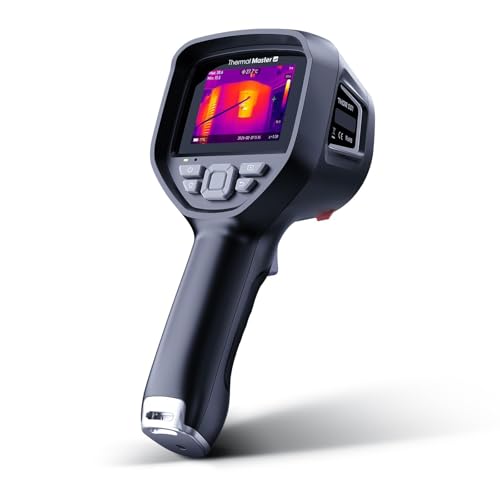
The Thermal Master Thor 002 punches well above its tier by delivering a native 256×192 thermal sensor boosted to 512×384 via X³IR upscaling, combined with a smooth 25Hz refresh rate. That means you see fast-moving temperature changes — like a cycling HVAC compressor or a flickering electrical connection — without the laggy, stuttering feed that plagues cheaper imagers. The 40mK thermal sensitivity lets it resolve minute differences that hint at moisture intrusion or failing insulation.
A 5000mAh battery keeps this unit running for over ten hours in the field, and the 18W fast charging means you can top it off during a lunch break. The 3.5-inch 640×480 IPS display isn’t the largest, but the pixel density is high enough to distinguish subtle heat gradients. Six simultaneous measurement points (center, hottest, coldest, plus three user-defined spots) give you serious diagnostic power without needing to run every frame through PC software.
Field reports from electrical and mechanical inspectors highlight its reliability in sub-freezing conditions and its ability to hold consistent readings after repeated bumpy transport. The one reliability caveat — a small number of units required a forced reboot (hold power + play buttons for ten seconds) after a power-on failure — was addressed directly by the manufacturer offering a two-year warranty replacement. For the price, the imaging clarity and battery endurance set a new bar.
Why it’s great
- Upscaled 512×384 IR resolution reveals subtle temperature variance
- 10.5-hour battery with 18W fast charging supports all-day inspection
- Laser pointer and auto high/low temp alarms improve accuracy
Good to know
- Occasional power-on issues resolved by forced reboot or warranty claim
- Heavier at 3.12 lbs compared to pocket-sized thermal cameras
2. TOPDON TC005 Dual-Lens Thermal Imaging Camera
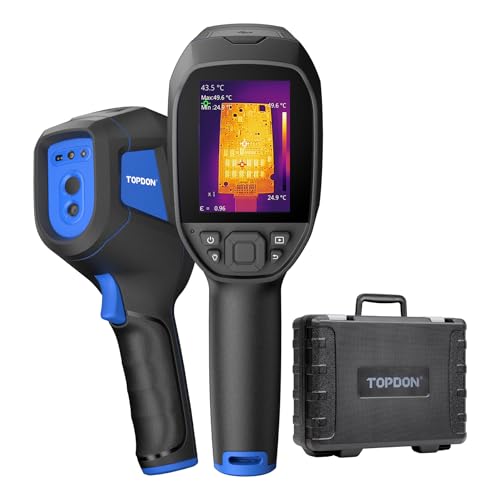
The TC005 from TOPDON adds a dedicated 2MP visible-light camera alongside its 256×192 thermal sensor (upscaled to 512×384 via TISR processing), which means you can overlay digital photo context onto your thermal scans. This dual-lens approach is a genuine time-saver during building envelope inspections — you snap a visible image of a wall section and immediately see the corresponding heat signature without swapping tools.
A built-in laser distance meter reaches up to 4 meters, giving you measurable reference points for your thermal images without needing a separate tape measure. The 3.5-inch display offers clear on-site evaluation, and the 64GB of internal storage means you can shoot full inspection sets all week without offloading. Wi-Fi connectivity to the TopInfrared mobile app and USB-based TopView PC software allow for rapid report generation, though the PC software is still in a rough beta state according to some users.
Mechanics and home inspectors alike praise the TC005 for diagnosing stuck brake calipers (reading 400°F versus a normal 108°F) and catching ceiling insulation gaps in a single pass. Battery life consistently hits eight hours, and the IP54 housing with 2-meter drop resistance makes it genuinely field-durable. The main trade-off is that the PC analysis tool feels unfinished, so if you rely heavily on post-processing, expect some early-stage frustration.
Why it’s great
- Visible + thermal dual-lens saves time on building envelope scans
- Laser distance measurement adds accurate reference points
- 64GB internal storage handles weeks of inspection data
Good to know
- PC analysis software is unfinished beta — expect learning curve
- No microphone for voice annotations during video recording
3. TOPDON TC004 Thermal Imaging Camera
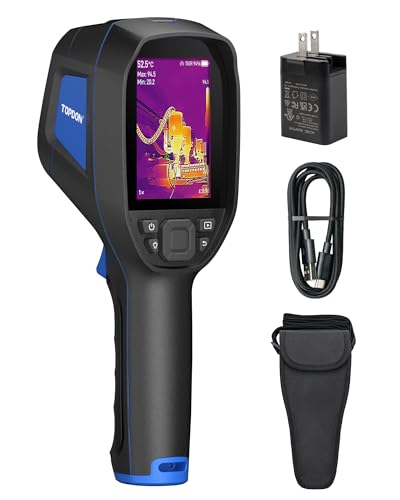
The TC004 strips out the visible-light camera and laser distance meter of its bigger sibling while keeping the same core 256×192 thermal sensor with TISR upscaling to 512×384. For a home inspector whose primary diagnostic tool is temperature variance, this is a smart compromise — you don’t lose any thermal detail, but you shed cost and a bit of bulk. The 3.5-inch display remains large enough to spot hot breakers or cold drafts in real time.
Built-in Wi-Fi allows cable-free image transfer to the TopInfrared mobile app, and the 64GB internal storage (matched to the TC005) means you won’t hit a capacity wall midway through a multi-property day. The red laser pointer helps you quickly align thermal hot spots with physical objects, which is invaluable when you’re scanning a crowded electrical panel. Users consistently report battery life exceeding eight hours, and the IP54 dust/splash protection holds up in attics and crawl spaces.
One practical caveat: the SD card’s native file format does not play well with iOS or macOS devices — you’ll need a Windows machine for direct card reading. Several reviewers also noted that the included WinZip software requires an annual subscription. If you’re already in a Windows workflow, this is a non-issue; if you’re Mac-based, factor in a workflow adjustment.
Why it’s great
- Same high-res thermal sensor as TC005 at a lower entry point
- 64GB internal storage with Wi-Fi transfer for quick reporting
- Pistol-grip design with tripod mount for steady scanning
Good to know
- File system incompatible with Mac/iOS without conversion
- Annual WinZip license required for included software extraction
4. FLIR C3-X Compact Thermal Camera
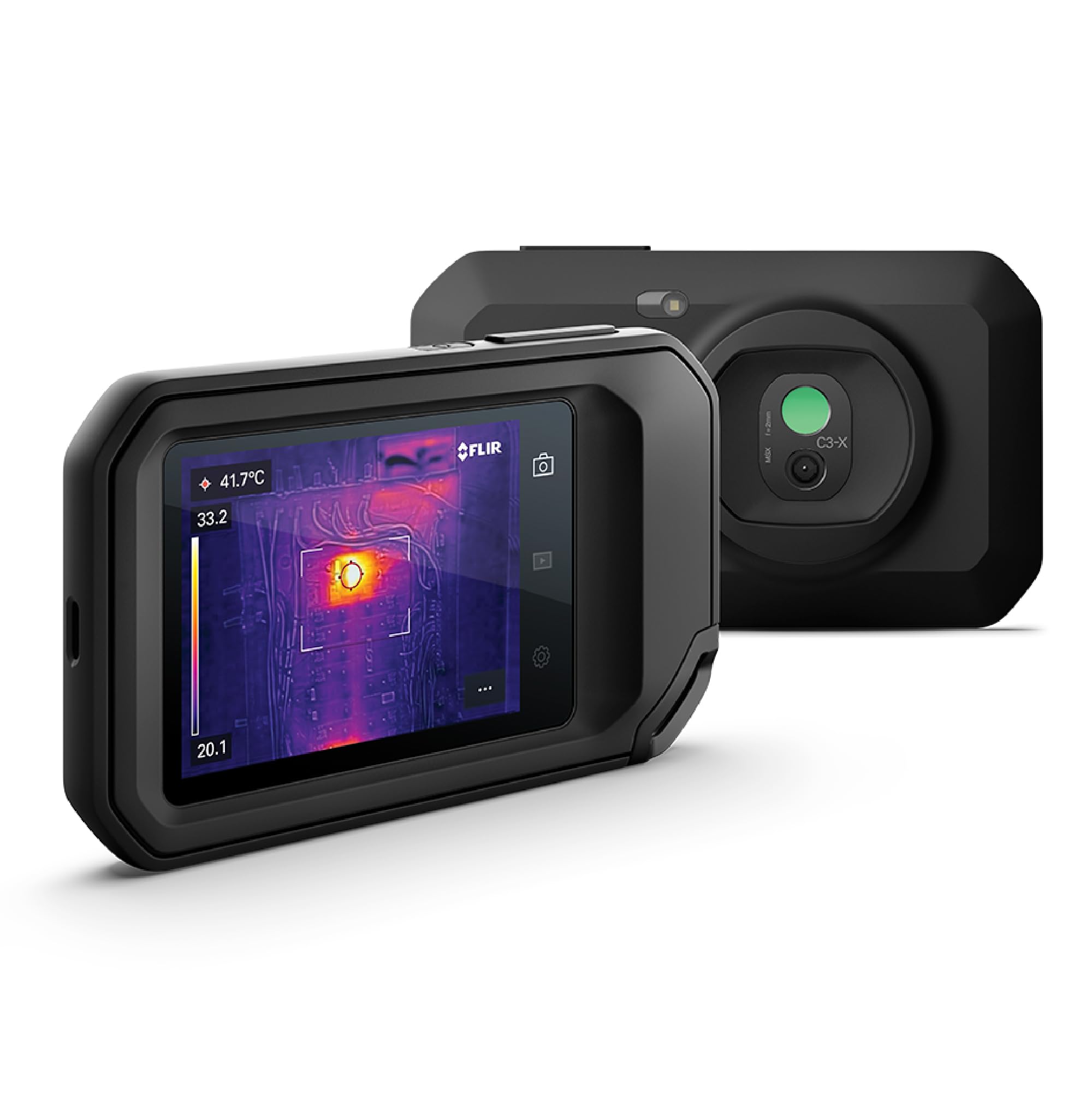
Weighing just 0.42 pounds, the FLIR C3-X is the thermal camera you actually carry every day rather than leave in the truck. Its 128×96 true thermal sensor (12,288 pixels) is lower resolution than the TOPDON units, but FLIR’s patented MSX overlay embosses visible-light edges onto the thermal image, significantly improving your ability to interpret what you’re seeing — a warm patch on a wall becomes clearly recognizable as a pipe or stud bay.
The C3-X measures from -4°F to 572°F and uses FLIR Ignite cloud connectivity to upload images directly for report generation. That cloud integration is genuinely useful for solo inspectors who need to email findings from the field without sideloading SD cards. The included pouch, lanyard, and USB cable make it easy to pack, and the pocketable size means it disappears into a tool bag.
Be aware that there is no laser pointer for spot temperature targeting, and the roughly three-hour battery life is noticeably shorter than competitors. Some users report intermittent power-on issues where the screen shows static patterns before recovering, and the slow frame rate makes it less ideal for scanning fast-moving machinery. It’s best suited for quick thermal checks during a broader visual inspection, not for deep diagnostic work on complex systems.
Why it’s great
- Extremely compact design fits in a shirt pocket
- MSX overlay makes thermal images much easier to interpret
- Direct cloud upload via FLIR Ignite for fast reporting
Good to know
- Low 128×96 IR resolution limits subtle temperature detection
- Short ~3-hour battery compared to all-day competitors
5. FLIR TG165-X Thermal Camera with Bullseye Laser
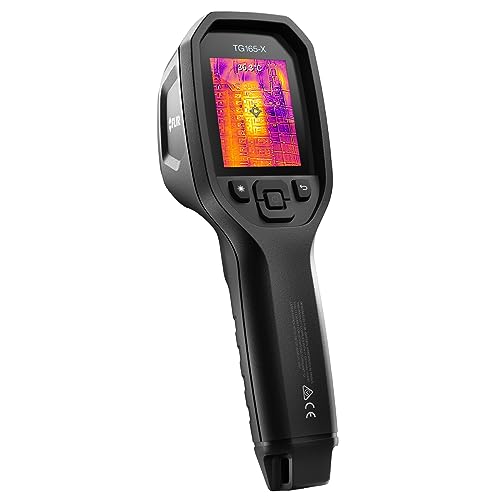
The TG165-X trades pixel density for one major usability win: a Bullseye laser that physically indicates the exact spot being measured. With a 4,800-pixel IR array (roughly 80×60 effective), the thermal image itself is coarse, but the laser targeting eliminates the guessing game of “which patch of drywall did the camera just read?” That certainty matters when you’re pinpointing a warm circuit breaker or tracing a hot water pipe behind a wall.
FLIR’s MSX overlay is present here too, embossing visual detail onto the low-res thermal frame so you can still make sense of the image. The temperature range spans -13°F to 572°F, which covers the vast majority of residential inspection scenarios. The IP54-rated housing and drop-tested build (backed by a 2-10 year warranty — 2 years parts/labor, 10 years on the detector) give it a commercial-grade lifespan.
Users report it excels at finding cold attic joists through drywall, detecting live electrical wires, and spotting water leaks in ceilings. The occasional freezing issue (requiring a reset by holding up and middle keys) appears in some units, and the coarse resolution means you won’t catch subtle moisture boundaries. Think of it as a highly accurate spot thermometer with thermal imaging context — not a full diagnostic imager.
Why it’s great
- Bullseye laser gives you absolute confidence in measurement spot
- Drop-tested IP54 build with 10-year detector warranty
- MSX overlay improves readability of low-res thermal images
Good to know
- Very low 4,800-pixel IR resolution misses subtle temperature variance
- Occasional freeze-up requires manual reset
6. Teslong NTS500 Dual Lens Endoscope
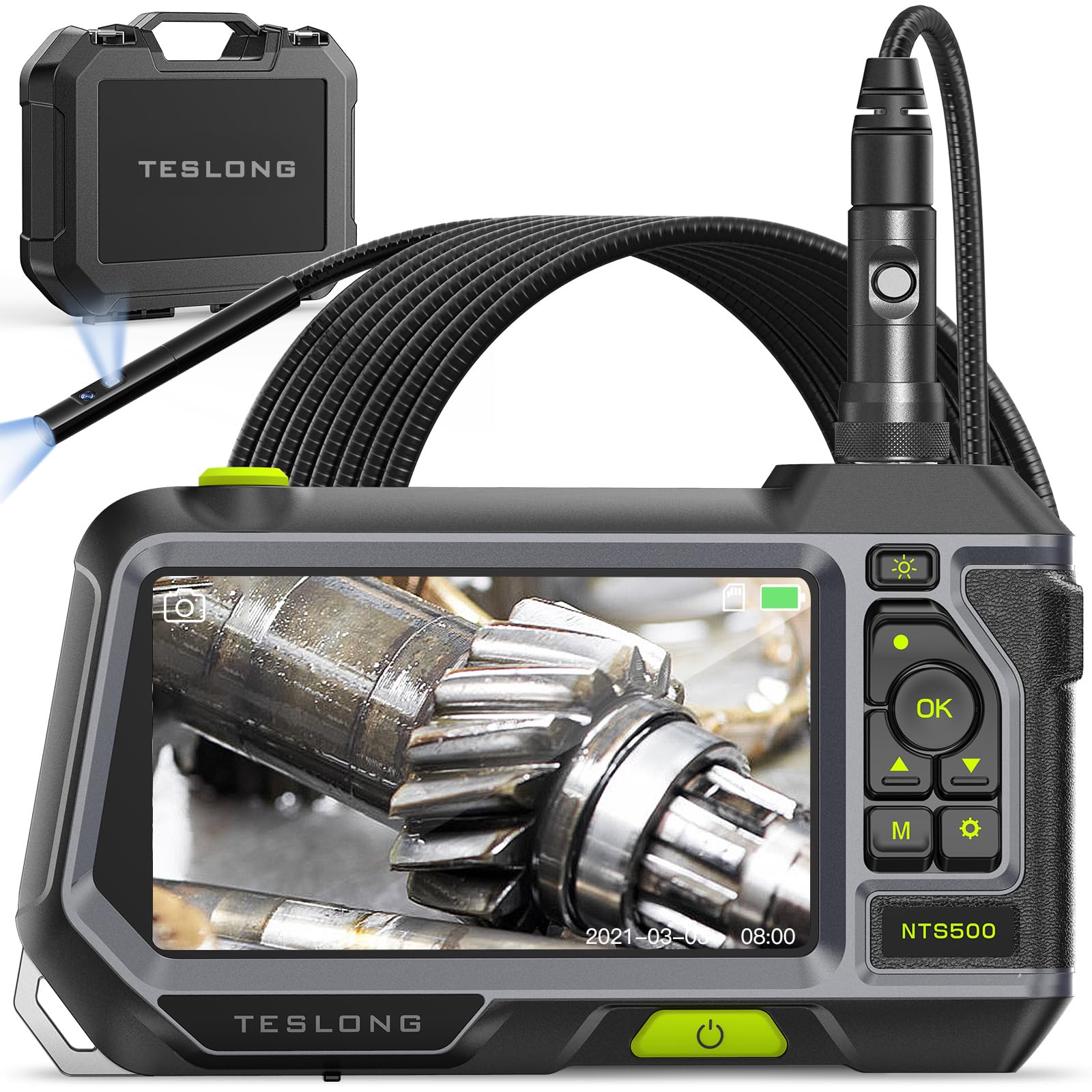
The Teslong NTS500 is the rare borescope that understands you need two points of view, not one. Two complete cameras live inside the same 5.5mm (0.21-inch) probe tip — a forward-facing lens and a side-facing lens — and you toggle between them with a single button. In practice, that means you can drive the probe down a wall cavity, hit an obstruction, rotate nothing, and just switch to the side view to see around the obstacle without any mirror attachments.
The 5-inch 720p IPS display provides an excellent viewing experience, and the 3500mAh battery delivers about four hours of continuous inspection. Its IP67 rating means it survives wet environments, rain, and plumbing work without issue. Six adjustable LED lights on the forward camera and independent illumination for the side camera mean dark cavities become perfectly visible. Users consistently describe the cable as “semi-rigid” — it holds the shape you bend it into rather than flopping, which makes navigating through spark plug holes and P-traps far more predictable.
Mechanics have replaced expensive Snap-on shop scopes with this unit, praising its clearer picture, dual-angle capability, and the ability to record photo/video directly to a micro SD card. The only consistent wish is for a replaceable battery — the internal pack will eventually wear out — but at this price point, the build quality and support from Teslong make it an easy recommendation for anyone doing wall, engine, or plumbing inspections.
Why it’s great
- Dual front/side cameras eliminate need for angled mirrors
- Semi-rigid cable holds shape for controlled navigation
- Sharp 5-inch 720p IPS screen with adjustable LED illumination
Good to know
- Battery is internal and not field-replaceable
- Requires micro SD card for photo/video recording (not included)
7. ChoosePRO 165ft Trolley Sewer Camera
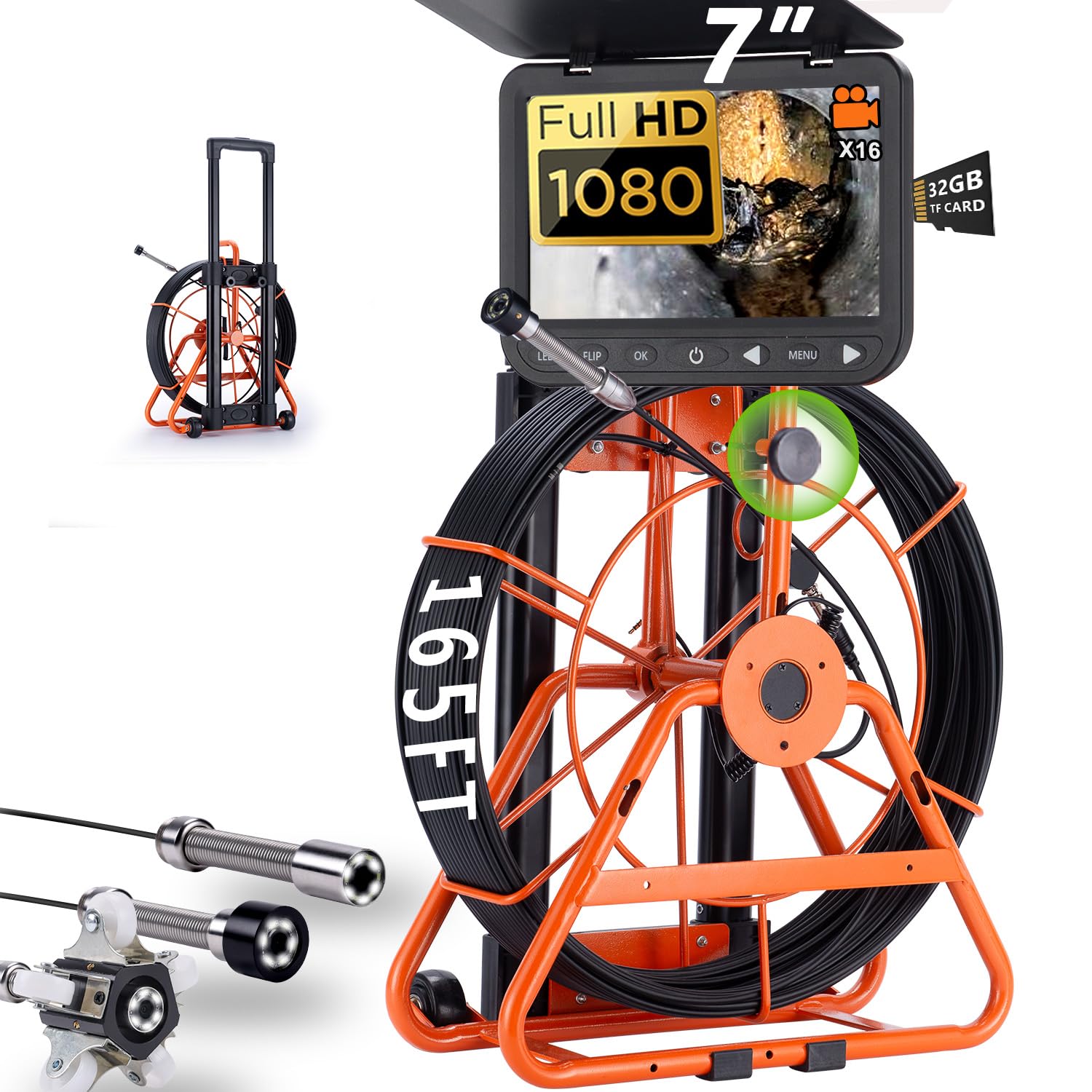
Stepping into sewer line inspection doesn’t require a five-figure investment, and the ChoosePRO 165ft unit proves it. With a true HD 1080P camera head feeding a bright 7-inch IPS monitor, you can clearly see roots, cracks, and offset joints in residential drain lines. The 5000mAh battery delivers over eight hours of operation, and USB-C pass-through charging means you can plug a power bank in while working to extend the shift.
The Quick-Unlock Y Clamp is a genuinely thoughtful mechanical detail — instead of fussing with tiny screws to lock the push rod, you lift a latch, feed the cable, and press it down. That saves minutes every time you set up or tear down. The telescoping aluminum handle with built-in wheels means you roll this rig across a lawn or driveway rather than carrying it, which matters when your day runs five inspections deep.
Rigid push rod cable (0.639-inch diameter) maintains enough column strength to navigate bends while still marking distance in feet. The 16x digital zoom helps confirm smaller defects, and on-board DVR recording to a 32GB card captures everything for your inspection report. Users consistently note that build quality and image clarity punch above the price point, though the cable length limits you to typical residential main lines rather than commercial laterals.
Why it’s great
- Quick-lock Y clamp saves setup time versus screw-based designs
- True 1080p image on a large 7-inch IPS screen
- Telescoping handle with wheels reduces back strain on long jobs
Good to know
- 165ft cable suits residential lines but not deep commercial laterals
- 16x zoom is digital — image degrades at maximum magnification
8. ChoosePRO 328ft Trolley Sewer Camera
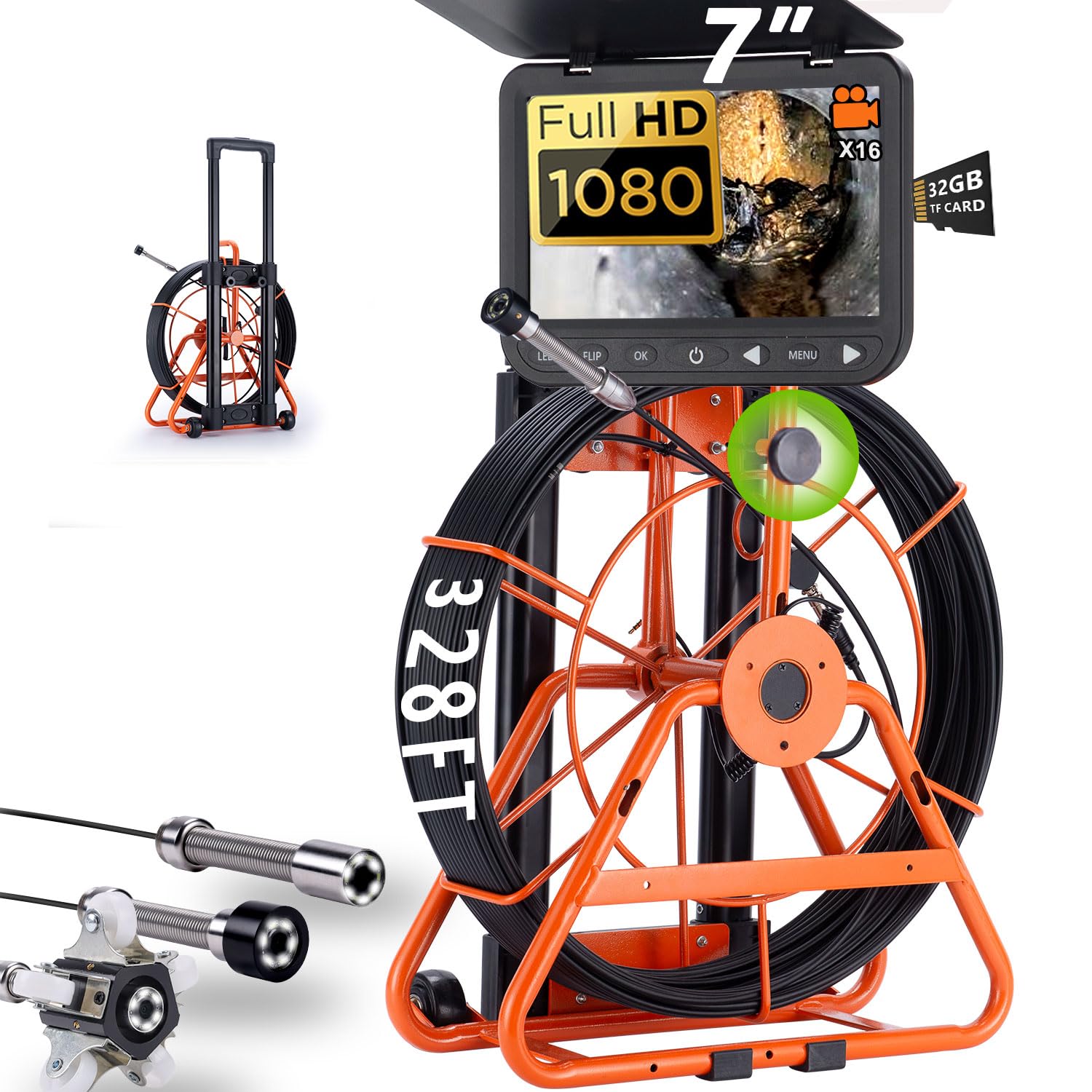
Virtually identical in design and build to the 165ft model, the ChoosePRO 328ft version doubles the cable length to 100 meters, unlocking access to deeper laterals, multi-story building stacks, and longer commercial sewer runs. The push rod retains the same 0.639-inch diameter, which is stiff enough to handle the extra length without excessive buckling or twisting when you hit a tight bend.
You get the same Quick-Unlock Y Clamp, the same 7-inch 1080p IPS display, and the same 5000mAh battery that pushes eight hours of run time. The 16x digital zoom, DVR capture to a 32GB card, and telescoping aluminum handle all carry over. The display mount uses all-metal aluminum crab claw and peanut clamps rather than plastic, which reduces wobble and extends the rig’s lifespan in rough truck storage.
User reports mirror the 165ft version — outstanding image clarity for the price bracket, easy setup, and reliable push rod navigation through 90-degree turns and long straight runs. The extra cable length does add weight, so the wheeled trolley and telescoping handle become even more critical for daily use. This is the right pick if you regularly inspect apartment complexes, commercial buildings, or properties with deep sewer connections.
Why it’s great
- 328ft cable reaches deeper laterals and commercial stacks
- All-metal display mount reduces vibration and screen damage
- Same clear 1080p image and user-friendly Y clamp as shorter model
Good to know
- Additional cable weight makes wheeled trolley essential
- Digital zoom on 1080p camera limits fine detail at max zoom levels
9. Anysun Self Leveling Sewer Camera with Locator

When you need not just to see a sewer defect but to know exactly where it sits underground, the Anysun brings a 512Hz locator transmitter built into the camera probe. This emits a signal that the included receiver picks up in Far mode (up to 23 feet) or Near mode (up to 13 feet), letting you mark the surface precisely before any excavation starts. That’s the difference between digging one hole and digging three.
The self-leveling camera head means the image stays upright no matter how the cable twists — a genuine time-saver when you’re pushing 200 feet of fiber optic cable through a 6-inch clay line. The 9-inch HD monitor is the largest in this roundup, making it noticeably easier to spot subtle cracks and root intrusions without squinting. An IP68 waterproof rating and 140-degree viewing angle, paired with 12 adjustable LEDs, provide clear images even in silt-heavy water.
The 4500mAh battery delivers eight to ten hours of run time, and the 32GB memory card stores plenty of inspection video. The thicker 7mm fiber optic cable is marked every meter for precise depth mapping. However, the locator function has drawn mixed reviews — some users report false signals or unreliable performance in certain soil conditions. The camera and reel itself are widely praised as robust and clear, and for the price, the locator is a useful bonus even if you treat it as a secondary tool.
Why it’s great
- Built-in 512Hz locator saves excavation time by marking defects above ground
- Self-leveling camera head keeps image upright regardless of cable twist
- Largest 9-inch HD monitor reduces eye strain on long inspections
Good to know
- Locator reliability varies with soil conditions — don’t rely on it alone
- 200ft cable sufficient for most residential main lines, but short for commercial
FAQ
Can a single camera handle both thermal imaging and plumbing inspection?
What infrared resolution do I actually need for residential home inspections?
How do I know if a sewer camera cable is stiff enough for my needs?
Can I use a thermal camera to find water leaks in walls?
Final Thoughts: The Verdict
For most users, the camera for home inspections winner is the Thermal Master Thor 002 because it delivers the highest thermal resolution and battery life in its tier, making it the most capable single diagnostic tool for electrical, HVAC, and building envelope inspections. If you need a dedicated Teslong NTS500 borescope for cavity and engine inspections, its dual-camera probe is unmatched at the price. And for underground sewer diagnostics, the Anysun Self Leveling System with integrated locator gives you the clearest path to marking defects before you dig.