
Spray in your face, a sudden rapid, and the moment you need to replay—but your old action camera gave you a blurry, shaky mess. Kayaking demands a camera that shrugs off submersion, locks horizon level through Class III turbulence, and delivers sharp 4K or 8K footage without needing a separate housing. The difference between a keeper clip and a disappointing smudge comes down to three specs: native waterproof depth, stabilization algorithm quality, and battery life that outlasts a full paddle session.
I’m Min — the co-founder and writer behind Gadgets Feed. I’ve spent countless hours dissecting spec sheets, cross-referencing waterproof ratings with real-world dive tests, and comparing stabilization performance across budget, mid-range, and flagship action cameras to find the ones that genuinely survive a kayak’s harsh environment.
Whether you’re shooting POV b-roll from a bow mount or documenting a multi-day expedition, finding the right camera for kayaking means prioritizing rugged build over megapixel count and real-world stabilization over marketing slogans.
How To Choose The Best Camera For Kayaking
Selecting a camera for kayaking isn’t the same as picking one for a hiking trail. Submersion, vibration from paddle strikes, salt spray, and extended recording sessions each impose specific requirements that generic action cameras don’t always meet. Focus on these four areas to narrow the field quickly.
Waterproof Depth & Housing Dependency
A camera rated to 10 meters (33 feet) natively means you can capsize, drop it in a riverbed, or paddle through a rainstorm without a bulky underwater housing. Some models are rated to 15 or even 20 meters, which provides serious peace of mind for whitewater or ocean kayaking. Models that require a separate housing to achieve waterproofing are less convenient — you risk fogging, reduced touch sensitivity, and one more piece of gear to lose. For kayaking, prioritize a camera with at least 10 meters of native waterproofing so you can mount it exposed on your deck or helmet.
Stabilization Type: EIS vs. Horizon Lock
Standard electronic image stabilization (EIS) reduces micro-vibrations from paddle strokes and choppy water but cannot correct full camera roll. Horizon Lock or 360° stabilization keeps the horizon perfectly level even when you lean into a turn or the camera spins on a mount — crucial for cinematic-looking kayak footage. Most premium models now offer horizon-leveling stabilization, while budget-friendly options stick to basic EIS. If your clips often look tilted or sea-sick, spend the extra on a camera with Horizon Lock or HorizonSteady.
Battery Endurance in Real Conditions
Manufacturer battery ratings are measured in a lab at room temperature. On a cold morning paddle or under direct sun while recording 4K, actual runtime can drop by 30-50%. A camera with a 1950 mAh battery (like the DJI Extreme Battery) or a cold-resistant Enduro cell will give you two to three hours of continuous recording — enough for most half-day trips. Always buy a camera that supports hot-swapping batteries, and consider the Adventure or Enhanced combos that include multiple batteries and a charging case.
Underwater Color & White Balance
Water absorbs red and orange light first, turning footage green or blue at depths beyond a few feet. Cameras with dedicated underwater shooting modes or a color temperature sensor automatically compensate for this loss, delivering natural skin tones and vibrant reefs. If you plan to film below the surface — snorkeling between rapids or documenting marine life — look for models that offer underwater scene presets or manual white balance. Without this feature, you’ll spend hours color-correcting footage in post.
Quick Comparison
On smaller screens, swipe sideways to see the full table.
| Model | Category | Best For | Key Spec | Amazon |
|---|---|---|---|---|
| GoPro HERO13 Black | Premium Action Cam | Best-in-class 5.3K video & Burst Slo-Mo | Waterproof to 33ft (10m) native | Amazon |
| DJI Osmo Action 5 Pro | Premium Action Cam | Best low-light & longest battery life | 40MP photos, 4H battery, 20m waterproof | Amazon |
| DJI Osmo Action 6 | Premium Action Cam | 8K video with variable aperture | f/2.0–f/4.0, 20m waterproof, 50GB storage | Amazon |
| GoPro MAX2 | 360° Action Cam | 360° 8K & invisible selfie stick | Waterproof, 29MP 360 photos, 6 mics | Amazon |
| Insta360 X5 | 360° Action Cam | AI reframing & best low-light 360 | Waterproof to 49ft (15m), 208min battery | Amazon |
| OM System Tough TG-7 | Rugged Compact | True optical zoom & macro underwater | Waterproof to 15m, shockproof 2.1m | Amazon |
| PENTAX WG-90 | Rugged Compact | Built-in macro LED ring & microscope mode | Waterproof to 14m, 6-LED macro ring | Amazon |
| Kodak PIXPRO WPZ2 | Rugged Compact | Budget-friendly waterproof point-and-shoot | Waterproof to 15m, 4X optical zoom | Amazon |
| AKASO Brave 7 LE | Budget Action Cam | Entry-level dual-screen action cam | Waterproof to 131ft with housing, 4K30fps | Amazon |
In‑Depth Reviews
1. DJI Osmo Action 5 Pro Adventure Combo

The DJI Osmo Action 5 Pro is the most balanced kayaking camera on the market right now. It’s waterproof to 20 meters natively — no housing required — and its 1/1.3-inch sensor with 2.4 µm pixels delivers exceptional low-light performance when you’re filming at dawn or under a forest canopy. The 4K/120fps recording and 360° HorizonSteady stabilization keep the horizon locked even if your kayak spins in an eddy.
Battery life is the real standout here. The Adventure Combo includes three 1950 mAh Extreme Batteries and a multifunctional case that charges all of them simultaneously. In cold weather down to -20°C, the camera still records for 3.6 hours. The dual OLED touchscreens make framing easy with gloves on, and the voice control works reliably within one meter so you can start/stop recording hands-free while paddling.
For kayakers who want a single camera that does everything — POV bow mount, handheld snorkeling clips, and overnight trips without worrying about charging — the Action 5 Pro checks every box. The 40MP still captures mean you can pull frame grabs that look like real photos, and the color temperature sensor eliminates the green cast common in underwater footage. The only trade-off is no 8K option, but 4K at 120fps with full horizon lock is arguably more useful for action sports.
Why it’s great
- 20m native waterproofing — dive without a housing
- Up to 4 hours recording with the Extreme Batteries
- 360° HorizonSteady eliminates all camera roll
- Brilliant low-light sensor for dawn/dusk paddles
Good to know
- No 360° spherical video option
- Extension rod lacks a remote shutter button
- Generates noticeable heat after 10+ minutes of 4K
2. GoPro HERO13 Black

The GoPro HERO13 Black delivers the highest video resolution in this group at 5.3K60, giving you 91% more pixels than 4K — a massive advantage if you want to crop, stabilize, or pull high-res stills from your kayak footage. The HyperSmooth stabilization rivals dedicated gimbal gear, and the Burst Slo-Mo captures action slowed to 13x normal speed, perfect for freeze-framing a wave crash or a paddle splash.
Waterproof to 33 feet (10 meters) natively, the HERO13 doesn’t require a housing for typical kayaking scenarios. The included Enduro battery holds up well in cold conditions, and the HB-series lens mod system adds versatility — the Ultra Wide Lens Mod gives the widest possible POV for cockpit shots, while the Macro Lens Mod works for detail shots of gear or marine life. The water-repelling lens cover helps eliminate flare from spray and reflections.
Where the HERO13 really shines is stabilization during high-vibration scenarios. The HyperSmooth 6.0 engine smooths out paddle-strike vibrations better than any previous GoPro, and the Horizon Lock works in all modes up to 5.3K30. If you’re a serious paddler who wants the absolute best slow-motion and resolution for cinematic edits, the HERO13 is the benchmark. Just note that at 5.3K60, battery life drops to around 79 minutes in standard conditions.
Why it’s great
- 5.3K60 video with 13x Burst Slo-Mo
- HyperSmooth 6.0 — class-leading stabilization
- HB-series lens mods for specialty shots
- Water-repelling lens cover reduces flare
Good to know
- Battery life at highest resolution is under 80 minutes
- Native waterproof depth limited to 10 meters
- Lenses and mods cost extra
3. DJI Osmo Action 6 Enhanced Combo
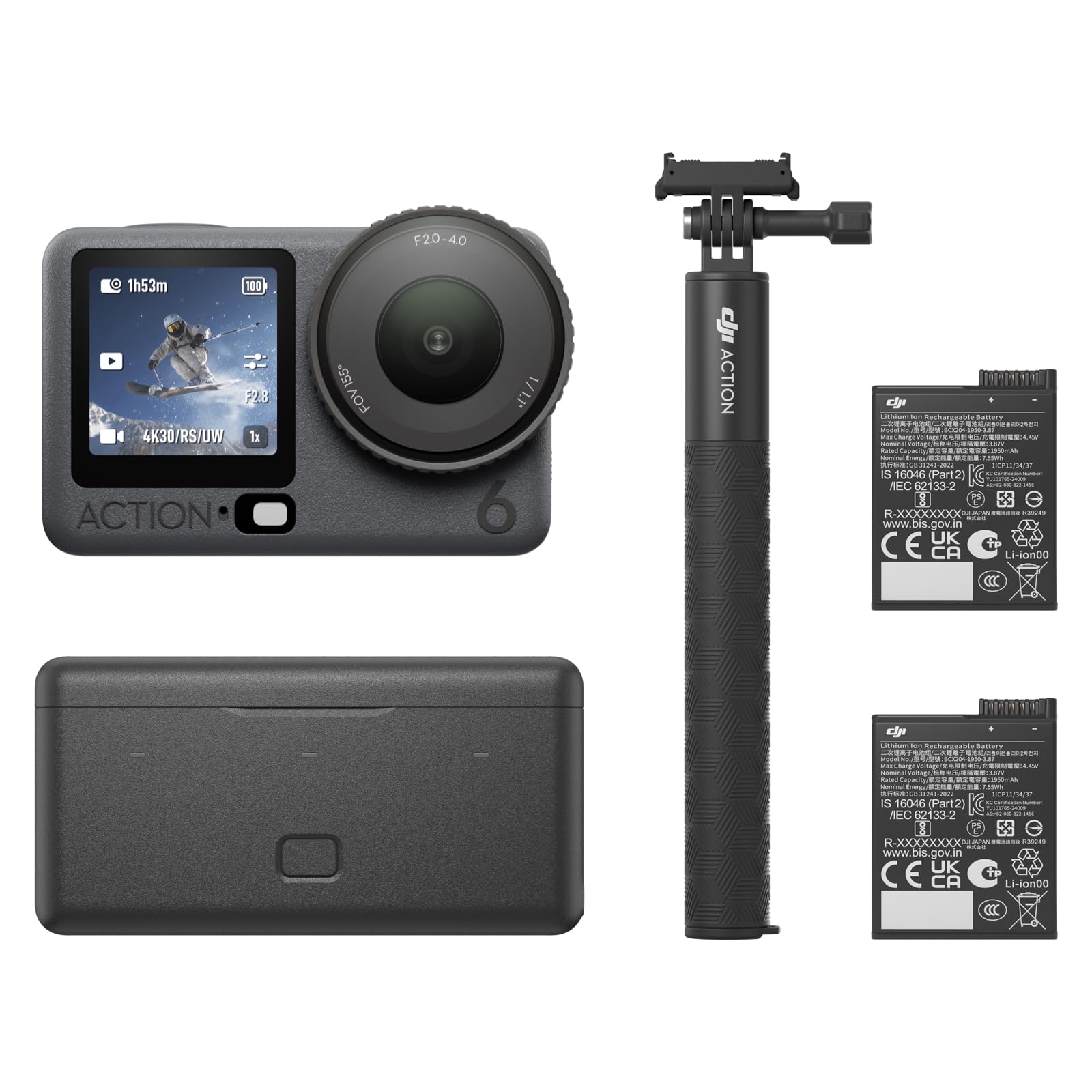
The DJI Osmo Action 6 pushes into 8K territory with a new 1/1.1-inch square sensor and a variable aperture (f/2.0 to f/4.0) that adapts to changing light conditions automatically. For kayaking, this means you can shoot from bright midday glare into shadowed riverbanks without sudden exposure jumps. The 8K resolution gives you tremendous cropping ability — you can reframe a 4K clip from 8K source and still retain sharpness for social media.
Waterproof to 20 meters natively, the Action 6 matches the Action 5 Pro’s depth rating. The Enhanced Combo includes two 1950 mAh Extreme Batteries plus a multifunctional battery case, giving you roughly 6-8 hours of total recording time. The internal 50GB storage is a lifesaver if you forget a microSD card, and the wireless cloud upload means footage backs up automatically while you’re still on the water.
Where the Action 6 differentiates itself is the 360° HorizonSteady at up to 4K/60fps — a major upgrade over the Action 5 Pro’s 4K/30fps limit for horizon locking. The dual-direction quick-release mount makes it effortless to switch between horizontal and vertical orientation for TikTok-style clips. The matte black finish hides fingerprints well on a wet kayak deck, and the magnetic mounting system feels incredibly secure. If 8K and maximum reframing flexibility are priorities, this is the camera to beat.
Why it’s great
- 8K30 video with variable aperture sensor
- 360° HorizonSteady at 4K/60fps
- 50GB internal storage + wireless cloud backup
- 20m native waterproofing
Good to know
- Built-in microphone quality is weak — external mic recommended
- Enhanced Combo short one battery vs. Adventure Combo
- Aftermarket case can limit touchscreen access
4. GoPro MAX2
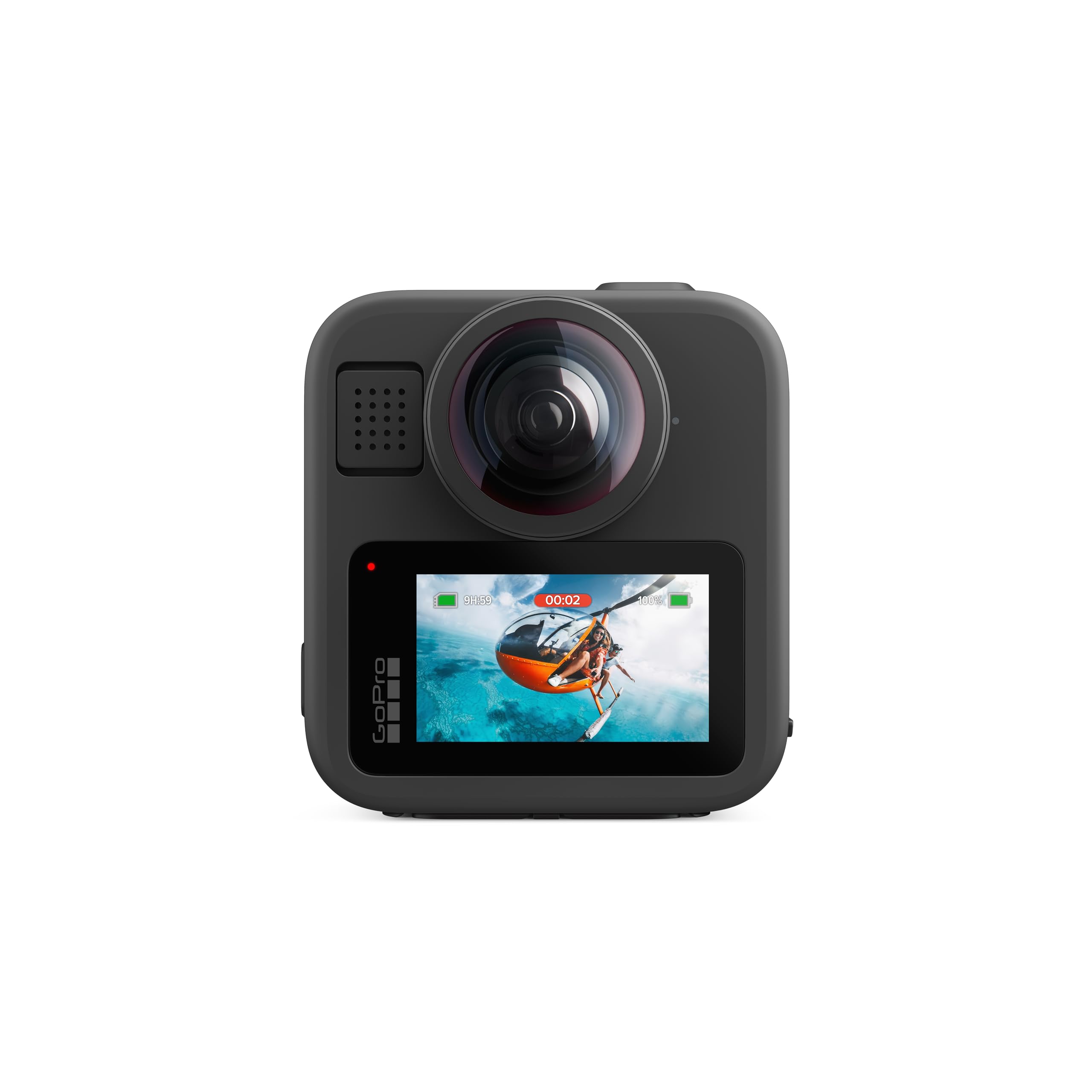
The GoPro MAX2 is the first GoPro to deliver true 8K 360 spherical video, and for kayakers that means one huge advantage: you never have to aim the camera. Mount it on a bow or stern pole and capture everything around you — paddle strokes, following craft, wildlife on both banks — then reframe in post using the Quik app. The invisible selfie stick effect works perfectly with the 1/4-20 mount threads, making it look like a drone or another person is filming you.
The 6-microphone ambisonic audio array shifts perspective as you reframe, so sound matches the visual angle — a rare feature in action cameras. The HyperSmooth stabilization includes Horizon Lock that stays level even when you spin the camera 360 degrees. The lenses are fully replaceable, which matters when sand or a stray paddle scratch is inevitable. Waterproof without a housing, the MAX2 is ready for splashy conditions right out of the box.
The trade-off with 360 cameras is heat and battery life. In 8K time-lapse mode, the battery drains roughly 50% per hour. Real-world 4K reframed clips look outstanding, but you’ll want at least one spare Enduro 1960 mAh battery for a full day on the water. The learning curve for reframing is real — expect to spend time in the app before you nail the angles. But for unique kayak content that no standard action cam can produce, the MAX2 is unmatched.
Why it’s great
- True 8K 360 spherical video — never miss a shot
- Invisible selfie stick effect for third-person POV
- 6-ambisonic mics with perspective-matched audio
- Replaceable glass lenses reduce repair costs
Good to know
- Battery drains fast in 8K mode — 50% per hour typical
- Heat buildup can be an issue during continuous recording
- Reframing in the app has a notable learning curve
5. Insta360 X5 Essentials Bundle

The Insta360 X5 brings dual 1/1.28-inch sensors and triple AI chip design to deliver 8K30 360 video with notably better low-light performance than previous 360 cameras. For kayak use, the 49-foot (15 meter) waterproof rating outpaces every other camera on this list except the DJI flagships — you can snorkel with it to significant depths without any housing. The 208-minute battery life is exceptional for a 360 cam, and the fast charging hits 80% in just 20 minutes.
The invisible selfie stick effect creates dramatic third-person shots that look like you’re being followed by a drone. The new InstaFrame mode outputs a ready-to-share flat video instantly, which is a massive time-saver if you don’t want to edit 360 footage. The 4-mic array with the new Wind Guard reduces wind noise effectively while paddling — voices remain clear even at 15 knots. The fully replaceable lenses are tough, scratch-resistant, and swap in seconds if you do manage to damage one.
The X5’s AI reframing makes it the most beginner-friendly 360 camera for kayaking. You can shoot everything and decide the angles later — which is exactly what you want when your hands are busy with a paddle. The FlowState Stabilization combined with 360° Horizon Lock means your footage stays perfectly level regardless of kayak motion. The one downside is that the 114cm invisible selfie stick is fine for most shots, but longer poles require third-party solutions. For the price, the X5 delivers the best 360 value per dollar for paddling enthusiasts.
Why it’s great
- Waterproof to 49ft (15m) — deepest 360 cam here
- 208-minute battery with 20-minute fast charge to 80%
- AI reframing for instant export without editing
- Replaceable scratch-resistant lenses
Good to know
- Selfie stick included is only 114cm — longer poles sold separately
- MicroSD card not included in the bundle
- Battery life feels shorter in cold water conditions
6. OM System OLYMPUS Tough TG-7

The OM System Tough TG-7 is a rugged compact camera, not an action cam, but it’s one of the best tools for kayakers who care about still photography and optical zoom. The 4X optical zoom (25-100mm equivalent) lets you get close to distant birds, shoreline details, or a fellow paddler without digital cropping. Waterproof to 15 meters, shockproof to 2.1 meters, and freezeproof to -10°C, it survives conditions that would destroy a typical mirrorless camera.
The variable macro system is exceptional for kayak trips — you can shoot from infinity down to 1 centimeter from the lens using the microscope mode. The five underwater shooting modes (including Underwater HDR and Underwater Microscope) automatically adjust white balance and contrast for submerged subjects. The 4K video at 30fps and 120fps high-speed recording cover video needs, and the vertical video mode is handy for quick Instagram uploads from the water.
The TG-7’s small 12-megapixel sensor won’t match a smartphone in low light, and it lacks the stabilization of an action cam for video. But for a dedicated stills camera that lets you compose through an optical zoom and capture raw files, nothing in this list comes close. If your kayaking priorities lean toward wildlife photography and macro shots of marine life rather than high-frame-rate POV video, the TG-7 is the right choice. The only catch is that the battery can die without warning, so carry a spare.
Why it’s great
- 4X optical zoom for distant subjects
- Five dedicated underwater shooting modes
- Microscope mode captures 1cm macro detail
- Raw file support for professional editing
Good to know
- Small sensor struggles in low light vs. modern flagship phones
- Battery dies without warning — no gradual indicator
- Bulky compared to a standard action camera
7. PENTAX WG-90 Black Waterproof Camera
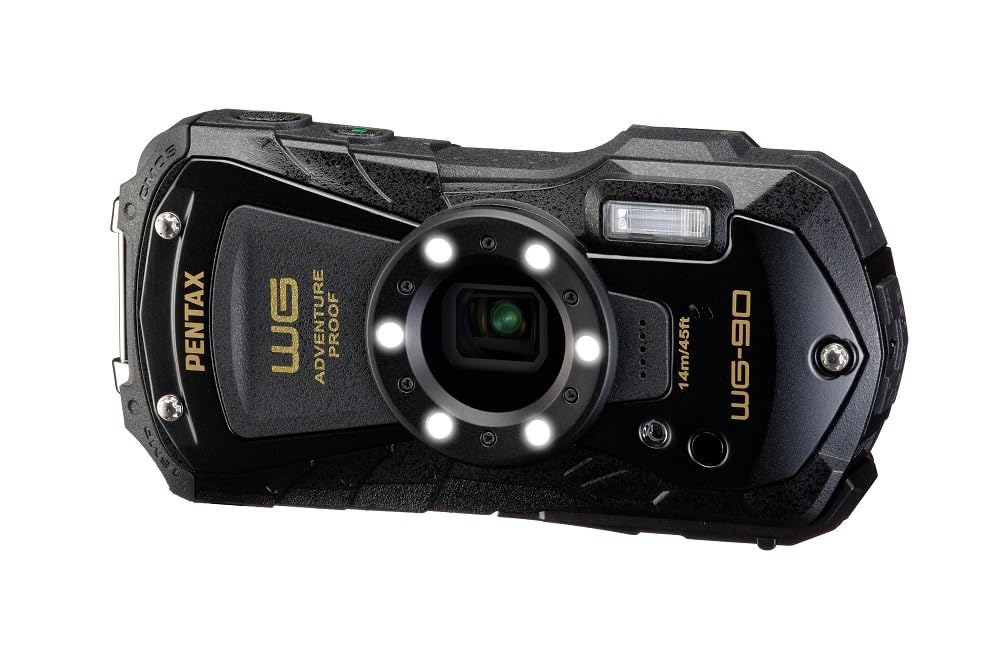
The PENTAX WG-90 is a tough, purpose-built compact that excels where action cameras fall short: macro photography with built-in illumination. The six LED Macro Lights circle the lens barrel and provide bright, even light for extreme close-ups — ideal for shooting tiny aquatic insects, barnacles, or gear details on the water. Waterproof to 14 meters and shockproof to 1.6 meters, it’s built for the same rough handling as the TG-7 but at a more accessible price point.
The 16-megapixel back-illuminated CMOS sensor with ISO 6400 sensitivity handles a range of conditions, and the 5X optical zoom (28-140mm equivalent) gives you versatile framing for both landscapes and tight macro shots. The Digital Microscope mode captures subjects you can’t see with the naked eye, making it a genuinely unique tool for nature-oriented kayakers. The Underwater shooting mode optimizes color and contrast based on real underwater image data.
The trade-off is that the WG-90 lacks the video stabilization and high frame rates of action cameras — video is Full HD at 30fps. The auto settings can be mediocre in mixed light, and the menu system requires manual tweaking to get the best results. But for stills-focused paddlers who want a built-in macro light and don’t need 4K slow-motion, the WG-90 is a rugged, affordable alternative. The included Macro Stand is cleverly designed for long observation sessions of tiny subjects without hand fatigue.
Why it’s great
- Six-LED macro ring for illuminating tiny subjects
- Digital Microscope mode captures unseen detail
- 5X optical zoom with wide-angle coverage
- Underwater mode optimizes color for submerged shots
Good to know
- Video is limited to Full HD 30fps — no 4K
- Auto exposure settings can be inconsistent
- Battery door seal design may be less robust than older WG models
8. Kodak PIXPRO WPZ2 Rugged Waterproof Digital Camera

The Kodak PIXPRO WPZ2 is a budget-friendly entry into waterproof point-and-shoot cameras that doesn’t force you to sacrifice optical zoom. At 16 megapixels with a 4X optical zoom (27-108mm equivalent), it lets you frame distant subjects on the water — something no action cam can do natively. Waterproof to 15 meters (49 feet) without a housing, it’s ready for snorkeling breaks and accidental immersions. The shockproof rating of 2 meters means it survives drops from a kayak seat or deck.
Image quality is solid in good light, with lifelike colors and decent dynamic range for its class. The camera is dustproof, so sand and grit aren’t a concern when you’re launching from a beach. The bundle includes a monopod, card reader, screen protector, and floating strap — the floating strap alone is worth having, as it prevents a dropped camera from sinking to the bottom of a lake. The interface is simple enough that you can hand it to a beginner and get usable shots immediately.
The limitations are clear once the light drops. The WPZ2 has no optical image stabilization, so you need a steady hand or calm water for sharp stills at full zoom. Video is capped at 1080p Full HD — fine for social sharing but not for cinematic edits. There’s no WiFi or Bluetooth for quick transfers, so you’ll need to use the included card reader. For casual paddlers who want a simple, rugged camera with zoom that their phone can’t match, the WPZ2 packs huge value for the money.
Why it’s great
- Affordable entry point with 4X optical zoom
- Waterproof to 15m without a housing
- Floating strap included — camera can’t sink
- Dustproof and shockproof for beach launches
Good to know
- Video limited to 1080p Full HD
- No optical image stabilization
- No WiFi or Bluetooth for wireless transfer
9. AKASO Brave 7 LE Action Camera with 64GB Card

The AKASO Brave 7 LE is a budget-conscious action camera that includes a waterproof housing rated to 131 feet (40 meters) and dual color screens — a front-facing screen for selfie framing and a 2-inch rear touchscreen. At 4K30fps and 20MP photos, it delivers respectable resolution for the price. The included 64GB microSD card means you can start shooting immediately without a separate purchase. The kit also includes two rechargeable batteries, a remote control, and a full mounting kit.
The 6-axis Electronic Image Stabilization 2.0 smooths out paddle vibrations better than similarly priced competitors. The WiFi remote control is genuinely useful for kayakers — mount the camera on your bow or a paddle mount and trigger recording from your wrist. The IPX7 water-resistant design handles rain and splashes, but for full submersion you’ll need the included housing, which does reduce touchscreen responsiveness. Battery life is roughly 2 hours per charge, and the dual-battery kit keeps you running for a full day.
The Brave 7 LE isn’t going to match GoPro or DJI on stabilization quality or low-light performance. The audio has a white-noise issue that’s noticeable in quiet scenes, and the camera resets settings if you remove the battery. But for a first-time action camera user or a paddler on a strict budget who needs 4K capability and a full accessory kit, it’s a genuinely capable starter package. The digital zoom is mediocre — avoid using it and crop in post instead — but the core image quality is good in natural light.
Why it’s great
- Best value kit — includes 64GB card, remote, and dual batteries
- Dual screens for vlogging and self-framing
- IPX7 weather-resistant body plus deep housing
- WiFi remote control for hands-free recording on the water
Good to know
- Audio has white noise issues in quiet scenes
- Camera resets settings after battery removal
- Housing needed for full waterproofing reduces touch usability
FAQ
Can I use a standard GoPro mount on a kayak deck?
Is 4K resolution needed for kayak videos?
What battery life should I expect for a full day of kayaking?
Do I need a red filter for underwater kayak shots?
Final Thoughts: The Verdict
For most users, the camera for kayaking winner is the DJI Osmo Action 5 Pro because it delivers the best balance of 20-meter native waterproofing, industry-leading battery life, and 360° HorizonSteady stabilization in a compact package. If you want the absolute highest resolution and best slow-motion for cinematic edits, grab the GoPro HERO13 Black. And for 360° spherical footage that lets you reframe any angle after the paddle, nothing beats the Insta360 X5.