
Our readers keep the lights on and my morning glass full of iced black tea. As an Amazon Associate, I earn from qualifying purchases.
Specs are compiled from manufacturer listings and verified buyer reviews and can change over time — please confirm the key details on the product page before buying.
You want to print a mountain vista on your wall, and that means you need a camera that captures every crack in the rock and every wisp of cloud. The camera for landscape photography that does that best is the one with the highest resolution sensor you can afford, plus strong dynamic range (the ability to see details in both bright sky and dark shadows) and reliable autofocus so you do not miss focus in tricky light.
I’m Min — the founder and writer behind Gadgets Feed. This guide is built by comparing the manufacturers’ published specifications and the patterns across verified customer reviews, so you get each pick’s real strengths and trade-offs instead of marketing spin.
For every product, I have broken down the critical specs like sensor resolution, autofocus capability, and burst rate to help you select the best camera for landscape photography that fits your exact skill level and budget.
Quick Picks
- Canon EOS R5 Mirrorless Camera (Body Only) — Top Performer
- Leica Q2 Digital Camera (19050) — Compact Luxury
- Sony Alpha 7C II Full-Frame Mirrorless Camera — Travel Ready
- Nikon Z6 III Full-Frame Mirrorless Camera — Low-Light Beast
- Sony a7 III Full-Frame Mirrorless — Best Value
- Canon EOS 5D Mark IV DSLR (Body Only) — Pro DSLR Workhorse
- Nikon Z 5 with NIKKOR Z 24-50mm f/4-6.3 Compact — Entry Full-Frame
- Nikon D5600 DX-Format DSLR with 18-55mm VR Lens — Budget DSLR
How To Choose The Best Camera For Landscape Photography
Landscape photography is about capturing massive detail across a wide scene with rich color and low noise. Your camera choice boils down to three key decisions — sensor size, autofocus system, and build quality for the elements.
Sensor Size and Resolution
A full-frame sensor (a large sensor, roughly 36mm x 24mm) gives you a wider field of view and better performance in low light compared to APS-C (a smaller sensor, roughly 23.6mm x 15.6mm, common in beginner cameras). Higher megapixels let you crop into distant features without losing detail, but they also mean larger file sizes. For large prints, you want at least 24MP (megapixels, or millions of pixels per image); 30MP and above is ideal.
Autofocus Points and Speed
For static landscapes, 39 autofocus points (the tiny sensors that lock focus on a subject) can be enough, but modern systems with 693 points cover nearly the entire frame, letting you lock focus on a foreground rock or a distant peak without recomposing. Phase-detection autofocus is faster and more reliable in dim conditions than contrast-detection.
Build Quality and Battery Life
Landscape shooters often hike miles and shoot in rain or dust. A weather-sealed body protects internals — the Nikon Z6 III survived downpours, per reviewers. A battery that lasts a full day outdoors (like the Sony a7 III’s) means you do not carry spares. A fold-out touchscreen, like on the D5600, helps with low-angle shots.
Quick Comparison
| Model | Best For | Megapixels | Autofocus Points | Continuous Shooting | Amazon |
|---|---|---|---|---|---|
| Canon EOS R5 | Highest resolution prints | 45 MP | — | 12 fps | Amazon |
| Leica Q2 | Compact luxury walk-around | 47.3 MP | 49 | — | Amazon |
| Sony Alpha 7C II | Travel-friendly full-frame | 33 MP | 759 | — | Amazon |
| Nikon Z6 III | Low-light action landscapes | 24.5 MP | 299 | — | Amazon |
| Sony a7 III | All-around value mirrorless | 24.2 MP | 693 | 10 fps | Amazon |
| Canon EOS 5D Mark IV | Professional DSLR ruggedness | 30.4 MP | 61 | 7 fps | Amazon |
| Nikon Z 5 | Entry-level full-frame | 24.3 MP | 273 | 4.5 fps | Amazon |
| Nikon D5600 | Budget beginner DSLR | 24.2 MP | 39 | 5 fps | Amazon |
In‑Depth Reviews
1. Canon EOS R5 Mirrorless Camera (Body Only)

The resolution king for wall-sized landscape prints with zero compromise on speed.
You get a 45MP full-frame CMOS sensor (a type of image sensor that converts light into electrical signals) paired with a DIGIC X image processor, so every mountain ridge and blade of grass appears with crisp detail. The high-speed shooting reaches up to 12 fps (frames per second) with a mechanical shutter and up to 20 fps with the electronic shutter — that is a huge step up in the EOS R-series line, and it means you can capture fleeting light changes across a scene. Buyers report that the 45MP sensor allows heavy cropping, so you can pull distant elements from a wide shot and still have enough resolution for a large print.
Owners mention excellent eye detection AF (autofocus that tracks a subject’s eye) for birds and sports, and the IBIS (In-Body Image Stabilization, which shifts the sensor to counteract hand shake) lets you shoot handheld at slower shutter speeds in low light. The downside is battery life — reviewers get about 650 shots per charge, which is shorter than the Sony a7 III’s. The RF mount (the lens connection system for Canon mirrorless cameras) also means you need to budget for new lenses unless you adapt EF glass (older Canon DSLR lenses).
Print-Ready Power
- 45MP sensor delivers extreme detail for heavy cropping and large prints.
- 12 fps mechanical / 20 fps electronic shutter captures fast-changing light.
- Excellent dynamic range and clean high ISO up to 10000, per reviewers.
Field Limitations
- ~650 shots per charge — plan for spare batteries on long hikes.
- RF lens system requires an adapter or new investment.
Ideal for: Serious landscape photographers who need maximum resolution for heavy cropping and large prints, and who shoot both stills and 4K/120fps video.
Consider alternatives if: Your budget is tighter and you are happy with 24-30MP resolution for social sharing and 16×20 prints.
2. Leica Q2 Digital Camera (19050)

A 47MP fixed-lens rangefinder that forces you to compose with your feet.
The Leica Q2 packs a 47.3MP full-frame sensor behind a Summilux 28mm f/1.7 ASPH prime lens (a high-quality non-zoom lens with a fixed wide-angle view), which is optically superb and offers more detail than most people ever need — the raw files (unprocessed image data from the sensor) are about 140Mb each. Instead of a zoom, this camera forces you to think, as one reviewer puts it, “shoot now and crop later”, and the 47MP resolution lets you crop quite a lot while maintaining clarity. The 28mm wide-angle lens is more than adequate for most landscape situations, and you can always take three vertical shots to stitch a panorama.
Customers note that the weather-sealed body is a boon for wet conditions, and the camera is fast, quiet, and very sharp. But the lens is fixed — there is no swapping glass for a different focal length. At this price point, you are paying for the Leica build and the unique shooting style, not versatility.
One-Lens Philosophy: The 28mm f/1.7 prime is superb and weather-sealed, but you cannot zoom or swap it — you must move your feet or crop in post. Reviews praise the “wonderful color range” and large prints at 16×20 inches with excellent clarity.
Who It’s For: Shooters who value simplicity, a fast wide aperture, and a compact full-frame body for travel landscapes, and who are comfortable with a fixed focal length.
Best for: minimalist landscape photographers who prefer a single, exceptional wide-angle lens and want the Leica experience in a compact weather-sealed body.
skip it if: you need a zoom lens for versatility — the Q2 is a fixed 28mm, and you cannot change the lens at all.
3. Sony Alpha 7C II Full-Frame Mirrorless Camera

Full-frame power squeezed into a body smaller than most APS-C cameras.
The Sony Alpha 7C II packs a 33MP full-frame Exmor R CMOS sensor (a back-illuminated sensor that improves low-light performance) and a dedicated AI Processor for advanced subject recognition, all in an incredibly compact and lightweight body. The autofocus system has 759 points and uses contrast detection, which sounds complex but really means it can lock onto a distant tree or a bird against a mountain sky instantly. Reviewers point out that the eye-tracking autofocus is fast and accurate, and the IBIS (In-Body Image Stabilization) is effective enough for handheld twilight shots.
You also get outstanding 4K 4:2:2 10-bit movie recording at up to 60p, so the same camera works for time-lapse landscape video. The battery lasts forever, according to multiple reviewers. The trade-offs are a lower-resolution screen and viewfinder compared to the Sony a7 III, and a single SD card slot. That single slot could be a risk for pro shooters, but for travel and hobbyist landscape work it is rarely a problem.
Travel-Friendly Full Frame
- 33MP sensor is a balance between resolution and file size.
- 759 autofocus points with AI subject recognition.
- Excellent battery life — shoppers say it “lasts forever”.
Cost-Cutting Trade-Offs
- Single SD card slot — no backup for critical shoots.
- Lower-resolution screen and EVF (electronic viewfinder) than the a7 III.
Grab this if: you want a full-frame camera that slips into a small bag for hiking, and prefer modern AI autofocus over the older a7 III’s system.
Look elsewhere if: you need dual card slots for professional work or a higher-resolution EVF for manual focus.
4. Nikon Z6 III Full-Frame Mirrorless Camera

A rugged full-frame body with an ISO range that reaches 204800 for true night landscapes.
The Nikon Z6 III has a native ISO sensitivity range of 100-64000 (the sensor’s sensitivity to light; lower numbers are less sensitive and produce cleaner images), extendable up to Hi 1.7 (equivalent to ISO 204800), which means you can shoot the Milky Way and moonlit scenes without heavy noise. The Best in Class EVF (electronic viewfinder) has a max brightness of 4000 nits and a 5760k-dot resolution, so composing in bright sunlight is no problem. Buyers report the camera is weather-sealed — it survived downpours — and autofocus detection down to -10EV (exposure value, a measure of how dim a scene can be for autofocus to still work).
Owners mention that the menu is less intuitive than Sony’s, but the camera has high-end functions like dual memory cards (CFexpress and SD) and a comfortable grip. The 6K/60p internal N-RAW video recording is excellent for landscape video. The downside is battery life — roughly 2 hours of continuous use — and the autofocus can be finicky at night.
Night-Ready Sensor
- Native ISO 100-64000 with extended range to 204800 for low-light landscapes.
- Weather-sealed — reviewers report surviving heavy rain.
- Dual card slots (CFexpress and SD) for backup.
Interface Hurdles
- Battery lasts ~2 hours — pack spares for a full day out.
- Menu system is less intuitive than Sony’s, per reviewers.
Ideal for: night and astro-landscape shooters who need extreme ISO performance and solid weather sealing.
Consider other options if: you want a simpler menu or need all-day battery life without carrying spares.
5. Sony a7 III Full-Frame Mirrorless with 28-70mm Lens

The 24.2MP hybrid that still holds its own with 693 autofocus points and 15-stop dynamic range.
The Sony a7 III uses a 24.2MP back-illuminated full-frame sensor with 15-stop dynamic range (the number of stops of exposure between the darkest and brightest details the sensor can capture) and 14-bit uncompressed RAW, giving you excellent latitude to recover shadows and highlights in landscape edits. Its 693 phase-detection autofocus points cover 93% of the frame — 693 points compared to the Nikon D5600’s 39 points — which means you can lock onto a foreground element and recompose without losing focus. The continuous shooting speed is 10 fps, which is more than enough for landscapes.
Buyers consistently praise the impressive battery life, noting that a spare is seldom needed — a major plus for long hiking days. The kit 28-70mm lens is decent for urban and portrait work but is not wide enough for serious landscapes; you will want a dedicated wide-angle lens. Unlike the Sony Alpha 7C II, this body is older but still very competitive for its price.
All-Day Runner: The battery lasts so long that customers note “spare not needed.” The 693 AF points and 10 fps burst are still competitive even years after release, making this a smart value pick for landscape photography where speed matters less than reach.
Best for: budget-conscious landscape shooters who want a full-frame sensor and industry-leading battery life without overspending.
pass on it if: you need a higher-resolution sensor (the a7 III is 24.2MP) or the latest AI autofocus — you want the Alpha 7C II or Canon R5 instead.
6. Canon EOS 5D Mark IV DSLR (Body Only)
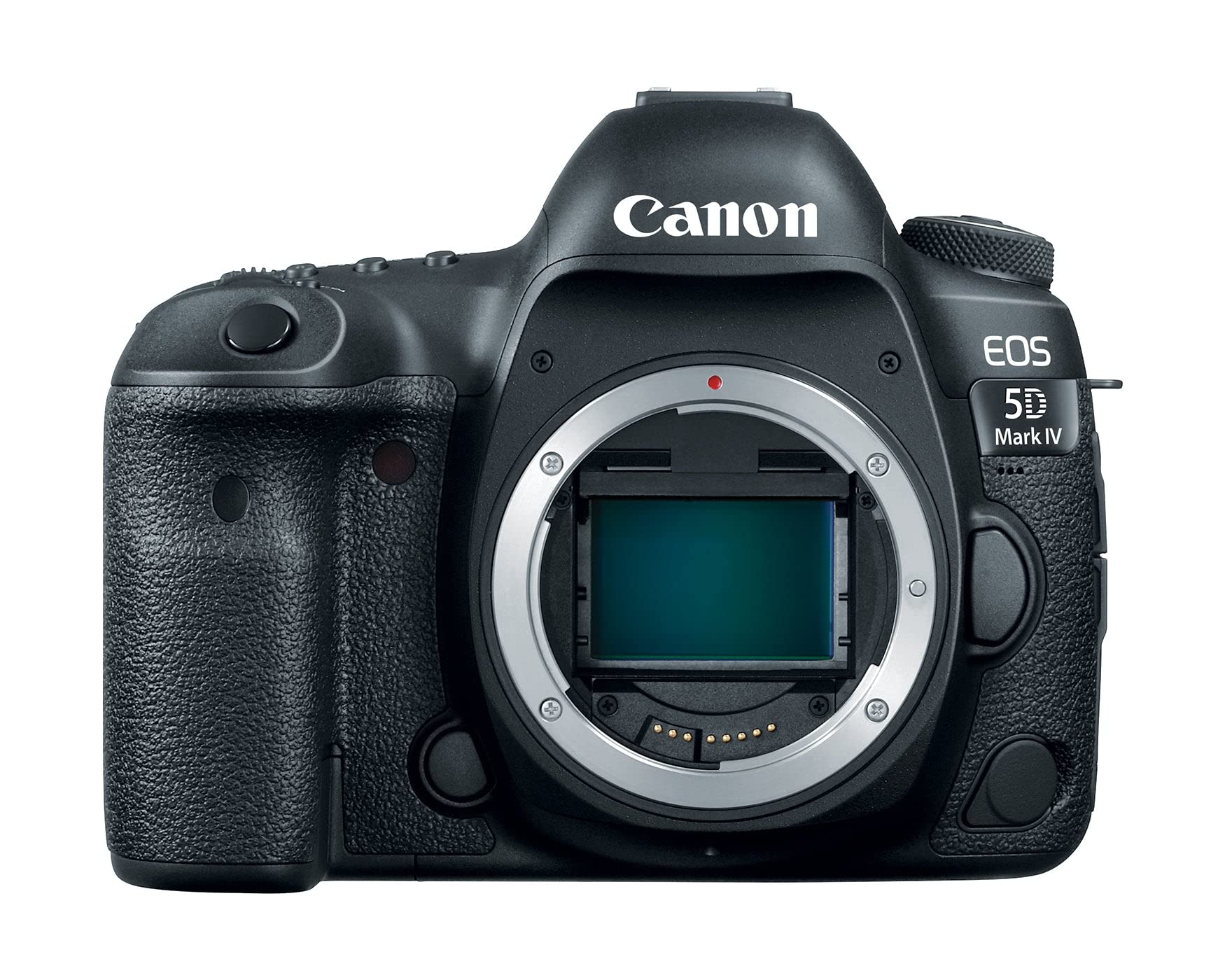
A 30.4MP full-frame DSLR with legendary dynamic range for shadow recovery in post.
The Canon 5D Mark IV has a 30.4MP full-frame CMOS sensor and a DIGIC 6+ Image Processor, delivering a continuous shooting speed of up to 7.0 fps. That is 30.4MP compared to the Nikon D5600’s 24.2MP, meaning you get noticeably more detail for cropping into distant peaks. The 61 autofocus points are fast and customizable, and reviewers point out excellent dynamic range and noise performance — they note easy shadow recovery and low noise even at ISO 1600 and above. The Dual Pixel CMOS AF in live view works on a full touchscreen interface, making it easy to tap to focus on a specific area of the frame.
The fixed LCD monitor is a limitation — you cannot flip it out for low-angle shots like you can on the Nikon D5600. But the optical viewfinder is bright and responsive, and the battery lasts for days on standby — shoppers say one battery can last a full day of shooting. The body is built like a tank, and the wide availability of EF lenses is a huge plus for expanding your landscape kit.
Dynamic Range Champ
- 30.4MP sensor with excellent dynamic range — easy shadow recovery, per reviewers.
- 61-point autofocus system is fast and customizable.
- Stellar battery life — “one battery for a full day”, per one reviewer.
Physical Design Gaps
- Fixed LCD — no fold-out screen for low or high angles.
- 7 fps burst is slower than mirrorless competitors like the Sony a7 III’s 10 fps.
Ideal for: DSLR loyalists and pros who need rugged construction, incredible battery life, and a sensor with generous dynamic range for shadow recovery.
Look elsewhere if: you need a fold-out touchscreen for creative angles or faster burst speeds for handheld bracketing (taking multiple shots at different exposures).
7. Nikon Z 5 with NIKKOR Z 24-50mm f/4-6.3 Compact Zoom Lens

The most affordable entry point into full-frame mirrorless with a versatile 24-50mm zoom kit.
The Nikon Z 5 is Nikon’s most compact, lightweight full-frame interchangeable lens Z series camera with a 24.3MP sensor. It includes the sleek NIKKOR Z 24-50mm f/4–6.3 compact zoom lens, which covers the wide-angle to normal focal length range — perfect for starting out in landscapes. The 273-point hybrid autofocus (phase detection + contrast detection) with Eye-Detection AF for people, dogs, and cats is responsive enough for most static scenes, and the 5-axis in-body image stabilization helps you shoot handheld at slower shutter speeds without camera blur.
Buyers report that the 4.5 fps continuous shooting is slow compared to the Sony a7 III’s 10 fps — 4.5 fps compared to 10 fps — so it is not for action landscapes like birds against a mountain. But reviewers also highlight that the camera supports third-party lenses, making it flexible for budget builds. The 4K/30p video with USB power delivery adds to its versatility.
Full-Frame Gateway: At this price, the Z 5 is a genuine full-frame body with in-body stabilization and a wide kit zoom. Owners mention it is “user friendly” and takes “stunning pics” straight from the start. The low 4.5 fps burst is its limiting factor, but for static landscapes it is not a problem.
Best for: beginners making the jump from smartphone or APS-C to full-frame, who want a compact body and a versatile kit lens for travel landscapes.
it’s not for you if: you need faster burst speeds for moving subjects — the 4.5 fps will frustrate you compared to the Sony a7 III’s 10 fps.
8. Nikon D5600 DX-Format DSLR with 18-55mm VR Lens

A lightweight 24.2MP DSLR with a vari-angle touchscreen that teaches you the basics.
The Nikon D5600 is a DX-format DSLR with a 24.2MP sensor and a 39-point phase-detection autofocus system — the same resolution as the Sony a7 III but in an APS-C body with a smaller sensor. It shoots Full HD 1080p video at 60 fps and has a 3.2-inch, 1.037m-dot vari-angle touchscreen that flips out for high, low, and self-portrait angles. The kit lens is the AF-P DX NIKKOR 18-55mm f/3.5-5.6G VR, which is decent for getting started but, as customers note, is “replaceable” and best swapped for a 50mm f/1.8 for sharper landscapes.
Buyers point out some real limitations: the single command dial makes manual mode difficult, there is no USB charging, the Wi-Fi/Bluetooth is nearly useless (phone-only), and the battery lasts only about 40 RAW+JPEG shots before needing a change. At 5 fps burst, it is slower than the Sony a7 III’s 10 fps. The 39 autofocus points (compared to 693 on the a7 III) can feel cramped for composing complex landscapes.
Beginner-Friendly
- 24.2MP sensor delivers crisp photos for learning composition.
- Vari-angle touchscreen great for low and high-angle landscape shots.
- Lightweight and easy to carry; feels brand new from the start, per one reviewer.
Limiting Trade-Offs
- Single command dial makes manual exposure awkward.
- Short battery life (~40 RAW+JPEG shots) — need spare batteries for a day out.
- 39 autofocus points feel limited for advanced composition.
Best for: complete beginners or teens who want an affordable, lightweight DSLR with a flip screen to learn landscape composition and exposure.
look elsewhere if: you have already outgrown entry-level gear — the single dial and short battery life will frustrate you quickly.
Understanding the Specs
Megapixels and Print Size
Megapixels (millions of pixels per image) determine how much detail the sensor captures. For landscape photography, 24MP is the baseline for a sharp 16×20-inch print. At 30MP and above (like the Canon EOS 5D Mark IV’s 30.4MP or the Leica Q2’s 47MP), you can crop into distant features and still have enough resolution for large wall prints. More megapixels also mean larger file sizes — each raw file from the Leica Q2 is about 140MB, so you need big memory cards and fast storage.
Autofocus Points and Coverage
Autofocus points are the tiny sensors on the camera sensor that lock onto a subject. More points mean wider coverage across the frame — a camera like the Sony a7 III with 693 points covers 93% of the image area, letting you focus on a rock at the edge without recomposing. The Nikon D5600’s 39 points cover a much smaller area, so you may have to focus and recompose, risking a slightly off-focus shot. For landscapes, 39 points can work, but modern systems are faster and more flexible.
FAQ
Do I need a full-frame camera for landscape photography?
How many megapixels do I need for landscape photography?
What is dynamic range and why does it matter for landscapes?
Is the Nikon D5600 good for landscape photography?
Should I get a DSLR or mirrorless for landscapes?
How important is weather sealing for a landscape camera?
Can I use the Sony a7 III for video in addition to landscapes?
What lens should I pair with my landscape camera for wide shots?
Is the Leica Q2 worth the money for landscapes?
How does the Canon EOS R5 compare to the Nikon Z6 III for landscape photography?
Final Thoughts: The Verdict
For the majority of shoppers, the camera for landscape photography winner is the Canon EOS R5 because it combines a 45MP sensor, 12 fps burst, and 8K video in a single body that handles both stills and video flawlessly. If you want the best travel-friendly full-frame with AI autofocus, grab the Sony Alpha 7C II. And for serious night and astro landscapes, the standout is the Nikon Z6 III with its extreme ISO range and proven weather sealing.
How We Picked
We do not accept paid placement. Every pick is matched to a real buyer and a real use-case; we do not hands-on test units.
Sources & Methodology
Specifications: manufacturer listings and product documentation. Review insights: verified customer reviews, as of July 2026. Pricing: not shown on this page (it changes often); check the current price via the retailer link.
As an Amazon Associate, Gadgets Feed earns from qualifying purchases. This does not affect which products we feature.