
Wind noise at highway speeds is the single biggest enemy of a motovlog. Choosing the right camera means finding one that can handle constant vibration, sudden changes in light as you pass under trees, and still deliver clean audio from your voice-over the roar of your exhaust. This guide cuts through the marketing claims to focus on the specs that actually matter for riding photography.
I’m Min — the co-founder and writer behind Gadgets Feed. I’ve spent countless hours analyzing stabilization systems, external microphone compatibility, battery endurance, and mounting options across the most popular action cameras to find which ones actually survive the asphalt.
Whether you ride a sportbike, a naked, or a cruiser with straight pipes, the best camera for motovlogging must deliver stable footage and intelligible audio without drain-battery anxiety halfway through a canyon run.
How To Choose The Best Camera for Motovlogging
Not every action camera is ready for life on two wheels. You need a body that can tolerate vibration, a stabilization system that doesn’t drift when the road gets bumpy, and an audio setup that doesn’t sound like a hurricane. Below are the three most critical areas to evaluate before buying.
Stabilization That Handles Pavement Imperfections
Standard electronic stabilization works great for walking. On a motorcycle, you need a system like GoPro’s HyperSmooth or DJI’s RockSteady that can correct for high-frequency vibration transmitted through handlebars and helmet mounts. Look for 6-axis gyro stabilization at minimum and check if the camera offers horizon-lock features to keep the world level when you lean into corners.
External Microphone Support is Non-Negotiable
Every built-in microphone on every action camera sounds terrible at 60+ mph. You must have a physical 3.5mm or USB-C audio input for a lavalier mic under your helmet. Some newer 360 cameras support direct connection to wireless microphone transmitters. If a camera lacks an external mic port, cross it off your list for spoken word motovlogging.
Quick Comparison
On smaller screens, swipe sideways to see the full table.
| Model | Category | Best For | Key Spec | Amazon |
|---|---|---|---|---|
| GoPro HERO13 Black Creator Edition | Premium Action | All-in-one pro motovlog rig | 5.3K/60fps + Media Mod & Volta | Amazon |
| DJI Osmo Action 6 Essential | Premium Action | Variable aperture & longest battery | 8K + f/2.0–f/4.0 + 4hr battery | Amazon |
| Insta360 X4 Motorcycle Bundle | 360 Camera | Mounting flexibility with 360 reframing | 8K 360 + Heavy-Duty Mount | Amazon |
| DJI Osmo 360 Motorcycle Combo | 360 Camera | Best pure 360 motorcycle kit | 8K 360 + Carbon Fiber Stick | Amazon |
| GoPro MAX2 | 360 Camera | Invisible selfie stick 360 shots | True 8K 360 + 29MP photos | Amazon |
| DJI Osmo Nano Standard | Compact Action | Ultra-portable POV camera | 4K/60fps + 143° FOV + 200min | Amazon |
| Xtra Muse | Gimbal Pocket | Built-in 3-axis gimbal for vlog | 4K/120fps + 1″ CMOS + 3-axis | Amazon |
| GoPro HERO Black Compact | Entry Action | Budget-friendly entry to GoPro | 4K30 + HyperSmooth + 33′ waterproof | Amazon |
| MWIRB 8K Video Camera | Economy Camcorder | Low-cost start for beginners | 8K/15fps + 6-axis anti-shake | Amazon |
In‑Depth Reviews
1. GoPro HERO13 Black Creator Edition

The Creator Edition is the definitive motovlog toolbox from GoPro. It bundles the HERO13 Black body with the Media Mod, which gives you a 3.5mm mic jack, two cold-shoe mounts, and an HDMI-out port, plus the Volta grip that functions as a battery extender, tripod, and remote shutter all in one. For riders who want their camera to double as a full filmmaking rig at the twist of a mount, this is the most complete package on the market.
At 5.3K/60fps, the HERO13 captures 91% more resolution than standard 4K, allowing you to crop and stabilize in post without losing detail around your helmet cam footage. The HyperSmooth 6.0 stabilization with AutoBoost keeps the horizon level even when you hit pavement imperfections at speed, and the removable Enduro battery extends cold-weather performance — critical if you ride year-round in lower temperatures.
The included Light Mod attaches directly to the Media Mod for low-light tunnel shots or evening commutes, while the magnetic latch mount system makes swapping between helmet, handlebar, and chest mounts quick. The only drawback is the price, but you’re getting a camera body plus roughly worth of accessories that solve the specific audio and power problems every motovlogger faces.
Why it’s great
- Includes Media Mod with 3.5mm mic input
- Volta grip adds hours of recording time
- 5.3K resolution allows heavy post-crop without quality loss
Good to know
- Bulkier than a bare camera when all modules are attached
- Requires Micro SD card not included in the bundle
2. DJI Osmo Action 6 Essential Combo
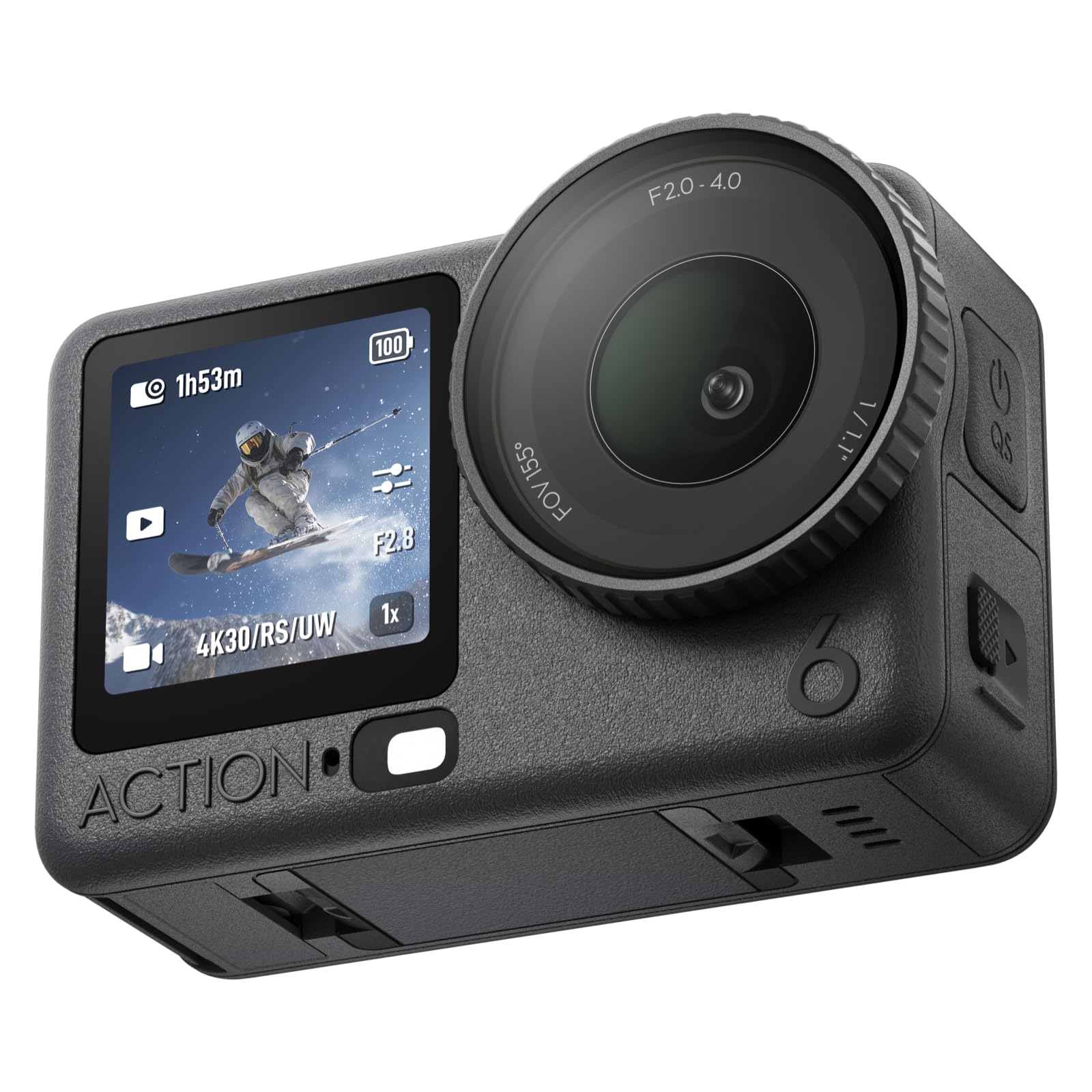
The Osmo Action 6 breaks new ground with a variable aperture of f/2.0 to f/4.0, a first for action cameras. This means you can let in more light during dusk rides and stop down for sharp daytime highway footage — all without swapping lenses. The 1/1.1-inch square sensor delivers true 8K video at 30fps, giving you room to reframe later, and the RockSteady 3.0 stabilization handles handlebar vibration with ease.
Battery endurance is the headline here: up to 4 hours in normal conditions, which covers even the longest motovlog sessions without a recharge stop. It’s also cold-resistant, so battery life doesn’t tank the moment temperatures drop below freezing. The dual microphone support lets you connect two DJI transmitters directly — perfect for interview-style content with a passenger or for using one mic on your voice and one on the bike exhaust.
Built-in 50GB of onboard storage gives you a buffer if you forget your micro SD card, and the 20m waterproof rating means rain won’t stop your shoot. The Essential Combo keeps the bundle lean, so you can pick your own helmet or handlebar mount without paying for extras you won’t use.
Why it’s great
- Variable aperture adapts to changing light on the road
- 4-hour battery eliminates range anxiety
- 50GB internal storage as backup
Good to know
- No 3.5mm jack — relies on DJI wireless mic ecosystem
- Essential Combo doesn’t include a curved adhesive mount
3. Insta360 X4 Motorcycle Bundle

Designed specifically for two-wheeled enthusiasts, this bundle pairs the X4 camera with a heavy-duty clamp and action invisible selfie stick. The magic of 360 capture means you can mount the camera on your handlebar or tail and never worry about pointing it in the right direction — everything around you is recorded, and you choose the angle later in the AI-powered app. This is the smoothest path to dynamic drone-like follow shots of yourself leaning into a turn.
True 8K 360 video at 30fps gives you enough resolution to reframe to 4K without pixelation. The FlowState Stabilization combined with 360-degree Horizon Lock keeps the entire sphere level regardless of how bumpy the road gets, and the upgraded lens guards are tool-free to swap on the fly. Battery life hits 135 minutes, which is a 67% improvement over the X3, and the fast charging gets you back to full in about 55 minutes.
The motorcycle bundle saves you roughly 20% compared to buying the camera and mount separately. The heavy-duty clamp is vibration-dampened and tested at triple-digit speeds, which is the most common point of failure for motovloggers using universal mounts. Just know that 360 editing has a learning curve — expect to spend time reframing your clips before publishing.
Why it’s great
- Bundle includes vibration-tested motorcycle mount
- 8K 360 allows reframing to any angle after the ride
- FlowState stabilization handles handlebar vibration
Good to know
- 360 editing workflow requires patience and app time
- No external microphone input — relies on built-in mics
4. DJI Osmo 360 Motorcycle Multi-POV Combo
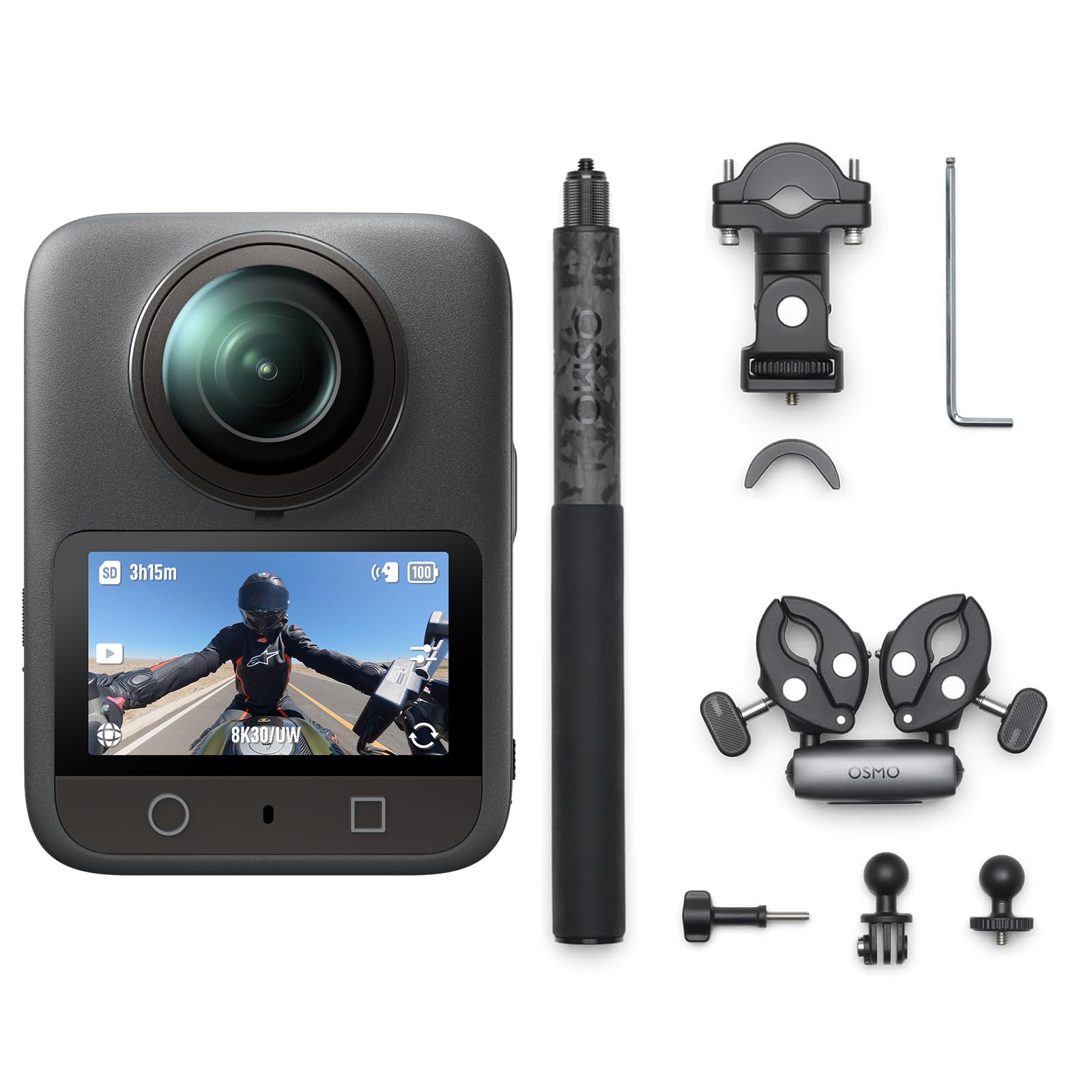
DJI’s entry into the 360 motorcycle space is a direct competitor to Insta360, and it brings a larger 1-inch sensor to the table for better dynamic range and low-light performance. With native 8K/30fps 360 capture and support for up to 100 minutes of non-stop recording, you can chase long mountain passes without battery swaps. The included 1-meter high-strength carbon fiber invisible selfie stick is rigid enough to stay steady at highway speeds.
The heavy-duty mount is machined for minimal vibration transfer, and the dual clamp system keeps the camera planted even on rough pavement. Post-ride reframing in the DJI Mimo app lets you export traditional wide-angle shots, third-person chase angles, or helmet-cam POVs from a single recording session. The 190-minute battery life figure comes from the standby time measurement; real 8K recording yields closer to 100 minutes, which is still class-leading for 360 cameras.
Audio performance is a strong suit here — the 360 mics capture immersive spatial audio that you can configure in editing. For riders who want the highest quality footage and are willing to invest in the DJI ecosystem, this combo is the most photo-first option on the list. Keep in mind that the Mimo app has been removed from Google Play, so you’ll need to sideload or use the iOS version for full control.
Why it’s great
- 1-inch sensor provides best-in-class dynamic range
- Motorcycle bundle with vibration-dampened mount
- Carbon fiber selfie stick is exceptionally rigid
Good to know
- Mimo app removed from Google Play — Android workaround required
- No external microphone input jack
5. GoPro MAX2
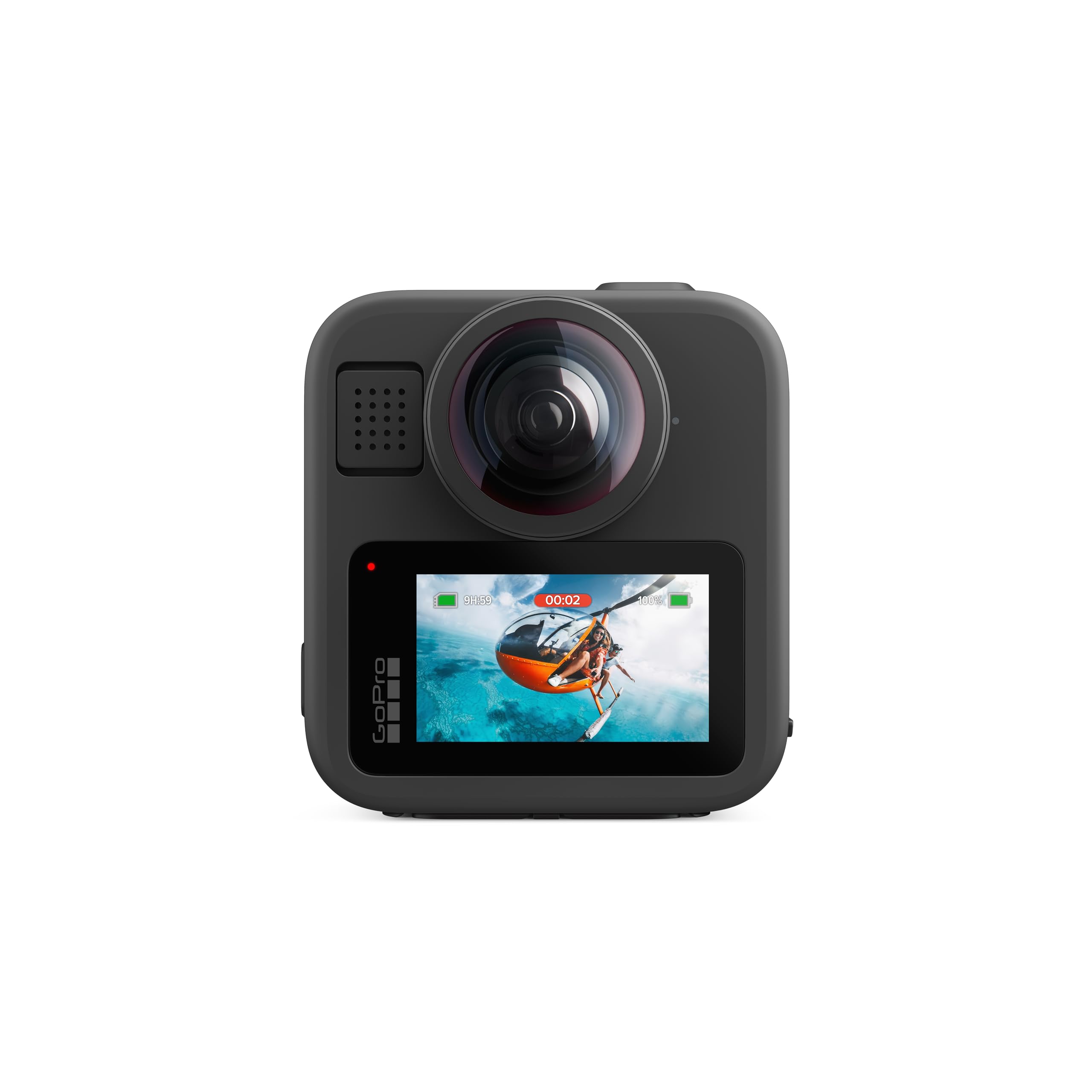
The MAX2 is GoPro’s answer to creators who want both 360 capture and traditional action cam functionality in one body. With True 8K spherical video, you never need to aim — just mount it on your handlebar and capture the entire hemisphere. The app-based reframing lets you pull multiple traditional 4K clips from a single 360 video, giving you a wide shot of the road ahead and a POV of the gauges from the same ride.
The six built-in microphones capture ambisonic audio that shifts perspective as you pan through the 360 space, effectively giving you spatial audio without an external mic. The replaceable glass lenses are a practical upgrade for motovloggers — one rock chip and you swap the lens cover instead of sending the whole unit back. HyperSmooth stabilization with Horizon Lock keeps the image level even when you roll the camera in 360 mode.
Invisible mounting works perfectly with the included selfie stick for the classic third-person shot that makes it look like a drone is following you. The 1960mAh Enduro battery lasts about 1 hour of 360 time lapse, so expect to carry spares for longer rides. The touch screen is intuitive, but the wealth of modes means you should practice on a short neighborhood ride before filming a canyon run.
Why it’s great
- Replaceable lenses protect against road debris damage
- 6-mic ambisonic audio adapts to 360 panning
- Dual functionality — 360 capture and traditional Hero mode
Good to know
- Battery life is shorter than dedicated action cameras
- Large file sizes require fast internet for app uploads
6. DJI Osmo Nano Standard Combo
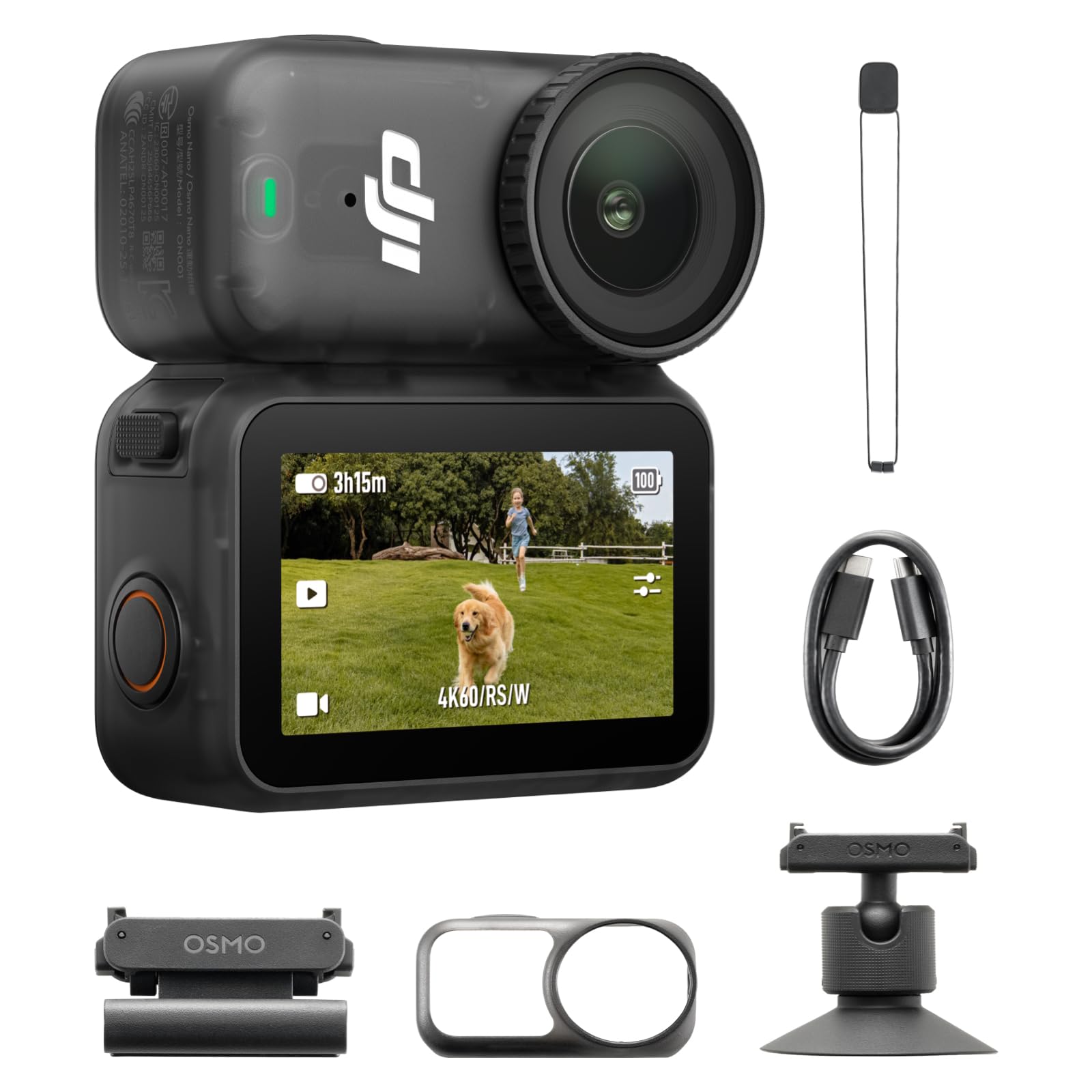
Sometimes you want a camera that disappears into your pocket and can be mounted anywhere in seconds. The Osmo Nano’s magnetic system — including the included hat clip and lanyard — makes it the fastest camera to deploy on a ride. With 4K/60fps and a 143-degree ultra-wide field of view, it captures enough of the road and surroundings for a solid motovlog, especially when paired with a helmet side mount.
The 200-minute battery life is among the best in this roundup, and the 64GB of built-in storage means you can start recording the moment you open the box. It supports direct connection to two DJI microphones via OsmoAudio, which solves the wind noise problem for spoken content. The 1/1.3-inch sensor is large enough for decent low-light performance during evening commutes.
This is not a 360 camera and it lacks the high-end stabilization of the Osmo Action 6, so you’ll want to mount it on your helmet for the smoothest results rather than directly to handlebars. The Standard Combo doesn’t include a tripod, but the magnetic ball-joint adapter works with most GoPro-style mounts. It’s a secondary camera buy that slots into your kit for lightweight days.
Why it’s great
- Magnetic mounts enable rapid placement changes
- 200 minutes of battery life for day-long rides
- 64GB onboard storage means zero setup delay
Good to know
- Not ideal for handlebar mounting — best on helmet
- DJI mic ecosystem required for external audio
7. Xtra Muse

The Xtra Muse takes a different approach to stabilization by embedding a physical 3-axis gimbal inside a pocket-sized body. Instead of relying solely on electronic image stabilization, the gimbal physically counter-rotates to keep your footage level. For motovlogging, this means you can mount it on a chest harness or a handlebar extension rod and get gimbal-smooth footage without post-processing that can crop your wide shots.
A 1-inch CMOS sensor records 4K video at 120fps, giving you smooth slow-motion playback of lean angles and fast overtakes. The face and object tracking is fast enough to follow you as you walk back to the bike during a walkaround segment, and the 2-inch touch screen is responsive for quick mode changes between helmet off and helmet on. Battery life reaches roughly 161 minutes, which covers most day rides without a top-up.
The gimbal is at its best when used as a held camera or chest-mounted unit — direct handlebar attachment can overwhelm the motors if the vibration is too strong. It’s a niche pick for motovloggers who want that cinematic gimbal glide look rather than a traditional POV, and who have the patience to tighten the gimbal lock between sessions.
Why it’s great
- Physical 3-axis gimbal delivers true cinematic motion
- 1-inch sensor for superior low-light and depth of field
- Face tracking keeps you centered during walkaround vlogs
Good to know
- Not vibration-proof for direct handlebar mounting
- Gimbal mechanism requires care when storing or transporting
8. GoPro HERO Black Compact

The HERO Black Compact is GoPro’s most accessible entry point for new motovloggers. It shoots 4K30 with HyperSmooth stabilization, which is more than enough for daytime vlogs that don’t need 8K resolution. The 12MP photos are a step down from the higher-tier models, but for quick Instagram posts from the saddle, they’re serviceable. The compact body weighs only 3 ounces and the foldable prongs let you clip it into any GoPro mount instantly.
Waterproof to 33 feet without a housing, it survives rain storms and creek crossings without extra protection. The included 50-in-1 accessory kit gives you a handlebar mount, helmet mounts, a chest strap, and an adhesive pad, so you can experiment with different mounting positions without buying extra parts. The 64GB micro SD card included in the bundle means you can start shooting right away.
The battery lasts about 1 hour at 4K30 — enough for a commute but not a full-day ride without a backup battery or USB-C power bank. There is no 3.5mm microphone jack, so your audio will be limited to the built-in mics unless you use a USB-C adapter or a wireless GoPro-compatible mic. It’s a starter kit for riders testing whether motovlogging is for them before spending on pro gear.
Why it’s great
- 50-piece accessory kit covers every mounting need
- HyperSmooth stabilization at a budget-friendly price
- Waterproof without a housing — ready for any weather
Good to know
- No 3.5mm mic input for clean audio
- Battery life is limited to about 1 hour of 4K
9. MWIRB 8K Video Camera
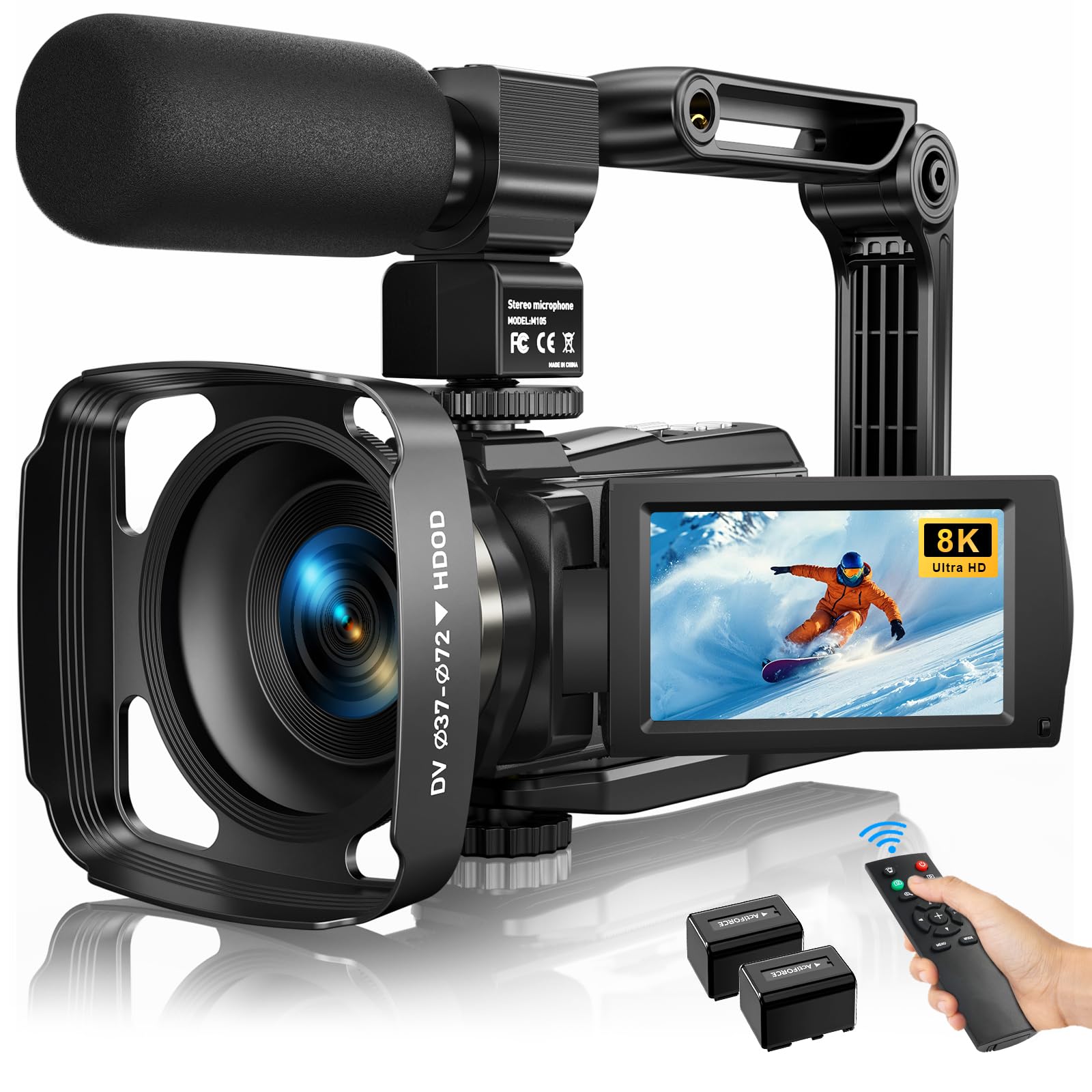
For riders who want to dip their toes into motovlogging without committing to a premium action camera, this MWIRB unit brings a surprising featureset. It records up to 8K at 15fps (practical 4K at 30fps) and uses a 6-axis anti-shake system that smooths out minor vibrations. The included external X-Y stereo microphone is a noteworthy addition — it mounts to the camera’s hot shoe and reduces wind noise significantly compared to the internal mics.
The 3-inch 270-degree rotating touchscreen makes it easy to frame yourself when the camera is mounted on a handlebar extension or a tripod, and the infrared night vision mode works for tunnel footage or after-sunset rides. It comes with two rechargeable batteries, a remote control, and a carrying bag, so the kit is complete out of the box. The Wi-Fi transfer via the iSmart DV2 app lets you grab clips for quick social uploads without pulling the SD card.
This is a traditional camcorder form factor, not a compact action camera. It’s larger and won’t fit in a pocket or under most helmet chin mounts. The 6-axis anti-shake isn’t as effective as GoPro HyperSmooth at high-frequency handlebar vibration, so you’ll get the best results mounting it on a handlebar extension rod with a vibration dampener. It’s a learning tool that gives you the external mic port and basic stabilization at a fraction of the cost of premium cameras.
Why it’s great
- Includes external stereo microphone for better wind handling
- Infrared night vision works in total darkness
- Complete kit with batteries, remote, and carry bag
Good to know
- Not weather-sealed — not safe in rain without a bag
- 6-axis anti-shake struggles with heavy handlebar vibration
FAQ
Can I use a regular GoPro without an external mic for motovlogging?
Should I get a 360 camera or a traditional action camera for motorcycle videos?
What is the best mounting position for a motovlogging camera?
How important is waterproofing for motovlogging?
Do I need 8K for motovlogs or is 4K enough?
Final Thoughts: The Verdict
For most riders, the best camera for motovlogging winner is the GoPro HERO13 Black Creator Edition because it bundles the Media Mod mic input, Volta battery grip, and 5.3K resolution into a complete motovlog solution that needs no additional purchases. If you want the flexibility of 360-degree capture and the ability to reframe your shots after the ride, grab the Insta360 X4 Motorcycle Bundle. And for maximum battery endurance and the first variable aperture on any action camera, nothing beats the DJI Osmo Action 6 Essential Combo.