
Our readers keep the lights on and my morning glass full of iced black tea. As an Amazon Associate, I earn from qualifying purchases.
Specs are compiled from manufacturer listings and verified buyer reviews and can change over time — please confirm the key details on the product page before buying.
Chasing golden-hour light means your camera needs to nail focus on a moving subject in dim conditions, then survive the hike back to the car. The best bodies for this trade-off autofocus fast enough to track a bounding deer and keep noise low when the sun drops. This guide breaks down the real-world strengths of the top interchangeable-lens cameras for nature work, from budget-friendly DSLRs to full-frame powerhouses.
I’m Min — the founder and writer behind Gadgets Feed. This guide is built by comparing the manufacturers’ published specifications and the patterns across verified customer reviews, so you get each pick’s real strengths and trade-offs instead of marketing spin.
For capturing wildlife, landscapes, and birds, the best camera for nature photography balances rugged build, fast autofocus, and low-light sensor performance to match your hiking style and shooting goals.
Our Picks at a Glance


How To Choose The Best Camera For Nature Photography
Nature photography punishes gear differently than studio or street work. You are fighting low light at dawn, fast-moving subjects, and weather that can change in minutes. Three core specs decide whether a camera helps you or holds you back in the field.
Autofocus Speed and Coverage
For wildlife, the camera needs to lock onto an eye or a bird in flight and hold it. More autofocus points spread across the frame mean the camera can track a subject that is not dead-center. A high burst rate lets you fire several shots in a second so you can pick the sharpest frame later.
Sensor Size and Low-Light Performance
Full-frame sensors capture more light per pixel, which keeps photos clean when the sun is low. APS-C sensors are smaller, but they give your lens a longer effective reach, which helps you fill the frame with a distant animal without carrying a huge telephoto. Your choice depends on whether you shoot mostly at dawn or mostly at long range.
Image Stabilization and Weather Sealing
Handheld telephoto shots get shaky, so built-in stabilization is a real advantage when you cannot use a tripod. Weather sealing keeps dust and moisture out of the body and lens when you are caught in a light rain or a dusty trail. These features often separate a trail-ready camera from a studio-only one.
Quick Comparison
| Model | Best For | Sensor | Autofocus Points | Continuous Shooting | Amazon |
|---|---|---|---|---|---|
| Nikon D7500★ Best Overall | Action & low-light | 20.9MP APS-C DSLR | 51 | Up to 8 fps | Amazon |
| Canon EOS 2000D / Rebel T7Budget Champion | Beginners on a budget | 24.1MP APS-C DSLR | 9 | 3 fps | Amazon |
| Panasonic LUMIX G85Hybrid Pick | Hybrid photo & video | 16MP Micro Four Thirds | 49 | 4K Photo up to 30 fps | Amazon |
| Canon EOS R100 | Lightweight beginners | 24.2MP APS-C Mirrorless | 121 | — | Amazon |
| Canon EOS R50 | Travel & vlogging | APS-C Mirrorless | — | — | Amazon |
| OM SYSTEM OM-5 Mark II | Rugged trail use | Micro Four Thirds | 242 | — | Amazon |
| Canon EOS RP | Budget full-frame | Full-Frame Mirrorless | — | — | Amazon |
| Sony Alpha a6700 | AI subject tracking | 26MP APS-C Mirrorless | 759 | 11 fps | Amazon |
| Sony Alpha 7 IV | Pro-grade versatility | 33MP Full-Frame Mirrorless | 693 | — | Amazon |
| Canon EOS R6 Mark II | Wildlife & action | 24.2MP Full-Frame Mirrorless | — | Up to 40 fps (electronic) | Amazon |
| Nikon Z6 III | Bright-light EVF & video | Full-Frame Mirrorless | 299 | Up to 120 fps | Amazon |
In‑Depth Reviews
1. Nikon D7500 DSLR
Our pick — over 4.5★ from 650+ verified ratings; the strongest balance of quality and price.
A rugged DSLR that pairs a 51-point autofocus system with a burst rate built for moving wildlife.
When a bird flushes from a bush, the D7500’s 51-point AF system with 15 cross-type sensors snaps onto it, and the 8 fps continuous shooting catches the wingbeat sequence. Owners consistently report fast, accurate autofocus and sharp low-noise images, calling it “the thing everyone raves about” for action work. The 20.9MP APS-C sensor keeps noise down when the light fades to dusk, which is exactly when nature gets active.
The bundled 18-140mm lens is a genuine all-rounder, and its zoom range covers everything from a sweeping landscape to a closer portrait of a perched bird. That lens is weather-resistant, so a light drizzle on the trail does not end your session. The large 3.2-inch tilting touchscreen LCD makes it easy to compose low-angle shots of flowers or ground-dwelling animals without lying in the dirt.
It is a 2017 model, so the tech is dated, but the crowd favorite—4.8 stars across 600+ ratings—shows that real-world results outrank the spec sheet. The trade-off is weight; this is a sturdy, heavy body, and button layouts differ from older Nikons, which takes a short adjustment period. Buyers report excellent viewfinder clarity and battery life that lasts a full day of hiking.
rugged workhorse
- 51-point AF tracks fast-moving subjects reliably.
- Weather-resistant 18-140mm kit lens handles trail moisture.
- 4K UHD video with a tilting touchscreen for flexible angles.
heavy and dated
- Body is heavier than modern mirrorless alternatives.
- Button layout demands a learning curve for Nikon newcomers.
best for: the photo enthusiast who wants fast action tracking and long battery life on a full-day hike.
skip if: you need the lightest possible kit for multi-day treks; its rugged build adds real heft.
2. Canon EOS 2000D / Rebel T7
A starter DSLR kit that bundles everything a first-time nature photographer needs to learn the craft.
For someone moving up from a phone, this kit removes every barrier to entry: the box includes the camera, an 18-55mm lens, a wide-angle and telephoto lens, a 128GB memory card, filters, a flash, and a tripod. You can start shooting landscapes and close-up details the day it arrives. The 24.1MP APS-C sensor and DIGIC 4+ processor deliver sharp, high-quality photos that owners call “easy to use” and “a great deal” for beginners.
The 9-point AF system is basic, so fast-moving birds will challenge it, but for perched wildlife and static scenery it locks on fine. The 3 fps continuous shooting is slow, meaning you will want to wait for the perfect moment rather than spray-and-pray. Built-in Wi-Fi with NFC makes transferring a favorite shot to your phone for quick sharing a simple process.
Battery life earns praise, and the Scene Intelligent Auto mode lets a novice point and shoot while they learn manual controls. The catch is the kit tripod, which owners mention breaking within months, and the 3 fps speed limits action photography. This is a camera to learn the fundamentals on, not to chase sprinting animals with.
easy for novices
- Complete kit with two extra lenses, flash, and 128GB card.
- Full HD 1080p video at 30 fps for recording nature moments.
- Built-in Wi-Fi with NFC for easy phone transfer.
basic autofocus
- 9-point AF and 3 fps limit fast-action wildlife shots.
- Kit tripod is flimsy; budget for a replacement.
reach for: you are a teen or adult starting out and want every accessory included to learn without extra spending.
look past: your main goal is photographing birds in flight; its autofocus and burst speed are entry-level.
3. Panasonic LUMIX G85
A mirrorless hybrid whose in-body stabilization steadies handheld telephoto shots and 4K video alike.
The G85’s defining feature is its 5-axis in-body image stabilization, which works in both photos and 4K video to produce clear handheld shots even in low light. That means you can drop the tripod for many situations and still get sharp frames of a waterfall or a grazing animal. The 16MP Micro Four Thirds sensor, lacking a low-pass filter, resolves roughly 10 percent more fine detail than older 16MP sensors.
Its integrated 2360K-dot OLED live viewfinder and 3-inch tilt-and-touch LCD (1040K dots) give you flexible framing options. The 4K Photo mode shoots up to 30 fps, letting you pull a still frame from a burst of action after the moment passes. The 12-60mm Power O.I.S. kit lens covers a versatile 24-120mm equivalent range, enough for landscapes and moderate wildlife reach.
Consensus is that this is a superb value for video-first shooters, with excellent ergonomics and a weather-sealed kit lens. By comparison, its 16MP resolution is lower than APS-C rivals, which shows when you crop heavily into a distant subject. A minority of buyers found the body heavier than the lighter G7 or noticed softness in the kit lens, so handling it in person is wise.
best fit: hikers who want one camera for both crisp stills and stabilized 4K footage of their trips.
consider: you plan heavy cropping of distant wildlife; its 16MP sensor gives you less room to zoom in post.
4. Canon EOS R100
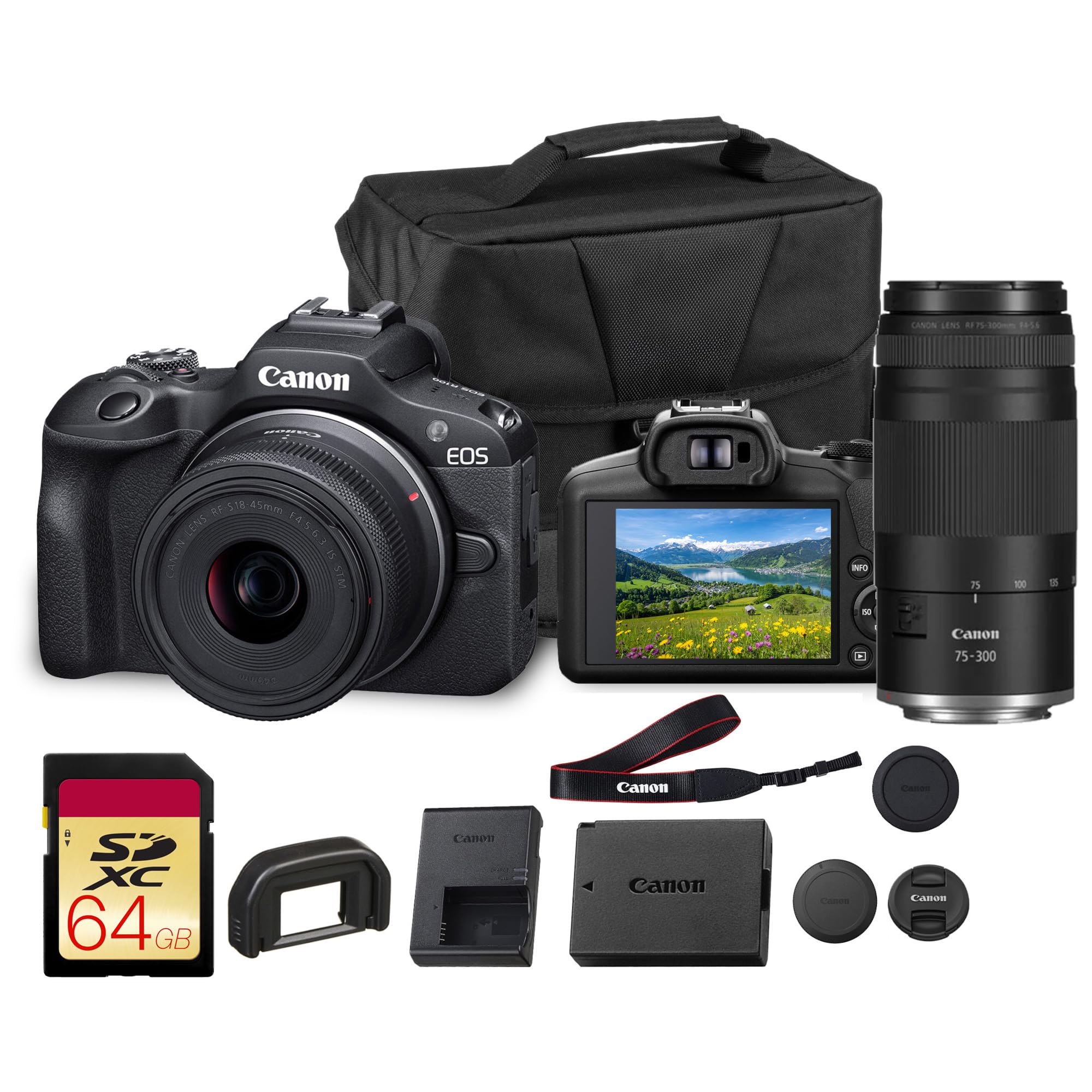
A featherlight mirrorless with a 121-point hybrid autofocus and two lenses covering wide to telephoto reach.
Weighing far less than traditional DSLR systems, the R100 is built to come along on day hikes without dragging you down. This double-lens bundle pairs the RF-S 18-45mm f/4.5-6.3 IS STM for landscapes with the RF 75-300mm f/4-5.6 telephoto for distant birds and wildlife. That combination gives a beginner a complete setup for landscapes, portraits, travel, and wildlife without buying another lens.
The 24.2MP APS-C sensor and DIGIC 8 processor produce crisp, color-rich images with background blur even in low light. Its 121 autofocus points provide much more flexible framing than entry DSLRs, quickly locking onto subjects across the frame. Owners praise its ease of use for beginners and note it produces professional-style photos right from the start.
A 75-300mm telephoto reach is the key here for nature work, letting you fill the frame with a deer or a heron without getting close enough to spook it. Keep in mind the camera has no built-in flash, and a couple of owners mentioned the neck strap clip could detach, so a third-party strap is a smart upgrade. It is a lightweight, reliable kit that grows with you as you learn.
great match: the hiker who wants a low-weight mirrorless with genuine telephoto reach for wildlife.
skip it: you shoot in very low light at dawn regularly; the kit lenses are slow at f/4.5-6.3.
5. Canon EOS R50
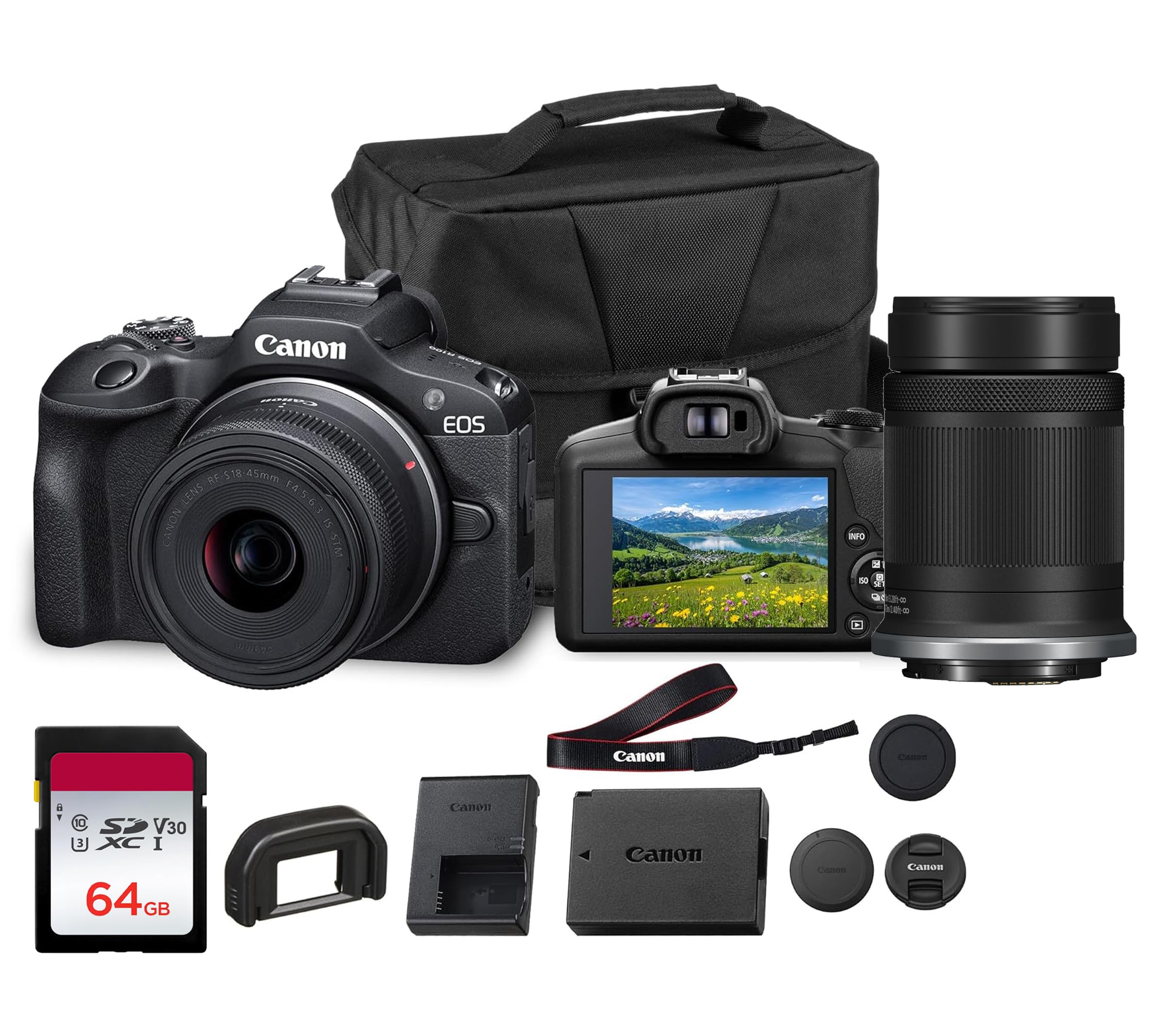
A pocket-friendly mirrorless whose twin stabilized zooms make it ideal for travel and small bags.
Owners describe the R50 as “convenient to take her places” and perfect for slipping into small bags on a road trip. This kit includes the RF-S 18-45mm f/4.5-6.3 IS STM standard zoom plus a 55-210mm f/5-7.1 IS STM telephoto, both with image stabilization to counteract handheld shake. The longer 55-210mm reach is exactly what you want for wildlife, compressing distance so a distant subject fills more of the frame.
Its small, light body suits small to medium hands, and the fully articulating screen flips out for self-recording or low-angle nature shots. A 64GB memory card and shoulder bag are included, so it is a ready-to-shoot travel companion. Image quality earns consistent praise, with one buyer noting it takes pictures that “blow people’s minds” and works beautifully for salon portrait work with window light.
You get a camera that’s easy to carry all day, and it still reaches distant wildlife. With a 1.6x crop factor (a sensor that magnifies your lens’s zoom), the 210mm lens becomes a roughly 336mm equivalent, so you can fill the frame with shy animals without getting close. It earns 4.7 stars across 200+ ratings, making it among the most consistently loved cameras here. If you want a compact body with a modern autofocus system that tracks moving subjects, this fits you well. skip it if you need a full-frame sensor for ultra-wide landscapes—this crop sensor limits that.
perfect for: the traveler and light-packer who wants stabilized telephoto reach without a heavy body.
not ideal: professional wildlife work needing extreme telephoto or pro-grade weather sealing.
6. OM SYSTEM OM-5 Mark II

A compact, weather-sealed body with 242 autofocus points, designed to survive the trail in any weather.
The OM-5 Mark II is engineered specifically for outdoor travel, with a compact body that swaps a full DSLR for something far lighter on the trail. Its 242-point hybrid autofocus system is built to “capture every split second,” which translates to quick subject acquisition for moving animals. The Micro Four Thirds mount gives you access to a deep lineup of compact, high-quality lenses ideal for backpacking.
The Sand Beige color and beefier grip are practical upgrades over the Mark I, and the body is weather-sealed to handle trail dust and light rain. A dedicated computational photography button lets you access creative modes inspired by nature, and unlimited 4K video recording means you can document a long trek without a hard stop. Owners who made the switch from a DSLR report never regretting the lighter setup.
This camera has a smaller following—just a couple dozen ratings—so its 4.2-star average reflects a mix of enthusiastic owners and a few vocal detractors. One unit reportedly arrived missing its SD memory card, and one buyer felt image quality lagged behind the competition. The Micro Four Thirds smaller sensor means it struggles more in very low light than a full-frame body, but its portability is the whole point.
built for: the thru-hiker and outdoor traveler who wants a weather-sealed camera that disappears into a pack.
choose other: maximum low-light dynamic range is your priority; full-frame or larger APS-C sensors do better.
7. Canon EOS RP

The most affordable way into full-frame imaging, bundled with a versatile 24-105mm stabilized zoom.
For a landscape photographer craving that full-frame look, the RP is “a fantastic way to get into Full Frame while staying affordable,” as owners put it. The RF24-105mm F4-7.1 IS STM lens covers a wide-angle-to-telephoto range and includes optical image stabilization at up to 5 stops of shake correction, so handheld shots stay sharp. Full-frame sensors capture more light, which shows in vibrant colors and clean high-ISO files for dawn and dusk work.
The camera body is compact and lightweight for a full-frame system, making it genuinely practical for travel and hiking. It doubles as a high-quality webcam via the EOS Utility software or clean HDMI output, adding versatility beyond nature work. Phase-detection autofocus is fast and accurate for still subjects, and the 4K UHD 2160p video capability covers recording needs.
With 4.6 stars across 800+ ratings, this is a proven favorite for value-seeking full-frame shooters. The trade-offs are the kit lens’s soft edges at wide apertures (fixed by stopping down to f/8) and a burst speed better suited to landscapes than birds. It is excellent for landscapes and portraits, and clearly “not for sports,” per the consensus.
ideal for: landscape and portrait shooters who want full-frame image quality without the premium price tag.
look past: your subject is fast-moving wildlife; its autofocus and burst rate favor static scenes.
8. Sony Alpha a6700

A 26MP APS-C workhorse whose dedicated AI processor locks onto subjects with 759 autofocus points.
This is the camera for the photographer who wants the latest subject-tracking tech in a compact, travelable APS-C body. Its dedicated AI processor and Real-time Recognition system identify and hold onto animals and birds with remarkable accuracy, backed by a 759-point autofocus array. At 11 frames per second continuous shooting, you can capture a sequence of a fox pouncing or a hawk diving without missing the peak moment.
The 26MP Exmor R back-illuminated sensor with BIONZ XR processing yields sharp, low-noise images that punch above its APS-C class. It records 4K/60p from a 6K oversampled readout plus 4K/120p, matching stills capability for nature documentary work. Owners call it “a beast” and “a workhorse,” praising autofocus that “locks onto subjects reliably.”
By comparison, its 759 autofocus points dwarf the 51 on the Nikon D7500, giving you far more freedom to track subjects off-center. The honest caveats are a complex menu system, some reported overheating in long runs, and a handful of units turning off after 1.5 to 2 hours of heavy use. It is a top-tier APS-C camera that punches above its class, per the owners.
best for: the hybrid shooter who wants AI-powered subject tracking and 11 fps bursts in a light body.
mind trade: the menu system is genuinely complex, and long video sessions can trigger overheating warnings.
9. Sony Alpha 7 IV

A 33MP full-frame hybrid that pairs a 693-point autofocus system with 4K 60p video in every format.
For the serious nature photographer who also wants a video-capable body, the A7 IV delivers a stunning 33MP full-frame Exmor R back-illuminated sensor. Its 693 autofocus points and next-generation BIONZ XR processor produce what owners call “remarkably accurate” tracking for both animals and people. 7K oversampling delivers full-frame 4K 30p with no pixel binning, so video landscapes keep exceptional detail.
The camera is built around customization—dual card slots for CFexpress Type A and SDHC/SDXC, an improved menu system, and a bigger grip than older Sonys. Its low-light performance is strong, with high ISO noise reduction that keeps dusk shots clean. Reviewers consistently call the out-of-box image quality “immaculate” and note it is versatile enough for a first pro camera.
At 4.7 stars across 700+ ratings, the A7 IV is a proven pro-grade workhorse. The reported trade-offs are some overheating in extended use and a battery that benefits from a spare on long shoots. It is not the simplest camera for a beginner, with a steep learning curve from its many settings, but it rewards the effort with breathtaking flexibility.
reach for: you want a do-everything full-frame body that excels at both high-res stills and 4K video.
start simpler: you are brand new to interchangeable-lens cameras; its extensive menu is a lot to learn.
10. Canon EOS R6 Mark II

A full-frame speed demon offering an electronic shutter up to 40 fps for nailing split-second wildlife action.
This is the camera Canon built for exactly the scenario nature photographers live in: a deer bolting through a clearing, captured at up to 40 fps with the electronic shutter. Enhanced subject acquisition detects people, animals, cars, and more—with horses, trains, and aircraft added—while the advanced head, face, and eye detection tracks an animal’s eye even when it moves across the frame. The 24.2MP full-frame CMOS sensor keeps those rapid frames sharp and detailed even in low light.
6K-oversampled 4K video records uncropped at up to 60 fps, with Full-HD slow motion to 180 fps, and runs up to 6 hours without overheating. Built-in 5GHz Wi-Fi and Bluetooth 5 make transferring field shots to your phone easy. The 3.0-inch 1.62-million-dot vari-angle touchscreen and 0.5-inch OLED viewfinder with a 120 fps refresh rate keep you composed in any situation.
Owners rave about the crisp images and excellent video, calling it one of Canon’s best and noting its incredible focus tracking. The recurring gripe is battery life—a few hundred shots per charge, so carry spares on a full day out. It is a practical, weather-sealed choice for action, wildlife, and low-light work, though it notably requires an adapter if you own older EF lenses.
best for: the serious wildlife shooter who needs 40 fps bursts and animal eye-detection autofocus.
plan around: its short battery life and the need for an adapter to use older Canon EF lenses.
11. Nikon Z6 III

A full-frame mirrorless with a class-leading 4000-nit viewfinder, crisp even in harsh midday sun.
Shooting in bright mountain light is where the Z6 III separates itself. Its viewfinder hits a maximum brightness of 4000 nits with 5760k-dot resolution, so you can frame a landscape even when the sun is glaring down. The 120 fps maximum refresh rate renders fast-moving action naturally, and the DCI-P3 color gamut ensures accurate tones for delicate scenes like a sunset gradient.
On the capture side, it records 6K/60p internal N-RAW video plus oversampled 4K UHD, 4K/120p, and Full HD/240p slow motion. Its ISO range of 100-64000, expandable to 204800, keeps pre-dawn shots clean and flexible. Its autofocus works down to -10EV with multi-subject recognition, tracking a deer emerging from shadow about 20% faster than the Z6 II.
Owners praise the “excellent low light” performance and note it outperforms the older Z5 by a wide margin. The honest trade-offs are a complex menu system, an unreliable auto mode, and a battery that lasts around 2 hours—plus the body ships without a charger. With 4.5 stars across 200+ ratings, it is a powerful but demanding tool that rewards photographers willing to master its controls.
great for: the hybrid shooter who wants the brightest viewfinder available and top-tier 6K video in one body.
be prepared: a learning-curve-heavy menu and a battery that pairs best with a spare on long excursions.
Understanding the Specs
Autofocus Points and Burst Speed
Autofocus points are the small focus zones spread across your frame; more points let you lock onto a subject that is off to the side, not just dead-center. A higher burst rate, measured in frames per second (fps), means the camera fires more shots in a second, which is crucial for catching a bird mid-flight or an animal mid-stride. For nature work, look for at least 50 autofocus points and a burst rate of 8 fps or higher.
Sensor Size and Low-Light Reach
The sensor is the light-capturing chip inside the camera, and its size dictates how much light it gathers—full-frame sensors are larger and perform better in dim conditions like dawn or dense forest shade. APS-C and Micro Four Thirds sensors are smaller, but they give your lenses a “crop factor” that effectively extends your telephoto reach, making distant subjects appear larger. A 1.6x crop factor, for example, turns a 200mm lens into a roughly 320mm equivalent.
FAQ
What is the best autofocus mode for photographing wildlife?
How many autofocus points do I really need for nature photography?
Is a full-frame camera always better for nature photography than APS-C?
What does image stabilization do for handheld nature shots?
How important is weather sealing for a nature photography camera?
How long does a camera battery last for a full day of nature shooting?
Is the Canon EOS R100 good for beginners who want to shoot wildlife?
What is the difference between a DSLR and a mirrorless camera for nature photography?
Can I use older Canon EF lenses on the newer Canon RF mirrorless cameras?
Why do some nature photographers prefer a 4K photo mode?
Final Thoughts: The Verdict
If you want one dependable pick, the camera for nature photography winner is the Nikon D7500 because its 51-point autofocus, 8 fps burst, and weather-resistant kit lens are a proven combination for hiking and wildlife. If you want AI-powered tracking in a compact body, grab the Sony a6700 with its 759 autofocus points. And for full-frame landscapes without the premium price, the Canon EOS RP is the one to reach for.
How We Picked
We do not accept paid placement. Every pick is matched to a real buyer and a real use-case; we do not hands-on test units.
Sources & Methodology
Specifications: manufacturer listings and product documentation. Review insights: verified customer reviews, as of August 2026. Pricing: not shown on this page (it changes often); check the current price via the retailer link.
As an Amazon Associate, Gadgets Feed earns from qualifying purchases. This does not affect which products we feature.