
Our readers keep the lights on and my morning glass full of iced black tea. As an Amazon Associate, I earn from qualifying purchases.
Specs are compiled from manufacturer listings and verified buyer reviews and can change over time — please confirm the key details on the product page before buying.
Before you buy a camera for your RC helicopter, match it to your machine’s size, speed, and voltage—not just the biggest megapixel count. Your best pick depends on what you want: aerial footage saved to an SD card, a live first-person view (FPV) feed to your phone, or a full headset experience.
I’m Min — the founder and writer behind Gadgets Feed. This guide is built by comparing the manufacturers’ published specifications and the patterns across verified customer reviews, so you get each pick’s real strengths and trade-offs instead of marketing spin.
You can find a capable camera for rc helicopter that fits your skill level and budget, from budget-friendly action cams to premium FPV goggles and transmitters.
Our Picks at a Glance

How To Choose The Best Camera For RC Helicopter
Choose a camera based on if you need recorded footage for later review or a live FPV feed for real-time piloting. Action cameras and the cameras built into toy helicopters typically record to a memory card or stream over Wi-Fi, while FPV setups send a live video feed to goggles or a monitor with almost no delay.
Match the Voltage to Your Helicopter
FPV transmitters have a specific operating voltage range. If your helicopter uses a larger battery, like a 2S or 4S, you need a transmitter that can accept that power. Always verify the transmitter’s input range against your battery voltage before wiring, as overvoltage can permanently damage it.
Resolution Versus Live View
High resolutions like 1080P or 4K deliver crisp recorded footage for post-flight review. For live FPV flying, low latency matters more than pixel count for smooth control. Even slight video lag can make precise flying difficult, so prioritize low-latency feeds.
Quick Comparison
| Model | Best For | Video Resolution | Photo Resolution | Camera Type | Amazon |
|---|---|---|---|---|---|
| AKASO EK7000★ Best Overall | Standalone HD recording | 4K30FPS | 20MP | Action Camera | Amazon |
| DRONEEYE 4DV13Best Value | Beginner quadcopter flying | 1080P HD | 2 mp | Wi-Fi Drone Camera | Amazon |
| OBEST LM19 Osprey | Live video to a phone | 1080P HD | — | Dual Wi-Fi Camera | Amazon |
| AKK KC02 | Low-light FPV flying | 600TVL | — | Analog FPV System | Amazon |
| OBEST Chinook | Realistic military scale looks | 720P HD | — | Wi-Fi FPV Camera | Amazon |
| RunCam WiFiLink2 | HD digital FPV experimentation | 1080P60FPS | — | Digital HD FPV Kit | Amazon |
| Fat Shark Recon Echo | Complete headset FPV kit | Analog | — | Goggles & Camera Combo | Amazon |
In‑Depth Reviews
1. AKASO EK7000 Action Camera
Our pick — over 4★ from 39,000+ verified ratings; the strongest balance of quality and price.
A featherlight action cam that turns any heli into a 4K recording machine.
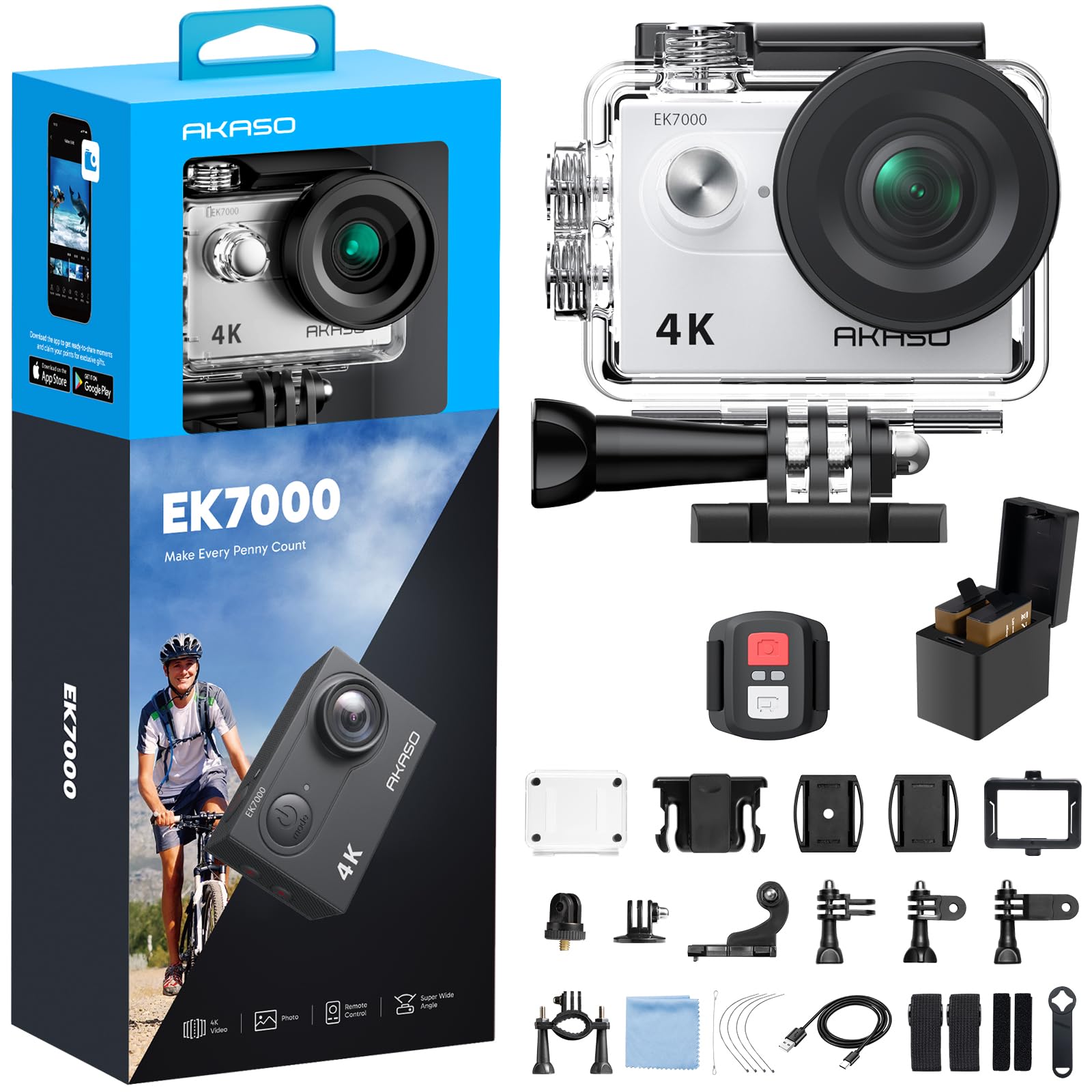
If you already own a helicopter and just want a standalone camera to strap on, this is the one to beat. It shoots professional 4K30FPS and 2.7K30FPS video with 20MP photos, which is 4 times the resolution of traditional HD cameras, so your rotors stay crisp even when the machine is moving fast. The built-in Electronic Image Stabilization (EIS) smooths out the vibration that plagues most RC airframes.
The bundle is the real story here. It includes a waterproof case rated for 131 feet, a wrist 2.4G remote, and 7 mounts so you can attach it to a helmet, a bicycle, or the belly of a helicopter. Built-in Wi-Fi lets you connect to the AKASO GO app on your phone to frame shots and edit, with the signal reaching up to 10 meters.
The thing everyone raves about is the build quality—over 7,000 owners call it out as the top strength. The battery life is the honest trade-off; it’s the most mixed aspect in the data, so carrying the spare 1050mAh battery that comes in the box is a smart move. As owners put it about the bundle: “Long battery life, the extra battery comes in handy.”
Why It Wins The Sky
- True 4K30FPS video with a 20MP sensor for detailed stills
- Waterproof case extends use to 131 feet underwater
- Wrist remote and 7 mounts offer flexible mounting
Where It Loses Altitude
- Battery life is the most common complaint; pack the spare
- The wrist remote is not waterproof
- The included waterproof case can muffle the microphone
The Takeaway: This is the pick for RC owners who want a versatile, mountable camera that also works on a bike, helmet, or underwater.
Think Twice If: You need a dedicated live FPV feed to goggles, since this records locally rather than streaming low-latency video.
2. DRONEEYE 4DV13
An agile beginner quad with a live camera feed and a very friendly price tag.
This is a complete quadcopter, not just a camera, so it’s the fastest route to a flying camera experience for a beginner. It carries a 1080P HD Wi-Fi camera that you can adjust, sending a live video feed to a specialized app on your phone. The 3D flip mode and Waypoint functions make it feel more like a toy than a tool, which is exactly the point.
One Key Take Off/Landing and Altitude Hold make it forgiving for beginners to launch and hover steadily. Headless mode simplifies orientation for novice pilots. Safety features include a low power alarm, emergency stop, and 4 propeller guards to protect the rotors on impact.
Owners say it includes 2 batteries, giving 10-15 min of flight each, so you get roughly half an hour of total airtime. That’s the standout spec here. The weak point in the feedback is the camera resolution—owners note the video quality is poor and not really 1080p, so treat the camera as a fun extra rather than a serious filming tool.
Best For: New pilots who want a whole flyable package with a camera and spare batteries without spending much.
skip it if: You expect crisp HD footage—the camera quality is the most common criticism, and serious filming needs a better sensor.
3. AKK KC02 FPV Transmitter

A budget analog video link that shines in low light and signals clearly at distance.
This is a ready-to-fly FPV system combining a camera and video transmitter (VTX) specifically for quadcopters and drones. The 1/3″ SONY SUPER HAD II CCD sensor delivers 600TVL picture quality that owners describe as crisp at a great distance, and it’s specially designed for outdoor flying. The low-power draw keeps your battery free for the motors.
Flexibility is the big win. It runs on a 7-20V operating voltage, so you can power it with a 2S to 4S battery, and it outputs a regulated 5V for the camera. The 2-button and 2-LED interface makes changing channels and frequencies simple in the field. Buyers report pulling clear video from 3.5 km away, which is far beyond Wi-Fi systems.
What wins people over is the raw functionality—over 40 owners flag it as the system’s best trait, and it outperforms pricier analog units without software or burnout issues. The honest catch is durability and heat; a few units die within days, and the case gets warm during use. One recurring note is that the VTX plug wires can be mislabeled, so double-check the wiring before powering up.
Best For: Hobbyists building or upgrading a multirotor who want an affordable analog FPV link with strong range and great low-light performance.
Watch Out For: The wiring on the plug isn’t always labeled correctly, and heat buildup means this needs airflow to stay reliable.
4. OBEST LM19 Ospery Helicopter
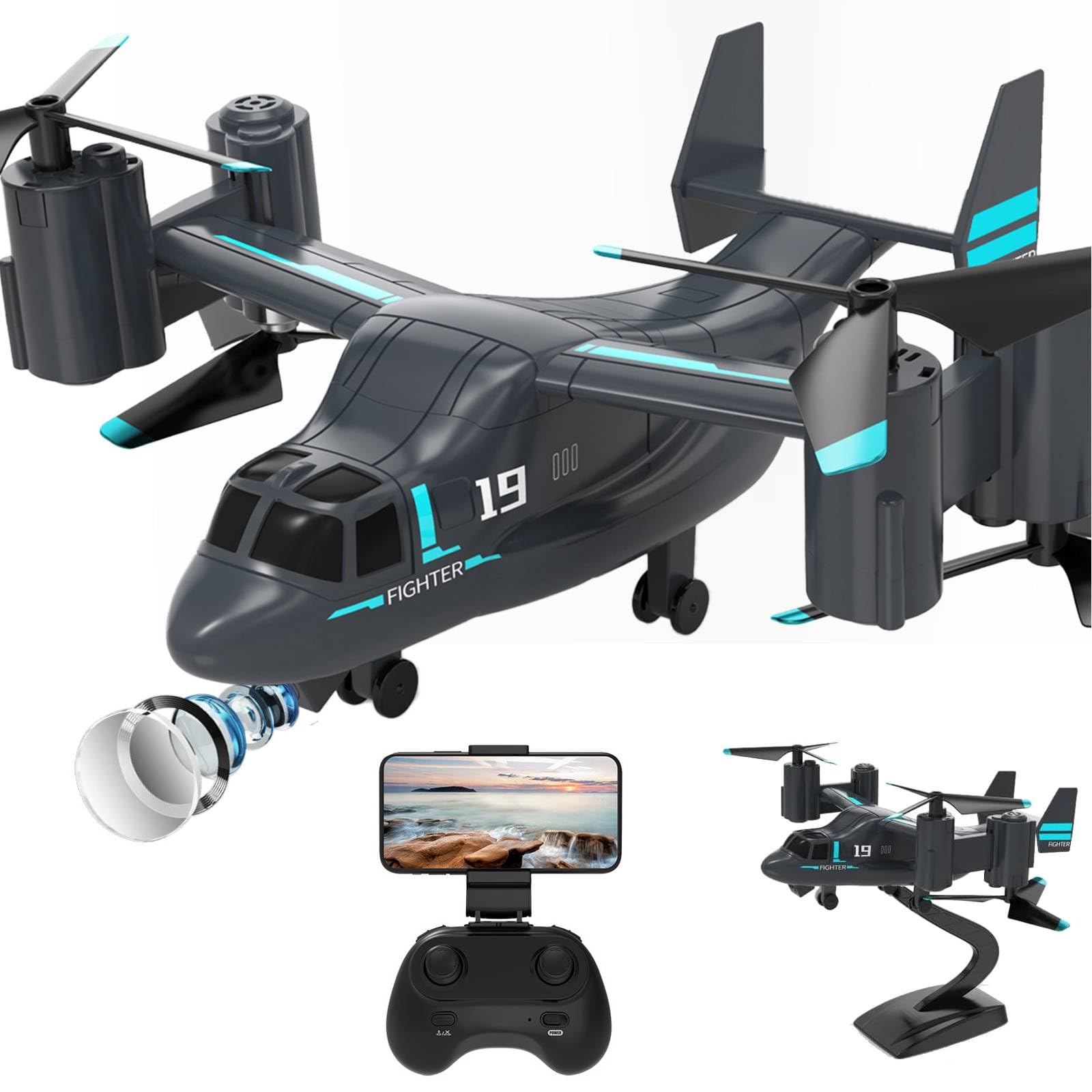
A military-scale Osprey that flies, glides, and streams live 1080P video from two angles.
This one stands apart because it’s a true RC helicopter silhouette with a dual-camera setup. It has a main camera for front views and a bottom camera that provides a real-time ground view and optical flow positioning, which improves the stability of hovering and low-altitude flight. Both stream high-definition video to your phone over FPV real-time transmission.
It offers two flying modes: a land-gliding mode for flat indoor surfaces and a traditional flying mode for the sky. The 1:100 scale LM19-A Osprey design with a display rack makes it a collectible piece for military fans, and the accompanying LED lights make night flights more visible. Two 800mAh modular batteries support up to 14 minutes of flight.
Owners are split on the controls; the remote can be tricky to master, but the phone app gives you Gravity Sensor control so the helicopter follows your phone’s direction, which feels more intuitive. The flight performance is the strongest praise in the feedback, handling both flying and gliding modes smoothly, and the build quality gets high marks for a toy in this class.
Dual-View Advantage
- Two cameras—front and bottom—for comprehensive coverage
- Fly and land-glide modes offer two ways to play
- Display stand turns it into a collectible when not flying
Handling Curve
- Remote control is reported as hard to control by some owners
- One report of a wing joint weakening after a day of use
- Only a 7-minute flight per battery, 14 with both
Reach For It If: You want a realistic scale helicopter with a live streaming camera that doubles as a display piece.
Look Elsewhere If: You want precise, responsive controls—the stability and ease of use are the weakest links in the feedback.
5. OBEST LM19-D Chinook
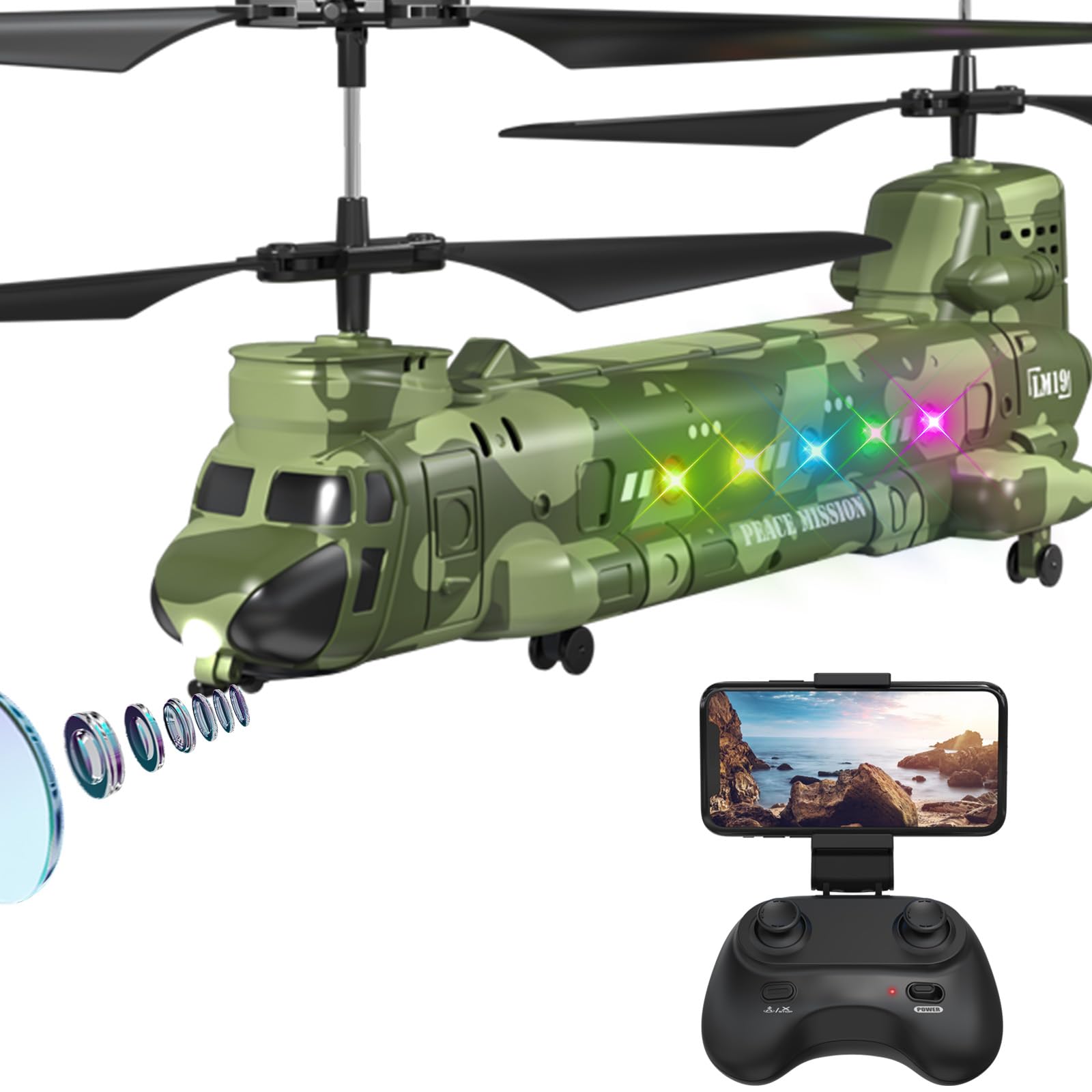
A twin-rotor military Chinook with a 720P camera and beginner-friendly altitude hold.
This budget-friendly Chinook brings the classic twin-propeller silhouette to the skies, made for kids and adults who want a realistic military look. The 720P Wi-Fi camera streams live images to your mobile device over FPV, so you can watch the flight in real-time through an app. It’s not the highest resolution on this list, but it’s plenty for casual fun.
The 2.4GHz remote controller has better signal transmission and is less prone to interference than lower-frequency options, making the flight easier to control. Altitude Hold locks the helicopter at a certain height when you release the throttle, which is a huge help for steady hovering. One Key Take-Off/Landing simplifies the whole process for new pilots.
The dual 800mAh modular batteries are the real highlight, supporting up to 20 minutes of flight—that’s the longest total airtime in this mid-tier group. Owners call it genuinely fun for families, and the controls get positive feedback for being simple and responsive. The recurring caution is durability, with one owner reporting the rotor toy broke after two weeks, so fly it calmly and keep it indoors or in calm weather.
The Verdict: A fun, responsive, and realistic-looking Chinook that gives beginners the most flight time per charge in its class.
Know This: Durability is the weakest point in the reviews; it’s a toy, not a rugged crash-proof flyer.
6. RunCam WiFiLink2 Digital FPV System
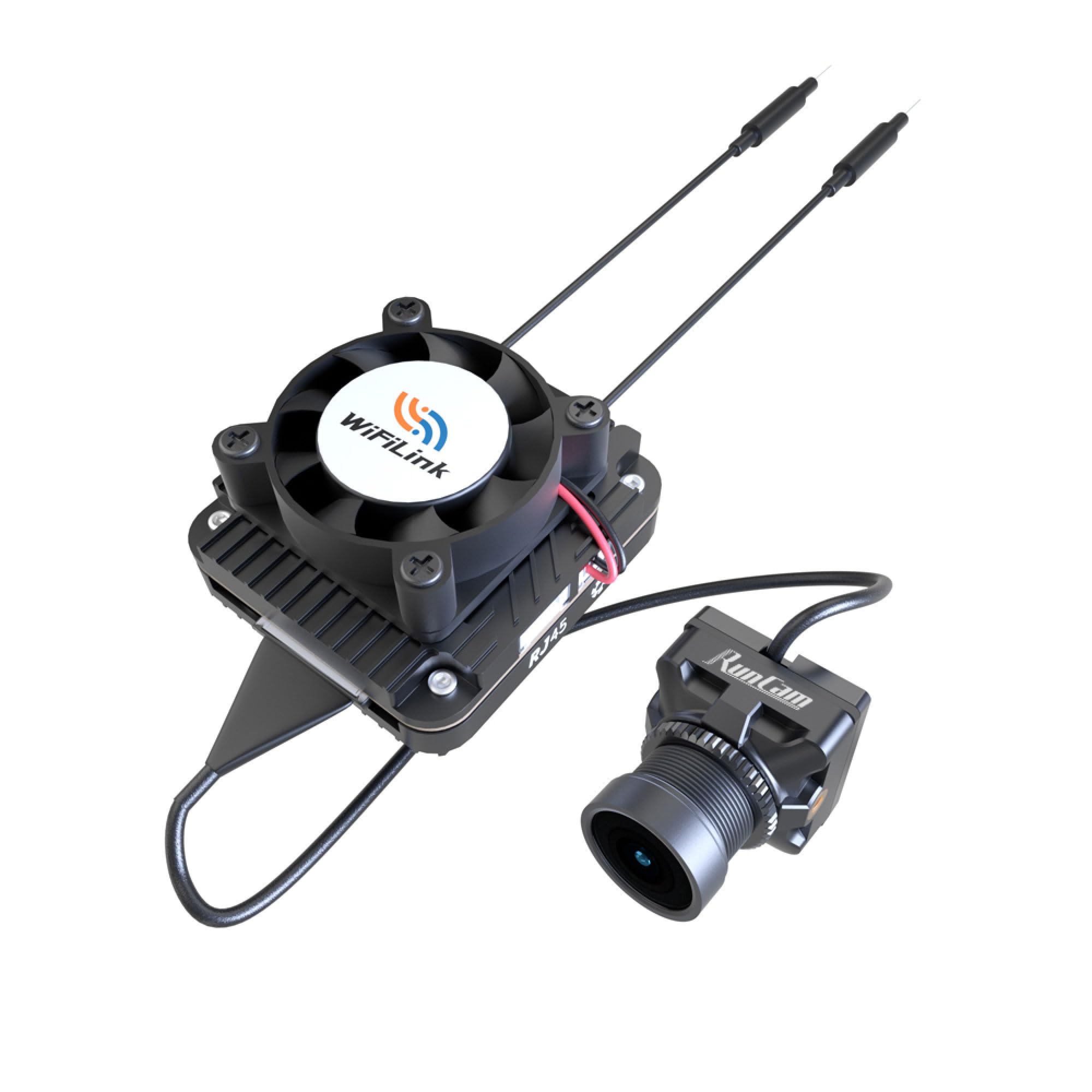
A 1080P60FPS digital FPV kit that lets tinkerers build a custom HD video link.
This is the pick for the builder who wants high-definition video without the high price of proprietary digital systems. The WiFiLink2 streams 1080P60FPS video from a micro FPV camera with a built-in VTX transmitter module directly to your mobile device or a compatible monitor. It’s built on OpenIPC, an open-source foundation that allows for deep customization of your FPV experience.
At only 30 grams, it’s light enough for micro drones and small fixed-wing aircraft, and the wide 9-30V voltage range means you can adapt it to almost any power setup you have. It supports multiple resolutions, giving you flexibility between quality and performance. It’s specifically designed for FPV monitors on mobile devices, and works excellently when paired with a RunCam VRX receiver.
This is a tinkerer’s tool, not a plug-and-play camera. Owners stress that it’s only for people who like experimenting, and that getting the settings right takes patience—the default settings are described as unusable. The latency is too high for freestyle racing but perfectly fine for cruising and filming. One reviewer noted the listing image shows more than what’s in the box, so check the contents carefully before ordering.
The Builder’s Reward
- True HD 1080P60FPS digital feed to your phone or monitor
- 30-gram weight is light enough for micro aircraft
- Wide 9-30V input adapts to many battery setups
The Tinkerer’s Tax
- OpenIPC setup is complicated and not beginner-friendly
- Default settings are unusable and need tuning
- High latency rules it out for fast freestyle flying
For The Experimenter: This is the most customizable HD digital system here, made for hobbyists who enjoy configuring their gear.
pass on it if: You want a ready-to-fly camera from the start—this one demands patience and technical expertise to shine.
7. Fat Shark Recon Echo

A complete goggles-and-camera kit that delivers the true first-person view experience.
For full FPV immersion, the Fat Shark Recon Echo is the complete package. It includes the goggles headset, a micro FPV camera (FSV1225), a video transmitter, a linear antenna, and a headband—everything you need to see from the helicopter’s perspective, ready to go from the start for RC helicopters and quadcopters. The goggles have an onboard DVR (a digital video recorder) to record your flights, though you’ll need to supply your own MicroSD card.
The camera uses a fixed-focus prime lens with a 2.5 millimeter focal length, and it sits on a B3 mount (a standard mounting bracket). For the price, owners mention being very surprised by the overall quality of the goggles. It’s a great analog starter kit for pilots who want the feel of rich flight without the complexity of a digital system.
The trade-off with the entry-level price shows in a few areas. The camera doesn’t include its own battery, despite the “ready to fly from the start” claim, so you’ll need to source a compatible one. Range is also a known weak point, with one owner reporting severe signal loss within a short distance even with different antennas. The instructions are minimal, so expect to research the wiring yourself.
Best For: Beginners who want a single, ready-to-use analog FPV kit with goggles and transmitter to start flying first-person immediately.
The Catch: It’s not truly ready from the start—the camera needs a battery you supply, and the claimed range is optimistic.
Understanding the Specs
TVL vs Resolution
TVL (TV lines) measures the resolution of analog FPV cameras, like the AKK KC02’s 600TVL. Higher TVL generally means a sharper analog picture. Digital cameras use pixel counts instead, like 1080P or 4K. For live FPV flying, TVL and low latency matter more than megapixels; for reviewing footage later, pixel resolution wins.
Operating Voltage Range
FPV transmitters need power that matches your helicopter’s battery. The AKK KC02 accepts 7-20V, meaning it can run on a 2S to 4S LiPo battery. Always check this range against your setup, as feeding a transmitter more voltage than it’s rated for can permanently damage it.
FAQ
What is the difference between an action camera and an FPV camera?
Will a camera for a quadcopter fit my RC helicopter?
How do I know what voltage my FPV transmitter needs?
Why does my Wi-Fi camera feed lag on my phone?
Is a higher resolution always better for an RC helicopter camera?
Can I use a GoPro on my RC helicopter?
What does altitude hold do for taking videos?
How long do the batteries last for camera-equipped RC helicopters?
Final Thoughts: The Verdict
For most people, the camera for rc helicopter winner is the AKASO EK7000 because it delivers true 4K30FPS recording with 20MP photos and a massive accessory bundle. If you want a complete beginner drone with a live feed and spare batteries, grab the DRONEEYE 4DV13. And for the rich first-person experience, the Fat Shark Recon Echo is the one to reach for.
How We Picked
We do not accept paid placement. Every pick is matched to a real buyer and a real use-case; we do not hands-on test units.
Sources & Methodology
Specifications: manufacturer listings and product documentation. Review insights: verified customer reviews, as of August 2026. Pricing: not shown on this page (it changes often); check the current price via the retailer link.
As an Amazon Associate, Gadgets Feed earns from qualifying purchases. This does not affect which products we feature.