
The single biggest frustration for selfie shooters isn’t bad lighting or skin texture — it’s the frame itself. You extend your arm, hit the shutter, and discover half your group is missing, your background is empty, or the angle looks like a mugshot. A dedicated selfie camera solves this by prioritizing wide-angle lenses, flip-out screens, and face-tracking autofocus that phone cameras still struggle to deliver consistently.
I’m Min — the co-founder and writer behind Gadgets Feed. I spend hours dissecting sensor sizes, lens field-of-view specs, and stabilization algorithms to find the gear that actually improves the selfie workflow, not just the spec sheet.
Whether you are vlogging solo, capturing travel memories with friends, or streaming clean video, finding the right tool requires looking beyond megapixel counts. This guide breaks down the top picks for the best camera for selfies based on real-world usability and category-specific features.
How To Choose The Best Camera For Selfies
Not every camera with a front-facing screen qualifies as a good selfie camera. The key differentiators sit in the lens width, the display articulation, and the autofocus system’s ability to track your face as you move the camera away from you. Ignoring these three pillars leads to awkward framing, soft focus, and a lot of retakes.
Lens Focal Length and Field of View
A selfie lens needs to be wide — ideally 20mm equivalent or wider. A standard 24mm or 28mm lens will crop your arm and background heavily when held at arm’s length. Look for 18mm or wider. Cameras like the Sony ZV-1 II with its 18mm ultra-wide lens let you fit multiple people and background context without needing a selfie stick.
Screen Articulation and Framing Accuracy
A fully articulated vari-angle screen that flips sideways and rotates forward is critical for composing selfies. Fixed screens or tilt-only screens force you to guess your composition. The DJI Osmo Pocket 3’s rotatable 2-inch touchscreen and the Canon EOS R8’s vari-angle LCD are gold standards here. If the screen faces you and shows live exposure, you will nail the shot.
Face and Eye Tracking Autofocus
When you are holding the camera at arm’s length, your face moves through the frame. Cameras with robust face/eye detection AF, like the Sony Alpha 6700 or the Canon EOS R8, keep focus locked on your eye even as you turn, tilt, or walk toward the lens. Without this, you get soft selfies where the sharpest point is behind you.
Quick Comparison
On smaller screens, swipe sideways to see the full table.
| Model | Category | Best For | Key Spec | Amazon |
|---|---|---|---|---|
| DJI Osmo Pocket 3 | Premium | Ultra-portable vlogging with gimbal stability | 1″ CMOS, 4K/120fps, 2″ rotatable screen | Amazon |
| Canon EOS R8 | Premium | Full-frame image quality with versatile selfie framing | 24.2MP full-frame, 4K/60p uncropped | Amazon |
| Sony ZV-1 II | Premium | Ultra-wide 18mm selfie lens with professional audio | 18-50mm zoom, 1.0-type sensor, directional mic | Amazon |
| Sony Alpha 6700 | Premium | Best APS-C hybrid with AI subject tracking | 26MP APS-C, 4K/120p, 759 AF points | Amazon |
| Canon EOS RP | Premium | Lightest full-frame entry for portrait selfies | 26.2MP full-frame, vari-angle touchscreen | Amazon |
| Insta360 X4 Air | Mid-Range | 360-degree shooting with invisible selfie stick effect | 8K 360 video, 165g, FlowState stabilization | Amazon |
| Xtra Muse | Mid-Range | Budget-friendly gimbal camera with reliable face tracking | 1″ CMOS, 4K/120fps, 3-axis gimbal | Amazon |
| AKASO 360 | Mid-Range | 360-degree selfie footage with AI tracking | 5.7K 360 video, dual 1/2″ 48MP sensors | Amazon |
| Nikon Z50 II | Mid-Range | Home-filmmaker ready with two-lens kit and color presets | 20.9MP APS-C, 4K/60p, built-in flash | Amazon |
In‑Depth Reviews
1. DJI Osmo Pocket 3

The DJI Osmo Pocket 3 earns the top spot because it bundles a 1-inch CMOS sensor, a 3-axis mechanical gimbal, and a 2-inch rotatable touchscreen into a package that fits in a jacket pocket. The gimbal eliminates the arm-shake jitters that plague vertical selfie video, and the rotatable screen lets you frame yourself precisely without needing a phone app. Face tracking is proactive — it locks onto your face and stays there even as you walk toward or away from the lens.
The 4K resolution at 120fps gives you slow-motion selfie clips with natural motion blur, while the Active Track 6.0 system keeps you centered during solo vlogs. Battery life hits 166 minutes with the included Battery Handle, which also adds a 1/4-inch thread for tripod mounting. The bundle includes a mini tripod and carrying bag, making it a complete vlogging starter kit.
Low-light performance is respectable for a 1-inch sensor, and the D-Log M color profile gives editors flexibility. The USB-C PD charging means you can top up quickly between shoots. Downside: the microphone receiver must be removed to hear audio playback, which slows workflow for interview-style selfies.
Why it’s great
- 3-axis gimbal delivers silky-smooth selfie footage without a stabilizer
- Rotatable 2″ screen enables accurate self-framing
- Fast face tracking keeps you sharp during movement
Good to know
- Microphone playback requires detaching receiver
- Electronic zoom is digital, not optical
2. Canon EOS R8

The Canon EOS R8 brings full-frame depth-of-field and low-light muscle to selfie shooting. The 24.2-megapixel CMOS sensor paired with the DIGIC X processor delivers sharp, detailed selfies with natural bokeh when using RF lenses like the 24-50mm kit zoom. The vari-angle 3-inch LCD flips out sideways and rotates 270 degrees, so you can monitor your own expression from any angle — no more arm-awkward mirror shots.
Dual Pixel CMOS AF II covers 100% of the frame with 1,053 AF zones, and the subject detection recognizes people instantly. For selfie video, the uncropped 4K/60p oversampled from 6K retains the wide field of view without losing resolution. The Canon Log 3 profile provides editing latitude for skin tones. The 40fps electronic shutter captures burst selfies for group shots where someone blinks.
Battery life is modest — around 500 stills or an hour of 4K video — and there is no in-body stabilization, so RF lenses with IS are recommended. The R8 is Canon’s lightest full-frame body at only 461g, making it painless to hold at arm’s length for extended selfie sessions.
Why it’s great
- Full-frame sensor produces superior skin tone separation and low-light clarity
- Fully articulating touchscreen makes front-facing composition effortless
- Fast 40fps burst mode captures group selfies without closed eyes
Good to know
- No in-body stabilization — lens IS is required for smoother handheld video
- Battery life is limited; a spare battery is recommended
3. Sony ZV-1 II

The Sony ZV-1 II is purpose-built for the selfie shoot. Its 18-50mm zoom lens starts at 18mm equivalent, which is significantly wider than typical 24mm starting points. At 18mm you can frame yourself plus two friends and still see background context — no cropped elbows. The 1.0-type sensor with F1.8-4.0 aperture provides defocused backgrounds even at wide angles, adding depth to otherwise flat selfie images.
Real-time Eye AF and face tracking are inherited from Sony’s full-frame line, locking onto your eye with tenacity. The directional 3-capsule microphone with included wind screen delivers clear audio for talking-head selfies. The side-tripod mount lets you use a mini tripod without blocking the battery door. The smooth skin effect softens blemishes without making skin look plastic.
Battery life is a weak point — expect about 60 minutes of continuous video. There is no optical stabilization at the wide end, and the 3.5mm microphone jack is missing, requiring the multi-interface shoe for external mics. Sony also removed the optical SteadyShot present in the original ZV-1, relying on electronic stabilization which crops slightly.
Why it’s great
- 18mm ultra-wide lens captures group selfies without cropping
- Reliable Eye AF locks onto your eye even in movement
- Integrated directional microphone reduces wind noise in outdoor selfies
Good to know
- Battery lasts only about an hour of video — carry spares
- Electronic stabilization crops the already wide field of view
4. Sony Alpha 6700

The Sony Alpha 6700 packs a dedicated AI processor that drives the most accurate subject recognition in the APS-C world. For selfie shooters, this means the camera distinguishes your eye from your sunglasses, your hat, and the background with near-zero hunting. The 26-megapixel Exmor R sensor captures fine skin texture and detail, while the BIONZ XR processor handles 4K/60p oversampled from 6K for crisp selfie video.
The vari-angle LCD flips forward fully, and the 2.36-million-dot EVF is available for framing in bright sun. In-body stabilization gives you 5 stops of shake reduction, which helps steady arm-held selfies. The 759-point phase-detection AF array covers nearly the entire frame. For advanced selfies, the 4K/120p recording mode creates smooth slow-motion clips.
The menu system remains Sony’s complex tiered architecture, and the grip is small for larger hands. Low-light performance at high ISO is decent for APS-C but not class-leading. The flash is marginal for fill light — better to use a wireless transmitter for bounce selfies.
Why it’s great
- AI-based subject detection locks onto your eye effortlessly
- In-body stabilization improves handheld selfie footage
- APS-C sensor with 26MP delivers sharp, detailed selfie images
Good to know
- Complex menu system requires time to learn
- Small grip may not suit users with larger hands
5. Canon EOS RP

The Canon EOS RP remains relevant for selfie duty because it is the lightest full-frame body Canon has built — 485g without a lens — and its vari-angle 3-inch touchscreen tilts forward for waist-level and overhead selfie angles. The 26.2-megapixel CMOS sensor combined with the DIGIC 8 processor renders accurate skin tones and natural color science that simplifies post-processing.
Dual Pixel CMOS AF provides responsive face tracking across 88% of the frame. Adapting vintage EF glass via the optional adapter opens up fast prime lenses for portrait selfies with creamy bokeh. The RF mount gives you compatibility with modern RF lenses like the compact RF 35mm F1.8 Macro IS STM, which pairs well for half-body selfies.
The RP lacks in-body stabilization, and the 4K recording suffers from a 1.7x crop factor, making wide selfie video less useful. The electronic viewfinder is smaller than higher-tier Canon bodies. Battery life for stills is rated at 250 shots, so a spare battery is mandatory for a full day of selfie shooting.
Why it’s great
- Lightest full-frame body reduces arm fatigue during long selfie sessions
- Canon color science produces flattering skin tones right out of camera
- Vari-angle touchscreen enables creative selfie angles
Good to know
- 4K video has a significant 1.7x crop
- No in-body stabilization — rely on lens IS or a gimbal
6. Insta360 X4 Air
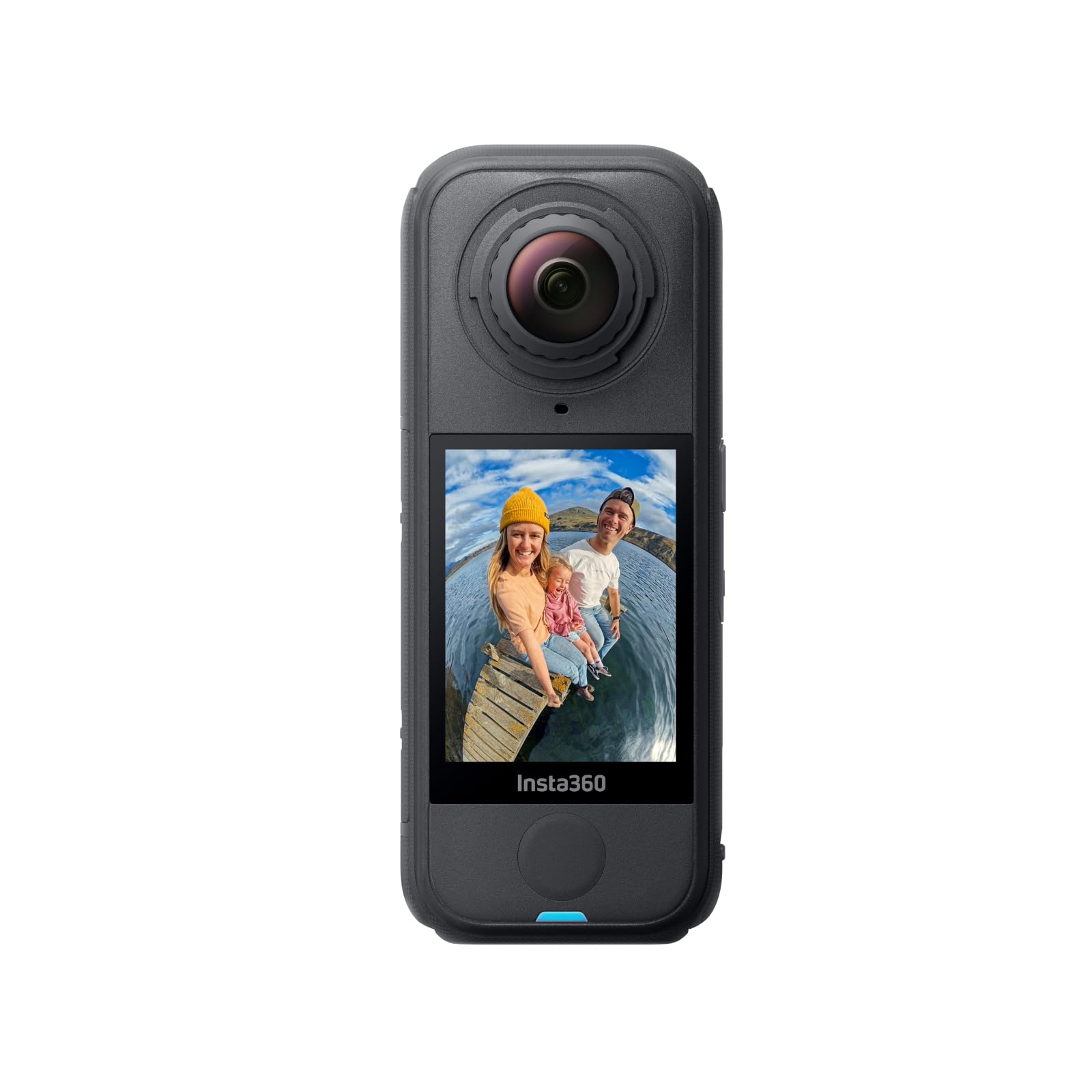
The Insta360 X4 Air changes the selfie paradigm by removing the need to aim the camera at all. Its dual 360-degree lenses capture everything around you at 8K resolution, and the shoot-first-frame-later workflow lets you choose your selfie angle after recording. The invisible selfie stick effect erases the stick from the shot, creating the illusion of a third-person perspective.
At 165g, it disappears in your pocket, and the FlowState stabilization keeps the virtual camera steady no matter how much the physical camera shakes. The 8K/30fps Active HDR mode helps maintain highlight and shadow detail in mixed lighting. AI-powered editing in the Insta360 app automates the reframing process, so you can generate a selfie video without manual key-framing.
The replaceable lens system is a practical addition for peace of mind. The included battery is non-removable, and the app-based editing workflow means you cannot use it as a pure standalone camera — everything goes through the smartphone app. Battery life is around 80 minutes of continuous recording at 8K.
Why it’s great
- Captures every angle — you never miss a selfie moment
- Invisible selfie stick effect creates drone-like third-person perspectives
- Ultra-light 165g design is easy to carry anywhere
Good to know
- Non-removable battery limits field hot-swapping
- Requires smartphone app for reframing and editing
7. Xtra Muse

The Xtra Muse delivers a 1-inch CMOS sensor and a 3-axis gimbal at a budget-friendly price point. For selfie shooters, the 3-axis stabilization eliminates the handheld shake that ruins talking-head videos. The Master Follow mode keeps your face centered in the frame as you move, similar to DJI’s Active Track. The 2-inch touchscreen switches between horizontal and vertical instantly.
The 4K/120fps recording provides smooth slow-motion selfie clips, and the 10-bit X-Log color mode preserves highlight and shadow details for color grading. Battery life reaches 161 minutes in standard modes, which is strong for a pocket gimbal camera. The standard bundle includes a carrying bag and a handle with a 1/4-inch thread for tripod mounting.
Some accessories from DJI Pocket series fit the Xtra Muse. The built-in microphone is usable but lacks the directionality of dedicated vlogging cameras. The app is simpler than DJI’s and does not offer AI-powered editing templates.
Why it’s great
- 3-axis gimbal ensures smooth selfie footage without a separate stabilizer
- Master Follow feature tracks your face automatically
- Battery lasts over 2.5 hours for extended shooting sessions
Good to know
- Built-in microphone lacks directional pickup
- App is not as feature-rich as competitors
8. AKASO 360
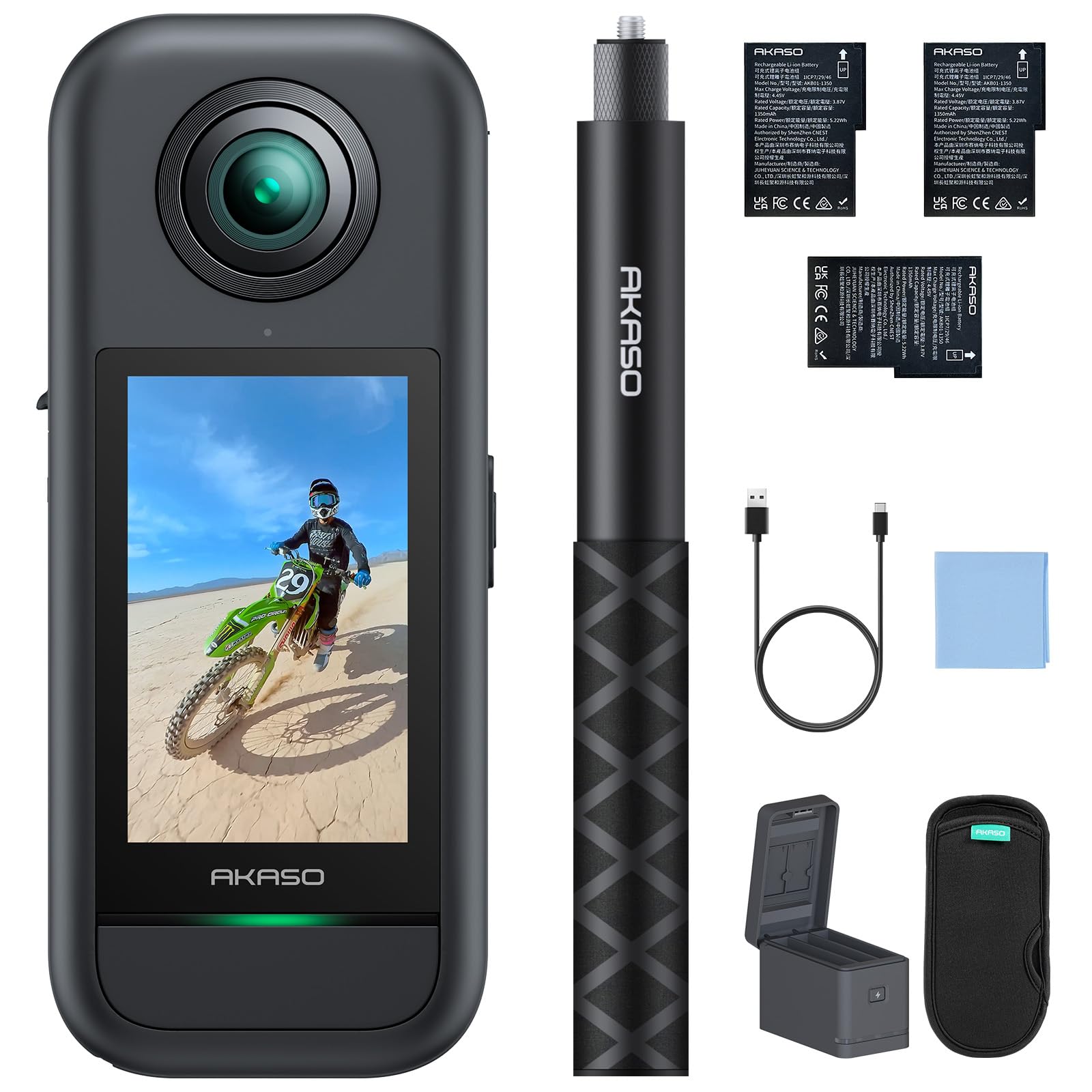
The AKASO 360 brings 360-degree selfie capability at a substantially lower price than the Insta360 competition. Its dual 1/2-inch 48MP sensors capture 5.7K 360 video and 72MP 360 photos. The invisible selfie stick effect works well, and the 360-degree Horizon Lock keeps the horizon level even during full rotations. AI subject tracking detects you and keeps you centered during action selfies.
The camera is weatherproof, handling rain and splashes without issues. The 360 Supersmooth stabilization smooths out shakes without a gimbal. The DNG8 RAW Photo mode gives you flexibility for editing detailed selfie stills. The included invisible selfie stick extends your reach for wider shots.
The app lacks advanced editing features compared to Insta360’s suite. Battery life runs around 54 minutes of continuous recording, so additional batteries are recommended. Low-light performance loses detail compared to cameras with larger sensors.
Why it’s great
- Weatherproof design allows selfie shooting in rain or splash conditions
- Invisible selfie stick effect creates third-person perspectives on a budget
- DNG8 RAW mode provides editing flexibility for selfie stills
Good to know
- Battery life is around 54 minutes — carry spares for all-day use
- App editing tools are less sophisticated than premium options
9. Nikon Z50 II

The Nikon Z50 II is designed for creators who want in-camera color presets and easy selfie shooting without heavy editing. The 20.9-megapixel DX sensor is significantly larger than any smartphone sensor, delivering lifelike colors. The Picture Control button offers 31 built-in presets that can be previewed on the vari-angle touchscreen before you shoot, so you can dial in a specific look for your selfie.
Autofocus automatically detects people and tracks them across the frame. The two-lens kit includes the 16-50mm standard zoom and the 50-250mm telephoto, giving you wide-angle selfie framing and portrait telephoto reach. The built-in electronic VR helps stabilize handheld selfie video. The 4K/60p video is oversampled for sharp results, and the 120fps slow-motion in Full HD is available for creative clips.
The flip-out LCD screen can drain the battery faster than the viewfinder. The kit’s included battery is only one, so buying a spare is advisable. The AF point count of 231 is lower than direct competitors like the Sony a6700.
Why it’s great
- 31 built-in color presets let you create a unique selfie look without editing
- Two-lens kit covers wide selfie framing and telephoto portraits
- Vari-angle touchscreen simplifies selfie composition and angle selection
Good to know
- Flip-out screen drains battery faster than EVF
- 231 AF points are fewer than some competitors in this tier
FAQ
Why does my camera crop the video when I turn on electronic stabilization for selfies?
Is a phone camera good enough for selfies or do I need a dedicated camera?
Can I use a selfie camera for streaming or Zoom calls?
Final Thoughts: The Verdict
For most users, the best camera for selfies winner is the DJI Osmo Pocket 3 because it combines mechanical gimbal stability, face tracking, and a rotatable screen in a truly pocketable form factor. If you want full-frame shallow depth-of-field and interchangeable lenses, grab the Canon EOS R8. And for zero-compromise selfie framing where you never need to aim the camera, nothing beats the third-person perspective of the Insta360 X4 Air.