
Our readers keep the lights on and my morning glass full of iced black tea. As an Amazon Associate, I earn from qualifying purchases.
Specs are compiled from manufacturer listings and verified buyer reviews and can change over time — please confirm the key details on the product page before buying.
Ski photography breaks cameras in two ways: the cold kills batteries, and the snow finds every seam. The guide below covers the models that are actually built to survive a lift ride, keep shooting at temperatures well below freezing, and still deliver the resolution you need when you get home to edit.
I’m Min — the founder and writer behind Gadgets Feed. This guide is built by comparing the manufacturers’ published specifications and the patterns across verified customer reviews, so you get each pick’s real strengths and trade-offs instead of marketing spin.
You do not need a full pro rig to shoot good snow. What you need is a camera that keeps running when the temperature drops, seals out meltwater, and reads the light coming off a bright white slope. This is a plain-English walkthrough of the camera for ski photography worth carrying up the hill.
Our Picks at a Glance


How To Choose The Best Camera For Ski Photography
Ski hills are hostile to electronics. The air at the top is thinner, the light is bright enough to fool a meter, and snow is basically grit in slow motion. Picking the right camera starts with three questions: does the body still run when the mercury drops below freezing, does the battery last long enough for a full day on the hill, and can the autofocus grab a fast moving rider against a low-contrast white background. Resolution, mount system, and stabilization come second.
Match the body to the temperature rating
Freeze-proof ratings are measured in degrees. A body rated to -10 °C means the manufacturer says it will keep working at that temperature. A body that only lists a general waterproofing depth without a cold rating is a gamble on a mid-winter lift ride. If your plan is January laps in a northern resort, prioritize anything with an explicit freeze-proof spec.
Battery life at temperature, not on the spec sheet
Lithium-ion batteries lose voltage in the cold, so a camera that promises four hours at room temperature may deliver much less at the top of the hill. Two batteries plus a chest pocket is the safest setup. Cameras marketed with a cold-resistant battery — or with a bundled spare — solve the problem before you leave the car.
Sealing versus outright waterproof depth
Waterproof depth is measured as a distance the body can survive submersion without a housing. A camera rated to 33 ft is fine if it ends up buried in a snowdrift. A camera rated deeper — say 65 ft or 20 m — covers the case where you slot a turn and take a face shot in a pow cloud. Depth ratings usually carry a time limit too, like two hours of continuous operation, so think of them as a window rather than an unlimited guarantee.
Quick Comparison
Every pick below lists the same three specs so you can compare them at a glance: what it is built for, its ruggedness rating, and its maximum still resolution.
| Model | Best For | Rugged Rating | Max Still Resolution | Battery Rating | Amazon |
|---|---|---|---|---|---|
| GoPro Hero12 Black E-Commerce Package★ Best Overall | POV runs and helmet-mounted footage | Waterproof to 33ft (10m) | 27 MP | 70 minutes | Amazon |
| Xtra Pro Dual Battery BundleBest Cold-Weather Value | Long cold-weather sessions on a budget | Waterproof to 65ft (no case) | 8.29 MP video resolution | 240 minutes | Amazon |
| GoPro Hero Black Compact BundleBudget Starter Pick | First action camera for casual snow clips | Waterproof to 33ft (no housing) | 12 MP | 1 hour | Amazon |
| DJI Osmo Action 5 Pro Hiking Bundle | All-day alpine runs and low-light slope work | IP68, 20m underwater | 8.3 MP | 4 hours | Amazon |
| PENTAX WG-90 Blue | Ski patrol, snow science, and cold field work | Freeze-proof to -10°C, waterproof to 39.8ft | 16 MP | 2.5 hours | Amazon |
| PENTAX WG-90 Black | Macro work in cold, wet environments | Freeze-proof to -10°C, waterproof to 46ft | 16 MP | 2 hours | Amazon |
| DJI Osmo Action 6 Essential Combo | 8K snow footage and hybrid vlog capture | Waterproof to 20m (no case) | 38 MP | 4 hours | Amazon |
| OM System Olympus Tough TG-7 | Multi-day alpine trips and macro snow shots | Freeze-proof to -10°C, shockproof 7ft | 12 MP (RAW) | Not listed | Amazon |
| Insta360 Ace Pro 2 Ultimate Bundle | Cinematic snow clips with a Leica lens | Waterproof underwater (case recommended) | 8K video, stills listed | 2 batteries included | Amazon |
| Nikon Z8 Full Frame Bundle | Shooting race-day action for editorial or print | Weather-sealed professional build | 45.7 MP | Not listed | Amazon |
| Sony Alpha 1 II | Pro snow sports on assignment | Professional sealed body | 50.1 MP | Not listed | Amazon |
In‑Depth Reviews
1. GoPro Hero12 Black E-Commerce Package
Our pick — over 4.5★ from 700+ verified ratings; the strongest balance of quality and price.
The snow-ride standard: sealed, stabilized, and small enough that you forget it is on your helmet.
If you want one camera that handles a full day of laps without drama, this is it. The Hero12 Black shoots 5.3K video at 60 frames per second — that is high-detail footage at a frame rate fast enough to make a mogul run read as smooth motion — and grabs 27 MP stills. A 27 MP photo means you can crop into a rider mid-air and still have pixels left for a print. The body is waterproof to 33 ft (10 m) with no housing, so a snowdrift or an unexpected dunk in a creek crossing on the way to the lodge is a non-issue.
Where this really earns its place on the hill is stabilization. HyperSmooth 6.0 is the in-camera shake correction that smooths out the chop in your footage, and the 360° Horizon Lock keeps the horizon level even if the camera itself rolls through a full rotation. A head-mounted POV shot on chopped powder then reads as a clean, watchable line instead of a jittery mess. Battery is a real consideration: the included Enduro battery delivers up to 70 minutes of 5.3K60 recording, and buyers report the OEM battery lasts nearly a full day of 5-minute clips. For short runs that is plenty. For long groomer laps it is not — pack a second battery.
The trade-offs are worth naming plainly. Battery life is the recurring theme in the review pages — several owners describe it as short, and that matches the 70-minute rating at the top setting. Reliability is also mixed in owner feedback, with some units working flawlessly while others have failed. The bundling here includes the Enduro battery, USB-C cable, curved adhesive mount, mounting buckle, and thumb screw, which saves a separate shopping trip before your first hill day. The included form factor also fits standard GoPro mounts, which is useful if you already own a chest rig or helmet mount.
What earns it top spot
- 27 MP stills and up to 5.3K60 video — you can crop hard without losing usable resolution
- Waterproof to 33 ft (10 m) with no housing needed
- HyperSmooth 6.0 stabilization and full 360° Horizon Lock keep POV footage level through spins
- Bluetooth audio connectivity lets you pair a wireless mic for commentary in the snow
- Comes bundled with the Enduro battery and standard mounts
Where owners hit friction
- 70 minutes at 5.3K60 is short for a full day — carry a spare battery
- Reliability is mixed in owner feedback; some units arrive flawless while a few have failed
- No gimbal-style mechanical stabilization — everything relies on in-body electronic smoothing
Pick this if: you want a proven, mount-compatible action camera for helmet POV, quick stills, and short-to-medium run footage.
Think twice if: you expect one battery to cover a full day on the mountain — the 70-minute rating at the top resolution is the number to plan around.
2. Xtra Pro Dual Battery Bundle
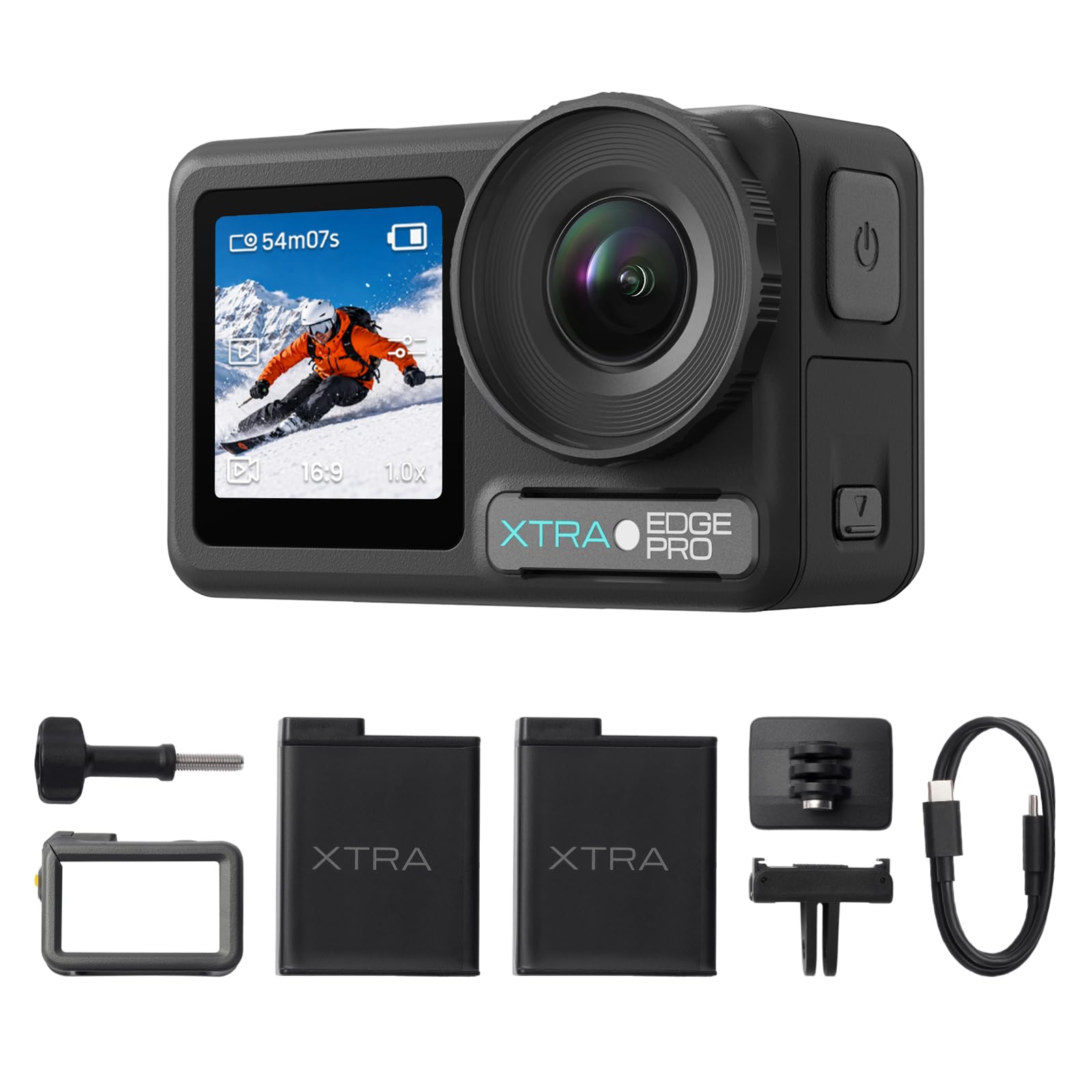
Cold-resistant battery, big 1/1.3″ sensor, and a dual-battery bundle built for long days on the hill.
Numbers matter on a ski hill, and this one has the biggest battery number in this whole line-up: 240 minutes — that is up to 4 hours of continuous shooting on one charge, and the bundle ships with a second cold-resistant battery. Compare that to the GoPro Hero12 at 70 minutes and you are looking at roughly 3.4 times the runtime on a single fill. That is the difference between swapping batteries at the base lodge and swapping them mid-run.
The image side is set up for the exact light you get on a slope. A 1/1.3″ sensor pulls in more light per pixel than the smaller chips used in cheaper action cameras, which is what keeps shots clean on an overcast day or at dusk near the bottom of the hill. The camera shoots 4K at 60fps — that is Ultra HD video at a frame rate smooth enough for fast descents — and includes a Night View Mode that brightens low-light scenes. It is waterproof to 65 ft without a case, deeper than most action cameras in this group, so a powder face-shot or a fall into a snowbank is fine. Stabilization comes in the form of 360 Lock, TiltGuard, and MotionMaster, which work together to cancel shake from a rider bouncing over chop.
Owners describe the camera quality as excellent and the value as strong, with the dual battery rating being a real plus in the field. Setup is quick, and there is a front screen — useful for framing yourself in a ski-lift selfie without spinning the body around. Compatibility with DJI action camera accessories gives you extra mount options without buying a separate ecosystem. About the honest trade: battery life is marked as mixed in owner feedback, which is why this bundle ships with two — plan on swapping if you shoot long clips at 4K60 back to back.
Long-run coverage: 240 minutes per charge and a second cold-resistant battery in the box push this past what most action cameras in this group can manage — a full day of ski laps is the target here, not a single run.
Cold-day optics: the large 1/1.3″ sensor keeps footage cleaner on overcast slopes and at dusk, where smaller-sensor cameras start showing noise.
Reach for this if: long sessions, cold temperatures, and a second battery ready in your pocket sound like your typical hill day.
Look elsewhere if: you want the broadest ecosystem of side-grip mounts and accessories — this camera leans on its DJI-compatible mounting points rather than a native GoPro accessory line.
3. GoPro Hero Black Compact Bundle
A lightweight GoPro with a fifty-piece mount kit, aimed at first-time snow shooters.
Weighing just 3 oz, this is the lightest camera in the line-up and the easiest to forget on a helmet or strap. It shoots 4K at 30fps, grabs 12 MP stills, and can pull 8 MP photos straight out of video through the GoPro Quik app — handy if you want to grab a rider mid-past from footage rather than chase a photo. The compact body is waterproof to 33 ft without a housing, matching the Hero12 on sealing, and HyperSmooth stabilization smooths out bumps on the way down.
What buyers are likely to value most here is the bundle, not the framerate. The 50-in-1 accessory kit covers the mounts, ties, and adapters most people would otherwise buy one by one, and there is a 64GB SanDisk Extreme Pro microSD card included. That means you can ski with this camera from the start — no separate memory card run, no scrambling for a helmet mount the night before a trip. Voice control covers eight commands in eleven languages, so you can start and stop recording without taking your gloves off.
The honest limit is battery. GoPro lists one hour of recording at the highest video settings, and the battery is not removable — that landed hard with at least one user who wanted to extend filming and could not. For half-day sessions and short hill runs that is workable. For an eight-hour mountain day you want the Hero12 instead. The Quik app also required a smartphone in good standing with the software; older iPhones have been reported as incompatible by at least one buyer, so check compatibility before relying on app features.
Best read of the bundle: with the accessory kit and 64GB card already in the box, this is the lowest-effort way to get a real GoPro onto a helmet without buying four separate add-ons.
One thing to plan around: the one-hour recording cap and the sealed-in battery mean you buy this for two-to-three-hour sessions, not a full resort day.
Right for: beginners who want a genuinely light GoPro with every mount they will need for their first season of snow clips.
Wrong for: anyone who plans to ski bell-to-bell — the one-hour battery ceiling and non-removable battery are the trade-offs here.
4. DJI Osmo Action 5 Pro Hiking Bundle
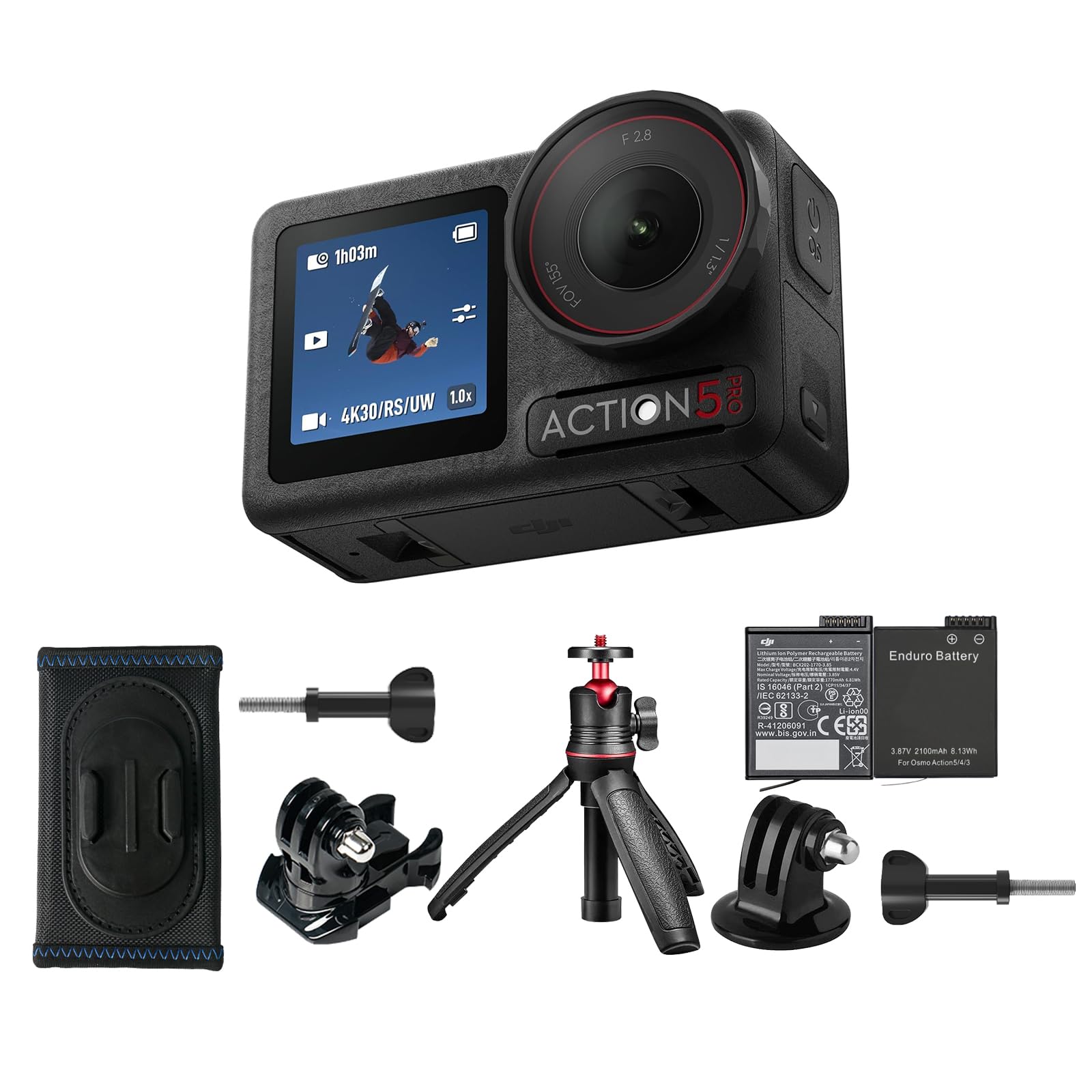
Four hours of runtime, a 1/1.3″ sensor, and an IP68 rating — this one is built for long days in cold air.
Battery is where this pick separates itself from nearly every other action camera on this list. DJI rates it at up to four hours of recording in normal conditions, and — critically for ski use — 3.6 hours at -20 °C (-4 °F). That cold rating is a real number, not a guess: your hand-warmers are not needed to keep the camera alive. Combined with the IP68 sealing (which is a waterproofing standard rating depth and water intrusion protection) and 20-meter depth capability without a case, this is the pick for people who want one battery to cover a full resort day.
The optics side leans on a 1/1.3″ sensor with 2.4 µm large pixels and 13.5-stop dynamic range. That means the sensor holds detail in bright snow and in the shadows of a treed run at once — the classic exposure problem with backlit riders. A 4 nm chip handles subject tracking and keeps fast-moving subjects centered in the frame, and 360° HorizonSteady stabilization cancels roll-axis shakes so a spinning drop-in still reads level. There is also a color temperature sensor for automatic white balance, which matters when snow bounces light back in every direction.
The bundle does real work here: it ships with an extra battery, a mini extension rod, and a backpack strap mount, so a skier or rider with a pack can shoot hands-free on the descent. Dual OLED touchscreens front and back make framing easy even with gloves on, and DJI supports a direct wireless audio connection to DJI Mic 2 or Mic Mini transmitters with no receiver needed. About 7,400 reviews sit behind a 4.4-star rating, and the crowd consensus is that stabilization and image quality deliver. The reliable caveat is that battery complaints appear scattered among the positives, and a couple of owners mention units that did not last long — worth buying from a source that handles returns cleanly.
Standouts for ski duty
- Up to 4-hour recording and 3.6 hours at -20 °C — the strongest cold-weather battery claim in this line-up
- IP68 rated and usable to 20m without a housing
- 1/1.3″ sensor and 13.5-stop dynamic range hold detail in both bright snow and shadowed runs
- Bundle includes an extra battery, mini extension rod, and backpack strap mount
- Direct wireless pairing with DJI Mic 2 / Mic Mini for clean audio
Honest limits
- Battery feedback is mixed among buyers, and a few units have failed early
- Dual OLED screen is small for detailed review on a bright, sunny slope
Go with this if: you do not want to think about battery swaps mid-day — the 4-hour rating and cold-temp coverage carry the load.
Avoid if: you prefer a GoPro-mount ecosystem — the OSMO uses its own magnetic quick-release system, so existing GoPro accessories will not fit.
5. PENTAX WG-90 Blue

A tough point-and-shoot built for one job: keeping working when the thermometer hits -10 °C.
If you are on ski patrol, an avalanche-safety researcher, or a guide who actually works in the cold all day, this is a different kind of camera than the helmet cams. It is built with a heavy-duty body that stays waterproof down to 14 meters (about 39.8 ft) for up to two hours of continuous operation. It survives a 1.6-meter drop, resists dust and grit, and is rated freeze-proof against temperatures as low as -10°C. That freeze-proof rating is not a marketing phrase — it is a documented operating limit that matters at the top of a resort where mid-winter temps sit below zero for hours at a time.
On the image side it uses a back-illuminated 16 MP CMOS sensor with a sensitivity ceiling of ISO 6400. That high ISO ceiling matters because it lets the camera keep shooting as light drops at the tail end of an afternoon run. There are six LED Macro Lights arranged in a ring around the lens barrel for close-up work, which is unlikely to be your primary use on the hill, but could matter for snow-crystal or ice-lens photography on a still morning. Underwater and Underwater Movie modes are built in, tuned to color and contrast from actual water shots — useful if snow melt turns a run into a trickle of slush.
Buyer volume here is thinner — around 30 ratings at a 4.3-star rating — so you are reading less crowd feedback than with the action cams. Owners generally describe it as tough and easy to use, and Japanese reviews from the source listings highlight the build and quick shipping as wins. The telephoto lens has 5x optical zoom with a maximum focal length of 25mm — modest reach, so plan on wide views rather than long-distance shots. The Blue colorway is the pick here if you want to see the camera easily in snow. Missing flash is the honest caveat — you are working with ambient light.
Why it makes the shortlist: freeze-proof to -10°C, waterproof to 14 meters for two hours, drop-tested from 1.6 meters — this is a deliberately overbuilt small camera for cold and wet work.
Where it falls short: no built-in flash, 5x optical zoom only, and a smaller buyer review base than the action cameras on this list.
Choose this if: you work in or near snow all day and you want a sealed pocket camera that just keeps working.
Skip if: you want the highest-resolution look and a big body of owner feedback — this is a specialist tool rather than a crowd favorite.
6. PENTAX WG-90 Black

A sealed black-body version of the WG-90 with 99 autofocus points and a five-times optical zoom.
This is the WG-90 built for close-up detail. The macro system is the standout spec: six LED ring lights are positioned around the lens, and a dedicated Digital Microscope mode captures subjects a naked eye would not resolve. That macro capability is the one place this camera stands apart from every action camera on the list, since snowflake photography, ice-crystal work, or details on a binding and boot only read on a lens that focuses down to one centimeter. The included Macro Stand maintains that one-centimeter minimum focusing distance even during extended shooting.
The rest of the chassis matches the WG-90 blueprint: waterproof to 14 meters for up to two hours of continuous operation, shockproof against a 1.6-meter drop, freeze-proof to -10°C, and grit-sealed against dust. Five-times optical zoom with 28mm wide-angle coverage makes this a better all-rounder than the telephoto-compact WG-90 Blue, because you can frame a wide alpine landscape and then zoom for detail. Video recording is Full HD in H.264 format, and there is triple anti-shake protection for handheld stability. The 2.7-inch LCD panel has an Anti-Reflection coating and an Outdoor View Setting mode, which matters when the sun is doing its best to whiteout your screen on a bright slope.
Buyer sentiment on the WG-90 platform is honest but divided. Photo quality is the most-discussed aspect and it comes in as mixed — some owners describe the images as sharp, while others note the auto settings occasionally make poor aperture and shutter decisions. The manual-mode approach is the realistic path to the best-looking shots, and that carries a learning curve. Flipped the other way, owners who put in the time say the camera is durable and easy to travel with. For snow photography specifically, the freeze-proof rating and depth sealing are the real reasons to consider this — not a pixel count that will impress anyone with a mirrorless body.
The angle that matters: macro at one centimeter with six LED ring lights is a capability no action camera on this list offers, and it survives -10°C while doing it.
Where to look elsewhere: if your shot list is riders in motion, this is the wrong tool — the WG-90 is built for standing still and looking closely.
Buy this for: snowflake macros, ice detail, or documentation work where the subject is small and stationary.
Pass if: your actual shot list is fast-moving riders — this camera can do it, but a helmet-mount action camera will serve you better.
7. DJI Osmo Action 6 Essential Combo
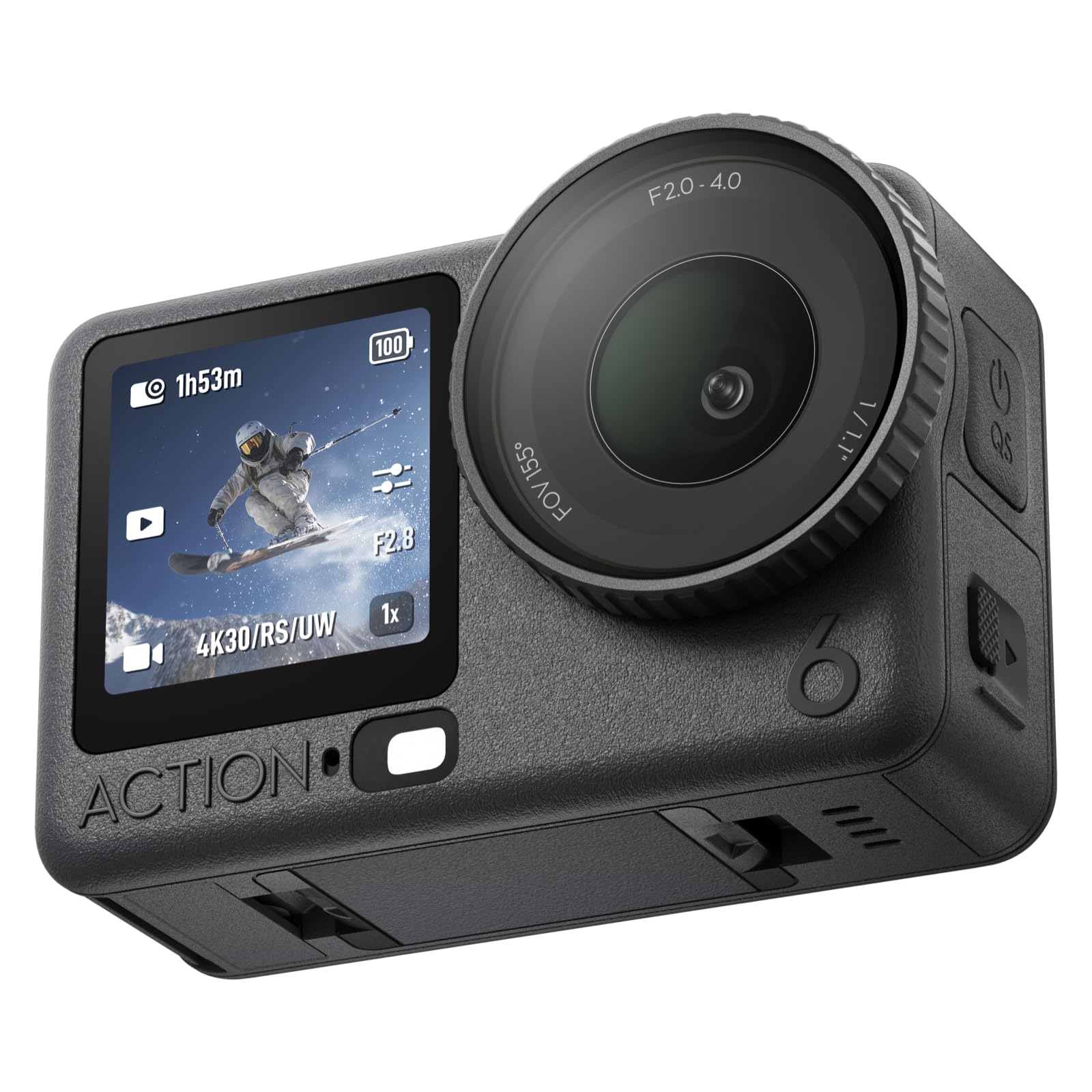
The action camera with a variable aperture — f/2.0 to f/4.0 — and 8K video off a 1/1.1″ sensor.
Variable aperture is the headline spec. Most action cameras run a fixed opening, which means they compensate for bright snow by leaning on software. This one adjusts between f/2.0 and f/4.0 to control how much light reaches the sensor. On a bluebird day, a narrower aperture helps tame the glare off the snow. On an overcast run, the wider opening captures more light. Video maxes out at 8K, and the 1/1.1″ square sensor supports a 4K Custom Mode that lets you reframe one shot into multiple aspect ratios for social.
Battery is rated at up to four hours of recording in normal conditions with a cold-resistant design that, per DJI, keeps rolling when the temperature drops. That is the single most useful claim for ski photography on this camera — your day is limited by how many runs you can ride, not by battery anxiety. Stabilization is handled by 360° HorizonSteady and RockSteady 3.0, with HorizonSteady supporting up to 4K at 60 frames per second. That keeps your horizon level and the footage smooth through tilts and spins. Underwater depth is 20m with no case, and sealing is IP-grade rated for snow and meltwater.
Buyer favorites come through clearly: sharpness, color, and stabilization dominate the positive reviews, and the camera is described as compact and lightweight enough to mount anywhere. 50GB of built-in storage means longer record sessions before you need to swap a card. Wireless cloud upload makes an overnight backup job easy at the lodge. The recurring caveat is reliability — a group of owners describe units that failed early and had to be returned, while most work fine. The dual screens and DJI Mimo app connection are popular with vloggers. There is no external memory card included, so plan for one.
The standout: variable aperture from f/2.0 to f/4.0 — you can adjust how much light hits the sensor instead of letting software compensate for blown-out snow.
What to plan for: no bundled memory card, so budget for a V30-rated microSD before your first hill day.
Best suited to: hybrid shooters who want 8K footage, a bright dual-screen setup, and one camera that handles skiing, vlogging, and everyday shots.
Not the pick if: you want the widest cold-weather battery headroom — the earlier Osmo Action 5 Pro bundle has more built-in runtime and ships with an extra battery.
8. OM System Olympus Tough TG-7

A full point-and-shoot form factor that survives -10°C, a 2.1-meter drop, and 100 kgf of crush force.
Five ruggedness numbers define this camera. It is waterproof to 15 meters, dust-sealed, shockproof against a 2.1-meter drop, crushproof to 100 kilogram-force of pressure, and freeze-proof to -10°C. Anti-fog treatment on the lens also matters here — a camera that goes from a warm car into a cold snowpack and back fogs up on the inside otherwise. It is the closest thing on this list to a classic rugged point-and-shoot, with the strength of being genuinely pocketable and easy to grab on a cold morning.
Under the hood there is a high-resolution F2.0 lens, a maximum 4x zoom, the TruePic VIII engine, and a back-illuminated CMOS sensor. Video reaches 4K, stills can be shot in RAW, and there is a four-mode variable macro system that focuses down to one centimeter from the end of the lens — which puts it in the same macro territory as the Pentax WG-90. Five underwater modes, including underwater microscope and underwater HDR, apply to river crossings and slushy lifts as much as they apply to a snorkel trip. Vertical video mode is included for social posting straight from the camera.
What owners like about the TG-7 is its portability and the fact that it just works in bad weather. Real gripes exist too: image quality is the most-discussed topic and Amazon marks it as mixed — some describe shots as crisp in bright light, while others note the small sensor struggles in low light compared to a phone. The LCD is compact enough that framing underwater takes practice. The battery can also die without warning, so a spare is smart insurance. If you shoot in strong ambient light — an afternoon slope with sun on the snow — it delivers. If you shoot at dusk with a small sensor, the results will not compare to a mirrorless body.
Numbers that matter: -10°C freeze-proof, 2.1-meter shockproof, 100 kilogram-force crushproof — you can literally sit on it when it is in a pack.
Where it stops short: as with most small-sensor rugged cams, low-light image quality is the limit — you want bright conditions or a backup flash.
Pick it for: travel, multi-day alpine trips, or any cold-wet environment where pocketability and durability beat sensor size.
Pass if: you shoot primarily at night or in deep shade — the small sensor will not match a bigger camera in that light.
9. Insta360 Ace Pro 2 Ultimate Videography Bundle
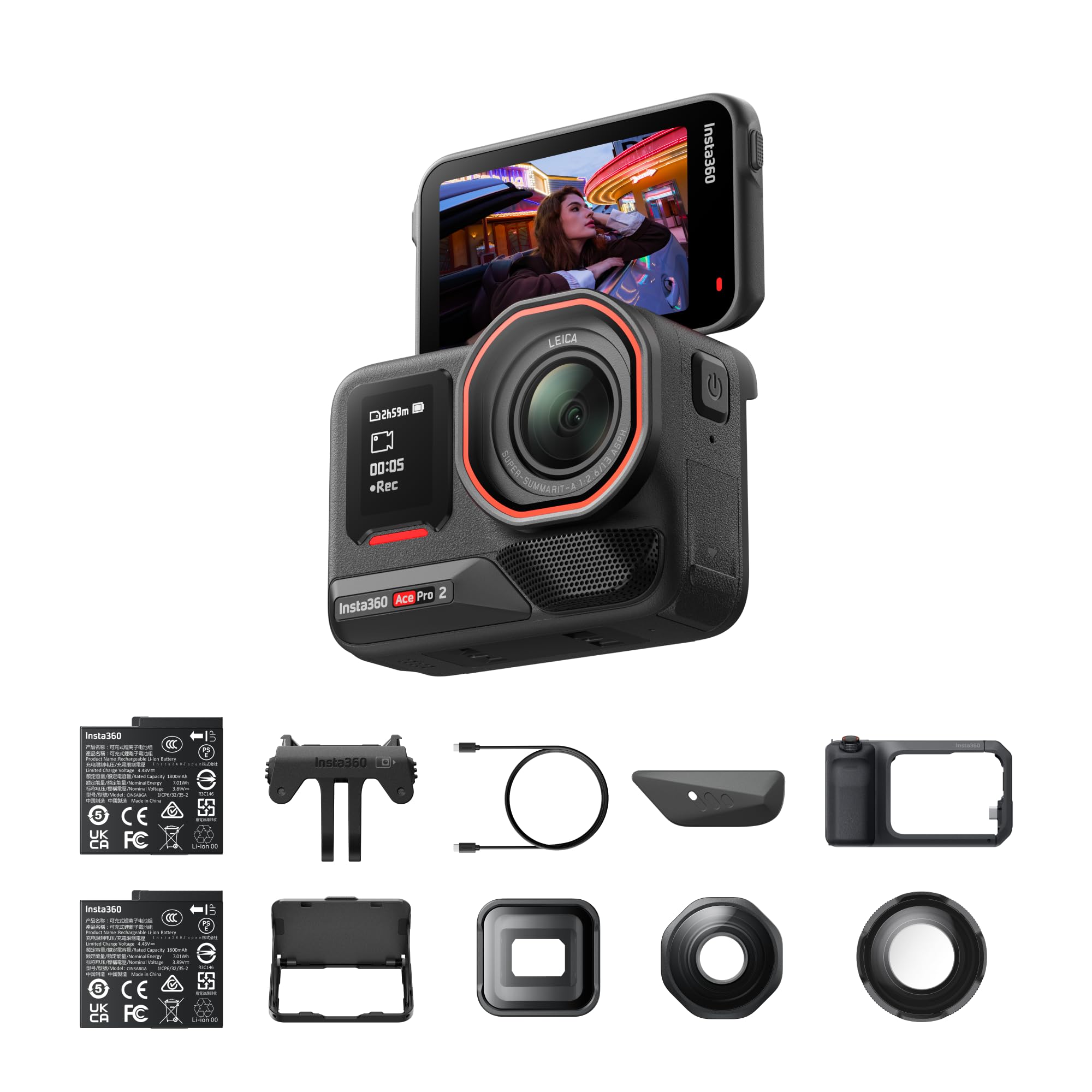
A Leica-branded 8K action camera with a pro grip kit, three lenses, and two batteries in the box.
Co-engineering with Leica is the reason this camera is on the list. A 1/1.3″ 8K sensor paired with a Leica SUMMARIT lens shoots 8K at 30fps or 4K at 60fps with Active HDR — that is high dynamic range, which is the processing that keeps bright snow and shadowed trees readable in the same frame. Built-in Leica color profiles (B&W High-Contrast, Eternal, Vivid, Natural) let you lay a look onto footage in one tap without an editing session. A Pro Imaging Chip and 5nm AI chip handle the noise reduction and image processing, which is what makes this camera competitive in low light.
The bundled Xplorer Grip Pro Kit is what turns this into a street-and-slope shooting rig. It connects to the camera for smooth 1–2x lossless zoom (meaning you zoom without losing resolution), exposure control, and fast mode switching. It also carries a built-in 2010mAh battery for extended shooting time. The bundle ships with two batteries, a cinematic lens, a close-up lens, and an ultra-wide lens, plus a flip screen hood and the camera itself. That accessory stack is unusually complete — it covers wide, close, and cinematic framing without buying add-ons.
Where owners agree: image quality, color, and performance all read as strong, and the low-light output is described as second to none. The recurring caveats are real. The magnetic mount and flip-up touchscreen are popular features, and the audio with the removable wind guard is described as good. If you are chasing the sharpest-looking snow footage with a distinctive color grade, this is the camera in this line-up built for that job.
The reason to spend here: a Leica SUMMARIT lens and 8K30 with Active HDR, plus the bundled Xplorer Grip Pro with its own 2010mAh battery.
Real trade to know: the Xplorer Grip Pro accessory removes the camera’s USB door when attached — fine for slope work, but you lose the waterproofing benefit when the grip is on.
Perfect for: creators who want a single snow rig that produces cinematic-looking footage straight out of camera, with three lens options and two batteries in the box.
Not for: anyone looking for the lightest setup or the widest battery headroom — the accessory grip is deliberate bulk, and the Osmo Action 5 Pro holds a longer battery rating.
10. Nikon Z8 Full Frame Mirrorless Bundle

A pro hybrid body with a 45.7MP stacked sensor, 20fps burst, and deep-learning autofocus for race-day action.
If you are shooting snow sports for editorial, print, or a race-day campaign, a full-frame body is the tool the assignment demands. The Z8 pairs a 45.7 MP stacked CMOS sensor with the EXPEED 7 processing engine, and the autofocus system detects focus as low as -9 EV — which is an extremely dim light level, meaning it can lock on a rider as the light drops on a late-afternoon run. Subject detection and 3D tracking cover people, dogs, cats, birds, cars, bikes, motorcycles, trains, and planes, and the whole system is built with an AF algorithm developed using deep learning technology.
For action, the burst data matters. The Z8 shoots 20, 30, 60, and 120 fps and uses a silent, vibration-free electronic shutter — no mirror slap to blur a handheld shot at a long lens. Blackout-free viewfinder means you can keep framing while the buffer fills, and continuous shooting at 20 frames per second is the standard setting for race action. Video features include 12-bit 8K/60p and 4K/120p RAW plus 10-bit ProRes 422 HQ internal video recording, so the same body covers motion and stills without a second camera along. RAW stills are 14-bit, and there is also High Efficiency RAW, 10-bit HEIF, and JPEG 8-bit.
The bundle includes a full travel case, an external mini condenser microphone, a 72-inch adjustable monopod, a 12-inch vlogging tripod, a 128GB SanDisk Ultra SDHC card, and a digital photography guide, so the add-on kit is genuinely usable from day one. The buyer base is smaller — around 50 ratings — but the star rating is high, and the consensus is that the package represents a strong value as a body-plus-accessories set. The real trade: the compact, lightweight handling is relative to pro bodies, not to action cameras — this is a much heavier setup than a helmet-mounted camera and needs a proper bag for the hill.
Why it earns the premium slot: 45.7 MPstacked CMOS sensor, -9 EV AF sensitivity, and 20fps burst shooting mean it holds detail on fast riders in fading light.
Built for: working photographers who need the same body to shoot stills and 8K/60p RAW video on assignment, with a bundle that covers the supporting gear.
Not the right call if: you want a pocketable setup — this is a full-frame mirrorless system that needs a bag, and the buyer feedback base is much smaller than the action cameras here.
11. Sony Alpha 1 II

Fifty megapixels at thirty frames per second — a blackout-free viewfinder for pro snow sports work.
The central number here is 50.1 megapixels. That is the resolution of the full-frame Exmor RS sensor, and it pairs with Sony’s BIONZ XR image processing engine to create high-resolution rendering with real depth. The relevant trick for snow sports is that the sensor’s pixel count stays at an approximately 21 megapixel resolution when you switch to APS-C mode or crop to APS-C size after shooting — so a tight crop on a distant racer still gives you a usable file. That flexibility is why snow sports shooters who deliver both wide slope shots and tight action frames tend to gravitate to this class of body.
Speed is the other half of the story. A dedicated AI processing unit recognises people based on human pose estimation and also supports recognition of animals, vehicles, and insects. Blackout-free viewing with full autofocus and auto-exposure tracking runs at up to 30 fps, and the system handles up to 120 AF/AE calculations per second on sensor data. In a ski context that means the camera can keep up with a rider who is moving fast against a low-contrast snow backdrop. Video reaches 8K 4:2:2 10-bit XAVC HS recording with optional Full HD proxy, and 4K can be cropped and edited from 8K source footage at 8.6K oversampling — useful if you want a high-motion highlight reel from the same body you shoot stills with.
Owner sentiment is strong but the sample is small: around 20 ratings at a 4.6-star rating. Buyers describe the image quality as exceptional and the autofocus as fast and reliable, with natural skin tones and strong low-light performance. Feedback on value is split — several owners describe it as pricey, and that is the honest read. This is the top-of-the-line option in the entire article, and it costs accordingly. If your job is producing snow-sports content for a branded campaign or a national publication, this is the tool. If you shoot a few clips on a weekend, the action cameras above will already cover you.
What it brings to the hill: 50.1 MP resolution with a 21 MP APS-C fallback, 30 fps blackout-free burst, and a dedicated AI unit for reliable subject recognition.
The honest trade: this is the highest-price pick in the article, and only around 20 buyer ratings sit behind it — you are trusting the specs more than a big review base.
For pros only: commercial snow sports photographers and hybrid shooters delivering 8K video plus high-resolution stills on paid assignments.
Not worth it if: you shoot for fun or post mostly to social — a helmet-mount action camera delivers the geometry that snow sports usually want.
Understanding the Specs
Freeze-proof Rating and Cold-Cutoff
A freeze-proof rating is the manufacturer’s tested minimum operating temperature. A body rated to -10°C keeps working at that temperature, which matters because the top of a lift is often ten degrees colder than the base. A camera without a stated cold rating generally can still shoot in the cold, but the risk of a shutdown increases as the thermometer drops — particularly with an already half-drained battery.
Waterproof Depth Without a Housing
Waterproof depth is the depth of water the camera tolerates with no add-on case. Ratings on this list range from 33 ft (10 m) up to 20 m and 65 ft, and most carry a continuous-operation time limit — around 2 hours for the rugged compacts. Snow alone does not need a deep rating, but a fall into a snowbank or a wet lift ride does. Deeper ratings mean fewer worries when snow turns to slush.
Battery Ratings and Cold-Weather Reality
Battery ratings in this category are measured at room temperature, usually at the highest video setting. A 4-hour rating at normal temperatures, or a 3.6-hour rating at -20 °C, gives you a clear picture of how the camera behaves on a cold hill. Two batteries are always safer than one, and a warm inside pocket keeps them working through lunch stops.
Sensor Size and Low-Light Read
Sensor size is given as a fraction like 1/1.3″ or 1/1.1″. Bigger sensors capture more light per pixel, which is why larger sizes appear on the better-performing picks. Combined with dynamic range — the ability to hold detail in both bright snow and shadowed trees at the same time — sensor size is what determines whether an afternoon slope shot comes out clean or blown out.
Stabilization and Horizon Lock
Stabilization comes in two forms in action cameras: shake correction that smooths jitter, and horizon lock that keeps the image level even if the camera rolls. Full 360° horizon lock means the image stays flat through a spin. For helmet-mounted POV footage, this is the single biggest factor behind whether the footage reads as watchable or nauseating.
Burst Rate and Autofocus Tracking
Burst rate is measured in frames per second (fps) and describes how many still images the camera can capture in a row. Autofocus tracking keeps a chosen subject in focus while it moves through frame. Together they decide whether you can get a sharp frame of a rider at the exact moment of a turn, or a hundred near-misses. Both figures appear in the specs of the mirrorless bodies on this list.
FAQ
Will a GoPro-style action camera work for ski photography, or do I need a full-frame body?
What does freeze-proof to -10°C actually mean?
How long does the battery actually last on a ski day?
Do I need a waterproof case on a ski hill?
Is a larger image sensor better for snow photography?
Will my existing GoPro mounts work with a DJI or Insta360 camera?
How much resolution do I need for ski photography stills?
What is the difference between 8K and 4K for ski footage?
Are macro lights or macro modes useful in snow?
Does built-in storage replace the need for a memory card?
Final Thoughts: The Verdict
For most people looking for the best camera for ski photography, the GoPro Hero12 Black E-Commerce Package is the pick — it seals against snow, shoots 5.3K60 video and 27 MP stills, and HyperSmooth 6.0 with 360° Horizon Lock makes helmet POV footage actually watchable. The Osmo Action 5 Pro has the larger review base, but the Hero12 Black fits the standard GoPro mount ecosystem you will need on the hill. If long battery life matters more than ecosystem, grab the Xtra Pro Dual Battery Bundle with its 240-minute rating and second cold-resistant battery. And for shooting race-day assignments where crops and prints are the deliverable, the Nikon Z8 bundle is the one to reach for. Across every pick here, the deciding spec is cold-weather battery life, sealing, and dynamic range — not pixel count. With 700-plus owners behind a 4.6-star rating, the Hero12 Black is the safest first pick for helmet POV.
How We Picked
We do not accept paid placement. Every pick is matched to a real buyer and a real use-case; we do not hands-on test units.
Sources & Methodology
Specifications: manufacturer listings and product documentation. Review insights: verified customer reviews, as of September 2026. Pricing: not shown on this page (it changes often); check the current price via the retailer link.
As an Amazon Associate, Gadgets Feed earns from qualifying purchases. This does not affect which products we feature.