
Our readers keep the lights on and my morning glass full of iced black tea. As an Amazon Associate, I earn from qualifying purchases.
Specs are compiled from manufacturer listings and verified buyer reviews and can change over time — please confirm the key details on the product page before buying.
If you shoot youth soccer, track meets, or motocross, the single most important thing to know is this: a camera that records 4K at 60 frames per second or higher keeps fast motion sharp instead of smearing it. The list below covers capable action cams, gimbal pocket cameras, and full-frame mirrorless bodies that all clear that bar.
I’m Min — the founder and writer behind Gadgets Feed. This guide is built by comparing the manufacturers’ published specifications and the patterns across verified customer reviews, so you get each pick’s real strengths and trade-offs instead of marketing spin.
You want smooth, detailed sports footage, and 4K at 60fps (3840×2160 pixels, 60 frames per second) is the baseline for that. This list uses flexible matching for that requirement, so not every pick is the exact model you searched for — the nearest same-type camera does the same job, and every one here was verified as capable of 4K 60fps or higher. Read on for the most reliable camera for sports videography choices worth your money today.
Our Picks at a Glance


How To Choose The Best Camera For Sports Videography
Choosing a camera for sports videography means picking the tool that keeps a moving subject sharp, framed, and in focus while you pan, run, or stand on a sideline. A few specs decide whether a camera earns its place, and they are not the ones a general camera buyer worries about.
Frame rate beats megapixels for motion
Frame rate is how many still images the camera captures every second. A camera that shoots 4K at 60 frames per second records twice as many frames as one locked to 30, so a sprinter’s stride or a ball off the bat stays crisp rather than smearing. For true slow-motion replays, look for 120fps or higher, which stretches a second of real time into several seconds of playback.
Stabilization keeps a running shot level
Sports footage is shot while moving — following a cyclist, chasing a toddler on a field, or bracing against a fence. A gimbal (a motorized pivot that cancels your hand shake) or an electronic stabilizer that reads the camera’s motion and corrects it keeps a sprinting subject level. The picks here pair in-body hardware with software correction so the horizon stays flat even when you tilt.
Sensor size and low light
The sensor is the chip inside that captures light, and a physically larger one gathers more of it. That matters under gym lights or at a night game, where a small sensor turns into grainy, noisy footage. A 1-inch or full-frame sensor handles dim sidelines far better than a tiny phone-grade chip, and it gives you cleaner color when the floodlights are weak.
Quick Comparison
| Model | Best For | Max Video | Sensor | Stabilization | Amazon |
|---|---|---|---|---|---|
| Sony Alpha a7S III★ Best Overall | Pro sports and low light | 4K 120p | Full-frame 12.1MP | In-body (IBIS) | Amazon |
| DJI Osmo Action 5 ProBest Value | POV action and waterproof | 4K 120fps | 1/1.3″ | 360° HorizonSteady | Amazon |
| Xtra MuseBudget Gimbal Pick | Budget gimbal shooting | 4K 120fps | 1″ CMOS | 3-axis gimbal | Amazon |
| GoPro Hero12 Black | Adventure and rugged use | 5.3K 60fps | 1/1.9″ | HyperSmooth 6.0 | Amazon |
| Insta360 Ace Pro 2 | Sharp 8K and low light | 8K 30fps | 1/1.3″ | FlowState | Amazon |
| DJI Osmo Action 6 | Big built-in storage and 8K | 8K 30fps | 1/1.1″ | RockSteady 3.0 | Amazon |
| DJI Osmo Pocket 3 | Run-and-gun vlogging | 4K 120fps | 1″ CMOS | 3-axis gimbal | Amazon |
| GoPro HERO13 Black Bundle | All-in-one starter kit | 5.3K 60fps | 1/1.9″ | HyperSmooth 6.0 | Amazon |
| Nikon Z6 III | 6K RAW and hybrid work | 6K 60p | Full-frame | In-body VR | Amazon |
| Canon EOS R6 Mark II | Autofocus tracking speed | 4K 60p | Full-frame 24.2MP | 8-stop IBIS | Amazon |
| Panasonic HC-X20 | Events and interviews | 4K 60p | 1.0″ MOS | 5-Axis HYBRID O.I.S | Amazon |
In‑Depth Reviews
1. Sony Alpha a7S III Full-Frame Mirrorless Camera Body Black
Our pick — over 4.5★ from 300+ verified ratings; the strongest balance of quality and price.
The sports camera pros reach for when the lights are low and the action never slows.
Start with the sensor, because it is why this body costs what it does. Sony uses a 12.1MP Exmor R chip that is deliberately tuned for video rather than huge stills, and it sits behind a 759-point autofocus system (759 separate spots the camera can lock focus on across the frame). The result is that a sprinter crossing the frame stays locked and sharp, even at the edges where cheaper cameras give up.
Frame rate is the other half of the story here. This camera records up to 4K at 120p — 120 frames every second — in 10-bit 4:2:2 color with full pixel readout in all recording modes. What that means in plain terms: when you slow that clip down, a swimmer’s stroke or a butterfly of a punch replays smoothly instead of turning to mush. One card-speed detail matters, though: buyers report “V60 SD card handles 60fps 4K 10-bit; V90 needed for 120fps.” So budget for a fast card if you want the slow-motion mode.
Shooting a dim nighttime track meet and still getting clean footage is what this camera does best. It reaches ISO 409,600 and 15-plus stops of dynamic range, so a night track meet stays clean instead of grainy. It is the highest-rated pick on this list, holding 4.8 stars across 300+ owners. That review count trails budget rivals like the Osmo Pocket 3, but no other pick scores higher, and owners are emphatic about the quality.
Where It Dominates
- 4K 120p in 10-bit with full pixel readout — real slow-motion without banding.
- ISO up to 409,600 makes night-game and gym footage genuinely usable.
- 759-point autofocus that tracks faces and animals without hunting.
- S-Cinetone profile gives broadcast-ready color straight out of camera.
Worth Knowing First
- It is a body only — no lens is included, so add glass to the total.
- Fast V90 cards are needed for 120fps, which adds up for heavy shooters.
- Photos are weaker than a dedicated stills camera; video is the priority here.
Reach for it if: you shoot night or gym sports and need clean 4K 120p slow-motion, and you already own Sony E-mount lenses.
Look elsewhere if: you want a lens included or a one-bag kit — a bundled action cam fits that better.
2. DJI Osmo Action 5 Pro Essential Combo, Waterproof Action Camera
A pocket-sized action cam that holds up when you strap it to a bike or a chest mount.
What wins people over is how little this thing gives up for its size. The all-new 1/1.3″ sensor with 2.4 µm large pixels (bigger light-catching pixels mean better dim-light footage) delivers a 13.5-stop dynamic range, and the headline number is 4K at 120fps from a camera you can clip to a helmet. It is IP68 rated, which means it survives dust and being submerged to 20m without any housing.
Battery is the reason it stays on for a full session. DJI fits a 1950mAh high-capacity cell good for up to 4 hours of recording in normal conditions, and it keeps rolling down to -20°C. In the field that translates to a whole day of stop-start sports clips rather than swapping cells every hour. Owners do note the reality check: owners mention “~2hr continuous battery, handles 1.5-2hr podcasts” on the heavier end.
Stabilization is its quiet superpower. The 360° HorizonSteady system cancels roll-axis shake (the sideways tipping motion) so your horizon stays level even mid-sprint. It runs on a 4nm chip (a very small, power-efficient processor) that keeps fast-moving subjects centered, and you get dual OLED touchscreens, voice control within one meter, and direct wireless hookup to DJI Mic 2 transmitters. This is the one to grab if you want waterproof POV action for the price you would pay for a mid-tier mirrorless body alone.
Real-world read: reviewers treat this as a keeper for a first action cam — the magnetic mount and rubberized body make it genuinely easy to run and gun, and the color modes let you pull horizontal and vertical cuts from one shot. It handles fast-paced use like airsoft without breaking a sweat.
The honest trade-off: it uses a Micro SD card rather than the SD cards your mirrorless camera needs, so keep a spare in the bag.
The short version: buy it if you want waterproof, wearable 4K 120fps and value staying power over pro-grade color work.
Step up if: you need punchier low-light and a bigger sensor — that is where the rugged flagships earn their keep.
3. Xtra Muse, Vlogging Camera with 1” CMOS & 4K/120fps Videos
A gimbal camera that stabilizes your run-and-gun footage without the premium price tag.
For a shooter who films while moving, the 3-axis gimbal (a motorized mount that mechanically cancels your hand shake) is the whole reason to pick this over a phone. It holds a 1-inch CMOS sensor good for 4K at 120fps, and the mechanical stabilization keeps the frame smooth while you run, hike, or chase a pet across a field. A 2-inch touchscreen flips between horizontal and vertical so you can reframe the same shoot for a phone screen.
Buyers who came from phone vlogging tend to find it a real step up. It pairs with a DJI mic natively, the app connects clips to your phone instantly, and the Active Track keeps a moving subject centered while you focus on framing. Where the 1-inch sensor really pays off is color: 10-bit X-Log delivers up to one billion colors for grading, which is a lot of latitude for an entry-tier gimbal camera.
The catch buyers run into is consistency. The gimbal and portability are the standout wins, but functionality and connectivity land as mixed — some units need a firmware update and a few discharge cycles to behave, and the app is lighter on tools than DJI’s. Still, judged as a budget gimbal camera, the value math holds: the image quality in good light is what sells it, and the stabilization means your chase footage comes out usable on the first take.
Why It Earns A Slot
- 3-axis mechanical gimbal keeps handheld chase shots level.
- 1-inch CMOS at 4K 120fps — strong for the price tier.
- 10-bit X-Log with up to a billion colors for flexible grading.
- Native wireless pairing with DJI Mic Mini transmitters.
What To Expect
- Battery life and functionality read as mixed — plan for a top-up on long days.
- The companion app is less full-featured than the big-brand alternatives.
- Best in good light; challenging conditions push the small sensor.
Buy it for: smooth, affordable handheld sports and outdoor footage where the gimbal does the heavy lifting.
Pass if: you need bulletproof reliability in extreme weather or a deep pro feature set.
4. GoPro Hero12 Black E-Commerce Package

The mount-everywhere action cam that shoots 5.3K and shrugs off water, mud, and dust.
The spec that defines it is 5.3K at 60fps, which GoPro frames as 91% more resolution than 4K and 665% more than 1080p. That extra detail matters when you want to crop a wide action shot down to the winning moment and still keep it crisp. It also grabs 27MP photos, and you can pull 24.7MP stills straight from your video in the Quik app — handy when a sprinter’s finish-line lunge is your best frame of the day.
Stabilization runs on HyperSmooth 6.0 with 360° Horizon Lock, which keeps the shot level even if the camera rolls a full turn — no gimbal needed. It is waterproof to 33ft (10m) without a housing, and the 1720mAh Enduro battery pushes up to 70 minutes of continuous 5.3K60 recording for extended runtime. Bluetooth audio lets you wire in an external mic or earbuds, and you get up to 8x slow-motion at resolutions up to 2.7K.
What buyers keep coming back to is the build. This is the rugged pick — it handles saltwater fishing, bike commutes, and pool days alike. The recurring gripe, and it is well documented here, is battery: heavy 4K shooters report getting only half a session per charge, so spares are not optional for a full match day.
The standout: 5.3K60 with Horizon Lock is a format no budget action cam here matches, and the waterproof-to-33ft body means you never think twice about a splash.
The honest catch: battery is the weakest link — treat a spare cell as part of the kit for tournament-length days.
Pick it for: outdoor and underwater sports where durability and mounting flexibility beat everything else.
Think again if: you shoot long continuous sessions and want to skip carrying spare batteries.
5. Insta360 Ace Pro 2 Dual Battery Bundle
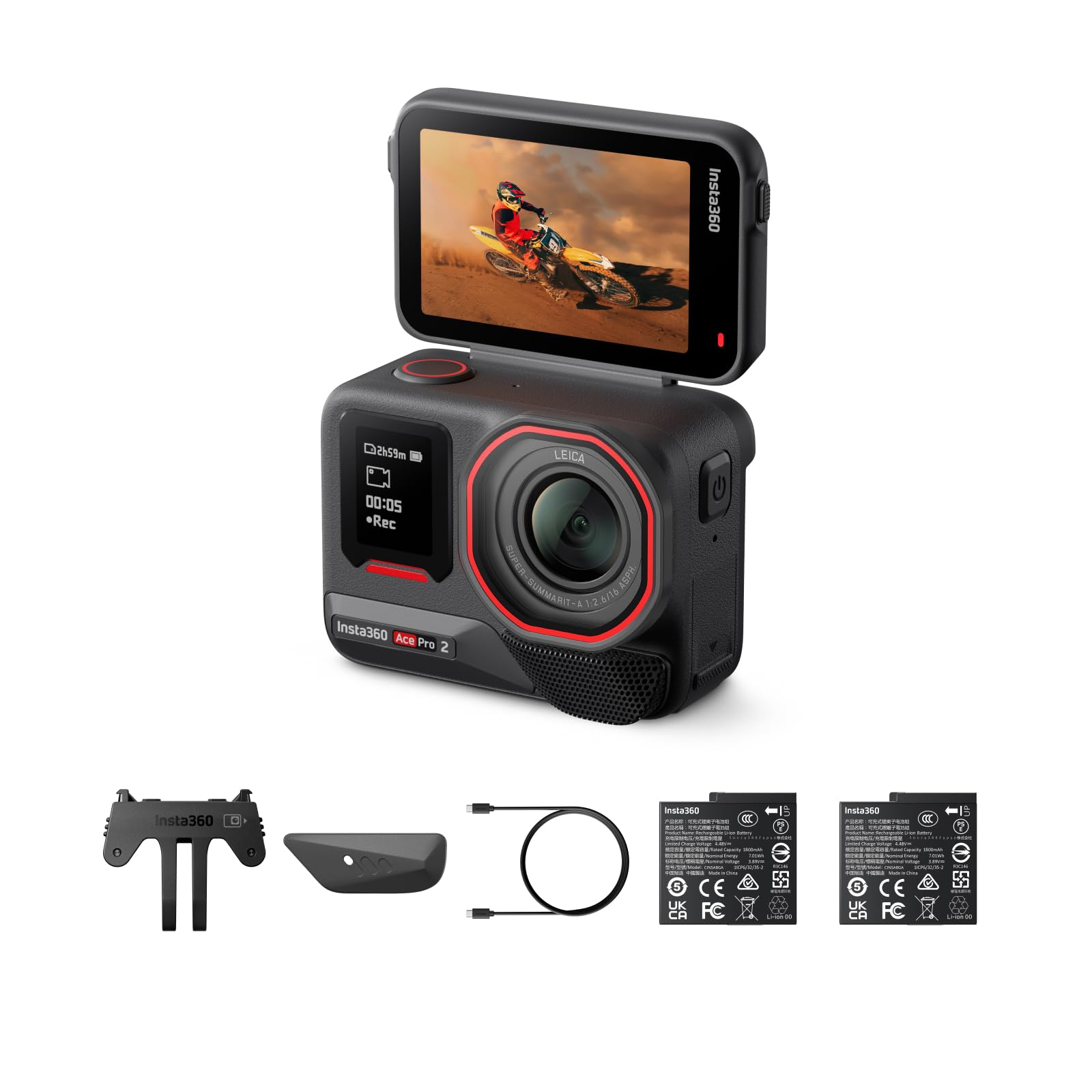
An 8K action camera co-engineered with Leica that turns dim sidelines into sharp footage.
If image quality is your priority, this action cam leads. It packs a 1/1.3″ 8K sensor (a large image sensor that captures 8K resolution) behind a Leica Summarit lens, with 13.5 stops of dynamic range (the range from darkest to brightest tones it can capture) and 2.4μm equivalent pixel size (a measure of how much light each pixel gathers). The dual AI chip setup — a Pro Imaging Chip for noise reduction plus a 5nm AI Chip for processing — delivers 100% more computing power than the original Ace Pro, and it shoots 8K at 30fps alongside 4K 60fps Active HDR (high dynamic range video that balances bright and dark areas).
Low light is where it separates from the pack. PureVideo Mode works up to 4K 60fps and uses AI noise reduction to keep details crisp when the light drops, which is exactly the situation at an evening game. It is waterproof to 39ft (12m), handles temperatures down to -4ºF, and a 157° wide-angle lens with MegaView FOV pulls the whole field into frame. The new Wind Guard clips on to tame wind noise, and it snaps onto a magnetic mount in seconds.
Compared with the Osmo Action 5 Pro earlier in this list, this one pushes resolution further with 8K versus 4K and adds the Leica color profiles. The trade is battery: the recurring complaint is runtime, even though the bundle ships with two cells, which softens the blow for a full day. If you want the sharpest footage an action cam can produce right now, this is the one, and the dual-battery bundle is the smarter buy for long sessions.
Standout Strengths
- 8K at 30fps plus 4K 60fps Active HDR from a Leica-lensed sensor.
- 13.5-stop dynamic range for control in harsh and dim light.
- Dual AI chip delivers 100% more computing power than the original Ace Pro.
- Magnetic mount and clip-on Wind Guard for quick rigging and cleaner audio.
Where It Costs You
- Battery life is the recurring gripe — the two-battery bundle helps but plan for it.
Made for: shooters who rank image sharpness and low-light detail above all else and want the best footage an action cam gives.
Not for: anyone chasing the longest single-charge runtime — carry both bundle cells.
6. DJI Osmo Action 6 Essential Combo
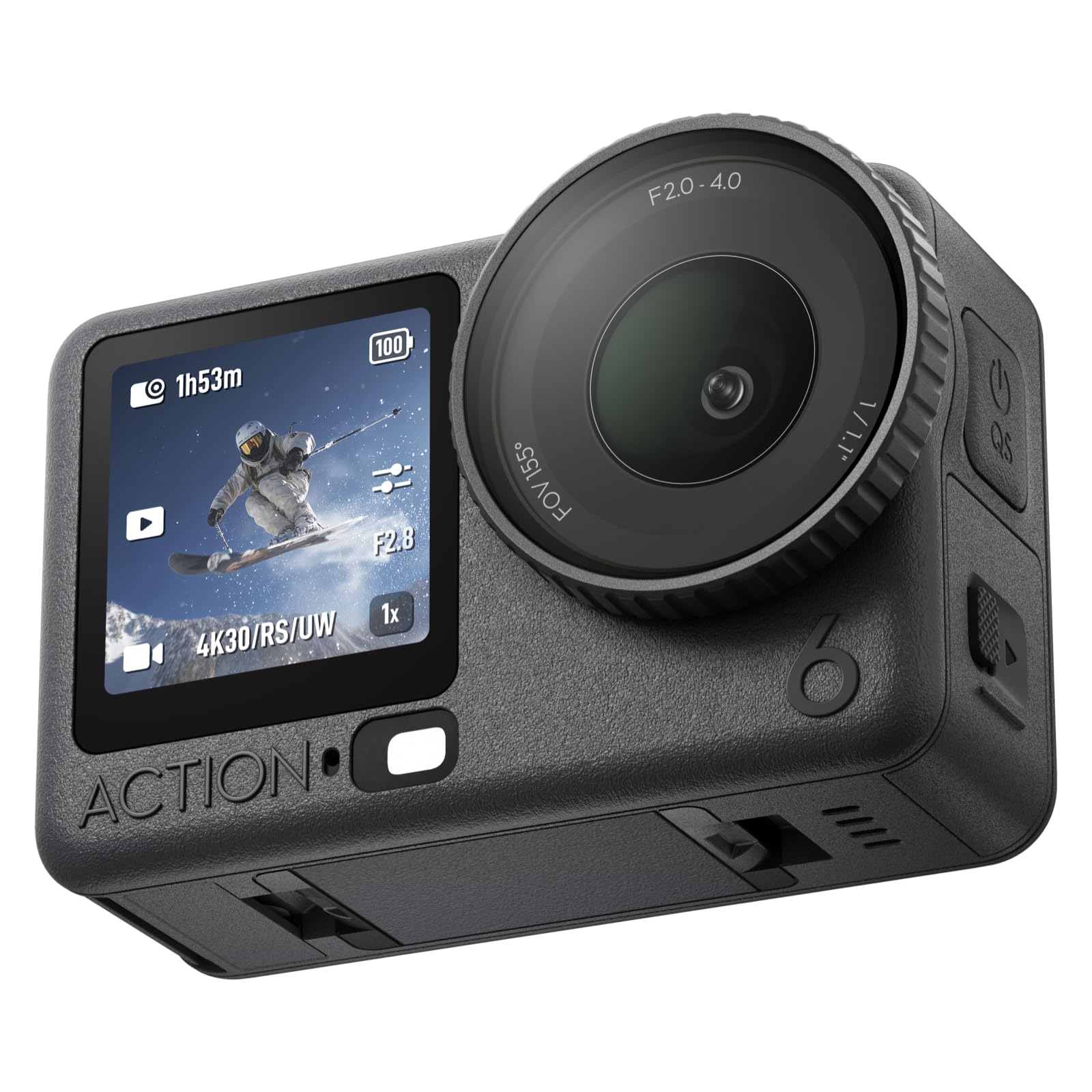
A small action cam built for little-league sidelines, dashcams, and full-day coverage.
The defining feature is the combination of an all-new 1/1.1″ square sensor and 50GB of built-in storage — shoot longer without ever swapping a card. That sensor shoots 8K at 30fps, and the 4K Custom Mode lets you reframe one clip into multiple aspect ratios for different platforms. A variable aperture that shifts from f/2.0 to f/4.0 adapts to changing light, so a morning game in shade and a midday field shoot both come out with vibrant color.
Where it earns its spot is the time on target. It delivers up to 4 hours of recording with a cold-resistant design, so a full tournament day fits in a single charge, and it goes underwater to 20m without a case. Stabilization runs RockSteady 3.0 for a natural first-person feel or HorizonSteady up to 4K/60fps to correct horizontal tilt. It handles 4K60fps for sports cleanly, and the wide default angle straightens out in settings to cover the whole field.
Owners who use it as a dashcam love the loop mode with a 30-second screen timeout and the magnetic snap-on mount that takes zero effort. It even works with existing GoPro accessories, which is a real perk if you already own a mount collection. The Essential Combo skips the curved adhesive base, so grab the Enhanced or Capture More kit if you need the extra battery and extension rod for long days.
what separates it: you can leave the memory card at home for a light session because it records up to 4 hours from a single charge and has 50GB of built-in storage.
One thing to plan around: the Essential Combo is the compact version without the curved adhesive base — pick a fuller combo if mounting flexibility matters.
Go with it if: you want all-day battery, built-in storage, and easy mounting for sidelines, dashcams, or handheld action.
Skip ahead if: you need the full accessory set from the start and would rather not buy the base separately.
7. DJI Osmo Pocket 3 Vlogging Camera with 1” CMOS & 4K/120fps
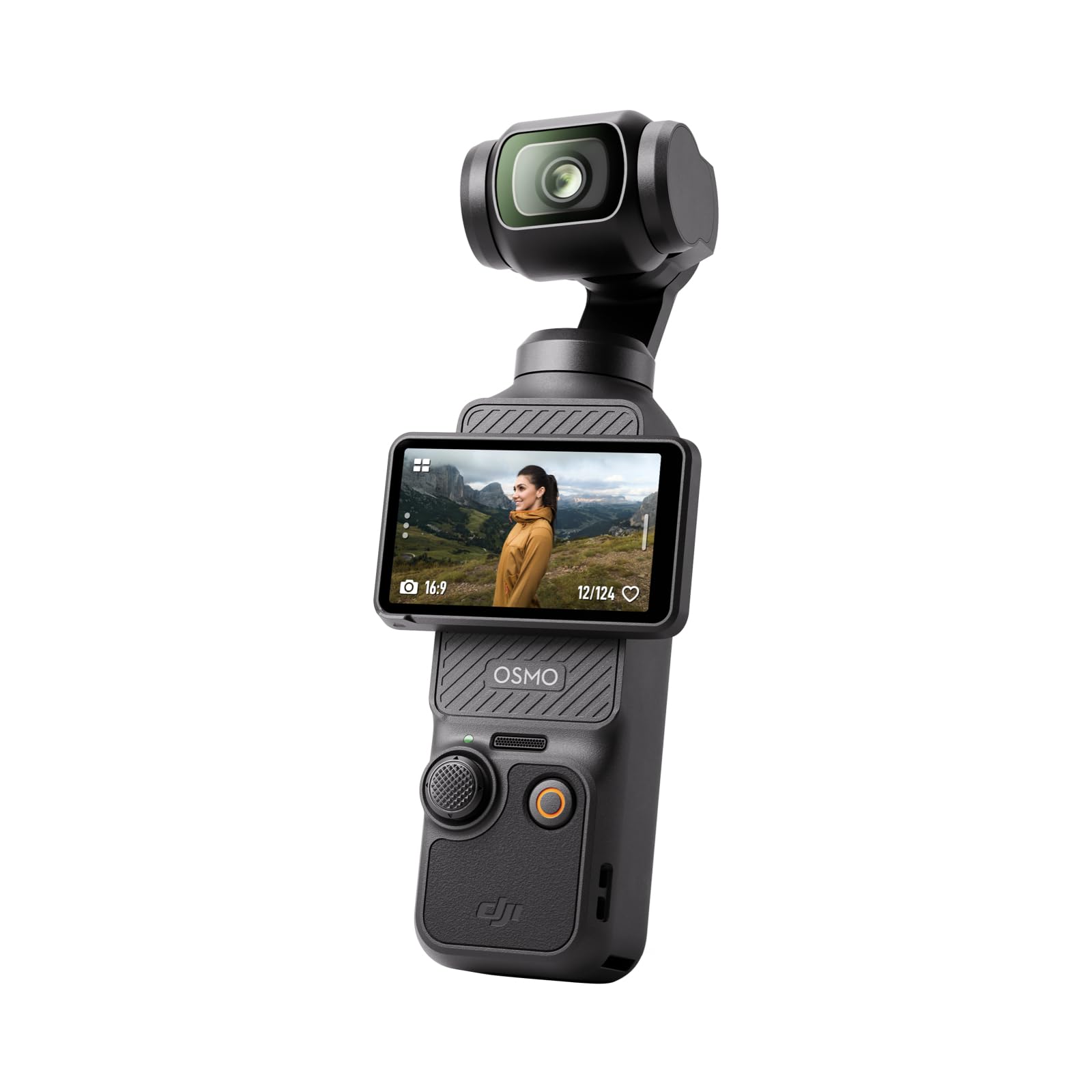
The pocket gimbal camera that made a huge crowd trade their phones for a dedicated device.
The 1-inch CMOS sensor shooting 4K at 120fps is what puts this on the shortlist. But the headline is the mechanical stabilization: the 3-axis gimbal physically levels the camera so walking and running shots stay fluid without you thinking about it. A 2-inch rotating touchscreen flips between horizontal and vertical, and ActiveTrack 6.0 keeps a moving subject center-frame even when you set the camera on a tripod and dance around it.
Color is a genuine pro-grade feature here. D-Log M and 10-bit color depth let you record up to a billion colors for flexible grading, and stereo audio captures clean sound without a separate mic. It connects directly to two DJI Mic 2 or Mic Mini transmitters, which is a big deal for a pocket camera. Buyers who replaced a mirrorless body with this note the convenience of a dedicated recording device — no phone distractions, instant setup.
Two realities to weigh. First, value and reliability land as mixed, and the gimbal makes the camera fragile — buyers warn the lens is delicate and the included case leaves part of the body exposed, so a bit of care is smart. Second, setup is more involved than an action cam. But for anyone whose sports footage is run-and-gun vlogging, tracking, and travel, the portability and image quality make this the crowd favorite by a wide margin.
The Winning Case
- 1-inch CMOS at 4K 120fps with 3-axis mechanical stabilization.
- D-Log M 10-bit color records up to a billion colors for grading.
- Connects directly to two DJI Mic 2 or Mic Mini transmitters.
- Pocketable, lightweight, and flips instantly between horizontal and vertical.
Handle With Care
- The gimbal is delicate and the included case leaves part of the front exposed.
- Setup and breakdown take longer than a rugged action cam.
The call: this is the pick for creators who film on the move and want gimbal-smooth 4K without carrying a rig.
Only if you accept: a fragile gimbal that needs careful packing and a bit of patience on setup.
8. GoPro HERO13 Black Bundle with 64GB Card & 50-Piece Accessory Kit

A ready-to-shoot kit that hands you the camera, the card, and a box of mounts in one go.
If you are starting from zero, this bundle is the shortcut. It pairs the HERO13 Black — 5.3K at 60fps (5120×2880 pixels, 60 frames per second), 27MP photos, and a 1/1.9″ sensor — with a 64GB microSD card and a 50-in-1 accessory kit, so you can mount it to a helmet, handlebar, or chest rig on day one. The 5.3K60 UHD recording also offers 4K at 120 and 2.7K at 240 for 8x slow-motion playback, which is exactly what a highlights reel needs.
The engineering behind steady footage is HyperSmooth 6.0 with AutoBoost and 360° Horizon Lock, which keeps the frame level no matter how the camera rotates and crops less than earlier versions. A 1900mAh Enduro battery delivers up to 1.5 hours of 5.3K recording, and the body is waterproof to 33ft without a housing. Wi-Fi 6 support speeds up file transfers, and timecode sync helps if you run multiple cameras at the same event.
The honest note here is about the extras, not the camera. Several buyers find the accessory kit feels cheap — one went as far as saying the tripod “can’t hold the weight of the camera” — so treat the mounts as starter gear and upgrade the ones you lean on. The camera quality itself, the easy operation, and the sheer number of included pieces are what make this a genuinely convenient first package for someone kitting out a sports bag.
The value play: you get the HERO13 Black plus a card and a pile of mounts in one purchase, which removes the guesswork of buying accessories separately.
Set expectations: the bundled accessories are budget-grade — swap the tripod and key mounts for sturdier ones if you shoot regularly.
Great for: beginners who want a complete, ready-to-mount sports kit without shopping for parts.
Trade-off to accept: the accessory quality varies, so the camera is the star and the add-ons are the bonus.
9. Nikon Z6 III Full-Frame Mirrorless Camera

A full-frame hybrid that records internal 6K RAW footage while keeping stills pros happy.
The video headline is 6K at 60p internal N-RAW recording, backed by oversampled 4K UHD, 4K at 120p, and Full HD at 240p for extreme slow-motion. For someone filming a track meet or a fast sport, that 240p mode is the tool that turns a split-second into a smooth replay. Add Hi-Res Zoom up to 2x digital during HD recording and 1.4x during 4K, and you can punch in without swapping lenses.
The viewfinder is where this body surprises people. It has a max brightness of 4000 nits (a very bright screen reading for a small display), a 5760k-dot resolution, and a 120fps refresh rate for lifelike motion. That brightness is a real difference when you are framing a shot in blazing sun. Autofocus detects subjects down to -10EV and is roughly 20% faster than the Z6II, with accurate detection of faces as small as about 3% of the frame.
The honest trade-off is that this is not a grab-and-go camera. The menus are deep, customers note battery life is on the weak side, and the setup takes learning. In return you get a full-frame hybrid that shoots 6K RAW stills and video without rolling-shutter drama (the skewing effect when you pan quickly), generous ISO from 100-64000, and dual card support for CFexpress Type B and SD — versatility that justifies the premium tier if you shoot both photo and motion work.
Why It Stands Out
- 6K 60p internal N-RAW plus 4K 120p and Full HD 240p slow-motion.
- 4000-nit, 5760k-dot EVF that stays clear in bright sun.
- Autofocus to -10EV and roughly 20% faster than the Z6II.
- Wide ISO range of 100-64000, extendable to ISO 204800.
Before You Commit
- Battery life reads as weak — carry spares for a full shoot.
- Deep menus and a steep setup curve for newcomers.
- Body only; you supply the lens and fast cards.
For the shooter who: wants internal 6K RAW and professional monitoring without a cinema-camera price jump.
Less ideal if: you want a simple point-and-shoot experience or long single-charge runtime.
10. Canon EOS R6 Mark II Mirrorless Camera (Body Only)

The action-tracking workhorse that locks onto athletes, animals, and vehicles at speed.
What makes this one stand out for sports is how aggressively it holds focus. It carries a 24.2MP full-frame sensor and a DIGIC X processor, but the real story is the subject detection: it tracks people, small animals, horses, trains, aircraft, cars, and motorcycles, and it can pick the subject type automatically. Advanced head, face, and eye detection tracks a runner or a rider even as they turn, so the frame stays sharp through the whole motion.
Speed is baked into everything. Electronic shutter shooting hits up to 40fps at 20MP, which is fast enough to catch a split-second changing facial expression or a bat mid-swing. Video is no afterthought: it records 6K-oversampled uncropped 4K up to 60 fps and Full-HD up to 180 fps without overheating, and offers up to 6 hours of continuous Full-HD recording. Stabilization is rated to 8 stops, which steadies handheld tracking shots when a tripod is not an option.
Compared with the Nikon Z6 III earlier in this list, the R6 Mark II leans toward autofocus breadth and burst speed rather than internal RAW. Buyers upgrading from older bodies call the menu system intuitive, and the multi-angle touchscreen makes low-angle sideline framing easy. The trade-off to know going in: it is a body only, so add a lens, and low-light shooters should plan for its battery life when shooting continuously.
The defining strength: subject-detection autofocus that locks onto people, animals, and vehicles makes it the surest bet for grab-the-action moments.
The honest caveat: it is sold as a body only, so lens cost comes on top, and a spare battery is wise for long events.
Worth it for: sports shooters who prize tracking accuracy and fast bursts over internal RAW recording.
Look at the Nikon if: 6K internal RAW is a must-have for your workflow.
11. Panasonic HC-X20 Professional 4K 60p Camcorder

A dedicated camcorder built for long-form coverage of games, meets, and live events.
The piece that earns its place for sports is reach. A 24.5mm wide-angle lens with an optical 20x zoom — and 32x i.ZOOM in Full HD, 24x in UHD — lets you pull a distant play right up close without moving from your seat. It pairs a 1.0-type MOS sensor with 4K at 60p and Full HD at 60p in a multi-format setup, using the HEVC codec to keep file sizes manageable for long recordings.
Focus and stabilization are tuned for moving subjects. 4K High Precision AF with Face Detection AF/AE keeps the right part of the frame sharp, and 5-Axis HYBRID O.I.S (a shake-correction system that works on multiple axes) steadies handheld work. For anyone covering an event, the pro inputs are the draw: XLR audio input, wired remote, triple manual ring, and versatile streaming protocols mean you can run it like a broadcast kit rather than a consumer gadget.
Owners describe it as a well-built machine with top-tier video quality, calling out the 4:2:2 10-bit and 4K 60 recording on fast SDXC cards. It is also a straightforward pick for documentaries, weddings, church services, and corporate filming, with quick setup when the action starts without warning. The one thing to accept is that its autofocus and exposure areweighted toward automatic control rather than deep manual tuning, so shooters who want full creative control may find it limiting. It also leans on manual rings and face detection rather than the subject-tracking smarts of a mirrorless body. For event and field coverage, though, the long zoom and pro audio inputs make it a specialized but genuine sports-coverage tool.
Why event shooters choose it: a 20x optical zoom with 4:2:2 10-bit 4K 60p recording on fast SDXC cards is built for coverage that runs hours.
The realistic limit: its exposure and focus are automatic-first, so shooters who want full manual control will miss it.
Consider this if: you film full games or live events and need long zoom, XLR audio, and hours of continuous recording.
skip it if: you want pocket portability or a lightweight travel setup.
Understanding the Specs
Frame Rate & Slow Motion
Frame rate is how many still images the camera captures each second, and it is the number that decides whether fast action looks smooth or smeared. A camera shooting 4K at 120 frames per second records four times the frames of a 30fps clip, so when you slow it down, a sprinter’s stride or a puck crossing the net stays fluid. Higher frame rates also demand faster memory cards, which is why a camera that supports 120fps often needs a quick card to actually record it.
Sensor Size & Low Light
The sensor is the physical chip inside that captures light, and its size drives how well the camera performs when the light drops. A bigger sensor gathers more light, which means cleaner footage under gym lighting or at an evening game instead of grainy, noisy footage. That is why a full-frame or 1-inch sensor camera tends to hold up better than a tiny phone-grade chip when the floodlights are weak.
Stabilization Systems
Stabilization cancels the shake from your hands and body while you move. Electronic stabilization reads the camera’s motion and corrects it in software, while a mechanical gimbal physically pivots to hold the frame level. For sports footage shot while running or panning, strong stabilization is what separates watchable footage from a shaky mess, and many action cameras add horizon-lock modes that keep the shot level through a full barrel roll.
Autofocus & Subject Tracking
Autofocus is the system that keeps your subject in focus automatically, and in sports it has to work on a moving target. Cameras with subject detection can lock onto people, faces, and eyes, keeping them sharp as they dart across the frame. The best performers here track athletes in motion, so you frame the play instead of chasing focus manually.
FAQ
What frame rate do I actually need for sports video?
Do I need a fast memory card to shoot 120fps?
Is an action camera or a mirrorless camera better for sports videography?
How much battery runtime can I expect during a game?
Will a 1-inch sensor handle indoor gym lighting?
What is the difference between a gimbal and electronic stabilization?
Can these cameras shoot vertical video for social media?
Are these cameras waterproof enough for wet sports?
How do I keep a moving subject in focus during a play?
Which pick is best if I mostly film at night or under stadium lights?
Final Thoughts: The Verdict
For most shooters, the camera for sports videography winner is the Sony Alpha a7S III, because its 12.1MP sensor and ISO up to 409,600 keep night-game footage clean and its 4K 120p mode delivers true slow-motion. If you want waterproof, wearable action footage that shrugs off splashes, grab the DJI Osmo Action 6 for its up to 4-hour runtime and 50GB of built-in storage. And if you shoot on the move and want gimbal-smooth 4K without a rig, the DJI Osmo Pocket 3 is the one to reach for.
How We Picked
We do not accept paid placement. Every pick is matched to a real buyer and a real use-case; we do not hands-on test units.
Sources & Methodology
Specifications: manufacturer listings and product documentation. Review insights: verified customer reviews, as of September 2026. Pricing: not shown on this page (it changes often); check the current price via the retailer link.
As an Amazon Associate, Gadgets Feed earns from qualifying purchases. This does not affect which products we feature.