
The ocean is the most punishing environment for camera gear — salt spray, sand, sudden wipeouts, and the relentless challenge of locking focus onto a fast-moving surfer against a bright, ever-changing horizon. Choosing the right tool for this specific job means prioritizing burst rate, weather sealing, and AF tracking above raw megapixels.
I’m Min — the co-founder and writer behind Gadgets Feed. This guide is the result of hundreds of hours spent cross-referencing technical data sheets for burst rates, AF point coverage, IBIS effectiveness, and environmental sealing ratings across mirrorless, DSLR, action cam, and superzoom platforms.
After diving deep into the specs, I’ve curated a focused list of the most capable contenders for shooting surf, balancing image quality with the ruggedness and speed required. This is the definitive guide for anyone seeking the absolute best camera for surf photography.
How To Choose The Best Camera For Surf Photography
Surf photography demands a unique mix of speed, durability, and focal length that a typical portrait or landscape camera simply cannot deliver. Before you commit to a system, evaluate these four critical pillars — they will determine whether you walk away with a barrel shot or a blurry splash.
Weather Sealing & Build Quality
Salt water is a camera’s worst enemy. Look for cameras with a fully “weather-sealed” or “splash-proof” magnesium alloy chassis. The OM System and Panasonic Lumix Micro Four Thirds lines are legendary for this, offering sealed bodies and lens mounts. A camera without robust gaskets around the battery door, port covers, and lens mount will likely suffer corrosion or failure after repeated sessions near the salt spray zone.
Autofocus Tracking & Burst Rate
A surfer moving at 20 mph on an unpredictable wave requires a camera with a hybrid or phase-detection autofocus system, capable of tracking vertical and diagonal movement. A burst rate of at least 10 frames per second (fps) with a deep buffer is essential. Mechanical shutter is preferable for slower panning shots, while electronic shutter allows for silent, high-speed capture of the peak moment without vibration.
Lens Reach & Stabilization
You cannot paddle out without a telephoto lens. A focal length of 200mm or more is the baseline for catching action from the shoreline or a jet ski. In-body image stabilization (IBIS) is incredibly valuable, as shooting handheld at 400mm in windy ocean conditions introduces significant micro-shake. For the ultimate reach, a superzoom bridge camera like the Nikon P950 offers an 83x optical zoom, giving you the equivalent of a 2000mm lens.
Sensor Size & Low-Light Performance
Full-frame sensors offer the best dynamic range and high ISO performance for cloudy or early morning sessions. However, Micro Four Thirds and APS-C sensors provide a smaller, lighter kit with a 2x or 1.5x crop factor — effectively extending your telephoto reach without adding weight. For dedicated water work inside the impact zone, a rugged action camera like the Insta360 X5 or OM System TG-7 is the only practical choice.
Quick Comparison
On smaller screens, swipe sideways to see the full table.
| Model | Category | Best For | Key Spec | Amazon |
|---|---|---|---|---|
| Canon EOS R3 | Premium Mirrorless | Professional Action Tracking | 30 fps / Eye Control AF | Amazon |
| Sony A7 IV | Full-Frame Hybrid | High-Res & Versatility | 33MP / 4K 60p / 693 AF pts | Amazon |
| OM System OM-1 | Micro Four Thirds | All-Weather Speed | 20 fps / IP53 Sealed | Amazon |
| Nikon Z6 III | Pro Mirrorless | Low-Light & Video | 6K/60p / -10EV AF | Amazon |
| Canon EOS R5 | High-Resolution | Imperial & Pro Work | 45MP / 8K RAW / 20 fps | Amazon |
| Canon EOS R6 II | Action Photographer | High-Speed Burst Tracking | 40 fps / Dual Pixel AF II | Amazon |
| Panasonic S5II | Video Hybrid | Cinematic Surf Film | Phase AF / Unlimited 4:2:2 | Amazon |
| Panasonic G85 | Value Build | Budget Entry+Sealing | 16MP / 5-Axis IBIS / 4K | Amazon |
| OM System E-M10 IV | Lightweight M4/3 | Compact Travel Surf | 20MP / 4.5-step IBIS | Amazon |
| Sony A7 III | Reliable Full-Frame | All-Round Action | 24.2MP / 693 AF / 10 fps | Amazon |
| Nikon P950 | Superzoom Bridge | Extreme Shore Telephoto | 83x Optical Zoom (2000mm) | Amazon |
| OM System TG-7 | Rugged Compact | In-Water Shoot | Waterproof 15m / Shockproof | Amazon |
| Insta360 X5 | 360° Action | Immersive POV Content | 8K 360° / Waterproof 15m | Amazon |
In‑Depth Reviews
1. Canon EOS R3 Mirrorless Camera

The Canon EOS R3 is engineered for the most demanding action photography, with a stacked 24.1MP full-frame sensor and a blazing 30 fps electronic shutter with full AF/AE tracking. For surf photography, its Eye Control AF system is transformative — simply look at the surfer and the focus point follows your gaze instantly, even through a spray-filled frame.
The R3’s body is built to the highest Canon weather-sealing standards, using magnesium alloy and robust gaskets. It features a 6K oversampled 4K video mode up to 60 fps and the Deep-Learning AI subject recognition that tracks not just people but also animals, a feature that works remarkably well for surfers duck-diving or paddling.
Battery life is exceptional with the LP-E19 pack, rated for over 700 images per charge, which is reassuring during a long dawn patrol session. The downside is the price point, which puts it squarely at the professional end. The buffer depth is extremely deep, capturing over 150 RAW images in a single burst without slowing down.
Why it’s great
- Eye Control AF allows instant subject acquisition while panning with waves.
- Professional-grade weather sealing survives salt spray and rain.
- 30 fps electronic shutter captures every micro-second of a barrel exit.
Good to know
- High premium pricing limits this to serious professionals.
- Relatively large and heavy for travel.
2. Sony Alpha 7 IV Full-Frame Mirrorless

The Sony A7 IV is a superb hybrid for surfers who need exceptional image quality for stills and 4K 60p 10-bit video for wave edits. Its 33MP full-frame sensor with the BIONZ XR processor offers incredible dynamic range, retaining shadow and highlight detail in harsh ocean lighting — like a deep blue wave face with a blazing white sky.
Real-time Eye AF and Real-time Tracking are among the best in any camera, locking onto a surfer’s face or head and maintaining lock even as they fade behind the curl. The camera’s 5-axis image stabilization is effective for handheld telephoto use, providing up to 5 stops of compensation from a jet ski or rocky shoreline.
The body offers a solid degree of weather sealing, including dust and moisture resistance, but it is not as aggressively sealed as an OM System or Canon R3. For serious wet work, a rain cover is recommended. It also features a large 3.68M-dot OLED EVF with a 120 fps refresh rate, which is great for composing fast-moving shots.
Why it’s great
- 33MP offers massive cropping flexibility for distant surf shots.
- Real-time Eye AF is incredibly sticky for tracking moving surfers.
- Excellent 4K 60p oversampled video for hybrid shooters.
Good to know
- Weather sealing is decent but not professional-level for salt spray.
- 4K 60p mode has a Super 35 crop factor.
3. OM System OM-1

The OM-1 is built from the ground up for the great outdoors. It features a 20MP stacked BSI Live MOS sensor and a quad-pixel AF system that delivers fast and accurate subject tracking. Its IP53 weather-sealing is industry-leading, meaning it is fully protected against dust and water jets — ideal for the spray of the impact zone.
With a burst rate of 50 fps in electronic shutter and an incredible 120 fps in single AF mode, the OM-1 can capture every micro-bubble and spray droplet of a barrel exit. The Pro Capture mode is a game-changer for surf: a half-press of the shutter continually buffers images, and the camera saves up to 35 frames from *before* you fully pressed the shutter — so you never miss the takeoff moment.
The Micro Four Thirds sensor provides a 2x crop factor, effectively turning a 200mm lens into a 400mm equivalent on the full-frame scale. This dramatically reduces the size and weight of your rig. The Olympus 100-400mm lens is a popular pairing for a long-reach but lightweight shoreline setup. The 5-axis IBIS is rated for up to 7 stops, making handheld capture at fast shutter speeds a breeze.
Why it’s great
- IP53 weather sealing is the best on this list for salt resistance.
- Pro Capture function ensures you never miss the peak of the wave.
- 2x crop factor gives exceptional telephoto reach with small lenses.
Good to know
- Micro Four Thirds sensor limits background bokeh and high ISO performance.
- Menu system can be complex and dated for some users.
4. Nikon Z6 III

The Nikon Z6 III brings a best-in-class electronic viewfinder with 4000 nits of brightness, a 5760k-dot resolution, and a 120 fps refresh rate. This is a massive advantage when shooting surf in blinding white sand and sky — you can clearly see the surfer against the glare. The camera features a 24.5MP BSI full-frame sensor and a partially stacked design for faster readout speeds.
Autofocus has been significantly improved, with detection down to -10 EV and Deep Learning technology that recognizes faces as small as ~3% of the frame. This means the Z6 III will lock onto a surfer’s head even when they are a tiny speck on the horizon. The burst rate reaches 14 fps with full AF tracking, which is enough to catch a carving turn or a wipeout sequence.
The weather-sealed body is built to handle tough conditions, with a robust magnesium alloy chassis. It also offers 6K/60p internal N-RAW recording for video shooters who want to oversample 4K footage. Battery life is rated at approximately 2 hours of continuous shooting, which is adequate for a session.
Why it’s great
- 4000-nit EVF eliminates glare issues in direct sunshine.
- Excellent low-light autofocus (-10 EV) works in overcast dawn conditions.
- Compact and lightweight for a full-frame camera.
Good to know
- Burst rate of 14 fps is slower than the competition at this price.
- Battery life is average; a spare is needed for a lengthy session.
5. Canon EOS R5

The Canon EOS R5 is a 45MP juggernaut that delivers the highest resolution on this list. When paired with an RF 100-500mm f/4.5-7.1L IS USM lens, it offers a phenomenal platform for surf photography. The 45MP sensor allows for aggressive cropping, turning a distant surfer into a full-quality portrait after the fact.
Its Dual Pixel CMOS AF II system covers 100% of the frame, and the Deep Learning subject detection locks onto surfers, animals, and vehicles with exceptional accuracy. With a mechanical burst of 12 fps and an electronic burst of 20 fps, it’s fast enough to capture any wave sequence. The 5-axis IBIS works in harmony with IS lenses to deliver sharp images at telephoto focal lengths.
Video capability is also top-tier, with 8K RAW and 4K HQ 120 fps recording. However, the 8K mode can generate heat; the R5 has been updated to manage this well, but be mindful of long recording sessions in direct sun. The build is weather-sealed but not as aggressively as the R3, so a splash cover is wise for extreme conditions.
Why it’s great
- 45MP sensor allows massive cropping for distant surfer faces.
- 8K video and 4K 120 fps for ultra-slow-motion wave impact.
- Amazing IBIS and lens stabilization for handheld telephoto shooting.
Good to know
- 8K recording can cause thermal management issues in direct sunlight.
- High price is an investment; budget for RF lenses.
6. Canon EOS R6 Mark II

The Canon EOS R6 Mark II is a specialist for speed. With an electronic shutter burst rate of up to 40 fps, it outpaces nearly every camera in its class for capturing the exact moment of a spray-drenched re-entry. The Dual Pixel CMOS AF II provides fast and reliable tracking on people, including surfers within the frame.
The 24.2MP full-frame sensor is a sweet spot for speed and quality, offering excellent low-light ISO performance up to 102400. This matters when shooting in the golden hour or on overcast days when the sea looks slate grey. The camera also features 8-stop IBIS, which is a boon for handheld telephoto shooting.
Video capabilities are strong with 6K oversampled 4K 60p and 4K 120p slow motion. The body is weather-sealed and ergonomically comfortable. The EVF refresh rate of 120 fps ensures that you can follow a surfer’s trajectory without lag, even in fast-paced panning scenarios. The main trade-off is the lower resolution compared to the R5 or A7 IV.
Why it’s great
- 40 fps burst with AF tracking is unmatched for capturing wipeout sequences.
- Excellent low-light performance for early morning and sunset sessions.
- 8-stop IBIS is among the best for handheld panning.
Good to know
- 24MP sensor offers less cropping latitude than the 45MP R5.
- No headphone jack; monitoring is via USB-C adapter.
7. Panasonic Lumix S5II
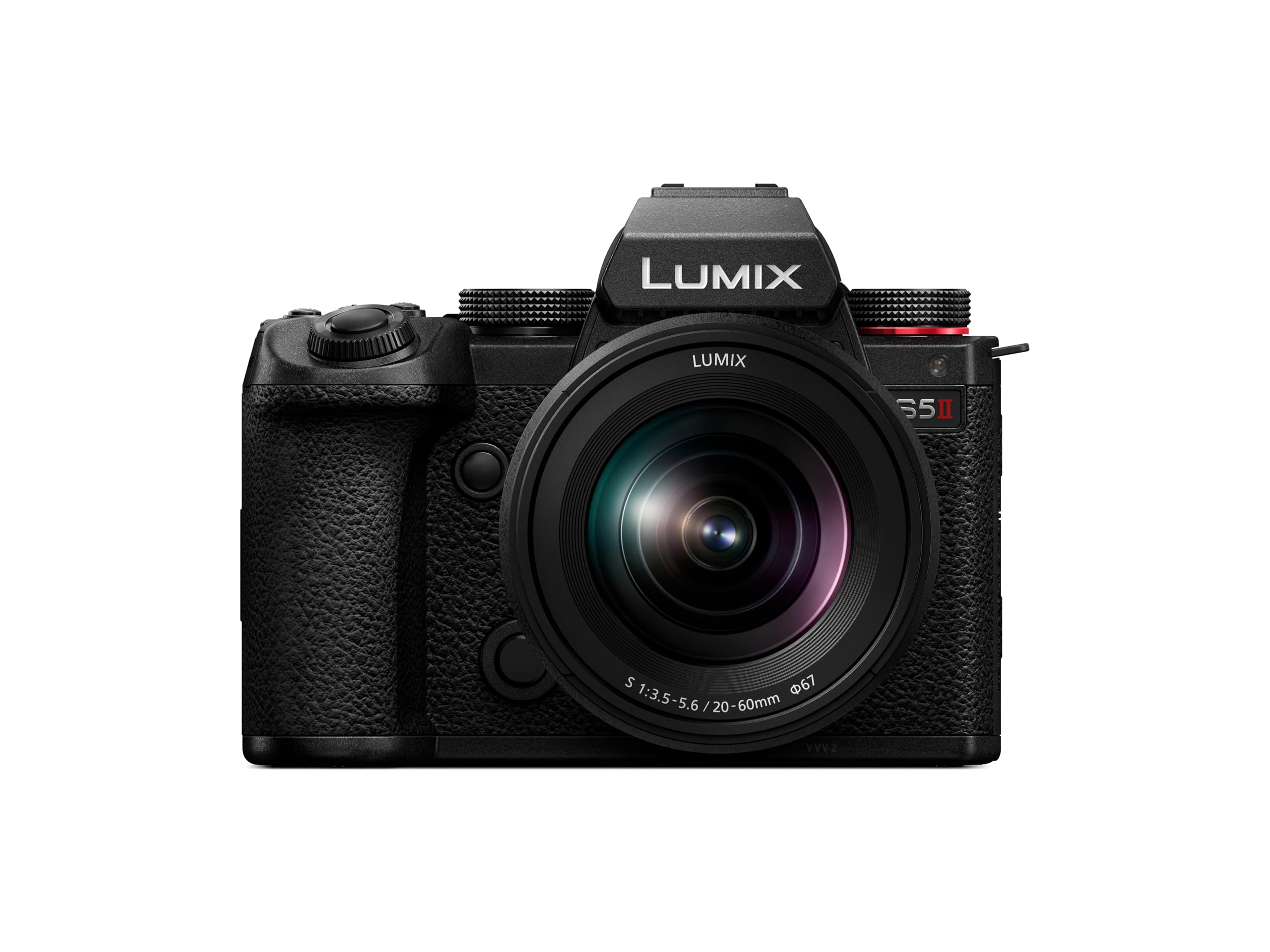
The Panasonic Lumix S5II marks a significant step for the L-Mount lineup, as it finally introduces Phase Hybrid Autofocus (PDAF). This eliminates the previous generation’s struggle with continuous AF for video. For surf, this makes the S5II a compelling choice for anyone wanting to film long sequences of wave riding.
The camera features a 24.2MP full-frame sensor and an upgraded Active I.S. system that is particularly effective for walking shots. The video capabilities are where it truly shines: unlimited 4:2:2 10-bit recording with V-Log/V-Gamut capture offering 14+ stops of dynamic range. The Real-Time LUT feature allows you to apply color grading directly in-camera, perfect for creating a consistent look.
The body is weather-sealed and offers a large, comfortable grip. The kit lens — a 20-60mm f/3.5-5.6 — is versatile for land-based shots. For telephoto surf work, you would need to invest in an L-Mount lens like the Sigma 150-600mm. The main drawback is battery life; the S5II is known for shorter battery endurance, so multiple spare batteries are a must.
Why it’s great
- Phase Hybrid AF finally enables reliable video tracking for moving surfers.
- Unlimited 4:2:2 10-bit recording with V-Log for professional-grade color.
- Active I.S. is excellent for walking and panning shots.
Good to know
- Battery life is poor; a battery grip is recommended.
- L-mount telephoto lenses are less abundant than Sony or Canon options.
8. Panasonic Lumix G85

The Panasonic Lumix G85 is a durable, entry-level micro four thirds camera that punches far above its price point for surf photography. Its magnesium alloy front plate and weather-sealed body mean it can handle spray and sand much better than most similarly priced cameras. The 16MP sensor is older, but the 5-axis Dual I.S. 2 stabilization is superb for its class.
The G85 includes a 12-60mm f/3.5-5.6 kit lens that is also weather-sealed. While 16 megapixels is not high, the sensor’s design with no low-pass filter resolves fine details well. The camera shoots 4K UHD video and offers the 4K Photo mode, which lets you extract 8MP still frames from 30 fps video — a useful trick for nailing the perfect wave expression.
The EVF is a 2.36M-dot OLED unit, which is clear and bright. The articulating 3-inch touchscreen helps when shooting from low angles. The autofocus is contrast-detect, which can be slower in low light and less reliable than phase-detect for tracking, but the 49-area system is adequate for slower-moving or predictable surfers. This is a fantastic starting point for learning surf photography.
Why it’s great
- Weather-sealed body and kit lens are perfect for sand and spray.
- Excellent IBIS for its price, stabilising telephoto shots.
- 4K Photo mode helps catch the exact moment from video.
Good to know
- Contrast-detect AF struggles with fast-moving subjects in low light.
- 16MP sensor offers less cropping flexibility and dynamic range.
9. OM System E-M10 Mark IV

The OM System E-M10 Mark IV is exceptionally small and lightweight, making it the ultimate camera for a trip that prioritizes packing space. It houses a 20MP Live MOS sensor and the classic 5-axis In-Body Image Stabilization capable of 4.5 shutter speed steps of compensation. This makes it possible to shoot sharp at slower shutter speeds, a common trick for panning with a wave.
The flip-down LCD and dedicated selfie mode are not strictly for surf, but the articulating screen is useful for getting the camera into a low position on the sand without lying down. The built-in 14-42mm EZ pancake lens is not telephoto, but the camera can be paired with an affordable M.Zuiko 40-150mm f/4.0-5.6 R lens for only a small addition of weight.
The E-M10 IV is not fully weather-sealed like its OM-1 sibling, so it is not a camera to leave in heavy spray. However, it is a very capable tool for the dry shoreline photographer. The camera uses contrast-detect AF with 121 points, which is snappy in good light but not class-leading for action. It is a fantastic value for image quality in a tiny package.
Why it’s great
- Incredibly compact and lightweight, ideal for hiking to a beach.
- 20MP sensor delivers excellent images for the size.
- 5-axis IBIS is very effective for handheld telephoto panning.
Good to know
- No weather sealing; not safe for direct salt spray exposure.
- Contrast-detect AF can miss fast-moving action shots.
10. Sony A7 III

The Sony A7 III remains a classic for a reason. Its 24.2MP Back-Illuminated full-frame sensor, combined with 693 phase-detection AF points covering 93% of the image area, provides incredible autofocus performance and dynamic range. For surf, the Real-time Eye AF and Real-time Tracking are still highly effective and sticky for surfer movement.
The camera offers up to 10 fps continuous shooting with full AF/AE tracking, which is sufficient to capture the main action of a wave. The 15-stop dynamic range is excellent for recovering blown-out highlights from a bright sun reflection on the water. The battery life is exceptional, rated for up to 710 shots per charge.
The A7 III’s weather sealing is modest by modern standards. The lens mount and body seams have some gaskets, but it is not designed to be a heavy-duty camera for continuous exposure to salt spray. A dedicated rain cover is a good investment. The 4K video is excellent, but the 5-axis IBIS is slightly less refined than the newer A7 IV.
Why it’s great
- Excellent dynamic range for handling harsh ocean lighting.
- 693 phase-detect AF points provide reliable subject tracking.
- Incredible battery life for long days at the beach.
Good to know
- Weather sealing is basic; not ideal for heavy spray.
- 10 fps burst is the slowest among the premium full-frame options.
11. Nikon Coolpix P950

The Nikon Coolpix P950 is the dedicated telephoto specialist for the shoreline shooter who does not want to carry a massive 800mm full-frame lens and tripod. Its 83x optical zoom lens has a 35mm equivalent focal length of 24mm to a staggering 2000mm. This brings far-off surfers, barely visible to the naked eye, into a full-frame composition.
The lens has built-in optical image stabilization (VR), which is essential when hand-holding at 2000mm. The camera includes a dedicated “Bird” and “Moon” mode, and while these are not for surf directly, the long telephoto stability they impart is useful for sharp surfing shots. The 16MP sensor is small, limiting low-light quality and dynamic range, but it is a compromise for the incredible reach.
The P950 shoots 4K UHD video and captures RAW stills. The autofocus can struggle with fast unpredictable movement at the long end of the zoom, and the burst rate is slow. This camera is not for shooting rapid sequences in a barrel. It is ideal for the power surfer on a long point break where the surfer is far out and the waves are predictable.
Why it’s great
- 83x zoom reaches surfers impossible to capture with conventional kits.
- Built-in VR is effective for handheld telephoto shots.
- All-in-one camera eliminates the need for expensive lenses.
Good to know
- Small sensor limits low-light performance for dawn/dusk surfing.
- Autofocus can be slow and hunt at extreme telephoto ranges.
12. OM System Olympus TG-7

The OM System Olympus TG-7 is a rugged compact camera built for the most extreme environments. It is waterproof to 15 meters (50 feet), shockproof to 2.1 meters (7 feet), crushproof to 100 kgf, and freezeproof to -10°C (14°F). For surf photography, this is the camera to take into the impact zone. It will survive a wipeout and a tumble on the reef.
The TG-7 features a high-resolution f/2.0 lens with a 4x optical zoom (25-100mm equivalent). It has a dedicated Underwater mode with five sub-modes for different water conditions. The macro capability is incredible, with the Variable Macro System letting you shoot from 1cm away, capturing the detail of a salt-crusted fin.
The image quality is typical of a 12MP small-sensor point-and-shoot: excellent in bright daylight, but noisy and low-detail in low light. It shoots 4K video at 30fps. The best use of the TG-7 for surf is attaching a small rig to a long handle and using it to shoot paddling action from directly inside the lineup. It is not a replacement for a mirrorless camera on land.
Why it’s great
- Waterproof directly out of the box; no separate housing needed.
- Extremely rugged and shockproof, safe for the harshest wipeouts.
- Excellent macro and underwater modes for unique surf perspectives.
Good to know
- Image quality is not comparable to interchangeable-lens cameras.
- Small sensor struggles badly in low-light conditions.
13. Insta360 X5

The Insta360 X5 is a 360-degree action camera that is a complete game-changer for surf content creation. With dual 1/1.28-inch sensors shooting 8K 360° video, it captures *everything* around it. You mount it to a handle, a surfboard nose, or a helmet, and later reframe the shot in post-production using AI — essentially choosing the perfect angle after the session.
It is waterproof to 15 meters (49 feet) without a case, making it ideal for being right next to the surfer or in the water. The FlowState Stabilization and 360° Horizon Lock ensure the footage is buttery smooth, even when the surfer is hitting a bumpy section of the wave. The Invisible Selfie Stick effect creates a drone-like third-person perspective of the surfer in the water.
The new Wind Guard on the 4-mic array delivers clearer audio in windy ocean conditions. Battery life is improved to over 200 minutes, and fast charging reaches 80% in 20 minutes. The X5 is not for high-resolution stills; its strength is creating engaging, hyper-active POV video posts. It excels at doing something no traditional camera can do.
Why it’s great
- Waterproof to 15m; safe for hands-free in-water mounting.
- Invisible Selfie Stick creates a unique third-person surf perspective.
- Edit later with AI; never miss the shot while holding the camera.
Good to know
- Image quality is not comparable to a DSLR/mirrorless for prints or crops.
- Requires post-production reframing in the app or desktop software.
FAQ
Can I use a phone gimbal for surf photography?
How many frames per second do I really need for a barrel shot?
Should I get a dedicated housing for my mirrorless camera?
Is a teleconverter useful for surf photography?
Final Thoughts: The Verdict
For most users, the absolute best camera for surf photography is the OM System OM-1 because it offers IP53 weather-sealing, Pro Capture mode, and a 2x crop factor in a lightweight, rugged body. If you want the highest resolution for cropping into distant surfers, grab the Canon EOS R5. And for the adrenaline of in-water POV or 360° content that no other camera can replicate, nothing beats the Insta360 X5.