
An underwater camera has to do two contradictory things well: seal out immense pressure while capturing light that behaves completely differently than in air. The moment you go below the surface, red wavelengths vanish first, then orange, then yellow, leaving everything in a blue-green cast. A camera that handles that color shift without artificial filters, and seals reliably past ten meters, separates a successful dive from a flooded disappointment.
I’m Min — the co-founder and writer behind Gadgets Feed. To build this guide, I sifted through hundreds of spec sheets, cross-referencing depth ratings, sensor sizes, battery capacities, and real-world sealed performance data to find the most reliable options on the market today.
Whether you snorkel reefs at five meters or hit the thermocline at thirty, the right setup means bringing back footage that looks like the ocean actually does. That is exactly what you will find in this guide to the best camera for underwater.
How To Choose The Best Camera For Underwater
Picking an underwater camera is a trade-off between depth capability, image quality, and form factor. You can go with a dedicated rugged compact, a smartphone housing, or a premium action camera — each has very different strengths beneath the surface. The three specs that matter most are depth rating, sensor size, and color management, because the ocean is hostile to all three.
Depth Rating: The Hard Ceiling
A camera rated for 15 meters without a housing is not the same as one rated for 50 meters inside a housing. The seal mechanism — O-rings, cam locks, or vacuum-tested ports — defines whether you can trust the unit past ten meters. For casual snorkeling, a camera with a built-in 15-meter rating works. For scuba, you need a housing rated for at least 40 meters or a camera like the DJI Osmo Action 5 Pro that hits 20 meters with an IP68 rating.
Sensor Size and Low-Light Recovery
Water absorbs light quickly, so a larger sensor with bigger individual pixels captures more photons. A 1/1.3-inch sensor with 2.4 µm pixels, like the one in the DJI Osmo Action 5 Pro, recovers shadow detail far better than a smaller 1/2.3-inch sensor found in older action cams. Larger sensors also give you cleaner footage when you need to raise ISO values to compensate for depth.
Color Correction and White Balance
Red light disappears within the first five meters. Cameras that rely on a single auto white balance algorithm produce flat, blue-green images. A camera with a dedicated underwater mode, or better yet a physical color temperature sensor, will automatically compensate for the missing spectrum. The TG-7 has five underwater scene modes, while the DJI Osmo Action 5 Pro uses a color temperature sensor to correct in real time.
Quick Comparison
On smaller screens, swipe sideways to see the full table.
| Model | Category | Best For | Key Spec | Amazon |
|---|---|---|---|---|
| DJI Osmo Action 5 Pro Adventure Combo | Premium Action Cam | Low-light & long dives | 1/1.3″ sensor, 20m IP68, 4hr battery | Amazon |
| DJI Osmo Action 6 Enhanced Combo | Premium Action Cam | 8K detail & variable aperture | 1/1.1″ sensor, 8K30fps, f/2.0-f/4.0 | Amazon |
| GoPro MAX2 | 360 Action Cam | Reframable 360° footage | True 8K 360, 1960mAh Enduro battery | Amazon |
| Insta360 X5 Essentials Bundle | 360 Action Cam | Post-capture angle selection | Dual 1/1.28″ sensors, 208min runtime | Amazon |
| GoPro HERO12 Black Bundle | Mid-Range Action Cam | Versatile bundle with accessories | 5.3K HDR, HyperSmooth 6.0, 33ft depth | Amazon |
| OM System OLYMPUS Tough TG-7 | Rugged Compact | Macro & scientific underwater | 15m waterproof, 4x optical, 5 underwater modes | Amazon |
| SeaLife SportDiver Ultra Housing | Phone Housing | Using your smartphone underwater | 130ft depth, audible leak alarm | Amazon |
| OM SYSTEM PT-059 Housing for TG | Dedicated Housing | Scuba with TG-6/7 | 147ft depth, full camera control | Amazon |
| Pentax WG-1000 | Budget Rugged Compact | Casual snorkeling & hiking | 15m waterproof, 4x optical zoom | Amazon |
In‑Depth Reviews
1. DJI Osmo Action 5 Pro Adventure Combo

The DJI Osmo Action 5 Pro sets a new benchmark for underwater action cameras with its 1/1.3-inch sensor and 2.4 µm pixels that pull in significantly more light than the older 1/2.3-inch sensors found in previous generations. This sensor advantage, combined with a 13.5-stop dynamic range and a dedicated color temperature sensor, means footage at 15 meters retains natural reds and oranges without the heavy blue cast typical of lesser cameras. The IP68 rating takes it to 20 meters without a housing, which covers most recreational diving and all snorkeling scenarios.
The Adventure Combo includes three 1950mAh Extreme Batteries and a multifunctional battery case, giving you up to 12 hours of total recording capacity for multi-day trips. The 4nm chip enables subject tracking that locks onto swimmers or divers in both 16:9 and 9:16 formats, while the 360-degree HorizonSteady stabilization eliminates any roll-axis wobble. Dual OLED touchscreens make menu navigation underwater much easier than the dim LCDs on older action cams.
One minor note is that the camera does generate noticeable heat during prolonged 4K/120fps recording, and the touchscreen responsiveness drops slightly when wet, but the physical buttons remain fully usable. For anyone who wants the best all-rounder that works from the pool deck down to 20 meters, this is the clear choice.
Why it’s great
- Outstanding low-light performance from the large sensor and large pixels
- Real-time color temperature sensor eliminates blue-green casts automatically
- 20-meter IP68 rating means no housing needed for most dives
Good to know
- Runs warm during extended 4K/120fps recording
- Touchscreen can be sluggish with wet fingers
2. DJI Osmo Action 6 Enhanced Combo
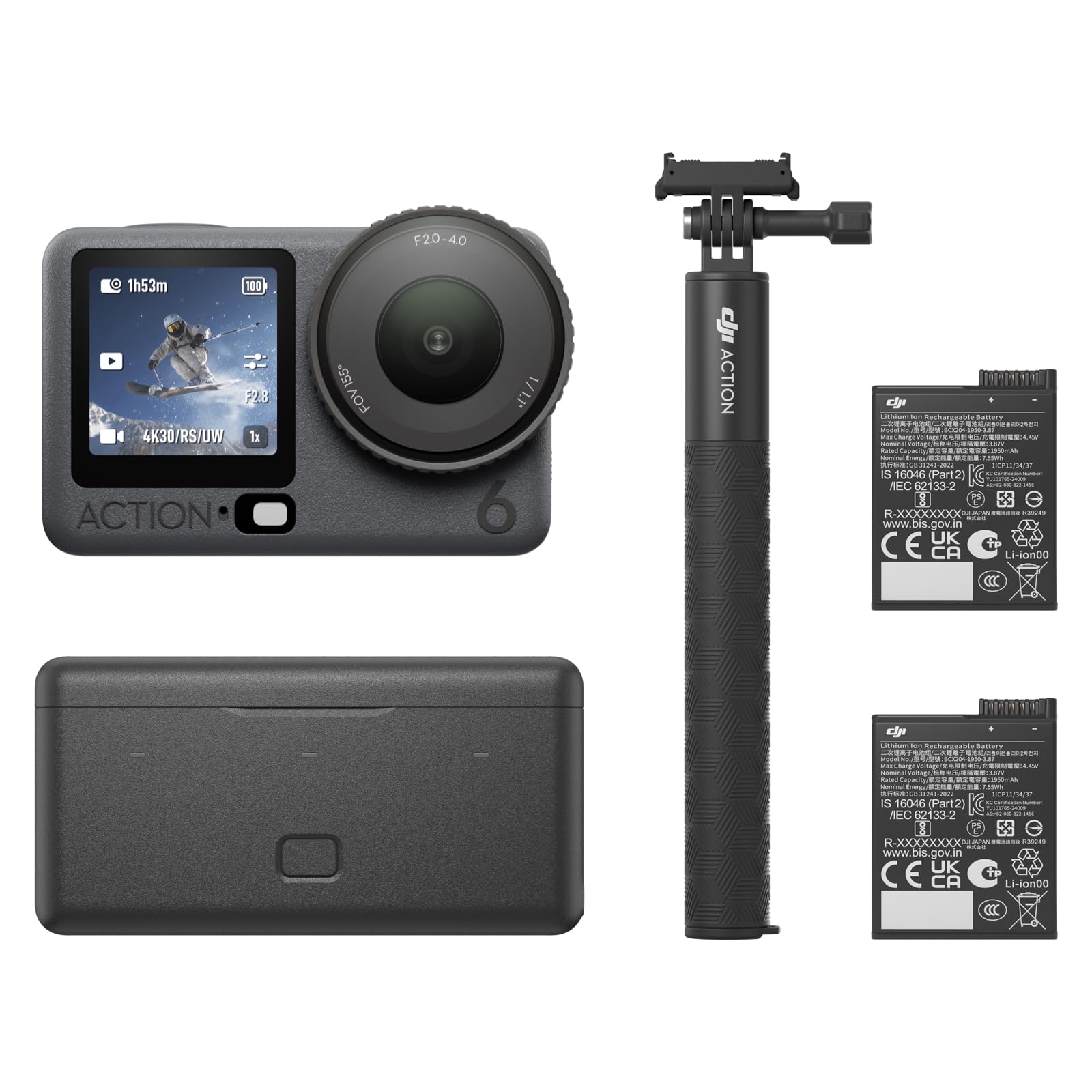
The Osmo Action 6 elevates the platform further with an all-new 1/1.1-inch square sensor and a variable aperture ranging from f/2.0 to f/4.0, giving you direct control over depth of field and light intake in a way no other action camera at this price point offers. The square sensor means you can reframe 4K footage into multiple aspect ratios — 16:9, 9:16, 1:1 — without cropping into the effective resolution. This is a massive advantage for social-media-focused shooters who want vertical diving clips alongside wide reef panoramas.
Underwater, the variable aperture lets you stop down to f/4.0 in bright surface conditions for sharper edges, then open to f/2.0 at depth where light is scarce. The 8K30fps capture provides enough resolution headroom to stabilize and reframe in post without visible quality loss. The 360-degree HorizonSteady and RockSteady 3.0 work together to keep horizon lines perfectly level even during strong currents or rapid head turns. The Enhanced Combo includes two 1950mAh batteries and a multifunctional battery case, plus a 1.5-meter extension rod.
Battery life sits at around 4 hours per pack under normal use, though 8K recording pulls it down to roughly 90 minutes per charge. The built-in 50GB storage is a thoughtful addition — you can start shooting immediately before inserting a microSD card. The touchscreen is identical to the Action 5 Pro, so wet responsiveness remains a mild concern, but the physical shutter lever works reliably with gloves.
Why it’s great
- Variable aperture f/2.0–f/4.0 for precise depth-of-field control underwater
- 1/1.1-inch square sensor delivers superior dynamic range and reframing flexibility
- 50GB built-in storage removes the immediate need for a microSD card
Good to know
- 8K recording reduces battery life to under 90 minutes per pack
- Built-in microphone audio quality is average; an external mic is recommended for vlogging
3. GoPro MAX2
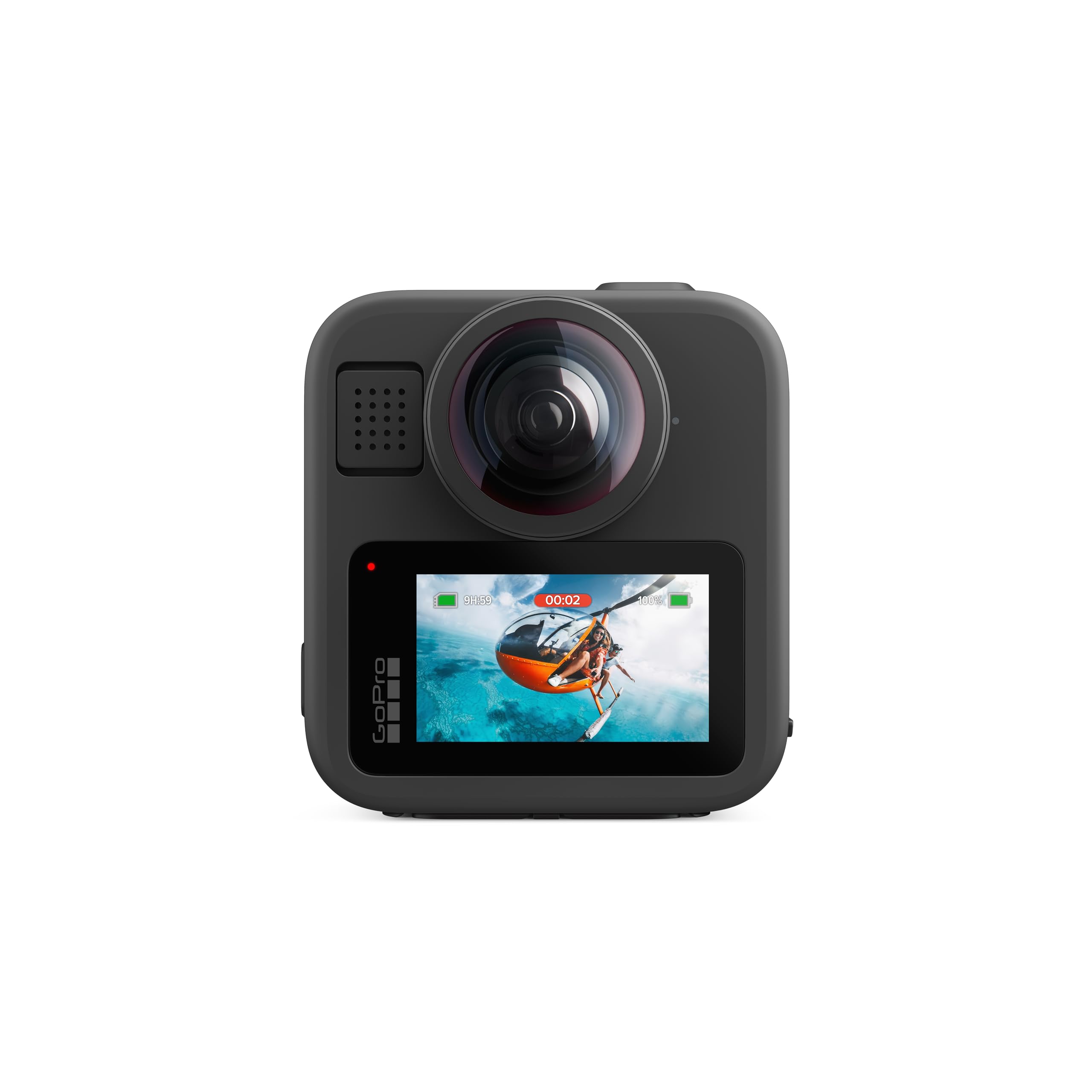
The GoPro MAX2 solves the biggest frustration of underwater filming: aiming. With True 8K 360-degree capture, you never need to point the camera at a subject because it records everything around you simultaneously. The spherical footage can later be reframed into traditional 4K videos in the Quik app, pulling the best angle from any direction. The invisible selfie stick effect works perfectly for solo divers who want third-person footage without a second person.
The 1/1.7-inch dual sensors and HyperSmooth stabilization with 360-degree Horizon Lock keep footage level regardless of how much the camera rotates during a dive. The replaceable glass lenses are water-repelling and scratch-resistant, which is critical for saltwater environments where sand and grit constantly abrade lens surfaces. The 1960mAh Enduro battery is cold-resistant and maintains performance in water temperatures down to 14°F (-10°C), though in tropical waters you will see roughly 50% battery drain per hour of 360 time-lapse shooting.
The six-microphone array captures ambisonic audio that shifts perspective as you reframe footage, creating an immersive sound field that matches the visual perspective. The main drawback is heat generation during extended 8K recording — some users report the camera becoming noticeably warm after 20 minutes. Also, the 360 workflow requires the Quik app for reframing, which adds a step compared to traditional fixed-lens cameras.
Why it’s great
- True 8K 360 capture eliminates the need to aim the camera underwater
- Replaceable glass lenses are a lifesaver for scratch-prone saltwater environments
- HyperSmooth stabilization with Horizon Lock keeps footage perfectly level
Good to know
- Runs hot during extended 8K recording sessions
- Requires the Quik app for reframing 360 footage into traditional video formats
4. Insta360 X5 Essentials Bundle

The Insta360 X5 takes a dual-sensor approach with two 1/1.28-inch sensors that capture 8K30fps 360-degree video, and the triple AI chip design applies advanced noise reduction that produces clean footage even in dim conditions like deep reef walls or overcast days. The 360-degree FlowState Stabilization and Horizon Lock work without a gimbal, which is especially useful for bumpy boat entries or swimming against current. The 49-foot (15-meter) waterproof rating without a housing matches the TG-7 for depth capability.
The battery life is the standout spec here: up to 208 minutes of runtime, with fast charging from 0 to 80% in just 20 minutes. The Utility Fast Charge Case in the Essentials Bundle lets you charge an extra battery on the go, which is critical for full-day dive trips. The InstaFrame mode outputs a ready-to-share flat video instantly, and the AI editing in the Insta360 app can auto-generate highlight reels without manual timeline work. The invisible selfie stick effect works flawlessly for solo footage.
The replaceable lenses are a major advantage over cameras with fixed bonded glass — if a lens gets scratched on coral or sand, you swap it in seconds rather than replacing the entire camera. The 4-microphone array with the new Wind Guard significantly reduces wind interference above water, though underwater the audio is mostly muffled anyway. The main trade-off is that 360 footage demands post-processing and app usage, which not every user wants to deal with immediately after a dive.
Why it’s great
- 208-minute battery runtime with 20-minute fast charging to 80%
- Replaceable scratch-resistant lenses are ideal for rugged underwater environments
- Triple AI chip design delivers clean, vibrant low-light footage
Good to know
- 360 workflow requires the Insta360 app for reframing and editing
- MicroSD card not included in the bundle
5. GoPro HERO12 Black Bundle

The GoPro HERO12 Black Bundle packs the camera with a 50-piece accessory kit and a 64GB microSDXC card, making it the most all-in-one package for someone who wants to start shooting immediately. The 1/1.9-inch sensor with 5.3K HDR video captures high dynamic range footage that retains shadow detail and highlight information simultaneously, which is especially valuable in shallow reef environments where bright sunlight and dark crevices coexist. The 33-foot (10-meter) waterproof rating without a housing covers snorkeling and pool use, but for scuba you will need a separate housing.
HyperSmooth 6.0 stabilization with Horizon Lock keeps footage steady even when swimming against chop or bouncing on a boat deck. The Enduro battery provides up to 2.5 hours of 1080p/30fps recording or about 90 minutes at 5.3K/30fps, which is sufficient for a single dive session. The wireless Bluetooth audio support means you can connect AirPods as a remote microphone for above-water commentary, though this does not work underwater.
The 50-piece accessory kit includes adhesive mounts, clip mounts, and a head strap, all of which help position the camera for different POVs. The main performance limitation is low-light capability — the smaller sensor struggles in dim water below 15 meters compared to the larger sensors in the DJI cameras. Some users also note that a GoPro subscription is required for certain cloud features, which adds ongoing cost.
Why it’s great
- Comprehensive bundle includes 50 accessories and a 64GB microSD card
- 5.3K HDR video captures excellent dynamic range in mixed lighting
- HyperSmooth 6.0 with Horizon Lock keeps footage stable without a gimbal
Good to know
- Smaller 1/1.9-inch sensor limits low-light performance at depth
- Some cloud features require a GoPro subscription
6. OM System OLYMPUS Tough TG-7

The OM System Tough TG-7 is the dedicated underwater compact that action cameras cannot fully replace because it offers a true optical zoom lens (4x, f/2.0–f/4.9) and a dedicated macro shooting system that captures subjects as close as 1 centimeter from the lens. The underwater microscope mode is unique in this category — it lets you photograph tiny organisms like nudibranchs and coral polyps with detail that would require a separate macro lens and housing on a mirrorless system. The 12MP back-illuminated CMOS sensor paired with the TruePic VIII processor delivers sharp, vibrant images in good light.
The camera is waterproof to 15 meters out of the box, shockproof from 2.1 meters, crushproof to 100 kgf, and freezeproof to -10°C. The five underwater scene modes — including Underwater HDR and Underwater Microscope — adjust white balance and contrast specifically for aquatic conditions. The built-in 4K video at 30fps and 120fps high-speed recording at 1080p cover both standard and slow-motion underwater clips. The red body color actually helps with visibility on the reef and reduces the chance of dropping it among dark rocks.
The main compromises are the small sensor size, which produces noticeable noise above ISO 800, and the lack of any stabilization mechanism for video — you will need steady hands or a tray setup for smooth footage. The battery life is adequate at roughly 330 shots per charge, but the battery indicator tends to drop suddenly without gradual warning. For macro enthusiasts and divers who want a dedicated point-and-shoot that does not require a separate housing, the TG-7 remains the gold standard.
Why it’s great
- Underwater microscope mode captures subjects from 1 centimeter away
- True optical zoom (4x) outperforms any digital zoom on action cameras
- Rugged to 15m, shockproof, crushproof, and freezeproof out of the box
Good to know
- Small sensor produces noise at ISO 800 and above
- No in-body stabilization for video — steady hands required
7. SeaLife SportDiver Ultra Underwater Housing

The SeaLife SportDiver Ultra is the most practical solution for divers who want to use their existing smartphone rather than buying a dedicated camera. The housing is rated to 130 feet (40 meters) and uses a cam-lock sealing mechanism with audible and visual moisture and pressure sensors that instantly alert you if the seal is compromised. The interior tension spring and rubber grip tabs hold the phone securely while providing shock protection, which is important when handling the housing on a rocking boat.
The included Sea Dragon 2500F color filter and COB LED lighting with a 90+ CRI rating correct the blue-green color shift naturally, restoring red and orange tones without requiring post-processing. The large shutter lever is designed for gloved hands, and all camera controls — zoom, focus, white balance, lens selection — remain fully accessible through the housing. Seven mounting points let you attach the housing to a Flex-Connect Tray for dual-light setups, which is a professional feature normally found in much more expensive housings.
Each housing is individually pressure-tested before packaging, and the kit includes spare O-rings, lubricant, removal tools, extra Moisture Muncher capsules, and a travel case. The main limitation is that the housing is only compatible with iPhone 11 and up plus most Android models — you need to verify your phone size against the internal dimensions before purchasing. Also, the touchscreen does not work underwater, so you must set your camera settings before the dive or use the physical buttons for the limited controls they offer.
Why it’s great
- Leverages your existing smartphone camera, which likely has a sensor better than most compacts
- Audible and visual leak alarms provide real-time safety feedback
- Included color filter and 90+ CRI COB LED restore natural underwater colors
Good to know
- Touchscreen is unusable underwater — all settings must be configured before the dive
- Phone size compatibility must be verified; not all large phones fit
8. OM SYSTEM PT-059 Underwater Housing for TG-Series

The OM SYSTEM PT-059 is the official housing designed specifically for the Tough TG-6 and TG-7 cameras, extending their depth rating from 15 meters to 45 meters (147 feet) of reliable operation. The polycarbonate body is lightweight at 16 ounces yet feels solid, and the large, easy-to-press buttons retain full access to every camera function including the mode dial, zoom lever, and shutter. Users consistently report zero leak incidents when the O-ring is properly maintained, which is the ultimate measure of a housing’s trustworthiness.
The housing supports optional lens accessories like the FDA-01 fish-eye lens adapter, which expands creative possibilities beyond the built-in 4x optical zoom. It can also accommodate two external strobes or video lights via optional fiber-optic ports, making it a viable platform for serious underwater photography. The built-in flash can be used through the housing without leakage, but external lighting is recommended for depth beyond 10 meters where ambient light disappears.
The housing does not include a vacuum leak-check system, which is a notable omission at this price point — you must rely on visual inspection of the O-ring and the moisture indicator. The control dials are also slightly smaller than ideal for gloved hands, requiring a bit more precision to turn. For anyone who already owns a TG-6 or TG-7 and wants to take it beyond snorkeling depth, this housing is the safest and most feature-complete option available.
Why it’s great
- Extends TG-6/TG-7 depth rating to 45 meters (147 feet) with full leak protection
- Full camera function access including mode dial, zoom, and external flash support
- Lightweight polycarbonate construction at only 16 ounces
Good to know
- No built-in vacuum leak-check system — seal inspection is manual
- Control dials could be larger for easier use with dive gloves
9. Pentax WG-1000

The Pentax WG-1000 is the most affordable entry point for someone who needs a waterproof, shockproof, dustproof camera for casual snorkeling and outdoor use. It is rated to 15 meters for up to one hour of continuous operation and is shockproof from a 2-meter drop. The 16MP sensor with ISO 3200 sensitivity and a 4x optical zoom lens with 27mm wide-angle coverage provides decent image quality in bright daylight conditions above the surface. The seven capture modes, including an Underwater mode and Scene mode, help adjust settings for submerged use.
The camera includes an O-CC180 Protector Jacket to prevent scratches during transport, and a carabiner strap for clipping to a backpack or BCD. A unique feature for a budget camera is that it can be sterilized with ethanol or sodium hypochlorite solutions, making it suitable for use in medical or industrial environments. The 20 color modes — including Black and White, Sepia, Japan Style, and Italian Style — add creative flexibility for above-water shots.
The image quality is the biggest compromise at this tier. Underwater photos can exhibit a green color cast even with the Underwater mode, and the autofocus system struggles in low contrast scenes like sand or blue water. Some users report blurry images and internal fogging after extended underwater use. The removable plastic cover must be taken off to charge the battery or access the SD card, which is inconvenient during a dive trip. For the budget-conscious snorkeler who needs basic waterproof documentation, the WG-1000 gets the job done, but the image quality gap versus the TG-7 or the action cameras is wide.
Why it’s great
- Most affordable waterproof camera at a 15-meter depth rating
- Durable rubberized body with shockproof and dustproof construction
- Sterilizable housing makes it useful for medical and industrial settings
Good to know
- Underwater image quality often shows a green color cast with soft focus
- Plastic cover must be removed to charge or access the SD card
FAQ
Can I use a GoPro without a housing for scuba diving?
What is the best camera for underwater macro photography?
How do I prevent fogging inside an underwater camera housing?
Is a smartphone housing better than a dedicated underwater camera?
Final Thoughts: The Verdict
For most users, the best camera for underwater winner is the DJI Osmo Action 5 Pro Adventure Combo because it combines a large 1/1.3-inch sensor with a 20-meter IP68 rating and real-time color temperature correction for footage that looks natural straight out of the camera. If you want 8K resolution with variable aperture control for creative depth of field, grab the DJI Osmo Action 6 Enhanced Combo. And for true macro underwater shooting that optical zoom and dedicated microscope mode provide, nothing beats the OM System Tough TG-7.