
Finding a camera that delivers cinematic 4K video without punishing your workflow used to mean spending thousands on a dedicated cinema rig. The modern video-first market has changed that, but the sheer volume of specs—sensor size, bit depth, frame rates, crop factors, stabilization methods—makes choosing the right tool harder than ever. The wrong pick leaves you fighting rolling shutter in bright sun or pulling your hair out over a log profile that’s flat to the point of unusable.
I’m Min — the co-founder and writer behind Gadgets Feed. I’ve spent hundreds of hours dissecting spec sheets, comparing dynamic range figures, and cross-referencing codec support to find the cameras that actually deliver on their video promises without requiring a small production company’s budget.
Whether you’re filming talking head content, run-and-gun b-roll, or cinematic interviews, the decision hinges on factors like sensor readout speed and color science. This guide breaks down the top options to help you find the best camera for video.
How To Choose The Best Camera For Video
Video specs can be confusing, but a few core parameters separate a capable vlogging tool from a true cinematic workhorse. Focus on these areas first.
Sensor Size & Crop Factor
A larger sensor (full-frame or Super 35) gathers more light, allowing better low-light performance and shallower depth of field. However, many cameras crop into the sensor when shooting 4K 60fps or active stabilization modes. Check the crop factor—an APS-C camera may deliver full-frame bokeh but require wider lenses for the same field of view. Micro Four Thirds sensors offer portability and deep depth of field, ideal for vloggers who need everything in focus.
Stabilization: IBIS vs. Electronic
In-body image stabilization (IBIS) shifts the sensor to counteract handheld shake, and when combined with a stabilized lens yields gimbal-like smoothness. Electronic stabilization adds a slight crop and can introduce warping in fast pans. For static interviews or gimbal work, pure IBIS is fine. For run-and-gun footage, look for cameras with excellent hybrid stabilization that doesn’t sacrifice dynamic range.
Codec, Bit Depth & Log Profiles
A 10-bit 4:2:2 internal codec gives you far more latitude for color grading than 8-bit, especially when recovering highlights. Log profiles (like S-Log, V-Log, or C-Log) preserve maximum dynamic range but require post-processing. If you don’t plan to grade, a flat picture profile with good color science out of camera is just as valuable. Also, note whether the camera uses a full-frame or cropped sensor for log recording—some crop heavily in 4K 60fps log.
Quick Comparison
On smaller screens, swipe sideways to see the full table.
| Model | Category | Best For | Key Spec | Amazon |
|---|---|---|---|---|
| Sony a7 III | Mirrorless Full-Frame | Hybrid stills/video | 15-stop dynamic range | Amazon |
| Canon EOS R8 | Mirrorless Full-Frame | Lightweight 4K 60fps | Uncropped 6K oversampled 4K | Amazon |
| Blackmagic Pocket 6K G2 | Cinema Camera | Professional filmmaking | Super 35 sensor / 6144×3456 | Amazon |
| Blackmagic Pocket 4K | Cinema Camera | Affordable cinema quality | 13 stops dynamic range | Amazon |
| Sony ZV-E10 | Mirrorless APS-C | Vlogging / content creation | 6K oversampled 4K | Amazon |
| Nikon Z50 II | Mirrorless APS-C | Travel with two-lens kit | 4K UHD/60p / 31 color presets | Amazon |
| Panasonic LUMIX G85 | Mirrorless MFT | Stabilized 4K on a budget | 5-axis IBIS + OIS | Amazon |
| DJI Osmo Action 5 Pro | Action Camera | Waterproof adventure vlogging | 1/1.3″ sensor / 4K120fps | Amazon |
| Canon EOS RP | Mirrorless Full-Frame | Entry-level full-frame | 26.2MP full-frame sensor | Amazon |
| Nikon Z 30 | Mirrorless APS-C | Webcam / streaming | No 30-min recording limit | Amazon |
| Panasonic LUMIX FZ80D | Bridge Camera | Super-telephoto zoom video | 60x optical zoom (1200mm) | Amazon |
In‑Depth Reviews
1. Sony a7 III with 28-70mm Lens

The Sony a7 III remains a benchmark for hybrid video work. Its 24.2MP back-illuminated full-frame sensor delivers 15 stops of dynamic range and clean footage up to ISO 204,800, making it a low-light champion. The 693 phase-detection AF points cover 93% of the frame, and Eye AF tracks subjects reliably during 4K recording.
What truly sets this camera apart for video is its 4K HDR capability with S-Log2 and S-Log3 profiles, plus HLG for direct HDR output. The NP-FZ100 battery delivers roughly 710 shots per charge—far exceeding most mirrorless rivals. The kit 28-70mm f/3.5-5.6 lens is a competent starter, though upgrading to a faster prime unlocks the sensor’s low-light potential.
Rolling shutter is noticeable in fast pans, and the 4K 60p requires a Super 35mm crop. The menu system also demands a learning curve. However, for filmmakers needing a single body for both high-end video and photography, the a7 III’s value proposition is nearly unmatched.
Why it’s great
- Excellent low-light and dynamic range
- Reliable real-time Eye AF for video
- Superb NP-FZ100 battery life
- 4K HDR with S-Log and HLG
Good to know
- 4K 60p uses Super 35 crop
- Noticeable rolling shutter in fast pans
- Menu system is complex
2. Canon EOS R8

The Canon EOS R8 borrows the core internals from the much pricier R6 Mark II—the same 24.2MP full-frame sensor and DIGIC X processor—but slims down to a body that’s Canon’s lightest RF-mount camera. It shoots uncropped 4K 60p oversampled from 6K, delivering sharp, detailed footage with Canon’s famous color science out of the box.
Dual Pixel CMOS AF II covers 100% of the frame with 1,053 AF zones and deep-learning subject detection for people, animals, and vehicles. C-Log 3 and HDR PQ profiles are available for grading, and Full HD 180fps slow-motion adds creative flexibility. The vari-angle touchscreen and OLED EVF with 120fps refresh rate make it comfortable for both handheld and tripod shooting.
The LP-E17 battery is small, typically managing under 500 shots or roughly an hour of 4K 60p recording. Overheating at 4K 60p can kick in after about 30 minutes, and the single UHS-II card slot lacks backup redundancy. For videographers who prioritize portability and an RF lens ecosystem, the R8 is a lightweight powerhouse with minor thermal trade-offs.
Why it’s great
- Uncropped 4K 60p oversampled from 6K
- Excellent Dual Pixel AF II subject tracking
- Lightest RF-mount full-frame body
- C-Log 3 and HDR PQ profiles
Good to know
- Small LP-E17 battery capacity
- Single UHS-II card slot
- No IBIS; relies on lens stabilization
- Overheating caution at 4K 60p
3. Blackmagic Pocket Cinema Camera 6K G2

The Blackmagic Pocket Cinema Camera 6K G2 sets a new standard for professional video on a mid-range budget. Its Super 35 sensor records native 6144×3456 resolution with 13 stops of dynamic range and dual native ISO up to 25,600, delivering filmic images even in challenging light. The active Canon EF mount gives you access to hundreds of affordable lenses without an adapter.
Recording options are comprehensive: internal ProRes up to 4K DCI and 12-bit Blackmagic RAW at up to 60fps. The tilting 5-inch LCD eliminates the need for an external monitor, and the mini XLR input with phantom power allows professional audio capture. The bundled DaVinci Resolve Studio license covers your entire post-production workflow.
The NP-F570 battery lasts only about 60 minutes—most operators rig an external V-mount battery for all-day shoots. Continuous autofocus is absent, and the camera lacks any form of IBIS. This is a tool for serious filmmakers who plan their shots, not for run-and-gun vloggers.
Why it’s great
- Super 35 sensor with 13 stops DR
- Internal 12-bit Blackmagic RAW
- DaVinci Resolve Studio included
- Mini XLR input with phantom power
Good to know
- Short NP-F570 battery life (~60 min)
- No in-body stabilization
- No continuous autofocus
- Requires external battery for extended use
4. Blackmagic Pocket Cinema Camera 4K

The original Blackmagic Pocket Cinema Camera 4K democratized cinematic video. Its Micro Four Thirds sensor shoots native 4096×2160 DCI 4K with 13 stops of dynamic range and dual native ISO up to 25,600. The active MFT mount works with native lenses or adapters for Canon EF, PL, and Leica M glass, while the 5-inch LCD offers On-Screen focus peaking and false color for precise manual focus pulls.
Internal recording to CFast 2.0 and SD UHS-II (or external SSD via USB-C) supports 12-bit Blackmagic RAW and ProRes up to 4K 60fps. The mini XLR input with phantom power allows professional audio, and the bundled DaVinci Resolve Studio license is worth hundreds alone. The lightweight carbon fiber body is ideal for gimbal or handheld rigs.
The LP-E6 battery lasts roughly 30-40 minutes—essentially an UPS for swapping cards, not a power solution. The screen is dim at 250 nits, making it hard to see in sunlight. There is no IBIS and no continuous autofocus. This camera demands manual discipline but rewards it with unmatched image quality at its price tier.
Why it’s great
- 13 stops dynamic range with dual ISO
- 12-bit Blackmagic RAW internal recording
- DaVinci Resolve Studio included
- Mini XLR input with phantom power
Good to know
- Very short LP-E6 battery life
- No IBIS or continuous AF
- Dim 5-inch LCD in direct sun
- Large 1080p crop factor
5. Sony ZV-E10
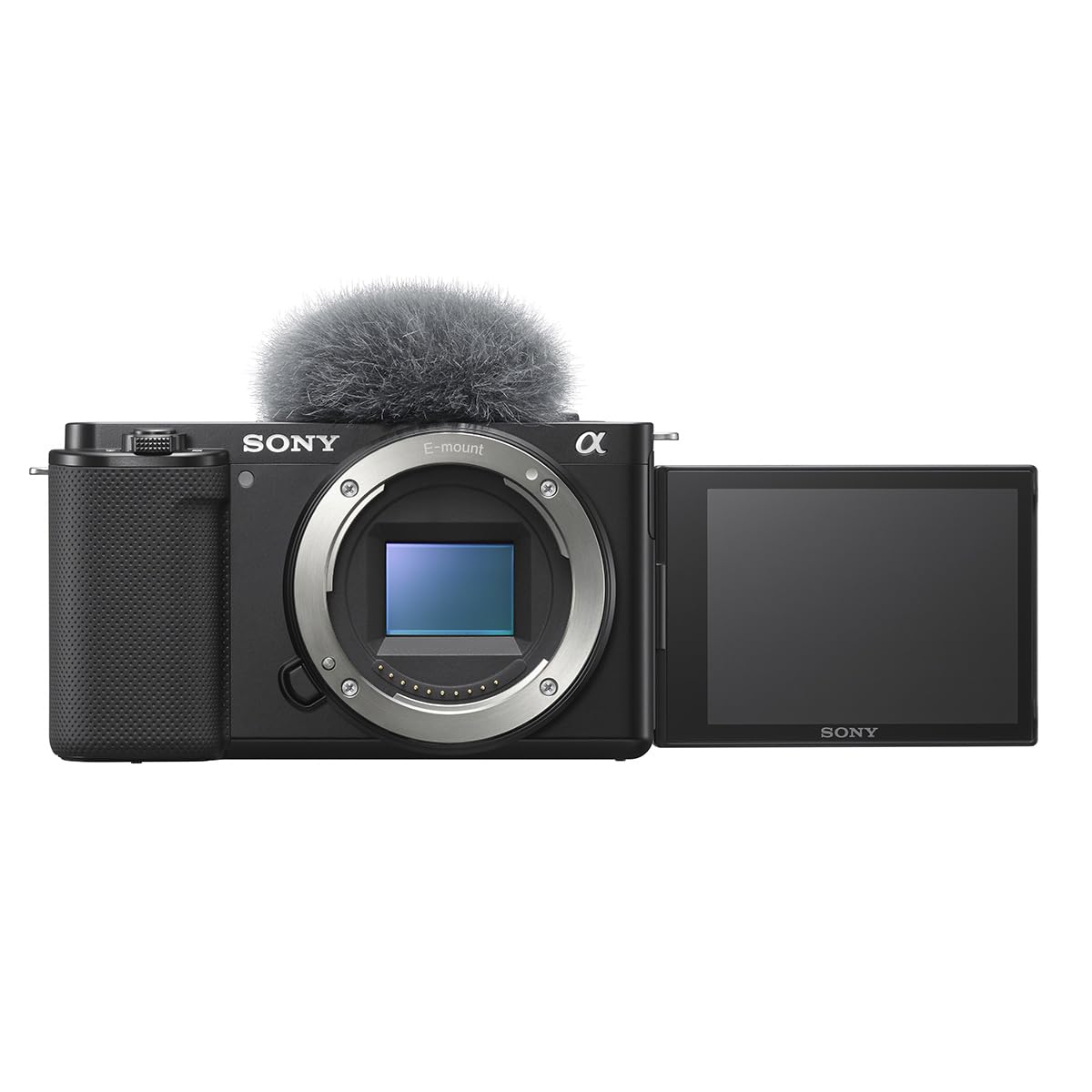
The Sony ZV-E10 is purpose-built for content creators. Its 24.2MP APS-C Exmor CMOS sensor oversamples 4K from 6K with full pixel readout, delivering sharp, detailed footage. The BIONZ X processor drives 425 phase-detection AF points with real-time Eye AF for both humans and animals, and the Product Showcase Setting smoothly transitions focus from face to an object held up to the lens.
The Background Defocus button instantly toggles shallow depth of field, while the directional 3-capsule microphone captures clear audio with adjustable sensitivity. It streams directly over USB-C without extra hardware, supports S-Log2/S-Log3 and HLG for grading, and includes Clear Image Zoom up to 1.5x without quality loss. The flip-out touchscreen makes self-framing effortless, and the lightweight body keeps gimbal fatigue low.
The 4K 30p footage carries a crop that limits wide-angle options, and the tiny LCD is hard to monitor critically—many users add an external monitor. Severe rolling shutter is present during fast pans, and the lack of IBIS means you need a gimbal or stabilized lens for smooth handheld walking shots. Battery life is about 25 minutes of 4K recording, so carry spares.
Why it’s great
- 6K oversampled 4K with full pixel readout
- Fast, reliable Eye AF and product showcase
- Compact, vlogger-friendly design with flip screen
- S-Log/HLG and USB streaming
Good to know
- No IBIS; needs gimbal or OSS lens
- Heavy rolling shutter in movement
- Small LCD hard to monitor
- Short battery life (~25 min 4K)
6. Nikon Z50 II with Two Lenses

The Nikon Z50 II brings versatile video specs to a compact APS-C body. It shoots 4K UHD at 60p and Full HD 120p for slow-motion, while built-in electronic VR helps stabilize handheld clips. The 20.9MP DX sensor, paired with the EXPEED 7 processor, captures video with lifelike colors and 31 built-in Picture Control presets for creative looks straight out of camera.
The two-lens kit (16-50mm f/3.5-6.3 VR and 50-250mm f/4.5-6.3 VR) covers 24-375mm equivalent, making it the most versatile travel zoom package in this guide. Autofocus automatically detects and tracks nine subject types (people, dogs, cats, birds, vehicles), with dedicated bird and airplane modes for enhanced accuracy. The built-in flash handles indoor fill, and the SnapBridge app transfers clips quickly to your phone.
The 20.9MP sensor is conservative compared to 24MP rivals, and the 16-50mm kit lens has a slow variable aperture. For professional video work, the 8-bit max internal recording limits color grading flexibility compared to 10-bit competitors. Still, for a lightweight travel kit that shoots great video and stills out of box, the Z50 II delivers.
Why it’s great
- Two-lens zoom kit: 24-375mm equivalent
- 31 creative Picture Control presets
- 9-subject autofocus detection
- Compact, travel-friendly design
Good to know
- 8-bit internal video limits grading
- 20.9MP sensor is below 24MP rivals
- Slow kit lens aperture in low light
7. Panasonic LUMIX G85 with 12-60mm Lens

The Panasonic LUMIX G85 remains a top contender for filmmakers who need gimbal-smooth footage without a gimbal. Its 5-axis in-body stabilization works in tandem with the 12-60mm Power O.I.S. lens to produce remarkably steady handheld 4K footage. The 16MP Micro Four Thirds sensor (no low-pass filter) records 4K QFHD at 30fps and Full HD 1080p at 60fps.
The camera includes Panasonic’s 4K Photo and Post Focus modes, allowing you to pull 8MP stills from video and adjust focus points after shooting. The OLED live viewfinder (2,360K dots) and 3-inch tilt touch LCD offer flexibility for odd angles. The magnesium-alloy front plate and weather sealing add durability, while the included hot shoe and mic jack support external audio.
Autofocus performance in 4K video is notably slower than Panasonic’s DFD system in stills, hunting in low light. Battery life is modest, and there is no headphone jack for audio monitoring. The 16MP sensor is lower-resolution than APS-C rivals, and the 4K 30fps cap limits high-frame-rate work. For budget-friendly shoestring filmmaking, the G85’s stabilization alone justifies its inclusion.
Why it’s great
- Best-in-class 5-axis IBIS + OIS
- Weather-sealed magnesium alloy build
- 4K Photo and Post Focus modes
- Excellent value with kit lens
Good to know
- Slow 4K video autofocus in low light
- No headphone jack
- 16MP sensor is lower-res than APS-C
- 4K limited to 30fps
8. DJI Osmo Action 5 Pro Adventure Combo

The DJI Osmo Action 5 Pro bridges the gap between action cam durability and professional video quality. Its 1/1.3-inch sensor with 2.4µm pixels and 13.5-stop dynamic range delivers stunning low-light performance for an action camera, shooting 4K at 120fps and 155° FOV. The 4nm chip powers enhanced subject tracking that keeps fast-moving subjects centered in either 16:9 or 9:16 orientation.
360° HorizonSteady stabilization keeps the horizon level through any roll-axis shake, making first-person POV footage look gimbal-mounted. The Adventure Combo includes three 1950mAh Extreme Batteries offering a combined 12 hours of recording, plus a multifunctional battery case. IP68 waterproofing to 20 meters without a housing, dual OLED touchscreens, and voice control make this a complete action-vlogging solution.
The color temperature sensor delivers accurate white balance underwater and on land without filters, and direct wireless connection to DJI Mic 2 eliminates the need for an external receiver. When used as a dash cam, the one-button record feature works reliably even in rain. For action videographers who demand high frame rates, drift-level stabilization, and all-weather reliability, the Action 5 Pro is the new benchmark.
Why it’s great
- 4K120fps with 13.5-stop dynamic range
- 360° HorizonSteady stabilization
- 12-hour total battery life (3 batteries)
- IP68 waterproof to 20m without housing
Good to know
- Action cam field of view may be too wide for some
- Extension rod lacks selfie button
- Requires high-speed card for max resolution
9. Canon EOS RP

The Canon EOS RP offers the most affordable entry point into full-frame RF-mount video. Its 26.2MP full-frame CMOS sensor and DIGIC 8 processor produce beautiful stills and 4K video, though the 4K mode is cropped 1.6x and limited to 24/25fps. Dual Pixel CMOS AF provides fast, accurate focusing for both video and stills, and the vari-angle touch LCD makes vlogging framing straightforward.
The lightweight body (just 485g) is the smallest and lightest full-frame EOS camera, making it ideal for travel vloggers who want full-frame bokeh without the weight. It uses the RF mount natively and adapts EF/EF-S lenses via an optional adapter. The camera also functions as a high-quality webcam via the EOS Utility Webcam Beta software or clean HDMI output.
4K video lacks Dual Pixel AF in that mode, relying on slower contrast-detect autofocus, and the 4K crop essentially turns your wide lenses into normal lenses. The 4K codec is 8-bit only, limiting grading headroom. Battery life is modest with the LP-E17 pack. For a starter full-frame camera that shoots decent video and excellent stills, the RP is compelling, but dedicated videographers will quickly outgrow its video limitations.
Why it’s great
- Lightest full-frame RF-mount body
- Vari-angle LCD for vlogging
- Excellent still image quality
- Clear HDMI output for streaming
Good to know
- 4K is cropped 1.6x at 24/25fps
- No Dual Pixel AF in 4K mode
- 8-bit 4K codec only
- Small LP-E17 battery
10. Nikon Z 30

The Nikon Z 30 is designed specifically for creators who need a dedicated streaming and vlogging camera. It shoots crisp 4K 30p video with eye-tracking autofocus for both people and pets, and the flip-out touchscreen with a red REC light makes self-recording clear and confident. The built-in stereo microphone has adjustable sensitivity, while the lack of a 30-minute recording limit makes it ideal for long-form content.
USB-C webcam operation delivers smooth Full HD 60p without extra hardware, or 4K 30p over HDMI. The Nikon Z mount is compatible with the entire NIKKOR Z lens lineup, from fast primes to macro lenses, allowing you to expand your creative capabilities over time. The body is compact and lightweight, fitting easily into a small bag for on-the-go streaming setups.
There is no electronic viewfinder, relying entirely on the rear LCD for composition, which can be problematic in bright sunlight. The camera lacks IBIS, so handheld video requires steady hands or a gimbal, especially at telephoto focal lengths. Noise performance in low-light conditions is decent but not class-leading. For streamers and vloggers who want a simple, effective Z-mount video solution, the Z 30 delivers solid value.
Why it’s great
- No 30-minute recording limit
- Easy USB-C streaming at Full HD 60p
- Flip screen with red REC light
- Small, portable body
Good to know
- No electronic viewfinder
- No IBIS; needs gimbal or steady hands
- Average low-light performance
11. Panasonic LUMIX FZ80D

The Panasonic LUMIX FZ80D is a bridge camera that packs a colossal 60x optical zoom (20-1200mm equivalent) into a single body, making it the go-to choice for wildlife and sports videographers on a budget. It records 4K QFHD video and 4K Photo, allowing you to extract 8MP stills from your footage—a lifesaver for capturing distant action. The POWER O.I.S. stabilization system suppresses hand-shake vibration effectively at the telephoto end, keeping distant subjects sharp.
The 2,360K-dot live viewfinder (0.74x magnification) works well in bright sunlight, and the camera offers Post Focus technology, which lets you touch the screen to change the focus point after the shot. The compact, lightweight design makes it ideal for long hikes, and the included battery handles a day of careful shooting. The 20-1200mm range covers everything from sweeping landscapes to far-off wildlife without changing lenses.
Low-light performance is limited due to the small 1/2.3-inch sensor and the f/2.8-5.9 aperture range—the 1200mm end struggles in dim conditions, and images can appear grainy even at base ISO. There is no Wi-Fi or Bluetooth, so sharing clips requires a card reader. The interface can be non-intuitive for new users. For vloggers who need extreme reach without carrying multiple lenses, the FZ80D is a capable and affordable option, though image quality takes a back seat to zoom range.
Why it’s great
- 60x optical zoom (20-1200mm)
- POWER O.I.S. for steady telephoto video
- 4K Photo extraction from video
- Lightweight and compact for reaching far
Good to know
- Small sensor limits low-light quality
- No Wi-Fi/Bluetooth connectivity
- Grainy images at high ISO
- Sluggish autofocus at telephoto end
FAQ
What does 6K oversampled 4K mean for video quality?
What is dual native ISO and why does it matter for low-light video?
Final Thoughts: The Verdict
For most users, the best camera for video winner is the Sony a7 III because its full-frame dynamic range, reliable autofocus, and robust battery life make it a versatile workhorse for nearly any video project without breaking the bank. If you want a lightweight full-frame body with oversampled 4K and fantastic subject tracking, grab the Canon EOS R8. And for pure cinematic quality in a dedicated cinema body with 12-bit RAW recording, nothing beats the Blackmagic Pocket Cinema Camera 6K G2.