
Our readers keep the lights on and my morning glass full of iced black tea. As an Amazon Associate, I earn from qualifying purchases.
Specs are compiled from manufacturer listings and verified buyer reviews and can change over time — please confirm the key details on the product page before buying.
You are choosing between two very different tools: a pocket-sized vlogging camera with built-in stabilization, or a cinema-grade body that records flat, log footage you color-grade yourself. Your choice hinges on your shooting style: autofocus for solo vlogging, manual lenses for cinema work, and your tolerance for post-production. Each pick below targets a specific shooter, from pocket vloggers to studio filmmakers.
I’m Min — the founder and writer behind Gadgets Feed. This guide is built by comparing the manufacturers’ published specifications and the patterns across verified customer reviews, so you get each pick’s real strengths and trade-offs instead of marketing spin.
Match the camera to your workflow, not just the spec sheet. A camera for videography is a decision about sensors, dynamic range, and stabilization that shapes every frame you shoot.
Our Picks at a Glance

How To Choose The Best Camera For Videography
Before you fall for a high megapixel count or a famous brand name, start with how you actually plan to shoot. A solo vlogger who needs reliable autofocus and built-in stabilization has completely different needs than a filmmaker who will lock the camera on sticks and pull focus manually all day. Define the job first, and the right specs follow.
Match The Sensor To Your Light
Sensor size dictates light gathering: larger sensors excel in low light, smaller ones struggle. A pocket camera with a 1-inch sensor (like the DJI Osmo Pocket 3) captures clean footage but struggles in dim settings, while full-frame bodies (like the Sony a7 III) and Super 35 cinema cameras excel in low light. If you mostly shoot outdoors during the day, the smaller sensors are fine. If you chase golden hour or indoor events, a larger sensor earns its higher cost.
Decide On Autofocus vs. Manual Focus
Modern autofocus, especially the eye-tracking systems from Sony, Canon, and Nikon, lets a solo creator film themselves without a focus puller. Cinema-focused bodies from Blackmagic Design often lack continuous autofocus entirely, trusting you to control focus with your own hands or a follow-focus rig. Choose autofocus for moving subjects, manual focus for static ones.
Understand Stabilization And Its Limits
Some cameras build stabilization into the body itself, which is called in-body image stabilization or IBIS. Others rely on a gimbal or a lens with built-in stabilization. For walking and run-and-gun shots, IBIS in the body or a three-axis mechanical gimbal makes handheld footage look smooth. For static tripod interviews, you do not need it, and you can put that budget into a better lens or a higher resolution sensor instead.
Quick Comparison
| Model | Best For | Sensor | Max Video | Stabilization | Amazon |
|---|---|---|---|---|---|
| Sony FX30★ Best Overall | Cinema-grade APS-C | 20.1 MP APS-C | 6K Oversampled 4K | In-body | Amazon |
| DJI Osmo Pocket 3Pocket Vlogger | Travel & Vlogging | 9.4 MP 1″ CMOS | 4K/120fps | 3-Axis Gimbal | Amazon |
| Panasonic G97Compact Hybrid | Compact Hybrid | Micro Four Thirds | 4K 30p | 5-Axis Dual I.S.2 | Amazon |
| Insta360 Ace Pro 2 | Action & Street | 1/1.3″ 8K | 8K30fps | Software + Grip | Amazon |
| Canon EOS R50 | Beginners | APS-C RF | Oversampled 4K | Lens-based IS | Amazon |
| Blackmagic Pocket 4K | Indie Filmmaking | 4/3″ MFT | 4K RAW/ProRes | None | Amazon |
| Nikon Z 6II | Hybrid Full-Frame | 24.5MP BSI Full-Frame | 4K UHD | In-body | Amazon |
| Canon EOS R8 | Lightweight Full-Frame | 24.2MP Full-Frame | 4K 60p Oversampled | Lens-based IS | Amazon |
| Nikon Z5 II | Low-Light Hybrid | 24.5MP Full-Frame | 4K/60p N-RAW | 5-Axis In-body | Amazon |
| Sony a7 III | Versatile Full-Frame | 24.2MP Full-Frame | 4K UHD | In-body | Amazon |
| Blackmagic Pocket 6K G2 | Professional Cinema | 21.2MP Super 35 | 6K RAW/ProRes | None | Amazon |
In‑Depth Reviews
1. Sony Cinema Line FX30 Super 35 Camera
Our pick — over 4.5★ from 500+ verified ratings; the strongest balance of quality and price.
A cinema-grade APS-C body that delivers professional color science and reliable autofocus without the full-frame price tag.
The FX30 is built for creators who want a real cinema camera, not a stills camera with video modes. Its 20.1 MP Exmor R APS-C sensor is the same Super 35 format used across the industry, and with 495 autofocus points and dual base ISO, it shoots clean, low-noise footage in a wide range of light. The S-Cinetone picture profile gives you a filmic look straight out of the camera, which means you can skip heavy color grading if you are on a deadline.
Owners praise the image quality as genuinely cinema-grade, with fast, accurate autofocus and a sturdy build that feels reliable on a shoot. It records oversampled 6K down to 4K, so you get sharp, detailed frames, and the compact body is more portable than larger cinema rigs. An internal fan prevents overheating, so you can record long sessions without shutdowns.
The honest trade-off is battery life. In real use, a single NP-FZ100 battery lasts only around 1 to 2 hours, so heavy production days will need an external power pack or several spares. The FX30 also works beautifully with external monitors and recorders like the Ninja V over full HDMI, making it a favorite for podcasters and sermon streamers who want a permanent, reliable camera on a tripod. Just be ready to budget for power.
Why It Wins Shoots
- Top-tier autofocus with 495 phase-detection points keeps moving subjects sharp
- S-Cinetone profile delivers a cinematic look with zero grading
- Dual card slots (CFexpress and SD) offer backup security for paid work
The Power Catch
- Battery life of roughly 1-2 hours demands spares or external power
- The APS-C crop means you need a wide lens for tight indoor shots
- Professional menu system has a learning curve for beginners
Reach for this if: you are a content creator or filmmaker upgrading from a mirrorless hybrid who wants true cinema features without jumping to the FX3 or a full-frame rig.
Look elsewhere if: you need all-day battery endurance straight from the start, since the FX30 demands power management.
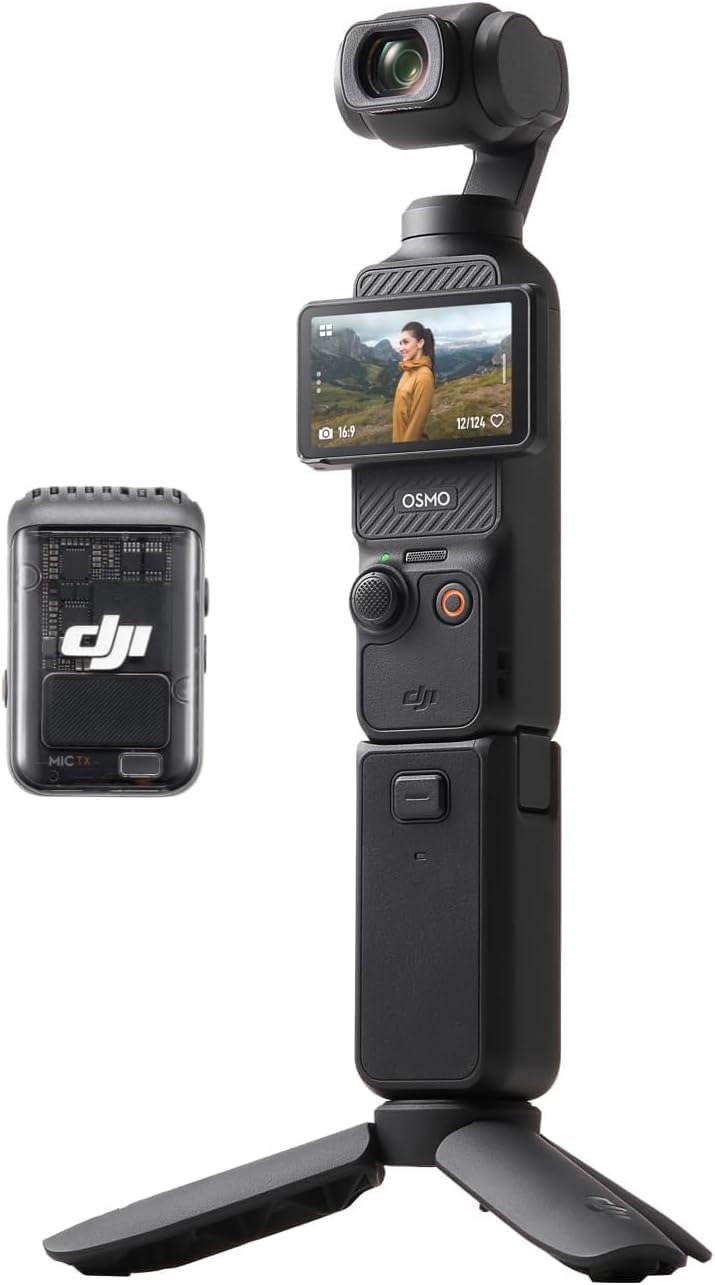
2. DJI Osmo Pocket 3 Creator Combo
A pocket-sized gimbal camera that makes smooth, professional-looking vlogs easy, with a 2-inch rotating touchscreen.
The Osmo Pocket 3 puts a 1-inch CMOS sensor and 3-axis mechanical stabilization into a body that slips into your pocket, which is why it has become the go-to for travel vloggers and TikTok creators. It records 4K at an impressive 120fps, so you can slow down action for dramatic, cinematic b-roll, and the D-Log M profile with 10-bit color captures up to a billion colors for flexible grading in post. You get the rotating 2-inch screen that flips to vertical, making it painless to shoot for both YouTube and Instagram.
The thing everyone raves about is the quality — it is genuinely hard to believe footage this sharp and stable came from a device this small. The ActiveTrack 6.0 feature locks onto you and keeps you center-frame, even while you jump, dance, or spin on a tripod, which is a standout for solo creators. The Creator Combo includes the DJI Mic 2 transmitter, a wide-angle lens, a battery handle, and a mini tripod, so it arrives as a complete daily kit.
Owners say it plainly: “Obsessed.” Its build and low-light performance are top-tier for a pocket camera. It won’t replace a full-frame, but it delivers pro-quality video in a pocketable form. The trade-off: it is a niche tool — skip it for interviews on sticks or long documentaries, but for daily content it is unbeatable.
Why It Goes Viral
- Built-in 3-axis gimbal delivers silky handheld footage with zero rig gear
- Rotating touchscreen swaps between landscape and vertical instantly
- Pairs wirelessly with two DJI Mic transmitters for clean, clear audio
Know Before You Buy
- The small 1-inch sensor cannot match full-frame low-light performance
- Fixed-lens design means you cannot swap lenses for different looks
- Battery life runs about 166 minutes, so long days need the battery handle
Grab this for: travel vlogging, daily content creation, and solo creators who want professional stabilization without learning a complex system.
Pass on it if: your work is studio-based or requires interchangeable lenses, since this is a complete, sealed unit.
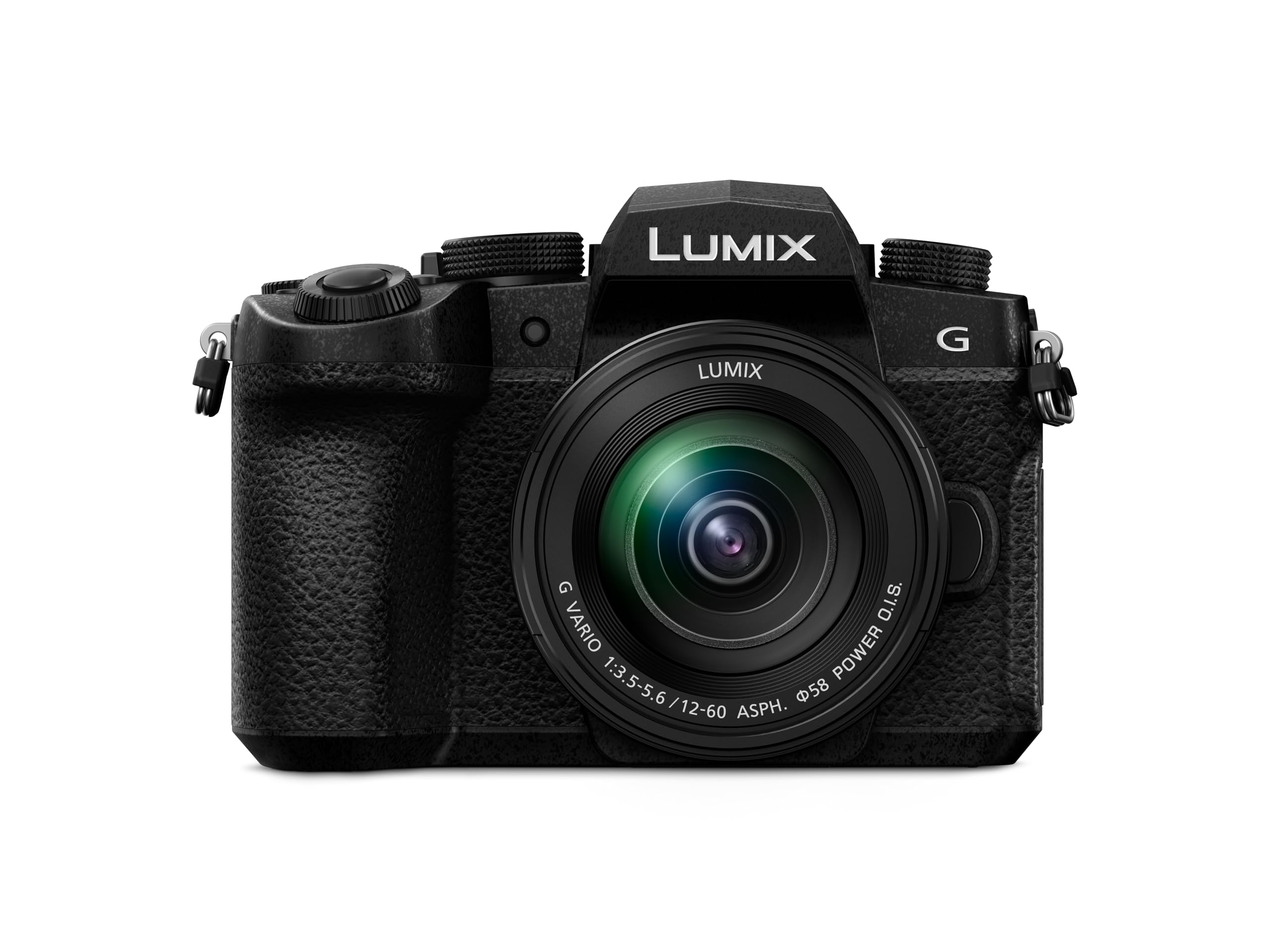
3. Panasonic LUMIX G97 Compact Hybrid
A small, lightweight Micro Four Thirds hybrid that pairs a sharp kit lens with serious 5-axis stabilization.
The G97 is the travel-friendly option for creators who want a real interchangeable-lens camera that does not weigh them down. Its Micro Four Thirds body and 12-60mm f/3.5-5.6 kit lens keep the kit compact, while the built-in 5-stop, 5-axis Dual I.S.2 system steadies your handheld footage in a way that used to require a gimbal. It shoots 4K 30p with no time limitation, which means no overheating shutdowns on long recording sessions, and it offers 12 stops of V-Log L for flat, flexible color grading.
The build quality earns strong praise, with a magnesium body and a 2,360k-dot OLED viewfinder that makes framing easy even in bright sunlight. The dedicated ISO, white balance, and exposure compensation dials give you quick, tactile control, and the 1,840k-dot free-angle LCD flips out for vlogging. For hybrid shooters who also want great stills, the kit lens delivers rich colors and sharpness wide open, and the autofocus system works well in most situations.
The catch is battery endurance — buyers report the battery drains in under 10 minutes of continuous 4K recording, so you will want spare batteries or an AC adapter for longer shoots. The small body also gets mixed reactions on grip comfort for larger hands, and the contrast-detect autofocus can struggle in low light or fast action. It is an excellent value for the price, but it is a camera for deliberate, considered shooting rather than frantic run-and-gun.
Best for travel: the Micro Four Thirds system keeps the whole kit small, with the 24-120mm equivalent reach from the kit lens.
Worth noting: the in-body stabilization is effective in low light, yet continuous 4K drains the battery fast, demanding spares.
Choose this if: you are a hybrid shooter who wants a small, well-built camera with a versatile kit zoom and excellent stabilization for travel.
Think twice if: your sessions run long, since the battery drains quickly during 4K recording.
4. Insta360 Ace Pro 2 Ultimate Videography Bundle
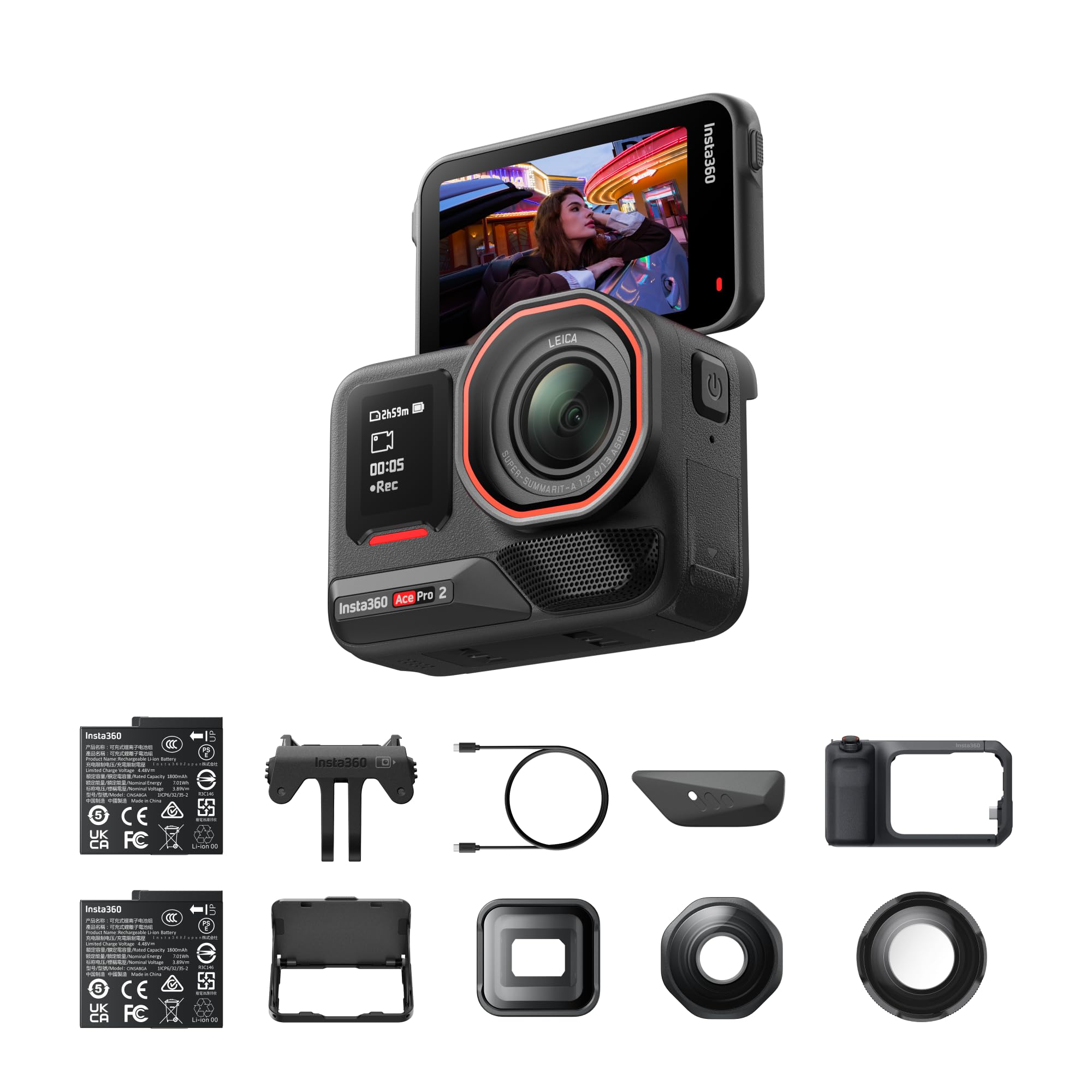
An 8K action camera co-engineered with Leica that shoots stunning footage and comes loaded with lenses for every scene.
Its 1/1.3-inch 8K sensor and Leica SUMMARIT lens deliver breathtaking 8K30fps video, or 4K60fps with Active HDR when you want more dynamic range in one pass. The low-light performance is second to none in this category, thanks to a Pro Imaging Chip and 5nm AI Chip that process advanced noise reduction, so your evening street shots stay clean and detailed.
This Ultimate Videography Bundle stands out for what is in the box: the Xplorer Grip Pro Kit adds a built-in 2010mAh battery and a zoom dial for smooth, lossless 4K slide zoom between 1-2x, so you get a cinematic push-in without losing quality. You also get a Cinematic Lens, a Close-Up Lens for macro work, and an Ultra Wide Lens, plus a Flip Screen Hood and two batteries. With Leica color profiles applied in one tap, you get retro, vibrant, or black-and-white high-contrast looks without any editing.
What wins people over is the versatility — owners call it a rugged tank that beats its rivals on image quality, with vivid colors and sharp 4K30 footage straight from the start. The dual-use flexibility means it works as an action cam for bike rides or surfing and a creative street photography tool, especially with the grip kit attached. A fair caveat: the Xplorer Grip Pro requires removing the USB cover, which impacts the waterproof seal, and the added lenses make it a specialized kit rather than a grab-and-go camera.
The all-rounder: quality is the most praised aspect by a wide margin, with owners impressed by the clear 8K video and ease of use.
Balance the deal: durability feedback is genuinely mixed, so treat the USB port cover with care when swapping the grip.
Pick this for: adventure filmmakers and street photographers who want one camera that covers action, vlogging, and creative stills.
skip it if: you need interchangeable lenses for studio work, since this is an integrated action camera system.
5. Canon EOS R50 Mirrorless Camera Bundle
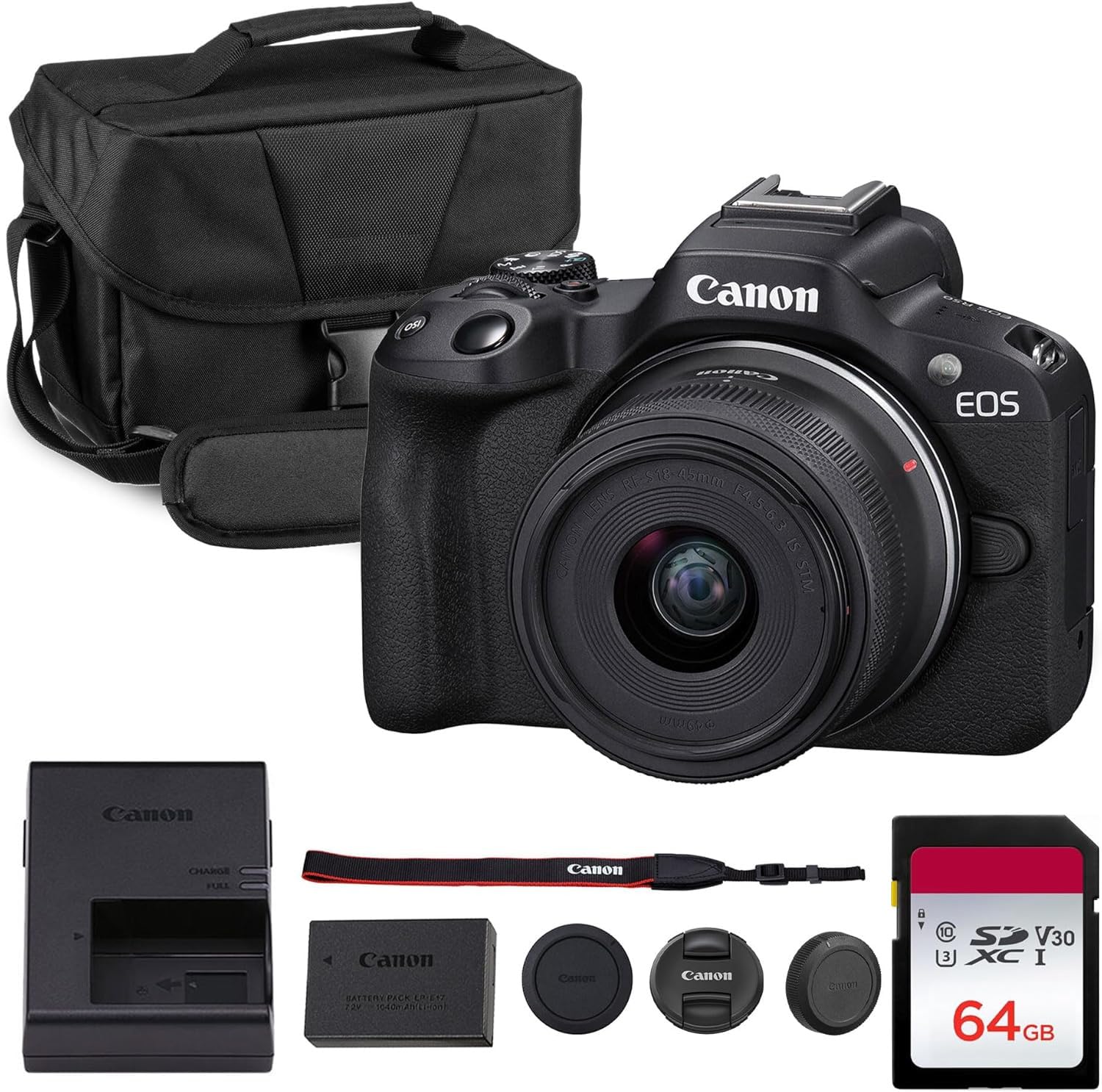
A lightweight, beginner-friendly APS-C mirrorless camera that delivers sharp oversampled 4K with near-easy autofocus.
The R50 is Canon’s answer for new creators who want great video without wading through complex menus. It uses an APS-C RF mount sensor and shoots oversampled 4K video, which means it processes more data than needed for 4K and downsamples it for extra sharp, detailed footage. The Dual Pixel AF II system delivers reliable subject tracking with face and eye detection, so you can trust the camera to keep you in focus while you move around.
It is genuinely pleasant to carry — the lightweight body suits small to medium hands, and the bundle adds a 64GB UHS-I SDXC memory card and a shoulder bag, so it is ready from the start. The 18-45mm lens covers wide to standard focal lengths, ideal for daily content, portraits, and street shooting, with image stabilization built into the lens for steady handheld clips. Creative Assist and vertical video mode make it easy to create and share content on social platforms.
Owners consistently praise the camera quality and ease of use, describing it as a great starter that produces professional-looking photos and video without complex setup. The main limitations are physical rather than optical: there is no in-camera stabilization, so you will rely on the lens IS or a gimbal for smooth walking shots, and the buffer fills quickly during continuous shooting. If you are a beginner wanting a simple, high-quality entry into video, this is a very enjoyable place to start.
Friendly by design: the easy-to-use settings and lightweight feel are what owners love most, making the learning curve remarkably short.
Plan for stability: with no in-body stabilization, smooth handheld motion work will need a gimbal or a stabilized lens.
Best for beginners: anyone stepping up from a phone who wants a quality interchangeable-lens camera without learning complex professional tools.
Not for you if: you shoot a lot of walking or run-and-gun footage, since you will need extra stabilization gear.
6. Blackmagic Design Pocket Cinema Camera 4K

A true cinema camera with 13 stops of dynamic range and RAW recording, built for filmmakers who want to grade every frame.
The Pocket Cinema Camera 4K is not a vlogging camera, and it does not pretend to be. It is a purpose-built cinema tool with a 4/3-inch sensor and native 4096 x 2160 resolution, plus 13 stops of dynamic range and dual gain ISO up to 25,600 for clean, low-noise footage in all lighting. It records to SD/UHS-II, CFast 2.0, or directly to external SSD via USB-C, and it includes an activation key for DaVinci Resolve Studio, giving you a full professional editing and color-grading suite in the box.
What wins people over is the image quality, which owners describe as stunning and professional-grade, with a beautiful sensor “texture” that pairs well with vintage lenses. The lightweight carbon fiber polycarbonate body includes a large 5-inch LCD display, so you do not need an external monitor, and the multifunction handgrip puts essential controls at your fingertips. For documentary, narrative, and interview work where the camera sits on sticks or a rig, this is an incredibly capable and affordable option.
The trade-offs are specific: no continuous autofocus, no in-body stabilization, and no flip screen, so this is a manual-focus, tripod-first camera. Battery life runs about 30 minutes per charge, and the screen is hard to read in direct sunlight. As owners put it: “Only have trouble with auto focus and stabilization when its not on a stand.” If you are okay with manual control and planned setups, this delivers cinema quality that paid for itself in a day for many production teams.
For the purist: the 13 stops of dynamic range and RAW recording give you maximum control in post, exactly what narrative filmmakers need.
Know the limits: no autofocus or stabilization means you must rig it properly for handheld work, making it less grab-and-go than a hybrid.
Made for: filmmakers, documentarians, and church or studio productions that shoot planned narrative or interview content on a tripod.
Wrong tool if: you want a single, versatile camera for vlogging, events, and run-and-gun shooting with autofocus.
7. Nikon Z 6II Full-Frame Mirrorless

A versatile full-frame hybrid that pairs excellent low-light 24.5MP stills with solid 4K UHD video and dual card slot security.
The Z 6II is the camera for shooters who need one body that handles both serious photography and video with equal grace. Its 24.5MP BSI full-frame sensor excels in low light, delivering clean, true-to-life colors and sharp images straight out of the camera. For video, it records 4K UHD with a 1.0x optical zoom multiplier, and the in-body stabilization is so effective that owners shoot smooth handheld footage without needing a gimbal.
Owners praise the accurate, true-to-life colors and the excellent in-body stabilization that eliminates the need for extra rig gear. The dual card slots accept CFexpress/XQD plus UHS-II SD, so you have flexibility and confidence when shooting weddings or events where you cannot afford to lose footage. The deep handgrip feels comfortable and durable even on long assignment days.
The Z 6II also offers USB-C constant power and charging, so you can keep it running during livestreams, video shoots, and timelapses without worrying about the battery draining. It is compatible with a growing line of NIKKOR Z lenses, as well as around 360 F-mount NIKKOR lenses with the FTZ adapter, so you can bring your existing glass along. The one notable limitation is the screen, which does not flip forward for self-filming, but for most hybrid work, this is a trusted, capable workhorse.
Owner favorite: the IBIS is a standout, letting creators capture smooth handheld video that needs no gimbal, even for business branding shoots.
One limitation: the fixed screen direction means self-filming is awkward, though a connected smartphone app workaround exists.
Get this if: you are a hybrid shooter or event photographer who wants excellent low-light performance, dual card backup, and in-body stabilization.
Reconsider if: vlogging and self-shooting are your primary use, since the screen does not rotate toward you.
8. Canon EOS R8 Full-Frame Mirrorless

Canon’s lightest full-frame RF mount camera, packing R6 II internals and superb low-light 4K into a compact travel-friendly body.
The R8 is the affordable doorway into full-frame video, delivering the same sensor, autofocus, and video capabilities as the more expensive R6 II in a lighter, smaller body. It records uncropped 4K at up to 60fps, oversampled from 6K for exceptional sharpness, and offers Full HD high-frame-rate recording at up to 180fps for slow-motion work. The 24.2MP CMOS sensor and DIGIC X processor deliver outstanding image quality, with low noise at high ISOs and improved rolling shutter compared to older Canon cameras.
What wins people over is the build quality and image quality, with owners praising the crisp footage and the camera’s ability to capture stunning images in dimly lit environments. The Dual Pixel CMOS AF II covers up to 100% of the frame with 1,053 AF zones and uses deep learning to track people, animals, and vehicles, including aircraft, trains, and horses. The 3-inch vari-angle LCD touchscreen flips out for vlogging, and the 0.39-inch OLED viewfinder offers a 120fps refresh rate for smooth, natural viewing.
Owners describe it as the R6 II without the price, with excellent low-light performance and a fast, accurate autofocus that locks onto eyes and faces. It is an ideal backup or budget alternative to the R6 II, and its lightweight design makes it perfect for travel and street shooting with a 50mm lens. The compromises are the single SD card slot, a smaller battery, and no in-body stabilization, so you will rely on lens-based IS or a gimbal for smooth handheld video.
Low-light magic: the full-frame sensor and DIGIC X processor deliver excellent high-ISO performance with minimal noise, perfect for evening shoots.
Compact trade-offs: the single SD slot and smaller battery mean event shooters will want spare batteries and a faster card.
Perfect for: content creators and photographers stepping up to full-frame who want outstanding image quality in a camera light enough to carry all day.
Not ideal if: you shoot long events without access to power, since the smaller battery and single card slot demand more management.
9. Nikon Z5 II Full-Frame Mirrorless
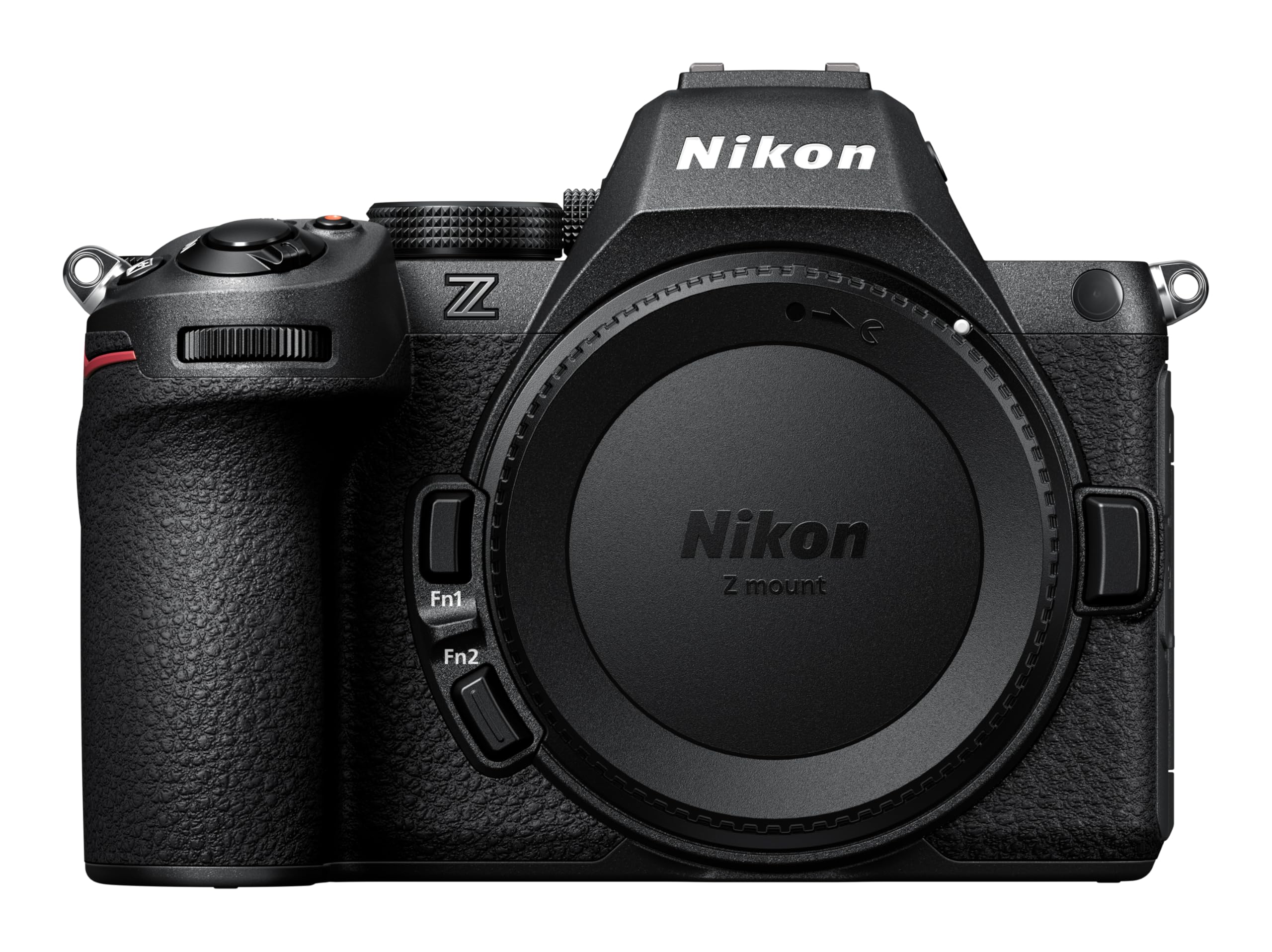
A full-frame mirrorless that autofocuses in near-total darkness, with 4K/60p capture and 12-bit N-RAW recording in-camera.
The Z5 II is Nikon’s most compelling hybrid value in years, pairing a 24.5MP BSI-CMOS full-frame sensor with the faster EXPEED 7 processing engine. It shoots up to 30fps stills and records 4K/60p video, with in-camera 12-bit N-RAW for serious color grading. The autofocus is the headline feature: it detects subjects down to -10EV, which means it can lock focus in near-total darkness, and it automatically recognizes nine subject types including people, birds, dogs, cats, cars, and airplanes.
Owners call it a fantastic camera for the money, praising the superb build and ergonomics, great out-of-camera JPEGs, and excellent dynamic range with low noise. The 5-axis in-body stabilization offers up to 7.5 stops of correction, so you can hand-hold shots confidently in challenging light. The bright EVF has a maximum brightness of 3000 nits, an upgraded shooting experience for anyone coming from a DSLR, and the camera supports Nikon Imaging Cloud for automatic image transfer and firmware updates.
This is a great step up from older Nikon bodies like the D7500 or Z5, with much faster autofocus, higher frame rates, and improved low-light performance. It is an enthusiast-level camera that handles beautifully with long telephoto lenses for birds and nature, and the dual UHS-II SD card slots offer reliable backup. The sensor readout is fast enough to minimize rolling shutter, while the camera-to-cloud service adds convenience for photographers who want automatic image transfer.
The Standout Features
- AF detection down to -10EV locks focus in near-total darkness
- 7.5 stops of in-body stabilization for confident handheld shooting
- 12-bit N-RAW recording gives pro colorists maximum flexibility
The Practical Trade-offs
- As a relatively new model, the owner base is smaller than established rivals
- Full-frame lenses remain a significant investment beyond the body
- Lacks the full pro build and weather-sealing of higher-end Nikon Z bodies
The smart investment: shooters who want flagship-tier autofocus and video features without paying flagship prices will find this exceptional value.
Check your lens budget: the body is affordable, but full-frame glass is where the real cost lies.
10. Sony Alpha a7 III Mirrorless Camera

A legendary 24.2MP full-frame hybrid with class-leading autofocus and outstanding 4K video that still sets the standard.
The a7 III is the camera that changed the mirrorless game, and it remains a remarkably capable videography tool. Its 24.2MP back-illuminated full-frame sensor delivers 15-stop dynamic range and 14-bit uncompressed RAW, with an ISO range up to 204,800 for exceptional low-light performance. It shoots up to 10fps with silent or mechanical shutter and full autofocus tracking, and the 693 phase-detection points and 425 contrast AF points cover 93% of the image area.
What wins people over is the image quality and the autofocus, with owners praising the fast, accurate subject tracking and the impressive eye AF that locks onto subjects with ease. The 4K video is stunning, and the excellent battery life means you can shoot all day on a single charge, a rare feature for a mirrorless camera. The 28-70mm f/3.5-5.6 kit lens is sharp and versatile for daily content, portraits, and street shooting.
Owners describe it as pro-level at an accessible price, with superior autofocus speed and accuracy compared to traditional DSLRs and outstanding low-light capability. It is a smooth transition for photographers coming from Fujifilm or Canon systems, with intuitive menus and buttons once you set it up. The main considerations are the 8-bit video internal recording, which lacks the 10-bit color depth of newer rivals, and the complex menu system that takes time to configure.
The proven performer: owners consistently praise the autofocus speed and accuracy, calling the eye AF genuinely impressive for both photos and video.
Consider the age: internal video is 8-bit, so serious colorists may want a 10-bit camera or an external recorder.
Trusted for: hybrid shooters who need one camera for great photos, solid video, fast autofocus, and long battery life.
Upgrade if: you need 10-bit color depth or higher resolution for professional color grading work.
11. Blackmagic Design Pocket Cinema Camera 6K G2

A Super 35 cinema camera with 6K resolution and a 13-stop dynamic range that is the gold standard for serious filmmakers.
The Pocket Cinema Camera 6K G2 is the bigger, higher-resolution sibling to the Pocket 4K, delivering a Super 35 sensor with native 6144 x 3456 resolution. It offers 13 stops of dynamic range and dual gain ISO up to 25,600, which means you can capture highlight and shadow detail that lesser cameras would blow out or crush. It records to SD/UHS-II, CFast 2.0, or external SSD via USB-C, and includes an activation key for DaVinci Resolve Studio for a complete post-production workflow.
What wins people over is the image quality, with owners describing it as optimal, excellent, and worth every penny for the quality it produces. The active EF/EF-S lens mount means you can use a huge range of affordable Canon and third-party glass, which is a major advantage for filmmakers building a kit on a budget. Paired with DaVinci Resolve, owners mention making incredible movies, with the RAW files handling smoothly on modern hardware.
The large, bright, adjustable tilt 5-inch LCD eliminates the need for an external monitor, and the carbon fiber polycarbonate composite body keeps the camera lightweight for a cinema rig. The trade-offs are that it is manual-focus only, battery life is about 60 minutes, and the steep post-production learning curve means it is not for beginners. Owners are clear that this is a serious tool for serious creators, describing it as a “work beast” that delivers.
The pro choice: the 6K Super 35 sensor and 13 stops of dynamic range give you professional-grade footage that grades beautifully.
Plan your setup: with no autofocus and 60-minute battery life, this is a manual-focus, rig-based camera for planned shoots.
Built for: indie filmmakers, commercial videographers, and any creator who wants true cinema resolution and dynamic range on a modest budget.
Avoid if: you want autofocus or a camera you can pick up and shoot without learning RAW workflows and color grading.
Understanding the Specs
Sensor Size and Resolution
The
sensor is the heart of any videography camera, and its physical size directly determines how much light it can capture. A larger sensor, whether a full-frame 24.5MP BSI CMOS or a Super 35 cinema sensor, produces cleaner footage in low light with better dynamic range. The resolution number, like 20.1MP or 24.2MP, tells you how much detail the sensor can resolve, but for video, the native video resolution and oversampling matter more than the still photo megapixel count.
Dynamic Range and Bit Depth
Dynamic range, measured in stops, tells you how much difference between the brightest highlights and darkest shadows your camera can capture in a single frame. A camera with 13 stops of dynamic range preserves detail in both a bright window and a dark interior, while an 8-bit camera can show banding in smooth gradients like skies. Log profiles like S-Log3, V-Log L, and Blackmagic RAW capture this wide range in a flat, desaturated file that you grade in post-production, and the bit depth (10-bit or 12-bit) determines how much color information survives that grading process.
FAQ
What is the difference between a full-frame and an APS-C sensor for video?
Why is dynamic range so important for videography?
Do I need a camera with in-body image stabilization?
Is 4K at 120fps better than 8K at 30fps for video?
What is oversampled 4K and why does it matter?
How long does the battery last on these videography cameras?
What is a log profile and should I use it?
Do I need an external microphone for better video sound?
What is the difference between N-RAW and Blackmagic RAW?
Should I buy a camera with one card slot or two?
Final Thoughts: The Verdict
For most serious videographers, the camera for videography winner is the Sony FX30 because it delivers true cinema-grade features like S-Cinetone, dual base ISO, and reliable autofocus in a compact APS-C body that has earned overwhelming owner praise for its image quality. If you want easy, stabilized vlogging that you can carry in your pocket, grab the DJI Osmo Pocket 3. And for maximum cinematic control with 13 stops of dynamic range and RAW recording, the Blackmagic Pocket 4K remains the filmmakers’ favorite for good reason.
How We Picked
We do not accept paid placement. Every pick is matched to a real buyer and a real use-case; we do not hands-on test units.
Sources & Methodology
Specifications: manufacturer listings and product documentation. Review insights: verified customer reviews, as of August 2026. Pricing: not shown on this page (it changes often); check the current price via the retailer link.
As an Amazon Associate, Gadgets Feed earns from qualifying purchases. This does not affect which products we feature.