
Our readers keep the lights on and my morning glass full of iced black tea. As an Amazon Associate, I earn from qualifying purchases.
Specs are compiled from manufacturer listings and verified buyer reviews and can change over time — please confirm the key details on the product page before buying.
Shooting indoors is like fighting with the lights off — your camera is gasping for photons, your subjects are on the move, and every corner drinks up what little light your kit lens leaves behind. The wrong lens turns family gatherings into a sea of blur, and the right one turns a dim living room into a portrait studio. This guide breaks down the eleven best options for keeping your indoor shots crisp, bright, and beautifully separated from the background.
I’m Min — the founder and writer behind Gadgets Feed. This guide is built by comparing the manufacturers’ published specifications and the patterns across verified customer reviews, so you get each pick’s real strengths and trade-offs instead of marketing spin.
Stop settling for muddy, dim photos and start capturing indoor moments in brilliant detail with the ultimate camera lens for indoor photography.
Our Picks at a Glance


How To Choose The Best Camera Lens For Indoor Photography
Indoor photography is a battle against low light and tight spaces. The core specs that win this battle are aperture, focal length, and autofocus speed — these three decide whether you walk away with sharp family portraits or a gallery of motion blur in a dim nursery.
Aperture — The Light-Grabber
A wide aperture (a small f-number like f/1.4 or f/1.8) lets in dramatically more light than a kit lens at f/3.5 or f/5.6. This means you can shoot at faster shutter speeds indoors without cranking up the ISO and introducing grain. It also thins out the depth of field, creating that blurry background (bokeh) that makes a subject pop out from the shelving behind them.
Focal Length — Your Shooting Distance
In a standard living room, a 35mm lens lets you capture a full scene including a couch and a Christmas tree, while an 85mm lens forces you to step back for just a head-and-shoulders portrait. For general indoor use, 35mm to 50mm is the balance; 85mm works if you have room to retreat. A 16mm or 20mm ultra-wide is for real estate, tight kitchens, or creative environmental shots where you want to exaggerate perspective.
Autofocus and Stabilization
Kids and pets move fast in unpredictable directions, so a lens with a rapid, accurate autofocus motor — like a stepping motor (STM) or a linear actuator — makes the difference between catching the smile and missing it entirely. Image stabilization (built into the lens or your camera body) helps reduce hand-shake blur at slower shutter speeds, which is critical when the ceiling lights are dim and you cannot raise the ISO any further.
Quick Comparison
| Model | Best For | Aperture | Focal Length | Weight | Amazon |
|---|---|---|---|---|---|
| Canon EF 50mm f/1.8 STM★ Best Overall | Best Overall Value | f/1.8 | 50mm | Light | Amazon |
| VILTROX 56mm f/1.7Compact Pick | Compact Sony APS-C Pick | f/1.7 | 56mm | 170g | Amazon |
| Sigma 30mm f/1.4 DC DNBest Value | Premium Sony APS-C Prime | f/1.4 | 30mm | 9.28 oz | Amazon |
| Sigma 16mm f/1.4 DC DN | Ultra-Wide for Sony APS-C | f/1.4 | 16mm | Bulky | Amazon |
| Nikon Z 50mm f/1.8 S | Best Nikon Z Standard | f/1.8 | 50mm | 415g | Amazon |
| Canon RF 85mm f/2 Macro IS STM | Versatile Portrait + Macro (Mirrorless) | f/2 | 85mm | 499g | Amazon |
| Nikon Z 85mm f/1.8 S | Best Nikon Z Portrait | f/1.8 | 85mm | 470g | Amazon |
| Sony FE 20mm f/1.8 G | Lightweight Ultra-Wide for Sony Full-Frame | f/1.8 | 20mm | 13.2 oz | Amazon |
| Tamron 70-180mm f/2.8 G2 | Telephoto Zoom for Sony Full-Frame | f/2.8 | 70-180mm | 855g | Amazon |
| Sony FE 35mm f/1.4 GM | Ultimate Sony Full-Frame Prime | f/1.4 | 35mm | 1.2 lbs | Amazon |
| Sigma 70-200mm f/2.8 DG DN OS | Pro Telephoto Zoom for Sony | f/2.8 | 70-200mm | 1345g | Amazon |
In‑Depth Reviews
1. Canon EF 50mm f/1.8 STM Lens, Black
Our pick — over 4.5★ from 18,000+ verified ratings; the strongest balance of quality and price.
The affordable “nifty fifty” that punches far above its weight in dim light.
For Canon DSLR shooters, this is the lens that redefines what buys. The 50mm focal length and a maximum aperture of f/1.8 let in enough light to shoot sharp portraits in a dim kitchen without cranking the ISO into the noise zone. It produces that sought-after subject-background separation — the background melts into a smooth blur while faces stay tack sharp. The stepping motor (STM) delivers near-silent autofocus for movie capture and smooth focus pulls for stills, though a small number of owners find the AF speed just okay rather than lightning-fast. At 50mm on a full-frame body (or a practical 80mm equivalent on APS-C cameras), it forces you to move and compose, which often leads to better, more intentional photos right away.
What wins owners over is the outright lens quality — well over a thousand praise it, followed by hundreds calling out the image quality and bokeh as exceptional for the money. A buyer captures it precisely: it is “sharp even at f/1.8, good colors/contrast.” The few trade-offs include softness in the extreme corners at f/1.8 and the lack of image stabilization, but on a modern DSLR with decent high-ISO performance that rarely matters for portraits. A 7-blade aperture creates pleasing, rounded bokeh that the older II model lacked. This is the lens that taught an entire generation of photographers how good a cheap prime can be.
It is significantly lighter than the older f/1.4 models and focuses much more quietly, making it a no-brainer upgrade. The 1.15-foot minimum focusing distance lets you fill the frame with smaller subjects like a newborn’s face or a plate of food, though the 0.21x max magnification does not make it a true macro. One consistent builder note: the focus-by-wire system means manual focus feels disconnected, but in everyday indoor use, the STM autofocus handles nearly everything without fuss.
Why It Dominates
- f/1.8 aperture plucks subjects out of dark backgrounds beautifully
- Silent STM autofocus works for both stills and video
- Lighter and sharper than Canon’s older f/1.4 version
A Few Realities
- Corners soften a touch at f/1.8
- No image stabilization built into the lens
- Manual focus is electronic, not direct mechanical
Reach for this if: you shoot Canon DSLR and want the sharpest, quietest, most affordable indoor portrait lens on the market.
Look elsewhere if: you need a zoom range for unpredictable indoor events where you cannot step closer or farther.
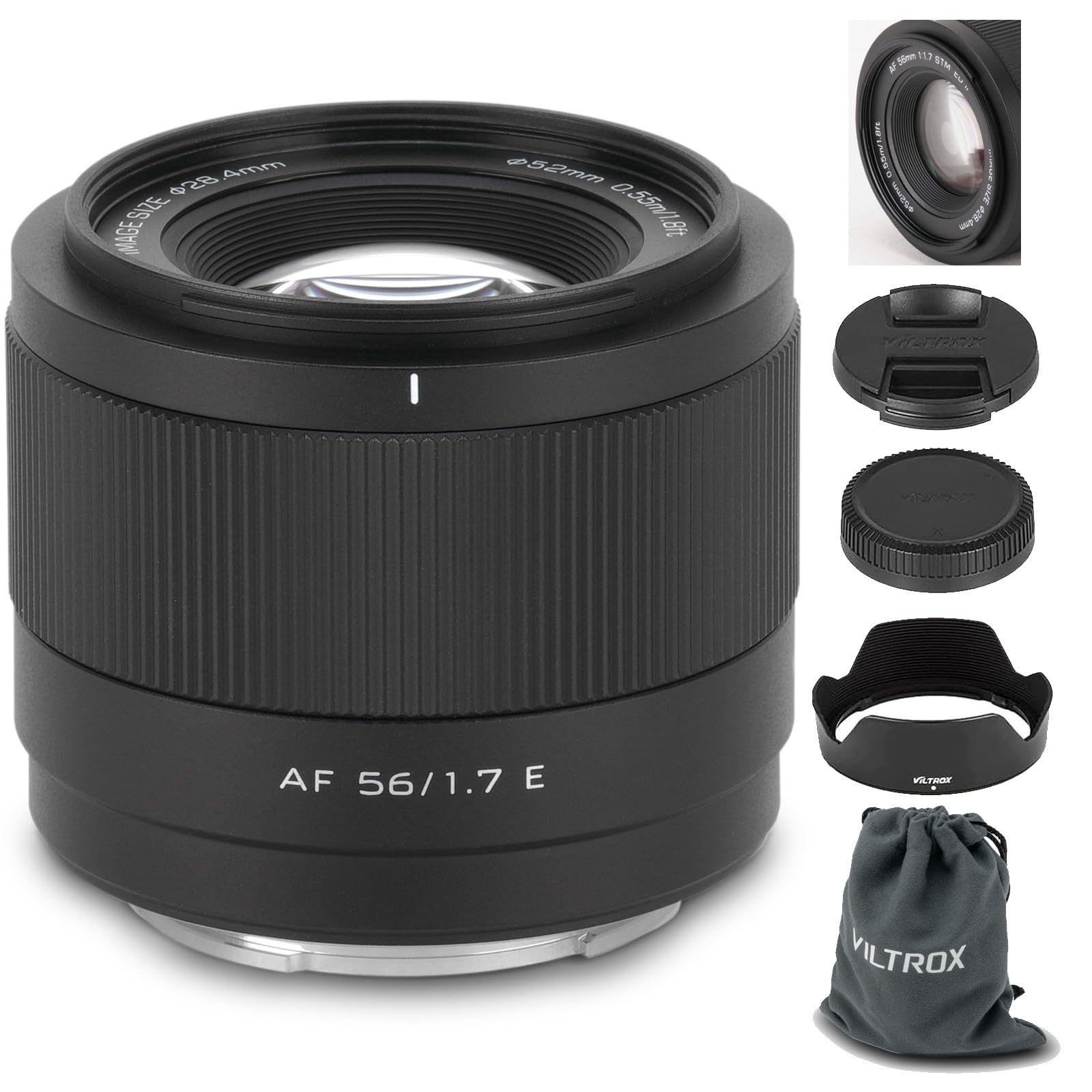
2. VILTROX 56mm F1.7 E-Mount APS-C STM Lightweight Auto Focus Lens for Sony E-Mount Cameras
A featherlight 170g Sony-Mount portrait lens that disappears on a walk around a dim house.
If your Sony a6000-series camera sits in a drawer because the kit lens is too slow in gloomy rooms, this 56mm f/1.7 changes the equation. The bright f/1.7 maximum aperture gives you control over depth of field — you can blur out a cluttered background behind a child learning to read — while grabbing two full stops more light than your typical zoom. Its STM silent motor delivers precise and fast autofocus, and it supports Eye AF and Face AF, so the lens can lock onto a moving toddler’s iris even in dim hallway light. Weighing only 170g (about six ounces), it is light enough to hang from a camera strap all day without noticing.
The 9-group, 11-element optical construction includes four ED (extra-low dispersion) lenses and three high-refraction-index lenses, which keep chromatic aberration — those purple or green fringing lines — to a minimum. With nine aperture blades, the out-of-focus light spots remain round and dreamy at any aperture, not hexagonal. The minimum focus distance is about 0.55m, which means you can lean in for a tight head-and-shoulders shot without backing into a wall. A handful of buyers on the optical quality front see it as outstanding for the price, placing it in the “acts like a k lens” territory by consensus.
The main thing to note is that this lens is designed for APS-C cameras; on a full-frame Sony body, the image circle will not cover the whole sensor, so your mileage will vary. Also, while the autofocus is generally fast and positive, an occasional owner finds the focusing motor audible in very quiet recording scenarios. But for the walking-around photographer who wants a sharp, small, fast lens that does not weigh down the bag, it is a stellar addition to any Sony E-mount APS-C kit.
Why It Wins for Portability
- Weighs just 170g, making it one of the lightest portrait-class lenses
- f/1.7 plus Eye AF locks onto subjects in low light
- 9 aperture blades create smooth, round bokeh
Consider This
- Designed for APS-C sensor; full-frame users see heavy vignetting
- Autofocus is not whisper-silent in all modes
Best for: Sony APS-C mirrorless owners who want a compact, lightweight prime that outperforms pricier rivals in brightness and sharpness without adding bulk.
skip it if: you shoot full-frame Sony and need full sensor coverage, or you insist on weather sealing for outdoor rain.
3. Sigma 30mm F1.4 Contemporary DC DN Lens for Sony E
The 30mm f/1.4 street-and-room master that delivers Art-line sharpness without the Art-line price.
This Sigma pressurizes the balance for indoor work: 30mm on an APS-C body gives you a field of view similar to a 45mm classic, wide enough to capture a couple and their dining table but narrow enough to keep the clutter out of frame. The f/1.4 aperture is exceptionally bright, gulping light for sharp, clean images in candlelit birthday-party rooms. With nine rounded aperture blades, the bokeh stays creamy and smooth — what customers describe as “creamy” across multiple reviews. The stepping ring motor focuses quickly and quietly, though autofocus performance gets mixed feedback: while the majority find it fast and accurate, a vocal minority report that it misses focus in a notable percentage of shots.
The build feels premium thanks to Sigma’s Contemporary series quality, pairing “Art line image quality” with a compact, affordable body. The lens ships with a hood and both caps. At 9.28 ounces, it is light enough to carry daily but dense enough to feel solid. The consensus from owners is that it delivers high-quality results, particularly its sharpness even at f/1.4 — most find it top-tier for its mount and price bracket. The low light performance is praised — paired with a Sony a6700, one owner notes it “gets some really good shots, regardless of the conditions (so far).”
You should be aware that the lens lacks any form of image stabilization, though many Sony cameras have in-body stabilization that compensates. Some chromatic aberration (purple fringing) appears on high-contrast edges, though it is correctable in post-processing. The zoom-by-wire focus ring can feel imprecise, but for anyone upgrading from a kit lens, this Sigma instantly transforms the quality of indoor photos without the financial sting of a GM lens. It is the best all-around prime for a Sony APS-C system looking for a single go-to indoor lens.
What Makes It a Steal
- f/1.4 aperture is over 29% wider than an f/1.8 lens, letting in much more light
- Sharp from center to edges, even at wide-open aperture
- Compact and lightweight for a fast prime
Potential Hiccups
- Autofocus is not 100% reliable; some buyers report a miss rate
- Noticeable purple fringing on high-contrast edges
For: Sony APS-C shooters who want a do-everything prime with excellent sharpness and low-light performance for a reasonable price.
Not for: anyone who needs silent, absolute AF reliability for fast-moving indoor sports or critical video tracking.
4. Sigma 16mm f/1.4 DC DN Contemporary Lens for Sony E (402965) Black

The ultra-wide that opens up tiny rooms into cinematic frames without sacrificing light.
When you are photographing a cramped nursery, a kitchen galley, or a whole-family gathering around a coffee table, an ultra-wide lens is your only option. The Sigma 16mm f/1.4 on an APS-C Sony gives you a field of view equivalent to 24mm full-frame — wide enough to include the entire room but with the massive light advantage of an f/1.4 aperture. This makes it superb for indoor real estate shots, vlog-style videos, or environmental portraits where the setting matters as much as the subject. The large f/1.4 aperture is perfect for super-low-light performance, so you can shoot an evening party without relying on an obtrusive flash.
Build quality is typical Sigma Contemporary: sturdy metal, a buttery focus ring, and it fully accommodates Fast Hybrid AF for quick, quiet locking. Owners mention it is extremely sharp, with rich color and great depth of field that makes simple indoor scenes look professional. The downsides are that it is noticeably bulkier and heavier than normal prime lenses of this type, and the 16mm focal length means you must get close to your subject for a portrait effect — but that is the nature of the wide-angle game. Some distortion is correctable in a photo editor, and the bokeh is decent if you place the subject close to the camera.
The lens does not have internal stabilization, so it pairs best with a Sony body that has in-body IBIS. A few customers note dust finding its way into the front element over time, though that is an occasional report rather than a pattern. Overall, it is widely considered one of the best ultra-wide primes for the Sony E APS-C system, praised for its sharpness and brightness beyond the usual kit zooms.
Stands out for: Lighting up an entire room at f/1.4 — the 16mm gives you a panorama-like view with the light-gathering of a prime lens, letting you shoot indoor events, tight real estate, and group shots without needing to back into a wall.
Reach for this if: you shoot wide indoor spaces (real estate, group gatherings, family rooms) and need a fast aperture to work without a flash.
Think twice if: you prefer a tighter, more flattering portrait perspective or hate carrying a slightly bulkier lens.
5. Nikon NIKKOR Z 50mm f/1.8 S
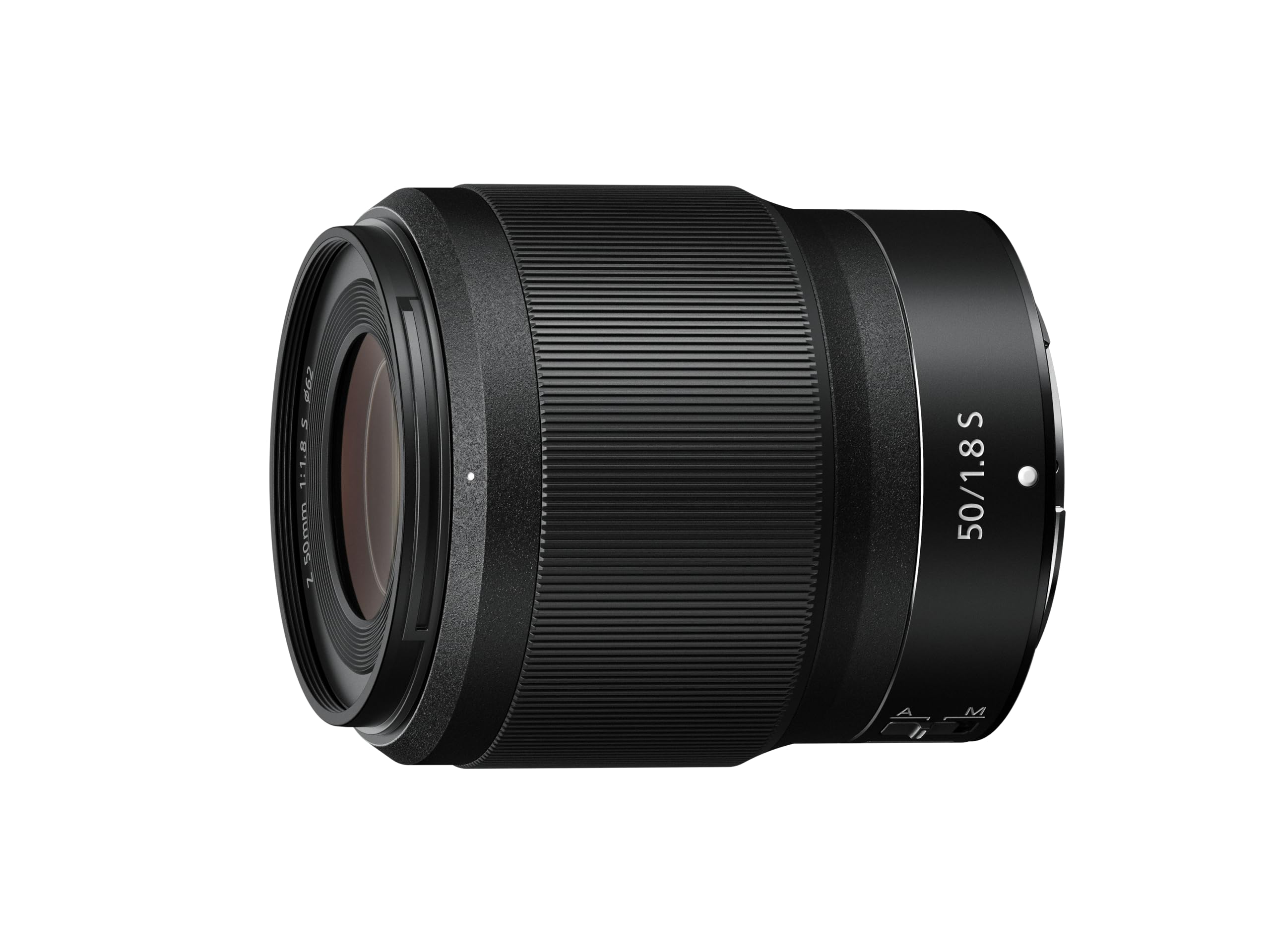
A 50mm prime that redefines “kit lens” with S-line optics and zero distortion.
Nikon’s Z 50mm f/1.8 S is not the old cheap fifty you remember — it belongs to Nikon’s premium S-line, meaning it packs extra ED glass, aspherical elements, and the Nano Crystal Coat that banishes flare and ghosting in dim, mixed indoor lighting. The f/1.8 aperture provides beautiful bokeh and superior low-light performance, and the Z camera’s 5-axis Dual Detect optical VR works with the lens to steady the frame at slower shutter speeds. The new ultra-quiet stepping motor makes autofocus virtually silent — a big advantage for recording video at a quiet dinner or capturing a sleeping baby without waking them.
Sharpness is the headline: owners say it is tack sharp wide open at f/1.8, with zero chromatic aberration and microcontrast that rivals the famous Zeiss Otus lenses when stopped down to f/4 through f/5.6. The “nifty fifty” is well built for a 50mm, weighing 415g. The 12-element, 9-group design solves the traditional issues of older 50mm lenses — flare control, corner softness, and color fringing — to near perfection. The consensus is that this is the best 50mm Nikon has ever made. One owner sums it up: it offers “Otus-level performance for.”
The trade-off is that this lens is larger than the old F-mount 50mm f/1.8 and costs more, but the jump in optical sophistication is immediately visible in indoor portraits. A few owners who wanted a more compact option switched to the Z 40mm f/2. But for anyone who values ultimate sharpness, bokeh quality, and silent autofocus, this Z prime justifies its higher price with near-flawless images. It works ideally for travel, graduation, and street photography — basically any indoor scenario where the 50mm perspective feels natural.
Why It’s a Class Leader
- Extreme sharpness and microcontrast from center to corner
- Zero chromatic aberration even at f/1.8
- Quiet, fast stepping motor and 5-axis VR stabilization
A Consideration
- Larger and pricier than typical budget 50mm lenses
- Cat’s eye bokeh at the extreme edge wide open
Grab this if: you own a Nikon Z-series camera and want the sharpest, most optically refined 50mm prime available for your system — ideal for indoor portraits and critical low-light work.
Pass if: you want the smallest, lightest footprint for casual family snaps and do not need S-line precision.
6. Canon RF 85mm F2 Macro IS STM, Black

The dual-threat 85mm that shoots creamy portraits in one click and half-macro detail in the next.
Canon’s RF 85mm f/2 is an unusual hybrid: a medium-telephoto portrait lens that also offers up to 0.5x maximum magnification, letting you capture the fine texture of a lace tablecloth or a ring detail at a short working distance. The bright f/2 aperture delivers beautiful bokeh and separates the subject from even the messiest indoor backdrop. The lens features optical image stabilization with up to 5 stops of shake correction — a big benefit for handheld shots in low light without raising the ISO. The Hybrid IS system works during macro shots too, compensating for angular and shift camera movement that is exaggerated at close range.
Owners rave about the ultra-crisp images, nice contrast, and good color — the photos have “no haze” even wide open. The minimum focusing distance is 1.15 ft (0.35m), a small advantage when working in tight quarters and needing to lean in. Image quality is the most praised aspect (47 counts), closely followed by the overall lens quality. The lens is compatible with Canon’s full-frame mirrorless cameras, including the EOS R, RP, R5, R6, and the newer R8. At 499g, it is lightweight for an 85mm with stabilization and macro capability.
The autofocus speed gets mixed feedback — it works well for normal portrait shooting and street photography, but can be a little noisy and occasionally hunts in macro mode. The overall noise level is noted as one of the more discussed negatives, with the IS system described as “dated” and rather loud. However, for the combination of portrait compression, a full stop of aperture (f/2), built-in stabilization, and half-macro functionality, it is a uniquely valuable pick for Canon RF owners who shoot a variety of indoor subjects from people to products.
Its niche: The RF 85mm f/2 is a solid overachiever — good for portrait separation and product detail, all in a single package. The stabilizer calms shake down to 5 stops, which is genuine help for dim-room handheld shooting.
Reach for this if: you shoot Canon RF and want a lens that doubles as a portrait prime and a close-up detail lens without switching glass.
pass on it if: you need silent, lightning-fast autofocus for tracking moving subjects, or demand a true f/1.4 portrait lens.
7. Nikon NIKKOR Z 85mm f/1.8 S
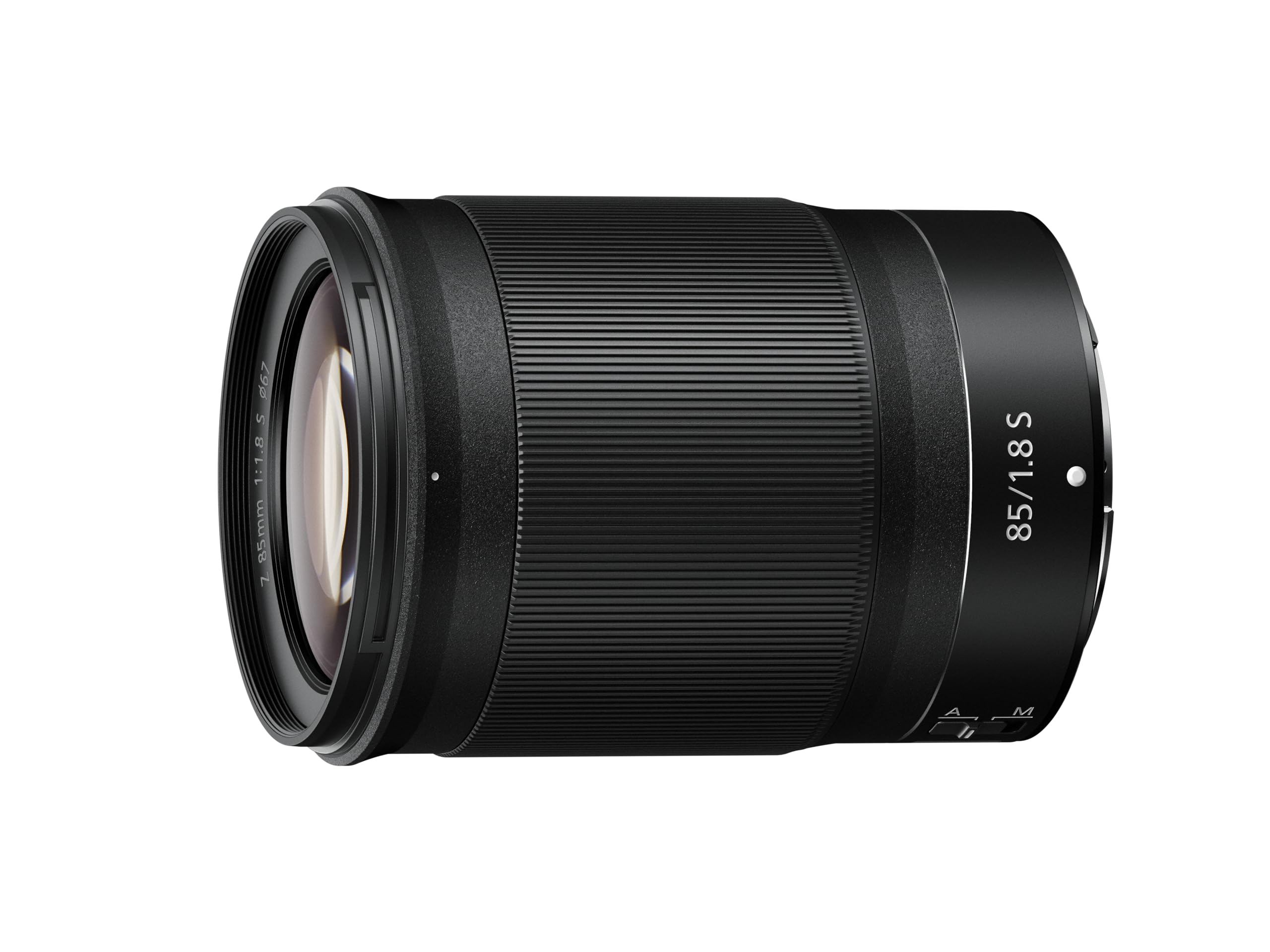
The Nikon Z portrait specialist that delivers razor-sharp corners and dreamy bokeh right from the start.
If your indoor photography revolves around people — family portraits, holiday gatherings, engagement parties — the Z 85mm f/1.8 S is a sharp, luxurious choice. The 85mm focal length compresses perspective, making faces look natural while dropping the background into a smooth blur. The nine-blade diaphragm creates rounded bokeh, so out-of-focus lights turn into soft circles rather than polygons. Two ED (extra-low dispersion) glass elements and the Nano Crystal coating ensure lifelike accuracy with virtually no chromatic aberration, a common issue in older telephoto lenses. The lens is dust- and drip-resistant, with extensive sealing to keep dust and moisture out of the barrel.
Owners consistently describe it as the best 85mm they have ever used, outclassing Sigma ART, Zeiss, Canon, and Sony versions they have owned. The autofocus speed and accuracy are excellent, working quickly even in dim-lit rooms and locking onto moving children. Sharpness is described as “stellar” — from center to corner, with beautiful falloff and natural skin tones. The lens weighs 470g, lighter than many comparable 85mm lenses, and its compact design makes it comfortable for long portrait sessions. It is a professional-grade lens with zero reported downsides from the majority of owners.
The only scenarios where it might not be the best fit are if you have extremely tight working space — an 85mm requires a bit of distance between you and your subject — or if you need a zoom range for events. A few owners note that at portrait distance, the sharpness transitions smoothly into a softer zone for a natural look, which is a design choice rather than a flaw. For anyone who shoots Nikon Z system and values pure portrait excellence, this is the lens you build a kit around.
Achieves perfection: The 85mm f/1.8 S sets the standard for what a portrait prime should be — zero chromatic aberration, lightning-fast focus, and bokeh that turns any living room into a high-end staging area.
Best for: Nikon Z-series owners who prioritize portrait quality above all else and want a lens that makes every shot look professional.
Not for: tight indoor spaces where you cannot step back 8-10 feet from your subject, or budget-conscious buyers.
8. Sony FE 20mm F1.8 G Full-Frame Ultra-Wide Prime Lens

A 20mm ultra-wide prime that squeezes G-class optics into a feathery 373g body.
For Sony full-frame shooters who want to capture an entire indoor scene — the whole dinner table, a full bookshelf, the entire living room — this 20mm f/1.8 G is an unprecedented tool. The ultra-wide 20mm focal length fits massive amounts of content into the frame, while the f/1.8 maximum aperture provides extraordinary exposure and depth of field control, letting you isolate a chandelier against a blurred ceiling. Advanced Aspheric elements deliver natural, lifelike high resolution across the entire frame, and two XD (Extreme Dynamic) linear motors drive autofocus that is fast, precise, and almost silent. It is among the most compact ultra-wide primes on the market at 13.2 ounces (373g), ideal for both full-frame and APS-C cameras.
Reviewers rave about its sharpness even wide open — they describe it as “phenomenally sharp” and “high-definition content” with near-zero chromatic aberration. The lens excels for both video and pictures, particularly vlogging and YouTube content creation, and its minimal breathing and smooth focus transitions make it a video shooter’s dream. An aperture ring with a detent switch allows for tactile control, and the lens supports a lockable aperture ring to prevent accidental bumps. The minimal distortion at f/1.8 means you get clean, clear footage without heavy correction in post. It works great for real estate, landscape, and sculpture photography as well.
The primary trade-off is that it has no built-in optical stabilization, but most Sony full-frame cameras (like the A7III and A7IV) have in-body IBIS that handles the job. A few users note that the aperture ring can be bumped inadvertently, though the lockable switch addresses that. The 20mm focal length is extreme — you must be very close to your subject for it to appear significant in the frame, and it is not a traditional portrait lens. However, for anyone needing to document a room, a group of people in a tight space, or a creative interior shot with exaggerated perspective, this is hands-down the best ultra-wide for Sony full-frame.
What Travelers and Creators Love
- Ultra-wide 20mm captures tight indoor rooms in a single frame
- f/1.8 still lets in plenty of light despite the wide view
- Compact, lightweight design at 373g
One Limitation
- No built-in optical stabilization; relies on camera IBIS
- 20mm perspective is too wide for standard portraits
Reach for this if: you need to shoot tight interior spaces, real estate, or creative wide-angle group shots, and want a lens that is both bright and small.
Look elsewhere if: your main subject is people in close-up portraits or you prefer a longer focal length for compression.
9. Tamron 70-180mm F/2.8 Di III VC VXD G2 for Sony E-Mount Full Frame

A fast telephoto zoom that brings f/2.8 brightness to the back of the room during an indoor event.
Indoor sports, dance recitals, and family ceremonies often demand you shoot from a distance, but a slow variable-aperture zoom will leave you with dark, noisy images. The Tamron 70-180mm f/2.8 G2 solves this with an f/2.8 aperture that stays constant through the entire zoom range — you can shoot at 180mm in a dim auditorium without losing light relative to 70mm. The VXD linear motor provides high-speed, high-precision autofocus with vastly improved subject tracking, crucial for following a toddler running across a gymnasium floor. Tamron’s proprietary VC (Vibration Compensation) image stabilization gives you up to four stops of shake correction, so you can handhold at slower shutter speeds and still capture sharp results.
Owners praise the superb build quality and razor-sharp images at f/2.8, with bokeh performance that is excellent for a zoom. It weighs 855g (1.9 lbs), which is noticeably lighter than Sony’s or Sigma’s 70-200mm f/2.8 options, making it more practical for all-day event shooting. The lens achieves a minimum focusing distance of 0.3m (11.8 inches) at 70mm, letting you get close for dramatic, wide-angle-style detail shots. At 180mm, the minimum focus opens to 0.85m (33.5 inches), still good for a tight headshot. The moisture-resistant construction and fluorine coating ward off dust and splashes.
One build note: the lens does not extend internally, so the front element moves outward during zoom, which can gather dust over time. The custom button is not used by all shooters, but it is there for you to program. A small number of owners reported minor heating during extreme tracking focus, but that is an outlier. The zoom range is 10mm shorter than a typical 70-200mm, but for most indoor uses — a stage performance, a ceremony, a gym — you will not miss that 20mm at the long end. It is the best combination of lightness, aperture, and stabilization in a telephoto zoom for Sony full-frame event shooters.
Versus the competition: Weighs 855g and keeps a 67mm filter thread for consistency with other Tamron lenses, while Sony’s equivalent 70-200mm GM II tips the scales much heavier — this is a lighter carry for all-day indoor event work with no loss in sharpness.
Best for: Sony full-frame shooters who need a fast, stabilized telephoto zoom for indoor events, sports, and performances where you cannot move closer.
it’s not for you if: you only shoot tight portraits at close range — a prime 85mm or 35mm will be smaller, lighter, and brighter.
10. Sony FE 35mm f/1.4 GM Full-Frame Large-Aperture Wide Angle G Master Lens

Sony’s reference 35mm f/1.4 — the one that defines G Master sharpness, speed, and bokeh in a compact body.
For Sony full-frame users who shoot a mix of indoor portrait, street, environmental, and video content, the 35mm f/1.4 GM is the do-everything prime that sets the standard. The 35mm focal length is wide enough to include context (a person and their bookshelf) but not so wide that perspective distorts faces. The f/1.4 max aperture delivers extraordinary brightness and depth of field control — you can shoot a dim birthday party at a high shutter speed without pushing ISO, throwing the candles and the cake box out of focus behind the subject. Two XA (Extreme Aspheric) elements deliver stunning resolution, while the ED (extra-low dispersion) glass reduces chromatic aberration. The Nano AR Coating II suppresses reflections, flare, and ghosting that often plague wide fast lenses in mixed lighting.
The lens is renowned for its blazing-fast autofocus — owners note it works flawlessly for both photography and cinematic video, with sharp edge-to-edge sharpness even at f/1.4. It is small and lightweight for a GM lens at 1.2 pounds, making it comfortable for all-day walk-around shooting. The consensus from reviewers is that it is “one of the greatest lenses to get” — versatile, excellent image quality, and very well built. It supports Sony’s lens breathing compensation for video, which keeps the angle of view steady during focus pulls. The autofocus is so fast that for video, one owner reports it can be too quick, causing the focus to jump around, but that is a sign of performance rather than a flaw.
The main barrier is cost — it sits in mid-range territory — but the optical performance justifies it for anyone requiring professional-level results from a single fast prime. It pairs beautifully with Sony’s A7C series for a compact but high-end kit. There is no image stabilization, but most full-frame Sony cameras have IBIS. For any Sony shooter who wants a single lens that covers indoor portraits, street, family gatherings, and even some landscape work, the 35mm f/1.4 GM is the ultimate one-lens indoor solution.
What Makes It a GM
- f/1.4 aperture combined with 35mm field of view is perfect for indoor storytelling
- Extreme resolution with minimal chromatic aberration
- Fast, accurate autofocus that works for both stills and video
- Premium price point is an investment
- No optical stabilization (relies on camera IBIS)
- Autofocus can feel too eager for controlled video focus pulls
Things to Consider
Grab this if: you are a Sony full-frame shooter who wants a single, exceptional 35mm prime that handles everything from dim indoor portraits to environmental shots with professional quality.
Pass if: your budget is tighter or you prefer a longer focal length like 50mm or 85mm for your main indoor lens.
11. 70-200mm F2.8 DG DN OS for Sony

The workhorse telephoto zoom that combines pro f/2.8 speed with built-in OS for indoor action.
For Sony full-frame shooters who need to capture indoor sports, stage performances, or high-energy ceremonies from a distance, the Sigma 70-200mm f/2.8 DG DN OS is the most compelling option on the market. It features the High-response Linear Actuator (HLA) AF motor for fast, quiet autofocus. The optical stabilization (OS) built into the lens is critical for steady shots at 200mm in dim rooms. It completes the f/2.8 DG DN full-frame mirrorless trio, pairing perfectly with Sigma’s 14-24mm and 24-70mm f/2.8 zooms for a comprehensive kit. The dust- and splash-resistant structure is borrowed from Sigma’s rugged Sports line, giving it extra durability against the elements of an indoor gym or crowded event.
Owners praise the stunning quality and sharp images, with super clean bokeh at f/2.8. The autofocus is faster than competing lenses in its price bracket, and the stabilization is described as strong enough for confident handheld shooting. It is considered the best value for money in the 70-200mm f/2.8 category, beating Sony’s GM I and GM II on price while matching them on image quality. One owner specifically uses it for ballroom dancing photography, noting the f/2.8 aperture combined with high ISO “needed for indoor ballroom dancing” makes it perfect for capturing moving subjects from across the floor.
The catch is weight: at 1345g (nearly 3 pounds), this is a hefty lens. An owner admits it “causes back strain” during sessions longer than three hours, but that is a universal trade-off for any full-frame 70-200mm f/2.8. The lens cap uses a twist-screw design that if not fully removed, can hinder zoom movement. It is big, it is heavy, and it demands a decent camera bag. But for the shooter who needs a fast telephoto zoom for indoor action and values sharpness, build quality, and stabilization, this is the best budget-friendly workhorse available for the Sony E-mount system.
The value argument: Sigma’s 70-200mm f/2.8 delivers pro-grade sharpness, stabilization, and autofocus for significantly less than its native Sony GM counterpart, making it the smart financial choice for serious indoor event shooters.
Best for: Sony full-frame shooters who need a fast, long zoom for indoor sports, theater, or events and want pro-level results without paying the GM tax.
Think twice if: you cannot handle the 1345g weight for handheld shooting, or you need a more compact lens for casual indoor use.
Understanding the Specs
Aperture (f-number)
The aperture is the lens opening that lets light reach the sensor. A smaller f-number (like f/1.4, f/1.8, or f/2) means a wider opening that lets in more light — crucial for capturing usable images in dim indoor settings without cranking up the ISO and introducing grain. A wide aperture also reduces depth of field, creating a blurred background (bokeh) that makes a subject stand out from a busy environment.
Focal Length (mm)
Measured in millimeters, the focal length determines your lens’s field of view. A short focal length (16-35mm) captures a very wide view, good for tight rooms or environmental shots. A “normal” focal length (35-50mm) approximates human peripheral vision, making it the ideal all-around choice for most indoor scenes. Longer focal lengths (85-200mm) compress the perspective and let you fill the frame with a subject from across the room, but require more distance to use indoors.
FAQ
What is the best focal length for indoor photography?
Is a 50mm f/1.8 good for indoor photography?
Do I need image stabilization for indoor photography?
Should I choose a prime lens or a zoom lens for indoors?
What does ‘f/1.4’ mean on a camera lens?
Will an 85mm lens work indoors?
What is the difference between EF and RF lenses for Canon?
Can I use a Sony E-mount lens on a Nikon camera?
What is APS-C vs full-frame for indoor lenses?
How do I choose between an ultra-wide and a standard lens for indoors?
Final Thoughts: The Verdict
If you want one dependable pick, the camera lens for indoor photography winner is the Canon EF 50mm f/1.8 STM because it delivers exceptional sharpness and light-gathering at a price that leaves room for other gear, backed by thousands of satisfied owners. If you shoot Sony APS-C and want a compact, lightweight portrait lens, grab the VILTROX 56mm F1.7. And for pure professional-grade indoor versatility on Sony full-frame, the Sony FE 35mm f/1.4 GM is the one to reach for.
How We Picked
We do not accept paid placement. Every pick is matched to a real buyer and a real use-case; we do not hands-on test units.
Sources & Methodology
Specifications: manufacturer listings and product documentation. Review insights: verified customer reviews, as of July 2026. Pricing: not shown on this page (it changes often); check the current price via the retailer link.
As an Amazon Associate, Gadgets Feed earns from qualifying purchases. This does not affect which products we feature.