
Getting a great shot of a room, a real estate listing, or a cozy café comes down to one thing: a lens wide enough to capture the whole space without making you stand in the next building. The wrong lens forces you back against a wall, distorts straight lines into curves, or goes dark the moment the sun dips behind a cloud. The right one — a wide-angle prime or zoom — solves all of that, letting you frame an entire room corner-to-corner with crisp, natural-looking lines.
I’m Min — the co-founder and writer behind Gadgets Feed. This guide is built by comparing the manufacturers’ published specifications and the patterns across verified customer reviews, so you get each pick’s real strengths and trade-offs instead of marketing spin.
If you shoot a full-frame camera or an APS-C body, finding the best camera lens for interior photography comes down to your exact camera mount (the brand and type of your camera) and budget. You balance the focal length (how wide the view is), the maximum aperture (how much light it lets in), and the optical image quality.
How To Choose The Best Camera Lens For Interior Photography
Picking a lens for interior work is different from picking one for portraits or sports. You are fighting tight spaces, mixed lighting, and the need to keep vertical lines straight. These three specs will guide your decision.
Focal Length: How Wide Is Wide Enough
On a full-frame camera, a 14-24mm zoom or a 15-20mm prime gives you the field of view (how much of the scene you see) you need to capture an entire room in one frame without having to stitch multiple photos together. If you use an APS-C camera (a camera with a smaller sensor, like a Sony A6400 or a Nikon Z50), you need to multiply the lens’s focal length by 1.5x to get the full-frame equivalent. That means a 12mm lens on an APS-C body sees roughly the same angle as an 18mm lens on a full-frame — still wide enough for most rooms.
Maximum Aperture: Your Room-Light Friend
Interiors rarely have perfect lighting. A lens with a wide maximum aperture — f/2.8, f/1.8, or bigger (a lower number lets in more light) — means you can shoot handheld in a dim living room without cranking up the ISO and adding digital noise (grainy speckles). The catch is cost and size: f/2.8 zooms cost more and weigh more than f/4 zooms. If you use a tripod most of the time, f/4 is perfectly fine.
Optical Distortion: Keeping Straight Lines Straight
Rectilinear lenses (lenses that keep straight lines straight, unlike fisheye lenses) are designed to render straight lines as straight. Even among rectilinear ultra-wides, some barrel distortion (where lines bow outward) is common at the widest end. Look for a lens with low distortion ratings, or one that a camera body or software like Lightroom can correct automatically without losing too much resolution.
Quick Comparison
On smaller screens, swipe sideways to see the full table.
| Model | Category | Best For | Key Spec | Amazon |
|---|---|---|---|---|
| Sony FE 14mm f/1.8 GM | Premium Prime | Ultra-wide full-frame, maximum light | 14mm, f/1.8, 460g | Amazon |
| Sigma 14-24mm F2.8 DG HSM (Canon) | Premium Zoom | Fast zoom versatility on Canon | 14-24mm, f/2.8 constant | Amazon |
| Sony FE 20mm F1.8 G | Compact Prime | Lightweight full-frame travel | 20mm, f/1.8, 13.2 oz | Amazon |
| Sony E 15mm F1.4 G APS-C | APS-C Prime | Sony APS-C content creators | 15mm (22.5mm equiv.), f/1.4 | Amazon |
| Nikon NIKKOR Z 14-30mm f/4 S | Travel Zoom | Nikon Z mirrorless shooters | 14-30mm, f/4, 17.1 oz | Amazon |
| Canon EF 17-40mm f/4L USM | Value L-Series | Budget entry to L-series | 17-40mm, f/4, weather-sealed | Amazon |
| VILTROX AF 13mm F1.4 E | Budget Speed | Affordable wide aperture for Sony APS-C | 13mm, f/1.4, 415g | Amazon |
| Rokinon AF 12mm F2.0 Sony E APS-C | Entry Ultra-Wide | Budget ultra-wide for Sony APS-C | 12mm (18mm equiv.), f/2.0, 8 oz | Amazon |
In‑Depth Reviews
1. Sony FE 14mm f/1.8 GM Prime Lens

The 14mm f/1.8 aperture makes the Sony FE 14mm f/1.8 GM the sharpest, fastest ultra-wide prime for full-frame Sony cameras, ideal for real estate or architecture shooters with a Sony A7-series body who want corner-to-corner clarity right from the center. The 14mm focal length fits nearly an entire room in a single frame, so you do not have to stitch photos together. The wide f/1.8 aperture lets you shoot in near-darkness without a tripod, like a dimly lit basement. Buyers report it is “virtually distortion free” for its super-wide angle.
At just 460 grams (about 1 pound), it is remarkably light for a lens this wide and fast. The two XD linear motors deliver fast, silent autofocus, so tracking a moving subject across a room is no issue. The downside is the built-in bulbous front element — you cannot screw on standard filters, so you will need a specialized rear filter holder or rely on post-processing for polarizing effects. One buyer using it for landscape and architecture noted, “the awkward filter system is the trade-off.”
For a combination of raw low-light power and optical precision, this lens is hard to beat; skip it if you shoot Canon or Nikon and want a filter-friendly lens.
Why it’s great
- Industry-leading sharpness at f/1.8, even in the corners
- Extremely compact and light at 460g for a 14mm f/1.8
- Fast, near-silent autofocus with two XD linear motors
Good to know
- Bulbous front element prevents use of standard screw-on filters
- Premium price point puts it in the high-end bracket
- No optical image stabilization built-in
2. Sigma 14-24mm F2.8 DG HSM (Canon)

The Sigma 14-24mm F2.8 DG HSM gives you more framing flexibility than the top-pick Sony 14mm prime — the 14-24mm zoom range lets you frame the shot tighter or wider without swapping lenses, while the constant f/2.8 aperture (the lens opening stays the same size whether you are at 14mm or 24mm, letting in plenty of light in dim rooms) means you can shoot a dim living room at the same exposure across the zoom. For Canon DSLR shooters or those adapting to mirrorless (using an adapter on a newer Canon mirrorless body), this is the lens that replaces a bag full of primes.
Reviewers consistently call it “extremely sharp” with “virtually no distortion.” At the 14mm end, it matches the field of view of the Sony prime above while adding the option to zoom, so you can crop in on a window detail. The HSM (Hyper Sonic Motor) provides fast, accurate autofocus. Owners mention it is noticeably sharper and cheaper than the Canon RF 15-35 f/2.8. This pick is for the Canon EF shooter who needs one lens that covers real estate shoots in the morning and outdoor architecture in the afternoon.
pass on it if you prioritize the lightest possible kit or need a filter-friendly design — choose this Sigma over the top pick if you want a zoom’s versatility for interior framing and already shoot Canon EF or adapted mirrorless.
Where it shines
- Flexible 14-24mm zoom covers both ultra-wide and moderate wide
- Constant f/2.8 aperture keeps exposure consistent while zooming
- Extremely sharp with minimal barrel distortion, per buyer reviews
Worth noting
- No image stabilization built-in
- Heavier than comparable prime lenses at this focal length
- Some customers note the lens hood can be loose and fall off
3. Sony FE 20mm F1.8 G Full-Frame Ultra-Wide Prime

Imagine you’re shooting a dark café corner handheld, needing a lens that won’t weigh you down. At just 13.2 ounces, the Sony FE 20mm F1.8 G is a full 6.4 ounces lighter than the Sigma 14-24mm, yet it still packs an ultra-wide 20mm view and a bright f/1.8 aperture for low-light handheld shooting. Buyers rave about its “fast, precise autofocus” and the fact that it shows very low vignetting (darkening at the edges) even wide open at f/1.8. The Advanced Aspheric elements control distortion well, meaning interior walls stay straight in your frame. One reviewer who replaced a Zeiss 16-35mm f/4 with this lens called it “incredible for video,” noting it is “small and light” and delivers great close-focusing ability for detail shots.
The two XD (Extreme Dynamic) linear motors make autofocus near-silent, which is a plus for video work. This lens makes you want to take it everywhere — but the 20mm view may be too tight for extremely cramped rooms, like a tiny bathroom. it’s not for you if you need wider than 20mm for small spaces. Pick it for the Sony full-frame shooter who values a compact kit above all else.
At just 13.2 ounces, it’s the lightest ultra-wide prime in its class.
What stands out
- Exceptionally light at 13.2 oz, ideal for travel
- Bright f/1.8 aperture for low-light interior work
- Quiet, smooth autofocus with little focus breathing
The trade-offs
- No optical image stabilization built-in
- 20mm may be too tight for extremely cramped rooms
- Manual focus only, not automatic for video use
4. Sony E 15mm F1.4 G APS-C Wide Angle Lens

The single number that matters most in this category is the 22.5mm full-frame equivalent focal length, and this lens scores a perfect practical fit for interior work — wide enough to capture a bedroom in one shot without the exaggerated perspective of a 14mm. The wide f/1.4 aperture (a full stop brighter than the f/2.0 on many budget primes, letting in twice as much light) means you can shoot a dimly lit kitchen handheld at ISO 800 instead of ISO 3200, keeping images clean and noise-free. This is the lens for the Sony APS-C shooter who wants the best optical performance for that sensor size.
Buyers call it “hands down the best APS-C vlogging lens” for its compact size and creamy bokeh (the soft blur behind objects) at f/1.4. The aperture ring includes a click-stop switch, so you get tactile feedback for photography or silent, smooth control for video. Two linear motors provide fast, accurate autofocus and tracking, which is useful if you include people moving through a space. One limitation is the price — this is a premium APS-C lens, costing more than some full-frame options. look elsewhere if you shoot full-frame or want a cheaper alternative for your APS-C camera.
The price-to-value read here is that you pay a premium for top-tier APS-C optics and build, but the f/1.4 speed and compact design deliver exceptional results for interior photography on Sony APS-C bodies.
The upsides
- Fast f/1.4 aperture sets the benchmark for APS-C wide primes
- Practical 22.5mm full-frame equivalent for interiors
- De-clickable aperture ring for silent video control
Keep in mind
- Premium price for an APS-C lens
- No weather sealing mentioned for this model
- Designed specifically for APS-C sensors, not full-frame
5. Nikon NIKKOR Z 14-30mm f/4 S

What you actually get at this lower price is a retractable lens mechanism that collapses the Nikon NIKKOR Z 14-30mm f/4 S to just 3.5 inches, fitting easily in a small 10-liter bag alongside your camera body. The constant f/4 aperture is one stop slower than f/2.8 options (letting in half as much light), but the compromise buys you a lens that is lighter, more compact, and takes standard 82mm filters — a rarity for a 14mm lens. Reviewers point out it is “tack sharp to the corners even at 14mm” and has “no distortion or flare issues,” calling it excellent for architectural photography.
The retractable design and weather sealing (dust and moisture protection) make it a practical companion for outdoor-to-indoor shooting. At 17.1 ounces, it is heavier than the Sony 20mm but offers zoom flexibility. The f/4 maximum aperture means you will likely need a tripod or higher ISO in very dim rooms.
Pick it if you need a compact, filter-friendly wide zoom for Nikon Z. steer clear if you regularly shoot in very dark rooms without a tripod — this is the exact budget buyer it is perfect for.
Why we’d pick it
- Retractable design makes it incredibly compact for a 14-30mm zoom
- Accepts standard 82mm screw-in filters, rare for a 14mm lens
- Excellent sharpness and low distortion, per architectural shooters
A few caveats
- f/4 aperture limits low-light performance without a tripod
- Software distortion correction is needed, which crops the image slightly
- Not as fast for action or astrophotography as f/2.8 alternatives
6. Canon EF 17-40mm f/4L USM Ultra Wide Angle Zoom Lens

If you are moving from a Canon kit lens and want to step into the L-series (Canon’s professional-grade lineup) without the premium price of the 16-35mm f/2.8L, the Canon EF 17-40mm f/4L is the classic entry point. At 17mm, it gives you a 104-degree diagonal angle of view on a full-frame camera, which is wide enough for most rooms like a typical living room. The f/4 aperture is serviceable for tripod-based interior work or well-lit spaces. Shoppers say a “huge image quality upgrade from the 18-55mm kit lens,” praising its “superb build, smooth rings, and fast AF.”
One reviewer who required a -6 micro-adjustment on their 7D noted that at 40mm, sharpness is “close to the 24-70mm f/2.8L,” but that the lens shows some chromatic aberration (purple and green fringing) at the wide end. The weather-resistant construction means you can use it in dusty or damp environments without worry. This lens asks you to accept f/4 and some corner softness at 17mm in exchange for entry into Canon’s L-series at a fraction of the cost. Pick it for the budget-conscious Canon DSLR shooter who wants L-series build. skip it if you need f/2.8 speed for handheld low-light work.
Just be aware that the corner softness and chromatic aberration at 17mm are its one weakness, especially if you plan to shoot wide open in challenging light.
Strong points
- Affordable entry point into Canon’s professional L-series line
- Weather-sealed construction protects against dust and moisture
- Versatile 17-40mm zoom range covers most interior needs
Before you buy
- f/4 aperture is restrictive for handheld low-light shooting
- Some chromatic aberration (purple/green fringing) at wide angles
- Micro-adjustment may be needed on some camera bodies
7. VILTROX AF 13mm F1.4 E Mount Lens
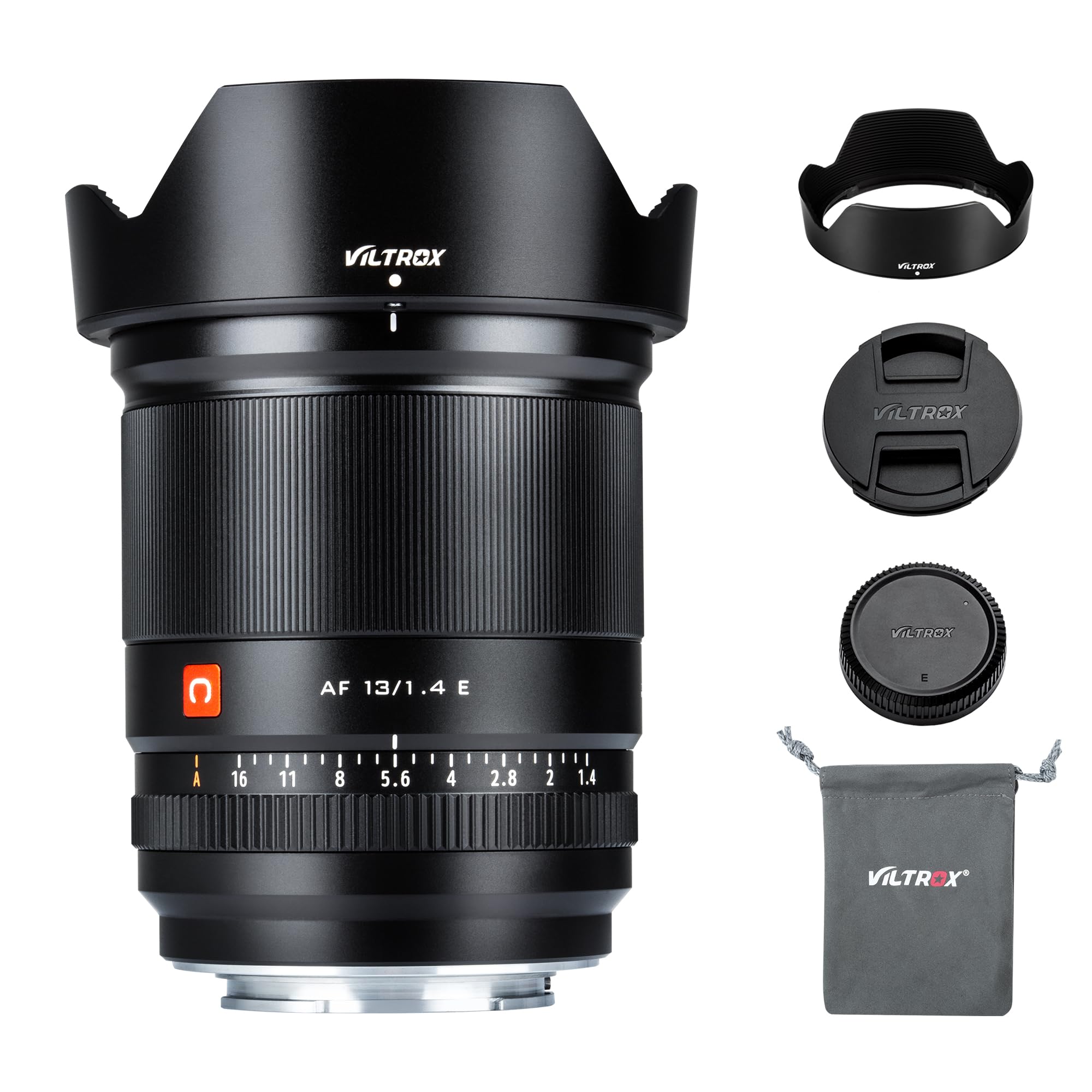
The VILTROX AF 13mm F1.4 matches the premium Sony 15mm f/1.4 G on aperture speed but costs less than half as much. The f/1.4 aperture is the standout spec here — it lets in 43% more light than the f/2.0 on the Rokinon 12mm, the difference between shooting a dark living room at ISO 800 versus ISO 1250. One buyer called it “excellent optical quality” with a “sharp center at f/1.8” and “good corners stopped down,” noting the quiet STM (stepping motor) autofocus motor and minimal focus breathing for video. The all-metal body weighs 415g (about 14.6 oz) and includes a USB Type-C port for firmware updates.
The 0.22m close-focus distance lets you fill the frame with small architectural details like doorknobs or light switches. The drawback is that you are buying from a third-party brand with less consistent quality control than Sony or Sigma. This is the budget-conscious choice for the Sony APS-C shooter who refuses to compromise on low-light ability. pass on it if you want guaranteed weather sealing or the most consistent build.
The one clear reason to choose it is the unmatched combination of f/1.4 brightness and sub‑$500 price for Sony APS-C interiors.
What we like
- Very fast f/1.4 aperture at a budget-friendly price
- Solid all-metal build with USB-C for firmware updates
- Close 0.22m minimum focus distance for detail shots
The downsides
- Third-party brand with less consistent quality control
- Manual focus ring can feel slightly loose
- No weather sealing compared to higher-end Sony options
8. Rokinon AF 12mm F2.0 Sony E APS-C

At 8 ounces (about half the weight of the VILTROX 13mm at 415g), the Rokinon AF 12mm F2.0 is the lightest and most affordable lens in this lineup — the top pick for the Sony APS-C shooter who wants to try ultra-wide interior photography without a big investment. The 99.1-degree rectilinear field of view gives you a wide enough perspective to see if this is the genre for you. The f/2.0 aperture is capable in moderate light but asks you to raise ISO faster than f/1.4 alternatives — so in a dim room you may get more digital noise.
Buyers report “corner-to-corner sharpness stopped down” and call it a “great value” for the price. The Linear STM motor provides quiet autofocus for video, and the weather-sealed all-metal housing feels solid despite the light weight. However, one reviewer had a disappointing experience where the lens “stopped working” after unboxing, requiring a return, and another noted their package arrived with “no lens cap” and “no case.” This suggests some variability in quality control and packaging. For the beginner on a tight budget who wants to see the ultra-wide difference before committing to a premium lens, this is the gateway pick.
it’s not for you if you need the widest possible aperture for dark rooms or want consistent packaging.
Why it’s great
- Ultra-light at just 8 ounces, perfect for all-day carry
- Very affordable entry into ultra-wide interior photography
- Weather-sealed metal body adds durability
Good to know
- Some quality control issues reported in customer reviews
- f/2.0 aperture is less capable in very dim interiors
- Autofocus can be slower than higher-end lenses
Understanding the Specs
Focal Length
Measured in millimeters (mm), this is how much of the scene the lens sees. A lower number means a wider view. For full-frame cameras, 14-24mm is the standard interior range. For APS-C cameras, multiply the lens’s focal length by 1.5x to get the full-frame equivalent — so a 12mm APS-C lens behaves like an 18mm on a full-frame camera. If you go below 14mm full-frame equivalent, you risk distorting straight lines and making rooms look exaggerated.
Maximum Aperture
This is the widest the lens can open, written as f/1.4, f/2.8, or f/4. A smaller number (f/1.4) lets in more light than a larger number (f/4) — roughly twice as much light for each full stop (f/2.8 lets in twice the light of f/4). For interior work, a wider aperture (f/1.4 to f/2.8) gives you the ability to shoot handheld in dim rooms without a flash or a high ISO that adds digital noise. A lens with f/4 works well if you often use a tripod.
FAQ
Can I use a full-frame lens on an APS-C camera for interiors?
What is a rectilinear lens and why does it matter for interior photos?
Do I need a tripod for interior photography with an f/4 lens?
Final Thoughts: The Verdict
When it comes down to it, the camera lens for interior photography winner is the Sony FE 14mm f/1.8 GM because it delivers the widest field of view, the bright f/1.8 aperture, and the corner-to-corner sharpness that makes interiors look professional with minimal post-processing. If you want the flexibility of zooming and are shooting a Canon DSLR, the Sigma 14-24mm F2.8 DG HSM is your best bet. And for the Sony APS-C shooter on a tighter budget who refuses to compromise on low-light speed, the standout is the VILTROX AF 13mm F1.4.