
Our readers keep the lights on and my morning glass full of iced black tea. As an Amazon Associate, I earn from qualifying purchases.
Specs are compiled from manufacturer listings and verified buyer reviews and can change over time — please confirm the key details on the product page before buying.
To make a living room feel spacious or a tiny bathroom look usable in a photo, you need a lens that captures the whole scene without bending the door frames. That is what a real estate lens does — it gives you a wide, natural-looking view that makes buyers feel like they are standing in the room. The key is matching the right focal length (how wide the shot gets), aperture (how much light it grabs), and stability (keeping the image sharp) to your camera.
I’m Min — the founder and writer behind Gadgets Feed. This guide is built by comparing the manufacturers’ published specifications and the patterns across verified customer reviews, so you get each pick’s real strengths and trade-offs instead of marketing spin.
This guide breaks down the top seven wide-angle zooms for real estate. Whether you shoot for an agency or flip houses yourself, these are the camera lens for real estate photography options that deliver clean, wide interiors.
Our Picks at a Glance


How To Choose The Best Camera Lens For Real Estate Photography
A real estate lens lives or dies by three things: how wide it goes, how sharp it stays in the corners, and how much light it can pull in when the only window is on the north side of the house. Here is what to look at before you buy.
Focal Length — The Wider the Better (Up to a Point)
For interior real estate shots, you need a lens that starts at 24mm or wider on a full-frame camera. A 16-35mm zoom gives you a generous wide end for tight bathrooms and a slightly tighter 35mm end that avoids the “fisheye” look on normal-sized rooms. Lenses that go as wide as 14mm let you capture an entire bedroom wall to wall, but you have to watch out for barrel distortion (curved lines that make door frames look like they bulge outward).
Aperture — The Low-Light Trade-Off
An f/2.8 aperture lets in twice as much light as f/4, which helps when you are shooting a dim basement or a room with a single small window. The catch is that f/2.8 zooms are heavier and usually cost more. Many real estate photographers happily use f/4 lenses because they shoot from a tripod anyway, making the extra stop of light less important. If you prefer to work handheld, f/2.8 gives you a cleaner, less noisy image without raising the ISO (the camera’s sensitivity to light, which adds grain when turned up).
Image Stabilization — Your Handheld Safety Net
Vibration Reduction (VR from Nikon) or Image Stabilization (IS from Canon) lets you shoot at slower shutter speeds without blur from shaky hands. That is a real advantage when you are rushing through a listing and do not want to set up a tripod in every room. Stabilization rated at four stops — meaning you can shoot at 1/6 second and still get a sharp image — is a practical benefit for real estate work.
Quick Comparison
| Model | Best For | Focal Length | Max Aperture | Weight | Amazon |
|---|---|---|---|---|---|
| Canon EF 17-40mm f/4L USM★ Best Overall | Budget L-Series Canon | 17-40mm | f/4 | 500g | $799.00Amazon |
| Canon EF 16-35mm f/4L IS USMAlso Great | Best Overall Canon | 16-35mm | f/4 | 615g | $1,149.00$1,448.01Amazon |
| Nikon NIKKOR Z 14-30mm f/4 S | Ultra-Wide Versatility | 14-30mm | f/4 | 17.1 oz | $1,246.95Amazon |
| Tamron 17-28mm f/2.8 Di III RXD | Best Value Sony | 17-28mm | f/2.8 | 14.82 oz | $899.00Amazon |
| Tamron 16-30mm F/2.8 Di III VXD G2 | Sharp Nikon Z Value | 16-30mm | f/2.8 | 15.9 oz | $879.00$929.00Amazon |
| Nikon AF-S 16-35mm f/4G ED VR | Stabilized Nikon F-Mount | 16-35mm | f/4 | 1.5 lbs | $794.23Amazon |
In‑Depth Reviews
1. Canon EF 17-40mm f/4L USM Ultra Wide Angle Zoom Lens
Our pick — over 4.5★ from 850+ verified ratings; the strongest balance of quality and price.
The most affordable way into Canon’s professional L-series glass — you get weather sealing and a 17-40mm range for a fraction of the cost of the 16-35mm f/2.8L.
For Canon shooters on a budget, this 17-40mm f/4L is the gateway to Canon’s L-series (Luxury series) professional lenses. It covers a 17-40mm focal range (which translates to roughly 27-64mm on an APS-C body, like the Canon Rebel series) and has weather-resistant construction for exterior shoots. The ring-type ultrasonic motor (USM) gives you fast, near-silent autofocus, and it focuses as close as 11 inches, so you can shoot tight detail shots of countertops or fixtures.
Buyers consistently praise its value: one review calls “The 17-40mm f/4 one of Canon’s best deals in L-series glass,” noting you have to spend twice as much to get a lens of similar quality that is just one stop faster. Another APS-C shooter calls it a “must-have” for its build quality and smooth focus rings. The trade-off is that at f/4 it is slower than f/2.8 alternatives, and the 17mm wide end is not as dramatic as 14mm or 16mm lenses. It also lacks image stabilization, so you will want a tripod for the dim rooms — unlike the Canon 16-35mm f/4L IS, which has stabilization built in.
What it does best
- Affordable entry to Canon L-series wide-angle optics
- Weather-resistant construction for exterior shoots
- Smooth, quiet USM autofocus and close focus at 11 inches
Where it cuts corners
- No image stabilization — tripod recommended for interiors
- f/4 aperture struggles in very low light
Reach for this if: You are building a Canon kit on a budget and want L-series build quality for real estate exteriors and well-lit interiors.
Avoid if: You shoot dim, windowless rooms handheld — the lack of IS and slower aperture will show blur and noise.
2. Canon EF 16-35mm f/4L IS USM Lens
The Canon wide zoom that balances sharpness, stabilization, and a price that beats the f/2.8 — this is the lens that does everything a real estate shooter needs without demanding a premium.
You get sharp, steady interior photos even without a tripod because the Image Stabilization (IS) is rated at up to four stops — so you can shoot handheld at slow shutter speeds and still keep the image crisp. The 16-35mm focal range covers tight bathrooms at the wide end and normal-sized living rooms at the tighter 35mm end. The 9-blade rounded diaphragm (the mechanism that controls the opening inside the lens) gives you smooth out-of-focus backgrounds, which helps when you want a chandelier or a fireplace to stand out.
Buyers consistently call it “incredibly sharp” and note that it compares favorably to the far more expensive 16-35mm f/2.8L II, which costs a lot more for just one extra stop of light. One reviewer who tested it on a 5D Mark III called it a “flawless lens” that takes amazing photos even at f/8 (a common aperture for interior shots). The catch is that it uses the older EF mount for DSLRs. If you have switched to a Canon mirrorless body like the EOS R series, you will need an adapter. At 615 grams, it is heavier than the lighter mirrorless zooms below, like the Tamron 17-28mm for Sony.
Why it leads the list
- Image Stabilization up to four stops keeps handheld shots sharp
- Corner-to-corner sharpness that rivals lenses costing more
- Rounded 9-blade diaphragm for natural background blur
A couple of things to know
- EF mount needs an adapter for Canon mirrorless bodies
- f/4 aperture means less light than a 2.8 in dim rooms
This lens is for you if: You own a Canon DSLR (or can use an adapter) and want the best mix of sharpness and stabilization for interior work without paying the f/2.8 tax.
You should pass if: You shoot handheld in very dark rooms regularly and need f/2.8 to keep the ISO down — the f/4 will push you into noisier territory.
3. Nikon NIKKOR Z 14-30mm f/4 S

Starting at 14mm, this zoom fits a full room in one shot and still collapses to just 3.5 inches for storage — a rare combo of ultra-wide reach and portability.
You get a 14mm wide end that no other lens on this list matches — it lets you capture an entire room, including both side walls and the floor, in a single frame without backing through a wall. The constant f/4 aperture is a stop slower than a 2.8, but for tripod-based real estate work that rarely causes issues. The retractable mechanism collapses the lens to only 3.5 inches for storage, making it the most packable ultra-wide for a Z-series body.
Buyers report it is “tack sharp all the way to the corners even at the widest setting” and one reviewer who used it for documenting rooms in a new house says it “was able to cover a much wider view than the standard 24-70mm kit lens.” At 17.1 ounces, it is lighter than many similar lenses. The optical image stabilization helps when you do shoot handheld. The trade-off: the 14mm end can introduce some barrel distortion that needs fixing in software like Lightroom, and the retractable design means you cannot use screw-in filters on the front while the lens is collapsed.
What makes it special
- 14mm ultra-wide end fits tight rooms no other zoom reaches
- Collapsible to 3.5 inches for compact travel
- Optical stabilization and quiet STM autofocus (stepping motor, near-silent for video)
Things to plan around
- f/4 is slower than a 2.8 lens for dim-light handheld work
- Retractable design complicates front screw-in filter use
Grab it for: Nikon Z shooters who need to fit large rooms into a single frame and value compact portability over a faster aperture.
Think twice if: You shoot mostly handheld in dim rooms — the f/4 aperture will push your ISO higher than an f/2.8 lens would.
4. Tamron 17-28mm f/2.8 Di III RXD for Sony E-Mount

At just 420 grams with an f/2.8 aperture, this Tamron is the lightest bright-aperture wide zoom for Sony E-mount — a real workhorse for handheld real estate shoots.
Weighing only 14.82 ounces (420 grams), this is one of the lightest f/2.8 wide zooms for Sony E-mount cameras. The f/2.8 aperture lets you shoot a dim interior at 1/60 second without the noise that comes from cranking the ISO (the camera’s light sensitivity setting). It also shares a 67mm filter thread with many Tamron telephoto zooms, so you do not need to buy separate filters for different lenses. The RXD stepping motor (Rapid eXtra-silent stepping Drive) keeps autofocus near-silent, which matters for video walkthroughs.
Buyers call it a “solid build, decent sharpness for cost” and one reviewer specifically noted it is a “workhorse for real estate.” Another owner said images are “sharp from f/2.8, excellent at f/8 to f/11 for landscapes.” The focal range runs from 17mm to 28mm — narrower than some competitors. You cannot reach 14mm like the Nikon Z 14-30mm does, and some users wish for a wider option. But Sony shooters get a fast, lightweight zoom that is a clear value champion compared to Sony’s own GM lenses.
Why it is a top pick
- f/2.8 aperture for cleaner handheld shots in low light
- Very lightweight at 420g ideal for all-day shoots
- 67mm filter thread matches other Tamron lenses
Its trade-off
- 17mm is not as wide as 14mm lenses for very tight rooms
- No image stabilization built into the lens
Perfect for: Sony E-mount shooters who want a fast f/2.8 wide zoom without paying Sony’s premium — and who prefer to keep the kit lightweight.
Not ideal if: You need a wider-than-17mm view for cramped bathrooms or hallways.
5. Tamron 16-30mm F/2.8 Di III VXD G2 for Nikon Z
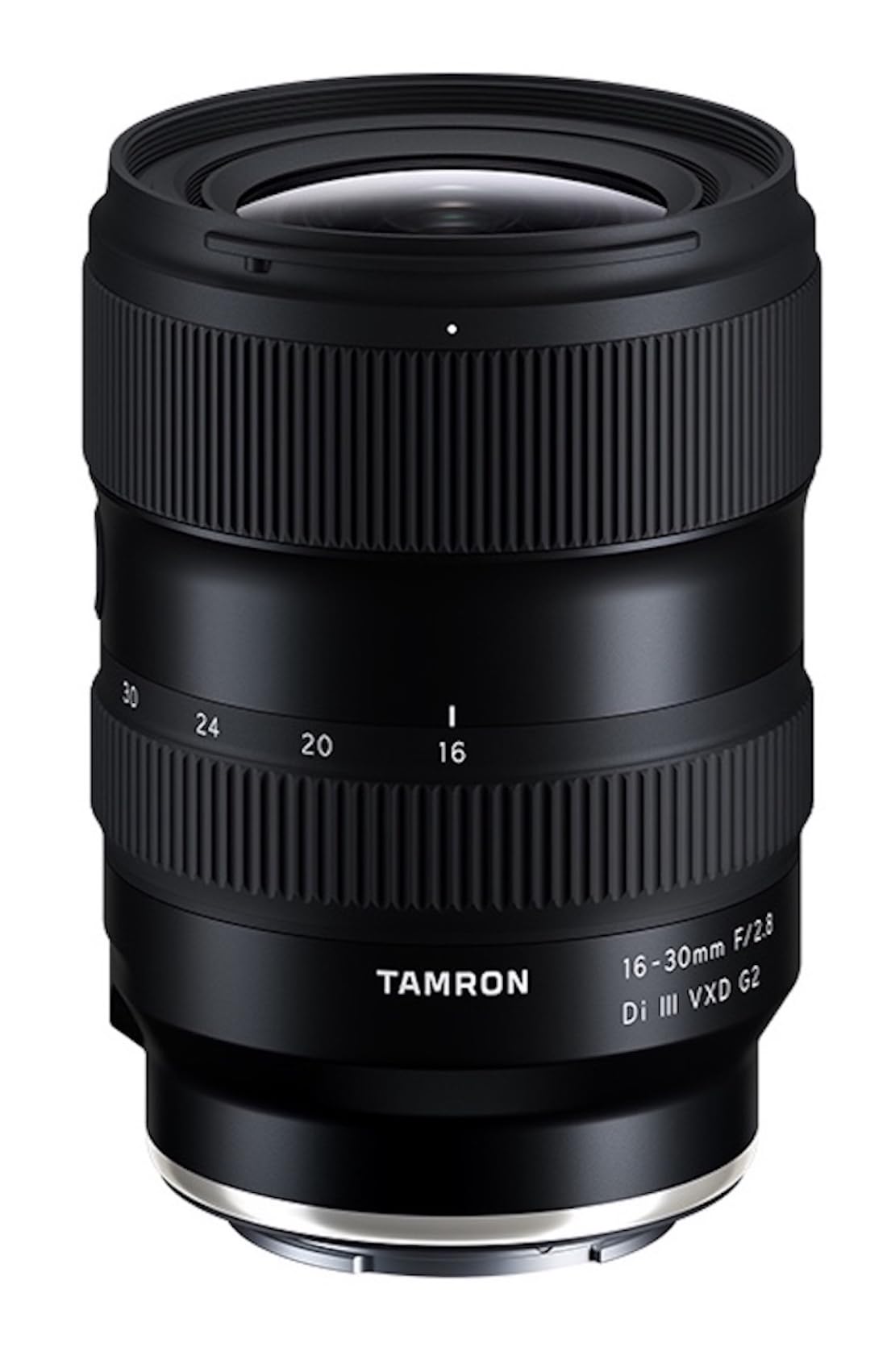
This third-party zoom edges past the Nikon-branded f/2.8 by starting at 16mm instead of 17mm — one mm that makes the difference between fitting a full bathroom in the frame or not.
Compared to the Nikkor Z 17-28mm, this Tamron offers a 16mm wide end that captures a noticeably wider view. That extra millimeter helps when you are backed into a corner of a small bathroom. At 15.9 ounces, it is lighter than many f/2.8 zooms, and the VXD linear motor (Voice-coil eXtreme-torque Drive) delivers fast, quiet autofocus that customers note performs “very well” for real estate photo and video work. Moisture-resistant construction with a fluorine coating helps protect the lens from light rain during exterior shoots.
Buyers are largely positive: one owner calls it “one of the best lenses for this price” and says “the corners are relatively sharp, and the center is almost perfect.” However, one reviewer changed their rating after extended use and said they “can’t recommend this lens” due to quirks with image quality, though they suspected they received a bad copy. The 6-year limited USA warranty (if bought from an authorized dealer) provides confidence.
Why it stands out
- 16mm wide end is one mm wider than the Nikkor Z f/2.8
- Lightweight at 15.9 oz for an f/2.8 zoom
- Moisture-resistant construction with fluorine coating
Possible drawbacks
- Mixed user reports on long-term corner sharpness
- No built-in image stabilization
Choose it if: You want a lightweight f/2.8 Nikon Z zoom that starts one mm wider than the Nikon-branded 17-28mm.
Pass if: You need consistent corner sharpness — a few user reports suggest you may need to test individual copies.
6. Nikon AF-S FX NIKKOR 16-35mm f/4G ED VR

The only wide-angle zoom for Nikon DSLRs that adds Vibration Reduction (VR II) — one reviewer reports tack-sharp handheld shots at 1/6 second, which makes tripods optional in most rooms.
For Nikon DSLR owners who have not yet moved to the Z system, this 16-35mm f/4 zoom is a strong option because it includes Vibration Reduction (VR II) rated at up to four stops. That stabilization is a real asset for real estate — one reviewer reports “VR works well (tack sharp at 1/6 sec handheld),” which means you can skip the tripod in many rooms. The lens uses 17 elements in 12 groups for sharp optics and minimal ghosting, and it takes standard 77mm screw-in filters.
Buyers call it “super sharp” and praise its performance for interiors and landscapes. The lens is lighter than the Tokina 16-28mm f/2.8, but one reviewer notes the build quality is “lower than other Nikon Pro lenses” with plastic cladding and a gold label that can wear off. The manual focus has a slight lag, and the shallow lens hood is easily damaged. Still, for Nikon DSLR owners, the combination of a 16mm wide end, VR stabilization, and standard filters makes it a practical choice that the newer Z-mount lenses cannot directly replace without an adapter.
Its real advantages
- VR II stabilization gives up to 4 stops of handheld sharpness
- 16mm wide end fits tight rooms
- Standard 77mm filter thread
Build compromises
- Plastic barrel and cladding feel less rugged than pro lenses
- Manual focus ring has a slight lag
- Shallow lens hood is easily damaged
Best for: Nikon F-mount DSLR owners who want VR stabilization for handheld real estate shoots without switching to mirrorless.
skip it if: You need a rugged, all-metal lens for daily professional use — or if you have already moved to a Nikon Z body.
Understanding the Specs
Focal Length & Field of View
The focal length, measured in millimeters, determines how much of a room fits into a single shot. A 14mm lens captures a much wider view than a 35mm lens — think fitting a full kitchen in one frame vs. just the island and counter. For real estate, you generally want a lens that starts at 24mm or wider on a full-frame camera. Anything longer than 24mm makes small spaces look cramped.
Maximum Aperture (f-stop)
The aperture controls how much light the lens lets in. An f/2.8 lens gathers twice as much light as an f/4 lens, so you can shoot at faster shutter speeds or lower ISO in dim rooms. The trade-off is that f/2.8 lenses are heavier, larger, and more expensive than f/4 lenses. If you always use a tripod, f/4 works perfectly. If you shoot handheld, f/2.8 gives you cleaner images because you can keep the ISO low.
Image Stabilization (VR / IS)
Image stabilization (called Vibration Reduction by Nikon or Image Stabilization by Canon) counteracts small hand movements so you can use slower shutter speeds without blur. A stabilization rating of “up to four stops” means you can shoot at 1/6 second instead of 1/60 second and still get a sharp image. This is a big convenience for real estate agents moving quickly through a property without a tripod.
Lens Mount & Format Compatibility
The mount determines which cameras the lens physically attaches to: Canon EF fits Canon DSLRs, Nikon F fits Nikon DSLRs, and Nikon Z or Sony E fit their respective mirrorless systems. Full-frame lenses work on both full-frame and APS-C cameras, but the field of view is narrower on an APS-C sensor (a smaller sensor that crops the edges of the image). For example, a 16mm lens on an APS-C body gives a 24mm-equivalent view, which is still wide enough for most rooms.
FAQ
What focal length is best for real estate photography?
Is f/2.8 or f/4 better for real estate photos?
Do I need image stabilization for real estate photography?
Can I use an APS-C lens for real estate photography?
Will a Canon EF lens work on a mirrorless camera?
How important is corner sharpness for real estate?
What is barrel distortion and should I worry about it?
Are third-party lenses like Tamron good for real estate?
Final Thoughts: The Verdict
If you want one dependable pick, the camera lens for real estate photography winner is the Canon EF 16-35mm f/4L IS USM because it combines corner-to-corner sharpness, four-stop image stabilization, and a reasonable price into a single zoom that handles interiors beautifully. If you want the widest view for Nikon Z, grab the Nikon NIKKOR Z 14-30mm f/4 S. And for Sony shooters who need a bright f/2.8 aperture without the weight, the Tamron 17-28mm f/2.8 Di III RXD is the clear value champion.
How We Picked
We do not accept paid placement. Every pick is matched to a real buyer and a real use-case; we do not hands-on test units.
Sources & Methodology
Specifications: manufacturer listings and product documentation. Review insights: verified customer reviews, as of July 2026. Pricing: not shown on this page (it changes often); check the current price via the retailer link.
As an Amazon Associate, Gadgets Feed earns from qualifying purchases. This does not affect which products we feature.
Related Guides
Product prices and availability are accurate as of the date/time indicated and are subject to change. Any price and availability information displayed on Amazon at the time of purchase will apply to the purchase of this product. As an Amazon Associate I earn from qualifying purchases.
CERTAIN CONTENT THAT APPEARS ON THIS SITE COMES FROM AMAZON. THIS CONTENT IS PROVIDED "AS IS" AND IS SUBJECT TO CHANGE OR REMOVAL AT ANY TIME.
Amazon and the Amazon logo are trademarks of Amazon.com, Inc. or its affiliates.